
Having participated and agreed, now outraged – the 500 billion trap: How the Greens scored their biggest political own goal
Xpert Pre-Release

Available in 27 languages 📢
Prefer Xpert.Digital on GoogleⓘPublished on: March 26, 2026 / Updated on: March 26, 2026 – Author: Konrad Wolfenstein
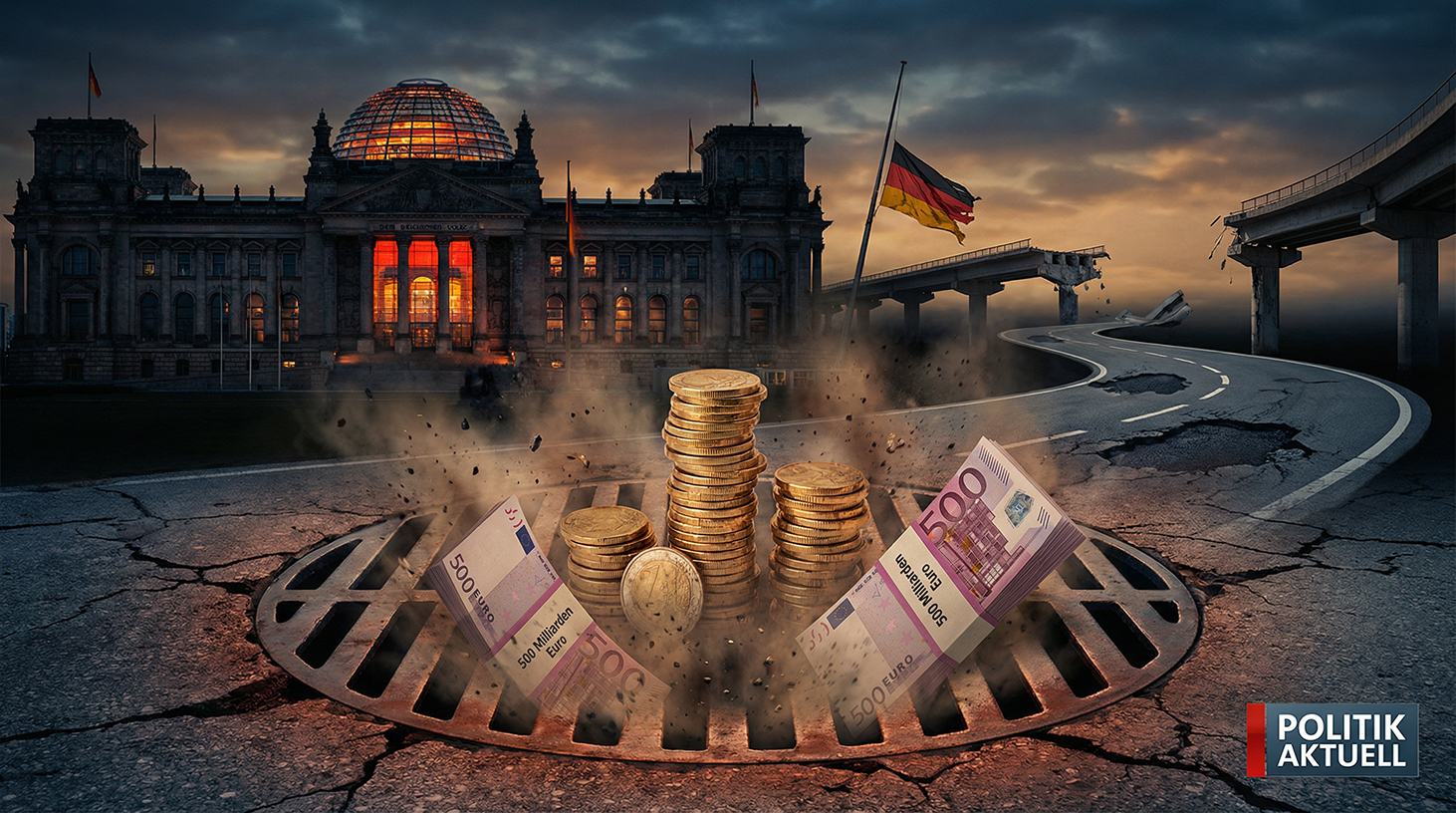
They participated and agreed, now they're outraged – the 500 billion trap: How the Greens scored their biggest political own goal – Image: Xpert.Digital
The biggest mistake, or even fraud, of Chancellor Merz's presidency? The gigantic budget fraud surrounding our infrastructure
95 percent misappropriation: How the government is plundering the 500 billion euro special fund
Billions misappropriated: Why the largest infrastructure project could end up in court
In the spring of 2025, a historic €500 billion special fund was supposed to pave the way for a modern Germany: renovating dilapidated bridges, digitizing schools, and financing the energy transition. A year later, a fiscal disaster has been revealed. According to leading economic researchers, up to 95 percent of the new billions in debt did not flow into additional projects but merely served to plug gaps in the regular federal budget. Ironically, the Greens, who under Chancellor Friedrich Merz had secured the necessary two-thirds majority for the gigantic debt pact, are now seething with anger and accusing the government of violating the constitution. But the bitter truth is: the party knowingly walked into a trap it had itself warned against. A cautionary tale of political naiveté, the lack of legal guarantees, and the question of who will ultimately pay the price for this billion-euro debacle.
Related to this:

Self-inflicted, self-complained: The bitter irony of the Greens in the debt dispute
The biggest own goal in German opposition politics in years
It is one of the most remarkable political caricatures in recent German history: A party that sees itself as the guardian of sustainable fiscal policy and the protector of the constitution approves a gigantic debt project – and then, a year later, files a lawsuit because the money is allegedly being used unconstitutionally. The Greens and the €500 billion special fund are a textbook example of what happens when political compromises are made under time pressure and in an exceptional situation, without legally binding safeguards for one's own core principles. The result is a party-political disaster – and a fiscal disaster for Germany.
The promise: 500 billion for future investments
In March 2025, Germany entered a new era in fiscal policy. Even before the new Bundestag convened, the CDU/CSU and SPD agreed on a multi-billion-euro financing package comprising two key elements: a relaxation of the constitutional debt brake for defense spending and the establishment of a €500 billion special fund for infrastructure and climate neutrality, financed by loans. This special fund – henceforth known as SVIK – was to be used over a period of twelve years to repair dilapidated bridges, modernize schools, expand the digital network, and finance the transition to climate neutrality.
A two-thirds majority in the Bundestag was required to amend the Basic Law. The CDU/CSU and SPD alone did not have this quorum. They needed another party – and the choice fell on the Greens, who, despite leaving the previous government, still held enough seats in the old Bundestag. This put the Greens in a powerful negotiating position: they could either block the legislation or help shape it. They opted for the latter – but not without conditions.
The Greens hesitate, negotiate – and then agree
The negotiations were dramatic. Initially, the Green Party leadership, Katharina Dröge and Britta Haßelmann, recommended rejecting the package. Their criticism was fundamental: the special fund, in its proposed form, was too vaguely defined, the term "infrastructure" too broad, and, most importantly, there was no legal guarantee that the loans would be used exclusively for genuinely additional investments. Dröge and her party colleagues fought to have the word "additionality" enshrined directly in the Basic Law (Germany's constitution). Without this legal framework, they warned, the government could use the special fund to reallocate budget items that were already planned.
Chancellor candidate Friedrich Merz and the then SPD parliamentary group leader Lars Klingbeil verbally assured the Greens that the money would be used for genuine additional investments. Furthermore, €100 billion was explicitly reserved for climate protection. This apparently sufficed for the majority of the Green parliamentary group to approve the measure. On March 18, 2025, the old Bundestag voted, with the Greens helping to secure the necessary two-thirds majority. The special fund became a reality, enshrined in the new Article 143h of the Basic Law. The irony of history would materialize more quickly than even the most skeptical observers had anticipated.
One year later: The numbers speak a devastating language
In March 2026, exactly one year after the historic vote, the Munich-based ifo Institute presented its analysis of the use of the Special Fund for Infrastructure Investment (SVIK). The result was devastating: 95 percent of the new debt incurred from the special fund in 2025 was not used for additional infrastructure investments. Debt issuance under the SVIK amounted to approximately €24.3 billion in 2025 – yet actual federal investments increased by only €1.3 billion compared to the previous year.
The Cologne Institute for Economic Research (IW) reached a similar conclusion in a study published concurrently, quantifying the misappropriation rate at 86 percent. The mechanism of this misappropriation is as simple as it is alarming: In 2025, the German government reduced investment spending in the regular core budget and transferred certain items – particularly subsidies in the transport sector, i.e., funds for rail – to the special fund. Thus, the special fund was not used for new, additional projects, but rather to plug the regular budget deficit. Finance Minister Lars Klingbeil initially rejected the criticism, pointing out that overall federal investment had increased by around 17 percent to almost 87 billion euros. However, his ministry admitted that funds for rail had indeed been transferred to the special fund to relieve the burden on the core budget.
Ifo President Clemens Fuest described the situation as a major problem, since the money was intended for additional investments that would support long-term economic growth. Economist Lars Feld was even more direct: Additional debt created leeway for social spending and election promises – that was to be expected.
Our EU and German expertise in business development, sales and marketing

Our EU and German expertise in business development, sales and marketing - Image: Xpert.Digital
Industry focus areas: B2B, digitalization (from AI to XR), mechanical engineering, logistics, renewable energies and industry
More information here:
A thematic hub offering insights and expertise:
- Knowledge platform covering global and regional economies, innovation and industry-specific trends
- A collection of analyses, insights, and background information from our key areas of focus
- A place for expertise and information on current developments in business and technology
- A hub for companies seeking information on markets, digitalization, and industry innovations
Greens caught in a dilemma: Why the lawsuit against the special fund is failing – it can't be done with or without the AfD
The Greens and the problem of the will to sue without the power to sue
The Greens reacted with outrage to the devastating figures. Parliamentary group leader Katharina Dröge described the misappropriation of funds as the biggest mistake of Friedrich Merz's chancellorship. Green budget expert Andreas Audretsch declared that the federal government had misappropriated billions of euros, thereby violating the constitution. Two legal opinions commissioned by the Green parliamentary group conclude that the federal budget for 2025 could be unconstitutional. Dröge stated that if the parliamentary group had the necessary majority, it would file a lawsuit.
That's precisely where the problem lies: An abstract constitutional review action before the Federal Constitutional Court requires a quorum of at least one-quarter of the members of the Bundestag. The Greens and the Left Party together do not reach this quorum – and the Greens categorically rule out any cooperation with the AfD. However, law professor Markus C. Kerber from the Technical University of Berlin sees potential avenues for action: If the use of funds is not transparent and fully accounted for, it constitutes an unconstitutional preparation of the federal budget – and in this case, every member of the Bundestag is entitled to bring an action. Legal scholar Christian Hillgruber from the University of Bonn emphasized that the Basic Law explicitly requires that the funds raised for the special fund be spent on additional investments – if this does not happen, there is a violation of the Basic Law.
Related to this:

The bitter irony: Who created this situation?
An honest assessment leads to an uncomfortable conclusion. The Greens are now lamenting a situation they significantly contributed to creating. They gave their decisive votes to the special fund, even though they themselves recognized that the additionality of the investments was not legally binding in the Basic Law. Verbal assurances from Merz and Klingbeil formed the basis of their approval. The Greens had initially spoken out explicitly against the package. Then came an internal change of heart, triggered by the prospect of at least securing the 100 billion euros for climate protection. The result is now clear: The 100 billion for climate protection are nominally reserved, but are being devalued by the same logic of shuffling funds that characterizes the entire special fund.
It is politically understandable that the Greens pursued a course of compromise. The situation at the time was exceptional: Russia's war of aggression against Ukraine weighed heavily on Europe, and the pressure to rearm was immense. The Greens had a choice between refusal and participation. They opted for participation – but in doing so, they failed to legally secure a core condition of their own position. That is the real mistake.
What economists say – and what that means for Germany
The conclusions of the ifo Institute and the Cologne Institute for Economic Research (IW Köln) are relevant not only to fiscal policy but also to the overall economy. Germany has been experiencing weak growth for years. Its infrastructure is dilapidated – bridges, railways, schools, broadband networks. The special fund was intended to mobilize investments precisely for these areas, investments that would make Germany more competitive in the long term. If, instead, the borrowed funds are primarily used to relieve the burden on the current budget, the overall economic effect will be significantly less than hoped.
Lars Feld succinctly summarized the dilemma: Additional government debt that is not channeled into productive investments increases the national debt but does not improve the country's economic performance. The special fund has thus far largely failed to achieve its purpose – not because the idea was flawed, but because its political implementation has not aligned with the economic objectives.
The quorum problem and the impotence of the opposition
The structural weakness of the Greens in this conflict lies in their parliamentary position. As an opposition party, they lack the means to directly hold the governing coalition of the CDU/CSU and SPD accountable in Karlsruhe. The only remaining option – via civil society and individual constitutional complaints – is arduous, lengthy, and legally uncertain. The Federal Constitutional Court has demonstrated in the past that it only overturns parliamentary budgetary decisions in exceptionally clear-cut cases.
Furthermore, there is a constitutionally noteworthy argument: The special fund itself is enshrined in the Basic Law – in Article 143h. Constitutional provisions cannot, in principle, violate the Basic Law; that would be a legal circular argument. The lawsuit would therefore not have to challenge the special fund itself, but rather the specific manner in which it is used in the 2025 budget law. This is a significantly narrower legal avenue.
What remains: A lesson in political accountability
The story of the 500 billion euro special fund is a cautionary tale that should have consequences for all political parties. Anyone agreeing to a compromise must ensure the legally binding safeguarding of its core conditions – not through verbal promises, but through legislation. In politics, as in business, what ultimately matters is what's written in the contract.
The Greens thus bear an undeniable share of the responsibility for the current situation. They provided the votes without constitutionally guaranteeing the return. This doesn't make the government any less responsible for the misappropriation of funds – but it does explain why the Greens are in a weak political position today. Germany urgently needs investment in its infrastructure, its schools, its digital networks, and its energy transition. The special fund could have been the vehicle for this. Instead, it has become a symbol of political broken promises – and of the limitations of well-intentioned constitutional constructs when they encounter a government primarily interested in short-term budget stabilization.










