
The DISC model in politics: Why our politicians fail so often – and how a psychological model could change that
Xpert Pre-Release

Available in 27 languages 📢
Prefer Xpert.Digital on GoogleⓘPublished on: June 1, 2026 / Updated on: June 1, 2026 – Author: Konrad Wolfenstein

The DISC model in politics: Why our politicians fail so often – and how a psychological model could change that – Image: Xpert.Digital
Are our politicians incompetent? What we can learn from John F. Kennedy, Xi Jinping, Konrad Adenauer, and Helmut Schmidt
Psychology instead of populism: Why the character of politicians is more important than their party platform
The business world leads the way: Why politicians should disclose their personality profiles
Dissatisfaction with politics is growing, and trust in democratic institutions is steadily declining. When citizens complain about government failures, they usually focus on party platforms, flawed ideologies, or the political system itself. But one crucial factor is almost always overlooked in these debates: the personality of the actors involved. What has long been standard practice in the free market and modern corporate management remains a black box in the political arena. How do politicians make their decisions? How do they react to crises and immense pressure? And why do brilliant minds often fail due to the mechanisms of power?
This article explores an innovative approach: applying the established DISC model to analyze behavioral types in politics. The aim is not to scrutinize or weed out politicians, but rather to explore whether we can find a vocabulary that makes political decisions more comprehensible. A deeper psychological understanding of the people behind the offices would not only create transparency but also defuse the toxic, outrage-driven discourse of our time. This is a plea for a new, more mature political culture.
Personality and Power: The DISC Model as a Tool for Political Aptitude Analysis
The feeling that current politics is failing is not a new phenomenon. It's part of the collective experience of democratic societies to lament the gap between what politicians promise and what they actually deliver. But the intensity with which this lament is currently being voiced is remarkable: According to a representative survey conducted by the Körber Foundation in 2025, 76 percent of Germans rate the economic situation as less than good or bad, 62 percent do not believe that Germany is prepared for the upcoming transformation challenges, and only 19 percent trust the federal government. Satisfaction with democracy itself is at an all-time low: 53 percent express little or no trust in the democratic system. These figures are alarming – and they raise a fundamental question: Does the problem lie in the system, in the structures, or in the people who hold political office?
The answer likely lies in the combination of all three factors. However, this article focuses on a frequently neglected aspect: the personality of politicians. Specifically, it explores whether the DISC model – an established tool in organizational psychology for analyzing behavioral types – could contribute to making political suitability more transparent, comprehensible, and less susceptible to media manipulation.
The myth of the born statesman: What truly distinguished great politicians
When political contemporaries lament the quality of today's leaders, nostalgic references to a supposedly better past almost always resonate. Konrad Adenauer, Winston Churchill, Willy Brandt, Helmut Schmidt – these names represent an era of political leadership that serves as a benchmark in the collective memory. But what exactly made these figures so effective? And was their time truly simpler, or did they possess skills that are lacking today?
Konrad Adenauer, the first Chancellor of the Federal Republic of Germany, embodied a blend of tactical pragmatism, strategic patience, and an unwavering focus on his goals. He was not a populist orator in the classical sense—he was an architect. The integration of West Germany into the West, its rearmament, and its reconciliation with France: these crucial decisions would have been unthinkable without a personality who thought long-term and withstood short-term popular resistance. Helmut Kohl, in turn, recognized the historic moment after the fall of the Berlin Wall earlier than anyone else and, against considerable opposition—from the Allies to parts of his own party—brought about German reunification. It was this instinct for historical circumstances, combined with an almost stubborn determination, that distinguished him from his contemporaries.
Winston Churchill represents a completely different type. What distinguished him was primarily courage – the willingness to swim against the current, to express unpopular opinions, and even to oppose his own party. His conviction that genuine achievement is impossible without a willingness to take risks stands in direct contrast to what is today called political caution or consideration for opinion polls. Willy Brandt and Helmut Schmidt, on the other hand, exemplify how different personality profiles can nevertheless both be successful. Brandt was the visionary, the dreamer – open to experimentation, emotionally approachable, and prepared to use vague formulations if they opened up new diplomatic avenues. Schmidt was the exact opposite: a pragmatist with a deeply ingrained sense of stability, who, based on his personal wartime experience, developed an almost obsessive determination to appear reliable and predictable.
Charles de Gaulle represents another personality type: the charismatic founding father, whose overwhelming self-confidence gave France a new national identity after the traumatic years of occupation and the collapse of the Fourth Republic. Singapore's Lee Kuan Yew, finally, embodied the principle of the meritocratic dominant—a statesman who transformed Singapore from a resource-poor developing country into one of the world's richest nations by systematically identifying and nurturing talent, and who elevated the equation of discipline, competence, and strategic vision to a guiding principle of the state. Henry Kissinger aptly described Lee Kuan Yew's vision as the will not merely to survive, but to thrive through superior intelligence, discipline, and ingenuity.
What unites all these figures is not an identical character profile—they are fundamentally different in their personalities. What connects them is the congruence between their personalities and the demands of their historical situations. The crisis manager Churchill might have been superfluous in calmer times; the patient architect Adenauer might have failed in Churchill's situation. This points to a fundamental insight: there is no universally superior political personality. There is only fit—the congruence between what a person is and what a situation demands.
The following comparison summarizes these observations and shows what each of these four types of state teaches about modern political leadership – and what additions each of them would have needed.
| Kennedy (I) | Xi Jinping (D) | Adenauer (D/G) | Schmidt (G/D) | |
|---|---|---|---|---|
| DISG profile | Initiative | Dominant | Dominant/Conscientious | Conscientious/Dominant |
| Core strength | Inspiration, vision, communication | Concentration of power, control, enforcement | Strategic patience, institution building | Crisis analysis, reliability, objectivity |
| Leadership style | Inspire and mobilize | Control through control | Shaping through patience | Steering through rationality |
| Dealing with pressure | Emotional strength, public presence | Authoritarian consolidation, no compromise | Sitting it out, tactical maneuvering | A factual decision, not populism |
| communication | Rhetorically brilliant, emotionally accessible | Symbolic, controlled, ideologically charged | Pragmatic, sober, little pathos | Direct, analytical, sometimes brusque |
| Historical Heritage | Myth of departure, unfinished vision | Systemic power consolidation, long-term effects uncertain | Foundation of the Federal Republic and Western integration | Anchor of stability in the oil crisis and NATO's dual-track decision |
| Greatest weakness | Implementation discipline, operational diligence | Lack of a culture of learning from mistakes, system rigidity | Emotional coldness, authoritarian traits | Empathy deficit, impatience with others |
| What we learn | A vision without implementation is wasted – requires strong G/S support within the team | Dominance without corrective action creates fragility – no system survives without feedback | Long-term thinking beats short-term popularity | Competence and reliability are key leadership assets – even without charm |
| Ideal complement | Strong G-type as an operational implementer | S-type as a bridge of trust to the population | I-type for public communication | I-type for emotional connectivity |
The most important overarching lesson: Not a single one of these four politicians excelled in all DISC dimensions. Their historical impact arose either because the situation perfectly suited their profile – like Churchill or Kennedy in times of crisis – or because they consciously or instinctively surrounded themselves with complementary personalities.
The DISC model: Four letters for the complexity of human behavior
The DISC model is a behavioral model based on the foundational work of American psychologist William Moulton Marston, who published his theory on the emotional and behavioral responses of typical people in 1928. The four letters stand for Dominant (D), Influential (I), Steady (S), and Conscientious (C). Further developed by John G. Geier at the University of Minnesota in the 1960s, the modern DISC profile emerged and is now used more than a million times a year worldwide.
The model functions fundamentally differently from many personality tests that are based on deep-seated character traits. DISC measures observable behavior and behavioral tendencies, not fixed character traits. It describes how people make decisions, how they communicate, and how they react to pressure and stress. Every person possesses all four dimensions, but in varying degrees. The dominant type (D) is results-oriented, direct, assertive, and loves challenges—they make decisions quickly but can neglect details and sometimes appear inconsiderate to others. The influential type (I) is extroverted, persuasive, enthusiastic, and motivating—they inspire teams but often struggle with consistent perseverance and structured implementation. The steady type (S) is patient, reliable, cooperative, and builds deep trust—their biggest blind spot is conflict avoidance and resistance to change. Finally, the conscientious type (C) is analytical, precise, quality-oriented, and data-driven—they risk becoming paralyzed by overanalysis and unnecessarily delaying decisions.
In Germany, the model was significantly popularized by Friedbert Gay and has been widely used in personnel development, coaching, sales training, and leadership development since the 1990s. A frequently misunderstood principle of the model is crucial: there is no better or worse type. The DISC profile is value-neutral. It describes, it does not judge. This point is of central importance for further discussion about its use in a political context.
DISC in business: When self-awareness becomes a competitive advantage
Empirical experience from numerous companies demonstrates that the DISC model can have significant positive effects on team dynamics, communication quality, and leadership effectiveness. The crucial mechanism is self-reflection: those who understand that their own impatience with details is a typical D-type trait can take targeted countermeasures or involve others who can fill this gap. Those who recognize that their colleague is not stubborn but a G-type who needs to process and analyze information before making a decision will experience less friction caused by misunderstandings.
In leadership contexts, the benefits are particularly evident. A study conducted as part of the Public Service Leadership Model in the USA showed that DISC assessments are especially valuable for developing two competencies: first, the ability to self-reflect, and second, the ability to effectively engage others. Leaders who know their DISC profile can provide more targeted feedback, better justify delegation decisions, and de-escalate conflicts because they understand that different reactions to stressful situations reflect personality rather than malice. Research shows that leaders who adapt their approach to individual personality preferences can significantly improve team performance and employee satisfaction.
Concrete examples from companies illustrate the effect. In sales teams, knowledge of DISC profiles leads to I-types being used for initial contact and relationship management, while G-types handle complex offers and negotiation details. In product development, more robust results are achieved when D-types set the direction, S-types ensure team cohesion, and G-types take care of quality assurance. In middle management, the model helps overcome paralysis in decision-making processes: A team consisting entirely of G-types tends to overanalyze, while a team consisting entirely of D-types tends to make hasty decisions without regard for the consequences. The optimal composition is a mix – and awareness of this mix is the prerequisite for intentionally creating it.
For leaders, the DISC model also has a therapeutic component: it normalizes weaknesses by contextualizing them. A dominant CEO who is perceived as heartless by employees is not necessarily a bad person – they may simply be a highly developed D-type who finds it difficult to listen and consider concerns as constructive input. This understanding creates the basis for targeted development work without damaging the individual's self-esteem.
Why the same model could revolutionize politics
Applying the DISC model to politics is not some absurd notion – it is the logical consequence of recognizing that political leadership is ultimately a form of organizational leadership. Politicians lead ministries, parties, coalitions, and countries. They make decisions with far-reaching consequences under uncertainty. They must communicate, mediate conflicts, and develop and implement visions. All of these are competencies that are significantly shaped by a person's personality profile.
Three-quarters of Germans are dissatisfied with their country's economic performance, and 80 percent perceive rising populism as a serious threat to democracy. This deep distrust is fueled by the perceived discrepancy between political promises and actual results. Part of this discrepancy arises not from malice, but from structural personality incompatibilities: A consistently harmony-oriented S-type at the head of a crisis ministry might systematically avoid the confrontations necessary to resolve the crisis. A highly dominant D-type as a coalition partner will stubbornly insist on positions that, within the overall framework of compromise, would actually have to be abandoned.
The problem is that these patterns are barely recognizable to voters because political discourse is primarily conducted around content and party platforms. Personality often appears in media portrayals only as a question of charisma or, more negatively, as a target for campaign attacks. A neutral, objective vocabulary that allows for the description of personality without judgment is lacking. The DISC model could provide this vocabulary.
If it were known that a candidate for the position of Interior Minister was a pronounced G-type, observers would understand his cautious, analytical, and sometimes slow decision-making in a different light. They would know that his strength lies in precise analysis, and at the same time, they would be aware that he might need a strong operational D-type as a state secretary to drive implementation with vigor. This isn't discrediting – it's competence management.
Our EU and German expertise in business development, sales and marketing

Our EU and German expertise in business development, sales and marketing - Image: Xpert.Digital
Industry focus areas: B2B, digitalization (from AI to XR), mechanical engineering, logistics, renewable energies and industry
More information here:
A thematic hub offering insights and expertise:
- Knowledge platform covering global and regional economies, innovation and industry-specific trends
- A collection of analyses, insights, and background information from our key areas of focus
- A place for expertise and information on current developments in business and technology
- A hub for companies seeking information on markets, digitalization, and industry innovations
Personality profile instead of populism: DISC as a tool for greater trust in politics
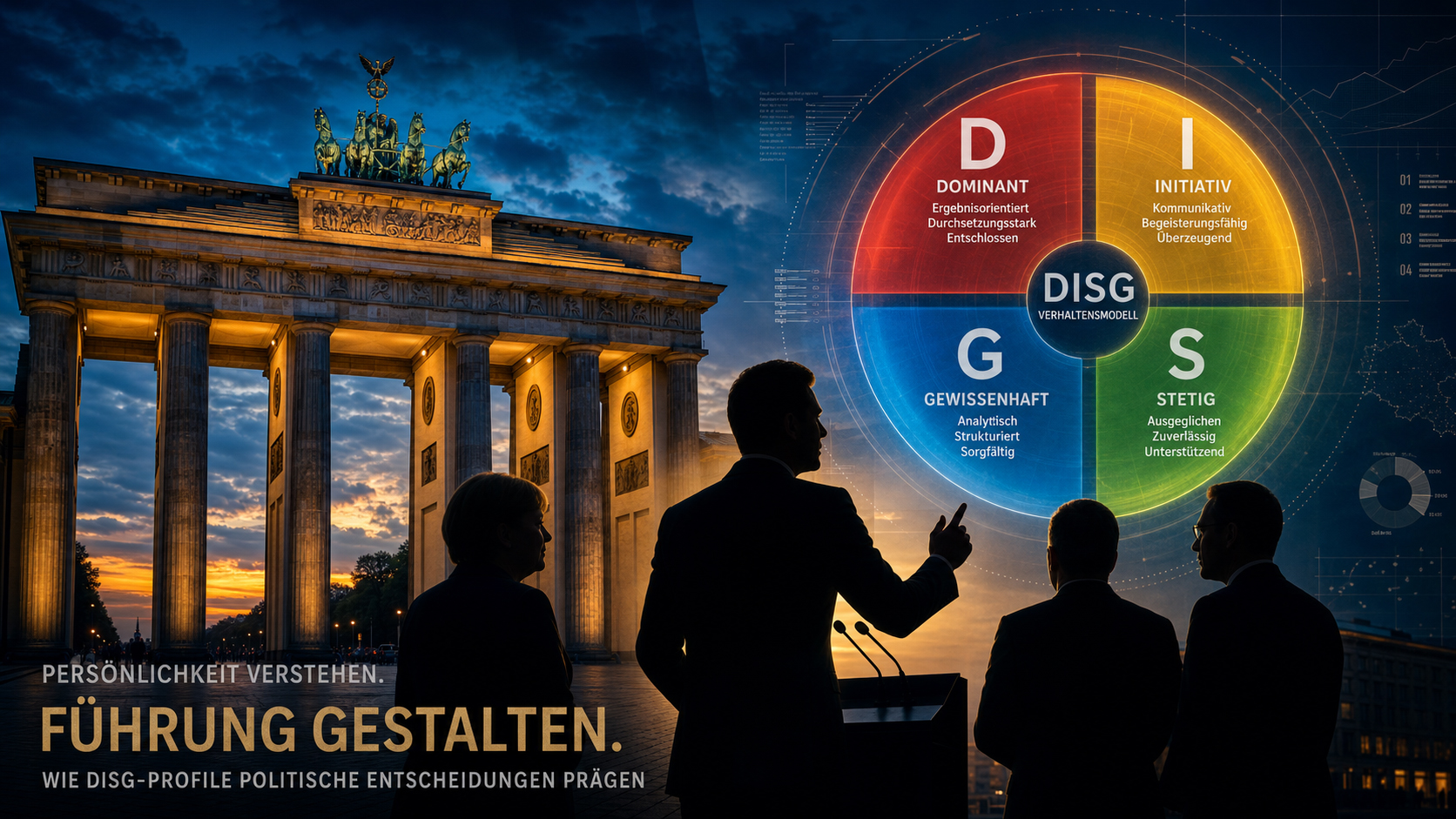
Why successful politicians need different DISC personality types — and how the system benefits from this – Image: Xpert.Digital
From mayor to chancellor: DISG along the political hierarchy
The required profiles of political actors vary considerably depending on the political level. At the local level – municipalities, cities, and counties – the primary focus is on concrete administrative tasks, direct citizen engagement, and the mediation of interests, which are often directly material: childcare places, road construction, and business development. Here, a consistent, reliable personality is often particularly valuable because it builds trust and signals continuity. Mayors and council members who act as S-types create stable local communities in which citizens feel heard.
At the state and federal levels, the demands are shifting. Strategic vision is required, along with the ability to manage complexity and contradictions, and the willingness to implement even unpopular decisions. State premiers and federal ministers navigate a tension between short-term political pressure and long-term structural necessities. A G-type can contribute the necessary analytical depth – but risks getting bogged down in reform gridlock. A D-type can forcefully implement changes – but risks losing key stakeholders along the way.
The EU level and international diplomacy, in turn, present different requirements. Here, coalition building and consensus management dominate; the focus is on balancing national interests within multilateral structures. The classic profile of a successful EU diplomat is often a combination of I (relationship building, persuasiveness) and G (precision in treaty details, adherence to rules). Pure D-types – who often excel in bilateral power politics – encounter structural limitations in multilateral settings.
This distinction is one of the strongest arguments for the DISC model in a political context: it sharpens the ability to differentiate between personal failure and structural incompatibility. A politician who excelled at the local level can fail at the federal level – not because she has become less capable, but because the job requirements have fundamentally changed.
Transparency instead of hate speech: How DISC could civilize political discourse
One of the most destructive mechanisms of modern political discourse is the personalization of substantive differences. Those who insist on a position in coalition negotiations are quickly labeled stubborn, arrogant, or power-hungry. Those who hesitate and weigh the options are caricatured as weak or leaderless. These oversimplifications not only harm the individuals involved—they damage the collective understanding of how complex political processes function.
The DISC model offers an alternative explanatory framework. If a politician evades questions in a press confrontation and fails to make a clear statement, the potential for a smear campaign could dissipate if the informed public is aware that she is a pronounced S-type, whose avoidance of confrontation is not a character flaw but a defining personality trait. The objective question that the media and voters could then ask would not be "Why is she lying?" but rather "What structural support does this person need to realize her potential in this role?"
Conversely, if a politician regularly causes outrage with confrontational, direct, and dominant statements, the DISC framework could help differentiate between strategic provocation and personality-driven directness. This doesn't mean excusing the behavior—it means understanding it. Political reporting that uses personality profiles as an analytical tool would be less susceptible to the performative logic of outrage that currently dominates large parts of political journalism.
Scientific studies from the University of Bern show that successful political leadership requires three essential skills: strategic goal setting and persuasiveness, interdisciplinary networking of expertise, and high social and emotional intelligence. These three dimensions can be directly mapped onto DISC profiles: persuasiveness and strategic thinking are ID domains; networking of expertise requires S and G; emotional intelligence is primarily an S strength. A holistic understanding of political suitability therefore presupposes a conscious examination of one's own personality structure and its limitations.
The limitations of the model: What DISG cannot and should not do
No objective analysis of the DISC model in a political context can do without an honest examination of its weaknesses and limitations. The scientific validity of the model is disputed. Wikipedia and various experts point out that the predictive validity of the DISC test—that is, its ability to predict job performance—has not been convincingly demonstrated. Test takers answer self-descriptions that are influenced by social desirability and situational factors. Psychological diagnosticians, such as Matthias Ziegler, Professor of Psychological Diagnostics in Berlin, criticize typological tests like DISC as theoretically outdated and argue that the scientific principles of Big Five personality research are methodologically superior.
This criticism is justified and must be taken seriously. The DISC model is not a diagnostic tool of clinical psychology—it is a practice-oriented communication and self-reflection instrument. It inevitably simplifies what is, in reality, highly complex. A person is not their DISC profile—they have a DISC profile that exhibits certain tendencies under specific conditions and in specific environments. Personality is not static; it develops, reacts to learning experiences, and changes with age.
This has clear consequences for the political context. A politician's publicly available DISC profile should never be the sole criterion for assessing their suitability. It would be gravely wrong—and dangerous—to deny someone access to political office based on their profile. The model cannot and should not be an admission criterion. It is a tool for transparency and understanding. It helps to categorize behavior, improve communication, and consciously compensate for structural weaknesses through team composition. Nothing more, but also nothing less.
Furthermore, a potential misuse scenario must be considered: In the hands of opportunistic actors, the DISC profile could become a tool for stigmatization – “He’s a G-type, he’s far too slow for our country” or “He’s a D-type, an autocrat.” This risk could be mitigated through institutional frameworks: DISC data could be stored with a neutral authority that cannot be accessed arbitrarily, but is available within the framework of defined political education programs and journalistic analyses – not as a weapon, but as information.
Institutional Implementation: A Thought Experiment with Practical Consequences
What would a concrete institutional implementation of the DISC model look like in a political context, if one takes this thought experiment seriously? One conceivable structure would be the establishment of an independent federal agency for political competence assessment – similar to the Federal Commissioner for Data Protection or the Federal Court of Auditors. All candidates applying for parliamentary seats, ministerial posts, or positions in the public service above a certain management level would be required to submit a standardized personality profile – not only DISC, but ideally in combination with other valid instruments such as the Big Five model.
The results would not be publicly available in the sense of full data access, but would be accessible to politically interested citizens in an aggregated, interpretive form. Election litmus tests could take on a new dimension: not just "What do you want to do?", but also "How do you typically deal with conflict?", "How do you react under pressure?", and "Which decision-making processes do you prefer?". These questions would be of great value to the media and voters alike—not to discredit anyone, but to enable informed decisions.
DISC profiles could play a dramatically more constructive role in coalition negotiations than they do today. If coalition partners know from the outset that Person A is a highly dominant D-type who perceives consensus-building as a weakness, and Person B is a pronounced S-type who prioritizes harmony over results, structural conflict potential can be addressed preventively – through moderation mechanisms, clear role distribution, and explicit communication agreements. This wouldn't solve all political problems – but it would be a step towards a more mature political culture.
At the local and municipal levels, where political processes are still more manageable, this model could be implemented with particularly low barriers to entry. Cities like Munich, Hamburg, or Stuttgart could launch pilot projects in which city councilors and mayoral candidates voluntarily disclose their DISC profiles and discuss them together in moderated formats. Such formats would not only improve mutual understanding but also change the public perception of politics: from a shark tank full of tactical vanities to a place of genuine, human complexity.
DISC as a reflection of a political maturation culture
The decisive argument for a societal debate on the DISC model in a political context is ultimately a cultural one. It concerns the question of what conception of humanity should underlie a democracy. The current conception is characterized by a curious contradiction: Voters expect perfection from politicians—complete competence in all areas, absolute reliability, boundless resilience—but often react to authentic self-reflection and the acknowledgment of limitations with ridicule or accusations of distrust. Anyone who says they need help in a particular area is considered weak. Anyone who always acts as if they have everything under control is seen as a leader.
In this cultural context, the DISC model would send a normative message: personality is not a weakness to be hidden. It is a resource to be understood and utilized. Politicians who know and can communicate their own personality type are not demonstrating weakness, but rather intellectual honesty. Essentially, they are saying: I know who I am. I know my strengths and weaknesses. And I act accordingly.
This attitude is referred to in progressive political discourse as reflective competence – a meta-competence considered essential for sustainably effective political action. An analysis by the Progressive Center emphasized that professional politics hardly fosters a culture of deeper, inner development for leaders. Self-reflection and clarity about one's own values are not merely a nice addition, but essential prerequisites for meaningful political engagement. The DISC model, if applied judiciously, could serve as a gateway to precisely this kind of culture.
Trust in political institutions is not an abstract concept – it is the social capital that holds democratic societies together. When 53 percent of Germans have little trust in democracy and 25 percent believe that politicians are controlled by "secret forces," this is not primarily an information problem, but a cultural one. People trust what they understand. What they can understand fuels less fear. And what fuels less fear mobilizes less populism.
A personality model that helps understand political behavior without condemning it contributes to the development of a political culture characterized less by outrage and more by insight. This is no small contribution. At a time when 80 percent of Germans perceive rising populism as a serious threat to democracy, any mechanism that improves understanding between citizens and their elected representatives is of societal value.
Personality as a voter advantage: What informed democracy means
Informed democracy requires that voters are informed not only about political content, but also about the people who are supposed to implement that content. A politician's personality significantly determines how they decide, how they communicate, how they manage crises, and how they deal with the opposition. If an electorate is systematically kept in the dark about this dimension, their basis for decision-making is structurally incomplete.
The DISC profile is not the only, but a practical, way to make personality accessible in public debates. It is already culturally ingrained, widely used in the business world, and methodologically simple enough to be communicated without in-depth expertise. Unlike clinical personality tests or complex scientific models, it is readily applicable to broad public discourse. This makes it—despite its scientific limitations—a suitable starting point for a societal process of understanding what we truly expect from our political leaders and what we are willing to comprehend.
Democracy is not a mechanism for selecting perfect people. It is a system for the peaceful shaping of community by people endowed with all human strengths and weaknesses. The better voters, the media, and institutions understand this interplay of personality and requirements, the more resilient democracy will become against the spirals of disappointment that fuel populism and erode trust today. The DISC model is not a panacea—but it is a useful tool in a discourse lacking in tools. And sometimes, that's exactly what's needed.





