
Peel Ports invests: Liverpool and Glasgow – The new logistics hubs in Great Britain
Xpert Pre-Release

Available in 27 languages 📢
Prefer Xpert.Digital on GoogleⓘPublished on: October 8, 2026 / Updated on: October 8, 2026 – Author: Konrad Wolfenstein
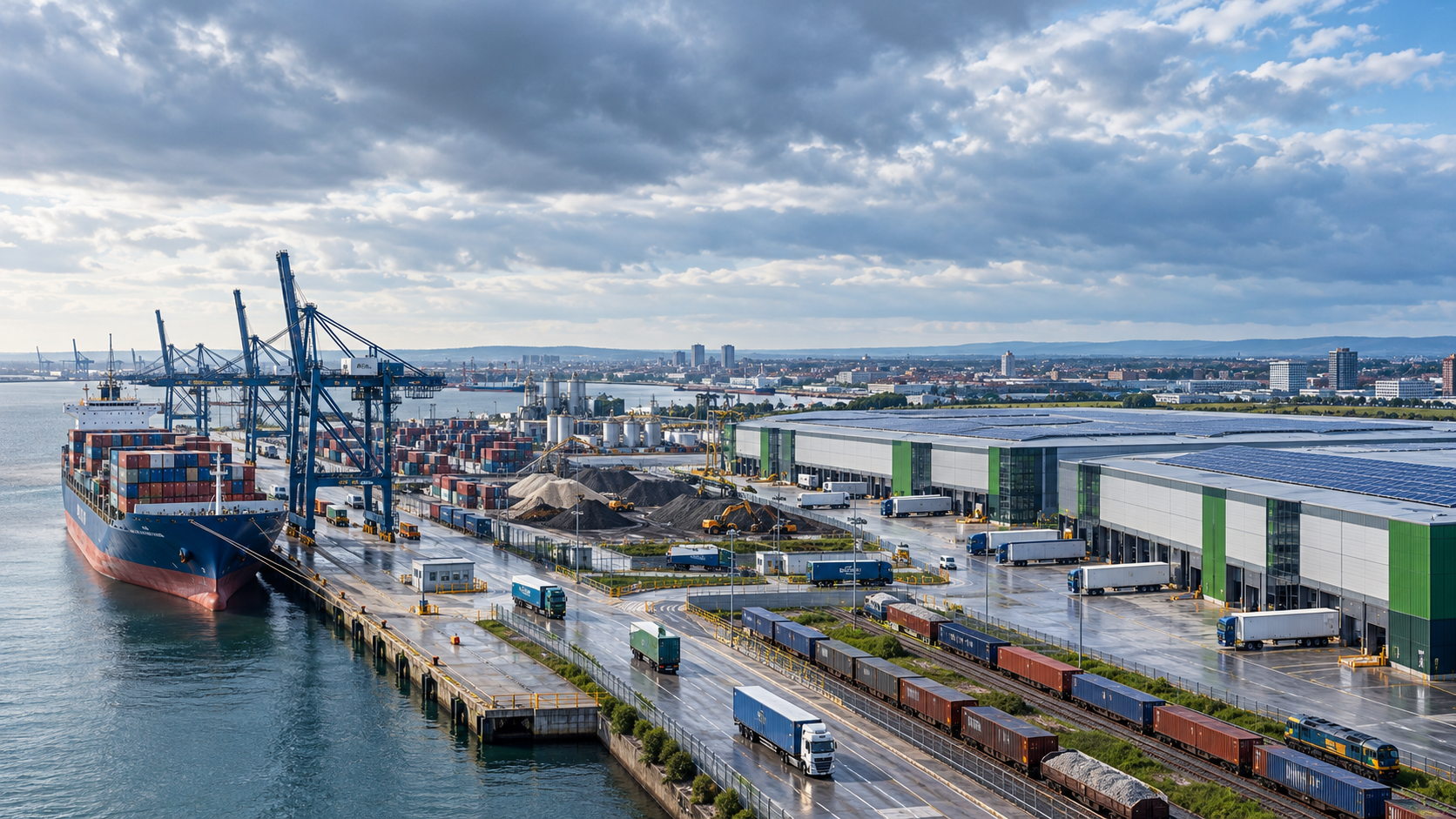
Peel Ports invests: Liverpool and Glasgow – The new logistics hubs in Great Britain – Creative image on the topic, with AI: Xpert.Digital
Why warehouses are suddenly more strategic than ships: Storage space as the key to supply chain resilience
Why modern warehouses will determine the future of logistics
Inventory as a competitive advantage: How logistics is changing
Peel Ports' planned expansion of its warehousing capacity is more than just an ordinary real estate project. The UK's second-largest port operator plans to create over one million square feet of additional Grade A warehouse space. This equates to approximately 93,000 square meters and has the potential to fundamentally transform the interplay between port operations, warehousing, and hinterland transport. At a time when geopolitical tensions, volatile energy prices, and disruptions to key shipping lanes are pushing the boundaries of traditional supply chain models, the availability of suitable warehousing space is becoming a crucial competitive advantage. The new warehouses in Liverpool and Glasgow are intended to function not merely as storage locations, but as integral components of a flexible and resilient supply chain, enabling businesses to avoid production disruptions and better adapt to market changes. In this context, warehousing space becomes critical infrastructure, helping companies increase efficiency and respond quickly to unforeseen challenges.
One million square feet against the new uncertainty: Why warehouses are suddenly more strategic than ships
The port as the heart of the modern supply chain: A look at Peel Ports' expansion
Peel Ports' planned expansion of modern storage capacity is far more than an ordinary real estate project. The UK's second-largest port operator intends to create over one million square feet of additional Grade A-rated space across its network. This equates to approximately 93,000 square meters, a scale that could significantly alter the relationship between port operations, warehousing, and hinterland transport. Around 900,000 square feet, or about 83,600 square meters, are earmarked for Liverpool. A further 100,000 square feet, nearly 9,300 square meters, are planned for the King George V Dock in Glasgow.
Economically, it's not just the volume that matters, but also the location of the warehouses. New warehouses are being built where goods enter the country and are transferred between ship, road, and rail. This transforms the port from a mere transshipment point into an integrated part of the supply chain. The warehouse is no longer just a building where goods await onward transport. It takes on functions such as inventory management, quality assurance, processing, consolidation, and risk management.
This development reflects a fundamental shift. For decades, inventories were primarily viewed as tied-up capital and therefore a cost factor. Companies optimized their supply chains for low inventory levels, high turnover rates, and the most precise delivery possible. Geopolitical tensions, volatile energy prices, disruptions to key shipping lanes, weather-related production outages, and fluctuating transportation costs have exposed the limitations of this model. Security of supply now has a measurable economic value. Having suitable storage capacity at the right moment allows companies to avoid production interruptions, take advantage of procurement windows, and better absorb price spikes.
The scale changes the market
The distribution of the investment reveals where Peel Ports sees the greatest leverage. Liverpool will receive the vast majority of the new capacity, at 900,000 square feet. Glasgow will be complemented by a smaller, but strategically important project. This results not in a construction program evenly distributed across the network, but rather in a targeted strengthening of two western gateways serving different regional markets, which can also be interconnected.
For Liverpool, the planned area represents a significant expansion of existing services. The port is already equipped to handle containers, roll-on/roll-off cargo, bulk goods, and other types of cargo. New warehouses can complement these functions without the need to first transport goods to a distant inland warehouse. This reduces additional handling and creates the opportunity to immediately sort incoming goods by type, recipient, urgency, or sales region.
Despite its smaller size, the project at King George V Dock follows a similar logic. Its location near Glasgow places it within easy reach of a major consumer, industrial, and distribution hub. For companies in Scotland, a port-adjacent warehousing option can reduce their reliance on logistics centers further south. This is particularly relevant when transport capacity is limited, travel times fluctuate, or goods, due to their nature, cannot be handled indefinitely.
The investment should therefore not be viewed solely as additional building space. It expands the operational capacity of the ports. During periods of normal demand, the capacity can be used efficiently. Simultaneously, in strained situations, it creates a buffer that prevents short-term import peaks from immediately leading to bottlenecks in the hinterland. This option value is a significant part of its economic importance.
The British warehouse market is not simply scarce
The statement that demand exceeds supply only partially describes the market. In the UK, a total of approximately 64 million square feet of logistics space was available in the first half of 2026. The vacancy rate was around 7.76 percent. On the surface, this does not suggest a widespread shortage. At the same time, around 76 percent of the space taken up was for Grade A properties, while their available supply had fallen to approximately 35.1 million square feet. The problem, therefore, is less an absolute lack of warehouse space than a qualitative, geographical, and functional misallocation.
Many older buildings no longer meet the requirements of today's large users. They may have insufficient ceiling heights, limited floor load capacity, inadequate yard space, too few loading bays, poor energy efficiency, or lack suitable provisions for automation. An unsuitable location can also render a formally available building virtually worthless economically. A warehouse without efficient road access, rail access, or proximity to an import hub can incur higher follow-up costs than a more expensive but better-integrated site.
In the first half of 2026, approximately 15.7 million square feet of new construction were completed nationwide. In the second quarter alone, this figure reached about 8.4 million square feet, roughly 15 percent higher than in the first quarter. Particularly noteworthy was the demand for very large existing properties exceeding 400,000 square feet. Sales of these properties reached approximately 4.3 million square feet, significantly exceeding the figure for the same period of the previous year. At the same time, the speculative development pipeline shrank by approximately 63 percent compared to its peak in 2022.
This creates a market with two faces. While weak overall economic growth limits the expansion plans of some users, the supply of suitable, modern space is simultaneously decreasing because high construction costs, financing costs, planning risks, and limited utility connections are hindering new projects. A national vacancy rate can mask these bottlenecks. For a company that urgently needs a large, modern, and accredited warehouse at a specific port, the amount of vacant space somewhere in the country is irrelevant.
Grade A is an operational category
The term Grade A is often used like a quality seal, but its economic significance lies in the building's usability. Modern warehouses typically offer greater ceiling heights, durable floors, sufficiently deep shunting yards, a high number of loading docks, and a technical infrastructure that supports automated or semi-automated processes. In addition, they feature improved thermal insulation, efficient lighting, digital metering systems, and often the option to integrate photovoltaics, charging infrastructure, or additional mezzanine space.
For the operator, such a warehouse doesn't automatically reduce every cost item. Modern buildings are expensive, and specialized equipment increases capital requirements. The crucial question is whether the productivity gains outweigh the higher investment or rental costs. With high throughput, even a small reduction in unloading, storage, or order picking time can generate significant savings. Furthermore, better space utilization reduces the required floor space per stored unit.
For sensitive or regulated goods, additional factors come into play. Fertilizers, chemicals, certain industrial precursors, and defense-related products require defined safety, quality, and documentation standards. Suitable fire compartments, controlled access, reliable traceability, and product-specific storage zones are then not merely convenience features, but prerequisites for operation. A modern building therefore has a higher economic value if it is not only energy-efficient but also accreditable and flexibly divisible.
Energy efficiency is gaining in importance. It reduces ongoing operating costs and lessens vulnerability to energy price shocks. However, environmental quality should not be measured solely by the building envelope. An energy-efficient building can partially negate its advantages if it generates additional road kilometers or is poorly integrated into multimodal networks. Only the combination of building quality, location, and process design creates a reliable overall assessment.
The port becomes a production factor
Port-centric logistics shifts storage and complementary services as close as possible to the quayside. The goal is to avoid unnecessary intermediate movements. Instead of transporting goods to an inland warehouse after unloading and then later to a production or distribution site, they can be stored, sorted, inspected, packaged, or forwarded as needed at the port.
This approach changes the cost structure. Every avoided transport segment saves not only mileage, but also vehicle time, personnel, fuel, tolls, and maintenance costs. Furthermore, it reduces coordination efforts. Fewer interfaces mean fewer handovers, lower error risks, and better inventory visibility. Especially with bulk goods, additional handling can lead to losses, contamination, or quality deviations. Direct storage at the destination therefore protects not only the profit margin, but also the goods themselves.
Port-centric logistics, however, is not a panacea. If the majority of demand is located far inland, a central inland warehouse may still be more efficient. Similarly, consolidating diverse import flows can favor a national distribution center. The optimal solution depends on the value, volume, perishability, security requirements, sales geography, and transport frequency of the goods.
The strength of the port model therefore does not lie in the complete displacement of traditional logistics hubs. It lies in expanding the range of options. Companies can maintain base inventories at the port while fast-moving volumes are strategically transported inland. They can absorb import peaks without having to over-engineer their permanent inland infrastructure. For port operators, this creates the opportunity to move from pure transshipment fees to longer-term and more stable revenue streams.
Liverpool wins as the western gateway
Liverpool possesses several structural advantages for this strategy. The port is located on the British west coast and has deep-water access, road connections, and a link to the rail network. Important industrial and consumer centers in the north and the Midlands are easily accessible via the M53, M57, M58, M62, and M6 motorways. A large proportion of the British population and a significant portion of the logistics infrastructure are closer to Liverpool than to some ports in southern England.
Geographic location becomes increasingly important when companies diversify their import routes. Many UK supply chains have historically relied heavily on southern and eastern ports. This concentration can be efficient as long as sea routes, terminals, and hinterland networks function reliably. However, in the event of disruptions, it increases concentration risk. Liverpool offers an alternative entry route, particularly for transatlantic traffic and cargoes using western sea lanes.
The economic benefits do not arise automatically from the existence of a port. They require sufficient storage space, handling technology, personnel, and hinterland capacity. This is precisely where the planned warehouses come into play. A port can only effectively attract additional ships or larger convoys if it can receive and distribute the cargo after unloading. Storage capacity thus becomes a prerequisite for economies of scale at both the nautical and terminal levels.
Liverpool is simultaneously strengthening its position vis-à-vis other British ports. Competition is no longer solely based on berths, water depth, and handling speed. Shippers are increasingly evaluating the complete package of port services, including warehousing, customs clearance, onward transport, and digital transparency. Ports that can offer these services from a single source, or at least in close coordination, retain customers more effectively and increase switching costs.
Glasgow fills a strategic gap
The project at King George V Dock is smaller, but of great regional importance. Located near the center of Glasgow, it has excellent road and rail connections. This provides Scottish companies with an additional option for storing imported goods close to the regional market, potentially reducing transport times and less reliance on long road shipments from England.
Scotland has a different economic and settlement geography than southern and central England. Large distances, a lower density of some logistics services, and the concentration of economic activity in the Central Belt increase the value of well-located hubs. A modern warehouse on the Clyde can therefore have a greater strategic impact than its absolute size would suggest.
Furthermore, Glasgow can serve as a complement to Liverpool. Sea, road, and rail links exist between Scotland, Northern England, Ireland, and continental markets, which can be combined into a networked port offering. If one route is temporarily unavailable or a location becomes overloaded, a second high-performance warehouse location increases flexibility. Resilience arises not simply from more space, but from spatially distributed and interconnected capacity.
Here too, occupancy remains crucial. A regional buffer is beneficial for the national economy, but can become costly for individual businesses if it remains permanently empty. Peel Ports must therefore attract a sufficient number of long-term customers or establish a flexible, multi-user concept. The ability to repurpose space between industries and product groups will be a key factor in determining whether the project remains profitable even with fluctuating demand.
Your intralogistics experts

Consulting, planning and implementation of complete solutions for high-bay warehouses and automated storage systems - Image: Xpert.Digital
More information here:
Fertilizers and their importance for logistics
Fertilizers make resilience measurable
The sharp increase in demand from the fertilizer sector is a particularly vivid example of this transformation. Inquiries regarding fertilizer imports in Liverpool were at times more than 200 percent higher than previous levels. This is not simply due to a short-term increase in volume. Companies are reviewing their ship sizes, ports of entry, inventory levels, and sources of supply because global trade routes and production sites have become more vulnerable to disruption.
Fertilizers are closely linked to energy prices, natural gas availability, international sanctions, and geopolitical risks. The UK is heavily reliant on imports for key products such as urea, ammonium nitrate, and phosphates. Rising prices or longer delivery times affect not only the agricultural input trade. Higher fertilizer costs impact the entire food chain through reduced agricultural yields and increased production costs.
Port-adjacent storage allows importers to accept larger shipments and release quantities over longer periods. This enables them to leverage economies of scale in maritime transport while simultaneously meeting seasonal demand peaks. The inventory becomes a form of insurance against supply disruptions. However, this insurance is not free. Capital is tied up, storage losses must be limited, and price risks must be hedged.
The economic trade-off is therefore not between inventory and efficiency, but rather which inventory level is optimal under realistic probability of disruptions. A system entirely geared towards minimal inventory appears advantageous during normal operation, but can cause enormous consequential costs in the event of a disruption. Conversely, a permanently excessive inventory would be inefficient. Modern multi-user warehouses offer a middle ground, as different customers can utilize flexible capacities without having to build their own separate facilities.
Chemicals and bulk materials require specialized solutions
For chemicals and bulk goods, the proximity between the quay and the storage area is particularly valuable. These products are often moved in large batches and require storage conditions tailored to their specific properties. Dust generation, humidity, mixing, temperature, fire protection, and occupational safety all influence the design of the facilities. A standard warehouse may be unsuitable for such goods, even if it appears modern on the outside.
Specialized facilities increase barriers to market entry. Permits, security systems, trained personnel, and documented processes cannot be replaced in the short term. This results in security of supply for customers and a closer relationship for the operator. At the same time, liability and operational risks increase. An incident can cause significant direct damage, disruptions, and reputational loss.
The flexibility of the new spaces must therefore be carefully planned. Excessive specialization can complicate future uses if goods flows change. Conversely, an overly general design limits the number of high-value applications. A modular structure with separable areas, adaptable technology, and clearly defined safety zones makes economic sense. This allows for the accommodation of different product groups without compromising standards.
For bulk cargo, even reducing the number of handling operations can bring significant advantages. Fewer material movements lower energy consumption, wear and tear, and loss rates. At the same time, a direct connection between the berth, conveying equipment, and storage accelerates unloading. Shorter berth times improve quay utilization and can reduce costs for both the vessel and the cargo.
Defense logistics is becoming a growth driver
Demand from the defense and aerospace sectors is becoming an additional driver of the UK's industrial and logistics market. Increased defense spending not only leads to more production of end systems, but also raises demand along a broad supply chain encompassing metals, electronics, spare parts, packaging, maintenance, and secure storage. This, in turn, is driving demand for industrial space far beyond the immediate locations of major defense companies.
The existing defense-related logistics footprint in the UK market is estimated at around 28 million square feet. An additional demand of approximately 1.5 to 3 million square feet could arise as early as 2027. In the long term, increased spending could necessitate further large-scale development annually. This demand competes with retail, manufacturing, data centers, and other uses for suitable land and network connections.
Port locations offer distinct advantages. Heavy or oversized goods can often be transported more efficiently by ship than over long road distances. Secure port areas facilitate access control and monitoring. At the same time, they can be connected to production and maintenance sites in the hinterland. New warehouse facilities in Liverpool and Glasgow therefore fit into a trend in which ports are increasingly viewed as integral components of national security and industrial capacity.
However, this does not mean that every additional hall is automatically suitable for defense-related use. Security requirements, information protection, separate traffic flows, and sometimes special construction standards can be extensive. The strategic advantage initially lies in the available, modern, and adaptable space. Whether this actually translates into defense business depends on certifications, contracts, and integration into specific supply chains.
Inventory levels are assigned an option value
Traditional inventory models primarily view warehousing as the sum of capital, space, insurance, and shrinkage costs. In a volatile world, another value comes into play: the option of being able to deliver or produce despite a disruption. This option value increases with the probability of interruptions and the magnitude of the potential loss.
For a manufacturer, a missing component can halt an entire production line. The value of additional storage space is then measured not by the price of the component, but by the avoided downtime costs. For agriculture, the timely availability of fertilizers can determine the yield and quality of a harvest. For critical infrastructure or defense, supply reliability can even have security policy implications.
Port-based inventory also offers tactical flexibility. Goods can remain centrally upon arrival and be distributed later according to actual demand. Companies do not have to determine the final regional allocation at the time of shipment. This is particularly valuable when demand forecasts are uncertain or when multiple sales markets are served from the same inventory.
At the same time, resilience should not be confused with simply maintaining the highest possible inventory levels. Excessive stock increases depreciation, price, and obsolescence risks. For hazardous materials, safety and compliance costs also rise. The quality of a resilient supply chain is therefore demonstrated by its ability to manage inventory, supplier diversity, alternative routes, and transport capacity collaboratively. New warehouses are a tool within this system, not the system itself.
Productivity arises at the interfaces
The greatest efficiency gains often lie not within a single warehouse, but between ship, terminal, warehouse, and hinterland transport. When arrival times, unloading planning, space utilization, and pickup are digitally coordinated, waiting times decrease. Trucks can be dispatched more effectively, rail capacities can be better utilized, and storage areas can be prepared in advance.
For Peel Ports, the expansion opens up the possibility of controlling more parts of the value chain. Transshipment, storage, customs clearance, inventory management, freight forwarding, and onward transport can be offered as an integrated service. From the customer's perspective, this reduces the number of contractual partners and interfaces. From the port operator's perspective, revenue per ton of cargo increases, while long-term warehousing relationships reduce dependence on fluctuating ship arrivals.
However, integration also carries a competitive risk. Shippers may fear becoming too dependent on a single operator. Transparent pricing, open interfaces, and the ability to integrate external freight forwarders therefore remain crucial. In the long run, a high-performing ecosystem is more attractive than a closed structure where every additional service can only be obtained from the port operator.
The labor market also influences productivity. Modern factories require fewer purely manual tasks, but more skilled workers for technology, safety, data control, and plant operation. Regional benefits therefore depend on whether further training and recruitment keep pace with the expansion of the facility. A highly automated building without sufficient skilled workers cannot deliver on its productivity promises.
Sustainability depends on occupancy rates
Port-centric logistics can reduce emissions by avoiding unnecessary road transport and shifting more goods to rail, coastal shipping, or inland waterway. Liverpool has road and rail connections as well as the Manchester Ship Canal. Glasgow also has multimodal links. This infrastructure makes it possible to move cargo onward using the most suitable mode of transport after arrival.
However, the environmental benefit is not guaranteed. Additional warehouses generate construction emissions, land use, and energy consumption. If they remain underutilized, this burden is spread across small quantities of goods. If, despite the proximity to the port, almost all goods are transported by truck over long distances, the overall impact is less favorable. Therefore, real shifts in traffic patterns, high building utilization, and efficient process management are crucial.
Grade A standards can reduce energy consumption during operation. Photovoltaics, LED lighting, heat pumps, intelligent control systems, and a well-designed building envelope reduce operating costs and emissions. For heavy commercial vehicles, the availability of high-capacity grid connections is also becoming increasingly important. Electric trucks, refrigeration technology, and automated systems increase electricity demand. Therefore, insufficient grid connection capacity can become a bottleneck, even in modern buildings.
A reliable sustainability assessment should consider the entire journey of the goods. Relevant factors include the shipping route, port handling, storage duration, energy source, utilization of onward transport, and avoided intermediate journeys. Only when these factors align will an energy-efficient warehouse become a truly lower-emission supply chain.
The investment strengthens Peel Port's market position
Strategically, Peel Ports is further shifting its business model from infrastructure provider to integrated logistics partner. Port space is scarce and difficult to replicate. Those who develop it early for modern storage gain an advantage over competitors who can offer handling capacity but no readily available adjacent space.
The investment can combine several revenue streams. In addition to rents and storage fees, income is generated from transshipment, handling, inventory management, customs services, and transport. At the same time, regular customers can attract additional shipping traffic to the port. This creates a positive feedback loop between the real estate and port businesses: more storage capacity attracts more cargo, and more cargo increases the demand for storage.
This advantage is particularly pronounced when the spaces are suitable for multiple users. A multi-user model distributes the demand risk and allows for seasonal shifts between industries. Fertilizers, grain, industrial intermediates, and other bulk goods have different cycles. Flexible occupancy can stabilize overall utilization.
The downside is the high capital commitment. Modern port warehouses require not only buildings, but also roads, drainage, security, fire protection, technology, and potentially rail or conveyor systems. If leasing is delayed or demand falls, financing and depreciation will negatively impact the bottom line. Success therefore depends on whether Peel Ports not only builds the facilities, but also fills them with reliable customer contracts and operational services.
Regional value creation instead of mere transit
Ports generate the greatest regional benefits when goods are not only transshipped but also processed, stored, and distributed on-site. Additional warehouses extend the value chain at the location. Besides direct jobs, this creates contracts for construction, maintenance, security, cleaning, transport, IT, and technical services.
For Northwest England, the expansion of Liverpool's port can strengthen its position as an industrial and logistics hub. Companies will gain access to more conveniently located import and warehousing options. This can influence location decisions, as a reliable supply of intermediate goods and good export connections are key criteria for production investments. The port will thus become an integral part of regional industrial policy, even if the investment is privately motivated.
In Glasgow, the smaller project can fulfill a similar function for Scotland's Central Belt. A high-performance entry infrastructure improves conditions for manufacturers, traders, and agricultural supply chains. While it won't automatically eliminate all regional cost disadvantages, it can reduce transport distances and dependence on southern hubs.
The employment effect should nevertheless be assessed objectively. Modern warehouses are space-intensive and increasingly automated. The number of direct jobs per square meter is often lower than in manufacturing or inner-city services. The greater economic benefit lies in the increased productivity of other sectors, the avoidance of supply chain disruptions, and the attraction of further investment.
Construction costs and demand remain the main risk
The greatest uncertainty lies in future occupancy rates. Current demand for modern logistics space is robust, but the UK economy is growing only moderately. Companies may postpone expansion decisions, reduce inventory, or consolidate their networks. A bottleneck visible today may not persist for the entire lifespan of a building.
Construction and financing costs also remain significant. Material prices, wages, interest rates, and technical requirements can all increase budgets. Furthermore, port locations are often more complex than typical industrial parks. Contamination, flood protection measures, corrosion, existing operations, and limited building space complicate implementation. Delays diminish the advantage of responding promptly to current demand.
Another risk is industry concentration. Fertilizers, chemicals, and defense offer growth potential but are highly sensitive to politics, regulation, and international conflicts. If a geopolitical situation eases or trade flows shift, demand can change rapidly. Flexible building concepts and a broad customer mix are therefore more important than betting on a single sector.
Finally, bottlenecks outside the port can limit the benefits. Congested roads, a shortage of train drivers, inadequate track windows, or weak power grids cannot be solved by building additional warehouses. Expansion must be coordinated with the capacity of the entire corridor. Otherwise, the bottleneck will simply shift from the warehouse to the next interface.
A signal for the British economy
This investment underscores the increasing recognition of logistics real estate as strategic infrastructure. The British government now views ports, warehouses, transport routes, and data more as an interconnected system. This reflects an economy where security of supply, industrial capacity, and national resilience are once again gaining greater importance.
This development does not signify a complete departure from globalized supply chains. The UK will remain dependent on international sourcing and maritime connections. Rather, the way globalization is organized is changing. Companies are seeking multiple suppliers, alternative ports, greater transparency, and targeted safety stocks. Efficiency is not being sacrificed, but rather expanded to include the costs of potential disruptions.
Peel Ports is responding to precisely this transition with its new facilities in Liverpool and Glasgow. The new space can shorten transport routes, accommodate larger import consignments, and meet industry-specific warehousing needs. At the same time, it strengthens the operator's negotiating position with shippers, as they can offer not just a berth, but a more comprehensive solution.
The crucial perspective, therefore, is this: the project's value does not lie in a million square feet of concrete and steel. It lies in its ability to eliminate time, risk, and movement from supply chains. If this succeeds, the halls will become productive infrastructure. If the integration fails, they will remain expensive real estate in a good location.
The real competition begins after unloading
The British port industry will increasingly compete less solely for ship calls and more for control of the processes that occur after the quayside. Storage, processing, data, customs, rail, and regional distribution determine how attractive a port is to long-term customers. Peel Ports' investment should therefore be seen as a strategic step towards vertical integration.
This model offers customers tangible advantages, provided prices, quality, and flexibility are right. Shorter transport routes reduce costs, additional inventory increases supply security, and modern warehouses facilitate compliance with regulatory requirements. Particularly for fertilizers, chemicals, industrial precursors, and defense-related goods, the port location can create immediate operational benefits.
At the same time, a sober assessment remains necessary. Not every supply chain benefits equally from proximity to a port, and not every square meter of modern space automatically becomes productive. Crucial factors include capacity utilization, specifications, multimodal connectivity, digital integration, and a viable customer mix. The projects in Liverpool and Glasgow have good prerequisites, but their success will only become apparent in daily operation.
The strongest signal from this investment is nonetheless clear. In a time when companies are repricing risks, storage space is transforming from a supposedly passive cost center into an active competitive tool. Ports that understand this shift early on are no longer just selling cargo handling. They are selling availability, responsiveness, and time. That is precisely why a warehouse can be more strategically important today than an additional ship.
Your global marketing and business development partner
☑️ Our business language is English or German
☑️ NEW: Correspondence in your native language!

Konrad Wolfenstein
I and my team are happy to be available to you as your personal advisor.
You can contact me by filling out the contact form here [email protected]:or simply call me at +49 7348 4088 965. My email address is
I'm looking forward to our joint project.










