
"Deficient" rating for infrastructure in the USA: How the 2026 World Cup exposes the dramatic decline of the USA
Xpert Pre-Release

Available in 27 languages 📢
Prefer Xpert.Digital on GoogleⓘPublished on: June 3, 2026 / Updated on: June 3, 2026 – Author: Konrad Wolfenstein
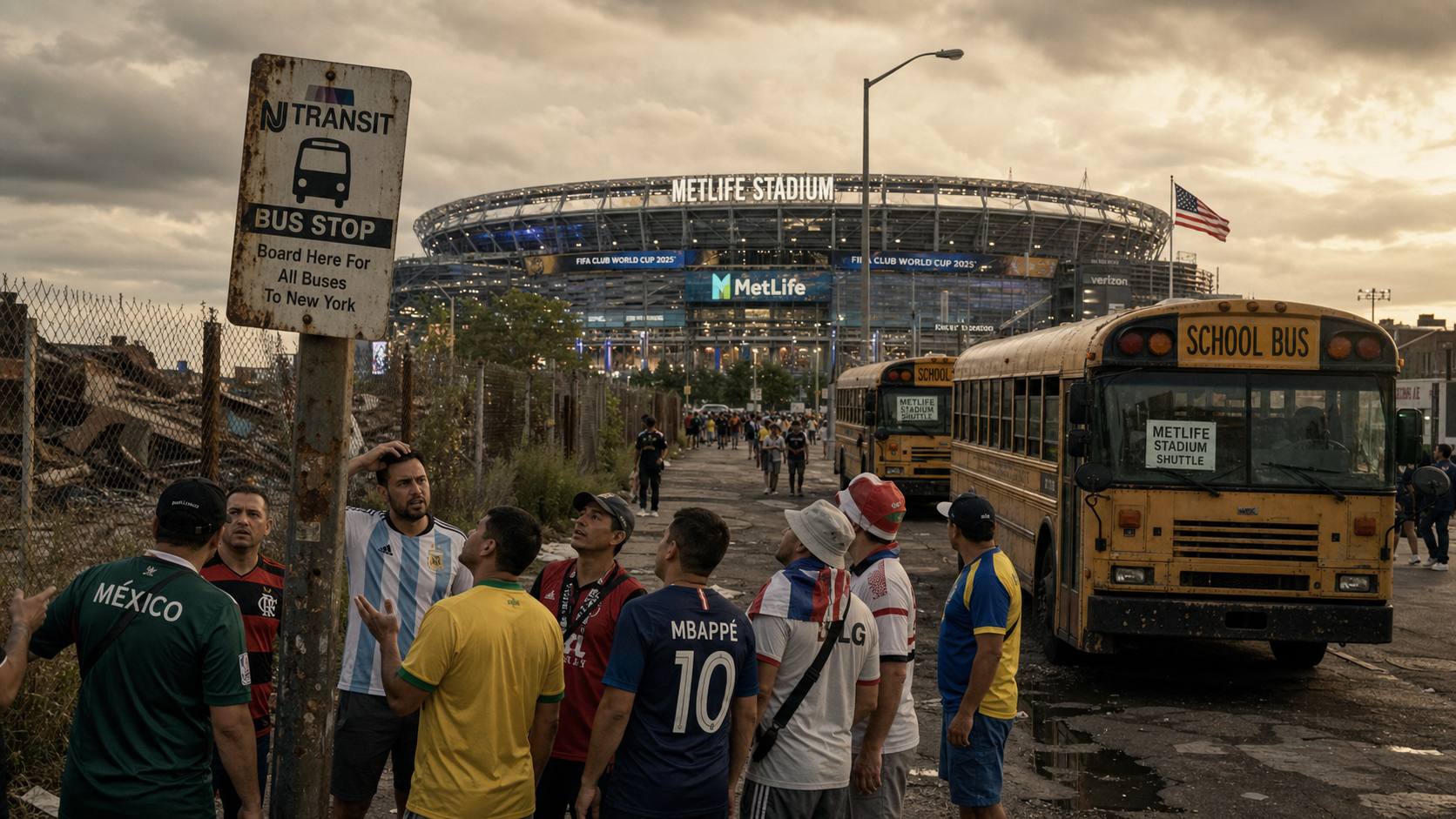
A "deficient" rating for US infrastructure: How the 2026 World Cup exposes the dramatic decline of the USA – Creative image: Xpert.Digital
"Fail" rating: Why the US infrastructure is in danger of failing at the mega-event World Cup 2026
School buses and exorbitant prices: $150 for a train ticket? The absurd infrastructure chaos before the World Cup in America
Trillions for the military, school buses for fans: The involuntary stress test of the USA for the 2026 World Cup
The 2026 FIFA World Cup was meant to be North America's shining showcase – a testament to its global grandeur and logistical superiority. But the closer the mega-event draws, the more relentlessly it exposes the deep cracks in a nation that has neglected its own resources for decades. When millions of international fans flock to the stadiums in the summer of 2026, they will often find not a modern public transport network, but rather an improvised chaos of repurposed school buses, absurd ticket prices, and crumbling infrastructure. World football is involuntarily becoming a global stress test, revealing the structural failures of a superpower that invests nearly a trillion dollars annually in its military, yet often fails to organize a smooth train journey for its guests. What has long been a bitter reality for the local population threatens to become a genuine culture shock for millions of international visitors.
The 2026 World Cup as an X-ray: America's structural failure in global competition
When world football exposes the world power – a country in a self-experiment with its own weaknesses
The 2026 FIFA World Cup is no ordinary sporting event. It is a real-time stress test – a global mirror held up to a superpower that has neglected its own resources for decades. What hundreds of thousands of international fans will experience in the coming weeks is not just sport. It is an involuntary encounter with the structural deficiencies of a nation that likes to see itself as the most advanced country on earth – and whose infrastructure is rated "failing" by its own engineers.
Between ambition and reality: The bid for a World Cup
The fact that the USA, together with Canada and Mexico, sought to host the 2026 World Cup was a deliberate geopolitical decision. Washington wanted to show the world that America could host the biggest sporting event on the planet – sovereign, organized, and cosmopolitan. The award by FIFA in 2018 was celebrated as a victory. What faded into the background, however, were the logistical realities that any mass event inevitably reveals.
78 matches in eleven cities across a continent – this is a mobilization challenge that no other World Cup host country has ever had to manage on this scale. But while countries like Japan, Germany, or France can rely on a dense public transport infrastructure that has developed over decades when hosting major tournaments, many American cities face a structurally different situation: the automobile dominates, public transport is often a makeshift solution – and now millions of foreign fans are expected to use a system that was never designed for them.
The emergency solution as standard: Transport to MetLife Stadium
Nowhere is the problem more painfully evident than at MetLife Stadium in New Jersey, scheduled to host the World Cup final on July 19, 2026. What should be the pinnacle of global football threatens to become a mobility odyssey for many fans – and the story of transit ticket prices is more than telling.
NJ Transit, the responsible transit authority, initially announced train tickets for $150 each way. For comparison, the regular fare for the same route from Penn Station to the stadium is $12.90. The route is about 14.5 kilometers long, and the ride takes 15 minutes. After intense public pressure, the price was reduced to $98—still more than seven times the normal fare. A similar situation occurred with the shuttle buses: originally set at $80, the price dropped to $20 after criticism. New York Governor Kathy Hochul ultimately negotiated a fleet of yellow school buses to shuttle between the Port Authority Bus Terminal, Times Square, and the stadium.
The result is telling: instead of a coherent, pre-planned transportation system, an improvised patchwork of overpriced regular trains, repurposed school buses, and private shuttle services emerged. Uber, for example, offers shuttle services for $49 per ride – but only in one direction, namely from the stadium back. Fans have to organize their own transportation to the stadium. Those arriving by car pay up to $225 for parking near the stadium. In Miami, prices of almost $250 for a parking space were even reported. For visitors from Europe, who are used to taking the subway directly to a stadium for just a few euros, this is a truly memorable experience.
The engineers' report card: Grades for a sick system
What fans subjectively experience is backed up by data. The American Society of Civil Engineers (ASCE), the professional association of American civil engineers, publishes a comprehensive "Report Card for America's Infrastructure" every four years—a grade on the nation's infrastructure condition based on the American school grading system. The result of the most recent report, from 2025: Overall US infrastructure receives a "C"—the first overall grade not in the failing range since the association began this assessment in 1998. However, this modest progress should not obscure the fact that nine of the 18 assessed categories remain in the D range. According to the ASCE, this means that the infrastructure is in "fair to poor condition," with numerous elements nearing the end of their service life.
Public transport is particularly hard hit: the transit sector received a grade of D, the worst possible category along with the wastewater system. For comparison, in 2021 the grade was even D-, which would be roughly equivalent to a D- in Germany. ASCE President Marsha Anderson Bomar summed it up perfectly when she said that not enough is being invested in infrastructure and that the country is essentially just trying to catch up. This statement is not polemical – it is a sober diagnosis of a structural failure that has been building up for decades.
Other parts of the transportation network also fare poorly. Roads receive a D+ rating, as do dams and power grids. Rail lines (combined freight and passenger) have even been downgraded to B-, due in part to safety concerns and capacity constraints. Over 42,000 American bridges are officially classified as structurally deficient, meaning they have safety-related deficiencies. According to the American Federation of Road and Transportation Engineers (ARTBA), nearly 221,800 bridges require repair or replacement—more than a third of all bridges in the country. The cost of all necessary repairs is estimated at over $400 billion.
A historical legacy: How America missed out on its rail network
The question of why the US is in a state that no other developed industrial nation would tolerate cannot be answered without considering its historical context. The decision to prioritize the automobile as the primary mode of transportation was not a natural development—it was politically motivated and industrially driven. Starting in the 1950s, governments poured massive subsidies into the construction of highways and interstates, while public transportation was left to the private sector and thus effectively abandoned to economic decline. Streetcar networks in cities like Los Angeles were bought up and shut down by automakers and oil companies—a process that later became known as the "Great American Streetcar Scandal.".
The result of this decades-long policy is an urban structure designed around the car, one that is hardly amenable to alternative thinking. The so-called urban sprawl—the widespread, car-dependent expansion of American cities—costs the US economy more than a trillion dollars annually, according to estimates by the New Climate Economy. It causes higher costs for public infrastructure and services, drives up healthcare costs due to lack of exercise, and makes the population in large parts of the country dependent on a single mode of transportation—the car. Those who don't own a car or can't drive are simply left behind in many American cities.
Now, at the 2026 World Cup, the consequences of decades of misallocated investment are being reaped. Only two of the eleven US host cities – Seattle and San Francisco – have an Amtrak station near the stadium. In Houston, the light rail trains meant to transport fans to the stadium run every twelve minutes – a completely inadequate capacity for a World Cup with massive crowds. In Los Angeles, fans are shuttled to the stadium from designated metro stations. In Boston, the organizers openly recommended that visitors simply come by car.
The investment gap: A trillion-dollar mortgage on the future
The US infrastructure problem isn't just a convenience issue for World Cup tourists—it's a fundamental economic threat. The ASCE estimates that the total investment needed for all 18 assessed infrastructure categories will reach $9.1 trillion by 2033. This contrasts with projected public and private investment of $5.4 trillion, leaving a funding gap of $3.7 trillion. Between 2024 and 2033, $3.7 trillion is needed just to bring infrastructure up to an acceptable standard. (Note: The English word "trillion" is equivalent to the German "Billionen," hence the headline has been adjusted accordingly.).
The economic consequences of this inaction are quantifiable. If the investment gap is not closed, the US will lose $10 trillion in gross domestic product by 2039, according to ASCE calculations. $2.4 trillion in export revenue will be lost, and more than three million jobs will disappear. Current estimates indicate that every American household loses approximately $2,700 per year due to dilapidated infrastructure. If the investment gap could be closed, American families could save $700 annually.
The Highway Trust Fund, which traditionally provides the majority of road and bridge financing, has been dependent for decades on a fuel tax that hasn't been increased since 1993. At a time when electric vehicles make up a growing share of traffic and tax revenues are therefore structurally declining, this fund is at risk of becoming permanently underfunded. The Infrastructure Investment and Jobs Act, passed in 2021, which allocated approximately $1.2 trillion for infrastructure investment, was an important step. However, the ASCE emphasized that while the funds provided a positive boost, their full impact will take years, and the investment gap has not yet been closed.
At the same time, the budget situation is escalating: The Congressional Budget Office (CBO) is forecasting a deficit of $1.9 trillion for fiscal year 2026. Under these fiscal conditions, a massive infrastructure initiative is hardly politically feasible – because it would either increase debt, require tax increases, or crowd out other spending.
World Cup as an economic mirror: Ticket prices as a symptom
If the infrastructure crisis is one symptom of the 2026 World Cup, then ticket prices are another. The American principle of "dynamic pricing"—prices based on supply and demand—was applied by FIFA for the first time in World Cup history. The result: With over 500 million ticket requests worldwide, prices exploded. For the US opening match against Paraguay in Los Angeles, FIFA initially set Category 3 tickets—the cheapest segment accessible to the general public—at $1,120. On the resale market, offers reached as high as $2,735.
For the final at MetLife Stadium, the cheapest official ticket category was $2,030 and the most expensive $6,730. On the secondary market, individual tickets were even offered for $2.3 million – an offer that prompted FIFA President Gianni Infantino to promise to personally deliver a hot dog to the buyer. Even US President Donald Trump expressed surprise, stating he would not pay that price and expressing concern that his constituents in Brooklyn and other lower-income communities could not afford the experience. Infantino, however, defended the model, arguing that one had to "apply market prices" – they were in the most advanced entertainment market in the world.
This statement encapsulates a fundamental tension: the American market model optimizes for high-spending demand, not for broad access. What is accepted in the context of a superstar concert or an NFL game encounters massive resistance at a global tournament with billions of fans of vastly different purchasing power. The cheapest tickets, priced at $60, which FIFA announced as a concession, are available in only a tiny fraction of the stadium's capacity and are located in the highest seats. The average price of a ticket for the World Cup final has increased many times over compared to 2022 (when it ranged from $206 to $1,600). Access to global football thus becomes, for many fans, purely a matter of wealth.
Our US expertise in business development, sales and marketing

Our US expertise in business development, sales and marketing - Image: Xpert.Digital
Industry focus areas: B2B, digitalization (from AI to XR), mechanical engineering, logistics, renewable energies and industry
More information here:
A thematic hub offering insights and expertise:
- Knowledge platform covering global and regional economies, innovation and industry-specific trends
- A collection of analyses, insights, and background information from our key areas of focus
- A place for expertise and information on current developments in business and technology
- A hub for companies seeking information on markets, digitalization, and industry innovations
From stadium to bridge: How the World Cup exposes structural weaknesses of the USA
Systemic Failure: Why American Cities Are Structurally Disadvantaged
A look at the individual host cities reveals just how heterogeneous – and overall how unprepared – the American urban fabric is for such an event. Atlanta at least has the MARTA system, which offers a direct connection from the airport to downtown. Los Angeles opened a new subway line in the lead-up to the World Cup. Seattle extended its light rail system to Lumen Field and is offering free shuttle service on World Cup day. These are the positive exceptions.
However, the norm is different. Kansas City and Dallas – both World Cup host cities – are perceived, even in the US, as cities with particularly weak public transportation infrastructure. Kansas City has never built a city-wide rapid transit system. Dallas operates a light rail network whose coverage and frequency are completely unsuitable for mass events. For the World Cup, both cities are relying on a combination of parking garages, shuttle buses, and private ride-hailing services – precisely the same car-based system that created the problem in the first place.
The Federal Transit Administration did provide $100 million – divided among the eleven venues, that's between $8 and $10 million each. While this sum sounds substantial, it's ridiculously small compared to the actual costs of upgrading the infrastructure. For comparison, a single new subway station in New York City typically costs several hundred million dollars. That money is enough for information kiosks, additional buses, and organizational measures – but not for structural changes.
Two types of crisis: Germany and the USA compared
It would be wrong to force the state of US infrastructure into a simple comparison with Europe without acknowledging the weaknesses of the European side. Germany, for example, is facing its own infrastructure crisis – just of a different kind. The punctuality rate of Deutsche Bahn's long-distance services was a mere 60.1 percent in 2025. The previous year it was 62.5 percent, and in 2015 it was still 74.4 percent. A continuous decline over a decade. According to Deutsche Bahn, 80 percent of all delays in long-distance services are attributable to outdated, unreliable, and overloaded infrastructure. By 2036, more than 40 key routes are scheduled to be closed for several months each for major overhauls – a modernization project that will continue to burden travelers for a long time to come.
But the difference lies not in the severity of the crisis, but in its nature. Germany has a comprehensive rail network that functions in principle, but suffers from decades of underinvestment. There are subways, commuter trains, regional trains, and long-distance trains – a network whose basic structure is robust, even if it produces daily delays. In many US cities, however, this alternative to the car simply doesn't exist. It's not a network that needs to be renovated – but a vacuum that first needs to be filled.
This is a fundamental difference. One that is also reflected in how fans will travel to the 2026 World Cup. European visitors from cities with dense public transport – Madrid, Paris, Vienna, Zurich – will simply find no adequate alternative to the car in US cities like Dallas or Kansas City. Asians from Japan or China, accustomed to state-of-the-art high-speed rail systems and metro networks running every minute, will experience a similar situation. For many of these travelers, the 2026 World Cup will not just be a sporting event – it will be a cultural shock.
The automotive lobby as a permanent mortgage: Structural causes of undersupply
The state of US infrastructure is not due to the negligence of individual politicians or officeholders. It is driven by a systemic logic, explained by lobbying power, the legislative structure, and the spatial organization of American capitalism.
First, let's look at financing: In the US federal system, a large portion of infrastructure responsibility lies with the states and municipalities. These are chronically underfunded and politically focused on short-term election cycles. Investments in public transportation only pay off after decades – which is politically unattractive to elected officials who stand for re-election every two or four years. Roads and highways, on the other hand, are quickly visible, bring immediate contracts to construction companies and the automotive industry – and therefore traditionally enjoy stronger political lobbying support.
The automotive industry, along with the oil industry, has been among the most powerful interest groups in the American political system for decades. They have not only actively lobbied against investment in public transportation, but have also pushed through urban planning standards that cemented car dependency: parking requirements for buildings, minimum distance regulations, and zoning laws that strictly separate residential and commercial areas. Urban sprawl was not a spontaneous civic preference—it was legally and economically enforced.
The economic costs of this structure are immense. Traffic congestion alone cost America around $160 billion annually in wasted time and fuel, according to older estimates. Projecting further, the combined costs of congestion in Europe and the US will rise to over $293 billion per year by 2030. Households in car-dependent, sprawling urban areas pay, on average, 50 percent more per capita for public infrastructure and services than residents of more compact cities. The individual mobility burden of owning a car—purchase, insurance, operation, and repair—consumes a significant portion of household income that would be available for consumption, education, or savings in more mobile societies.
Critical infrastructure beyond local transport: energy, water, bridges
The weakness in transportation is symptomatic of a deeper, widespread infrastructure failure that extends far beyond public transport. The US power grid receives a D+ rating in the ASCE report. Large sections of it are so old that they are ill-equipped to meet the demands of the energy transition – the growing feed-in of renewable energies, rising demand from electric vehicles, and AI-powered data centers. Twenty-seven extreme weather events caused $122 billion in damage in 2024 alone – and the grid that was supposed to absorb them is not structurally designed for resilience.
Drinking water and wastewater systems receive grades of C- and D+, respectively. Millions of American households are still connected to the drinking water network via lead pipes—a problem that gained international notoriety through the contaminated water scandal in Flint, Michigan. It is estimated that a corroded main water pipe bursts somewhere in the US every two minutes. Dams receive a D+ rating, meaning that a significant portion of the country's approximately 90,000 dams are considered at risk.
Despite slight improvements, the state of bridges remains alarming. Over 42,000 bridges are structurally deficient. With 163 million crossings daily, bridges classified as unsafe are in use. A study published in the journal PLOS ONE predicts that by 2050, approximately 25 percent of all American steel bridges could be at risk of collapse if massive investments are not made in maintenance and climate-resilient retrofitting. By 2080, nearly half of the bridges examined could be so badly damaged that they are no longer safe to use. The collapse of the Francis Scott Key Bridge in Baltimore in March 2024 brought this abstract figure to life with a concrete, horrific image: four lanes of a major traffic artery sank into the Chesapeake Bay within seconds.
Digital infrastructure and business location: A new risk is emerging
One area often overlooked in the public debate about infrastructure is digital infrastructure – and here, the ASCE 2025 report sends mixed signals. For the first time, broadband was included as a separate category, with a grade of C+. This sounds better than it is: In rural and structurally weak urban areas, access to high-speed internet remains woefully inadequate. For an economy that increasingly relies on digital services, remote work, and AI-driven production, this represents a significant competitive disadvantage.
The connection between physical and digital infrastructure is not merely an academic concept. Data centers, which form the backbone of the growing AI industry, require reliable power. An energy infrastructure rated D+ massively jeopardizes this reliability. Logistics centers, without which no e-commerce model can function, need well-maintained roads and bridges. Poor road conditions directly increase the operating costs of logistics companies – through faster vehicle wear and tear, higher fuel consumption, and more accidents. Years ago, the World Economic Forum's Global Competitiveness Report showed the US lagging significantly behind European countries like Portugal and Spain in its infrastructure ranking – a finding that is shameful for an economy aspiring to global leadership.
The paradox of world power: military vs. infrastructure
The US spends more on its military than the next ten countries combined. The defense budget for 2026 is around $895 billion. At the same time, there is a $3.7 trillion shortfall to bring its infrastructure up to an acceptable level. This paradox is politically deliberate: for decades, defense spending was considered a matter of cross-party consensus, while infrastructure often became a political football.
The Infrastructure Investment and Jobs Act of 2021, passed under President Biden with broad bipartisan support and providing $1.2 trillion, was a turning point. For the first time in years, infrastructure was once again treated as a national priority. But now, under the Trump administration, a snapback to previous investment levels is looming: Should congressional funding revert to the old levels, the cumulative economic damage potential, according to the ASCE, would increase to $5 trillion in lost economic output over 20 years, in addition to $1.9 trillion in lost disposable income for American families. At the same time, in 2025, Congress passed a reconciliation bill that increased the deficits by an estimated $4.7 trillion—further drastically shrinking the fiscal leeway for future infrastructure investments.
What the World Cup teaches us: Infrastructure is destiny
Major events like the FIFA World Cup have a unique characteristic: they make visible structures that remain invisible in everyday life. A commuter in a car-dependent American suburb drives to work every day and accepts the situation because they know no alternative. A fan from Tokyo or Frankfurt arriving in Houston or Dallas for the first time experiences the same situation as a stranger – without the effect of habituation, without the built-in tolerance.
This external perspective is valuable – not as a crude critique of America, but as an opportunity for self-reflection. Large segments of the American public accept car ownership as a natural law, even though it is a historical construct created by lobbyists. The 2026 World Cup offers a rare opportunity to question this construct. Specifically, when international fans experience firsthand the inadequacy of public transportation alternatives, when local politicians have to justify an improvised school bus service in front of world television cameras, and when US newspapers report that a regular train ticket to the final was originally supposed to cost $150.
Whether this will give rise to a new political will remains to be seen. For that to happen, what has always been structurally lacking in American infrastructure policy would be necessary: a long-term investment perspective that extends beyond the next election. Countries like France, Japan, and Germany have proven that dense, reliable public transportation networks are not merely an end in themselves, but a fundamental economic basis – for productivity, inclusion, climate protection, and international competitiveness. Those who ignore this will ultimately pay not with bad grades, but with trillions of dollars.
The 2026 World Cup is not just a sporting event. It is the most expensive class photo of a nation that desperately needs a crash course in infrastructure policy.
🎯🎯🎯 Data-driven B2B industry hub as a quasi-in-house solution

The quasi-in-house solution: How Xpert.Digital closes operational gaps in B2B marketing and sales – Smart Content-Driven Business - Image: Xpert.Digital
Xpert.Digital is a data-driven B2B industry hub led by Konrad Wolfenstein . The company acts as an external, quasi-in-house solution for industrial partners, closing operational gaps in marketing, content, and sales – without requiring additional resources on the client side.
More information here:
Your global marketing and business development partner
☑️ Our business language is English or German
☑️ NEW: Correspondence in your native language!

Konrad Wolfenstein
I and my team are happy to be available to you as your personal advisor.
You can contact me by filling out the contact form here [email protected]:or simply call me at +49 7348 4088 965. My email address is
I'm looking forward to our joint project.










