
Roads, railways, waterways: Is Germany's infrastructure threatened with collapse despite a record budget?
Xpert pre-release

Available in 27 languages 📢
Prefer Xpert.Digital on GoogleⓘPublished on: August 12, 2025 / Updated on: August 12, 2025 – Author: Konrad Wolfenstein
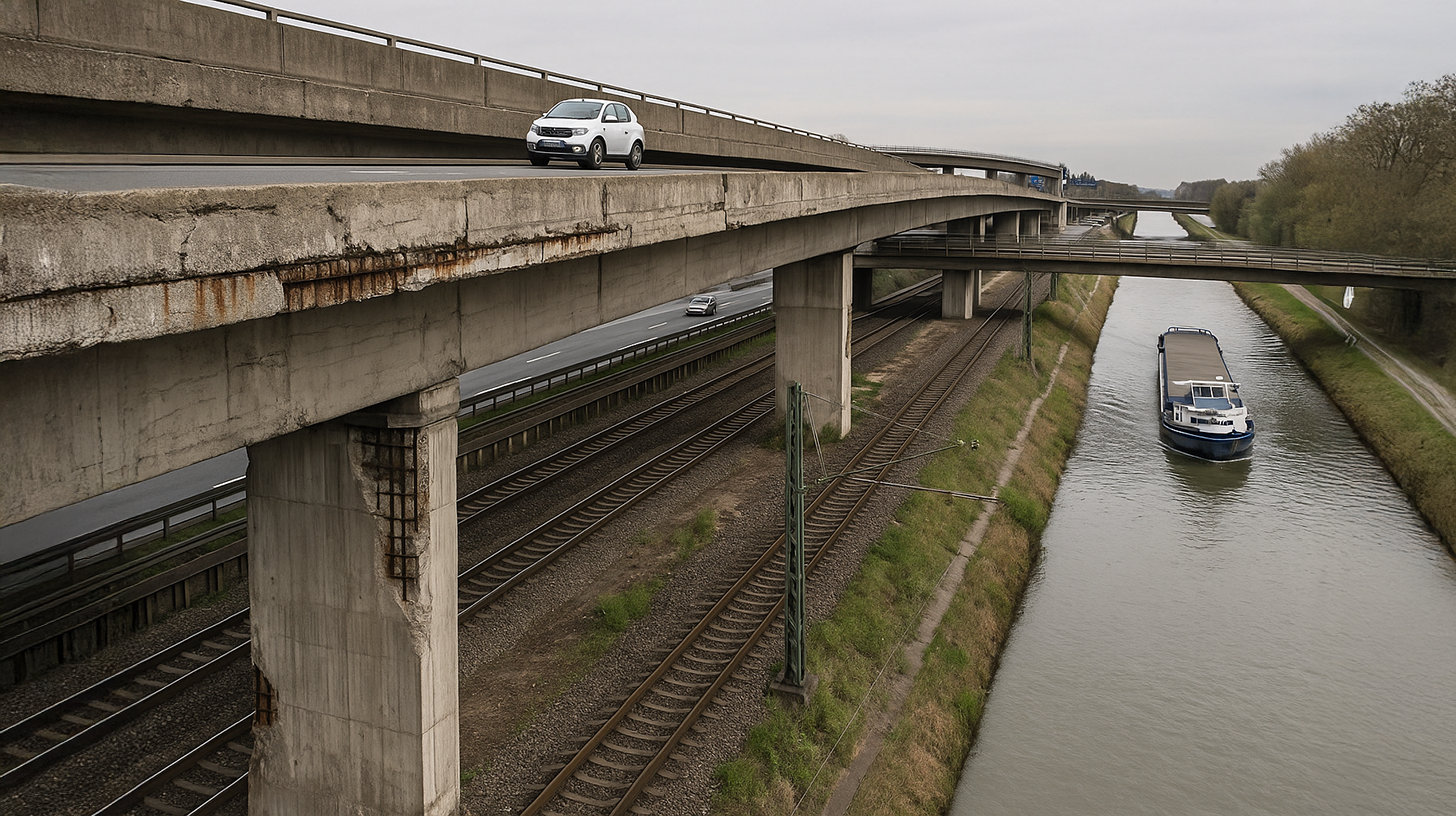
Roads, railways, waterways: Why Germany's infrastructure is threatened with collapse despite a record budget – Creative image: Xpert.Digital
Federal Budget 2026: A critical look at transport infrastructure investments
What is the 2026 federal budget and what criticisms have been leveled against it?
### Record investments or a sham? Why the new federal budget is causing controversy ### The 500 billion trick: How the government is secretly cutting infrastructure funding ### Billions from truck tolls: Why your money isn't reaching where it's needed ###
The 2026 federal budget was initiated by the Federal Cabinet on July 30, 2025, and comprises planned expenditures of €520.5 billion. The Federal Government promises record investments in infrastructure and promotes the budget as a major step forward for the modernization of Germany. But is this portrayal truly accurate, or is it more political marketing than substantial improvements?
This question is of particular concern to the logistics industry, which relies on a functioning transport infrastructure on a daily basis. The German Freight Forwarding and Logistics Association (DSLV) has a clear answer: the advertised "investment offensive" is more hype than substance. What lies behind this criticism, and what specific problems do experts foresee with the planned financing of Germany's transport infrastructure?
Suitable for:

Why is the investment offensive described as “more show than substance”?
The main criticism of the 2026 federal budget is directed at the way the federal government presents its transport investments. Frank Huster, CEO of the DSLV (German Association for Freight Forwarding and Logistics), criticizes the government for continuing a "course of reallocating funds" instead of a genuine increase in investment.
The central problem lies in the handling of the new special fund for infrastructure and climate neutrality (SVIK). This €500 billion special fund was originally conceived as an additional source of financing. Instead, however, it is apparently being used to compensate for cuts in the regular transport budget. The DSLV criticizes the fact that the SVIK should have an "additive effect," not a "compensatory" one.
The figures confirm this criticism: While spending in budget item 12 for 2026 increases by only €243 million compared to the key figures from June, it “does not even come close to reaching the level of 2025.” The problem is particularly evident in the case of federal highways: Total spending in 2026 amounts to €15.17 billion, only slightly above the initial government draft for 2025 – and this despite the fact that the special infrastructure fund did not yet exist at that time.
What is the special fund for infrastructure and climate neutrality and how does it work?
The Special Fund for Infrastructure and Climate Neutrality (SVIK) is a €500 billion, debt-financed investment program that was approved by the Bundestag and Bundesrat in March 2025. It is designed to run for twelve years and is intended to enable additional investments in various infrastructure sectors.
The 500 billion euros are divided as follows: 300 billion euros are available to the federal government for its own investments, 100 billion euros are earmarked for states and municipalities, and a further 100 billion euros will go into the climate and transformation fund. 21.3 billion euros from the special fund are planned for transport infrastructure in 2026.
The SVIK (Federal Fund for Infrastructure Investments) is intended to finance investments in seven areas: transport infrastructure, energy infrastructure, hospital infrastructure, education, childcare and scientific infrastructure, research and development, digitalization, and civil protection and disaster relief. The constitutionally mandated "additionality" of the investments is considered fulfilled if the investment expenditures in the federal budget amount to at least ten percent of the adjusted total expenditures.
How is the truck toll used to finance infrastructure?
Truck tolls play a central role in financing German transport and are simultaneously a point of contention between various interest groups. Since December 1, 2023, a CO₂ surcharge of €200 per ton of CO₂ has been introduced, roughly doubling the toll rates. Additionally, the toll obligation was extended to trucks weighing more than 3.5 tons on July 1, 2024.
In 2024, the federal government generated approximately €12.96 billion in revenue from truck tolls. However, these revenues are not used exclusively for roads: roughly €7.78 billion went toward the planning, construction, maintenance, and operation of federal highways, while €5.95 billion was used as subsidies for railway construction costs. Only €160 million went to federal waterways.
For 2026, the federal government plans to collect six billion euros from the CO₂ surcharge on truck tolls. Following criticism from the German Freight Forwarding and Logistics Association (DSLV), this money could be used to finance the transformation of road freight transport, which is considered the "largest CO₂ emitter in land transport." Instead, a significant portion of the toll revenue – a total of 3.13 billion euros – flows into other modes of transport and is therefore unavailable for the renovation of federal highways.
Why is the road financing cycle seen as a problem?
The so-called "road financing cycle" was a system in which revenues from truck tolls were earmarked for road investments. This system was introduced in 2011 and was intended to establish a form of user financing. Until 2019, truck tolls covered approximately 90 to 96 percent of federal highway investments.
However, this financing cycle was broken with the toll reform of 2023. The coalition government introduced the concept of "transport financing transport," in which a large portion of the additional toll revenue flows into rail. As a result, in 2024, for the first time, €6 billion from truck tolls could be used for the modernization of the rail network.
The German Freight Forwarding and Logistics Association (DSLV) and other associations sharply criticize this development. They argue that the road financing cycle will not be closed in 2026, despite the commitment made in the coalition agreement. This leads to structural underfunding of road infrastructure, even though truck drivers contribute directly to its financing through tolls. The new grand coalition of the CDU/CSU and SPD announced in its coalition agreement that it would reintroduce financing cycles with revenue allocations for the respective modes of transport.
What problems exist with the federal waterways?
Federal waterways represent a particularly problematic case in German transport infrastructure financing. They are the “only transport routes without access to the SVIK” (Swiss Federal Waterways and Shipping Administration) and their investments are “largely financed through revenues from truck tolls.” This leads to structural underfunding of this mode of transport.
The financial requirement for necessary investments in the maintenance and expansion of federal waterways alone is estimated at approximately €1.1 billion annually. If one includes the costs for implementing the "Concept for the Passage of Fish in Waterways" and addressing the maintenance backlog, the realistic requirement rises to €1.3 billion per year.
Insufficient funding has concrete consequences: The Kiel Canal has already had to be temporarily closed to large ships due to deficiencies in its renovation, resulting in detours and additional costs averaging €70,000 per trip. Without reliable funding for waterways, the risk of bottlenecks and complete closures increases, warns the DSLV (German Association for Freight Forwarding and Logistics).
Why is the reduction in track access charge subsidies being criticized?
A particularly controversial point in the 2026 federal budget is the planned reduction in track access charge subsidies for rail freight transport from €275 million to €265 million. This cut comes at a time when track access charges – the fees that railway companies have to pay for using the railway network – are rising sharply.
Track access charges for a standard freight train on the federal network already rose by around 16 percent in December 2024. Depending on the outcome of ongoing legal disputes, a further increase of 8 to 35 percent is possible for December 2025. The VDV (Association of German Transport Companies) estimates the actual need for track access charge subsidies at at least 350 million euros annually.
Although the German government attempted to curb the price increase by lowering the equity interest rate for DB InfraGO from 5.2 to 2.2 percent, this only results in track access charges rising "less sharply." The fundamental problem remains.
It seems paradoxical that, at the same time, track access charge subsidies for long-distance passenger rail services are to be almost doubled from 105 to 200 million euros. The VDV (Association of German Transport Companies) criticizes this unequal treatment as "incomprehensible," since rail transport should be considered as a whole system.
Your dual -use logistics expert

Dual -use logistics expert - Image: Xpert.digital
The global economy is currently experiencing a fundamental change, a broken epoch that shakes the cornerstones of global logistics. The era of hyper-globalization, which was characterized by the unshakable striving for maximum efficiency and the “just-in-time” principle, gives way to a new reality. This is characterized by profound structural breaks, geopolitical shifts and progressive economic political fragmentation. The planning of international markets and supply chains, which was once assumed as a matter of course, dissolves and is replaced by a phase of growing uncertainty.
Suitable for:
Rails, roads and bridges – Germany's mammoth task in the infrastructure renovation plan: Will Germany's infrastructure finally become fit for the future?
How large is the actual backlog of renovations in Germany?
The backlog of repairs to Germany's transport infrastructure is considerable and has worsened in recent years. Currently, 7,112 kilometers of autobahns are classified as requiring repair – an increase of 1,315 kilometers compared to the 2017/18 survey. This corresponds to approximately 12 percent of the entire autobahn network.
The situation is even more dramatic on federal highways: 13,600 kilometers, or 33 percent of all federal highway kilometers, are in need of repair. In total, this means that almost 25,000 kilometers of roadway on German highways are damaged.
The condition of the bridges is particularly alarming. While the Ministry of Transport speaks of 4,000 motorway bridges that need to be renovated in the next ten years, the environmental organization Transport & Environment arrives at significantly higher figures: 5,905 bridges need to be replaced, and a further 10,240 are so heavily burdened that a complete replacement is likely necessary. In total, approximately 8,000 motorway bridges and 3,000 federal highway bridges are classified as requiring renovation.
The rail network also shows massive problems: 17,636 kilometers of track are in need of repair, which corresponds to about 28 to 29 percent of the total rail network. The number of railway bridges that need to be replaced with new structures has increased from 1,089 to 1,160.
What are the financial dimensions of the infrastructure renovation?
The costs for the necessary modernization of Germany's transport infrastructure are astronomical. According to calculations by Transport & Environment, up to 100 billion euros must be invested at the federal, state, and municipal levels just for the replacement of bridges.
The Commission on the Future of Transport Infrastructure Financing already estimated in 2013 the additional annual expenditure for maintaining existing infrastructure at €7.2 billion, of which €5.3 billion was for the road network alone. Since these figures have not been reached for over a decade, the backlog of necessary repairs has steadily increased.
Deutsche Bahn is planning a modernization program for its rail network by 2030, with an estimated cost of at least 45 billion euros. In 2024 alone, 16.4 billion euros are to be spent on the renewal of 2,000 kilometers of track, 2,000 switches, as well as numerous train stations and bridges.
The annual financial requirement for federal waterways is a realistic €1.3 billion. Over the entire twelve-year term of the SVIK (Sustainable Infrastructure Investment Program), the federal government plans transport investments of €166 billion, of which €107 billion is for rail, €52 billion for federal roads, and €8 billion for waterways.
What happens if the infrastructure is not adequately renovated?
The consequences of inadequate infrastructure maintenance are already visible and will worsen dramatically without decisive action. Isolated closures of motorway sections to heavy trucks, such as those that have already occurred on the A1 near Leverkusen, demonstrate that the functionality of the infrastructure is already at risk.
A particularly drastic example was the Carolabrücke bridge in Dresden, which partially collapsed into the Elbe River in September 2024. The Ringbahn bridge on the A100 motorway in Berlin also had to be completely demolished and rebuilt due to a crack in its supporting structure. Such scenarios could become more frequent without sufficient investment.
The economic consequences are significant: If investments in dilapidated bridges and roads are neglected, the final cost is higher – both economically and socially. Contracts already awarded to private companies demonstrate that delayed repairs do not lower prices and that bidders can dictate the cost.
For the logistics industry, further deterioration of infrastructure means significant additional costs and planning uncertainty. The DSLV (German Association for Freight Forwarding and Logistics) warns that crumbling transport routes are making Germany's economic position "increasingly unstable and less attractive for industry and trade." Neighboring EU countries have long viewed the deterioration of Germany's infrastructure with concern.
What solutions are proposed?
Various solutions are being discussed to address the infrastructure crisis. The DSLV (German Association for Freight Forwarding and Logistics) is calling for a more stable and sustainable financing architecture that must be designed to span multiple years. This means that investment commitments should be predictable and reliable over several years.
A key point is the restoration of closed-loop financing. The ZDK (German Association of Motor Trades and Repairs) demands a “consistent earmarking of truck toll revenues for the maintenance and expansion of road infrastructure.” The new grand coalition has announced corresponding financing cycles with revenue earmarked for the respective modes of transport in its coalition agreement.
For the railways, the establishment of a rail infrastructure fund is being demanded, as was already envisaged in the original coalition agreement. Such a fund could enable long-term, multi-year investment commitments and thus prevent inflationary effects in the construction industry.
Experts are calling for a fundamental reform of financing for waterways. The SPD parliamentary group has developed a concept intended to enable additional investments in transport infrastructure (“Transport routes: Soundly financed – efficiently managed”).
Industry emphasizes that public investment must meet certain requirements: it should incentivize private investment, create structural framework conditions, and be strategically aligned with future challenges. Short-term political considerations should not be the primary factor in setting priorities.
Is the 2026 federal budget truly a breakthrough?
The analysis of the 2026 federal budget proposal and the criticism leveled against it reveals a mixed picture. On the one hand, the federal government is indeed planning substantial investments in transport infrastructure – the talk of “record investments” is not entirely unfounded. With €33.7 billion earmarked for transport investments and the €500 billion special fund, considerable financial resources are being mobilized.
On the other hand, the criticisms from the logistics sector cannot be dismissed. The accusations of "reallocating funds" instead of genuine increases, the structural underfunding of waterways, and the problematic reduction of track access charge subsidies reveal systemic weaknesses in the financing architecture.
The lack of planning certainty and sustainability in the financing is particularly problematic. If the SVIK (Swiss Association for the Promotion of Investment in the Public Sector) is primarily used to plug gaps in the regular budget instead of enabling additional investments, it fails to fulfill its intended purpose. The failure to achieve a breakthrough in a stable, multi-year financing structure could prove to be the biggest oversight.
The immense backlog of repairs—almost 25,000 kilometers of damaged highways, over 16,000 dilapidated bridges, and 17,636 kilometers of railway in need of repair—makes it clear that Germany faces a mammoth infrastructure challenge. While the planned investments may be at a record level, given the decades of accumulated maintenance, they may not be enough to halt the deterioration.
Ultimately, the success of the 2026 federal budget proposal will not be measured by the promised sums, but by whether it succeeds in establishing reliable and adequate funding for all modes of transport. Only if the structural problems in the financing architecture are solved can Germany future-proof its infrastructure and remain competitive as an economic location.
Advice - planning - implementation

Markus Becker
I would be happy to serve as your personal advisor.
Head of Business Development
Advice - planning - implementation
Konrad Wolfenstein
I would be happy to serve as your personal advisor.
contact me under Wolfenstein ∂ Xpert.digital
call me under +49 89 674 804 (Munich)










