

The end of one-way logistics: How new EU laws are changing Europe's supply chains forever
Xpert Pre-Release

Available in 27 languages 📢
Prefer Xpert.Digital on GoogleⓘPublished on: June 28, 2026 / Updated on: June 28, 2026 – Author: Konrad Wolfenstein
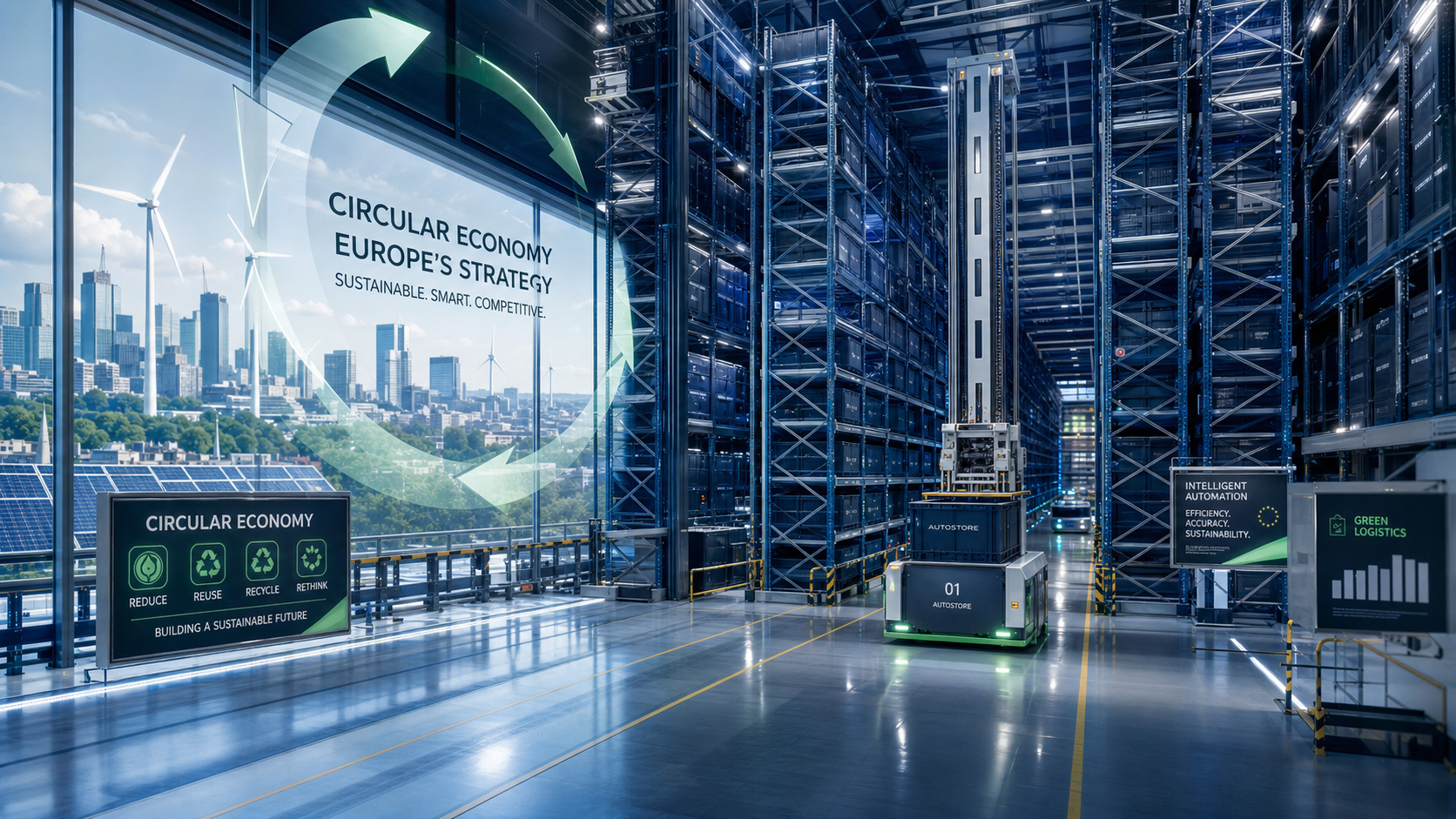
The end of one-way logistics: How new EU laws are changing Europe's supply chains forever – Image: Xpert.Digital
The Draghi shock: Why the circular economy is now becoming a matter of survival for industry
The EU circular economy and smart intralogistics: Strategic responses to regulatory change
CBAM, PPWR & Co.: What the radical transformation of the EU single market means for your company
Europe's economy is facing a tectonic shift. For decades, global prosperity was based on a linear principle: raw materials were imported cheaply, processed, consumed, and disposed of at the end of their life cycle. But geopolitical dependencies, disrupted supply chains, and the undeniable effects of climate change have pushed this model to its limits. Since the widely noted Draghi report on competitiveness from autumn 2024, at the latest, it has been clear: Europe must reinvent itself to avoid falling behind in global competition with the US and China. The European Union's response to this historic challenge is an unprecedented package of regulatory measures that elevates the circular economy from a niche environmental issue to a crucial industrial and security policy imperative.
With legislation such as the EU Packaging Regulation (PPWR), the Carbon Border Adjustment Scheme (CBAM), the Ecodesign Regulation (ESPR), and the upcoming Circular Economy Act (CEA), Brussels is changing the fundamental rules of industrial value creation. The focus is shifting radically: primary raw materials are becoming more expensive, secondary materials more attractive, and single-use models are being systematically pushed out of the market. For companies, this means far more than just new compliance obligations – it requires a complete overhaul of their supply chains.
This is precisely where an area often viewed merely as a background cost factor comes into focus: intralogistics. The warehouse of tomorrow is no longer just a place where finished goods await shipment. It will become a highly complex hub for reverse logistics, a depot for valuable secondary raw materials, a testing center for reusable containers, and a data server for the digital product passport. Those who want to strategically master the transformation to a circular economy must start with their warehouse infrastructure and software architecture. This article outlines the new regulations facing businesses, how they interrelate, and why modern, automated intralogistics solutions are key to transforming regulatory pressure into a genuine competitive advantage.
Why does Europe even need a circular economy?
Europe is facing a structural competitiveness crisis, which has been measurable in concrete figures since the Draghi report of September 2024. In his report on EU competitiveness, the then ECB President and later Italian Prime Minister Mario Draghi estimated the annual additional investment required to close productivity gaps and simultaneously achieve the Union's environmental and social goals at at least 750 to 800 billion euros. The core problem is threefold: weak growth momentum, a lack of innovation, and a dangerous dependence on raw materials – especially on China for critical minerals such as lithium, rare earths, and cobalt. While the US and China are consistently expanding their industrial ecosystems and supporting them with massive state investment programs, Europe's structural lag is deepening in strategically crucial sectors such as semiconductors, battery technology, and rare earths.
Europe's dependence on imported primary raw materials is not only an economic problem, but also a geopolitical risk of the highest order. For heavy rare earth elements, which are indispensable in modern electric drives and wind turbines, Europe's import dependence is close to 100 percent. For critical raw materials such as lithium and rare earths, the recycling rate in the EU is less than one percent. Overall, European manufacturers use only twelve percent secondary materials in their products, even though significantly higher rates would be technically and logistically feasible. This imbalance is the starting point against which the European circular economy strategy is being developed.
In this context, the circular economy is no longer merely environmental policy, but an industrial and security policy necessity. It decouples economic growth from linear resource consumption, reduces import dependence on primary raw materials by establishing a functioning secondary raw materials economy within the single market, and creates the foundation for new, innovation-driven business models on European soil. The circular approach is thus the structural answer to all three problem areas identified in the Draghi report simultaneously: it can close the innovation gap through new business models in the areas of repair, remanufacturing, and recycling technology; it links decarbonization with competitiveness, because less primary raw material consumption also means fewer CO₂ emissions; and it reduces strategic dependence on raw materials and semi-finished products from third countries.
What is the Circular Economy Act and what specific goals does it pursue?
The Circular Economy Act (CEA) is the key EU regulation planned for the current legislative term in the area of sustainability and industrial resilience. According to the European Commission's work program, the legislative proposal is scheduled for the third quarter of 2026. Unlike previous circular economy strategies and action plans, which were primarily environmental in nature, the CEA is explicitly positioned as an instrument for strengthening industrial competitiveness. It aims to double the EU's circular economy rate to 24 percent by 2030, thereby also substantially improving security of supply for strategic materials.
The central goal of the CEA is the creation of a genuine single market for secondary raw materials and waste. This means that recycled materials should be traded in the European single market just as freely, safely, and with comparable legal certainty as new primary raw materials. This is not yet the case today because differing national regulations, inconsistent end-of-waste criteria, and divergent extended producer responsibility systems significantly hinder cross-border trade in secondary raw materials. An Austrian company wishing to purchase aluminum scrap from Germany currently faces a bureaucratic maze that unnecessarily increases the cost or prevents economically viable transactions.
The CEA (Circular Energy Act) is intended to harmonize several existing legal instruments into a single regulation, based on the principle of an omnibus agreement, and will build specifically on three main pillars: firstly, the creation of a functioning internal market for waste and secondary raw materials; secondly, the introduction of binding targets for the use of secondary materials in certain product categories; and thirdly, measures to promote circular business models such as product leasing, reprocessing, and remanufacturing. EU Commissioner Jessika Roswall, responsible for the environment and the circular economy, has emphasized that the law should not be yet another environmental law that burdens industry, but rather an industrial law that strengthens Europe's resource resilience.
For companies, this means that those who rely on circular economy business models today are preparing for a legal framework that will make these models scalable and legally compliant across Europe. Those who wait risk being under considerable time pressure when the regulation comes into force, while early adopters will have already built robust supply chains for secondary raw materials, invested in infrastructure, and established customer relationships within the circular economy.
How does the EU Competitiveness Compass position itself with regard to the circular economy?
The European Commission's Competitiveness Compass, adopted on January 29, 2025, translates the key recommendations of the Draghi report into operational priorities for the entire 2024-2029 legislative period. Three areas of action are central: first, closing the technological innovation gap with the US and China; second, integrating decarbonization and competitiveness more closely instead of pitting them against each other; and third, reducing excessive strategic dependence on third countries for critical raw materials, semiconductors, and digital infrastructure. Within this framework, the CEA (Competitiveness Assessment) is explicitly identified as one of the key legislative instruments for facilitating the free movement of circular economy products, secondary raw materials, and waste within the internal market, ensuring the availability of high-quality recycled materials in sufficient quantities, and structurally strengthening demand for these materials through minimum content requirements in products.
The Competitiveness Compass is also directly linked to the Clean Industrial Deal presented in February 2025, which aims to make the EU a global leader in the circular economy. The Commission's message is clear: Europe does not see the circular economy as a regulatory burden imposed on industry, but rather as a next-generation strategic competitive advantage – the structural pathway to positioning European industry as a global leader in a resource-efficient world economy that is significantly more resilient to geopolitical commodity shocks. Up to 47 legislative and non-legislative proposals are planned under the Compass by the end of 2026, of which the CEA is one of the most significant for industry.
What does the end of the linear supply chain mean specifically for companies?
For decades, the logic of global supply chains followed a simple, efficient principle: raw materials are imported, products are manufactured, delivered to customers, consumed, and disposed of at the end of their useful life. This linear model of take, produce, consume, and discard optimized itself over decades for cost efficiency and global division of labor. It was the fundamental organizational principle of 20th-century industrial society. The CEA does not break with this logic gradually through moderate adjustments, but systemically by changing the underlying incentives: primary raw materials become more expensive due to CBAM, ETS, and rising raw material prices; secondary materials become more attractive through the CEA, uniform end-of-waste criteria, and minimum requirements for recycled content; and single-use concepts are directly prohibited by the PPWR or replaced by mandatory reusable packaging.
It is crucial to understand that regulatory change does not begin with the CEA. It is already well underway. The PPWR will be fully applicable from August 2026, the CBAM will enter its definitive phase in January 2026, and the ESPR with the Digital Product Passport is being rolled out gradually to more and more product categories. The CEA adds the missing foundation to this system: a functioning, cross-border market for secondary raw materials. Companies that view these regulatory layers separately as isolated compliance tasks are missing the strategic dimension: This is about fundamentally redesigning supply chains, product concepts, and logistics processes for the next decade – not just filling out forms.
What does the EU Packaging Regulation PPWR entail and what deadlines do companies need to be aware of?
The Packaging and Packaging Waste Regulation (EU 2025/40), known as PPWR, entered into force on February 11, 2025, and will become fully applicable in all EU Member States on August 12, 2026. It replaces the previous Packaging Directive of 1994 and, for the first time, establishes a uniform, directly applicable legal framework for packaging in the EU single market. Because it is a regulation and not a directive, it applies directly without the need for national implementing legislation. Companies must comply with the European requirements immediately, without any national leeway or differing implementation deadlines.
The reusable packaging requirements under the Packaging and Packaging Directive (PPWR) represent the most structurally far-reaching requirement. By 2030, 40 percent of all transport packaging used in cross-border transport between legally independent economic operators within the EU must circulate in reusable systems. For internal transport between sites of the same company, as well as for domestic transport between independent economic operators, a complete reusable packaging requirement applies. All packaging on the EU market must be recyclable by 2030. For plastic packaging, mandatory minimum recycled content quotas are being introduced, meaning mandatory quotas for the use of recycled plastic, which will increase further by 2040. These are not recommendations or targets – they are legal obligations with direct consequences for investment, procurement, and logistics decisions.
Specifically, the following packaging formats will be subject to mandatory reusable packaging from 2030: pallets, flexible bulk containers, pallet wraps, buckets, strapping bands, trays, drums, plastic crates, canisters, plastic boxes, rigid bulk containers, and collapsible plastic crates. Single-use packaging of these formats will be directly prohibited in domestic trade and between company locations from 2030. Exceptions apply to packaging for dangerous goods, custom-made special packaging for large machinery and equipment, flexible direct-contact packaging for food, and cardboard packaging. Small businesses with less than 1,000 kilograms of packaging volume per year, fewer than ten employees, and an annual turnover of less than two million euros are also exempt.
What is the Carbon Border Adjustment Mechanism and why does it fundamentally change supply chains?
The Carbon Border Adjustment Mechanism (CBAM) will enter its definitive phase on January 1, 2026, at which point it will be fully and bindingly in force. It operates on a simple principle: anyone importing emissions-intensive goods from third countries into the EU must purchase and redeem CBAM certificates for the CO₂ emissions associated with the production of these goods. The price of these certificates is based on the current price in the European Emissions Trading System (EU ETS), which is currently between €70 and €100 per ton of CO₂. This is intended to ensure that imported goods are subject to the same CO₂ cost burdens as goods produced in the EU – and that European climate protection is not undermined by the relocation of CO₂-intensive production abroad.
Currently, the CBAM (Combined Emissions Trading System) applies to the iron and steel, aluminum, cement, fertilizer, hydrogen, and electricity sectors. The European Commission plans a significant expansion to downstream products: around 180 steel- and aluminum-intensive product categories are to be included under the CBAM in the future, including machinery, vehicle parts, household appliances, and industrial tools. This would considerably increase the CBAM burden for manufacturing industries, which currently only pay for raw materials. For steel products, CBAM-related additional costs already amount to around €150 to €550 per ton, depending on the product type, emissions intensity, and country of origin.
The CBAM (Collateral Carbon Market Analysis) fundamentally changes the entire nearshoring calculation. Companies that previously sourced steel, aluminum, cement, or fertilizers from third countries with low environmental standards—because no CO₂ prices were levied there—will have to pay real compensation for this cost advantage starting in 2026. Conversely, those who rely on European scrap, secondary aluminum, or recycled steel can significantly reduce their CBAM costs because these materials typically have considerably lower emission intensities than raw materials smelted from primary ores. This creates a direct, measurable economic incentive to diversify procurement sources, prioritize the use of recycled materials, and gradually transform supply chains towards a circular economy.
What role does the Ecodesign Regulation ESPR play and what does the Digital Product Passport mean?
The Ecodesign Regulation for sustainable products (ESPR, in force since July 2024) sets minimum product-related requirements for sustainability, energy efficiency, repairability, recyclability, and the use of secondary materials. It significantly expands the previous ecodesign approach, which focused primarily on the energy consumption of electrical appliances, to encompass the entire product life cycle – from raw material selection through the production phase and use period to recovery at the end of its life. The ESPR is being phased in to an increasing number of product categories; the first delegated acts concern textiles and furniture, with further product groups to follow in the coming years.
The central new instrument of the ESPR is the Digital Product Passport. It is a standardized digital document containing all relevant information about a product and remaining accessible throughout its entire life cycle: composition and origin of the materials used, CO₂ footprint of production, proportion of recycled materials, information on repairability and available spare parts, recycling instructions, and proof of any critical raw materials contained. This passport will be accessible via a machine-readable code on the product or its packaging and will be readable by consumers, recyclers, repairers, and authorities alike.
For warehousing and logistics processes, the Digital Product Passport (DPP) represents a new dimension of data compliance. Stored goods must be recorded with their passport data, managed in the warehouse management system, and transferred to the next stage in the supply chain during onward transport or resale. This requires deep integration between the warehouse management system, the conveyor control system, the ERP system, and, in the future, also external DPP platforms or registries. Systems equipped with open interfaces and modular software architecture will be able to meet these requirements with manageable effort. However, legacy, isolated solutions with proprietary systems lacking interoperability will be forced to undertake significant retrofitting.
How exactly do these regulations affect intralogistics within the company?
The regulations described – PPWR, ESPR, CBAM and the upcoming CEA – do not affect intralogistics at its periphery, but at the core of its daily operations, because the warehouse is the operational location where all these requirements must be translated into real processes.
First, they are changing what is stored in warehouses: Instead of single-use packaging, reusable containers are increasingly being used, which are returned in cycles and must be inspected, cleaned, stored, and made available again upon return. In addition to finished end products, secondary raw materials, refurbished components, and returned used products will also be stored in warehouses in the future, which place special demands on handling, batch purity, and quality documentation. The range of load carriers and goods that a warehouse has to manage is increasing considerably.
Secondly, they change the processes: The circular economy necessitates a significantly expanded reverse logistics system. Returned reusable containers must be scanned, inspected, and sorted according to their condition before being reintroduced into the cycle. Returned devices and components must be recorded, categorized, and, depending on their condition, sent for remanufacturing, repair, or recycling. These are entirely new process steps that must be mapped, controlled, and documented in warehouse facilities.
Thirdly, they change the requirements for the software: Traceability at the batch and serial number level, DPP data management, CBAM-relevant emission data for stored materials, and the quality documentation of reusable container cycles must be available in real time, stored in an audit-proof manner, and auditable for external reviews. A modern warehouse management system is therefore no longer just an inventory management and process control system, but a central hub of the regulatory compliance infrastructure of the entire company.
LTW Intralogistics Solutions – Intermodal Transport

LTW Intralogistics Solutions – Intermodal Transport – Image: LTW Intralogistics GmbH
LTW offers its customers not individual components, but integrated complete solutions. Consulting, planning, mechanical and electrotechnical components, control and automation technology, as well as software and service – everything is networked and precisely coordinated.
In-house production of key components is particularly advantageous. This allows for optimal control of quality, supply chains, and interfaces.
LTW stands for reliability, transparency, and collaborative partnership. Loyalty and honesty are firmly anchored in the company's philosophy – a handshake still means something here.
Related to this:
Smart management of secondary raw materials: Automated storage solutions for recycling and CEA
Which intralogistics solutions are particularly suitable for the requirements of the circular economy?
For companies looking to adapt their intralogistics to the circular economy, several complementary and interconnected solutions are available. European full-service providers of automated intralogistics offer a broad portfolio ranging from hardware and conveyor technology to fully integrated software.
Automated high-bay warehouses with rail-guided storage and retrieval machines are the heart of modern intralogistics systems, enabling high-density storage of goods on a minimal footprint. A key advantage is the utilization of vertical space: high-bay warehouses with heights of 30, 40, or even more than 40 meters allow for a tripling or quadrupling of storage capacity on the same building footprint compared to manually managed flat warehouses. This is a crucial advantage in the context of the circular economy, because reusable systems, reverse logistics, and the storage of secondary materials significantly increase the required storage volume in many companies, while the available floor space remains limited.
Modern storage and retrieval systems are capable of precisely handling virtually any type of load carrier: from standardized Euro pallets and industrial pallets to wire mesh containers and special load carriers, all the way to very heavy goods in the heavy-duty sector with payloads of several tons per storage location. This is relevant for the circular economy because secondary materials often occur in unusual shapes, dimensions, and weights – whether they are aluminum extrusion blocks, steel scrap in compacted bales, returned industrial components, or refurbished empty containers. Specialized storage and retrieval systems, which can be designed for goods up to 31 meters long or payloads of up to 18 tons, expand the potential range of applications to include material manufacturers, wood processing companies, and mechanical engineering firms.
For managing reusable container systems, in addition to traditional high-bay pallet warehouses, automated storage and retrieval systems (AS/RS) designed for standardized container formats are particularly relevant. They enable the efficient management of large container pools – from storing empty containers and precisely retrieving them for order picking to receiving and restocking returned containers. In combined systems, both storage areas – pallets and containers – can be connected via a shared conveyor system, thus enabling a continuous, fully automated material flow from production through order picking to shipping.
Intelligent conveyor technology and material flow systems connect all stations within an intralogistics plant – goods receiving, storage buffer, order picking, quality control, packaging zone, and shipping area – into a continuous, automated material flow. Elements such as transfer cars, vertical conveyors, floor conveyors, chain conveyors, roller conveyors, and automatic transfer stations make it possible to implement parallel material flows for forward and reverse logistics in a confined space, without the goods flows interfering with each other. This is particularly important in a circular economy context because returned reusable containers and goods taken back must be moved and processed simultaneously with the ongoing outbound goods flow without blocking it.
High-bay warehouses designed for deep-freeze storage deserve special mention in this context. Many reusable packaging systems in the food industry involve temperature-controlled products that must be stored at minus 28 degrees Celsius or lower. Compared to manual deep-freeze storage, fully automated high-bay warehouses not only significantly reduce energy consumption, but also space requirements and hygiene risks – because employees do not have to work permanently in the frozen area and the number of door openings is reduced to a minimum through automated storage and retrieval.
What role does warehouse management software play in implementing circular economy requirements?
Software is the invisible heart of every modern intralogistics system – and this statement is even more true in the context of the circular economy than before. A high-performance warehouse management system today must do far more than simply manage inventory and control storage and retrieval machines. It must seamlessly document proof of origin and batch data throughout the entire storage period of a product, track load carrier cycles and log the number of completed cycles of reusable containers, record and analyze quality data from returned goods, and transfer this information to higher-level ERP systems and, in the future, to digital product passport platforms.
Modular warehouse management software, based on proven standard functions and expandable with customizable modules, offers significant advantages. It controls the entire material flow from goods receipt to dispatch, supports various storage strategies such as FIFO (First In, First Out) and FEFO (First Expired, First Out) – particularly important for food, pharmaceuticals, and time-critical recyclables – and manages all load carrier information in real time. Complete, seamless transparency regarding inventory levels is not only an operational requirement but increasingly a regulatory obligation.
CBAM requires precise emissions data for imported materials, which cannot be obtained without complete documentation of origin. Quality assurance certificates for secondary raw materials must be documentable for customers and authorities in accordance with future CEA requirements. And the ESPR specifications for the Digital Product Passport require a standardized data structure that can be created, maintained, and shared within a WMS. A modern, browser-based WMS cockpit, accessible from anywhere, enables real-time monitoring of all processes within an intralogistics system – from the PLC level of individual storage and retrieval machines to the order level and the interface with the higher-level ERP system. For companies aiming to implement circular economy processes in their warehouses, this system integration is not an optional add-on, but rather a fundamental prerequisite for efficient and compliant operations.
How do automated storage systems contribute to reducing the CO₂ footprint?
According to recent studies, warehousing and logistics account for almost eleven percent of global CO₂ emissions. In this context, the energy efficiency of warehouse facilities is a key lever for achieving operational and company-wide climate targets – and at the same time a tangible economic driver, given that energy costs have become a genuine competitive factor due to the energy crisis of recent years.
Automated high-bay warehouses are significantly more energy-efficient than manual or semi-manual storage solutions in several respects. Firstly, the compact, vertical storage on a smaller footprint allows for a significant reduction in heated or air-conditioned usable floor space – a particularly important advantage for deep-freeze warehouses and temperature-controlled storage facilities for food or pharmaceutical products. Replacing a 6,000-square-meter cold storage warehouse with a fully automated 2,000-square-meter deep-freeze warehouse and a much higher storage capacity reduces cooling energy costs not only through the smaller footprint, but also through the reduced number of door openings, the elimination of permanently lit work areas, and the optimization of cooling capacity to the actual thermal load required.
Secondly, modern storage and retrieval machines utilize recuperation systems – DC link technology or energy recovery systems – in which the kinetic and potential energy generated during braking and lowering is recovered and either immediately reused for the machine's own travel or lifting motion or fed into the building's electrical grid. This technology enables energy savings of 25 to over 50 percent compared to systems without energy recovery. Thirdly, full automation reduces the need for continuous lighting, air conditioning, and employee-friendly temperature control in entire storage areas. Automated storage areas can operate completely in the dark, cold, and without human presence. Combined with renewable energy sources such as rooftop photovoltaic systems and smart energy management systems that smooth peak loads and maximize self-consumption, this results in logistics centers with very low specific energy consumption values, in line with ambitious net-zero strategies.
What significance does reusable logistics have for the nearshoring strategy of European companies?
Reusable logistics is not only a compliance requirement of the PPWR (Protection of Packaging and Water Resources Management), but also a tangible strategic building block for strengthening the European economic area within the context of the nearshoring debate. By circulating reusable containers in closed loops within the EU single market, goods flows are created that are structurally designed for short distances and no longer rely on single-use packaging produced in distant, low-wage countries and used only once.
The economic connection is compelling: reusable systems require a take-back infrastructure. Empty reusable containers must be returned after use, inspected, cleaned, stored, and made available again. For short transport distances within the European single market, the return transport costs are manageable and are more than offset by the savings on single-use packaging costs. However, for long intercontinental transport routes, the return transport logistics and the associated storage and handling costs quickly become prohibitive – economically viable reusable systems structurally preclude very long transport routes.
The CBAM amplifies this effect on the materials side: It makes imported, emission-intensive raw materials more expensive and creates incentives to relocate production facilities for basic materials such as steel, aluminum, and cement closer to the European processing and consumer market, or at least to convert to a European secondary materials economy. Together with the reusable packaging requirements of the PPWR, this creates a regulatory architecture that structurally favors European and nearshore supply chains over long-distance transport models. This presents a significant market opportunity for intralogistics providers from Austria and other Central European countries: The need for investment in new, high-performance storage systems for reusable packaging, secondary raw material storage, and circular logistics processes is growing throughout the European industrial area.
Which industries are particularly affected by regulatory change?
In principle, the new regulations affect all sectors that produce, store, transport, or sell goods within the EU single market. However, those sectors that are simultaneously subject to several of the described regulations are particularly affected.
The steel and metal processing industry faces a double burden: the CBAM (Convention on the Use of Materials and Equipment), which impacts imported raw materials, and the growing demand from its own customers for secondary materials and low-emission raw materials. The mechanical engineering and automotive industries face a triple challenge: the ESPR (European System for the Protection of Materials) with its requirements for repairability and product passports, the PPWR (Product Packaging and Packaging Regulations) with its mandatory reusable transport packaging, and, looking ahead, the CEA (Convention on the Use of Materials and Equipment) with its obligations to use secondary materials in production. The retail and e-commerce sectors are facing perhaps the most profound operational changes, because the PPWR's mandatory reusable packaging fundamentally challenges existing single-use transport packaging concepts: anyone currently using single-use stretch film, pallets, boxes, and bubble wrap will have to switch to reusable crates, pallets, and wrapping by 2030 and establish a complete take-back and cleaning infrastructure.
The food and beverage industry must establish reusable transport packaging systems without compromising hygiene, quality, and temperature requirements. The chemical and fertilizer industries are directly and immediately affected by the CBAM (Convention on Chemicals and Ammunition). The pharmaceutical industry faces challenges from ESPR (European System for the Prevention of Chemicals) and PPWR (Product and Product Warning Requirements), as well as the traceability requirements of the Digital Product Passport. In all these sectors, intralogistics is the operational hub that determines whether regulatory requirements are met efficiently, reliably, and cost-effectively—or whether they become an operational burden and a competitive disadvantage.
How can intralogistics systems be used for the recycling industry and the secondary raw materials sector?
The recycling industry and the secondary raw materials sector place unique demands on warehouse logistics, differing significantly from the requirements of traditional finished goods or commercial warehousing: materials vary considerably in weight, dimensions, and composition; batch purity is essential for further processing; traceability is a regulatory requirement; and quantities and compositions fluctuate considerably depending on collection results and market demand. At the same time, the recycling industry has traditionally been less automated, which offers significant potential for efficiency improvements.
Automated high-bay warehouses with stacker cranes designed for heavy or bulky goods can also be used for the structured storage and picking of secondary materials. Whether it's compacted aluminum bales, sorted plastic scrap in wire mesh containers, refurbished electric motors, or processed composite materials – a high-performance automated storage system with intelligent software can manage these materials batch-wise, automatically store them sorted by quality grade and origin, pick them precisely according to orders, and seamlessly document the entire material flow until shipment to downstream processors.
With its harmonized end-of-waste criteria, the CEA will ensure that such secondary materials can be traded more easily across Europe as fully-fledged raw materials, without having to navigate the regulatory gray area of waste legislation. This increases market liquidity for recycled materials, strengthens price transparency, and thus also creates the economic basis for professional warehousing solutions in an industry that has often operated with makeshift storage areas and manual processes. Companies in the recycling sector that invest early in automated warehousing technology will not only secure an efficiency and quality advantage, but also a compliance advantage once the CEA requirements are fully implemented.
What specific steps should companies take now to prepare strategically?
Regulatory change is unstoppable – it's already well underway. The PPWR (Product Product Reference Works) will be applicable from August 2026. The CBAM (Commonly Accepted Market Action Plan) will enter its definitive phase in January 2026. The Digital Product Passport is being rolled out for more and more product categories under the ESPR (European System for Product Safety). And the CEA (Commonly Accepted Economic Action) will be introduced as a legislative proposal by the end of 2026 at the latest. Companies that act strategically now still have the opportunity to plan infrastructure and system decisions for the long term, spread investments over several years, gain initial experience with reusable packaging and secondary raw material procurement, and build competitive advantages before the obligations fully take effect.
As a first step, companies should conduct an honest assessment of their current packaging and storage processes. Which packaging formats are used for which transport routes? What percentage of transport is cross-border between independent economic operators? How large will the pool of reusable containers need to be managed if the 40 percent reusable packaging quota is implemented by 2030? What additional storage capacity will this create? Based on this information, it can be determined whether existing storage infrastructure can be adapted through expansion or retrofitting, or whether a new building is more economical.
In parallel, companies should analyze their procurement flows from a CBAM perspective. Which materials are imported, in what quantities, and from which third countries? What are the emission intensities of these materials? What alternative European or nearshore sources are available? Where can the CBAM burden be reduced through the use of secondary materials? This analysis is often valuable because it systematically quantifies, for the first time, the full extent of future cost increases due to CBAM, thus objectifying the business case for circular economy investments.
The next step involves planning the warehouse infrastructure. Automated systems pay for themselves not only through increased personnel efficiency, but also by preventing costly errors in inventory management, reducing energy costs thanks to recuperation and intelligent energy management systems, and ensuring the future-proof nature of the compliance architecture. Turnkey, comprehensive solutions from a single source – from project planning through design, manufacturing, assembly, and commissioning to long-term service – significantly reduce interface complexity and ensure that all components are optimally coordinated.
Finally, the software question needs to be addressed strategically. A modern, modular WMS with an open API and continuous updates is essential to ensure that digital product passports, CBAM emissions data, batch records, and reusable packaging tracking don't result in cumbersome, isolated solutions, but rather can be integrated into a scalable system. Choosing a software platform that can accommodate current and future regulatory developments is therefore one of the most consequential strategic decisions intralogistics decision-makers will make in the next 24 months.
What strategic conclusions can be drawn for decision-makers in industry, trade, and logistics?
Europe is at a turning point in industrial policy. The Draghi Report, the Competitiveness Compass, the Clean Industrial Deal, the PPWR, the CBAM, the ESPR with its Digital Product Passport, and the upcoming CEA are not isolated initiatives from various commissions. They form a coherent, mutually reinforcing system that redefines the fundamental rules of industrial value creation in Europe and will gradually implement them over the coming years. The linear model of raw material imports, mass production, and single-use disposal will be systematically and irrevocably made more expensive. The circular model—with reusable systems, secondary raw materials, energy efficiency, digital traceability, and European value creation—will be structurally favored and made economically attractive.
For decision-makers in industry, trade, and logistics, this means: The question is no longer whether, but when and at what speed the transformation will take place. Companies that understand the investment in modern intralogistics, automated reusable packaging management systems, integrated WMS solutions, and circular supply chains as a strategic positioning – and not merely as a regulatory compliance burden – will emerge stronger in a changed competitive landscape. They will benefit from lower CBAM costs through the use of secondary materials, cost-effectively fulfill the PPWR reusable packaging obligation with efficient, automated infrastructure, and be able to meet the requirements of the ESPR Digital Product Passport with an integrated software architecture without costly retrofitting.
Intralogistics is not merely a cost factor operating behind the scenes, but rather the operational foundation upon which the circular economy becomes a reality in practice. Automated high-bay warehouses create space for secondary materials and reusable containers. Intelligent conveyor technology seamlessly connects forward and reverse logistics. Modular software maps traceability, quality data, and digital product passports. And turnkey, comprehensive solutions from a single source ensure that all these elements function as an integrated system – today, tomorrow, and within the industrial order of the coming decade defined by CEA and the circular economy.
Consulting - Planning - Implementation

Konrad Wolfenstein
I would be happy to serve as your personal advisor.
You can contact me at wolfenstein∂xpert.digital or
Just call me on +49 7348 4088 965 .
Your container high-bay warehouse and container terminal experts

Container high-bay warehouses and container terminals: The logistical interplay – expert advice and solutions - Creative image: Xpert.Digital
This innovative technology promises to fundamentally change container logistics. Instead of stacking containers horizontally as before, they will be stored vertically in multi-story steel racking structures. This not only allows for a drastic increase in storage capacity within the same area, but also revolutionizes all processes at the container terminal.
More information here:










