
The end of cheap globalism: Raw material shock & EU laws – The circular economy obligation for logistics companies
Xpert Pre-Release

Available in 27 languages 📢
Prefer Xpert.Digital on GoogleⓘPublished on: June 28, 2026 / Updated on: June 28, 2026 – Author: Konrad Wolfenstein
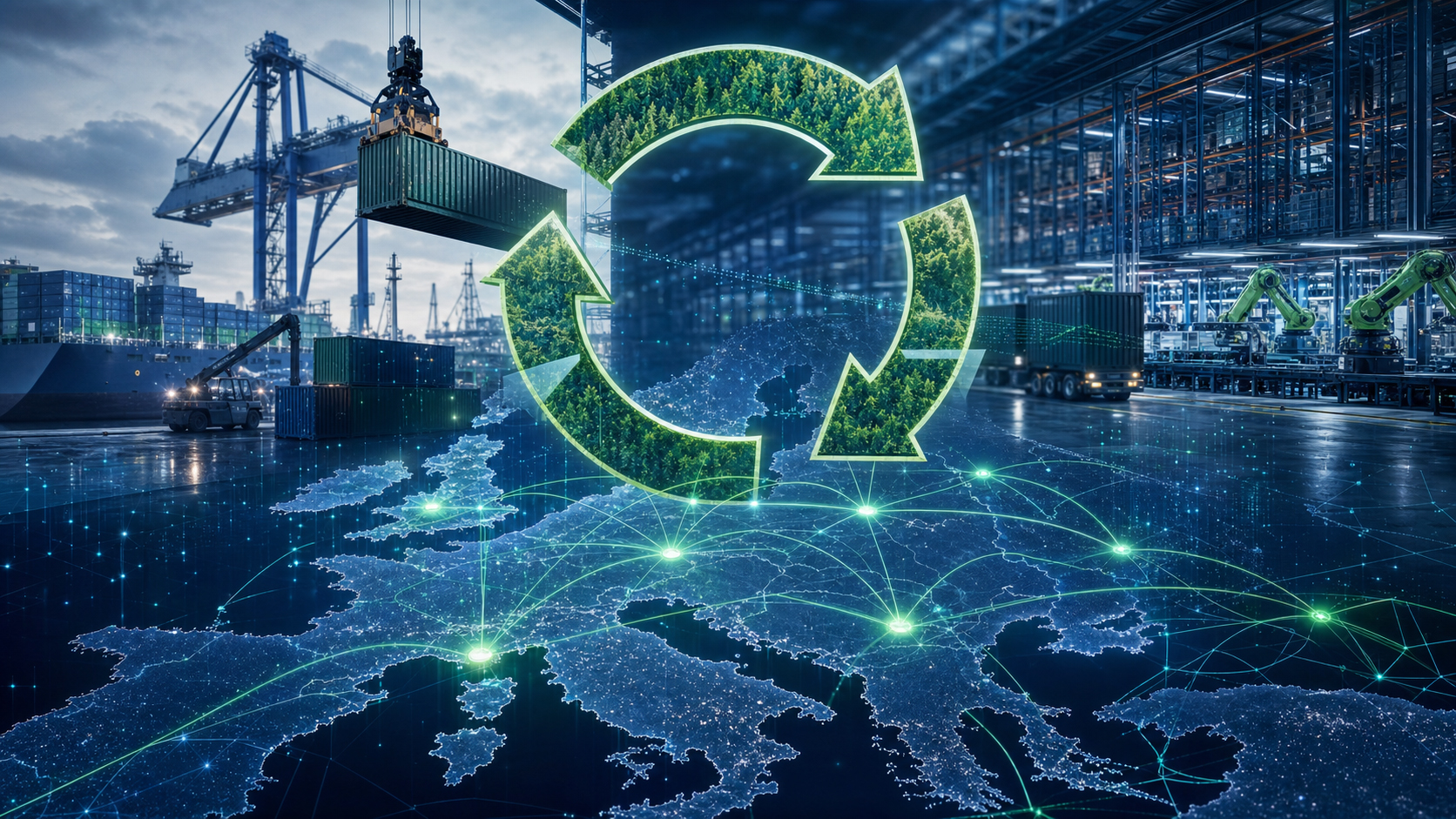
The end of cheap globalism: Raw material shock & EU laws – The circular economy obligation for logistics companies – Image: Xpert.Digital
Reverse Logistics & Nearshoring: Those who ignore this new EU trend risk their business
The Digital Product Passport is coming: Why the classic supply chain is finally obsolete
For decades, global logistics followed a simple formula: produce cheaply in the Far East, ship to Europe, and consider the end of the product lifecycle as waste. But this linear, one-way street model is on its last legs. Driven by massive geopolitical tensions, a dangerous dependence on raw materials from countries like China, and the EU's approaching Circular Economy Act (CEA), the European supply chain is facing a historic turning point. From 2026, theoretical sustainability concepts will become stringent regulatory obligations. Strategies such as nearshoring, reverse logistics, and the introduction of the Digital Product Passport (DPP) will become a matter of absolute survival for the industry. Those who fail to invest in automated intralogistics and circular material flows now risk not only hefty fines but also complete market exclusion. Learn why the global market is losing dramatic importance for European logistics companies—and how businesses can transform this radical shift from a mere cost factor into a strategic source of profit.
From environmental law to industrial policy: How the Circular Economy Act is revolutionizing the entire logistics industry — and why companies still relying on the old one-way street will soon be left behind
The EU's proposed Circular Economy Act (CEA) is far more than just another environmental law—it marks a radical paradigm shift in industrial policy. Faced with global crises and a dangerous dependence on raw materials from third countries, Europe is forcing its economy to transform: away from the resource-intensive, linear, throwaway model and toward a strategically autonomous circular economy. For B2B logistics and supply chain management, this means a fundamental reorganization. Approaches such as reverse logistics, nearshoring, and the digital product passport will quickly evolve from abstract concepts into strict regulatory obligations. Those who want to remain competitive in the future must now establish circular and data-driven supply chains and container logistics.
Europe's structural vulnerability: The end of cheap globalism
For decades, the prevailing formula was: buy where it's cheapest. Europe systematically outsourced raw material extraction, processing, and manufacturing to third countries—primarily China. The result is a dependency that is now openly considered a strategic security risk. Of the 17 so-called strategic raw materials that Europe needs for key technologies, the supply of eight is considered highly vulnerable. The EU sources 100 percent of its heavy rare earth elements, such as terbium and dysprosium, essential for electric motors and wind turbines, from China. Lithium and cobalt, the fundamental building blocks of electromobility, follow the same pattern of extreme import concentration.
The figures behind this dependency are sobering: According to the International Energy Agency, China controls over 85 percent of the world's rare earth processing capacity and around two-thirds of global production. Europe, on the other hand, currently recycles less than one percent of its consumed rare earths—a figure that starkly exposes the continent's structural helplessness in the face of external raw material supply chains. In parallel, in the fall of 2024, China established the China Resources Recycling Group, a state-owned entity that consolidates recycling activities in the areas of electronic waste and battery materials, thereby aiming for strategic dominance in the secondary raw materials sector as well.
Demand will rise dramatically in the coming years. EU demand for rare earth elements will increase sixfold by 2030 and sevenfold by 2050. The Commission expects lithium demand to increase twelvefold by 2030 and twenty-onefold by 2050. Those who continue to rely on fragile global supply chains will not be able to reliably meet this demand—especially if geopolitical crises disrupt supply routes or export restrictions are imposed.
The Circular Economy Act: Architecture of a new regulatory framework
The Circular Economy Act is the legislative centerpiece of the European response to this vulnerability. Unlike previous circular economy strategies, which were primarily environmental in nature, the CEA is explicitly positioned as an instrument for strengthening industrial competitiveness and resilience. Its Commission proposal is planned for the end of September 2026, with the legislative process expected to be completed between 2027 and 2028. The consultation has already concluded, and the European Economic and Social Committee adopted its opinion in June 2024.
The central quantitative target: The EU's circularity rate is to be doubled to 24 percent by 2030. By comparison, the circularity rate in Europe is currently significantly lower, and without targeted regulation, the trend is stagnating. To achieve this target, the Commission plans to anchor the CEA on three main pillars: first, the creation of a genuine single market for secondary raw materials; second, increasing the supply of recycled materials through binding quotas; and third, reducing strategic dependence on primary raw material imports.
The CEA is complemented by the Critical Raw Materials Act (CRMA), which has already entered into force and sets concrete 2030 targets for the European raw materials value chain: at least 10 percent domestic production, 40 percent domestic processing, and 25 percent recycling of the EU's annual demand for strategic raw materials—while simultaneously capping dependence on a single third country at a maximum of 65 percent. For logistics companies and supply chain managers, the consequence is clear: raw material and material flows will undergo structural changes—and with them, the entire logistics architecture.
Logistics under scrutiny: From linear to circular material flow
The traditional logistics model follows a simple one-way street: raw materials are extracted, processed, transported, used in construction, sold—and ultimately end up as waste. The CEA, in conjunction with the already applicable Ecodesign Regulation and the Packaging and Packaging Waste Regulation (PPWR), fundamentally changes this model. In the future, products must be repairable, reusable, and recyclable. The entire life cycle of a product—from raw material extraction to recycling—must be documented and verifiable.
For operational logistics, this initially means a doubling of tasks: In addition to the classic forward flow (forward logistics), the reverse flow (reverse logistics) must be managed with the same level of professionalism. The return, sorting, reprocessing, and reintegration of materials require separate processes, capacities, and infrastructure. What was previously considered a cost factor and organizational burden is becoming a regulatory requirement and—if consistently implemented—a serious source of revenue.
The challenges are substantial. Significant quantities of reusable containers are already lost due to shrinkage or incorrect returns. Traceability along the supply chain is inadequate, data standards are fragmented, and incentive structures currently reward speed and cost minimization in the forward flow—not diligence in the reverse flow. These structural weaknesses must be addressed before the CEA's regulatory requirements take effect.
Reverse Logistics: From Cost Factor to Strategic Profit Source
The economic reassessment of reverse logistics is one of the most underestimated aspects of the circular economy debate. Companies that view reverse logistics systems as mere compliance costs overlook enormous value creation potential. The recovery of secondary raw materials, product refurbishment, component reuse, and material recycling not only ensure raw material security but also provide tangible cost advantages—especially when primary raw material prices rise due to geopolitical turmoil.
Pooling systems are a particularly vivid example of the transformation of logistics into a circular infrastructure. In the pooling model, reusable transport packaging—pallets, plastic containers, standardized load carriers—is shared, returned after use, cleaned, and reintroduced into the cycle. Companies do not need to build up their own inventories, storage costs decrease, and capital tied up in inventory is reduced. Pooling systems operating across Europe also shorten transport routes, consolidate returns from different customers, and actively reduce CO₂ emissions. The new EU Regulation on Packaging and Packaging Waste (PPWR) will make such reusable systems the regulatory benchmark from August 2026: Companies will have to provide proof of the reusability, traceability, and recyclability of their transport packaging.
New business models are emerging in the B2B sector: Logistics service providers that master bidirectional route planning, build shared infrastructure for return transport, and cooperate with third-party logistics providers (3PLs) to minimize empty runs will realize significant cost advantages. Mathematical optimization approaches demonstrate that container pooling solutions enable substantial cost savings compared to non-cooperative models. Traditional one-way container transport without a return load concept is simply no longer competitive in a circular logistics environment.
The Digital Product Passport: Data Infrastructure of the Circular Economy
No circular economy can function without complete data transparency across the life cycle of every product and its components. This is precisely the function of the Digital Product Passport (DPP), which emerged from the Ecodesign Regulation (EU) 2024/1781. It is a structured, machine-readable collection of all relevant product information—from materials and ingredients used to the CO₂ footprint, repairability, spare parts availability, and recycling instructions.
From February 2027, the first specific product passport will become mandatory: the battery passport for traction batteries, two-wheeler batteries, and industrial batteries with a capacity exceeding 2 kWh. Further product categories will follow successively. Distributors, manufacturers, and importers must create, register, and continuously maintain the DPP when placing products on the EU market. Logistics providers, repair companies, and reconditioners are also obligated to make entries in the DPP whenever changes are made to the product.
The Digital Product Portfolio (DPP) is therefore not just a compliance tool, but the actual data infrastructure of the circular economy. It enables structured collaboration across the entire product lifecycle: manufacturers, logistics partners, recycling companies, and authorities all access the same standardized dataset. For logistics, this means that anyone who doesn't yet operate track-and-trace systems that can be seamlessly integrated into overarching DPP infrastructures will no longer be competitive in the medium term. The demands on digital data sovereignty and secure interface communication will increase dramatically.
Nearshoring as a strategic obligation: Geopolitics meets regulation
The pressure on European companies to regionalize their supply chains has increased dramatically in recent years. The Covid-19 pandemic, the war in Ukraine, the energy crisis, conflicts in the Red Sea, and the ongoing Taiwan issue have suddenly demonstrated the implications of having critical production and sourcing facilities on the other side of the globe. The consequence is a wave of reindustrialization of unprecedented scale: European and US companies are planning reindustrialization investments of US$4.7 trillion within three years—an increase from the previous year's estimate of US$3.4 trillion.
In Germany, according to an ABB Supply Chain Survey, 86 percent of the companies surveyed are planning reshoring or nearshoring to make their supply chains more resilient. Already, 47 percent of large European and US companies have invested in reshoring, and 72 percent are developing a corresponding reindustrialization strategy. The recent Capgemini study "Reindustrialization 2026" shows that the proportion of companies with concrete reshoring activities has risen to 42 percent (from 34 percent the previous year). Flagship projects such as the TSMC chip factory ESMC in Dresden (with an investment volume of over €10 billion), the VW PowerCo battery factory in Salzgitter, and the CATL Gigafactory in Erfurt mark the beginning of a new era of domestic industrial production in Europe.
The CEA is reinforcing this trend with regulatory pressure: Anyone wanting to process and utilize secondary raw materials within the EU must establish supply chains within Europe. Long transport routes for returns from the Far East are neither economically viable nor sustainable from a regulatory perspective. However, the ifo Institute rightly warns against the opposite extreme: Complete reshoring would reduce German GDP by 9.7 percent—nearshoring within the EU, Turkey, and North Africa reduces the economic damage to a manageable 4.2 percent. The strategy, therefore, is not blind reshoring, but intelligent risk management: identifying critical dependencies and mitigating them through regional alternatives.
The consequences for warehouse locations and logistics real estate are significant. Nearshoring is changing the geographical distribution of warehousing and distribution centers. Instead of fewer centralized mega-hubs at major ports, decentralized, regionally anchored high-performance warehouses are needed—in Poland, the Czech Republic, Romania, Hungary, but also in Baden-Württemberg, Bavaria, and Austria. Regional logistics hubs and multimodal transport networks are the answer to the decentralized production model.
LTW Intralogistics Solutions – Intermodal Transport

LTW Intralogistics Solutions – Intermodal Transport – Image: LTW Intralogistics GmbH
LTW offers its customers not individual components, but integrated complete solutions. Consulting, planning, mechanical and electrotechnical components, control and automation technology, as well as software and service – everything is networked and precisely coordinated.
In-house production of key components is particularly advantageous. This allows for optimal control of quality, supply chains, and interfaces.
LTW stands for reliability, transparency, and collaborative partnership. Loyalty and honesty are firmly anchored in the company's philosophy – a handshake still means something here.
Related to this:
Circular supply chains: Container pooling as a game changer – How automated intralogistics makes nearshoring profitable
Automation as a prerequisite: Why nearshoring fails without warehouse technology
Nearshoring without modern warehousing technology is an illusion. Companies relocating production back to Europe face significantly higher labor costs. In Central and Eastern Europe, wages are rising 3.5 times faster than productivity—the cost advantage over Asian locations is steadily eroding. The only sustainable solution: automation. It's no coincidence that 84 percent of companies engaged in reshoring or nearshoring plan to invest in robotics and automation simultaneously.
Highly automated intralogistics systems make it possible to completely compensate for the disadvantage of higher personnel costs while simultaneously meeting the requirements of the circular economy. Modern automated storage and retrieval systems (ASRS) offer extremely high storage density on a small footprint, operate around the clock without interruption, and achieve a level of material handling accuracy that far surpasses manual warehousing processes. Combined with intelligent conveyor technology—continuous conveyors, transfer cars, vertical conveyors, and automatically controlled floor conveyors—this ensures a smooth material flow from goods receipt to shipping.
These systems are particularly valuable for the circular economy because they can also precisely map the reverse flow. Intelligent warehouse management software (WMS) not only controls forward storage and retrieval but also manages returns, classifies materials for reprocessing, manages repair stock, and coordinates reintegration into the production cycle. FIFO and FEFO storage principles can be implemented, as well as complex strategies for material origin tracking, which are essential for the Digital Product Passport. Order picking—one of the most complex and costly processes in intralogistics—can be significantly accelerated and reduced in cost through the combination of automated storage technology and software-controlled order management.
Turnkey solutions that provide mechanics, conveyor technology, software control, and service from a single source offer a decisive advantage: They reduce interface risks, shorten implementation times, and enable holistic optimization of the entire material flow. Suppliers who can implement both standard solutions for typical high-bay warehouses and customized solutions for specific requirements—such as extremely heavy, long, or temperature-sensitive goods—will become indispensable partners in a logistics environment that demands increasingly complex return flow requirements.
Container logistics in transition: From single-use to circular network infrastructure
No logistics infrastructure is as symptomatic of the linear economic model as global container transport. Containers predominantly travel in one direction—fully loaded from Asian production sites to Europe, and empty or half-filled back. This structural imbalance costs the logistics industry billions annually and is simultaneously one of the biggest environmental inefficiencies in global freight transport. The circular economy requires a fundamental rethink at this level as well.
Container pooling concepts and bidirectional route planning are becoming key differentiators for the next generation of logistics. In the pooling model, containers, pallets, and transport units are no longer owned by individual companies but organized as shared infrastructure—available on demand, returnable after use, and maintained by the pool provider. The advantage lies not only in the direct cost reduction through the elimination of proprietary inventory but also in the ability to jointly optimize return and forward flows and minimize empty runs through intelligent capacity utilization.
For logistics service providers who want to support their customers' nearshoring strategies, this means: Those who don't master intermodal logistics concepts for shorter European distances, who don't develop collaborations with other 3PL providers for shared return infrastructure, and who don't invest in digital track-and-trace systems that enable seamless tracking of every container will be left behind in the new circular logistics market. The challenge posed by the PPWR, which introduces binding rules for reusable transport packaging from August 2026, is merely the regulatory first step towards a more profound transformation.
ESG, financing and competitive advantages: The economic logic of early adaptation
The transformation to a circular supply chain is not merely a matter of regulatory compliance—it is a strategic investment decision with clearly measurable economic consequences. Companies that adopt circular strategies early on secure several advantages simultaneously: firstly, market share among ESG-conscious corporate customers who increasingly demand circular economy certifications from their suppliers; secondly, more favorable financing conditions, as banks and investors rate ESG-compliant companies with lower risk profiles; and thirdly, access to funding from the European Green Deal Industrial Plan and the CRMA funding program for strategic projects.
For non-EU companies—manufacturers and suppliers from Switzerland, the United Kingdom, the USA, and Asia—the CEA also acts as a de facto market access regulation: Anyone wishing to import products into the EU must meet the material requirements, recycled content quotas, and DPP obligations—regardless of their company's domicile. This extraterritorial effect of the CEA is similar to the GDPR and the Carbon Border Adjustment Mechanism (CBAM) and makes the regulatory framework a global competitive factor.
At the same time, the short-term costs should not be underestimated. Documentation efforts, system changes, investments in reusable systems, and the conversion of storage technology place a particular burden on medium-sized enterprises. The structural challenges of the current circular economy framework—stagnating circularity rates, secondary raw materials being more expensive than primary raw materials, and limited success of extended producer responsibility (EPR)—will not be solved overnight through regulation. Ambitious adaptation strategies require reliable government support through investment incentives, harmonized standards, and a consistent waste hierarchy as a guiding principle.
What intralogistics providers now need to deliver: Technology solutions for the circular transformation
The transition to a circular economy places specific technical demands on warehousing and intralogistics infrastructure that go far beyond the performance of traditional high-bay warehouses. Successful providers in this segment must now master a broad portfolio that addresses the unique characteristics of circular material flows.
Automated high-bay warehouses with integrated goods receiving and shipping systems form the basis: They enable the precise storage of heterogeneous goods types—including sensitive, heavy, or geometrically irregular returns—and create the space density required by nearshoring-based distribution centers with limited land areas. Crucially, this involves the integration of high-performance WMS software that not only controls the forward flow but also intelligently manages returns—condition classification, quarantine storage areas, refurbishment control, and reintegration into production or the secondary market.
Conveyor systems that automatically route returns to an incoming goods inspection and communicate directly with the Digital Product Passport (DPP) based on material codes or QR code readings are the key technology for DPP compliance in warehouse logistics. Goods receipt is transforming from a simple booking process into a data-driven decision-making process: Which materials can be reused? What needs to be reprocessed? What can be recycled? All of this requires automated identification, sensors, and system integration.
The retrofit capability of existing systems is another crucial factor. Not every company can afford a complete new investment. Suppliers who can upgrade existing systems through software updates, new sensors, enhanced control systems, and modularly expandable conveyor components offer their customers a pragmatic transformation path without the risk of total system failure. Service networks with a regional presence—crucial for nearshoring scenarios, where warehouses are decentralized and located closer to production sites—round out the service profile.
Finally, the ability to provide specialized storage is gaining importance: Circular economy cycles produce diverse return fractions—from industrial machinery to battery modules to hazardous materials requiring special storage classes. Intralogistics providers who can implement industry-independent, comprehensive solutions for virtually any type of goods—including deep-freeze storage, heavy-load solutions, or extra-long goods—are preferred as partners in the circular transformation.
Geopolitics as a driver: When circular economy becomes security policy
The discussion surrounding the European circular economy would be incomplete without an honest geopolitical assessment. What at first glance appears to be environmental policy is, at its core, an industrial policy response to a power shift in the global resource system. Over the past 20 years, China has strategically invested in controlling raw material value chains—and with the establishment of the China Resources Recycling Group, it has taken the next step: controlling global secondary raw material flows as well.
Europe, which today recycles less than one percent of its rare earth elements and exports massive amounts of used electronics to Asia, is depriving itself of the raw material base for the energy transition and digitalization. The lesson is clear: a circular economy is not just about ecology—it is about resource sovereignty, security of supply, and thus a core component of European strategic autonomy. For companies that think from this perspective, investing in circular supply chains is not a cost item, but an investment in security and the future.
The consequence for supply chain strategy is clear: Anyone wanting to source and use secondary raw materials in the European single market must establish supply chains that begin and end in Europe. The international global market is losing strategic importance for this part of the value chain—not because it is unprofitable, but because it is too vulnerable. Nearshoring and the circular economy are two sides of the same strategic coin.
Those who hesitate now will invest twice as much tomorrow
The Circular Economy Act is no longer a distant future scenario—it is an ongoing regulatory process, with the first mandatory elements taking effect in 2026 and 2027. Companies in B2B logistics, supply chain management, and intralogistics are facing a crucial turning point: those who actively shape the transformation now—through investments in automated warehouse technology, digital product passport-enabled tracking systems, pooling infrastructures, and regional nearshoring structures—will secure competitive advantages, ESG-compliant customer access, and a favorable starting position in the emerging secondary raw materials market.
Those who wait, however, are exchanging today's low transformation costs for inevitable penalties, market exclusions, and expensive catch-up measures tomorrow. The history of Europe's dependence on raw materials shows where prolonged hesitation leads. The opportunity to grow out of this dependence—and thus create a more resilient, innovative, and profitable industry—is now on the table.
Consulting - Planning - Implementation

Konrad Wolfenstein
I would be happy to serve as your personal advisor.
You can contact me at wolfenstein∂xpert.digital or
Just call me on +49 7348 4088 965 .
Your container high-bay warehouse and container terminal experts

Container high-bay warehouses and container terminals: The logistical interplay – expert advice and solutions - Creative image: Xpert.Digital
This innovative technology promises to fundamentally change container logistics. Instead of stacking containers horizontally as before, they will be stored vertically in multi-story steel racking structures. This not only allows for a drastic increase in storage capacity within the same area, but also revolutionizes all processes at the container terminal.
More information here:










