
The logistics trap: Why more and more ships are not solving our supply chain problem
Xpert Pre-Release

Available in 27 languages 📢
Prefer Xpert.Digital on GoogleⓘPublished on: June 1, 2026 / Updated on: June 1, 2026 – Author: Konrad Wolfenstein
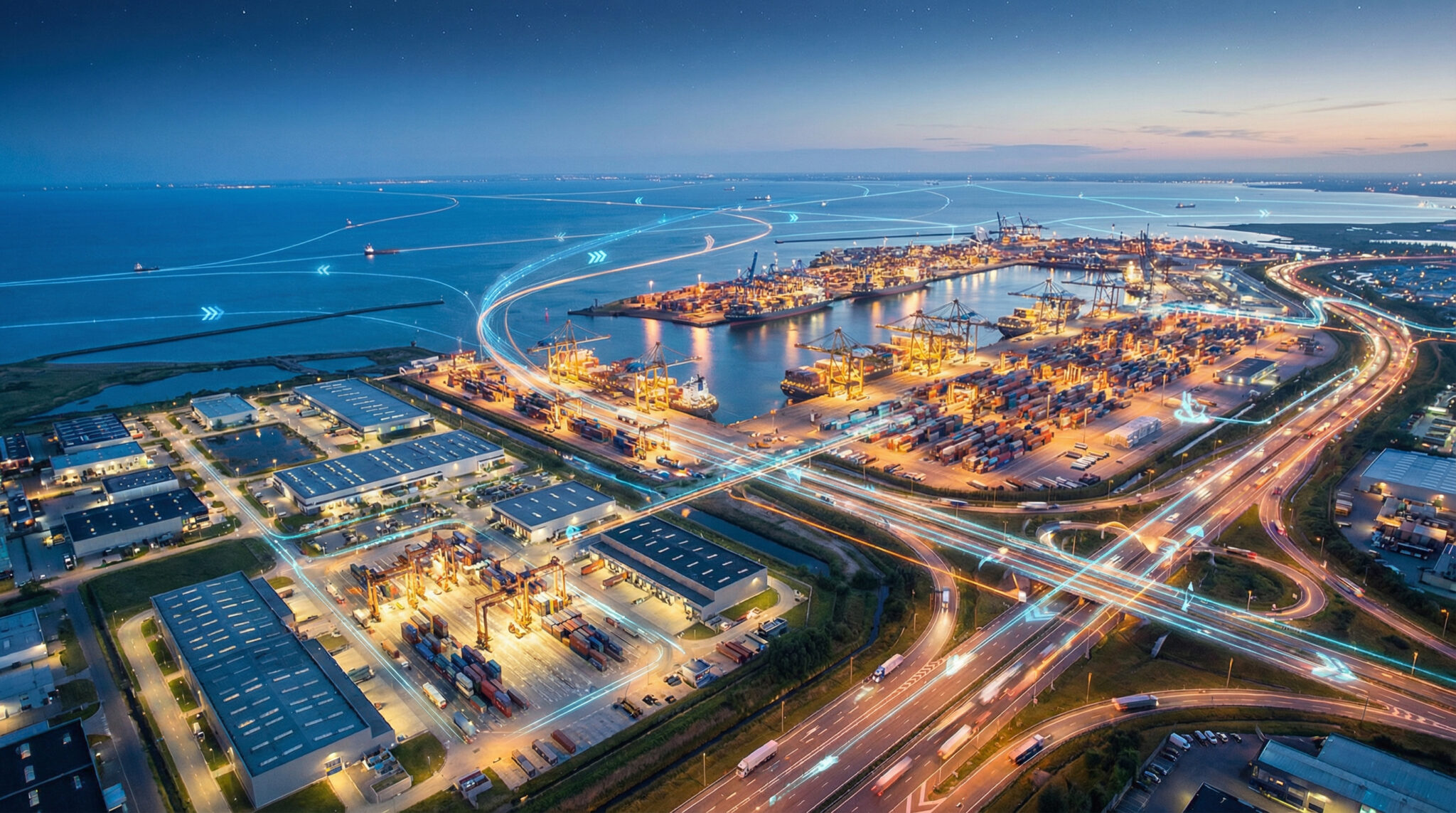
The logistics trap: Why more and more ships are not solving our supply chain problem – Creative image: Xpert.Digital
If capacity isn't the problem: The new economics of logistics complexity
The end of "just-in-time": Why the global supply chain will be radically restructured in 2026
### 65% pointless crane movements: Why the container chaos needs a radical solution ### Space shortage in ports: How gigantic container high-bay racking is supposed to save logistics ### When ports are bursting at the seams: The underestimated danger for global trade ###
The end of flat ports: Why the future of global logistics is growing into the third dimension ###
The global logistics industry faces a massive structural paradox in 2026: While the world's oceans are teeming with more container ships than ever before, global land-based freight transport is in danger of literally suffocating. Chronic space shortages at international ports, extremely growing volume peaks from giant megacarriers, and increasing geopolitical tensions are pushing supply chains to their absolute limits. Because traditional expansion of port areas in densely populated regions is virtually impossible, containers are piling up – and the unproductive restacking of containers is now consuming enormous resources. But to prevent collapse, there is a solution that is as radical as it is technologically demanding: Port logistics must expand into the third dimension. Learn why fully automated high-bay container warehouses may be the last hope for global trade, how artificial intelligence is alleviating the space problem, and what strategic upheavals the industry is now facing.
Related to this:

Why logistics doesn't fail because of ships, but because of space, complexity, and false assumptions
When containers can no longer find space
The logistics industry in 2026 faces a deeply rooted structural paradox: The world's oceans are teeming with more container ships and containers than ever before, shipyard order books are at an all-time high, and freight rates have partially stabilized after the peaks of the pandemic years. At sea, the world of container logistics appears adequately equipped. But as soon as the ships reach the ports, a different story begins: Terminals are bursting at the seams, yard space is chronically overstretched, expansion reserves are largely exhausted in most ports worldwide, and the next technological solution to this space shortage will only be provided by a small handful of highly specialized system providers.
This is precisely where the real bottleneck of global logistics lies: not on the water, but on land. Not in the number of ships, but in the scarcity of functionally usable, strategically located, and technologically developed space at the hubs of global trade. The term "capacity problem" falls short if it refers solely to shipping space. In modern container logistics, capacity primarily means addressable, accessible, and efficient storage space in close proximity to ports. And this is precisely what is structurally scarce and will become increasingly so.
For the economy as a whole, this means that the biggest challenge facing logistics today is the combination of increasing system complexity and dramatically limited available space at the hubs through which global trade flows. Anyone who fails to consider these two dimensions together will not understand the problem.
Global economy under pressure: Fragmentation instead of free flow
Parallel to the physical scarcity of land, the economic environment is undergoing fundamental shifts. Trade conflicts, punitive tariffs, sanctions regimes, and climate regulations are fragmenting the global economy at a pace that is overwhelming both political decision-makers and corporate strategists. Global trade growth is expected to weaken from around two percent in 2025 to just 0.6 percent in 2026, a decline of approximately two-thirds.
States no longer use tariffs merely as a protective instrument for individual industries, but as a geostrategic tool for projecting power. The result is a decoupling trend between major blocs, in which supply chains become the arena for geopolitical conflicts. Companies must now align their supply chain architecture not primarily with costs and time, but with geostrategic risks, regulatory predictability, and political resilience. In this context, the classic logic of globalization loses its explanatory power, and diversification, redundancy, and hedging take its place as new guiding principles.
Germany's export model facing headwinds
Germany is particularly exposed in this environment. The Federal Republic's export-oriented business model is based on open markets, reliable regulations, and highly specialized industry. If trade conflicts follow escalating patterns and key sales markets like China increasingly rely on domestic products and technologies, this model comes under structural pressure. The German government has lowered its growth forecast for 2026 to just one percent; the Ministry for Economic Affairs and Energy speaks of a double headwind due to tensions with both the US and China.
German foreign trade is suffering on two levels simultaneously: on the demand side, due to weaker growth or increasingly closed markets, and on the supply side, due to more fragile, longer, and more expensive supply chains. Added to this are rising regulatory requirements, from carbon border adjustment mechanisms to supply chain due diligence obligations, which further drive up planning costs. All of this increases fixed costs and forces companies to fundamentally rethink their production and logistics networks.
Structurally exhausted: Port areas have no more reserves
The most serious and underestimated problem in modern container logistics is the structural depletion of available space in and around major ports. This bottleneck is not new, but it has been growing for years and is now virtually irreversible in many ports. Between 2017 and 2021, a total of 26 million square meters of new logistics space was developed in Germany. Of this, only 1.2 million square meters, or approximately 4.6 percent, were located within port areas. Within a two-kilometer radius of the ports, the proportion increased to 2.9 million square meters, but even this is negligible compared to the growth in cargo handling volumes.
The causes of this land scarcity are multifaceted and partly structurally irresolvable:
Port areas are typically located in densely populated urban areas where adjacent land has long been used for other purposes. Housing construction, commercial development, nature conservation, and political resistance to land sealing make horizontal expansion practically impossible in most European ports. The frequently discussed rezoning of port areas for other uses further exacerbates the problem: Experts and chambers of commerce representatives explicitly warn that such rezoning would irrevocably weaken the core economic function of ports.
Furthermore, most port facilities are built on a historically developed infrastructure designed for smaller ships, lower individual throughputs, and less volatile traffic flows. Even where expansions are occasionally possible, planning approval procedures, environmental impact assessments, and permitting processes take so long that expansion capacity is often not available for a decade or more. The Port of Hamburg, for example, has announced one of its largest expansions in decades: an area of approximately 38 hectares in the Waltershof port area with a quay wall more than one kilometer long, aiming to increase handling capacity from four to six million containers per year by the mid-2030s. The associated infrastructure is scheduled for completion by then.
For the coming years, this means that ports will have to handle more cargo volume on the same or barely expanded areas, with increasing pressure from mega-ships, growing security requirements, and regulatory burdens. New construction of logistics properties in port areas reached a historic low in 2025, and the strong leasing activity, driven in part by Chinese online retailers and their logistics providers, has led to a noticeable shortage of available space in many regions.
Megaships, mega problems: Volume peaks as system destroyers
The economics of container shipping have driven the trend towards ever larger vessels for decades. The more TEU a ship can hold, the lower the unit costs on the water. Shipping companies have aggressively exploited this economies of scale and continue to do so: In 2025 alone, new container ships with a total capacity of 5.08 million TEU were ordered, representing an order book of approximately 35 percent of the active fleet. However, the side effects of this strategy are primarily felt by port and hinterland logistics.
When several mega-carriers call at a terminal within a short timeframe, massive volume peaks occur in the yard and on the pre-storage areas. According to industry analyses, container terminals today have to load and unload up to 8,000 TEU or more during a single ship call. This results in enormous quantities being handled at the terminals and in the hinterland within very short periods. The traffic flows to and from the terminals, by truck, rail, or inland waterway, can only partially compensate for these peaks. The result is congestion at the port gates, waiting times for ships at anchor, overcrowded interim storage facilities, and rapidly increasing demurrage charges.
In Rotterdam and Antwerp, Europe's largest container ports, bottlenecks and handling problems in 2025 led to Hamburg benefiting from shifts in cargo handling, recording a 9.3 percent increase in the first half of 2025. This vividly illustrates how congestion at one hub can have a domino effect on other parts of the network. The ports are not becoming too small because they lack sufficient space overall, but because they were designed for sustained load and consistent traffic, and the peak loads from mega-ships structurally disrupt this design.
Related to this:

The Collapsed Yard: When Restacking Becomes the Main Business
In conventional container terminals, containers are stacked in block storage using stacking machines or gantry cranes. As long as utilization remains moderate, this works relatively efficiently. However, as yards become increasingly densely occupied and stacks become ever higher, the system's logic breaks down. At high occupancy rates, terminal performance drops dramatically: An ever-increasing proportion of crane movements are simply used to move other containers out of the way to access the one actually needed. In some terminals, this so-called "shuffling"—the expensive and unproductive restacking—accounts for up to 65 percent of all container movements.
The consequence: the fuller the yard, the more energy, time, and machine capacity are consumed on purely unproductive movements, the longer the handling times become, and the more unpredictable the interfaces with hinterland logistics become. The yard is therefore not just physical storage space, but a dynamic, three-dimensional puzzle that becomes exponentially harder to solve if incorrectly allocated. This vicious cycle is a direct consequence of the combination of non-expandable space and increasing peak volumes due to megaships.
The third dimension: High-bay warehouses as a strategic answer to space shortages
Because horizontal expansion is hardly possible, the only scalable solution lies in the third dimension: not just stacking containers higher, but storing them industrially like palletized goods in an automated high-bay warehouse, with defined storage locations, direct access, and fully automated movement. This is precisely the approach pursued by specialized system providers such as the joint venture BoxBay, founded by the German SMS group and the port operator DP World.
BoxBay stores containers in steel racks up to 16 layers high, while conventional stacking systems reach a maximum of six layers. The crucial factor is not just the height, but the logic: every storage position is addressed within the system, and every container is directly accessible. Time-consuming restacking is completely eliminated. A continuous rail-guided transport system connects the aisles of the high-bay racking and moves containers for transfer to trucks or trains on land, or to cranes on the water.
The figures are impressive: BoxBay, the world's largest high-bay container warehouse, is currently under construction at the Port of London Gateway, with a contract volume of almost €100 million. The 16-tier facility, specifically designed for empty containers, will offer a capacity of up to 27,000 TEU and operate up to 65 percent more efficiently than conventional storage solutions. This technology allows for more than three times as many containers to be stored on the same footprint as conventional systems. The price for the underlying expertise is correspondingly high: This contract marks the transition from the pilot to the implementation phase, following the successful proof of concept trial at the Port of Jebel Ali in Dubai, which handled 63,000 container movements.
The technological origin of this system is significant: BoxBay is based on high-bay warehouse technology originally developed by AMOVA, an SMS group company, for steel mill logistics. For decades, coils weighing up to 50 tons have been managed automatically in high-bay warehouses there. This heavy-load expertise from intralogistics has been transferred to the container environment and further developed for series production. This exemplifies how specialized heavy-load intralogistics know-how from adjacent industrial sectors – that is, from companies with experience in the automated management of heavy, standardized loading units – is becoming the most strategically important solution competence for the port logistics of the future.
LTW Intralogistics Solutions – Intermodal Transport

LTW Intralogistics Solutions – Intermodal Transport – Image: LTW Intralogistics GmbH
LTW offers its customers not individual components, but integrated complete solutions. Consulting, planning, mechanical and electrotechnical components, control and automation technology, as well as software and service – everything is networked and precisely coordinated.
In-house production of key components is particularly advantageous. This allows for optimal control of quality, supply chains, and interfaces.
LTW stands for reliability, transparency, and collaborative partnership. Loyalty and honesty are firmly anchored in the company's philosophy – a handshake still means something here.
Related to this:
Technology partnerships as a competitive advantage: Who should invest in heavy-duty automation now?
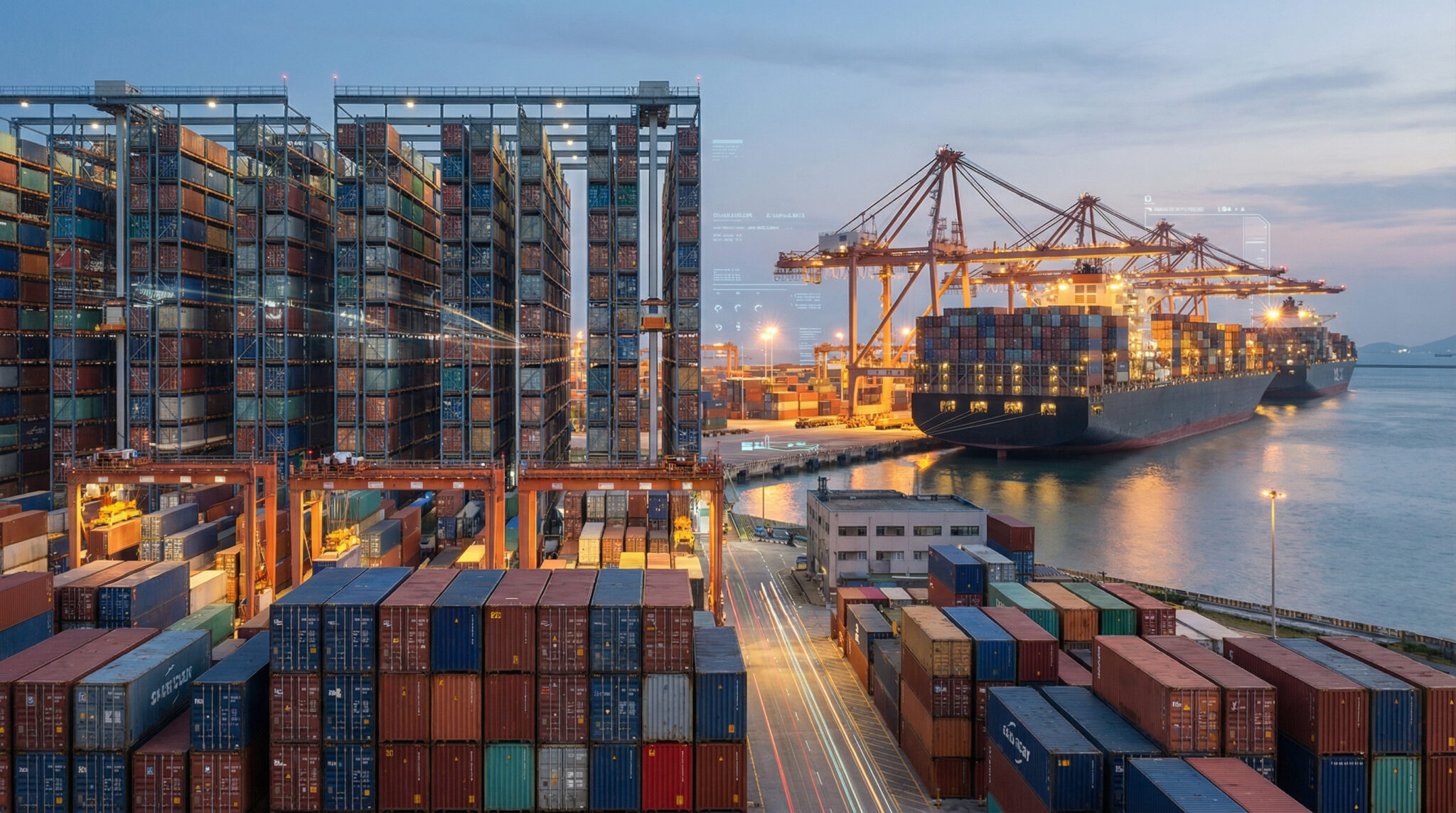
Container high-bay warehouse nearshoring: Relocated production, changed logistics – Creative image: Xpert.Digital
Few suppliers, enormous know-how: The bottleneck behind the bottleneck
High-bay racking solutions for full containers and empty container parks require a combination of expertise that hardly any company possesses to the necessary depth: heavy-duty steel construction with extreme safety reserves, highly dynamic conveying and drive technology, precise racking vehicles for loads up to 40 tons, complete IT integration between terminal operating system, warehouse management system and handling planning, as well as experience with the special requirements of the port environment, from wind and earthquake standards to salt corrosion and 24/7 operation.
BoxBay was awarded the German Logistics Prize 2022 because it is the first system of its kind to deliver a production-ready solution for this specific set of requirements. The joint venture combines SMS group's expertise in heavy-lift intralogistics with DP World's experience in port operations. Similarly specialized expertise in heavy-lift intralogistics for highly dynamic, fully automated storage systems is found in the industry only among a limited number of suppliers. This structural scarcity of qualified system suppliers is itself part of the bottleneck problem: The port sector urgently needs more such solutions, but the technological barrier to entry is high, and the market is only at the beginning of its scaling phase.
This has strategic consequences for port operators and terminal companies: Those who establish partnerships with such specialists today not only secure a technical solution, but also a long-term strategic advantage in a market where available contractors in this segment will remain scarce.
Related to this:

Interim storage as a systemic bottleneck along the entire chain
The bottlenecks don't end at the port gate. Along the entire logistics chain, container flows are increasingly shifting from smooth to congested processes because no single hub has sufficient storage capacity to reliably buffer peaks. Ports are forced to use their yards as long-term storage facilities when shippers can't pick up their containers on time or rail capacity is lacking. Inland terminals are becoming buffer zones because seaports are overloaded. Industrial companies are storing containers on their own factory premises because coordination with freight forwarders and terminals is no longer running smoothly.
This shift transforms containers from short-term transit goods into effectively permanent storage. The areas where these unwanted stockpiles are located were neither structurally nor organizationally designed for long-term storage. Added to this is the competition for land use: in ports near city centers, port-related areas compete with other urban development interests. Chamber of Commerce representatives and port experts explicitly warn that repurposing port areas for other uses would irrevocably weaken the core economic function of ports. In this tension between political pressure for land and growing logistical space requirements, port areas are becoming a strategic asset for the next decade.
Nearshoring: Relocated production, changed logistics
Against the backdrop of this structural scarcity of land and multiple geopolitical upheavals, nearshoring has developed considerable momentum. According to a study by the Capgemini Research Institute, 56 percent of large European and US companies have already invested in re- or nearshoring. However, from an economic perspective, nearshoring is not a guaranteed success: In many Eastern European countries, wages, energy prices, and land costs are rising faster than productivity. An analysis by the strategy consultancy Strategy& shows that in Central and Eastern Europe, labor costs have risen three and a half times faster than productivity, and the shortage of skilled workers in industry there is 16 percent higher than in Germany.
For logistics, nearshoring doesn't simply mean relief, but rather a structural shift: more volume on shorter, but more densely packed corridors, an increase in hub-and-spoke structures in the hinterland where intermediate storage and transshipment functions gain even more importance, and a growing significance of land-based transport modes, which in turn require space for terminals, transshipment facilities, and buffer zones. Nearshoring thus shifts capacity problems from intercontinental routes to regional logistics networks, but it doesn't automatically solve them.
The Red Sea and the cost of the detour
The geopolitical complexity of modern logistics is manifested in the ongoing crisis in the Red Sea. Since the end of 2023, Houthi attacks have led most major container shipping companies to suspend operations through the Suez Canal. Around 25 to 30 percent of global container traffic normally uses this route; according to the UN, the volume of cargo through the canal has plummeted by more than 40 percent.
The detour via the Cape of Good Hope significantly increases transit times, ties up shipping capacity permanently, and creates additional congestion at alternative ports, further straining their already limited yard space. While container freight rates have eased somewhat since their peak, overall logistics costs remain structurally elevated due to longer transit times, higher insurance premiums, and larger buffer stocks.
Regulations: CBAM and CO₂ taxes at sea increase the cost of long routes
With the Carbon Border Adjustment Mechanism (CBAM) and expanded emissions obligations in the shipping sector, the EU is intensifying economic pressure on long supply chains. From 2025, the share of fuel consumption used to calculate CO₂ certificate obligations in container shipping will increase from 40 to 70 percent, further pushing up sea freight rates. The shipping company Hapag-Lloyd estimates the resulting surcharges at between €15 and €100 per standard container.
At the same time, large-scale land-based projects are increasingly caught in the crossfire of climate policy, land sealing targets, and public participation. The construction of new container terminals, logistics hubs, or large-scale high-bay warehouses is subject to lengthy approval processes. This restricts supply and slows development precisely where new land is urgently needed.
From just-in-time to just-in-case: The paradigm shift costs space
A fundamental shift in strategy is also contributing to the shortage of logistical space. The just-in-time philosophy, which dominated for decades and relied on minimal inventory and precise supply chain synchronization, is under increasing pressure. It is being replaced by the just-in-case strategy, which deliberately relies on buffer stocks and redundancies. This is understandable from a business perspective, but it has a direct spatial consequence: higher safety stocks require space. Every strategic decision for more buffer stocks is therefore also a decision for greater space requirements – either in the form of expensive rental space or in the form of investments in technologies that utilize existing space more efficiently.
Following this logic, the issue of storage space becomes a hard business metric: cost per square meter of warehouse space, cost per unit moved, cost per additional storage day. Those who utilize the third dimension with high-bay racking and intelligent control reduce these costs per unit and gain flexibility in their overall inventory strategy.
Artificial intelligence as a capacity lever, not just as a cost reducer
In this context, AI and automation are not primarily cost reducers, but rather levers for increasing space and throughput. Their added value lies in maximizing usable output per square meter, per crane hour, and per parking space. By 2026, 93 percent of companies will already be working with or actively using generative AI, and agentic AI systems, which autonomously and in real time make goal-oriented operational decisions for routing, replenishment, and deployment planning, are rapidly gaining importance in terminal control.
Digital twins, or virtual representations of physical terminals and supply chains, make it possible to simulate various occupancy and traffic strategies before implementing them in real-world operations. The integration of real-time forecasting, simulation, and control is key to extracting significantly more logistical performance from the same physical space without adding a single square meter. However, automation alone is not enough. It must be accompanied by consistent standardization of loading units, interfaces, and information flows. Only when physical and digital flows are synchronized can the technology reach its full potential.
Strategic consequences for ports, terminals and industry
The described combination of structural land depletion, megaship dynamics, geopolitical volatility and technological upheaval results in clear strategic priorities for decision-makers.
First: Land strategy is a board-level issue. Storage and transshipment areas near ports can no longer be viewed as purely operational resources, but are a strategic production factor with a direct impact on competitiveness, service levels, and resilience. Securing, expanding, and technologically developing these areas must be prioritized at the decision-making level.
Secondly: Verticalization instead of expansion. Since horizontal expansion is no longer politically, ecologically and geographically possible in most ports, vertical development through high-bay warehouses, high-bay storage systems and multi-level hubs becomes the key lever.
Thirdly: Technology partnerships are not an option, but a prerequisite. Collaborations with specialized heavy-lift and intralogistics companies that possess the necessary expertise for highly automated, highly dynamic container high-bay warehouses must be established early on. The number of such suppliers is limited, and demand will increase.
Fourth: Actively manage complexity. Capacity without intelligent control only creates congestion elsewhere. AI-supported planning, simulation, and real-time control are necessary to extract maximum performance from limited space.
The bottleneck behind the bottleneck: A structural conclusion
The real message of this analysis is this: Global trade will not fail due to a lack of ships or containers. It will fail due to the structural exhaustion of the land areas where these containers are temporarily stored, transshipped, and forwarded, unless the industry invests decisively in developing the third dimension.
Ninety percent of global freight traffic is handled by sea. Every single one of these containers must eventually pass through a terminal, a yard, and a storage area. It is precisely at these points that the bottlenecks lie, determining the efficiency of the entire global logistics network. Ports have exhausted their horizontal capacity. Mega-ships are generating ever-increasing volume peaks. Shuffling consumes up to two-thirds of all terminal movements as unproductive capacity.
The answer to this problem is technically feasible – as BoxBay at the Port of London Gateway is currently demonstrating – economically sound, and strategically imperative. What's lacking is widespread implementation. And that requires the courage to commit to long investment cycles, the willingness to collaborate with a small group of highly specialized system providers, and the political resolve to permanently protect port areas as core logistics infrastructure, instead of gradually sacrificing them to urban development.
Consulting - Planning - Implementation

Konrad Wolfenstein
I would be happy to serve as your personal advisor.
me at wolfenstein∂xpert.digital contact
Just call me on +49 7348 4088 965 .
Your container high-bay warehouse and container terminal experts

Container high-bay warehouses and container terminals: The logistical interplay – expert advice and solutions - Creative image: Xpert.Digital
This innovative technology promises to fundamentally change container logistics. Instead of stacking containers horizontally as before, they will be stored vertically in multi-story steel racking structures. This not only allows for a drastic increase in storage capacity within the same area, but also revolutionizes all processes at the container terminal.
More information here:










