
Swarm storage | Electric cars as energy storage: The battle for the electricity market – When stationary metal boxes become gold mines
Xpert Pre-Release

Available in 27 languages 📢
Prefer Xpert.Digital on GoogleⓘPublished on: July 20, 2026 / Updated on: July 20, 2026 – Author: Konrad Wolfenstein
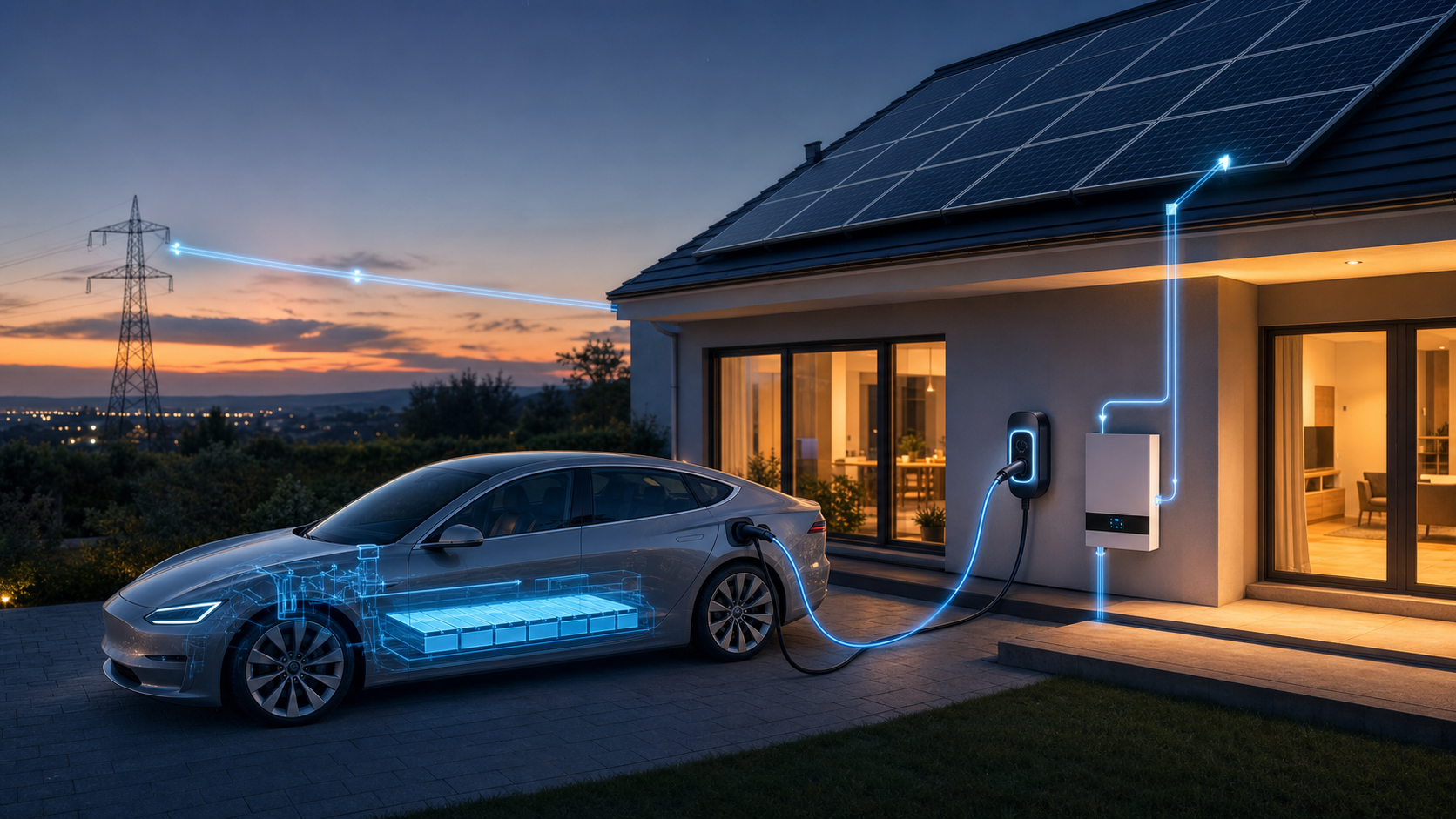
Electric cars as energy storage devices: The battle for the electricity market – When stationary metal boxes become gold mines – Image: Xpert.Digital
23 hours unused: How stationary metal boxes become gold mines through "Vehicle-to-Grid"
Billions in potential in the garage: Why parked electric cars are transforming the electricity market
Electric cars sit idle for an average of 23 hours a day – a fact long considered the epitome of inefficient mobility. Yet, this idle time conceals a gigantic, hitherto untapped potential for the European energy transition. With so-called bidirectional charging, also known as Vehicle-to-Grid (V2G), vehicle batteries are transformed into vast, decentralized energy storage systems. They can store surplus solar and wind power and feed it back into the grid when needed. This not only protects the grid infrastructure but can also save private households several hundred euros a year. While the EU is paving the way for this technology with new regulations starting in 2026, and automakers like BMW, VW, and Hyundai are rolling out initial commercial offerings, the revolution is threatened by a crucial obstacle: Instead of relying on open standards, each manufacturer is currently developing its own closed ecosystem. A look at the battle for the electricity market of the future, which teeters between opportunities worth billions and the threat of system inertia.
Bidirectional charging: The ingenious concept that is supposed to save our power grid from collapse
On average, a private car sits unused for around 23 hours a day – a figure that for a long time served merely as an argument against the inefficiency of individual mobility. However, with the transition to electromobility, this number takes on a completely new meaning, because the batteries of parked vehicles hold enormous energy-related potential. If an electric car can not only be charged but also feed electricity back into the grid, every garage, every company parking lot, and every roadside parking space potentially becomes a node in the energy system. This is precisely where the concept of bidirectional charging comes in, which is increasingly gaining momentum under the name Vehicle-to-Grid, or V2G for short.
The basic idea is brilliantly simple: During the day, when solar and wind power plants generate a lot of electricity and prices on the exchange are correspondingly low, the vehicles charge their batteries. As soon as demand rises in the evening or generation from renewable sources decreases, they feed some of this energy back into the grid or into the owner's home. For vehicle owners, this means potentially noticeable savings; for the overall system, it provides a valuable flexibility reserve that would otherwise have to be created through expensive expansion of storage capacities or grid infrastructure.
The billion-dollar bill behind the new network architecture
Several independent studies demonstrate the true extent of this potential, arriving at remarkably consistent figures. One widely cited study suggests that the widespread use of electric vehicles as energy storage devices could reduce the costs of the European energy system by up to €22 billion per year, provided the technology is implemented across the board. The Fraunhofer Group, in its own calculations, arrives at a similar figure and further points out that in Germany alone, a flexibility potential of up to 114 terawatt-hours could be unlocked by 2030, which corresponds to approximately four percent of total European electricity consumption.
The long-term investment perspective is particularly revealing. If, by 2030, around half of all electric cars and battery-electric trucks in Europe were capable of feeding electricity back into the grid, the necessary investment in the European energy grid could decrease by more than €100 billion between 2030 and 2040. This figure illustrates that V2G (vehicle-to-grid) is by no means just a nice side business for individual car owners, but rather a structural alternative to multi-billion-euro investments in traditional grid reinforcement and large-scale stationary storage.
Concrete figures also emerge at the household level. Study authors calculate that a four-person household in Germany could save more than 700 euros per year if the electric car battery is systematically used for self-sufficiency and grid support. If the electricity is also fed into the public grid, potential compensation payments for vehicle owners are added, which takes the economic viability of owning an electric car to a whole new level.
Brussels is tightening the reins
The increasing regulatory activity at the European level demonstrates that this potential should no longer remain untapped. Since April 2025, a delegated regulation of the EU Commission has been in force, supplementing the regulation on alternative fuels infrastructure with regard to standards for wireless charging, electric road systems, and, in particular, vehicle-to-grid communication. Furthermore, from January 8, 2026, all publicly accessible charging points in the EU had to comply with the ISO 15118 series of standards, which is considered a fundamental technical requirement for functions such as plug-and-charge and secure communication between vehicle and charging point. From January 1, 2027, the implementation of ISO 15118-20 will also become mandatory, for the first time also for privately or semi-publicly operated charging stations, thus laying the actual technical foundation for large-scale bidirectional charging.
In parallel, a remarkable dynamic has developed at the political level. In May 2026, two expert groups from the European Commission, together with a European coalition initiated by Germany, presented a comprehensive package of recommendations for simplifying data exchange for flexibility, smart charging, and bidirectional charging. This joint report is considered a European milestone because, for the first time, all key players in the electricity and electromobility sectors agreed on a common direction for market organization and uniform interoperability requirements, including standards, digital identity, operating principles, and governance. At a summit specifically hosted by the German Federal Ministry for Economic Affairs and Energy in May 2026, leading representatives of the European automotive, energy, and digital industries also pledged to launch corresponding services in Germany before the end of 2026.
At the same time, there is some confusion in the public debate about what the new deadlines actually mean. For example, in the spring of 2026, it was widely assumed that newly installed private charging points would be required to support bidirectional charging from 2027 onwards, a view that industry associations interpreted more nuancedly: The technical communication standard is mandatory, not automatically the actual feedback function in every individual case. This ambiguity between the legal obligation and actual market availability has characterized the entire development of bidirectional charging to date.
German car manufacturers are positioning themselves in the energy market
After several attempts failed to establish itself commercially in Germany, the technology finally broke through in September 2025. BMW and the energy company E.ON presented what they claim is the first commercial vehicle-to-grid (V2G) offering for private customers in Germany, available since the beginning of 2026 for buyers of the new BMW iX3 based on the so-called New Class. The operating principle is deliberately kept simple: For every hour the vehicle is connected to the BMW Wallbox Professional, customers receive a bonus of 24 cents, regardless of whether energy is actually being drawn at that moment. This bonus is capped at €60 per month or €720 per year, which corresponds to approximately 12,000 to 14,000 kilometers of free annual mileage.
What's remarkable about this model is the combination of a charging time bonus and the actual feed-in tariff: For every kilowatt-hour fed into the grid, users receive additional compensation that is always higher than their own electricity purchase price, while at the same time an intelligent battery management system is designed to prevent the high-voltage battery from aging due to the additional charging and discharging cycles. BMW explicitly emphasizes that customers retain full control over their mobility needs by being able to set individual charging destinations and departure times, ensuring that the battery's grid-friendly operation never comes at the expense of their own driving readiness.
Volkswagen is pursuing a similar, but independent, approach. Together with its in-house energy brand Elli, the Wolfsburg-based company has been preparing the market launch of a fully integrated V2G offering for private customers since April 2026. This offering is slated to be available from the fourth quarter of 2026, although pre-registration was already possible from June 2026. Volkswagen is explicitly positioning Vehicle-to-Grid not as an isolated, standalone product, but as a logical progression of a comprehensive home charging and energy ecosystem, which is to be gradually expanded to other European countries. The company is also active internationally: In Sweden, Volkswagen, together with the energy supplier Vattenfall and other partners, is testing a V2G pilot project with 200 electric vehicles and an equal number of bidirectional chargers from the provider Ambibox.
The South Korean Hyundai Motor Group, which also owns the Kia brand, has further specified its ambitions in the area of vehicle-to-everything (V2G) charging by the end of 2025, announcing an acceleration of its rollout at the group level in South Korea, parts of Europe, and the USA. In the Netherlands, which has become a European testing ground for bidirectional charging, Hyundai and Kia, together with Vattenfall, are planning a pilot project for the second half of 2026 involving up to 80 households. These households will participate in V2G charging for six months using a Hyundai Ioniq 9 or a Kia EV9 and will receive reimbursements of up to €500. The Dutch initiative Utrecht Energized, which currently includes 50 bidirectionally charging electric cars and aims to grow to 500 vehicles in the long term, also demonstrates that municipal and car-sharing models are increasingly relying on the technology. Renault has now established itself as the vehicle partner in this initiative, after Hyundai was initially planned.
A race for one's own ecosystem instead of common standards
As promising as the individual offers sound, a structural problem of the current market phase is also clearly evident: Each manufacturer currently prefers its own closed, all-in-one package consisting of vehicle, wallbox, software, and energy partner, instead of relying on open, cross-brand standards. BMW offers its service exclusively in combination with its own Wallbox Professional and the specially developed electricity tariff from E.ON, whereby switching between vehicle-to-home and vehicle-to-grid operation is currently not technically possible and the function is only available for the BMW iX3. Volkswagen, in turn, ties its offering tightly to its own Elli brand, while Hyundai and Kia are each establishing their own partnerships with different energy providers in various countries.
This fragmentation is openly addressed by industry representatives themselves. The German Association for Electrical and Digital Industries points out that regulatory hurdles and, above all, a lack of interoperability continue to hinder bidirectional charging, even though the technology offers considerable potential for grid stability and the energy transition. A similarly mixed picture emerged at the Vehicle-to-Grid conference in Münster in April 2026: While initial viable business models are emerging and the regulatory framework is visibly improving, uniform standards and, above all, simple, user-friendly solutions are still lacking for widespread market adoption.
This observation aligns with statements from the automotive industry itself. As part of the BDL Next research project, a BMW manager responsible for business development explained in May 2026 that bidirectional charging goes far beyond the conventional charging of an electric car and that vehicles could become genuine players in the energy market in the future, while simultaneously acknowledging that interoperability and regulation remain key challenges on the path to scaling the technology across Europe. It is also noteworthy that even within a single ecosystem like that of BMW and E.ON, the range of services offered is currently limited to a single vehicle model, although an expansion to other models in the New Class is anticipated.
Innovative photovoltaic solution for cost reduction (up to 30%) and time savings (up to 40%)

Innovative photovoltaic solution for cost reduction and time savings - Image: Xpert.Digital
More information here:
How electric cars are becoming virtual power plants — and who profits from it
Who really benefits from the electricity generated by a car battery?
Besides the technical fragmentation, market developments also raise an economically and socially relevant question of distribution: Who actually benefits most from bidirectional charging? In public discussions surrounding the BMW-E.ON offer, it was critically noted that the concept's true economic added value lies not only in grid stabilization, but also in the fact that energy suppliers like E.ON, with the pooled battery capacities of several thousand vehicles, effectively operate a virtual power plant and can profitably trade the resulting electricity on the futures market or the power exchange, while individual vehicle owners receive comparatively modest bonus payments. This criticism points to a fundamental tension: The profitability of V2G business models arises primarily from economies of scale on the part of energy suppliers and aggregators, while the individual car owner, as the supplier of physical storage capacity, receives a disproportionately low level of compensation.
At the same time, manufacturers downplay this criticism, arguing that safety and control for the end customer are paramount. Users can determine at any time how much energy should be available in the battery, and intelligent battery management ensures that the additional strain from V2G does not negatively impact the lifespan of the high-voltage battery. For the automotive companies themselves, V2G also opens up a strategically important new revenue stream beyond pure vehicle sales, as they can position themselves as providers of comprehensive energy platforms that integrate not only electric cars but also photovoltaic systems, heat pumps, and smart home solutions.
Why network integration is more complicated than the principle sounds
Behind the seemingly simple idea of storing excess solar power during the day and releasing it again in the evening lies a highly complex interplay of different systems, both technically and regulatory. At the European level, a target concept for grid integration is currently being discussed. This concept envisions a uniform, dynamic grid status signal across the EU, which would automatically distribute load and charging flows at every grid level in such a way as to prevent overloads from occurring in the first place, rather than requiring subsequent intervention. In addition, work is underway to create a common European data space, which is intended to enable a competitively organized internal market for bidirectional charging, with uniformly agreed grid connection conditions as its core element.
These efforts are necessary because bidirectional charging extends far beyond pure vehicle technology and deeply impacts the structure of distribution networks, metering concepts, and the tax treatment of storage technologies. The German Association for Electrical and Digital Industries (VDE) explicitly demands that electric cars, as bidirectional charging devices, be officially recognized as storage devices and treated equally to their stationary counterparts, i.e., conventional battery storage systems in buildings, for tax purposes. Without such regulatory parity, the economic attractiveness of V2G (vehicle-to-grid) charging risks remaining structurally disadvantaged compared to established home storage solutions, even if the technical prerequisites have long been in place.
Additional complexity arises from the question of whether vehicles should primarily supply the owner's household, the so-called vehicle-to-home (V2H) model, or whether they should actually feed energy into the public grid, thus operating in the narrower sense of vehicle-to-grid (V2G). A pilot project by the Volkswagen brand Elli deliberately started with the simpler variant, in which the vehicle battery merely serves as a home storage system and supplies household appliances with self-generated solar power, while a follow-up project will only in a second phase supply the public grid via the electricity exchange. This phased approach illustrates that even the automotive companies consider full market integration to be disproportionately demanding and are initially focusing on simpler, more controllable use cases.
The challenge of lack of compatibility
A key bottleneck for widespread market penetration lies in the limited technical compatibility between vehicles from different manufacturers and their respective charging infrastructures. While several car models are already equipped for bidirectional charging, and the technology is commercially available in some other European countries, it failed to gain traction in Germany despite repeated attempts over many years. Only with the combination of a new vehicle architecture, a suitable wallbox, and a specifically developed electricity tariff did BMW, together with E.ON, achieve a commercial breakthrough in 2025. The technical foundation for this was only laid with the complete integration of bidirectional charging capability into the vehicle architecture of the New Class.
From a regulatory perspective, the picture is also changing gradually, but not abruptly. New regulations on the infrastructure for alternative fuels for public charging points came into force in January 2026, with far-reaching consequences for operators, manufacturers, and planners. While these standards create important technical prerequisites, they do not replace cross-brand commercial compatibility as long as each manufacturer continues to rely on its own closed ecosystem of vehicle, wallbox, and energy tariff. In practice, this means that choosing a V2G-enabled vehicle effectively predetermines which specific wallbox and energy provider to use, thus limiting competition and potentially reducing cost advantages for end customers.
Between billion-dollar opportunity and system inertia
The economic logic behind vehicle-to-grid (V2G) is undeniable: given potential savings of around €22 billion per year at the European level and a possible reduction in grid expansion requirements of more than €100 billion by 2040 alone, it is one of the most cost-effective flexibility options available for the European energy system. At the same time, the current market phase exemplifies how significantly technological innovations can be hampered by a lack of interoperability and the diverging business interests of individual manufacturers, even when the overall economic benefits are clear.
The joint recommendations presented at the European level in May 2026 by the expert groups and the industry coalition mark an important step towards a more unified regulatory framework. However, the real market breakthrough will depend on whether the participating manufacturers are willing to open their hitherto closed, comprehensive offerings to open, cross-manufacturer standards. As long as BMW, Volkswagen, Hyundai, Kia, and other suppliers continue to operate primarily independently and enter into separate partnerships with individual energy providers, scaling the technology to the Europe-wide mass market level necessary to realize the projected billions in savings remains an ambitious but not yet achieved goal.
This suggests that the coming years will see a race between two forces: on the one hand, the regulatory momentum from Brussels and Berlin, which is increasingly pushing for binding technical standards and a genuine European single market for bidirectional charging; and on the other hand, the commercial interests of individual corporations, which can achieve higher margins and stronger customer loyalty in the short term through closed ecosystems. The outcome of this race will be crucial in determining whether electric cars actually become the flexible, swarm-based energy storage systems that the European energy system so urgently needs in the coming decades, or whether they will remain, for the time being, a technological promise that fails to materialize in the face of fragmented markets.
🎯🎯🎯 Data-driven B2B industry hub as a quasi-in-house solution

The quasi-in-house solution: How Xpert.Digital closes operational gaps in B2B marketing and sales – Smart Content-Driven Business - Image: Xpert.Digital
Xpert.Digital is a data-driven B2B industry hub led by Konrad Wolfenstein . The company acts as an external, quasi-in-house solution for industrial partners, closing operational gaps in marketing, content, and sales – without requiring additional resources on the client side.
More information here:
Your global marketing and business development partner
☑️ Our business language is English or German
☑️ NEW: Correspondence in your native language!

Konrad Wolfenstein
I and my team are happy to be available to you as your personal advisor.
You can contact me by filling out the contact form here [email protected]:or simply call me at +49 7348 4088 965. My email address is
I'm looking forward to our joint project.







