

Trump's AI coup? Why the word "superintelligence" is now supposed to revolutionize world markets
Xpert Pre-Release

Available in 27 languages 📢
Prefer Xpert.Digital on GoogleⓘPublished on: September 23, 2026 / Updated on: September 23, 2026 – Author: Konrad Wolfenstein
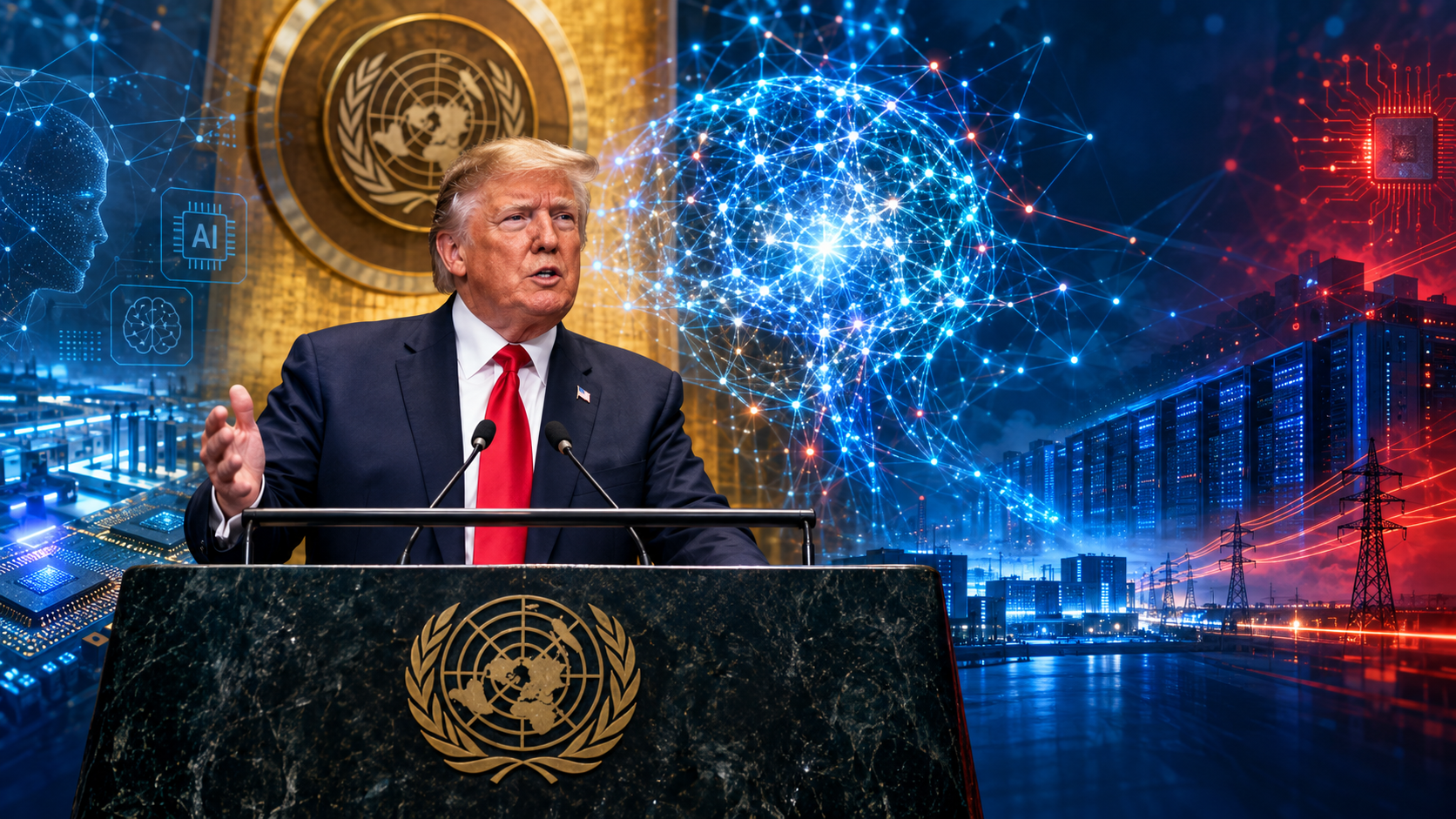
Trump's AI coup? Why the word "superintelligence" is now supposed to revolutionize world markets – creative image on the topic, with AI: Xpert.Digital
Battle for tech supremacy: Trump's risky rebranding of AI
AI or already superintelligence? The real reason behind Trump's new tech doctrine
Trump's superintelligence order: What this means for investors, Europe and our future
Donald Trump has dropped a linguistic bombshell: Artificial intelligence will henceforth be referred to as "superintelligence" in official US documents. What at first sounds like a mere rhetorical quirk of the US president, on closer inspection reveals itself as a hard-nosed industrial policy calculation in the global tech race, particularly against China. This radical rebranding establishes a new interpretive framework intended to justify far-reaching deregulation, channel gigantic capital flows, and legitimize the massive expansion of data centers. But this semantic trick carries considerable risks: It fuels inflated expectations, jeopardizes international standards, and threatens to stifle essential security debates in their infancy. A new abbreviation does not automatically create a new technological reality—but it can drastically alter the rules of the global economy. This is an in-depth analysis of the geopolitical and economic motives behind the new superpower narrative and the question of how Europe should respond to this conceptual chaos.
From the AI race to the superpower narrative: Trump's risky rebranding
A new abbreviation doesn't create new intelligence – but it can control billions, devalue rules, and suppress risks
Donald Trump's proposal to refer to artificial intelligence as "superintelligence" in official US documents appears at first glance to be a linguistic curiosity. In reality, however, it touches upon a crucial economic and geopolitical conflict: Should the next phase of digitalization be understood primarily as a global race for capital, computing power, and military-technological dominance, or as an economic structural transformation that requires innovation as well as verifiable safety standards, competition, and social legitimacy? The new term offers no technical answer. However, it significantly shifts the political framework toward acceleration, strength, and national superiority.
This rebranding is therefore more than just personal branding. Language influences expectations, expectations influence investments, and investments, in turn, shape market structures. When the government of the world's largest technology economy categorically refers to ordinary AI systems as superintelligence, it can create the impression that a historically new level of machine capability has already been reached. This is precisely what is not scientifically proven. Nevertheless, the term is economically effective because it can legitimize capital mobilization, infrastructure policy, export strategies, and deregulation. The crucial question, therefore, is not whether the acronym SI will prevail worldwide, but rather which interests and perverse incentives will be reinforced by this narrative.
A word as an industrial policy signal
On September 22, 2026, before the 81st UN General Assembly, Trump declared that the United States should henceforth use the term "superintelligence" in its documents. He justified this by arguing that the word "artificial" gave the false impression that the underlying intelligence was fake or worthless. At the same time, he linked the name change to the statement that the winner of the technological race would ultimately win. This transformed a semantic remark into an industrial policy message: AI should not be understood primarily as a tool requiring regulation, but rather as a superior strategic resource.
Whether the announcement will immediately trigger a legally and administratively binding renaming of all US documents remains to be seen. A presidential speech does not automatically replace implementing regulations, adapted agency guidelines, procurement rules, and legal definitions. Precisely because AI is precisely defined in numerous regulations, contracts, funding programs, and international standards, a comprehensive replacement would be more complex than a political declaration would suggest. Therefore, until detailed implementation instructions are available, a distinction should be made between a presidential verbal order and a fully implemented administrative practice.
Nevertheless, it would be wrong to dismiss the episode as mere rhetoric. Presidential language can quickly influence government agencies, state clients, and government-affiliated institutions. It gives companies clues as to which projects are politically desirable and alters investors' risk perceptions. Particularly in a market where valuations depend heavily on future expectations, a term like superintelligence can act as a state-enhanced demand stimulus. It promises not only more efficient software but also a technological revolution of historic proportions.
Superintelligence is not a synonym
In technical terms, artificial intelligence and superintelligence are not interchangeable. Artificial intelligence generally refers to machine-based systems that derive outputs such as predictions, content, recommendations, or decisions from inputs. This definition encompasses a very broad spectrum: image recognition, fraud detection, industrial quality control, route optimization, language models, and autonomous assistance systems are included, as well as experimental agents. The term itself says nothing about whether a system achieves or surpasses human capabilities.
Superintelligence, on the other hand, usually refers to a theoretical state in which a system is significantly superior to humans in almost all relevant cognitive areas. This would include not only rapid text production or above-average performance on selected tests, but also broad problem-solving skills, robust planning, scientific creativity, reliable adaptation to unfamiliar situations, and potentially self-improvement. Current systems can achieve impressive results in individual disciplines, but remain error-prone, context-dependent, and uneven in their capabilities. They do not demonstrably possess the comprehensive superiority that the term superintelligence typically presupposes.
The blanket renaming therefore creates a confusion of categories. It transforms a heterogeneous family of technologies into a seemingly uniform, already superhuman intelligence. This simplification may be attractive for political communication, but it is problematic for procurement, liability, insurability, and regulation. A system for predicting maintenance in a factory requires different testing criteria than a model that generates medical recommendations or controls critical infrastructure. Anyone who lumps all applications together under a single, maximalist term makes risk-based differentiation more difficult.
Semantics becomes economic policy
Technological terms are never entirely neutral. They structure markets because they define what constitutes innovation, risk, or strategic infrastructure. The term "artificial intelligence" focuses attention on the system's technical design. "Superintelligence," on the other hand, directs it toward a claimed rank above humans. This also shifts the implicit political objective: the focus is no longer on the sensible implementation of concrete tools, but rather on achieving a supposedly superior position over competing states.
This framing fosters a race-based economy. In a race, audits, approvals, and transparency requirements easily appear as delays, while high investments and rapid scaling are automatically seen as progress. This is effective from an industrial policy perspective, but by no means always economically efficient. A company can invest enormous sums in data centers without generating correspondingly high productive returns. Similarly, a country can lead in the number of installed accelerator chips and yet have deficits in skilled workers, power grids, application expertise, or competition.
The renaming thus serves as a political coordination signal. It can signal to investors, energy companies, semiconductor manufacturers, cloud providers, and defense contractors that the government prioritizes expansion. At the same time, it weakens the importance of careful cost-benefit analyses. The more superintelligence is portrayed as inevitable and decisive for victory, the more difficult it becomes to evaluate individual projects based on their actual profitability, resource consumption, and societal costs.
Capital power with an efficiency dilemma
The United States continues to hold an exceptional funding lead in the AI sector. According to the Stanford AI Index, private AI investments in the US reached approximately $285.9 billion in 2025. In China, using the same definition, the figure was around $12.4 billion. Globally, private AI investments amounted to approximately $344.7 billion, representing a 127.5 percent increase year-over-year. Generative AI attracted around $170.9 billion of this, accounting for almost half of the total private capital.
These figures document an enormous concentration. Around 83 percent of recorded global private AI investments in 2025 were in the United States. At the same time, 1,953 newly funded AI companies were founded there. This means the US possesses a combination of venture capital, cloud infrastructure, top universities, semiconductor expertise, and high-spending corporate customers that no other country offers in the same way.
The gap in invested capital should not be confused with a proportional technological lead. The Stanford AI Index concluded that in March 2026, the leading US model was only about 2.7 percent ahead of the best Chinese model on a key performance metric. American and Chinese models had repeatedly swapped the top spot since the beginning of 2025. Furthermore, China leads in the number of scientific publications, citations, patents, and installed industrial robots, while the US continues to produce more outstanding top-of-the-line models and particularly influential patents.
This creates an efficiency dilemma: The US capital advantage is real, but its marginal return could be declining. If Chinese companies, with significantly less reported private capital, achieve near-technical parity, high spending alone is insufficient as a measure of success. However, pure private financing data underestimates Chinese resource expenditure because state-directed funds, subsidized loans, public procurement, and infrastructure programs are only partially captured. Therefore, the comparison reveals neither American wastefulness nor a Chinese miracle economy. Rather, it shows that technological competitiveness arises from a complex interplay of capital, talent, energy, data, production, and government coordination.
China is closer in the rearview mirror
Trump's argument that the US must stay ahead of China has a plausible strategic basis. AI acts as a cross-cutting technology, impacting defense, cybersecurity, research, industrial automation, financial markets, and information spaces. Leading models can also generate demand for American cloud services, chips, software standards, and consulting services. Whoever controls the technological platform can create long-term dependencies through interfaces, security architectures, and ecosystems.
The notion that leadership can be secured primarily through speed and minimal regulation is problematic. China competes not only on business models, but also on industrial scaling, energy supply, manufacturing, and state-coordinated demand. In robotics, the country combines AI with a broad production base. It also possesses considerable strength in scientific publications, patents, and technical expertise. An American approach that relies almost exclusively on private hyperscalers and capital markets may be dynamic in the short term, but it also creates new dependencies on a few corporations.
Furthermore, export controls have contradictory effects. They can hinder China's access to state-of-the-art chips and limit military technology transfer. At the same time, they create incentives for domestic semiconductors, alternative software stacks, and more efficient model architectures. A policy aimed at protecting American technology must therefore distinguish between legitimate security interests and excessive isolation. If allies are burdened with complicated rules or denied reliable access, they could diversify their supply chains and promote their own alternatives.
The buzzword "superintelligence" exacerbates this logic because it portrays the competition as an all-or-nothing game. In reality, however, there are multiple layers of technological power: basic research, model training, chips, cloud capacity, applications, industrial implementation, standards, and trust. The United States may fall behind in one of these factors while continuing to dominate in others. A viable strategy, therefore, requires a portfolio of capabilities rather than a single ranking.
Data centers are becoming a matter of location
The AI boom is no longer just a software phenomenon. It requires data centers, high-performance processors, network connections, cooling systems, transformers, water, and vast amounts of electricity. The International Energy Agency estimated the global electricity consumption of data centers for 2024 at approximately 415 terawatt-hours. This corresponded to roughly 1.5 percent of global electricity consumption. By 2030, demand could more than double to approximately 945 terawatt-hours, with AI considered the most important growth driver.
In 2024, the US accounted for roughly 45 percent of global data center electricity consumption. By the end of the decade, data centers there could account for almost half of the additional electricity demand. They would then likely consume more electricity than the entire American production of aluminum, steel, cement, chemicals, and other energy-intensive goods combined. This inevitably transforms AI policy into energy, grid, and location policy.
The economic benefits of new data centers require a nuanced assessment. During the construction phase, contracts are generated for construction companies, electricians, plant engineers, cooling specialists, and network technicians. However, during operation, highly automated facilities often employ fewer people than traditional industrial projects with similar energy requirements. For municipalities, tax revenues and infrastructure investments can be attractive. At the same time, higher network costs, conflicts over water and land use, and the shifting of expansion costs to households and other businesses are potential risks.
In the US, more than 40 percent of the electricity generated for data centers currently comes from natural gas. Renewable energies account for about 24 percent, nuclear power for around 20 percent, and coal for approximately 15 percent. By 2030, natural gas is expected to cover the majority of the additional demand, followed by renewable energies. A largely unchecked expansion of renewable energy sources can therefore provide short-term security of supply, but it can also increase fuel dependencies and emissions. Long-term competitiveness requires not only numerous power plants, but also stable grids, affordable electricity prices, storage, demand-side management, and realistic planning for new generation capacity.
The rebranding to "superintelligence" could further polarize local opposition. Proponents can portray every infrastructure project as a national necessity, while critics can depict every new building as a symbol of unchecked technological capitalism. A transparent site assessment would be more economically sound: Who bears the network costs, how many permanent jobs will be created, what water rights are required, what waste heat can be utilized, and what contribution will the project make to regional economic development? National security can be a criterion, but it should not justify a blanket exemption from cost transparency and environmental impact assessments.
Productivity is possible, distribution open
The economic hopes behind the AI push are substantial. Generative systems can accelerate text generation, software development, analysis, design, and customer communication. Combined with industry-specific data, they can improve maintenance, support research, optimize logistics, and automate administrative processes. McKinsey estimated the annual value creation potential of generative AI in 63 studied use cases at between $2.6 trillion and $4.4 trillion. According to their findings, it could increase annual productivity growth by 0.1 to 0.6 percentage points by 2040, provided that the freed-up working time is used productively.
Such estimates are not guaranteed predictions. They describe potential benefits based on assumptions regarding implementation, process restructuring, training, and capital investment. In practice, the greatest benefit arises not from purchasing a language model, but from reorganizing workflows. Companies must make data available, define responsibilities, implement quality controls, and train employees. Without these prerequisites, AI becomes an additional software cost burden or, more quickly, generates more mediocre content without increasing added value.
From a macroeconomic perspective, much depends on whether productivity gains diffuse widely. If only a few platform companies possess powerful models, chips, and data, a large portion of the profits can remain with these providers as monopoly rent. Small and medium-sized enterprises (SMEs) then benefit from inexpensive tools but may lose bargaining power and know-how. Open standards, transferable data, competitive cloud markets, and sectoral centers of excellence are therefore just as important as cutting-edge research.
The term "superintelligence" can distort the sober productivity debate. It focuses attention on a hypothetical end stage, even though the short-term economic value lies in ordinary improvements: less waste, faster quote generation, better route planning, more efficient documentation, and more accurate forecasts. For most companies, what matters is not whether a model appears superhuman, but whether it is reliable, affordable, integrable, and legally manageable.
A new dimension of digital transformation with 'Managed AI' (Artificial Intelligence) - Platform & B2B solution | Xpert Consulting

A new dimension of digital transformation with 'Managed AI' (Artificial Intelligence) – Platform & B2B solution | Xpert Consulting - Image: Xpert.Digital
Here you will learn how your company can implement customized AI solutions quickly, securely and without high entry barriers.
A managed AI platform is your all-inclusive, worry-free solution for artificial intelligence. Instead of dealing with complex technology, expensive infrastructure, and lengthy development processes, you receive a ready-made solution tailored to your needs from a specialized partner – often within just a few days.
The key advantages at a glance:
⚡ Rapid implementation: From idea to ready-to-use application in days, not months. We deliver practical solutions that create immediate added value.
🔒 Maximum data security: Your sensitive data stays with you. We guarantee secure and compliant processing without sharing data with third parties.
💸 No financial risk: You only pay for results. High upfront investments in hardware, software, or personnel are completely eliminated.
🎯 Focus on your core business: Concentrate on what you do best. We take care of the entire technical implementation, operation, and maintenance of your AI solution.
📈 Future-proof & scalable: Your AI grows with you. We ensure continuous optimization and scalability, and flexibly adapt the models to new requirements.
More information here:
Pressure to innovate and risk: Trump's AI policy in focus
Labor market between leverage and displacement
The International Monetary Fund estimates that nearly 40 percent of jobs worldwide could be affected by AI. In advanced economies, this figure rises to around 60 percent due to the large number of knowledge-intensive jobs. Approximately half of the exposed jobs could become more productive through AI. However, the other half faces the risk of core tasks being automated, which could lead to a decrease in labor demand, wages, or new hires.
Exposure to automation does not automatically mean job loss. Many professions consist of diverse tasks, only some of which are automatable. An engineer can expedite technical documentation, while responsibility, customer coordination, and safety-critical decisions remain with humans. In other areas, such as standardized administrative tasks, simple translation, data entry, or routine customer communication, the pressure to automate can be significantly greater.
The distribution between entry-level and experienced professionals is particularly relevant. Many junior roles traditionally serve to build knowledge. While automating these tasks may save companies money in the short term, it could weaken their future talent pipeline. Experienced employees become more productive through AI, while newcomers have fewer opportunities to gain experience. This can create a new kind of skills gap that cannot be closed simply through short training courses.
Income distribution could also become more unequal. Employees whose knowledge is enhanced by AI can achieve higher productivity and incomes. Conversely, people in easily replaceable routine jobs come under pressure. At the same time, the capital gains of owners of models, data centers, and semiconductor companies increase. Without competition, further training, and appropriate tax and social policies, the AI boom could therefore increase overall economic income while simultaneously weakening social cohesion.
Trump's choice of words exacerbates this tension communicatively. When systems are considered superintelligence, human labor quickly appears secondary. This can lead companies to make hasty personnel decisions and unsettle employees. Responsible economic policy, on the other hand, should emphasize that performance must be measured in relation to specific tasks. Investment decisions should be determined not by a system's brand name, but by its proven impact on quality, costs, employment, and safety.
Regulation is not a counterweight
Since 2025, the Trump administration has pursued a distinctly acceleration-oriented AI policy. The American action plan encompasses more than 90 measures in the areas of innovation, infrastructure, and international diplomacy and security. These include faster permitting for data centers and semiconductor factories, the export of complete American technology packages, and a review of regulations considered to hinder innovation. This agenda explicitly treats AI leadership as an economic and national security priority.
Deregulation can be beneficial when regulations are outdated, contradictory, or unnecessarily slow. Permitting processes for networks and power plants in the US are often lengthy, and fragmented jurisdictions can stifle investment. However, it does not follow that minimal regulation automatically produces optimal results. High-tech markets exhibit information asymmetries, external costs, network effects, and strong concentration tendencies. Without minimum standards, companies can shift risks onto users, employees, communities, or the government.
Good regulation is therefore not the opposite of innovation, but rather a productive infrastructure. Safety audits, mandatory reporting of serious incidents, transparent liability, and protection against discrimination can build trust and facilitate market entry. Similar to technical standards in mechanical engineering, aviation, or medical technology, common requirements enable trade because buyers don't have to test every system from scratch. Poorly designed rules can stifle innovation; a lack of rules can also hinder it if uncertainty and liability risks impede investment.
The crucial economic policy task is to differentiate according to risk and application. An internal writing tool doesn't require the same scrutiny as an autonomous system in critical infrastructure. A basic model used by millions of companies generates different systemic risks than a narrowly defined, specialized application. The term "superintelligence" contributes nothing to this differentiation. It broadens the debate, but doesn't make it more precise.
Public skepticism meets elite narrative
Trump's optimistic portrayal stands in stark contrast to public opinion. A survey of 2,064 adults published in September 2026 by Politico and Public First found that 63 percent saw at least a moderate risk that advanced AI could pose an existential threat to humanity. 48 percent favored pausing the development of even more powerful models, 31 percent wanted to continue development because of potential benefits, and 22 percent were undecided. Therefore, on this specific question, there was no absolute majority in favor of pausing; it was a clear relative majority.
Partisan differences existed, but were less pronounced than the general polarization in Washington might suggest. Among Trump voters, 44 percent supported a pause, while 40 percent favored continued development. Among Kamala Harris's voters, support for a pause stood at 58 percent. Another survey by Data for Progress found 68 percent support for a bill that combined a temporary pause in development with a permanent ban on uncontrollable superintelligence. This included 63 percent of Republicans, 72 percent of Democrats, and 70 percent of independents. However, because of the combined wording of the questions, this result cannot be directly equated with a general call for a halt to AI.
The data do not show a uniformly technophobic public. They reveal ambivalence: Many people use AI or expect economic benefits, but at the same time desire binding limits. Public support depends heavily on how questions are phrased and whether a distinction is made between current AI, advanced models, and hypothetical superintelligence. Precise language is therefore crucial. If the government labels all AI as superintelligence, it may inadvertently reinforce the very fears it simultaneously dismisses as exaggerated.
For businesses, societal acceptance is a real factor of production. Resistance to data centers, data privacy lawsuits, labor disputes, and local permitting issues can delay projects. A policy that dismisses concerns categorically may save time in communication in the short term, but can destroy trust in the long run. Therefore, participation and verifiable safeguards are not only democratic obligations, but also tools for reducing political investment risks.
A problematic climate comparison
Trump's comparison between warnings about AI and warnings about climate change is analytically weak. With climate change, there is a broad scientific consensus on human causation and on the significant risks of unchecked emissions. With existential AI risks, the probability of occurrence, time horizon, and technical mechanisms are considerably more uncertain. There are serious warnings from leading experts, but no comparable empirical evidence that current systems will inevitably lead to an existential threat.
The differing levels of evidence do not mean that AI risks should be ignored. Especially in cases of potentially extreme damage, preventative measures can be economically rational, even if the probability is uncertain. The insurance industry, financial regulators, and disaster relief agencies regularly work with scenarios whose occurrence is not certain. Crucial factors are the combination of potential damage severity, probability, controllability, and the costs of preventative measures.
The climate comparison is also unproductive because AI itself has energy and climate consequences. The expansion of data centers increases electricity demand and can prolong the use of natural gas and coal if grids and low-emission generation don't keep pace. At the same time, AI can optimize power systems, accelerate materials research, and reduce emissions in industry and logistics. Responsible policymakers would have to measure these interactions instead of dismissing climate research and AI security together as an exaggerated culture of alarm.
Economically, this rhetorical equation leads to a false alternative: either technological progress or precaution. In reality, the quality of the rules determines whether innovation is sustainable in the long term. An economy that identifies risks early and manages them technologically can gain a competitive advantage. Security expertise is a valuable export commodity, especially in regulated markets.
International standards under pressure
The US aims not only to promote domestic AI but also to export complete technology packages comprising chips, cloud services, models, software, cybersecurity, and applications. The goal is an American-dominated ecosystem that binds partners to US technology and pushes back Chinese alternatives. This strategy can generate significant economic advantages because standards and interfaces create long-term network effects. Whoever provides the platform often profits from every downstream application.
However, unilaterally renaming the term hinders international compatibility. The OECD, the European Union, and numerous standards organizations use definitions that describe AI systems based on their functionality and risk. In these contexts, "superintelligence" typically refers to a potentially far more advanced class of systems. If American authorities use the same term for ordinary AI, translation problems arise in contracts, certifications, and regulatory processes.
Companies might be forced to maintain two parallel terminology systems: a politically influenced American terminology and a technical-legal international terminology. This causes compliance costs and legal uncertainty. This would be particularly problematic with regard to export controls, liability issues, and procurement, because it could become unclear which systems are actually meant. A symbolic gain in political marketing could thus turn into real transaction costs.
At the same time, it is questionable whether other countries will follow the American lead. Europe is likely to adhere to its legally enshrined definitions. China has little incentive to adopt Trump's branded term if it wants to establish its own standards. American research institutions and companies will also likely continue to use AI or KI for reasons of international comprehensibility. Therefore, an additional political term existing alongside the established technical language is more probable than a global replacement.
Businesses need clarity
For companies, the most important lesson is not to confuse political rhetoric with technological maturity. Investments should be based on measurable use cases: What process costs decrease, how does the error rate change, what data is required, what liability arises, and how dependent does the company become on a single provider? A model can be strategically valuable without acting intelligently in a human sense. Conversely, an impressive demonstration can be economically useless if integration and control are too expensive.
Procurement contracts should therefore define specific performance characteristics. These include availability, accuracy under real-world conditions, data location, security measures, input and output rights, switching options, logging, and rules for model changes. The term "superintelligence" provides no reliable information on any of these points. At worst, it fosters inflated expectations and weakens the buyer's negotiating position.
Accounting and investment planning also deserve more attention. High expenditures on chips, cloud resources, and proprietary models do not automatically translate into productive capital. Models age quickly, hardware depreciates, and new architectures can economically devalue existing systems. Companies should therefore distinguish between strategic learning investments and scalable productive investments. Pilot projects are worthwhile if they have clear decision criteria; endless experimentation without organizational implementation wastes capital.
Executive and supervisory boards face a dual responsibility. They cannot ignore technology simply because competitors are changing processes and products. However, they also cannot adopt every promise of the future. The right approach is controlled acceleration: learning quickly, collecting real-world data, safeguarding critical decisions, and limiting dependencies.
Europe's opportunity amidst the confusion of terms
For Europe, Trump's move is both a warning sign and an opportunity. The continent has less venture capital, fewer hyperscalers, and less training capacity than the US. At the same time, it possesses strong industrial companies, high-quality machine data, specialized research, and demanding customers in regulated markets. Europe's competitive advantage therefore lies less in the largest general language model than in reliable industrial AI, robotics, energy optimization, medicine, mobility, and public administration.
European regulation is often portrayed as a hindrance. This criticism is partly justified, particularly when requirements are unclear, overlapping, or disproportionate for smaller companies. Nevertheless, a coherent legal framework can create economic value if it is applied uniformly across Europe. Businesses need predictable liability, standardized audits, and access to data, capital, and computing power. Regulation without infrastructure is insufficient; infrastructure without trust is equally inadequate.
The provocative US terminology offers Europe the opportunity to position itself as a hub of technical precision. However, this would only be credible if approvals were expedited, capital markets deepened, and public procurement became more innovation-friendly. A European strategy must not be limited to regulating American risks. It must develop its own suppliers, open models, data centers, energy capacities, and application expertise.
For Germany, the industrial perspective is particularly relevant. Small and medium-sized enterprises (SMEs) need secure, integrable systems for design, production, maintenance, sales, and supply chains. The greatest value often arises not from spectacular superintelligence, but from the combination of domain knowledge, sensor data, and stable processes. Those who master this level can secure significant added value, even in a world dominated by US platforms.
Between brand and state doctrine
Trump's renaming fits a political approach in which new terms demonstrate ownership and agency. A name can simplify complex issues and mobilize supporters. In AI politics, the term "superintelligence" also promises greatness, optimism, and victory. It thus aligns with a strategy that presents technological dominance as an expression of national strength.
As a brand, SI could certainly attract attention. However, as an administrative term, it is unsuitable as long as no precise definition exists. If authorities interpret it as encompassing everything from text assistants to autonomous weapons systems, the term loses its organizing function. A functioning state doctrine requires differentiated categories, measurable goals, and institutional responsibilities. It must distinguish what should be promoted, tested, exported, or restricted.
Its political viability is also questionable. Presidential terms can disappear with a change of government, while companies plan investments over decades. Data centers, power plants, and semiconductor factories have long amortization periods. Anyone who bases billion-dollar decisions on a short-term communication signal is taking a significant regulatory risk. Lasting competitiveness arises from institutions, skilled workers, infrastructure, and legal certainty, not from a new acronym.
The initiative could still have consequences, even if it doesn't gain traction linguistically. It normalizes the notion that AI is an existential power factor and that government policy should actively accelerate its development. In doing so, it shifts the focus of the debate from digital services to industrial and geopolitical mobilization. This shift is likely to be more important than the question of whether government websites will feature "SI" more frequently in the future.
The economically sound perspective
The US has good reasons to expand its AI expertise. High levels of private investment, a strong innovation ecosystem, and large computing capacities create real advantages. AI can increase productivity, accelerate scientific research, and open up new export markets. Therefore, policies that address infrastructure bottlenecks, train skilled workers, and support AI adoption in companies are fundamentally sound.
The claim that today's AI is already superintelligence is, however, technically misleading and economically risky. It conflates existing systems with a hypothetical stage of development, inflates expectations, and hinders differentiated regulation. The term can mobilize capital, but it can also promote misallocations. It can generate national unity, but fragment international standards. It can spread optimism, but at the same time weaken the trust of those citizens who demand comprehensible safety regulations.
A sound strategy should not pit competition against precaution. The United States needs fast-track approvals, efficient power grids, open research, and entrepreneurial freedom. But it also needs liability rules, safety audits, competitive markets, and protection against abuse. China cannot be permanently overtaken by treating every critical argument as an impediment to growth. Technological leadership is also demonstrated by identifying risks earlier and managing them more effectively than the competition.
The most sensible approach to Trump's rebranding is therefore to take its political impact seriously without adopting his technical claim. Superintelligence is not a neutral substitute for artificial intelligence. It describes a possible future stage whose existence has not yet been proven. Anyone who uses the term for current systems is turning an analytical category into a political marketing promise.
For investors, companies, and governments, the criteria should be more sober. What matters are demonstrable performance, economic productivity, resource efficiency, controllability, and social acceptance. The US will not win the AI race simply by rebranding it. It can only win if its enormous capital and infrastructure advantage translates into sustainably productive, secure, and internationally compatible applications. This is precisely what will determine whether superintelligence heralds a new industrial era or merely becomes the most expensive political label of the digital economy.
🎯🎯🎯 Data-driven B2B industry hub as a quasi-in-house solution

The quasi-in-house solution: How Xpert.Digital closes operational gaps in B2B marketing and sales – Smart Content-Driven Business - Image: Xpert.Digital
Xpert.Digital is a data-driven B2B industry hub led by Konrad Wolfenstein . The company acts as an external, quasi-in-house solution for industrial partners, closing operational gaps in marketing, content, and sales – without requiring additional resources on the client side.
More information here:
Your global marketing and business development partner
☑️ Our business language is English or German
☑️ NEW: Correspondence in your native language!

Konrad Wolfenstein
I and my team are happy to be available to you as your personal advisor.
You can contact me by filling out the contact form here [email protected]:or simply call me at +49 7348 4088 965. My email address is
I'm looking forward to our joint project.










