

Service robots: When machines care, serve and sell – job killer or last resort?
Xpert Pre-Release

Available in 27 languages 📢
Prefer Xpert.Digital on GoogleⓘPublished on: September 4, 2026 / Updated on: September 4, 2026 – Author: Konrad Wolfenstein
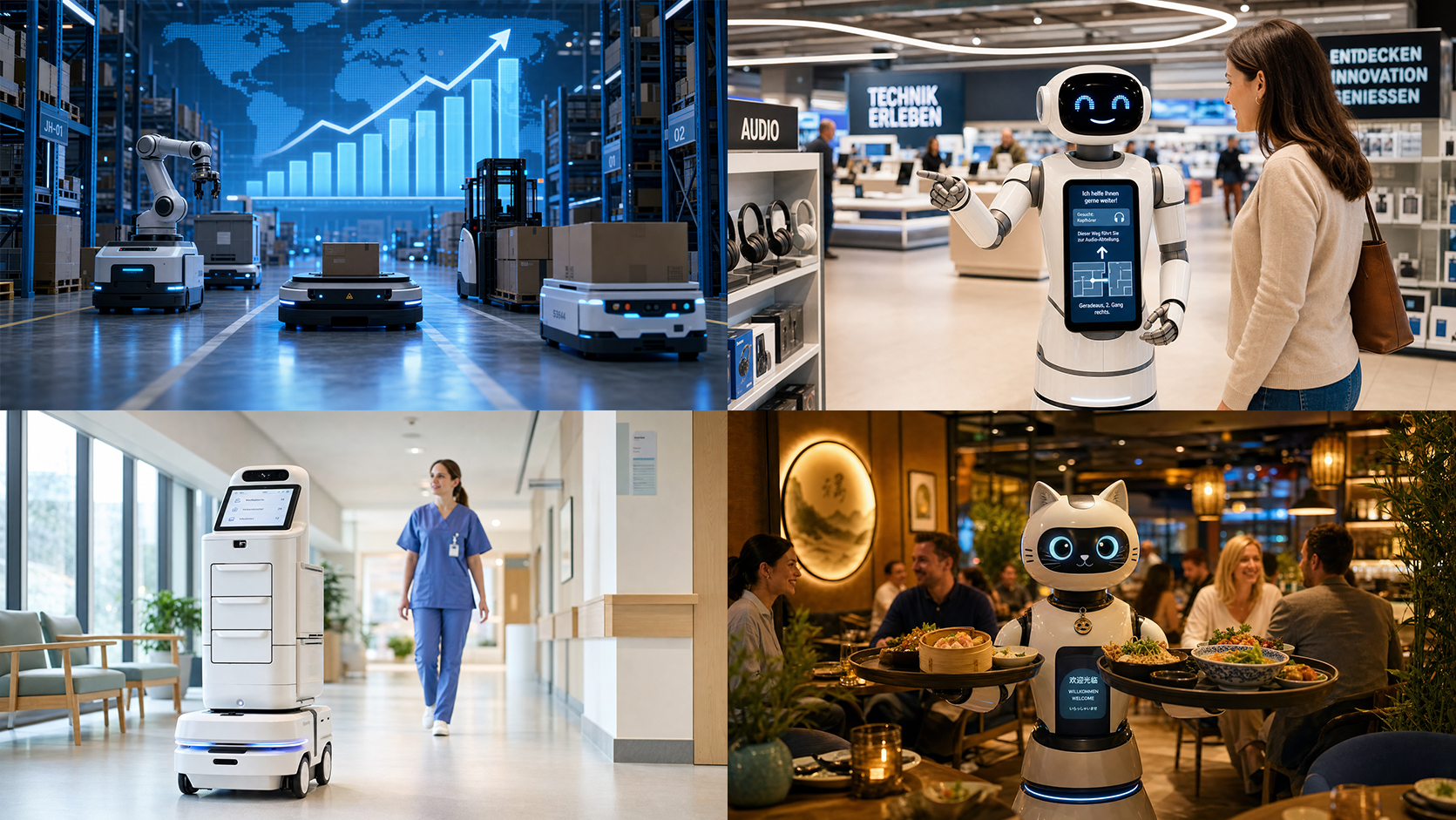
Service robots: When machines care, serve, and sell: Job killer or last resort? – Image: Xpert.Digital
When the waiter is made of metal: 4 examples show how robots are revolutionizing our everyday lives
Extreme staff shortage: Why the use of robots in Germany is now unavoidable
The severe labor shortage, an aging population, and neglected job boards are putting immense pressure on the German economy. But wherever human workers are lacking, technological reinforcements are already on the move: Mobile service robots bring us food, transport heavy laundry containers through hospital corridors, and guide us unerringly through electronics stores. What sounded like the scenario of a distant science fiction film just a few years ago is now a reality in nursing homes, restaurants, logistics, and retail. But what does this rapid development mean for our working world? Are machines displacing humans – or are they, rather, precisely the much-needed relief we urgently require to regain more time for empathy, personal attention, and genuine service? A look at four current examples from practice shows that the service robotics revolution has only just begun – and it is changing our everyday lives more profoundly than we realize.
Will the service industry soon no longer need people, or will robots ultimately save precisely these jobs?
Service robotics has evolved in recent years from a niche technology to a significant economic factor. What was considered a futuristic vision in research labs just a few years ago is now in daily use in nursing homes, restaurants, department stores, and warehouses. The four case studies examined here—from the care sector, the restaurant industry, retail, and the global market—reveal a remarkably consistent pattern: wherever staff is lacking, where distances are long, and tasks are monotonous, mobile assistance systems are stepping in to fill the gap. The crucial question is no longer whether robots will arrive, but rather how deeply they will intervene in existing work processes and what economic and social shifts this will entail.
How a rolling assistant eases the burden of everyday caregiving
The growing shortage of nursing staff is no longer an abstract figure, but a structural crisis. According to calculations by the Federal Statistical Office, between 280,000 and 690,000 nursing staff could be lacking in Germany by 2049, depending on the development scenario. Current analyses already indicate more than 200,000 open nursing positions and an average vacancy period of over 200 days, with only about nineteen applicants for every one hundred open positions nationwide. Against this backdrop, any technological system that can free nursing staff from administrative tasks without replacing the actual caregiving aspect is gaining in importance.
This is precisely where the SeRoDi research project came in, developed by the Fraunhofer Institute for Manufacturing Engineering and Automation in collaboration with industrial partners and several care facilities. The project focused on two different types of robots: an intelligent care cart for transporting laundry and dressings, and a robotic service assistant that delivers drinks and snacks directly to residents. Both systems were tested under real-world conditions for several weeks at the University Hospital Mannheim, the Waldhof Senior Center, and the Ida Scipio Home, significantly increasing the practical relevance of the results.
Technically, the care cart is based on the technology of driverless transport vehicles and navigates completely autonomously through the hospital, including independently using elevators. An integrated 3D sensor automatically detects which materials are removed and documents consumption without requiring manual record-keeping by nursing staff. The system is operated via standard smartphones and tablets, keeping the learning curve for staff low. The robotic service assistant, on the other hand, is significantly more communicative: It can be stocked with up to 28 drinks or snacks, has a touchscreen for selecting items, and actively engages with residents, for example, to remind them to drink enough fluids.
The testing phases also revealed how demanding real-world clinical practice is for autonomous systems. The robots moved most efficiently along predefined, single-lane routes through narrow corridors, while more complex, constantly changing environments require a deep understanding of a facility's internal processes. From an economic perspective, the aim is to minimize travel and logistics times and increase process reliability through automated inventory documentation, such as the seamless tracking of consumables. The medium-term plan is to develop the prototypes to series production in collaboration with industry partners, thus transitioning them from the research stage to regular clinical and care facility operations.
The foreseeable consequences for everyday care are multifaceted. Caregivers will be noticeably relieved of time-consuming transport services, leaving more time for direct, personal contact with those receiving care – precisely the time often described as most urgently needed in the debate about skilled worker shortages. For patients and residents, the reliable supply of materials increases the quality of service, as does the motivating verbal interaction, which can encourage greater independence, especially for older people. Current analyses from 2026 confirm this picture of realistic but limited benefits: Today's generation of service robots reliably take over secondary tasks such as transport, reminder functions, fall detection, and simple conversational interaction, while close physical care such as lifting, washing, or repositioning remains almost exclusively a subject of research and rarely occurs in practice. These systems do not replace caregivers, but rather relieve them of administrative burdens, allowing human attention to reach those who need it most.
The cat who doesn't want a tip
While efficiency and reducing workload are paramount in the care sector, the hospitality industry also links the use of robots to a compelling cost argument. The staff shortage in this sector is also severe, although the figures vary depending on the survey method: While the Federal Employment Agency reports an average annual shortage of around 2,700 skilled workers in the hotel and restaurant industry for the period 2024 and 2025, the industry association DEHOGA cites a total of over 65,000 vacancies nationwide, including unskilled workers. Between September 2019 and September 2021 alone, the German hospitality industry lost around 100,000 employees – a decline of more than eight percent, the effects of which are still being felt today.
In this situation, restaurateurs like Peirong Chen, who runs establishments in Munich and Dornbirn, Austria, are relying on the BellaBot service robot from the Chinese manufacturer Pudu Robotics in Shenzhen. The device is distributed exclusively in Germany, Austria, and Switzerland by the company Digpanda, headed by Managing Director Sha He. The approximately 1.30-meter-tall robot, with its distinctive display shaped like a cat's face and touch-sensitive ears, is no longer a niche product: By the end of 2022, Pudu Robotics had already shipped around 56,000 units worldwide and was present in more than 600 cities and over 60 countries, holding a market share of over 80 percent in the high-quality service robot sector for the restaurant industry outside of China.
The purchase price of approximately €20,000 per unit is quickly put into perspective from a business point of view when considering restaurateur Chen's calculation that a single robot can replace one or two human servers. Unlike human staff, the machine potentially works around the clock, requires no vacation time, and incurs no costs for short-time work compensation in the event of another lockdown or crisis – an argument that has gained particular weight in the industry since the COVID-19 pandemic. Equipped with four trays and a total load capacity of up to 40 kilograms, the BellaBot handles both transporting food and drinks to the table and returning dirty dishes. It navigates autonomously using laser spatial orientation and 3D sensors, avoids obstacles, and automatically detects when plates have been removed before continuing its journey independently.
From an economic perspective, the core benefit lies in the fact that 40 to 50 percent of traditional service processes in the restaurant industry consist of simply fetching and bringing food. Automating this portion shifts the remaining staff time towards tasks that truly require human expertise: advising customers, providing personalized service, and creating a pleasant guest experience. Both industry experts and restaurant owners emphasize that robots do not completely replace human workers, because this personal touch is irreplaceable by machines. Instead, overall service quality often improves because the remaining staff is relieved of some of their duties, and a positive side effect occurs: for guests, especially children, the endearingly clumsy, cat-faced robot acts as a real crowd-pleaser, generating additional attention and foot traffic.
🎯🎯🎯 Data-driven B2B industry hub as a quasi-in-house solution

The quasi-in-house solution: How Xpert.Digital closes operational gaps in B2B marketing and sales – Smart Content-Driven Business - Image: Xpert.Digital
Xpert.Digital is a data-driven B2B industry hub led by Konrad Wolfenstein . The company acts as an external, quasi-in-house solution for industrial partners, closing operational gaps in marketing, content, and sales – without requiring additional resources on the client side.
More information here:
The future of work: How service robots are relieving the burden on care and retail
Numbers that make the change tangible
The two case studies from the care and hospitality sectors reflect a much broader global trend documented by the International Federation of Robotics (IFR) in its annual World Robotics reports. Between 2018 and 2019, the global sales value of professional service robots increased by 32 percent to US$11.2 billion, while sales for personal and domestic use climbed by 34 percent to over 23.2 million units, representing a value of US$5.7 billion. IFR President Milton Guerry characterized this development at the time as the beginning of a structural market shift, driven by both staff shortages in professional applications and growing demand from private households for assistance systems.
This dynamic has continued in subsequent reports and has even accelerated in many areas. According to the latest World Robotics report for 2024, almost 200,000 professional service robots were sold worldwide – an increase of 9 percent compared to the previous year, while sales of medical robots surged by an impressive 91 percent over the same period. Service robots for private use achieved solid growth of 11 percent, with almost 20 million units sold. The development in the transport and logistics sector is particularly noteworthy: around 102,900 mobile robots for this purpose were sold worldwide in 2024, representing approximately 52 percent of all service robots installed that year and underscoring the dominance of this application area.
Within the professional service robot sector, medical robots remain the most profitable segment, accounting for approximately 47 percent of revenue. This is hardly surprising given demographic changes and the associated increase in demand for medical care. At the same time, alternative business models are gaining importance, particularly the so-called Robotics-as-a-Service (Robotics-as-a-Service) model, in which companies do not purchase robots but use them for a recurring fee. This model significantly reduces investment and capital commitment barriers and, according to current market analyses, will continue to grow in importance with double-digit annual growth rates until the 2030s. Estimates of the market volume for the current year vary between a few billion and over 30 billion US dollars, depending on the definition and scope, reflecting the still early stage of development of this market segment.
From a business perspective, the amortization calculation for logistics robots in continuous operation is particularly noteworthy: With 24/7 operation, such systems often pay for themselves within two to three years, and frequently even faster, with an expected lifespan of around 15 years, operating costs of only about 5 percent of the annual investment, and operational availability of 98 percent or more. At the same time, unit prices in the mass market for basic household robots are continuously falling, so that robotic vacuum cleaners are now available for under US$100. This dual trend—decreasing entry-level prices in the consumer sector and increasing investment security in the professional sector—significantly explains why service robotics is gaining momentum across all industries.
The robot as doorman, signpost and advertising figure
In German retail, service robotics is taking on a more experimental form, with a stronger focus on customer experience. Electronics retailers like Conrad are using autonomous assistants, such as the wayfinding robot Werner, which moves through the sales floors at a leisurely pace, as is MediaMarkt-Saturn with its customer-oriented robot Paul, which interacted with over 100,000 customers in Ingolstadt alone within a year. The talking, humanoid robot Pepper was also tested in a retail environment in Stuttgart, while Adler fashion stores are testing inventory robots to support stocktaking.
Deutsche Post is writing its own chapter with its Postbot cargo-carrying robot, which is based on French robotics technology and equipped with person and leg detection as well as safety stop sensors. The 1.5-meter-tall robot can transport up to 150 kilograms of mail and is intended to relieve the burden on delivery personnel who cover between 11,000 and 14,000 steps daily, as documented in the case of delivery worker Cindy Rexrodt. Last-mile delivery, the final and often most time-consuming stage of the delivery process to the customer's doorstep, is considered a multi-billion-euro market across all industries with considerable automation potential.
Technically, developers of such systems face different challenges than those in healthcare or the food service industry, because retail and delivery environments are significantly less structured, noisier, and more densely populated. Reliable speech and gesture recognition despite background noise, robust safety mechanisms for reliably stopping heavy loads in the immediate vicinity of pedestrians, and cost-effective everyday usability under real-world conditions are among the key technical challenges being researched by institutions such as the German Aerospace Center (DLR) and its Institute of Robotics and Mechatronics.
From an economic perspective, robots currently serve a dual purpose in retail. Firstly, they act as a PR-effective attraction, intended to boost the appeal of brick-and-mortar stores compared to online retailers, especially at a time when many city centers are struggling to attract customers. Secondly, they relieve employees of monotonous routine tasks such as giving repetitive directions or carrying heavy loads. Both participating companies and unions like ver.di emphasize that this does not directly replace qualified specialists or pose an immediate threat to existing jobs. Rather, an enhancement of human staff is expected, as sales conversations can be conducted with increasing sophistication, while physical strain, for example on delivery drivers, is reduced. The Baden-Württemberg Retail Association and participating consulting firms like Elaboratum anticipate that this form of robotics will become significantly more widespread in everyday life within the next five to ten years, although its actual integration into established business processes will still require considerable technical and organizational adjustments.
What these four examples reveal about the future of work
Looking at healthcare, hospitality, the global service robotics market, and retail together, a clear structural pattern emerges. In all four sectors, the real driver of automation is not the desire to replace people, but the simple fact that there are already not enough workers available for many positions. Demographic change in Germany will exacerbate this shortage in the coming decades, particularly in healthcare, where forecasts predict the demand for nursing staff could rise to over 2.15 million by 2049 – a third more than in 2019. Against this backdrop, robots appear less as a threat to jobs and more as a necessary addition to maintain a functioning level of service.
At the same time, these examples show that the economic benefits of service robotics today lie primarily in clearly defined subtasks: transport, logistics, material tracking, simple interaction, and repetitive routes can already be reliably automated, while complex interpersonal activities such as providing care, offering culinary advice, or conducting in-depth sales conversations will remain the domain of humans for the foreseeable future. This division of labor between humans and machines follows an economically comprehensible pattern: automation first occurs where the activity can be standardized, is physically demanding, or is highly repetitive, while all tasks that rely on empathy, experience, and situational judgment remain with humans.
For companies and institutions considering the use of such systems, this leads to a differentiated set of recommendations. The mere purchase of a robot only unfolds its full economic value when internal processes are adapted accordingly, as the Fraunhofer tests in the care sector impressively demonstrated, revealing that robots operate most efficiently on predefined, single-track routes. Those who simply add robotics to existing, unchanged processes will hardly realize the full efficiency gains. Successful implementations, such as those documented in the restaurant industry with the BellaBot, are always based on a deliberate redesign of workflows, in which the machine takes over repetitive routes and staff are strategically redirected to more value-added tasks.
In the long term, the rapid development of the global service robotics market, with double-digit growth rates in both the professional and consumer segments, suggests that these technologies will become more widespread and increasingly affordable in the coming years. The Robotics-as-a-Service model, in particular, is likely to accelerate this development, as it allows small and medium-sized enterprises in healthcare, hospitality, and retail to access robotics without high initial investments. The real economic challenge in the coming years will therefore lie less in the technological development of the robots themselves than in the organizational capacity of companies and institutions to meaningfully integrate these systems into existing staffing structures without losing the human element, which ultimately determines service quality, quality of care, and customer loyalty.
Your global marketing and business development partner
☑️ Our business language is English or German
☑️ NEW: Correspondence in your native language!

Konrad Wolfenstein
I and my team are happy to be available to you as your personal advisor.
You can contact me by filling out the contact form here [email protected]:or simply call me at +49 7348 4088 965. My email address is
I'm looking forward to our joint project.
☑️ SME support in strategy, consulting, planning and implementation
☑️ Creation or realignment of the digital strategy and digitization
☑️ Expansion and optimization of international sales processes
☑️ Global & Digital B2B trading platforms
☑️ Pioneer Business Development / Marketing / PR / Trade Fairs
📈🚀 From visibility to trust 👀🤝 Your scalable path with Xpert.Digital

From visibility to trust: Your scalable path with Xpert.Digital - Image: Xpert.Digital
In industrial B2B, sustainable business relationships rarely emerge overnight. They develop step by step – through visibility, professional relevance, recurring touchpoints, and growing trust. Xpert.Digital's 4-stage model addresses precisely this: It offers a structured path that begins with a manageable entry point and can evolve into deeper collaboration in business development if needed.
Instead of relying on loud marketing promises, this model puts the relationship at the forefront. Companies start with clearly defined, easily calculable measures and then decide, based on their own experience, how far they want to expand the collaboration. A key factor for this undisturbed trust-building process: The platform completely avoids annoying advertising ads, so the editorial focus remains solely on the companies' expertise.
More information here:









