
The FDP in free fall: Will the egos of two party leaders destroy their last hope? A kindergarten scenario or a survival strategy?
Xpert Pre-Release

Available in 27 languages 📢
Prefer Xpert.Digital on GoogleⓘPublished on: June 1, 2026 / Updated on: June 1, 2026 – Author: Konrad Wolfenstein
FDP in free fall: Will the egos of two party bigwigs destroy their last hope? A kindergarten game or a survival strategy? – Image: Xpert.Digital
Worst collapse in the party's history: Why the new FDP leaders are sending the wrong signal
“Lame hobbyhorse”: The brutal power struggle in the FDP escalates completely
When two old warhorses fight, insignificance laughs
The FDP is experiencing its most severe existential crisis. After its catastrophic exit from the Bundestag in 2025, the party conference in May 2026 was supposed to bring the long-awaited breakthrough. But instead of unity and a spirit of renewal, a bitter, publicly waged power struggle dominates: Wolfgang Kubicki and Marie-Agnes Strack-Zimmermann are engaged in an open duel for the chairmanship and the direction of the Liberals. Are the poisonous barbs of these two political veterans merely the wounded egos of a party in free fall? Or does this seemingly childish behavior conceal a long overdue, tough battle over direction that the FDP urgently needs to wage? This in-depth analysis illuminates the party's historic downfall, dissects its leadership using the psychological DISC model, and reveals which strategic and economic policy decisions will now determine the FDP's ultimate survival or demise.
Related to this:

FDP in free fall – barbs as a strategy or symptom of decline?
On May 30, 2026, the FDP elected Wolfgang Kubicki as its new party chairman at its national party conference in Berlin – with 59.27 percent of the delegate votes in a contested election against the surprisingly nominated Marie-Agnes Strack-Zimmermann, who garnered just over 39 percent. What was intended to appear as an orderly transition turned out to be a reflection of a deep internal party rift: That same evening, Kubicki answered the ARD question of how he intended to win over Strack-Zimmermann's supporters with a single, cold word – "Not at all." The defeated candidate had previously publicly offered her cooperation; the following day, Kubicki told her via the Bild newspaper: "Marie-Agnes, you only got 40 percent – now you know who's boss.".
This image of the FDP in early summer 2026 is not only politically explosive, it is also analytically revealing: Is the behavior of the two veterans childish vanity that harms a party fighting for survival? Or is the conflict between Kubicki and Strack-Zimmermann a necessary, albeit painful, process of clarification that could give the FDP back the direction it has lost for years? An in-depth economic and political analysis – supplemented by a personality assessment based on the DISC model – aims to answer this question.
From ruins to a search for meaning: The historic fall of the FDP
The worst election result in the party's history
The context of this dispute should not be underestimated. In the federal election on February 23, 2025, the FDP, under Christian Lindner, received only 4.3 percent of the second votes and thus failed to clear the five percent threshold – the worst result in the party's entire history. Compared to 2021, the party lost around 7.1 percentage points. Lindner himself didn't even win his direct mandate; he withdrew from politics. The repercussions are dramatic: Currently, the FDP is polling at only about 3.5 percent in federal election surveys – far below any parliamentary relevance.
The structural causes of this collapse are manifold and profound. First, the FDP suffered a massive loss of trust following the spectacular collapse of the traffic light coalition with the SPD and the Greens in November 2024. The internally circulated "D-Day document," which described a deliberate media staging of the coalition's demise, left behind the image of a party that was playing politics instead of governing. Second, the FDP suffered from an identity problem within the traffic light coalition, which North Rhine-Westphalia FDP leader Henning Höne later succinctly summarized: They often didn't know whether they wanted to be a responsible governing party or a rowdy opposition within the government. Third, in the public perception, the FDP had become the party of "no"—a veto player without a constructive program, blocking the coalition without offering any alternatives.
Extra-parliamentary existence as a breaking point
The role of the FDP as an extra-parliamentary opposition (APO), which it has occupied since February 2025, represents an existential humiliation for a party that sees itself as wanting to shape Germany's economic policy. Without a parliamentary group, it lacks financial resources, staff, the right to ask parliamentary questions, and media attention. The first attempt at a fresh start under party leader Christian Dürr, elected in May 2025, was far from convincing. Dürr – himself a member of the failed traffic light coalition – embodied for many a course of continuity where the party needed discontinuity.
When the entire FDP federal executive committee resigned in March 2026, the signal was clear: the party had abandoned its own leadership. In this power vacuum, the real conflict began, which finally erupted at the party conference in Berlin at the end of May 2026.
The battle for the helm: Chronology of a dispute that didn't want to be one
From teasing to showdown
The publicly aired tension between Kubicki and Strack-Zimmermann began in April 2026, when Kubicki announced his candidacy for party chairman. Strack-Zimmermann's reaction to this was succinct: "The FDP must be led into the future by a new generation, not just by old warhorses." Kubicki retorted dryly: "Better an old warhorse than a lame hobbyhorse." What sounds like a rhetorical exchange had a deeper programmatic dimension.
The differences between the two are not merely personal, but reflect two fundamentally different answers to the same strategic question: How can the FDP win back lost voters? Kubicki, who openly opposed a "firewall" against the AfD, advocates a conservative-liberal course aimed at winning back AfD voters through substantive persuasion – without endorsing AfD positions, but also without the categorical demarcation he considers counterproductive. Strack-Zimmermann, on the other hand, explicitly warned against the FDP shifting to the right and emphasized the defense of the political center and liberal core values. For her, a firewall against the AfD is not a tactical option, but a question of liberal self-understanding.
The contested vote and its consequences
The fact that Strack-Zimmermann surprisingly decided to run against Kubicki shortly before the vote on May 30 – after having previously supported the North Rhine-Westphalia leader Höne, who in turn withdrew his candidacy in favor of Kubicki – is a sign that she decided at the last minute that an uncontested Kubicki victory would send the wrong signal. She herself interpreted her result of 39 percent as a political mandate: almost 40 percent of the delegates had voted for a different course.
What followed was perhaps the most symbolic moment of the entire FDP drama: Strack-Zimmermann extended her hand, Kubicki rejected it. He stated clearly that he would show no consideration for the party's internal minority. The barbing had escalated from a Twitter pun into a concrete leadership dynamic. The new party leader signaled confrontation where the defeated party offered cooperation – and this immediately after an election in which the party was polling at 3.5 percent.
Is this a kindergarten – or necessary clarification?
The kindergarten thesis: Ego versus existence
The accusation that the internal party conflict resembles a kindergarten is justified – at least on the surface. A party fighting for its political survival can hardly afford to have its most prominent figures publicly exchanging barbs, rejecting offers of cooperation, and sending power signals instead of appeals for unity. Spiegel commentator Florian Gathmann put it bluntly: If Kubicki and Strack-Zimmermann don't pull themselves together, the Liberals might as well shut down. This concern is not unfounded. Every public display of division weakens the party's already tarnished image.
Added to this is the generational paradox: Kubicki, born in 1952, and Strack-Zimmermann, born in 1958, are both over 65 and represent a political era associated with the traffic light coalition debacle. If these two veterans are precisely the ones representing a fresh start, it strongly suggests that the FDP is appointing the wrong people for a credible renewal. The "second personnel overhaul within twelve months," as the Tagesspiegel aptly put it, seems more like a revolving door of personnel than a strategic realignment.
The clarifying thesis: Conflict as a search process
A more analytically nuanced interpretation of the dispute is different: What appears to be mere sniping is in reality a long-overdue battle over the party's direction, one that the FDP should have been having long ago. Two clearly distinguishable ideological lines are clashing.
Kubicki's conservative-liberal approach emphasizes consistent economic policy, deregulation, funded pensions, and a pragmatic, non-ideological opposition policy that also includes a willingness to cooperate constructively with political opponents without opening up coalition options. His programmatic foundation was elaborated in detail at the party conference in Berlin: a four-tier income tax system, waiting days for sick leave, reduction of federal agencies, and a return to nuclear energy.
Strack-Zimmermann's social-liberal approach, on the other hand, positions the FDP as a centrist party – as a corrective against an increasingly radicalized political landscape, as a defender of the rule of law, open society, and Western values. At the party conference, she advocated for a social-liberal orientation and opposed any form of firewall debate as an election campaign tool.
This difference is no small matter. It represents two fundamental answers to the question of what a liberal party should be in Germany in the 2020s: an economically liberal, pragmatic force that also appeals to right-wing populist disillusionment, or a value-liberal, democratically stabilizing force that defends the social center. This question should have been discussed earlier and more sharply – the barbs of recent weeks were, in this light, a belated but necessary clash of two opposing mentalities that had previously remained hidden beneath the veneer of the traffic light coalition.
Our EU and German expertise in business development, sales and marketing

Our EU and German expertise in business development, sales and marketing - Image: Xpert.Digital
Industry focus areas: B2B, digitalization (from AI to XR), mechanical engineering, logistics, renewable energies and industry
More information here:
A thematic hub offering insights and expertise:
- Knowledge platform covering global and regional economies, innovation and industry-specific trends
- A collection of analyses, insights, and background information from our key areas of focus
- A place for expertise and information on current developments in business and technology
- A hub for companies seeking information on markets, digitalization, and industry innovations
Kubicki vs. Strack-Zimmermann: Who fits the FDP's revival?
The DISC model as an analysis tool – Image: Xpert.Digital
The anatomy of two political typologies: The DISC model as an analytical tool
Theoretical framework: What the DISC model achieves
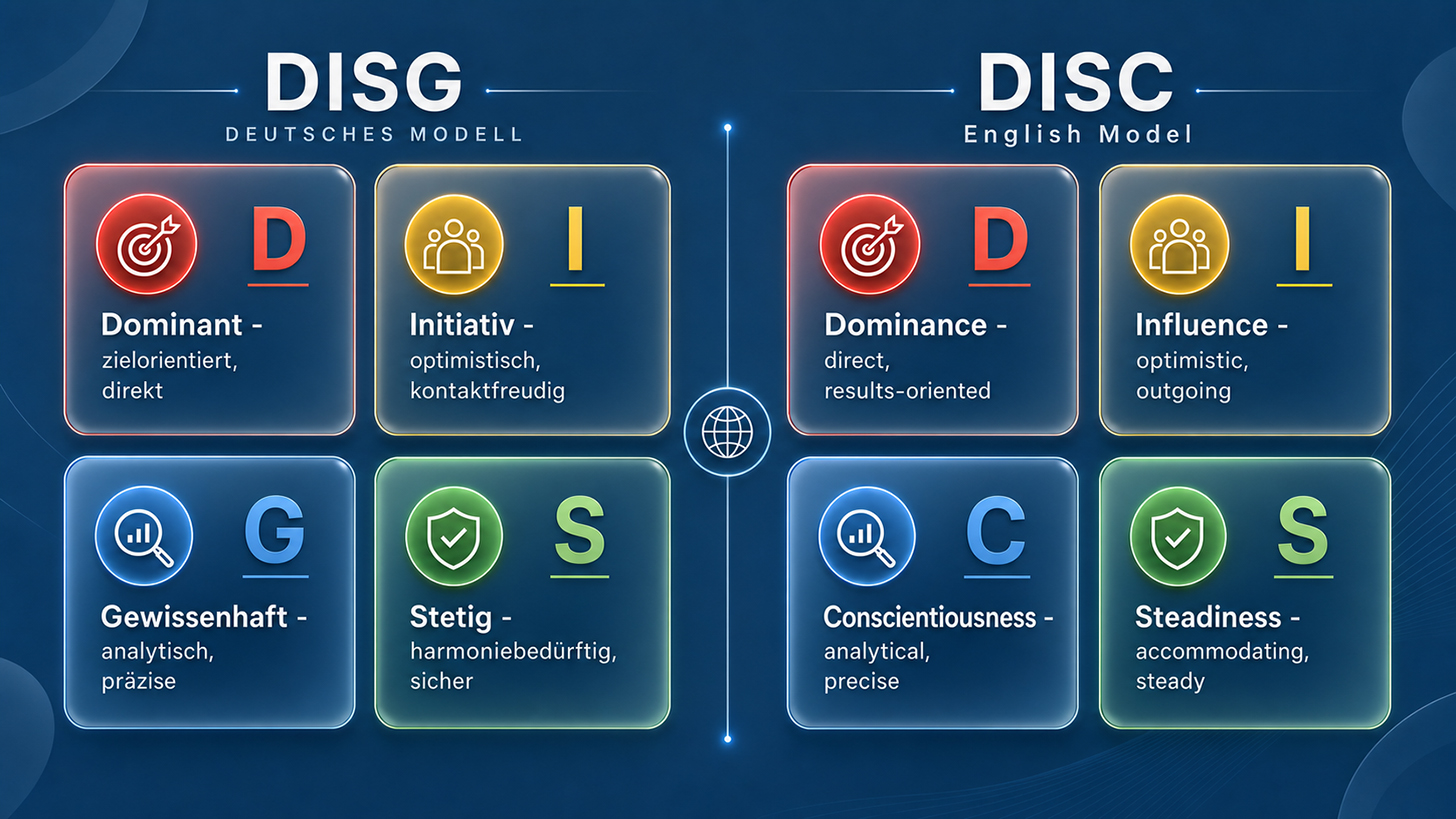
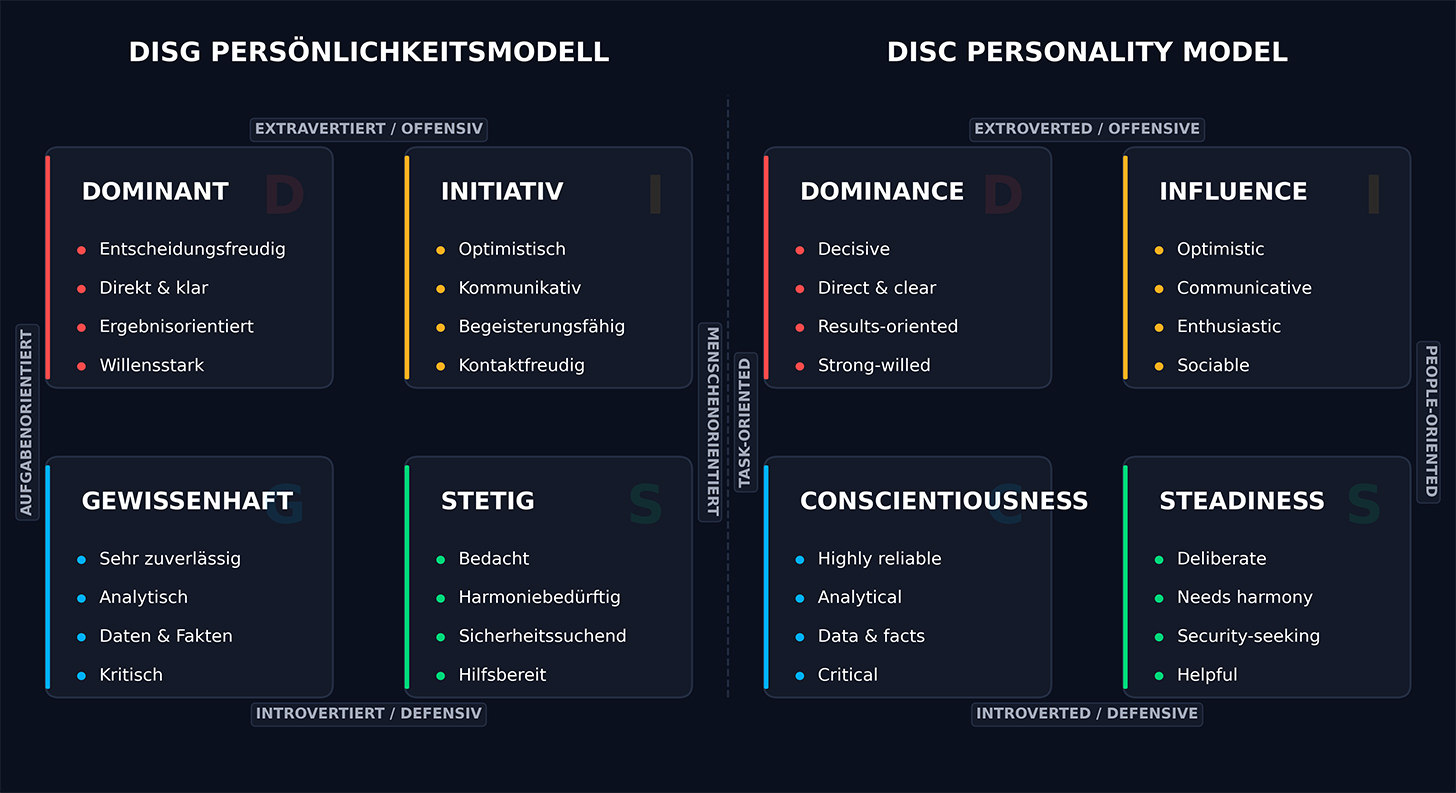
The DISC model – developed by psychologist John G. Geier in the 1970s based on the behavioral research of William Moulton Marston – distinguishes four basic behavioral tendencies: Dominant (D), Influential (I), Steady (S), and Conscientious (C). The principle is that every person embodies all four dimensions, albeit in varying degrees. The strongest type most clearly shapes observable behavior.
In a political context, the model is a useful interpretive tool, although not a scientifically validated diagnostic instrument. It allows for a structured analysis of communication patterns, leadership styles, and conflict behavior in individuals—and thus also helps answer the question of which politician is better suited to which requirements of a leadership role. Additionally, it should be noted that politics includes mixed types who combine several DISC dimensions, which necessitates a nuanced classification.
| criterion | Wolfgang Kubicki (D/I) | Marie-Agnes Strack-Zimmermann (I/D/G) |
|---|---|---|
| DISG profile | Dominant/Initiative | Initiative/Dominant (with conscientiousness) |
| Core strength | Rhetorical impact; network power; media presence | Thought leadership in defense; pointed crisis communication; in-depth content |
| Leadership style | Leading through visibility, charisma, claim to power, and targeted provocation | Leading through motivation, clear communication, pressure build-up, and professional positioning |
| Dealing with pressure | Offensive and humorous; rhetorical counterattack; escalation with entertainment value | A proactive approach; increased pressure; uncompromising argumentation in the face of adversity |
| communication | Sharp, rustic, entertaining; a ratings hit; "Quarterly lunacy from the North" | Fast-paced, sharp, emotional; “understandable” (76%), but polarizing (34% sympathy) |
| Historical Heritage | Liberal stalwart; Vice President of the Bundestag 2017–2025; Federal Chairman of the FDP 2026; comeback specialist | Face of the “turning point” in defense policy; Chair of the Defense Committee of the German Bundestag and the European Parliament |
| Greatest weakness | Ego overshadows content; risk of division; lack of diplomatic self-restraint | Harshness undermines rapport; empathy deficit; confrontation polarizes internally |
| What we learn | Visibility and the instinct for power create relevance – but polarization alone does not bind a team | Technical clarity and energy generate impact – but being right ≠ winning majorities |
| Ideal complement | Steady/Conscientious (S/G): Structure, fact-checking, diplomatic grounding | Stetig (S): Relationship management, de-escalation, coalition building |
Wolfgang Kubicki: The Dominant-Initiative Type (DI)
Based on everything that is publicly known about his demeanor, rhetoric, and political decisions, Kubicki is a classic hybrid of dominance and initiative – in short: DI.
The dominant aspect is evident in his direct, confrontational rhetoric, his uncompromising stance towards coalition partners, and his clear claim to power. He formulates his thoughts concisely, succinctly, and with a focus on impact. The Berliner Zeitung described his party conference speech as "combative" in the first half and noted that he takes an aggressive position – true to the dominant maxim that control and results are more important than consensus. His statement, "It doesn't matter at all how we feel about it, whether we're happy or sad" – addressed to Strack-Zimmermann's supporters – is prototypical of the dominant politician who prioritizes results over personal feelings.
The initiative aspect is equally pronounced. Kubicki is a political entertainer who seeks the limelight, is quick-witted, and knows how to polarize others—party members and opponents alike—and thus generate attention. Research describes him as someone who "enjoys making new contacts, talking, and convincing others of his views." Kubicki has perfected precisely this skill over decades as a long-standing member of the FDP, Vice President of the Bundestag, and TV talk show guest. His claim, as described in the Handelsblatt newspaper, to "not tell people what to think, eat, or wear" reflects the liberal pathos of freedom that he communicates charmingly and engagingly.
The weaknesses of the DI type are clearly evident in the political simulation: a lack of patience with details, a tendency towards unilateral decisions rather than team consensus, and a demeanor perceived as arrogant or ruthless. Kubicki's refusal to engage with the 40 percent minority within the FDP is classic DI behavior: this type prioritizes assertiveness over team integration – effective in a crisis situation when swift action is required, but toxic when internal party healing is needed.
Marie-Agnes Strack-Zimmermann: The Initiative-Dominant Type (ID) with conscientious traits
Strack-Zimmermann can also be classified as a combined type, with the initiative component appearing to be dominant, supplemented by dominance elements and a remarkably strong conscientious component – ID/G.
The core of her initiative lies in her ability to communicate complex topics – defense policy, European security, arms deliveries – in a popular and emotionally engaging way. Her public perception is clear: 76 percent of citizens who know her say she speaks clearly; 62 percent consider her competent, and 61 percent see her as a strong leader. The initiative type "has a highly motivating effect through her energy" – and it is precisely this quality that has made Strack-Zimmermann one of the most distinctive FDP figures of the last decade. Her self-chosen abbreviation "MASZ," her presence on TikTok, her slogan "Grandma Courage" – all of this is typical of the initiative type, who understands visibility as a resource and uses humor as a political tool.
The dominant aspect is evident in her willingness to seek conflict rather than avoid it: disputes with the President of the Bundestag, squabbles with the Chancellor's Office, the Taurus vote against her own coalition principles. She is not a politician who strives for harmony – but she seeks conflict strategically, not reflexively.
Particularly revealing is the conscientious aspect of her personality: her doctorate in political science, her years of substantive expertise in security and defense policy, and her analytical precision in matters of positioning all testify to a type of politician who prioritizes substance over showmanship – even if the showmanship is used for tactical reasons. The criticism leveled at Dürr, that he engages in "denial of reality," reveals the conscientiousness of an analyst who strives to precisely interpret the true mood of the public.
The weakness of the ID type lies in their tendency to appear more enthusiastic than consistent, and sometimes to sacrifice strategy in favor of impulsive decisions. Their short-term candidacy decision shortly before the party conference – without having built a viable campaign or base of support beforehand – was typical: This type of proactive politician acts on momentum, not always with calculation.
The DISC conclusion: Who is better suited for a fresh start?
The DISC model as an analysis tool in detail – Image: Xpert.Digital
The honest answer is: The FDP needs different qualities for different phases of a new beginning.
Kubicki, as a leader of the dominant type, possesses what a party needs in its initial struggle for survival: assertiveness, symbolic power, name recognition, and a willingness to speak uncomfortable truths. His ambition to lead the FDP back above five percent within a year and to reach the ten percent mark in the medium term is ambitious—but typical of the dominant type, who sets high goals to mobilize himself and others. He himself has admitted that he is "not the future of the FDP," but wants to ensure that the party has a future at all. This is a confident self-image: the dominant type as a short-term crisis manager, not as a long-term visionary.
As an ID/G type, Strack-Zimmermann possesses the qualities a party needs for its long-term substantive repositioning: programmatic substance, social appeal, emotional communication strength, and the ability to reach broad segments of the population repelled by the AfD's rhetoric. Her warning against a shift to the right is not merely a moral stance, but a market-strategic consideration: the political center is the FDP's largest potential voter base.
The DISC model suggests that, in the long term, the FDP needs a leader of the ID/G type – someone who communicates like Strack-Zimmermann but plans more precisely. In the short term, Kubicki's DI energy can stabilize the party and ensure its survival. The ideal would be a true tandem solution – which Strack-Zimmermann initially proposed – combining Kubicki's mobilizing power with Strack-Zimmermann's substantive reliability. The delegates' election has rejected this option for now. Whether it will materialize in practice depends on whether Kubicki develops the ability to curb his dominant impulse and allow space for the conscientious within the party leadership.
Economic dimension: What the FDP power struggle means for economic policy
The conservative-liberal course as an economic program
Kubicki's declared "conservative-liberal course" is not merely an ideological stance, but a concrete economic policy signal. The program adopted at the party conference in Berlin contains substantial proposals: A simplified four-tier tax system, reducing income tax from its current complex structure to four clear tax brackets (15, 25, 35, and 42 percent), would particularly benefit middle-income earners. The demand to abolish 100 of the more than 900 federal agencies within five years is a concrete deregulation approach intended to increase administrative efficiency.
The return to nuclear energy and the introduction of a fully funded equity-based pension are positions considered viable in expert economic discourse – and which would distinguish the FDP from all other parties in the Bundestag should it return. At a time when Germany is under enormous fiscal pressure due to the Merz government's €500 billion special debt policy, a clearly economically liberal opposition certainly has a niche.
Strack-Zimmermann's economic competence deficits
In contrast, it is striking that Strack-Zimmermann – despite her strong communication skills – was never among the FDP's most prominent voices in economic policy. Her focus was on defense and European policy. This is a significant limitation for a party that defines economic policy as its core competency. While the ID/G type can communicate complex issues, credibility in economic policy requires substantive depth, not just rhetorical skill.
The overall economic situation: Between relevance and irrelevance
The FDP finds itself in a classic trap for small opposition parties: without parliamentary representation, it lacks the institutional platform for its economic policy messages. Well-formulated tax reform concepts and deregulation proposals find little resonance in public debate when the party proposing them polls below four percent. At the same time, the FDP is the only party outside of parliament that clearly positions itself on the free-market spectrum – a potential unique selling point if it succeeds in credibly substantiating this claim.
The crucial economic question for the FDP is therefore not which tax program it chooses, but whether it can regain the trust of entrepreneurs, the self-employed, and high achievers who are deeply disappointed after the traffic light coalition debacle. This trust will not be restored by party platforms, but by political action. And this is precisely where the public power struggle between Kubicki and Strack-Zimmermann is counterproductive: it sends the signal that the FDP is investing its energy in internal power struggles instead of in policy substance.
Structural parallels: What the FDP can learn from 2013 – and what it cannot
The FDP has already found its way back from the Bundestag once in its history: After being ousted in 2013, it achieved a convincing re-entry in 2017 under Christian Lindner, with 10.7 percent of the vote, based on the slogan "It is better not to govern than to govern badly." This was possible because Lindner offered a clear narrative, appeared personally untainted, and the party presented a united front internally – despite all the internal tensions.
The situation in 2026 is fundamentally different and more difficult. First, the current personnel are significantly more worn out: Kubicki and Strack-Zimmermann are not fresh faces, but rather protagonists of the very era that contributed to the party's failure. Second, the political landscape is more complex: With the AfD as an established major party, a CDU that has shifted considerably to the right, and a Green Party that is also struggling to maintain its relevance, the FDP's competitive landscape has narrowed. Third, the FDP suffered long-term credibility damage as a result of the "D-Day Paper," damage that even a successful relaunch can only repair slowly.
The deeper lesson from 2013 for 2026 is not tactical, but strategic: The FDP's return to parliament was successful because it offered a clear, substantive answer to a societal question. The mantra was: liberal economic policy as an alternative to the social-democratic consensus. Today's FDP needs an equivalent – an equally memorable answer to the questions of the present. Whether Kubicki can muster the energy and focus to formulate this narrative – instead of exhausting himself in internal party squabbles – is the real open question for the FDP's new beginning.
Assessment and perspective: What is actually needed now
The FDP as an idea is not dead – the FDP as an organization is on the brink
One thing is clear: the political space that a consistently liberal party could occupy has not disappeared. The citizens who oppose excessive bureaucracy, high taxes, state paternalism, and ideologically driven economic policies still exist – potentially numbering in the millions. But this electorate is not automatically FDP territory. It is contested: by the economically liberal right wing of the CDU, by the BSW in certain social circles, and by the AfD among disillusioned middle-class citizens.
For Kubicki, this means: He has an offer, but no automatic audience. His strategic gamble of winning back voters lost to the AfD through a more conservative-liberal approach and pragmatism is not irrational – but it is highly risky. Any rapprochement with AfD positions in the public perception could permanently alienate the FDP's remaining urban, well-educated core audience.
For Strack-Zimmermann, this means that her minority position of 40 percent at the party conference is not just a respectable result – it is a duty. If she uses her position as head of the FDP's MEPs and her membership in the party's executive committee to demand programmatic corrections and articulate the social-liberal wing of the party, she can contribute more to the long-term health of the FDP than her short-term defeat might suggest.
Three scenarios for the FDP until 2029
The first and most optimistic scenario is this: Kubicki stabilizes the party tactically, achieves initial successes in state elections, Strack-Zimmermann develops into a programmatic counterpart in the background, and together they form a complementary leadership dynamic that leads the FDP back into the Bundestag in 2029. This presupposes that both subordinate their egos to party interests.
The second, and more realistic, scenario: The power struggle continues to simmer, the party remains below four percent in the polls, it regularly fails to win seats in further state elections, and Kubicki actually does not run again after a year – as he himself has announced. Then the FDP risks becoming a splinter party.
The third and most dire scenario: The FDP fails to clear the five percent hurdle again in 2029 and permanently loses its status as a relevant political force in the German party system. This would be a historic first, but not an impossible outcome – history is full of parties that failed to make a second comeback.
Kindergarten and clarification process at the same time
The bickering between Kubicki and Strack-Zimmermann is both childish and a necessary process of clarification – but not to the same degree. The programmatic substance of the dispute is valuable and unavoidable. The FDP has avoided calibrating its ideological compass for too long. Now it is doing so – late, publicly, and inelegantly, but at least it is.
The childishness lies in the tone, the refusal to show gestures and respect, the reflexive power plays of a chairman who demonstrates strength through inaccessibility rather than persuasiveness. This is politically unnecessary and strategically counterproductive. A party polling at 3.5 percent cannot afford the luxury of division.
Based on the DISC dimensions, the FDP, in its current situation, doesn't primarily need a dominant crisis manager or an assertive communicator. What it needs most is credibility – and credibility isn't built by triumphing over the internal minority, but by the ability to integrate two strong, distinct personalities into a coherent political force. This is the task at which the FDP is currently failing – and by which it will be judged when the next federal election comes around in 2029.





