
Supply chain | Six mega-corridors through Germany: Are we the biggest bottleneck in Europe?
Xpert Pre-Release

Available in 27 languages 📢
Prefer Xpert.Digital on GoogleⓘPublished on: June 17, 2026 / Updated on: June 17, 2026 – Author: Konrad Wolfenstein
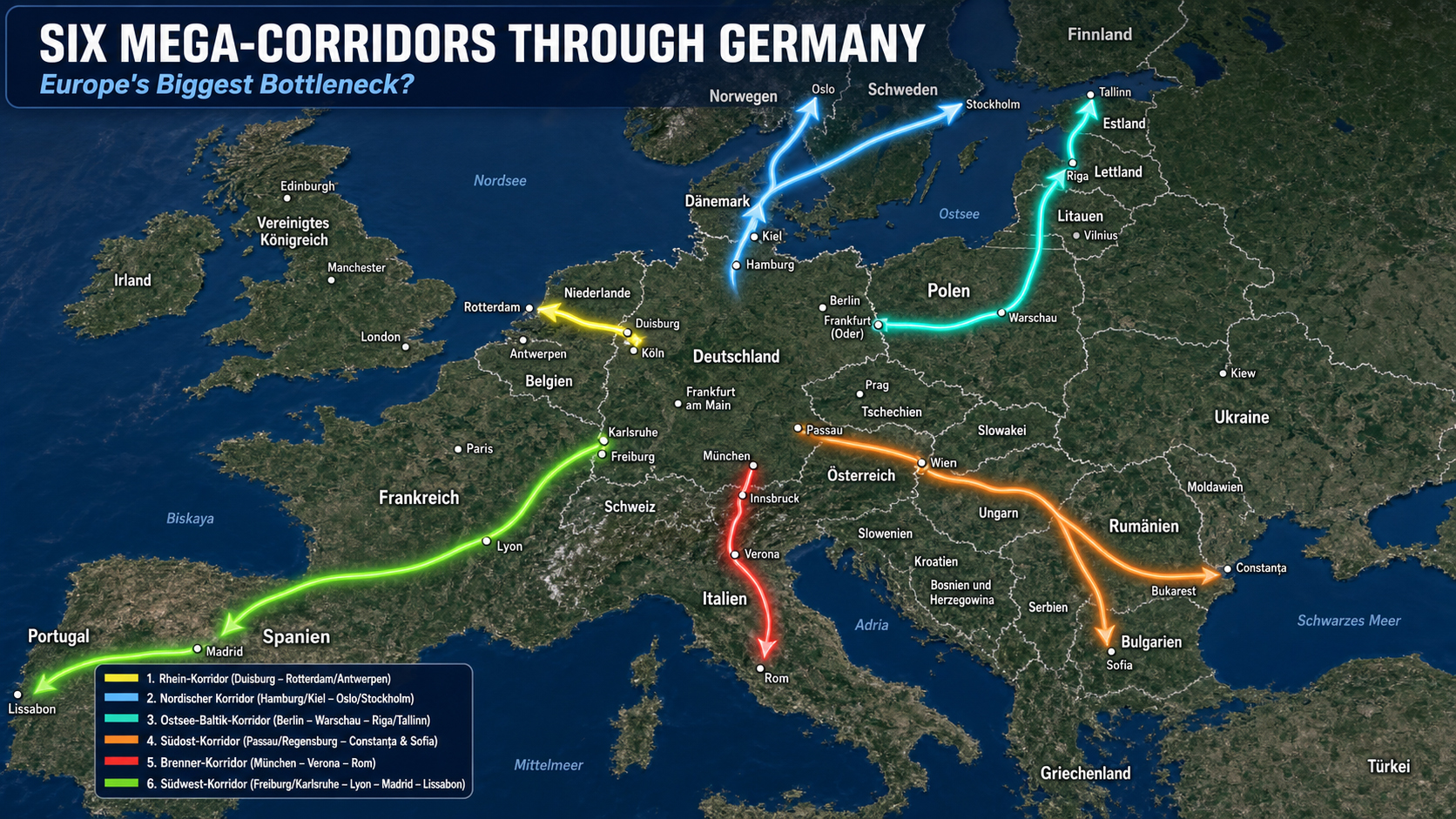
Supply chain | Six mega-corridors through Germany: Are we Europe's biggest bottleneck? – Creative image (AI/Beta): Xpert.Digital
Europe's lifelines run through Germany – but are they also most disrupted here?
Europe's biggest bottleneck? How the German transport network is slowing down the entire continent
6 mega-corridors, zero plan: Why Germany's infrastructure is becoming a permanent construction site
Germany lies in the heart of Europe – and that's precisely what's now becoming a problem. Of the nine Trans-European Transport Corridors (TEN-T), six alone run through Germany. Every freight train from Rotterdam to Italy, almost every supply chain from Scandinavia to the Mediterranean, inevitably relies on the German rail network. What sounds on paper like an enormous economic and geostrategic advantage for an export nation is proving to be a formidable challenge in reality.
Germany's infrastructure is groaning under the strain: chronic underfunding, decades of planning delays, and exorbitant cost overruns in major projects like the Fehmarn Belt Fixed Link and the Brenner Base Tunnel are the defining characteristics. Instead of serving as a rapid growth engine for the European single market, Germany is in danger of becoming the continent's biggest bottleneck. The following analysis examines why a central geographic location alone is no guarantee of quality, what astronomical sums are now at stake, and why the future of the entire European economy will be largely decided on German rail and road networks.
Related to this:

Germany's paradoxical central role: More corridors than any other country – and yet a structural problem
Germany is the geographical and economic center of gravity of the European continent. Nowhere is this fact reflected more clearly than in the architecture of the Trans-European Transport Network (TEN-T): six of the nine European transport corridors run through German territory – more than through any other member state of the European Union. What at first glance appears to be an honor is, upon closer analysis, a double-edged reality. For in no other country is the gap between the strategic importance of transport infrastructure and its actual condition as consequential for the entire continent as in Germany.
The TEN-T network, which since its reform by Regulation (EU) 2024/1679 now comprises nine European Transport Corridors, is the physical backbone of the European Single Market. It is designed to ensure that goods, people, and merchandise can cross the continent without interruption, without locomotive changes at borders, and without capacity bottlenecks. The European Commission estimates that the investment required for the core network alone by 2030 amounts to €515 billion – a figure that starkly exposes the project's structural underfunding, as the EU funding budget for the Connecting Europe Facility (CEF) for the period 2021 to 2027 amounts to only €25.8 billion for the transport sector.
The new network: Nine corridors, three expansion phases, one vision
From ten pan-European Helsinki axes to modern network architecture
The TEN-T network has undergone a complex historical development. Its intellectual predecessors are the ten pan-European transport corridors defined at the Crete Conference in 1994 and the Helsinki Conference in 1997, which at that time also included connections to Russia and through the post-Soviet space. With Russia's war of aggression against Ukraine, this network became geopolitically obsolete. The revised TEN-T Regulation, which entered into force in July 2024 as Regulation (EU) 2024/1679, systematically removed Russia and Belarus from the network maps and instead integrated Ukraine and Moldova into four of the nine core corridors.
The current network structure is divided into three hierarchical levels: The core network comprises the most important European connections and must be completed by 2030; the extended core network follows with a target date of 2040; and the comprehensive network, connecting all EU regions to the core network, is to be completed by 2050. These three levels are structured by nine European Transport Corridors, which represent the most strategically important long-distance axes of the Single Market. In addition, there are two so-called horizontal priorities: the European Rail Traffic Management System (ERTMS) and the European Maritime Area, which span all nine corridors and are intended to ensure the technological interoperability of the entire network.
The nine corridors: Europe's spine on rails and roads
The nine European transport corridors structure the continent along its most economically important axes:
| corridor | Course (simplified) | length |
|---|---|---|
| Baltic Sea–Adriatic Sea | Gdynia → Vienna → Ravenna | 2,400 km |
| North Sea–Baltic Sea | Helsinki → Warsaw → Antwerp | 3,200 km |
| Mediterranean | Algeciras → Lyon → Miskolc | 3,000 km |
| Orient/Eastern Mediterranean | Hamburg → Budapest → Nicosia | 3,700 km |
| Scandinavia–Mediterranean | Helsinki → Munich → Valletta | 4,858 km |
| Rhine-Alps | Genoa → Cologne → Rotterdam | 1,300 km |
| Atlantic | Lisbon → Madrid → Strasbourg | 8,200 km |
| North Sea–Mediterranean | Dublin → Le Havre → Brussels | 933 km |
| Rhine-Danube | Strasbourg → Budapest → Constanta | 2,137 km |
The six German mega-corridors in detail: Anatomy of a continental network
Corridor 1: The North Sea-Baltic Sea Connector – Germany's bridge to the north and east
The North Sea-Baltic Corridor is one of the most strategically important east-west connections on the continent. It stretches from the North Sea ports of Antwerp, Rotterdam, Amsterdam, Bremen, and Hamburg through Poland to the Belarusian border and on to the Baltic seaports of Klaipeda, Ventspils, Riga, and Tallinn, as well as Helsinki. Through Germany, it runs via Frankfurt (Oder), Berlin, Magdeburg, Hanover, and Cologne. The corridor is designed to be multimodal and, in addition to rail and road transport, also includes the Mittelland Canal as an inland waterway and coastal highway connections to Finland.
By far the most important single project in this corridor is Rail Baltica – a standard-gauge connection from Tallinn via Riga and Kaunas to Warsaw, intended to connect the three Baltic states fully to the Western European rail network for the first time. However, Rail Baltica is also one of the most dramatic examples of the failure of European megaproject planning: costs have increased by around 291 percent compared to the original estimates, making the project a symbol of the systemic weakness in cost control for cross-border infrastructure projects.
Corridor 2: The Orient-Eastern Mediterranean Link – Germany's Axis to Southeast Europe
The Orient/Eastern Mediterranean Corridor connects the German seaports of Bremen, Hamburg, and Rostock via the Czech Republic and Slovakia, with a branch through Austria, via Hungary to the Romanian port of Constanța and the Bulgarian port of Burgas, with connections to Turkey and the Greek ports of Thessaloniki and Piraeus, and via maritime highways to Cyprus. Within Germany, it connects Rostock, Bremen, Hanover, Magdeburg, Berlin, and Dresden, thus linking northern Germany to the entire southeastern European economic region.
This corridor encompasses railway lines, roads, airports, ports, urban rail networks, and the Elbe River as an inland waterway. Its importance has increased considerably since the traditional trade routes via Russia and Belarus ceased to exist after 2022. Freight movements that were previously handled via the Eurasian land bridge are increasingly shifting to the maritime corridors via the Black Sea ports and thus to this corridor – further exacerbating capacity bottlenecks on the German section.
Corridor 3: The Scandinavian-Mediterranean Corridor – Europe's central north-south axis
The Scandinavian-Mediterranean Corridor is Europe's main vertical artery. It runs from the Finnish-Russian border and the Finnish ports of Hamina Kotka, Helsinki, and Turku-Naantali via Stockholm and – with a branch from Oslo – through southern Scandinavia, Denmark, Germany (connecting the ports of Bremen, Hamburg, and Rostock), through western Austria, and on over the Brenner Pass through Italy to Palermo and Malta. Within Germany, the corridor passes through Hamburg, Bremen, Hanover, Nuremberg, and Munich.
This corridor encompasses two of the largest and most expensive infrastructure projects ever undertaken by Germany and Europe: the Fehmarn Belt Fixed Link and the Brenner Base Tunnel. Both projects exemplify the structural weaknesses of European megaproject implementation. The Brenner Base Tunnel is 40 percent more expensive than originally planned and is now expected to open no earlier than 2032, instead of the originally planned 2016. The Fehmarn Belt Tunnel, which is intended to traverse the 18-kilometer-wide strait between Fehmarn and the Danish island of Lolland, has become 52 percent more expensive and is now not expected to be completed before 2031. In spring 2026, the first of a total of 89 tunnel sections was lowered to the seabed as planned – a technical milestone, but this does not change the fact that the rail approach on the German side is also experiencing delays of at least three years.
Corridor 4: The Rhine-Alpine Corridor – Europe's busiest freight route
The Rhine-Alpine Corridor is, from an economic perspective, the most important single corridor in the entire TEN-T network. It connects the North Sea ports of Antwerp, Rotterdam, and Amsterdam with the Rhine Valley, runs via Basel to Milan, and on to the Italian port of Genoa. In Germany, it touches the economic centers of the Rhine-Ruhr and Rhine-Main-Neckar regions, connecting Duisburg, Cologne, Frankfurt, Mannheim, Karlsruhe, and Freiburg. In addition to rail and road, the corridor also includes the Rhine River, one of the world's busiest inland waterways.
Priority projects include the Gotthard and Lötschberg tunnels through Switzerland, some of which are already completed, and their connecting lines in Germany and Italy. The Federal Republic of Germany is obligated to fully equip the approximately 1,338-kilometer-long German section of the corridor with the European Train Control System (ETCS) by 2040. The Rhine-Alpine Corridor project extends from Oberhausen-Sterkrade to Haltingen near Basel and affects around 180 operating points along this route. Despite its enormous economic importance—the Rhine-Alpine Corridor is considered the busiest freight corridor in Europe—significant bottlenecks in rail capacity are known to exist on the German section and have not yet been structurally resolved.
Corridor 5: The Atlantic Corridor – Germany's connection to Western Europe
The Atlantic Corridor connects the Iberian Peninsula and the Western European Atlantic ports with the European hinterland. It runs from the ports of Sines/Lisbon/Porto and Algeciras via Madrid and Bilbao through France (Bordeaux, La Rochelle, Nantes, Paris, Le Havre) to Strasbourg and from there on to Mannheim. For Germany, this corridor means the economic connection of the Rhine-Neckar metropolitan region to the Western European Atlantic ports and the important French market. In industrial policy terms, this corridor is significant for export-oriented German industry because it represents a reliable alternative to the northern seaport routes via Hamburg and Bremen.
The challenge with the Atlantic Corridor lies less in a lack of German investment than in the incomplete high-speed rail lines on the French and Iberian sides, which limit the corridor as a whole. This illustrates a fundamental TEN-T problem: a corridor is only ever as efficient as its weakest link – and in many cases, that lies beyond the German border.
Corridor 6: The Rhine-Danube Corridor – The East-West Axis into the Danube Region
The Rhine-Danube Corridor connects Strasbourg, via Stuttgart and Munich, Vienna, Bratislava, Budapest, and Bucharest, to the Black Sea near Constanța. Its physical backbone, besides the railway lines, consists of the inland waterways Main and Danube, which form a navigable waterway axis from the North Sea to the Black Sea. For Germany, the particular importance of this corridor lies in its function as a main connection between the German-Swabian and Bavarian industrial regions and the growing markets of Central and Eastern Europe, as well as the Danube region.
The main priority projects in Germany are the Stuttgart–Ulm and Munich–Freilassing sections, which are considered the most critical bottlenecks on the German section. The Nuremberg Chamber of Industry and Commerce and the Stuttgart Chamber of Industry and Commerce have repeatedly drawn attention to the serious bottlenecks in the Rhine-Danube Corridor in the Strasbourg–Stuttgart–Munich–Wels/Linz section and have called for the urgent elimination of these bottlenecks with EU funding. For the export-oriented industries of Bavaria and Baden-Württemberg, whose supply and procurement chains extend deep into Eastern Europe, these bottlenecks are not an abstract infrastructure problem, but a direct cost factor.
Germany as a structural bottleneck: A critical diagnosis
Why a central location alone is no guarantee of quality
The fact that six out of nine European transport corridors cross Germany means, first and foremost, only one thing: Germany is an indispensable hub. Every freight train from Rotterdam to Munich, every high-speed train from Copenhagen to Milan, every container shipment from Hamburg to Budapest must inevitably pass through German territory. This geographical inevitability gives Germany a strategic position of power – and at the same time a systemic responsibility that it structurally fails to meet.
The diagnosis doesn't come from the outside, but from within: In its 2025 report No. 30, the Institute for Sociology and Social Economics (IfSO) at the University of Duisburg-Essen quantified Germany's investment gap in the expansion of the European TEN-T rail network alone at over €100 billion. This is not political polemics, but a sober estimate of the difference between what needs to be invested in the German TEN-T corridors and what has actually been committed and planned. For comparison: The Federal Ministry of Transport itself has determined a total funding requirement of €455 billion by 2030 for the infrastructure plans for rail, road, and waterways – a figure that, despite nominally high budget allocations, must be considered structurally inadequate due to massively increased construction costs (around 64 percent between 2016 and 2024) and chronic planning delays.
The cost spiral: What megaprojects really cost
In its special report 02/2026, the European Court of Auditors examined eight major TEN-T infrastructure projects and delivered a damning verdict: The five megaprojects for which reliable data is available were on average 17 years behind their original schedules – compared to an average delay of 11 years, which the same Court of Auditors had identified in 2020. The situation has therefore not improved in the past six years, but rather worsened. Real cost increases averaging 47 percent compared to original estimates characterize this project portfolio.
The concrete figures are sobering: The Lyon-Turin rail link has seen a cost increase of 127 percent and is now scheduled to open in 2033 instead of 2015. Rail Baltica has become 291 percent more expensive. The Brenner Base Tunnel will cost 40 percent more and will not be completed until 2032 at the earliest. The Fehmarn Belt Tunnel has become 52 percent more expensive, and its opening has been postponed to 2031 – with the rail connection on the German side not expected to be completed before 2032. These figures show that the failure to meet deadlines is not a coincidence, but a structural characteristic of cross-border megaprojects in Europe.
Funding gap and budgetary reality
The discrepancy between what is needed for the TEN-T corridors and what is actually available is particularly pronounced in Germany. While €21.93 billion was earmarked for federal rail infrastructure in the 2026 federal budget – a substantial sum in nominal terms – the Federal Ministry of Transport has simultaneously admitted a funding gap of approximately €15 billion for highways between 2026 and 2029. Meanwhile, the German Freight Forwarding and Logistics Association (DSLV) points out that the budget remains significantly undersized compared to the actual funding requirements.
The structural problem is not solely one of fiscal policy, but also one of prioritization. The Alliance for Rail has repeatedly documented that Germany lags behind other EU countries in terms of the share of rail in its overall transport budget, investing more funds in roads than in railways. This stands in paradoxical contradiction to the official climate protection and modal shift policy, which aims for a significant strengthening of rail freight. The new CEF funding period 2028–2034, with a total volume more than doubled to €81.4 billion, could mark a turning point here – provided Germany actually provides the corresponding co-financing.
Your container high-bay warehouse and container terminal experts

Container terminal systems for road, rail and sea transport in the dual-use logistics concept of heavy-lift logistics - Creative image: Xpert.Digital
In a world marked by geopolitical upheavals, fragile supply chains, and a new awareness of the vulnerability of critical infrastructure, the concept of national security is undergoing a fundamental reassessment. A state's ability to guarantee its economic prosperity, the provision of essential goods and services to its population, and its military capability increasingly depends on the resilience of its logistical networks. In this context, the concept of "dual-use" is evolving from a niche category of export control to a broader strategic doctrine. This shift is not merely a technical adjustment but a necessary response to the "paradigm shift" that demands a profound integration of civilian and military capabilities.
Related to this:
Germany's key role in TEN-T: bottleneck or growth engine of Europe?
Germany's systemic importance in the European network
Transit country and industrial exporter: A dual responsibility
Germany bears a dual burden within the TEN-T network. As a transit country, it must ensure that freight traffic between Northern and Southern Europe, and between Eastern and Western Europe, can traverse the German corridors without capacity bottlenecks. At the same time, as the EU's largest economy and a leading export nation, it depends on these corridors also providing its own industries with reliable connections to European and global markets. This combination makes Germany an indispensable infrastructure hub in Europe – with the systemic risk that bottlenecks in the German network will not only burden German companies but also destabilize Europe-wide supply chains.
Freight traffic in Germany is growing faster than the gross domestic product, continuously increasing the structural pressure on the already strained infrastructure. At the same time, years of underinvestment have left Germany's TEN-T rail network in a state that regularly leads to capacity bottlenecks and delays. The share of rail in freight transport in Germany has not developed as projected by the ambitious modal split targets set by the German government and the EU. Instead of a shift from road to rail, stagnation or even a slight reversal of this trend can be observed in certain segments – a clear indication that the existing rail infrastructure is not yet sufficient to support the stated goals.
Related to this:

ERTMS and the interoperability deficit: The invisible border
Besides the physical infrastructure, technological standardization is the second major challenge that Germany must overcome on its TEN-T corridors. The European Rail Traffic Management System (ERTMS) is intended to replace the 20 to 30 different national signaling systems currently existing in the EU. A freight train traveling from Hamburg to Budapest today has to change locomotives several times, depending on the route, because the national systems are not compatible – an infrastructural absurdity that causes considerable costs and time losses and systematically undermines the competitiveness of European rail freight compared to road transport.
The 2024 regulation mandates the use of ERTMS across the entire TEN-T network: by 2030 on the core network and by 2050 on the entire network. For Germany alone, 180 operating sites on the German section of the Rhine-Alpine Corridor need to be digitized for ERTMS deployment. The 2026 federal budget allocates €2.45 billion for ERTMS deployment on the rail infrastructure – a considerable sum, but one that seems modest in relation to the overall task of complete network digitization. The CEF program has earmarked a total of around €7 billion for ERTMS and smart mobility, a substantial share of which is expected to go to Germany.
Geopolitics and Infrastructure: The TEN-T as an Instrument of Foreign Policy
The eastward expansion of the network: Ukraine, Moldova, and the new logic of interconnectedness
The integration of Ukraine and Moldova into four of the nine TEN-T corridors is not merely an infrastructure project, but a geopolitical act of strategic importance. Extending selected corridors into Ukraine will create an economic foundation for these countries' integration into the EU single market, going beyond formal accession prospects. For Germany, Ukraine's largest trading partner among EU member states, this connection is of direct economic interest: robust and rapid transport links between Germany and Ukraine strengthen supply chain security for German industry and create the logistical basis for Ukraine's economic reconstruction after the war.
The Baltic-Black Sea-Aegean Sea Corridor (BBA), a new corridor opening up the eastern flank of the EU, connects the Baltic seaports with the Black Sea ports and creates an alternative north-south axis beyond the core German network. This diversification of the network architecture reduces Germany's central structural position in European transit traffic in the long term, which is welcome from a European systems perspective: A network that offers several equally viable routes is more resilient than one that relies on a single hub.
Global Gateway: The TEN-T as a counter-model to the Silk Road
The TEN-T network is also part of the EU's global infrastructure strategy, known as Global Gateway, which, with an investment volume of up to €300 billion for the period 2021–2027, aims to counter China's Belt and Road Initiative. For Germany, this means that investments in European transport corridors are not merely a domestic economic measure, but rather a geostrategic positioning in the global competition for supply chains, influence, and trade standards. Whoever controls the standardization of transport infrastructure—from track gauges and digital train control systems to terminal standards—significantly controls the rules of global trade.
The financing architecture: Ambitious plans and structural gaps
The Connecting Europe Facility: Between Aspiration and Reality
The Connecting Europe Facility (CEF) is the main EU funding instrument for the TEN-T network. Since its launch in 2014, the CEF has invested a total of €47.34 billion in the transport sector and supported 1,861 projects. In the current 2021–2027 programming period, €25.8 billion is available for the transport sector, of which €11.3 billion is earmarked exclusively for cohesion countries. The European Commission has proposed increasing the total budget to €81.4 billion for the following 2028–2034 period – more than double the current budget.
These figures sound impressive until you put them in relation to the actual investment required. The total investment needed for the TEN-T core network by 2030 is estimated at at least €515 billion – some estimates even reach €700 billion by 2030. Compared to a CEF transport budget of €25.8 billion, this represents a funding gap of historic proportions. The TEN-T network can therefore never be a purely EU project: national budgets, private capital, public-private partnerships, and fund investments must shoulder the lion's share. In this context, the debate on new financing models – particularly European infrastructure bonds modeled on the NextGenerationEU program – has gained considerable political momentum.
The next Multiannual Financial Framework: A strategic decision
In its draft Multiannual Financial Framework (MFF) for 2028–2034, the European Commission proposes reserving €51.5 billion for transport and military mobility within the Common Economic Forum (CEF). Of this, €17.65 billion is earmarked for military mobility alone – a tenfold increase compared to the current funding period. This shift reflects the changed geopolitical context: In the future, the TEN-T network is intended to be able to move not only goods and tourists, but also, if necessary, heavy military equipment quickly across Europe. For Germany, which, with its six corridors, would automatically become a military transit nation within the NATO framework, this means an overlap of civilian and military infrastructure planning, opening up new investment priorities and potentially new sources of funding.
The economic dimension: What's at stake
Infrastructure as the invisible foundation of the internal market
The economic importance of efficient TEN-T corridors for Germany and Europe can be quantified in several dimensions. According to IMF calculations, non-tariff trade barriers between EU member states still amount to approximately 44 percent of a conventional tariff for goods and even around 110 percent for services. Transport costs and logistical friction play a central role here: Every hour of delay at a border, every locomotive change due to incompatible train control systems, every detour due to a lack of direct connections increases transaction costs and undermines the competitiveness of European companies.
The Federation of German Industries (BDI) estimates that the EU is missing out on over one trillion euros – around nine percent of EU GDP – in additional economic output due to incomplete integration of the single market. A study by the University of Münster analyzed the growth impact of the TEN-T corridors in 241 NUTS 3 regions of Eastern Europe and reached a clear conclusion: the corridors generate growth not only in the regions directly served, but also in adjacent regions and along the same corridor axis. This multiplier effect is economically crucial: infrastructure's benefits are not limited to the local level, but are systemic.
Growth brake or growth engine?
The question of whether Germany, with its six rail corridors, is a bottleneck or an engine of growth cannot be answered with a single figure. In economic reality, it is both simultaneously – and it is precisely this ambivalence that makes the situation so strategically significant. On the rail lines that are being renovated, expanded, and digitally upgraded, measurable productivity gains are indeed being achieved for Germany's export-oriented industry and for transit logistics. On the sections characterized by underinvestment, insufficient capacity, and outdated technology, the same country acts as a brake on the pan-European economic cycle.
The challenge lies in the fact that this bottleneck effect has not only domestic political consequences, but also Europe-wide ones. A fully loaded freight train that rolls through Germany on the Rhine-Alpine corridor with hours of delay due to a lack of capacity is a cost factor for Dutch freight forwarders, Swiss industrial companies, and Italian exporters alike. This systemic nature of the bottleneck problem is the reason why the European TEN-T policy provides for binding implementation deadlines, EU coordinators for each corridor, and, for the first time, genuine enforcement mechanisms against defaulting member states.
Between vision and implementation reality
What Europe can and must expect from Germany
The TEN-T network is not the missing piece that will complete the European single market overnight. To use a construction metaphor, it is the supporting structure without which all other elements of the single market structure would remain unstable. A fully developed TEN-T would significantly stimulate trade, reduce logistics costs, unlock economies of scale for industry and commerce, and strengthen the continent's economic cohesion. The growth effects in Eastern European regions already connected to completed corridor sections empirically demonstrate this.
At the same time, the gap with the US or Chinese domestic markets cannot be closed by infrastructure alone. Its structural roots also lie in fragmented capital markets, a disparate services market, an incomplete digital single market, and diverging legal systems. The Draghi report of September 2024 and the Letta report of April 2024 identify transport infrastructure as one of four key sectors – necessary, but not sufficient. TEN-T is a conditio sine qua non, not the sole solution.
The real problem area: governance and speed of implementation
The most honest assessment of the TEN-T situation is this: the primary problem is not money, although the funding gap is real and substantial. The fundamental problem is structural. A project like the Brenner Base Tunnel, planned for completion in 2016 and now not expected until 2032 at the earliest, reveals a governance problem that cannot be solved by any CEF program or corridor coordinator alone. Rail Baltica, which has become 291 percent more expensive, is not a planning error of a single project, but a symptom of systemic weaknesses in Europe-wide infrastructure planning.
Germany faces a clear choice: It can leverage its privileged position as a hub for six of the nine European transport corridors – as an argument for investment, as a basis for economic growth, as geopolitical leverage. Or it can squander this position through underinvestment, planning delays, and political prioritization, thereby becoming the continent's biggest bottleneck. The figures show that the course of events will be set in the coming years. Europe's rail revolution has begun – but its centerpiece has yet to be built.
Analysis based on data from the European Commission, the German Federal Ministry of Transport, the European Court of Auditors, the Connecting Europe Facility, and independent expert studies. Status: June 2026.
Your global marketing and business development partner
☑️ Our business language is English or German
☑️ NEW: Correspondence in your native language!

Konrad Wolfenstein
I and my team are happy to be available to you as your personal advisor.
You can contact me by filling out the contact form here [email protected]:or simply call me at +49 7348 4088 965. My email address is
I'm looking forward to our joint project.
☑️ SME support in strategy, consulting, planning and implementation
☑️ Creation or realignment of the digital strategy and digitization
☑️ Expansion and optimization of international sales processes
☑️ Global & Digital B2B trading platforms
☑️ Pioneer Business Development / Marketing / PR / Trade Fairs
Your container high-bay warehouse and container terminal experts

Container high-bay warehouses and container terminals: The logistical interplay – expert advice and solutions - Creative image: Xpert.Digital
This innovative technology promises to fundamentally change container logistics. Instead of stacking containers horizontally as before, they will be stored vertically in multi-story steel racking structures. This not only allows for a drastic increase in storage capacity within the same area, but also revolutionizes all processes at the container terminal.
More information here:










