
Corridors 8 and 10: Intermodal transport solutions, container high-bay warehouses and terminals at strategic inland hubs
Xpert Pre-Release

Available in 27 languages 📢
Prefer Xpert.Digital on GoogleⓘPublished on: June 13, 2026 / Updated on: June 13, 2026 – Author: Konrad Wolfenstein
Corridors 8 and 10: Intermodal transport solutions, container high-bay warehouses and terminals at strategic inland hubs – Image: Xpert.Digital
Europe's strategic inland hubs: strengthening corridors 8 and 10 through intermodal transport solutions and container high-bay warehouses
Draghi's urgent warning: Why we need to pump billions into new Balkan terminals
Gigantic project in the Balkans: Europe's last chance against the Chinese Silk Road?
Europe faces a historic challenge: To remain competitive globally with China and the USA, the single market urgently needs to shed its logistical constraints. As Mario Draghi's widely discussed report starkly reveals, Europe risks falling behind economically if it fails to close its massive internal infrastructure gap. At the heart of Europe's catch-up efforts are the Pan-European Corridor 8 and Corridor 10 in the Western Balkans – strategic lifelines intended to connect the Black Sea with the heart of Europe. However, these multi-billion-euro plans are threatened by a crucial bottleneck: the enormous lack of space at intermodal transshipment terminals. This is precisely where a groundbreaking innovation comes in. Fully automated high-bay container warehouses, like those developed by the intralogistics specialist LTW, require up to 50 percent less space and could revolutionize rail freight. Read on to find out why smart technologies and astute geopolitical investments in the Balkans are now determining Europe's economic future.
Europe's lifeline in global competition: Corridor 8 and Corridor 10
Why intermodal transport solutions and intelligent intralogistics will determine Europe's economic future – and who has the tools for it
Europe's single market is under pressure that was almost unimaginable just a few years ago. While China has been pursuing infrastructure policy as geopolitics for a decade with its Belt and Road Initiative, and the US is driving industrial policy stakes with the Inflation Reduction Act that are undermining European companies, the European Union is struggling to find the right strategic response. Mario Draghi's competitiveness report, which he presented to Commission President Ursula von der Leyen in September 2024, describes the dilemma starkly: Europe maintains a fragmented system of 27 national markets with crushing regulatory barriers, while at the same time energy prices that are two to three times higher than in the US are eroding its industrial base. Additional investments of €750 to €800 billion per year are needed to close the gaps.
In this complex situation, a question gains strategic urgency, one that is still far too rarely discussed with the necessary rigor in public debate: How does Europe close its own internal infrastructure gap? Not the gap to Silicon Valley, but the physical, logistical gap within the continent itself – the missing rail connections, the congested road corridors, and the inefficient transshipment hubs that currently separate the Balkans from the single market. The answer lies in two transport axes that have been awaiting completion for decades: Pan-European Corridor VIII and Corridor X.
Two corridors as key geopolitical and economic projects
Corridor 8: The east-west lifeline between the Adriatic and Black Seas
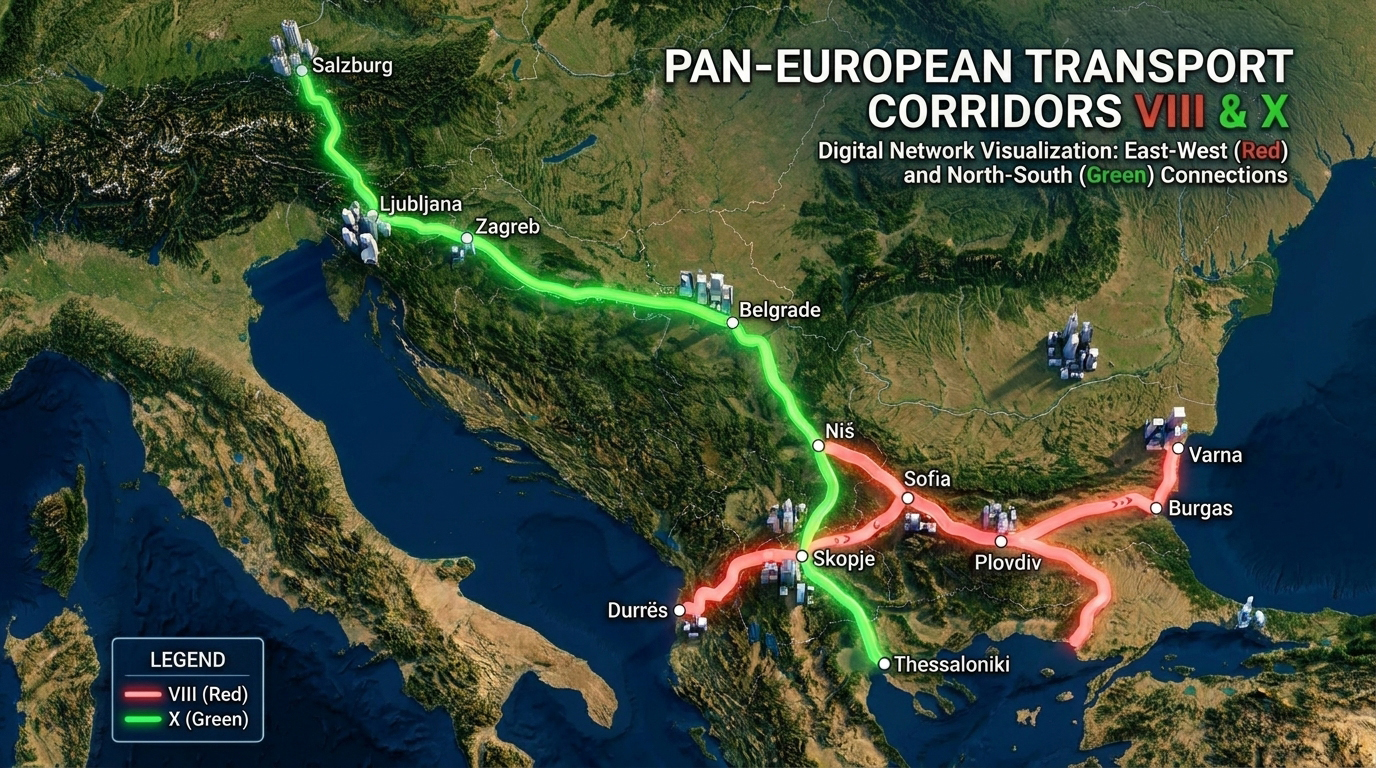
The Pan-European Corridor VIII is a multimodal transport system whose conceptual logic is strikingly simple: it connects the Adriatic Sea in the west with the Black Sea in the east over a total length of approximately 1,500 kilometers. The route leads from the southern Italian ports of Bari and Brindisi by ferry to Durrës in Albania, from there via Elbasan and Tirana through North Macedonia to Skopje and Kumanovo, crosses the Bulgarian border, passes Sofia and Plovdiv, and ends at the Black Sea ports of Varna and Burgas.
What appears on the map to be a complete, continuous corridor is in reality still a patchwork of modernized sections, missing links, and decades of planning delays. Thirty years after its conceptualization at the Second Pan-European Transport Conference in Crete in 1994, Corridor VIII is still only partially developed. The biggest bottlenecks are on the border between Bulgaria and North Macedonia, where a continuous rail link is lacking, and in the western sections of Albania, where the infrastructure remains in some places at a level dating back to the early 20th century.
The EU recognized the urgency and allocated funds specifically through its Global Gateway Programme. With a total investment of approximately €2.1 billion for the 594.7-kilometer rail corridor section in North Macedonia and Albania, the project is one of the most significant infrastructure projects in the Western Balkans. EU grants amount to €367.6 million, with the remainder coming from government loans and international financial institutions. In the eastern section, the 88-kilometer stretch in North Macedonia from Kumanovo to the Bulgarian border, the first construction phase to Beljakovce was completed in December 2024. The second 34-kilometer section between Beljakovce and Kriva Palanka is under construction, and the third section to the Bulgarian border is currently in the tendering phase.
In parallel, the European Investment Bank is modernizing the Durrës–Rrogozhinë railway section in Albania with a volume of €121 million to bring this 34-kilometer stretch up to EU standards and secure the connection to Albania's main port. This chain of investments makes it clear: Corridor VIII is not a romantic infrastructure project from bygone planning eras, but an active, largely European-funded key element of the Union's strategic foreign policy.
Corridor 10: The north-south central axis through the heart of the Balkans
While Corridor VIII runs east-west, Pan-European Corridor X follows a north-south axis from Salzburg via Ljubljana, Zagreb, Belgrade, and Skopje to Thessaloniki. EU Regulation 2024/1679 on the Trans-European Transport Network designated the main route of Corridor X and its branches as the new European Transport Corridor "Western Balkans – Eastern Mediterranean". This corridor comprises approximately 2,528 kilometers of railway lines, 2,300 kilometers of roads, twelve airports, and four seaports and inland ports.
Four sub-branches significantly increase the corridor's connectivity: Branch A connects Graz and Maribor with Zagreb, Branch B establishes the Budapest–Novi Sad–Belgrade connection, Branch C links Niš with Sofia and thus with Corridor IV towards Istanbul, and Branch D leads via Veles and Bitola into the Greek Egnatia Odos to Igoumenitsa. This branched topology makes Corridor X a network infrastructure that not only connects two endpoints but also opens up an entire economic region. Serbia, the largest Western Balkan country with around seven million inhabitants and a growing industrial sector, lies at the intersection of these axes and has a strategic interest in acting as a logistics hub between Central Europe and the Mediterranean.
Where the corridors meet: The strategic crossroads Sofia–Niš–Skopje
The true strategic brilliance of this infrastructure planning becomes apparent when one considers the intersection points of the two corridors. In the region around Niš, Skopje, and Sofia, the traffic flows of both axes overlap. Here, it will be decided whether Europe truly builds a coherent network or whether national borders and political delays fragment the added value of the infrastructure investments. The connection of Corridor VIII with Branch C of Corridor X at Niš–Sofia is not merely a road junction, but the potential heartbeat of a new Eastern European logistics landscape that will transport goods from East Asian ports across the Black Sea, through the Balkans, and into the Western European single market.
Europe's Single Market Strategy in the Context of Global Supply Chain Transformation
The Draghi Impulse: Invest or lose
The Draghi report, already cited, identifies specific challenges for the transport sector that go beyond conventional infrastructure policy. Europe's innovation gap with the US and China, its dependence on supply chains—painfully exposed by the COVID-19 pandemic and Russia's war against Ukraine—and structurally high energy prices form the triangle within which European logistics companies must operate. Diversifying supply chains, building strategic partnerships, and expanding the single market into the Western Balkans are not luxury ambitions, but economic necessities.
In its 2025 annual report on the Single Market and Competitiveness, the European Commission noted that while the European Single Market, with almost 450 million people, 23 million businesses, and a GDP of €17 trillion, ranks among the world's three largest economies, persistent obstacles and high administrative burdens prevent it from reaching its full potential. In particular, progress on Single Market integration has slowed.
The development of the TEN-T network, hierarchically structured into a core network (to be completed by 2030), an extended core network (by 2040), and a comprehensive network (by 2050), provides the institutional framework for the necessary infrastructure initiative. Regulation (EU) 2024/1679 establishes binding quality requirements for the first time and merges the existing core network corridors with the rail freight corridors into unified European Transport Corridors. The extension of four corridors to Ukraine and Moldova, while simultaneously downgrading connections to Russia and Belarus, sends a clear geopolitical signal.
Global Gateway: Europe's answer to China's Silk Road
The EU's Global Gateway Initiative, designed to counter China's global infrastructure expansion with an investment volume of up to €300 billion between 2021 and 2027, is finding its most direct regional expression in the Western Balkans. The Economic and Investment Programme for the Western Balkans (EIP) is mobilizing up to €30 billion in investment through a combination of EU grants, preferential loans, and guarantees. In 2022 alone, the Commission presented an investment package of €3.2 billion for 21 projects in the areas of transport, digitalization, climate, and energy connectivity.
Under the Economic and Investment Plan, the Western Balkans Investment Fund (WBIF) has already launched 68 flagship projects, which together are expected to mobilize €10.5 billion in investments – €3 billion of which will come from EU grants. The six Western Balkan states – Albania, Bosnia and Herzegovina, Kosovo, Montenegro, North Macedonia, and Serbia – are on a gradual path of integration into the TEN-T network. By signing high-level agreements with the European Commission, Bosnia and Herzegovina, Montenegro, North Macedonia, and Serbia have clearly committed themselves to this path.
At the 2023 Western Balkans Summit in Tirana, Commission President von der Leyen made an economic promise: with the additional funds from the €6 billion growth plan, the GDP of the six Western Balkan countries could double within this decade. Given that a common regional market could generate an additional 6.7 percent in GDP growth, according to World Bank calculations, these ambitions are by no means far-fetched.
Intermodality as a structural paradigm of modern freight logistics
What intermodal transport can achieve – and what has held it back so far
Intermodal freight transport involves moving goods in a single loading unit, such as a container, using a combination of different modes of transport, including road, rail, waterways, or air. This allows for the optimal use of the relative strengths of each mode: the nationwide coverage of road transport for the last mile, and the environmental and cost efficiency of rail and inland waterway transport on main routes. The European Commission has calculated that intermodal transport can reduce negative externalities by at least 40 percent compared to pure road transport between the same origin and destination points.
Nevertheless, the European Court of Auditors, in its 2023 special report on intermodal freight transport, makes a sobering conclusion: despite EU funding of around €1.1 billion between 2014 and 2020, intermodal freight transport still cannot compete on a level playing field with road freight transport due to obstacles in legislation and infrastructure. The Commission's targets for increased use of rail and inland waterways were unrealistic and not aligned with the objectives of the Member States. This is a damning assessment – but also a clear diagnosis of the need for improvement.
The European market for intermodal terminals nevertheless shows solid growth prospects. Forecasts predict that the market will grow at a CAGR (Compound Annual Growth Rate) of more than 5 percent between 2025 and 2030. In 2024, the German AGORA member terminals recorded a throughput of around 4 million loading units, a slight increase of approximately 3 percent compared to 2023. A further increase to around 4.2 million loading units is expected for 2025.
The terminal crisis: Too little space for too many containers
One of the most persistent structural problems facing intermodal transport in Europe is the lack of available space at transshipment terminals. Existing terminal areas near urban centers are often the result of historical development and cannot be expanded indefinitely. New terminal developments are hampered by competition for land, zoning regulations, and public resistance to industrial development in the urban periphery. At the same time, container volumes are growing. The market for automated container terminals reached a volume of US$11.3 billion in 2025 and is projected to grow to US$22.4 billion by 2035 – representing an average annual growth rate of 7.9 percent.
Conventional terminal concepts, which place containers flat on large open areas and handle them with reach stackers or gantry cranes, are not sustainable in this respect. They require enormous amounts of space, generate noise and light emissions, and, with high volumes, necessitate a disproportionately increasing number of vehicles and personnel. Automated high-bay warehouses for containers offer a fundamentally different system logic: They utilize airspace instead of floor space, can be operated fully enclosed, and reduce space requirements by 50 percent or more compared to conventional alternatives.
The high-bay warehouse concept for container terminals: Technology meets systems thinking
From pallet logistics to container high-bay warehouses
High-bay warehouses are a proven and widely used technology in traditional intralogistics. What LTW Intralogistics and its partner rXp InterregioCargo have now introduced to the intermodal container terminal segment is the consistent application of this system logic to entirely different dimensions and weight classes. At its core, an LTW container high-bay warehouse consists of an integrated loading track (with or without overhead contact lines), two rows of racks with storage spaces for all common containers and swap bodies, and two or more fully automated storage and retrieval machines (SRMs) in between, which handle the transfer between the train and the racks. Transfer ports in the building wall allow the containers to reach gantry cranes on the exterior, which handle the loading and unloading of trucks. The train loading itself is carried out using horizontal handling devices (EcoSliders) mounted on the SRMs.
The result is a system that can store up to 100 13.60-meter swap bodies within a width of only 12 meters per 100 meters of length. Alternatively, a redundant high-bay warehouse, including transfer zones, can be created on a footprint of approximately 9,000 square meters – this corresponds to six times the storage capacity of a conventional semi-trailer parking facility and the volume of twelve 700-meter trucks. These figures illustrate why the high-bay warehouse concept is not merely a technical innovation, but enables an economic paradigm shift in terminal planning.
System advantages in detail
The advantages of container high-bay warehouses over conventional flat terminals can be quantified and qualified in several dimensions.
In terms of space efficiency, the high-bay warehouse reduces the footprint of an intermodal terminal to a fraction of the area otherwise required. This minimal space requirement enables the construction of terminals at locations where there simply wouldn't be room for other transshipment methods. Furthermore, construction is also possible on terrain with significant differences in elevation, such as over railway tracks running in a cutting. This is a considerable practical advantage, especially for the Balkans with its challenging topography.
In terms of operational efficiency, the fully automated system allows immediate access to all stored transport units at any time. Unlike floor-level terminals, where containers can be blocked by others, the high-bay warehouse operates on a free access principle: every container is available at any time, regardless of its position in the warehouse. This significantly speeds up handling times and enables more precise scheduling of train departures.
For environmentally sensitive locations, a crucial factor is that since all handling operations take place indoors, no noise or light emissions escape. This makes construction possible even in the immediate vicinity of office or residential buildings – a significant advantage for urban logistics hubs and terminal concepts in densely populated areas. To minimize operational risk, stacker cranes and gantry cranes are at least redundant, ensuring operational capability even during maintenance work or unplanned outages.
The container high-bay warehouse from LTW Intralogistics is not just a laboratory project. It is already in successful operation, including for the Swiss Federal Office for Defence Procurement (armasuisse), for whom a 20-meter-high storage and retrieval machine with a payload of 18 tons and a high-bay warehouse with 206 storage locations was implemented. The system allows not only the storage of containers, but also of swap bodies and roll-off containers. Furthermore, innovative door systems have been integrated that allow minor maintenance work on containers directly at the storage location.
LTW Intralogistics Solutions – Intermodal Transport

LTW Intralogistics Solutions – Intermodal Transport – Image: LTW Intralogistics GmbH
LTW offers its customers not individual components, but integrated complete solutions. Consulting, planning, mechanical and electrotechnical components, control and automation technology, as well as software and service – everything is networked and precisely coordinated.
In-house production of key components is particularly advantageous. This allows for optimal control of quality, supply chains, and interfaces.
LTW stands for reliability, transparency, and collaborative partnership. Loyalty and honesty are firmly anchored in the company's philosophy – a handshake still means something here.
Related to this:
Intermodal boost for the Western Balkans: Returns, risks and strategic opportunities
LTW Intralogistics: Expertise, size and strategic positioning
More than four decades of systems expertise
LTW Intralogistics GmbH, headquartered in Wolfurt, Vorarlberg, Austria, was founded in 1981 and is part of the internationally operating Doppelmayr Group. The company develops, manufactures, and installs turnkey intralogistics systems worldwide, positioning itself as a full-service provider and general contractor. With locations in Wolfurt, Vienna, and Gleisdorf in Austria, Illerkirchberg in Germany, and Denver in the USA, the company has established a strong international presence. The range of completed projects extends from small and medium-sized enterprises to fully automated logistics centers with over 100,000 storage locations. To date, LTW has successfully completed over 750 projects with more than 1,700 stacker cranes.
The product range includes stacker cranes and conveyor technology with associated controls, as well as the corresponding software for automated high-bay warehouses. The service portfolio ranges from deep-freeze storage to climate-controlled, timber-framed high-bay warehouses. The customer base covers diverse industries: automotive (Continental Barum), food (11er Nahrungsmittel), pharmaceuticals, defense (armasuisse), and industrial logistics. This industry diversity is strategically valuable, as it demonstrates that the company not only excels in a niche market but has also developed strong systemic expertise in solving complex logistics problems.
Why LTW is the right choice for Corridor 8 and Corridor 10
LTW Intralogistics' qualifications for the challenges along the Southeast European transport corridors are not a given, but they can be convincingly explained. It stems from the intersection of four core competencies that no other company combines to a comparable degree.
Firstly, as part of the Doppelmayr Group, LTW is embedded in a multinational corporate network operating in over 50 countries. This provides the necessary financial strength, project management expertise, and international network to successfully implement large-scale projects in infrastructurally challenging regions such as the Western Balkans.
Secondly, LTW is one of the few companies worldwide that has not only designed, but actually built and commissioned, the high-bay container warehouse for intermodal terminals. The technological advantage is real and robust – it doesn't just exist on paper.
Thirdly, LTW is capable of acting as a general contractor. This means it not only supplies individual components but also assumes overall responsibility for a turnkey system: from planning and manufacturing to construction, commissioning, and after-sales service. In large-scale projects such as intermodal terminals in the Balkans, this ability to fully implement a project is crucial because local clients often lack the capacity to coordinate dozens of subcontractors.
Fourthly, through its cooperation with rXp InterregioCargo, LTW offers a complete system concept for intermodal logistics that goes far beyond the high-bay warehouse alone: The rXp RailTruck, a light, fast multiple unit train that can also operate in suburban rail networks thanks to its driving dynamics, combines with the LTW high-bay warehouse as the terminal core to create a complete system for combined transport on short to medium distances.
The strategic hubs: ports and inland hubs along the corridors
Varna and Burgas: The Black Sea as a gateway to East Asia
The Bulgarian Black Sea ports of Varna and Burgas are the eastern anchor points of Corridor VIII. Varna is Bulgaria's largest seaport and the country's leading container port, with an annual container throughput of over 160,000 TEU and two main terminals. Its geostrategic location at the crossroads of Europe and Asia makes it a key hub for regional logistics and trade. The port offers direct road and rail connections and is deeply integrated into the pan-European network.
The Port of Burgas has developed dynamically in recent years. The ReBirth 28 project, completed in April 2025 with an investment of approximately €85 million (a significant portion of which came from the EU's Connecting Europe Facility funding mechanism), created a new infrastructure with the Burgas West 28 deep-water berth. This berth can accommodate vessels up to 290 meters in length with a draft of 15.5 meters and a transport volume of 4,500 TEU. This is expected to increase container throughput by 30 percent. Following the expansion, the Advance Container Terminal Burgas will be able to handle up to 350,000 TEU per year. Container traffic has increased by a staggering 222 percent since 2013. The terminal's services are complemented by the BMF Dry Port Sofia, an inland container depot located in the Sofia-Bozhurishte Industrial Park, which provides excellent intermodal connections to the Bulgarian hinterland.
Durrës: The Adriatic gateway with structural challenges
The Albanian port of Durrës is the western anchor of Corridor VIII and Albania's most important port. It exemplifies how political decisions and external interests can override infrastructure development. The Emirate of Abu Dhabi's plans to transform the port into a tourism project and outsource freight operations to Porto Romano conflict with European infrastructure interests and have prompted action from the European Commission. Albania has since launched an international tender for the construction of a new seaport in Porto Romano, with a budget exceeding €390 million. The new container terminal is planned to be twice as deep and three times as wide as the existing one and equipped with automated services. Thanks to supporting infrastructure in Pristina and Struga, the new port is also intended to serve Kosovo and North Macedonia in the future.
This development makes it clear: the port locations along the corridors are not merely technical infrastructure facilities, but geopolitical arenas where EU interests, national development agendas, and external investor interests intersect. This is precisely why it is so important that European technology suppliers like LTW Intralogistics are entering this field with intelligent systems solutions – they bring not only efficiency, but also a European systems logic that significantly contributes to standardization and integration.
Strategic inland hubs: Sofia, Skopje, Belgrade, Niš
In addition to the seaports, the inland hubs along the corridors are gaining strategic importance. Sofia, as the intersection of Corridor VIII and Branch C of Corridor X, Skopje, as the crossroads of the east-west and north-south transport axes, and Belgrade and Niš, as hubs of Corridor X, offer themselves as prime locations for next-generation intermodal terminals. At these points, roads, railways, and, in some cases, waterways converge, and it is here that the final decision is made as to whether the containers transported on the main corridors can be efficiently integrated into regional distribution or whether bottlenecks arise.
A high-bay container warehouse at strategic inland hubs such as Niš, Skopje or Sofia would fulfill several functions simultaneously: short-term buffering of container flows during timetable differences between train and truck traffic, efficient transshipment operations between different train types, minimal land use in the urban environment of metropolitan areas, and complete transparency of stock levels through integrated software systems.
Economic analysis: What infrastructure investments in the corridors can achieve
The macroeconomic multiplier effect
Investments in transport infrastructure are well-known in economic literature as growth drivers with a pronounced multiplier effect. The Western Balkans is a region with considerable catch-up potential: The combination of EU accession prospects, growing labor markets, and a currently below-average infrastructure creates the conditions for above-average returns on infrastructure investments. The World Bank's estimate that a common regional market could enable additional GDP growth of 6.7 percent must be seen in context: It is based on simulations of a complete elimination of trade and infrastructure barriers. The decisive factor here lies in the transport infrastructure, which determines whether trade opportunities can actually be exploited.
The growth of Germany's bilateral trade with the six Western Balkan countries, at almost six percent in 2023 compared to the previous year, is a clear indication of increasing economic interdependence. However, this trade largely takes place on roads not designed for such volumes, and their bottlenecks – as demonstrated by the blockade of border crossings by truck drivers in January 2026 – repeatedly disrupt supply chains.
The hidden costs of the status quo
Analyzing the economic losses caused by the incomplete corridor development is methodologically complex because it often involves missed profits that don't appear in any statistics. However, the available data speaks for itself: Intermodal freight transport can reduce the negative externalities of road freight transport by at least 40 percent, but due to structural disadvantages, it is still not being used to the extent that would be economically and ecologically optimal.
The direct costs of the status quo are severe: congestion costs due to overloaded road corridors, increased transport costs due to suboptimal routing, lost trade volumes due to the lack of reliable rail connections, climate damage from an excessive share of road freight transport, and geopolitical vulnerability due to dependence on a few critical infrastructure hubs. The sum of these costs far exceeds the investment required for the full development of Corridors VIII and X.
The risk-return profile for investments in next-generation terminals
For private investors in intermodal terminals along the Balkan corridors, the risk-return profile requires a differentiated assessment. On the risk side are: political uncertainties in EU candidate countries, regulatory risks due to changing border regimes (as demonstrated by the EES issue in 2025/26), and infrastructure risks stemming from incomplete corridor sections.
On the return side are: the strong growth of container traffic in the Western Balkans, EU co-financing for infrastructure projects that substantially reduces private investment risk, strategic first-mover advantages at hubs that will be irreplaceable after completion of the corridors, and the structural scarcity of terminal space, which ensures a permanently high price level for transshipment services.
Automated container high-bay warehouses, such as the systems offered by LTW Intralogistics, further improve the risk-return profile in specific ways: Their small footprint significantly reduces land costs, the biggest uncertainty factor in site development. High space efficiency allows for the realization of economically viable terminal capacities even on smaller, already available plots of land in central locations. Furthermore, full automation largely decouples operating costs from local wage levels, which is a considerable strategic advantage in countries with volatile labor markets.
What remains to be done – and why the decision is being made now
The time window for strategic design
The moment has arrived for establishing new standards in intermodal transport along Corridors VIII and X. The TEN-T Regulation of 2024, with its binding deadlines—core network by 2030, extended core network by 2040, and full network by 2050—creates institutional pressure that is noticeably accelerating investment decisions. The growth plan for the Western Balkans, with its six billion euro funding volume, and the Global Gateway Programme, with 300 billion euros worldwide, provide the necessary resources. The geopolitical motivation to create alternative trade routes to Russia and alternatives to dependence on Chinese infrastructure is stronger than ever.
At the same time, the technological landscape is mature. What was considered a visionary concept ten years ago – fully automated high-bay container warehouses as the core component of intermodal terminals – is now tried and tested and fully operational. The question is no longer whether this technology works, but rather where and by whom it will first be deployed on a large scale.
Open issues and political risks
Not all challenges are technological or financial in nature. The sluggish implementation of Corridor VIII over the past thirty years had significant political causes: conflicts of interest between neighboring states, corruption in the awarding of concessions, dependence on external financing commitments, and a lack of institutional capacity at the national level.
The fact that the completion of the critical border section between Bulgaria and North Macedonia depends on North Macedonia's EU accession prospects aptly illustrates the problem: infrastructure as a political instrument can block the efficiency of the entire system for years. Similar dynamics are evident at the port of Durrës, where geopolitical interests from the United Arab Emirates directly clash with European development interests.
Added to this are operational challenges such as the EES border regime issue: The new EU regulation on registering third-country nationals in the Schengen Area, which was introduced gradually from October 2025, particularly affects professional drivers from the Western Balkans and has already led to serious blockages of border crossings. As long as combined rail transport is not available as an equivalent alternative to road transport, such disruptions in road traffic will trigger direct chain reactions in supply chains.
LTW Intralogistics in the overall architecture of the new logistics Europe
LTW Intralogistics' positioning as the preferred system provider for container high-bay warehouses at strategic hubs of European transport corridors stems not from a single product, but from a proven network of expertise. As an Austrian company with an EU home base, it is deeply integrated into the European funding system and can implement projects co-financed by EU funds. As part of the Doppelmayr Group, it possesses the financial resources and international structures urgently required for complex, large-scale projects in countries with still-growing institutional capacities. As a general contractor with its own engineering, manufacturing, and service departments, LTW is able to assume full project responsibility.
Crucially, however, it is the unique conceptual selling point: the ability to transfer classic high-bay warehouse expertise to the massive scaling requirements of intermodal container terminals. This solves a structural bottleneck in European logistics infrastructure – the immense lack of space at strategic hubs – with an elegant, proven, and systematically sophisticated technology. Anyone who wants to actively shape infrastructure standards at the hubs of Corridors VIII and X in the next five to ten years should keep a close eye on this player.
The complete integration of the Western Balkans into the trans-European transport network is not merely a regional policy project. Rather, it is one of Europe's most concrete responses to the geopolitical and economic challenges of the 21st century. It is about securing diversified, stable, and competitive supply chains, opening up a new economic growth area right on our doorstep, and demonstrating that Europe not only plans infrastructure but also builds it – using the best available technologies, which undoubtedly include the automated high-bay racking systems from Wolfurt in Vorarlberg.
Consulting - Planning - Implementation

Konrad Wolfenstein
I would be happy to serve as your personal advisor.
You can contact me at wolfenstein∂xpert.digital or
Just call me on +49 7348 4088 965 .
Your container high-bay warehouse and container terminal experts

Container high-bay warehouses and container terminals: The logistical interplay – expert advice and solutions - Creative image: Xpert.Digital
This innovative technology promises to fundamentally change container logistics. Instead of stacking containers horizontally as before, they will be stored vertically in multi-story steel racking structures. This not only allows for a drastic increase in storage capacity within the same area, but also revolutionizes all processes at the container terminal.
More information here:





