
Modern-day bank robbery? The biggest legal redistribution of wealth in history: The SpaceX IPO and the architecture of a mega-deal
Xpert Pre-Release

Available in 27 languages 📢
Prefer Xpert.Digital on GoogleⓘPublished on: June 3, 2026 / Updated on: June 3, 2026 – Author: Konrad Wolfenstein
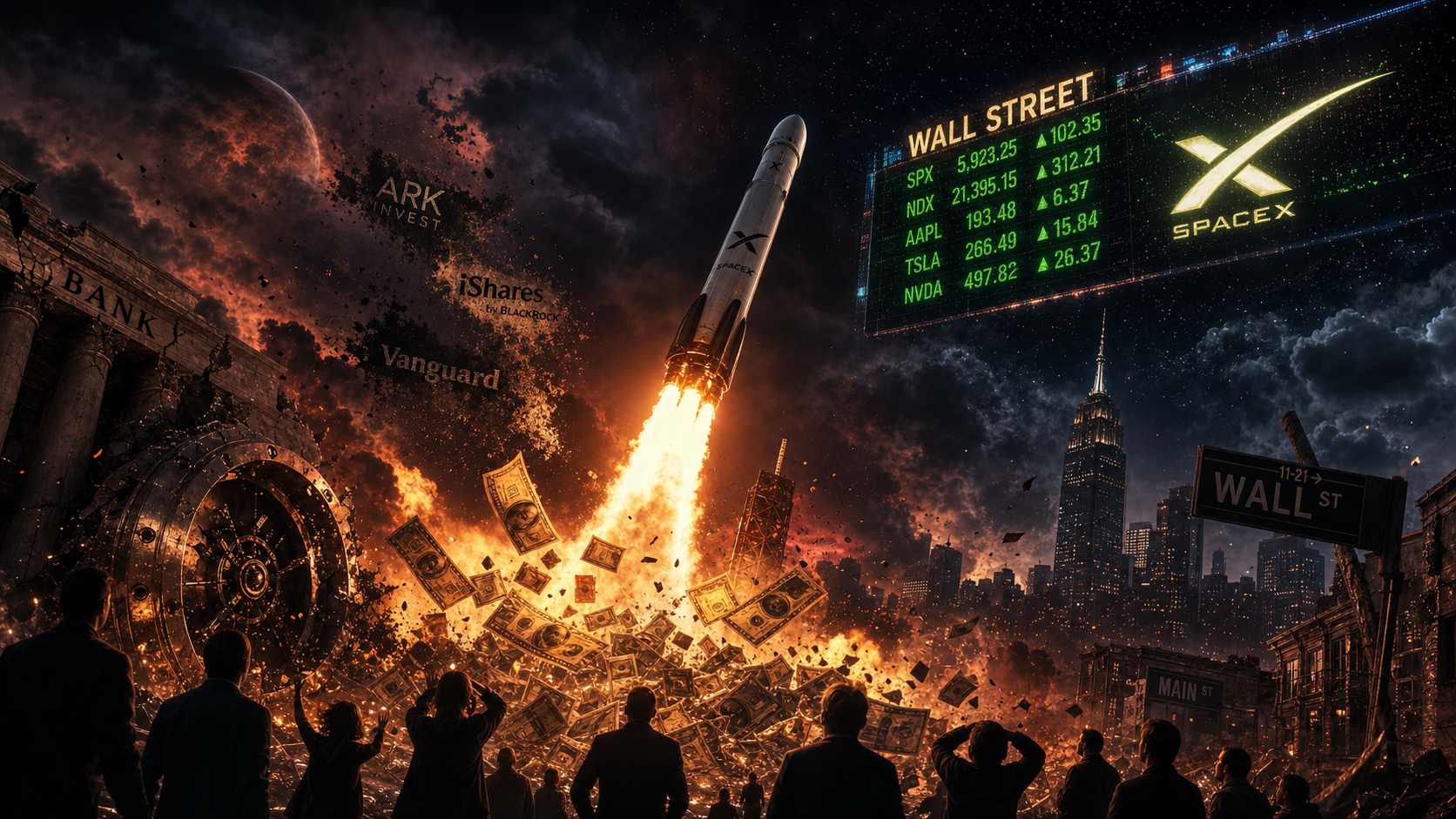
Modern-day bank robbery? The biggest legal redistribution of wealth in history: The SpaceX IPO and the architecture of a mega-deal – Image: Xpert.Digital
ETF savers are set to foot the bill: The brutal truth behind SpaceX's 1.75 trillion dollar deal
From Twitter to Mars: The ingenious but risky master plan behind the SpaceX IPO
The “Lex SpaceX”: How new Nasdaq rules are forcing millions of small investors into Musk’s empire
When SpaceX shares go public in June 2026, the financial world will not only be witnessing the largest initial public offering (IPO) in history – it will be the provisional culmination of an unprecedented financial feat. Through a complex, years-long series of mergers, Elon Musk has forged a $1.75 trillion empire from the struggling microblogging service Twitter, the highly unprofitable AI startup xAI, and the operationally powerful aerospace company SpaceX.
But behind the glittering promise of Mars missions and super-AIs lies a sophisticated architecture that serves primarily one purpose: the gigantic redistribution of debt and losses. Through tailor-made rule changes by the US stock exchange Nasdaq, millions of ETF savers around the globe will soon be made shareholders of this conglomerate without their consent. They will henceforth bear the risk for a company that is posting massive losses and in which Musk enjoys virtually unlimited power, while insiders realize gigantic profits. This article unravels the complex structure behind the mega-deal, illuminates the systemic risks, and clarifies who truly benefits from this historic wealth redistribution – and who ultimately foots the bill.
How Elon Musk merged loss-making companies into $1.75 trillion – and who ends up footing the bill
In October 2022, Elon Musk completed an acquisition that financial market observers viewed with skepticism from the outset: he bought the microblogging service Twitter for $44 billion – a price that many analysts considered significantly above its fair market value even then. What followed was not a strategic expansion, but an accelerated decline in value. Within a few months, advertising revenue plummeted as prominent advertising partners left the platform due to concerns about moderation policies. The investment fund Fidelity, one of the early investors in the acquisition, gradually reduced its stake – to a loss of approximately 78.7 percent compared to the original purchase price. In an internal stock allocation to employees in 2023, X, as the company was now called, was valued at just $19 billion – less than half the purchase price.
These figures are not insignificant; they are the starting point for everything that followed. Musk had paid an astronomical price for a company with massively shrinking advertising revenue, high debt burdens of around $13 billion, and a stagnant user base. Twitter was paying roughly $300 million a month in interest and principal on its debt—a financial millstone that overshadowed any operational improvements. Musk himself estimated his personal loss from the Twitter deal at around $24 billion.
The AI narrative as a lifeline: The path to xAI fusion
Instead of consolidating X, Musk chose a different path: He opened the next chapter in his merger strategy. In 2023, he founded xAI, an AI startup that developed the chatbot Grok and positioned itself in direct competition with OpenAI, Google DeepMind, and Anthropic. xAI's origin story is telling: It was a late entry into an already crowded market where competitors had built up a significant lead over the years. To become competitive, xAI had to invest enormous sums in computing infrastructure, AI chips, and engineers.
The financial results were sobering: In the first nine months of 2025 alone, xAI burned through roughly $7.8 to $8 billion in cash. For the entire year of 2025, the company projected a total loss of around $13 billion – with revenues of just $500 million. This equates to a loss ratio of more than 26 to 1: For every dollar earned, more than $26 was spent. By comparison, even the largest tech companies in their growth phase never exhibited anything close to such extreme cash burn rates.
In March 2025, the first consolidation step followed: X (formerly Twitter) was merged into xAI. The early Twitter investors who had financed Musk's $44 billion acquisition received xAI shares in exchange. A clever move: The liabilities and the X platform were embedded in the high-growth AI narrative, while the original lenders now held equity instead of debt. The combined entity – X plus xAI – was subsequently valued at around $113 billion. Whether this valuation had any substantial basis is questionable: The combined company was estimated to be burning through well over $12 billion per year, with minimal revenue from its own AI business.
SpaceX as an anchor: Solid core business, astronomical losses due to xAI
SpaceX itself is an exceptional company with genuine operational strengths. Its Starlink rocket and satellite internet segment is a legitimate market leader. In 2024, SpaceX increased its revenue by 51 percent to $13.1 billion. In 2025, revenue grew further to $18.67 billion. The core business—rocket launches and Starlink satellite internet—was indeed generating operating profit. Reuters reported in January 2026 that the company earned approximately $8 billion before special items on revenue of $15 to $16 billion.
But then, in February 2026, came the decisive step: SpaceX fully acquired xAI. According to the platform The Information, xAI was valued at $250 billion – with SpaceX itself valued at around $1 trillion, bringing the combined entity to a total value of $1.25 trillion. With this acquisition, xAI's enormous losses were directly transferred to SpaceX's books: The AI division recorded an operating loss of $6.35 billion in 2025, pushing SpaceX into the red on a consolidated basis – a net loss of approximately $4.94 billion.
At this point, a factual correction to the narrative circulating in the public sphere is important. Before the xAI acquisition, SpaceX itself was not a "loss-making company" in the true sense: its core business was profitable. The losses arose from the integration of the highly unprofitable xAI division. The combined loss rate of around $5 billion annually is still substantial – but it is the result of deliberate investment decisions in a capital-intensive growth strategy, not of a fundamentally broken company. This distinction is important for a serious analysis, even if it only alters the overall picture gradually.
The Bridge Loan: $20 billion in debt under a new flag
In March 2026, just weeks before the confidential filing of the IPO prospectus with the SEC, SpaceX secured a $20 billion bridge loan. This loan—taken out by an anonymous consortium of banks—replaced five existing credit facilities, including two loans originally attributable to X (formerly Twitter) and three lines of credit from xAI. In other words, the debts of the loss-making predecessor entities were consolidated under SpaceX and transferred into a single, newly structured instrument.
SpaceX's total debt thus decreased from $22.05 billion at the end of 2024 to $20.07 billion as of March 2, 2026 – a slight reduction, but not a substantial relief. The crucial clause: If the bridge loan is not repaid from other sources within six months of the IPO, SpaceX is obligated to use IPO proceeds for repayment. This means that a significant portion of the $75 billion SpaceX aims to raise in its IPO flows directly back to the banks – the very institutions that provided the loan, financed the acquisitions, and are now supporting the IPO. The cycle closes neatly.
This structure is technically legal and not unusual in the world of leveraged buyouts and mega-IPOs. However, it demonstrates how the entire transaction chain – from the Twitter acquisition to xAI and the SpaceX IPO – forms a coherent financial architecture, in which the participating banks profited at every step and will now benefit once again from the largest IPO in history.
Governance without a counterweight: Musk's complete control over a trillion-dollar company
Particularly noteworthy is the share structure that Musk designed for the SpaceX IPO. It's a two-class model: Class A shares, sold to public investors, carry one vote per share. Class B shares, reserved for Musk and select insiders, grant ten votes per share. The result: While Musk effectively owns roughly 42.5 to 43 percent of the company, with 83.8 to 85.1 percent of the voting rights, he de facto controls all key decisions.
Even more far-reaching: Musk simultaneously acts as CEO, CTO, and chairman of the board – and the only person with the formal authority to remove him from these roles is himself. A sunset clause, under which the special voting rights would expire after a certain period, is not included. Furthermore, the company's bylaws significantly restrict shareholders' rights to sue: jury trials are excluded, class action lawsuits against SpaceX or the IPO banks are prohibited, and arbitration is mandated instead. To even be eligible to file claims, investors must hold shares worth at least one million dollars or three percent of the company.
This governance model is not new – similar structures are used by Meta (Mark Zuckerberg), Alphabet (the Google founders), and previously by Snapchat. The difference, however, lies in the scale: With a valuation of $1.75 trillion and a single decision-maker without any institutional counterweight, a concentration of economic and corporate control is created that is unprecedented in the history of publicly traded companies. If a strategic error occurs – a misguided AI investment, a catastrophic Starship accident, a regulatory sanction – public shareholders have virtually no means of forcing a change of course.
The evaluation question: Is 1.75 trillion dollars justified?
With a valuation of $1.75 trillion and projected revenue of $18.67 billion in 2025, the price-to-sales ratio is approximately 94. Even when measured against EBITDA of $6.58 billion, the ratio exceeds 260. These figures do not reflect a sound business valuation—they reflect hope, narrative, and the promise of a future world.
The argument of the SpaceX proponents is familiar: Starlink, with billions of users worldwide, could become one of the most profitable communications companies in history. Starship—the giant rocket that has so far only completed test flights and suffered multiple explosive failures—is intended to eventually enable hourly launches and transport solar-powered data centers into space. Musk himself estimates that this approach will be the cheapest way to generate AI computing power within two to three years. This is a bet on technologies that don't yet exist, against timelines that Musk, by his own admission, regularly pushes back significantly.
Morningstar analysts point out that despite strong revenue growth, SpaceX continues to post net losses, reflecting the enormous capital intensity of the business. Stock market researcher Rob Arnott, quoted in Handelsblatt, sums it up succinctly: With such high valuations, a lot can go wrong, and the upside potential for new shareholders is limited. The comparison with Saudi Aramco is revealing here: Aramco raised approximately $25.6 billion at its 2019 IPO and was a highly profitable company with enormous cash flows. SpaceX aims to raise three times that amount – $75 billion – with a consolidated net loss of nearly $5 billion.
Our US expertise in business development, sales and marketing

Our US expertise in business development, sales and marketing - Image: Xpert.Digital
Industry focus areas: B2B, digitalization (from AI to XR), mechanical engineering, logistics, renewable energies and industry
More information here:
A thematic hub offering insights and expertise:
- Knowledge platform covering global and regional economies, innovation and industry-specific trends
- A collection of analyses, insights, and background information from our key areas of focus
- A place for expertise and information on current developments in business and technology
- A hub for companies seeking information on markets, digitalization, and industry innovations
How Nasdaq's "SpaceX Law" affects millions of ETF savers
The Nasdaq rule change: Tailor-made for a single purpose
One of the most remarkable aspects of the entire SpaceX IPO saga is the way market infrastructures were altered in the lead-up to the transaction. In March 2026, Nasdaq proposed a new "Fast Entry" rule, which took effect on May 1, 2026. This rule allows companies whose market capitalization places them among the top 40 of the Nasdaq-100 to be included in the index just 15 trading days after their IPO—instead of the previous waiting period of up to one year.
At the same time, the previous minimum requirement of ten percent free float for index inclusion was abolished. Instead, the rule now is: If the free float is below 20 percent, the company is weighted at three times its actual free float. For SpaceX, which currently only has around 2.86 to 3.75 percent of its shares publicly listed, this means a constructed index weight of approximately $225 billion – without any corresponding actual trading activity.
Reports indicate that SpaceX advisors actively negotiated these very rule changes with index providers. Nasdaq thus did what is sometimes referred to in financial journalism as "Lex SpaceX": it created a tailor-made exception for a single issuer. In the investment world, the independence of index providers from the listed companies is considered a fundamental prerequisite for the integrity of passive investment strategies. This boundary was at least partially blurred here.
The ETF problem: How millions of small investors are being forcibly invested
The consequences of this rule change for retail investors are significant. The Nasdaq-100 is one of the world's most widely used benchmark indices. Products like the popular Invesco QQQ ETF and numerous European replicas collectively manage trillions of dollars in assets. If SpaceX is included in the Nasdaq-100 15 trading days after its IPO, all these passive funds will be obligated to buy SpaceX shares—not because their fund managers find the company fundamentally attractive, but because they are required to replicate the index.
Analysts estimate that the inclusion of the Nasdaq-100 alone could trigger forced purchases of up to $12 billion. If the MSCI World, the CRSP Total Market Index, and the Russell 1000 are also included, the total amount of forced purchases from passive funds could rise to nearly $19.9 billion – roughly 26 percent of the total IPO volume would thus be directly absorbed by passively managed index products. Experts believe that an additional $5 billion in purchases could be added on the day of the index inclusion alone.
The perverse aspect of this mechanism is that the lock-up period for early insiders also gradually ends precisely when SpaceX is added to the index. The IPO prospectus stipulates a staggered release of insider shares: After the first quarterly report as a publicly traded company, insiders are permitted to sell up to 20 percent of their shares, and even 30 percent if the share price performs 30 percent above the IPO price. Early investors who acquired their SpaceX stakes at valuations well below $100 billion will thus be dumping their shares into a market with profits of 50x, 100x, or more, a market simultaneously flooded with passive ETF buyers. This isn't a conspiracy—it's the inherent logic of a market structurally optimized in favor of early investors.
Comparison with previous crises: Copy & paste from the financial crisis playbook?
The comparison with the US financial crisis of 2007–2009, which is occasionally drawn in public debates, is rhetorically effective but analytically inaccurate and should be differentiated. The subprime crisis was based on the systematic securitization and concealment of bad loans in complex financial instruments rated AAA by rating agencies—a collective failure of regulatory, institutional, and private sector actors at all levels. Nobody really knew what was in the CDOs.
The situation with the SpaceX IPO is different: This is a company with real revenue, an established technological lead, and a proven operational core. The risks are not hidden – they are detailed in the S-1 prospectus. Anyone buying SpaceX shares knows, or should know, that they are investing in a loss-making consolidated company with an all-powerful founder and an ambitious, yet unproven, technology strategy. These are not securitized subprime mortgages.
Nevertheless, there are structural parallels that should be cause for concern. In both cases, certain market participants—early investors, investment banks, deal arrangers—benefit disproportionately, while the last buyers in the chain bear the highest valuation risk. In both cases, regulatory and institutional changes artificially steer capital flows—back then through loose lending, today through adjusted index rules. And in both cases, the crucial transmission belt is the retail investor, who, via savings products or fund savings plans, is at the end of the process: once through mortgage insurance, today through ETF savings plans in the Nasdaq-100. The societal damage in the event of a spectacular correction would not be comparable to the systemic collapse of 2008, but it would be felt by millions of households.
The geopolitical dimension: State dependency as an invisible risk
Another aspect often overlooked in the IPO euphoria is the deep entanglement between SpaceX and the US government. SpaceX is one of the most important contractors for NASA and the US Department of Defense. According to reports, the US government has pledged payments to SpaceX totaling $57.7 billion. Starlink plays a strategic role in NATO infrastructure, as the war in Ukraine has vividly demonstrated.
This dependence on government funding is a double-edged sword: On the one hand, it guarantees stable revenues and a kind of implicit political insurance against market failures. On the other hand, it makes SpaceX vulnerable to regulatory decisions, political shifts, and the loss of government contracts. Musk's growing political role in the US—his close ties to the Trump administration and his influence through DOGE—creates an unprecedented conflict of interest between a private company and government power. This proximity can quickly prove to be a risk factor if political landscapes shift. A company so heavily reliant on government contracts, and whose owner is also a politically exposed person, faces systemic risks that cannot be adequately captured by conventional discounted cash flow analysis.
Outlook: What could happen after the IPO
Immediately after the initial public offering – planned for June 12, 2026 – market forces will kick in: passive funds will buy, early insiders will await their lock-up release, and analysts will begin developing valuation models for a company that is simultaneously a space corporation, an AI developer, a satellite communications firm, and a social media platform. The predictable result will be a significant valuation range between bull and bear cases.
A sharp correction within the first 12 to 24 months after the IPO is not unlikely. Historically, many of the most spectacular IPOs have exhibited significant underperformance in their initial phase: Alibaba lost considerable value within months of its record-breaking IPO, Saudi Aramco traded below its issue price for a long time, and Facebook plummeted by more than 50 percent in the first few months after its IPO in May 2012. SpaceX is being acquired by the last buyers in the chain—namely, passive ETF investors and retail investors—at a price that already reflects all optimistic scenarios. The risk-return profile for this buyer group is therefore structurally unfavorable.
It's clear who really benefits from this IPO: the early SpaceX employees and venture capital investors who bought in at valuations below $50 billion; the investment banks that accompanied every step of the merger chain and are now handling the largest IPO in history; and Elon Musk himself, who, through his roughly 43 percent economic stake at a valuation of $1.75 trillion, theoretically holds a fortune of around $750 billion – which could make him the first trillionaire in history if the share price continues to rise.
Economic Conclusion: Between Innovation and Financial Architecture
The transaction chain analyzed here—from Twitter to X to xAI, then to SpaceX and finally to the IPO—is neither a conspiracy nor a simple fraud. It is the highly complex financial architecture of an exceptional entrepreneur who has woven together regulatory loopholes, market psychology, political connections, and technological narratives into a coherent deal. Whether Starship will ever deliver the promised hourly launches, whether data centers in space will become profitable, whether Starlink will maintain its growth trajectory—these questions remain open and will determine the actual performance of SpaceX stock in the coming years.
What is certain is that the redistribution of capital from the broad spectrum of ETF savers to early insiders and accompanying banks is occurring on a scale unprecedented in the history of capital markets. Investors who contribute to Nasdaq-100 ETFs should be aware that, by summer 2026 at the latest, they will involuntarily become shareholders of a consolidated AI, aerospace, and media conglomerate with massive losses, minimal shareholder control, and a valuation that dwarfs even optimistic cash flow projections. This is not an argument against investing in indices—it is an argument for informed decision-making in an era where the lines between financial architecture and technological promise are increasingly blurred.
🎯🎯🎯 Data-driven B2B industry hub as a quasi-in-house solution

The quasi-in-house solution: How Xpert.Digital closes operational gaps in B2B marketing and sales – Smart Content-Driven Business - Image: Xpert.Digital
Xpert.Digital is a data-driven B2B industry hub led by Konrad Wolfenstein . The company acts as an external, quasi-in-house solution for industrial partners, closing operational gaps in marketing, content, and sales – without requiring additional resources on the client side.
More information here:
Your global marketing and business development partner
☑️ Our business language is English or German
☑️ NEW: Correspondence in your native language!

Konrad Wolfenstein
I and my team are happy to be available to you as your personal advisor.
You can contact me by filling out the contact form here [email protected]:or simply call me at +49 7348 4088 965. My email address is
I'm looking forward to our joint project.










