
A DIY project from Berkeley shows who really controls the robot supply chain – certainly not the USA
Xpert Pre-Release

Available in 27 languages 📢
Prefer Xpert.Digital on GoogleⓘPublished on: August 23, 2026 / Updated on: August 23, 2026 – Author: Konrad Wolfenstein
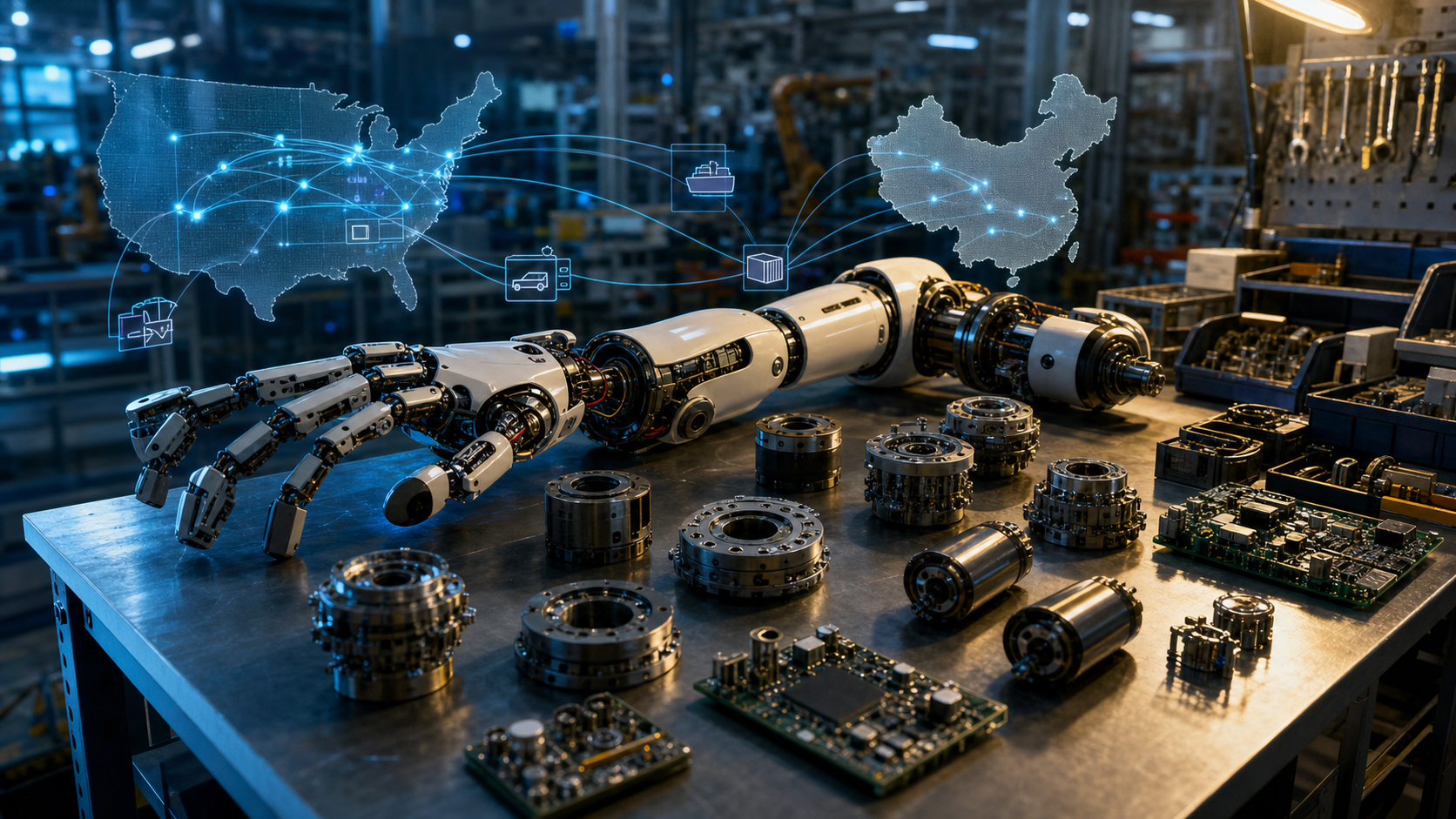
A DIY project from Berkeley shows who really controls the robot supply chain – certainly not the USA – Image: Xpert.Digital
This $5,000 3D-printed robot exposes America's biggest industrial illusion
The bill of materials of truth: Why Tesla's Optimus would be unaffordable without China
This project shatters the myth of Western tech sovereignty – How 3 simple components are becoming the global Achilles' heel
An open-source robot, 3D-printed for just $5,000, is currently revolutionizing research – and simultaneously exposing the Achilles' heel of the Western technology industry. The "Berkeley Humanoid Lite" project from the University of California impressively demonstrates that the hurdles to humanoid robotics no longer lie in physics, but almost exclusively in price. However, a closer look at the revolutionary robot's parts list reveals an uncomfortable geopolitical truth: more than half of the material costs go toward core Chinese components. While US authorities are reacting with new, strict restrictions to enforce domestic production, reality paints a completely different picture: without Shenzhen, even multi-billion-dollar prestige projects like Tesla's Optimus would face insurmountable cost problems. This is an in-depth analysis of the deceptive illusion of technological sovereignty, a fatal regulatory flaw, and the true power dynamics in the global race to automate the future.
The five-thousand-dollar robot and the illusion of sovereignty: A DIY project from Berkeley exposes America's industrial Achilles' heel
In the spring of 2025, a research team at the University of California, Berkeley, published a project that caused a considerable stir in the robotics community, though its political implications only became apparent in the summer of 2026. The "Berkeley Humanoid Lite" is a humanoid robot whose complete blueprints, firmware, and training algorithms are openly available online. Anyone with a standard 3D printer with a build volume of 200 x 200 x 200 millimeters can print the robot's structure themselves and assemble it with readily available components into a functional, 0.8-meter-tall bipedal robot. Material costs are around US$4,312 in the United States and only about US$3,236 in China. By comparison, commercial humanoid research platforms typically cost between US$80,000 and well over US$100,000. With this, Berkeley has eliminated a cost factor of almost two orders of magnitude and made humanoid robotics widely accessible to universities, start-ups and hobbyists for the first time.
Technically, the project is by no means a toy. The 22 joints are driven by 3D-printed cycloidal gears that achieve a mechanical efficiency of around 90 percent – a figure comparable to significantly more expensive, industrially manufactured gears. The researchers conducted long-term stress tests and demonstrated that components manufactured on different printers deliver consistent performance. This is no trivial finding, as additive manufacturing is generally considered susceptible to quality variations between different machines and batches. The real scientific message is this: The physical and technical hurdles for humanoid robotics were never the real bottleneck. The bottleneck was price. If a research project can show that a functional humanoid robot can be built for less than five thousand dollars, then the crucial justification for the existing market order collapses, a market in which entire research departments were dependent for years on a few extremely expensive platforms like those from Boston Dynamics or Unitree.
The bill of materials as an incorruptible witness to a geopolitical truth
However, a closer look at the Berkeley robot's parts list reveals a second, far more unsettling message. Of the total cost of $4,312, $2,298—roughly 53 percent—is attributable to just 22 actuators based on Chinese drone motors. Ten high-torque 6512 actuators cost $188 each, while twelve lighter 5010 units come in at $136 each. And that's before even factoring in the mini-PC, CAN bus adapters, bearings, and battery. A top-tier lab, deliberately optimizing for components that any user could actually buy, ended up with Shenzhen. This is no accident, nor is it negligence on the part of the researchers; it's simply the economically rational outcome of a free, global procurement market. It's also the most honest audit report the American robotics supply chain has received this year, even if it was never intended as such.
This finding can be both supported and put into perspective by independent market analyses, because Berkeley is not an isolated case, but rather the norm. According to calculations by Morgan Stanley in the widely cited report "Humanoid 100," China controls approximately 63 percent of the entire global supply chain for humanoid robotics and around 45 percent of what is referred to as the robot's body—that is, the physical hardware that enables movement in the first place. A Wall Street Journal study, cited by several industry analysts in the summer of 2026, found that around 61 percent of core components for ten American humanoid robot startups came from China. For Tesla, whose Optimus robot is considered the most prominent American project, it is estimated that completely eliminating Chinese suppliers would drive the manufacturing costs of the second generation from around $46,000 to approximately $131,000. In October 2025, Tesla awarded a contract worth approximately 685 million US dollars to the Chinese actuator manufacturer Sanhua Intelligent Controls, which is considered the exclusive supplier for the drive units of Optimus.
Why every robot joint contains three bottlenecks
To understand why actuators have become the bottleneck, it's worth taking a look at their technical composition. A single actuator, the motorized drive unit in a robot joint, essentially consists of three particularly sophisticated components. First, the neodymium-iron-boron permanent magnets inside the motor, which generate the necessary magnetic field. A single Tesla Optimus robot requires an estimated 3.5 kilograms of these magnets. According to various analysts, China controls around 69 percent of the world's rare earth mining and between 85 and 93 percent of its processing into finished magnets. Second, the harmonic gears, which translate the high rotational speed of a motor into slow, high-torque joint action with backlash-free precision in the micrometer range. Here, the Japanese manufacturer Harmonic Drive Systems traditionally holds around 55 percent of the global market share, while Chinese competitors like Leaderdrive have now reached approximately 38 percent market share in terms of units, but still lag behind the Japanese quality level by 20 to 30 percentage points in precision applications. Thirdly, there are the planetary roller screw drives for load-bearing joints such as knees and hips, which also require precision grinding in the micrometer range.
Including precision bearings and final assembly, several independent analysts estimate that China accounts for around 70 percent of the entire component supply chain for humanoid robots. The crucial structural reason for this lies not in a sudden superiority of Chinese engineering, but in its close integration with the domestic electric vehicle industry. Motors, magnets, transmissions, and power electronics for humanoid robots essentially require the same manufacturing processes as electric vehicle powertrains, only on a smaller and more precise scale. Because China has become the world's largest producer of electric vehicles in the past decade, it already possesses the industrial base, the supply chain infrastructure, and the concentrated regional resources to manufacture these components on a large scale and at low cost. In the Pearl River Delta around Shenzhen, virtually every required component, from brushless DC motors and depth cameras to force- and torque-sensitive sensors, can be sourced within a radius of about 100 kilometers, often with a delivery time of just a few days for initial samples.
An American agency is drawing a line that hardly anyone can follow
It was precisely at this moment of structural dependency that the American communications regulatory authority, the Federal Communications Commission (FCC), made a momentous decision on July 28, 2026. For the first time, it included advanced robotic devices manufactured abroad in its so-called "Covered List," a list of communications equipment classified as a national security risk. This applies to mobile mechanical devices, including explicitly humanoid robots, quadrupedal robots, and other wheeled or tracked ground platforms, provided they weigh more than 4.4 pounds, have environmental sensors, network connectivity of at least 200 kilobits per second, and autonomous control software. This definition is deliberately broad and, according to the agency, explicitly includes ordinary consumer products such as robotic vacuum cleaners or robotic lawnmowers, as long as the technical criteria are met. Exemptions include, among other things, connected road vehicles, rail vehicles, unmanned aerial and underwater vehicles, and medical and surgical robotic systems.
The crucial mechanism of this regulation lies in the definition of domestic production. To qualify as a so-called domestically produced finished product and thus remain exempt from the list, a device must be manufactured in the United States, and the cost share of its domestically produced components must exceed 65 percent of the total cost of all components—a figure slated to rise to 70 to 75 percent by 2029. Devices that do not meet this threshold are considered to be produced abroad and will no longer be eligible for new device certification from the Department of Defense, effectively amounting to a ban on importing, marketing, and selling them in the United States. Already certified models remain unaffected by the regulation and may continue to be imported, sold, and used; software and firmware updates for these existing devices are also permitted through an exemption until at least the beginning of 2029. Manufacturers whose products fail to meet the threshold can apply for conditional approval from the U.S. Department of Defense, but this requires them to disclose extensive information about their ownership structure, investors, supply chains, and software architecture.
🎯🎯🎯 Data-driven B2B industry hub as a quasi-in-house solution

The quasi-in-house solution: How Xpert.Digital closes operational gaps in B2B marketing and sales – Smart Content-Driven Business - Image: Xpert.Digital
Xpert.Digital is a data-driven B2B industry hub led by Konrad Wolfenstein . The company acts as an external, quasi-in-house solution for industrial partners, closing operational gaps in marketing, content, and sales – without requiring additional resources on the client side.
More information here:
Humanoid robotics: Why political directives fail in the face of industrial reality
When regulation and reality run in opposite directions
When this new regulation is compared with actual procurement data from Berkeley and market analyses of Tesla, Figure, Agility Robotics, and other American humanoid robot startups, a glaring contradiction emerges. The "Berkeley Humanoid Lite," with its 53 percent share of Chinese actuator costs in its total material value, falls far short of the required 65 percent domestic value-added threshold—and this is without even considering all the other imported small parts. A similar situation, albeit to varying degrees, applies to virtually every other humanoid robot project currently being developed in America, as demonstrated by the approximately 61 percent share of Chinese core components in ten American startups studied. The regulatory authority has thus set a target that is virtually impossible to achieve in the current industrial landscape. To put it bluntly, they have adopted a policy for robots but failed to prepare a bill of materials from which these robots could actually be built.
This gap between regulatory requirements and industrial capacity is not an American oddity, but rather the symptom of a structural problem that will take years, not a quarter, to close. Building an independent, competitive manufacturing base for precision gearboxes, permanent magnets, high-torque electric motors, and the associated sensors requires investment in production facilities, years of process optimization, the development of a skilled workforce, and, above all, a critical mass of demand to make such manufacturing economically viable. China did not build this base overnight, but developed it over a decade in parallel with the explosive growth of its electric vehicle industry – through targeted government industrial policy, regional support at the provincial level, and a large domestic customer base comprised of manufacturers like Unitree, AgiBot, and Fourier Intelligence. A comparable development in the United States or in Europe cannot be enforced by a single regulation, but requires a similarly long-term industrial policy effort, which so far is only visible in its beginnings, for example in the form of isolated investment announcements such as the 90 million US dollar relocation of robotics manufacturing capacities by the Japanese-American manufacturer Fanuc from Japan to Michigan.
Tokyo, Seoul and Taipei as short-term lifelines
As long as an independent American manufacturing base for precision components does not exist, the only realistic short-term solution to the one-sided dependence on China remains: diversifying procurement through allied Asian countries. In this context, Japan, South Korea, and Taiwan are no longer mere trading partners, but rather the only readily available access to motors, encoders, and semiconductors that are not exclusively sourced from a single geopolitical region. Japan still maintains its technological leadership in high-precision harmonic drives through companies like Harmonic Drive Systems, Nabtesco, and Sumitomo, particularly in the high-performance segment with a backlash of less than one arcminute, where Chinese suppliers, despite their rapid catch-up efforts, still lag significantly behind. South Korea and Taiwan, in turn, possess established expertise in power electronics, precision bearings, and semiconductor manufacturing, which are essential for control electronics and sensors in robotic systems. According to calculations by McKinsey, for example, Japan accounts for 20 percent of the world market for driver boards and power electronics, and South Korea for 15 percent, while Japan (30 percent) and Germany (15 percent) also hold significant shares in encoders and position sensors.
These three countries effectively constitute the only viable counterweight within a timeframe of just a few years, because they already possess world-class industrial capabilities and are also close security partners of the United States. Interestingly, a closer look at the supply chain reveals that this dependency is by no means one-sided. Chinese robot manufacturers are also heavily reliant on foreign technology, particularly in the area of computing power for training control software, where, according to Alpine Macro, around 87 percent of Chinese training computing power still relies on American semiconductors, and in high-precision Japanese RV gearboxes, which are used in approximately 73 percent of the high-torque, heavy-duty joints of Chinese robots. The supply chain is therefore less a one-way power imbalance than a finely balanced system of mutual dependencies, in which each side possesses structural leverage at different points. This also explains why purely protectionist measures like the new FCC rule can hardly be implemented effectively in isolation without simultaneously securing access to precisely those allied supplier countries that could close the actual gap.
From ideological project to risk management tool
A significant shift in the perception of this issue concerns the underlying motivation. Just a few years ago, the debate surrounding the reshoring of production chains was primarily conducted as a political project, driven by slogans such as national pride, job security, or trade retaliation. The nature of this debate has since fundamentally changed. Reshoring, the relocation of manufacturing capacity back to its original location, is no longer an ideological position but has become a pragmatic risk management tool. Companies and governments alike have recognized that the concentration of critical components such as rare-earth magnets, precision gears, or semiconductors in a single geopolitical region represents a structural risk of failure that can materialize at any time in trade conflicts, export controls, or geopolitical tensions. The Chinese export controls on rare-earth magnets in April 2025 demonstrated precisely this mechanism in practice when, according to public statements by Elon Musk, they directly impacted the production of the Optimus robot.
This shift from an ideologically motivated to a risk-based approach has far-reaching consequences for the next five years. Every major economic region, be it the European Union, Japan, India, or the United States, will have to establish its own industrial bases for critical robotics components during this period, regardless of the political orientation of its government. This does not necessarily mean a complete decoupling from China, which would hardly make economic sense given the enormous cost advantages of manufacturing there, but rather a deliberate diversification of sources of supply in order to have alternative supply routes available in the event of a crisis. This is precisely where the true strategic importance of Japan, South Korea, and Taiwan lies as bridging technology suppliers. While they may not offer the lowest prices themselves, they possess the necessary technological depth and political reliability to serve as a fallback option if needed.
The real race has only just begun
Market forecasts for humanoid robotics paint a picture of rapid acceleration. According to various industry observers, Chinese manufacturers will have produced between 80 and almost 90 percent of all humanoid robots shipped worldwide by 2025, with Unitree and AgiBot alone delivering over ten thousand units, while leading Western companies like Tesla, Figure, and Agility Robotics each only managed around 150 units. This discrepancy is not primarily due to a lag in control software or the underlying AI models, where Western providers, particularly from the United States, continue to be leaders, but rather to the already extensively described vertical integration of manufacturing. For the next phase of market development, in which the question is no longer whether affordable humanoid robots will arrive, but merely when and in what quantities, the decisive decisions will be made not in research labs, but on the factory floors producing gears, magnets, and sensors.
For companies that invest in robotics, automation, or related technology fields, or that plan to integrate such technologies into their business models, this has a clear strategic consequence. Those who rely solely on a single geopolitical source of influence are taking a risk that is likely to increase rather than decrease in the coming years, given the growing willingness of governments worldwide to use trade restrictions as a geopolitical tool. At the same time, the example of Berkeley vividly illustrates that the democratization of technology and the geopolitical concentration of manufacturing capacity are two parallel, partially contradictory developments. Open, freely accessible research drastically lowers the barriers to entry for new players, while the underlying physical manufacturing remains concentrated in a few geographic clusters. This tension will shape the robotics industry and the industrial policy surrounding it for the foreseeable future, and anyone who carefully reads a robot's bill of materials understands the true power dynamics in this sector better than any political pronouncements.
Your global marketing and business development partner
☑️ Our business language is English or German
☑️ NEW: Correspondence in your native language!

Konrad Wolfenstein
I and my team are happy to be available to you as your personal advisor.
You can contact me by filling out the contact form here [email protected]:or simply call me at +49 7348 4088 965. My email address is
I'm looking forward to our joint project.
☑️ SME support in strategy, consulting, planning and implementation
☑️ Creation or realignment of the digital strategy and digitization
☑️ Expansion and optimization of international sales processes
☑️ Global & Digital B2B trading platforms
☑️ Pioneer Business Development / Marketing / PR / Trade Fairs
📈🚀 From visibility to trust 👀🤝 Your scalable path with Xpert.Digital

From visibility to trust: Your scalable path with Xpert.Digital - Image: Xpert.Digital
In industrial B2B, sustainable business relationships rarely emerge overnight. They develop step by step – through visibility, professional relevance, recurring touchpoints, and growing trust. Xpert.Digital's 4-stage model addresses precisely this: It offers a structured path that begins with a manageable entry point and can evolve into deeper collaboration in business development if needed.
Instead of relying on loud marketing promises, this model puts the relationship at the forefront. Companies start with clearly defined, easily calculable measures and then decide, based on their own experience, how far they want to expand the collaboration. A key factor for this undisturbed trust-building process: The platform completely avoids annoying advertising ads, so the editorial focus remains solely on the companies' expertise.
More information here:









