
Steel, silicon and artificial intelligence: Who will win the race of humanoid robots?
Xpert Pre-Release

Available in 27 languages 📢
Prefer Xpert.Digital on GoogleⓘPublished on: April 12, 2026 / Updated on: April 12, 2026 – Author: Konrad Wolfenstein
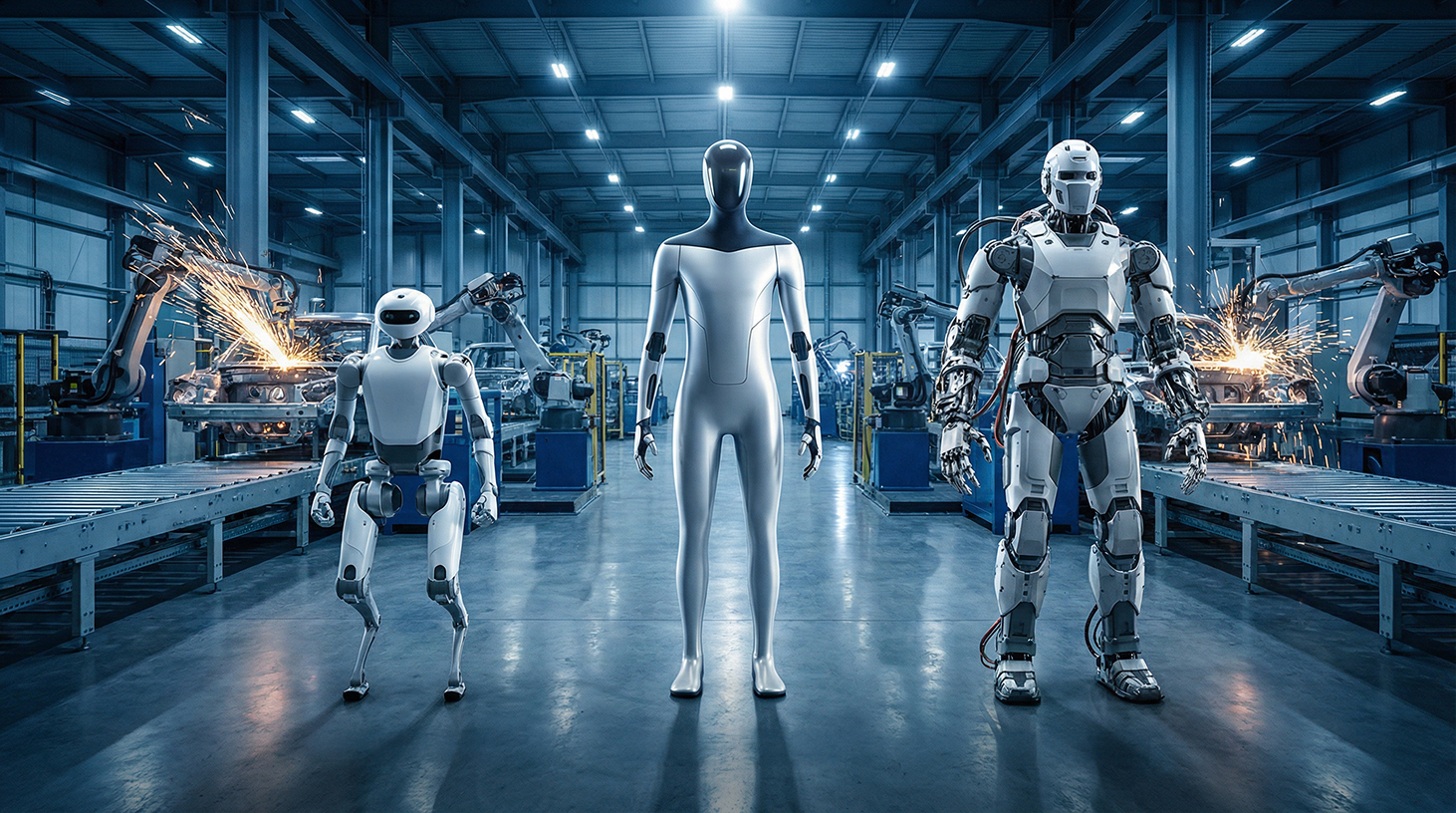
Steel, silicon, and artificial intelligence: Who will win the humanoid robot race? – Image: Xpert.Digital
Tesla, Figure or China Disruptor: Which humanoid robot will conquer our factories?
Artificial intelligence gets a body: These are the 3 most important robots in the world
Tesla Optimus vs. OpenAI partner: The bitter battle for the factory of the future
From science fiction straight to the assembly line: We are currently witnessing the breakthrough of "physical AI." Humanoid robots are no longer clumsy laboratory experiments or mere trade show gimmicks, but are performing hard work in real factories. Whether at BMW in automotive production, in gigantic logistics centers, or as an ambitious scaling project – the machines are increasingly taking over complex tasks. But behind this revolution rages a battle of philosophies: Will Tesla's mass-market prestige project prevail? Will the extremely affordable and open disruptor from China win? Or will an AI-powered industrial pioneer, which has already proven itself at BMW, define the new standard? We compare the three most important platforms of our time – Unitree G1, Tesla Optimus, and Figure 02 – and show who is truly leading the race for the automation of tomorrow.
Three machines, three philosophies – and the question that defines the factory of the future
If you wanted to measure the state of robotics by a single data point, this would be it: In 2025, the humanoid robot Figure 02 from Figure AI worked ten-hour shifts daily for over ten months at the BMW plant in Spartanburg, supporting the production of over 30,000 BMW X3 vehicles. The robot moved over 90,000 components, took approximately 1.2 million steps, and logged roughly 1,250 operating hours. What sounds like a footnote from a science fiction film is the result of a real-world industrial pilot project – and the starting point for what industry observers are calling the beginning of the age of "physical AI." The humanoid robot market reached a volume of $2.9 billion in 2025, and Goldman Sachs predicts it will rise to $38 billion by 2035.
2026 is the year these machines cease to be mere conference demonstration objects and begin performing real work. Boston Dynamics' Atlas robot sequences auto parts at Hyundai. Agility Robotics' Digit has moved over 100,000 storage boxes in a GXO warehouse. Tesla has over 1,000 Optimus units deployed in its own factories. Three platforms have emerged as the key players, around which a fundamental debate about technological philosophies is unfolding: Unitree G1, Tesla Optimus, and Figure 02.
Unitree G1: The accessible disruptor from China
The Unitree G1 is the democratization project of humanoid robotics. With a starting price of $13,500 to $16,000 for the education version and an upgrade to $43,000 for the enterprise configuration, it is the only robot in this comparison that is currently available for global order without a waiting period. For research labs, universities, and companies seeking a platform for experimentation, there is currently no serious alternative.
Technically speaking, the G1 is a compact humanoid with a height of 127 to 138 centimeters and a weight of 35 to 47 kilograms. Depending on the configuration, its degrees of freedom (DOF) range from 23 to 43, which—especially with the optional 12-DOF gripping hands in higher configurations—enables exceptional agility and manual dexterity. Its walking speed is approximately 2 meters per second, with sprint prototypes achieving speeds of 3.3 meters per second. The payload capacity is relatively low at 2 to 3 kilograms per arm, which is a limitation for heavy industrial tasks.
What makes the G1 particularly attractive to the research community is its open software architecture. Full support for ROS2, Python, and C++, along with native integration into NVIDIA's Isaac simulation environment, makes it the preferred development platform for AI-based motion control and reinforcement learning experiments. With over 1,000 units already shipped, Unitree also boasts an active developer community that is continuously developing new capabilities and application scenarios. The Unitree brand also owes its international visibility to spectacular demonstrations: at the 2026 Chinese New Year celebrations, G1 robots performed kung fu choreography and backflips – viral proof of this platform's exceptional agility.
To put it succinctly, the G1 is the platform for all those who want to research, develop and experiment today – not for those who want to industrially automate a factory floor tomorrow.
Tesla Optimus: The mass-market humanoid with the greatest AI ambitions
Tesla Optimus pursues a fundamentally different strategy. While Unitree focuses on availability and openness, Tesla prioritizes vertical integration, AI depth, and industrial scalability. The Optimus Gen 2 (and the Gen 3 currently under development) is designed for human body dimensions: 1.73 meters tall and weighing between 55 and 73 kilograms. Its payload capacity of over 20 kilograms places it in a completely different league than the G1, making it suitable for realistic industrial load-handling tasks.
Tesla's strategic trump card lies in its AI infrastructure. The Optimus system draws on training data from teleoperation, human demonstrations, factory data, and—most importantly—the vast data trove from Tesla's vehicle fleet. The neural networks that power Tesla's "Full Self-Driving" are directly transferred to the robot, promising a tremendous advantage in environmental perception and decision-making. Demonstrations showcase sensitive handling, small parts sorting, and human-like grasping behavior.
The target price is between $20,000 and $30,000 – which, given Tesla's production ambitions (currently over 1,000 units in its internal factory) and the economies of scale in automotive manufacturing, seems achievable in the medium term. The criticism: Optimus is currently only used internally at Tesla and has not yet undergone any independent external validation. Furthermore, the controversy surrounding the 2024 "We Robot" presentation, in which Optimus acted at least partially remotely, has drawn skeptics who doubt its claimed autonomy.
Optimus is the project with the most transformative potential, but also the highest degree of uncertainty. Tesla is building on scalability, an AI-centric philosophy, and the disruptive power of mass production – if this strategy succeeds, Optimus could become the best-selling humanoid industrial device of the next decade.
Figure 02: The industry pioneer with the best track record
Figure 02, as of 2026, is the robot with the most compelling real-world industrial proof of concept. Its ten-and-a-half-month production run at BMW in Spartanburg—with ten-hour shifts daily, 90,000 moving parts, and its contribution to the production of 30,000 X3 vehicles—marks the first time a humanoid robot has been successfully and sustainably integrated into a high-volume production environment. It met precisely the endurance and precision requirements of the automotive industry. This milestone has shifted the global discussion from large language models to large behavioral models and is considered a catalyst for the physical AI boom of early 2026.
Technically, the Figure 02, with a height of 1.70 meters, a weight of approximately 70 kilograms, and a payload capacity of 25 kilograms, is well-positioned for heavy-duty industrial tasks. With over 40 degrees of freedom, it surpasses both the G1 and the Optimus in dexterity. The partnership with OpenAI gives the system special AI capabilities: Figure 02 is trained in natural language and understands voice commands for task execution in real time. The so-called Helix AI provides the robot with visual, speech, and action understanding.
The Figure 02's weakness lies in its limited commercial availability: the robot is currently only accessible to research partners and selected industry partners – it is not available for general purchase. For companies looking to implement an industrial humanoid solution today, this limitation is significant. However, Figure AI is actively working on scaling up production, and the BMW success is being used as a blueprint for future applications.
🎯🎯🎯 Data-driven B2B industry hub as a quasi-in-house solution

The quasi-in-house solution: How Xpert.Digital closes operational gaps in B2B marketing and sales – Smart Content-Driven Business - Image: Xpert.Digital
Xpert.Digital is a data-driven B2B industry hub led by Konrad Wolfenstein . The company acts as an external, quasi-in-house solution for industrial partners, closing operational gaps in marketing, content, and sales – without requiring additional resources on the client side.
More information here:
Humanoids 2026: Who will win the race for AI supremacy?
The three-way table: A direct comparison
| feature | Unitree G1 | Tesla Optimus Gen 2 | Figure 02 |
|---|---|---|---|
| Price | $13,500–$43,000 | ~$20,000–$30,000 (target) | Not freely available for purchase |
| Availability | Instantly, worldwide | Internal / 2026 | Research partners only |
| Height | 127–138 cm | ~173 cm | ~170 cm |
| Weight | 35–47 kg | 55–73 kg | ~70 kg |
| Degrees of freedom | 23–43 DOF | 28 DOF | 40 DOF |
| payload | 2–3 kg | 20 kg | 25 kg |
| Walking speed | 2 m/s (up to 3.3 m/s sprint) | ~2.1 m/s | ~1.5 m/s |
| AI strength | NVIDIA Isaac, Reinforcement Learning | Tesla FSD infrastructure | OpenAI Helix-VLA model |
| Proof of practical experience | 1,000 units worldwide | 1,000 internal employees at Tesla | BMW production, 30,000 vehicles |
| Best suitability | Research, Development, Education | Scaled industry (medium term) | High-precision industrial automation |
The three platforms follow different philosophies and address different buyer segments; a direct comparison reveals the strengths and limitations of each. The Unitree G1 costs between $13,500 and $43,000, is immediately available worldwide, measures 127–138 cm in height, weighs 35–47 kg, and offers 23–43 degrees of freedom. Its payload is 2–3 kg, and its walking speed is 2 m/s (up to 3.3 m/s in sprint mode). The G1's AI capabilities are based on NVIDIA Isaac and reinforcement learning; with more than 1,000 units worldwide, it is particularly well-suited for research, development, and education. The Tesla Optimus Gen 2 has a target price range of approximately $20,000–$30,000, is initially available internally, and will be more broadly offered starting in 2026+. It is approximately 173 cm tall, weighs 55–73 kg, and has at least 28 degrees of freedom. Its payload is over 20 kg, its walking speed is around 2.1 m/s, and its AI capabilities are based on the Tesla FSD infrastructure; with over 1,000 internal units, Optimus is best suited for scaled industrial applications in the medium term. The Figure 02 is not commercially available and is only available to research partners; it is approximately 170 cm tall, weighs about 70 kg, and offers more than 40 degrees of freedom. With a payload of 25 kg and a walking speed of around 1.5 m/s, it uses AI models from OpenAI in combination with the Helix VLA model; its proven performance includes applications in BMW's production of 30,000 vehicles, making it particularly well-suited for high-precision industrial automation.
Technological convergence and the competition for the AI platform
What makes the 2026 robotics competition particularly interesting is the fact that it is increasingly a competition for AI capabilities rather than just mechanics. The DreamDojo model, released in March 2026, was trained on 44,000 hours of egocentric, first-person video footage—15 times longer and 96 times more capability than any previous dataset. Meanwhile, NVIDIA's Isaac robotics ecosystem has established itself as the AWS-equivalent infrastructure layer of the humanoid robot market. The ability to teach robots new tasks through simple voice commands, rather than complex manual programming, is the crucial quantum leap that makes the industrial-grade use of humanoid robots a real possibility.
A critical look: What's still holding the industry back
Despite all the enthusiasm, IDTechEx soberly identifies the key bottlenecks: The energy density and thermal management of the batteries limit operating time and increase downtime. Scaling up high-precision components such as screws, bearings, and high-performance actuators remains a critical challenge, as supply chains for the mass production of humanoids are not yet fully optimized. Regulatory issues—such as safety standards for human-robot collaboration or liability questions in the event of accidents—also remain unresolved.
Three robots, three visions of the future
Unitree G1, Tesla Optimus, and Figure 02 aren't simply the best, second-best, or worst humanoid of 2026—they represent three entirely different visions of what a humanoid robot should be. The G1 asks: How accessible can we make humanoids? Tesla Optimus asks: How can we scale humanoid robots like electric cars? Figure 02 asks: How deeply can a humanoid be integrated into a real-world industrial environment? The answers to all three questions will significantly determine what the factories, warehouses, and potentially even homes of the coming decade will look like. 2026 isn't the end of this competition. It's its serious beginning.
Your global marketing and business development partner
☑️ Our business language is English or German
☑️ NEW: Correspondence in your native language!

Konrad Wolfenstein
I and my team are happy to be available to you as your personal advisor.
You can contact me by filling out the contact form here or simply call me at +49 7348 4088 965. My email address is : [email protected]
I'm looking forward to our joint project.









