
Putin and Xi's move: Why the battle for Venezuela's oil resources is only just beginning and Europe must take Venezuela's crisis seriously as a strategic warning
Xpert pre-release

Language selection 📢
Published on: January 3, 2026 / Updated on: January 3, 2026 – Author: Konrad Wolfenstein
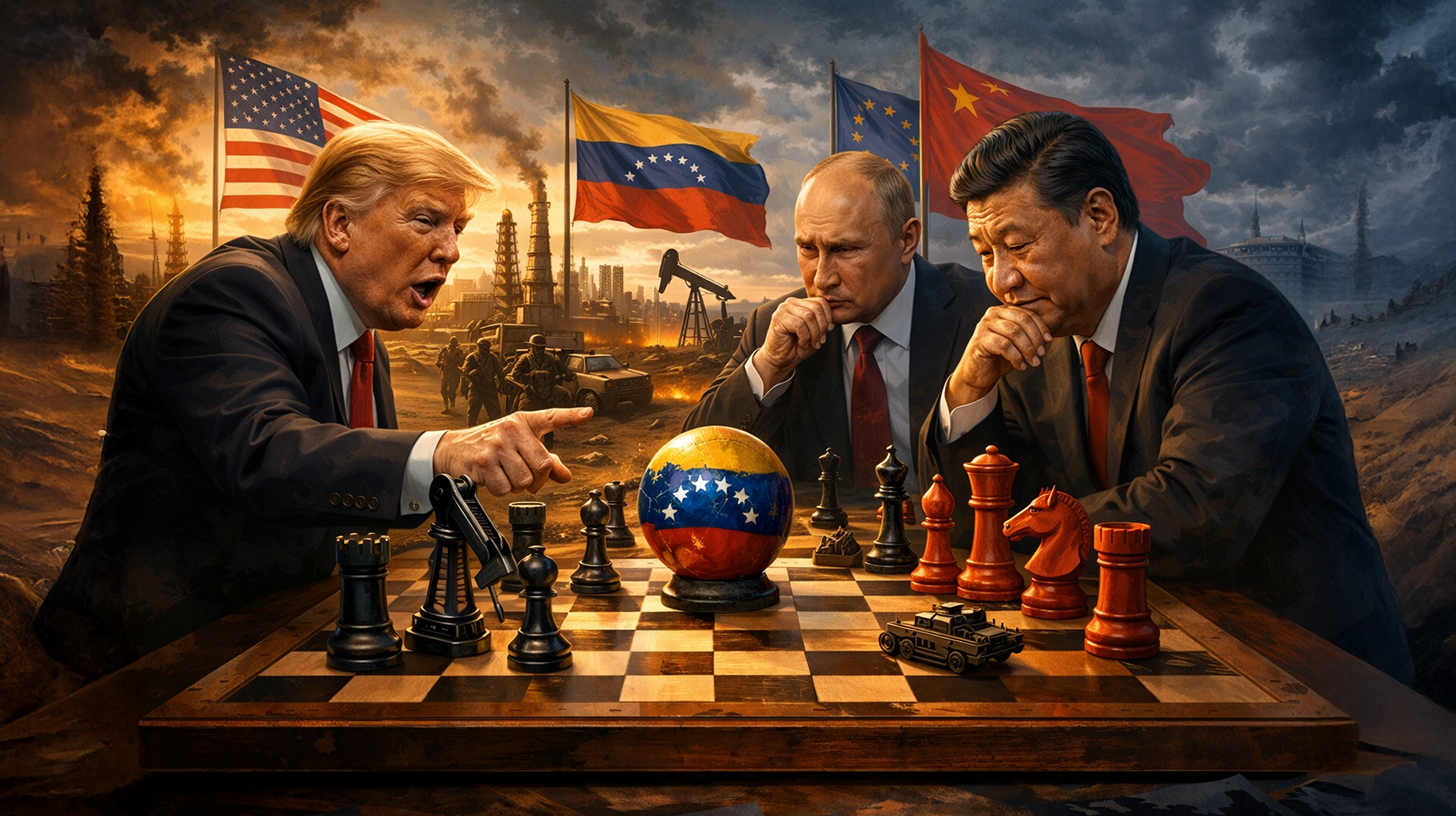
Putin and Xi's move: Why the battle for Venezuela's oil resources is only just beginning and Europe must take Venezuela's crisis seriously as a strategic warning – Image: Xpert.Digital
300 billion barrels of oil: Why the richest country in the world is suddenly becoming a threat to our security
Maduro's capitulation to Trump: A geopolitical earthquake with bitter consequences for Europe
January 2026 marks a turning point in international geopolitics, the repercussions of which extend far beyond the Caribbean. Venezuelan leader Nicolás Maduro's sudden capitulation to US President Donald Trump is more than just the end of a bilateral war of nerves; it is a brutal reality check for the global order. After months of military escalation through "Operation Southern Spear" and massive economic pressure, it has become clear that even deeply ingrained anti-imperialist rhetoric must give way to the harsh reality of physical power projection. But while Washington ruthlessly reclaims its dominance in its "own backyard," the crisis reveals an uncomfortable truth for Europe: the old continent is little more than a spectator in this new power game.
The events in Venezuela act as a magnifying glass, highlighting the weaknesses of European foreign and security policy. While China and Russia have long used the world's most oil-rich country as a strategic outpost, and the US pursues its interests with military force and pragmatic exceptions for its own corporations like Chevron, Europe remains in a dangerous state of passivity. The discrepancy between moral aspirations and realpolitik inaction has rarely been as glaring as it is now.
For European policymakers, this moment is a strategic warning that cannot be ignored. It demonstrates the fragility of global energy supply chains, the unreliability of supposed partners, and the limitations of Western sanctions policy in a fragmented world. Against the backdrop of a US administration that openly defines Europe as a problem in its security strategy and a global realignment of commodity markets, the EU faces an existential choice: either it finally develops genuine strategic autonomy – or it risks being crushed between the interests of the major powers.
The following analysis report sheds light on the multifaceted background of this crisis, exposes the economic paradoxes of the Venezuelan oil state, and outlines the urgent lessons that Europe must draw from the failure of its previous strategy.
Suitable for:

The geopolitical fragility of energy security and the illusion of reliable trade relations
Venezuelan President Nicolás Maduro's sudden shift in stance towards Donald Trump in early January 2026 marked far more than a bilateral conflict between two authoritarian leaders. The Venezuelan strongman, who as recently as December 2025 had spoken of an independent struggle against American imperialism, signaled a dramatic change of course in an interview with Spanish journalist Ignacio Ramonet. Maduro offered the US oil deals whenever, wherever, and however Washington desired them, and expressed his willingness to settle debts through commodity deliveries and to negotiate drug control agreements.
This turnaround didn't happen in a vacuum. It followed months of military and economic pressure: Operation Southern Spear had deployed around 15,000 American soldiers to the Caribbean region, 35 suspected drug boats had been attacked, and over 115 people had lost their lives. For the first time, the US used a drone to attack the Venezuelan mainland and destroyed a port facility. Several oil tankers were seized off the Venezuelan coast, and a $50 million bounty was placed on Maduro's head.
For European decision-makers in business and politics, this episode reveals fundamental weaknesses in the current world order that extend far beyond the specific case of Venezuela. The situation demonstrates the fragility of energy supply chains in an increasingly fragmented world order, the vulnerability of authoritarian regimes to external pressure, and the strategic importance of economic dependencies in geopolitical conflicts.
Venezuela as an economic paradox and geopolitical pawn
Venezuela possesses the world's largest proven oil reserves, estimated at around 300 billion barrels, surpassing even Saudi Arabia. Nevertheless, production has plummeted from its peak of 3.45 million barrels per day in December 1997 to a mere 1.14 million barrels in November 2025. This decline of over 67 percent is the result of decades of mismanagement, a lack of investment in infrastructure, and the loss of skilled personnel at the state-owned oil company PDVSA.
The country, once one of the five founding members of OPEC, paradoxically imports gasoline today, despite possessing some of the world's largest oil reserves. This discrepancy between theoretical potential and practical reality makes Venezuela an ideal case study of the dangers of resource curse, political instability, and external influence.
Venezuela's dependence on oil exports is extreme. Between 90 and 99 percent of its export revenues come from the oil industry. This structural monoculture makes the country highly vulnerable to price fluctuations on international energy markets and external political pressure. US sanctions, which have been systematically tightened since 2017, have cost Venezuela an estimated $226 billion in oil revenues between January 2017 and December 2024, equivalent to 213 percent of Venezuela's gross domestic product.
For European analysts, this highlights the risks of excessive dependence on individual raw material sources or export markets. The lesson from Venezuela is not only that diversification is necessary, but also that structural economic dependencies become strategic vulnerabilities once they become entangled in geopolitical conflicts.
The new bloc formation and Venezuela's role in the Sino-Russian-American power triangle
Maduro's ability to withstand massive American pressure for so long was largely based on the support of China and Russia. China has established itself as Venezuela's most important partner. In September 2023, the two countries signed a strategic all-weather partnership, a designation that Beijing reserves for only a few favored partner countries. China is the largest buyer of Venezuelan oil, with almost 70 percent of Venezuelan oil exports going to China in 2023.
The Chinese Development Bank granted the state-owned oil company PDVSA a loan of five billion dollars. Over the past ten years, Beijing has lent the world's most oil-rich country around 60 billion dollars, which Venezuela is repaying with oil deliveries. Private Chinese companies such as China Concord Resources Corp. are planning investments of over one billion dollars in the development of Venezuelan oil fields.
For its part, Russia sealed a strategic partnership with Venezuela in October 2025, providing for cooperation in the areas of energy, mining, transport, and security. In December 2025, Moscow pledged its full support to Caracas. Russian Foreign Minister Sergey Lavrov and his Venezuelan counterpart Yván Gil agreed to coordinate their actions on the international stage, particularly at the United Nations, to guarantee state sovereignty and non-interference in internal affairs. Possible arms deliveries were even discussed.
This situation illustrates the increasing fragmentation of the global economy into geopolitical blocs. Venezuela has become a test case for whether authoritarian regimes, through close ties with China and Russia, can withstand Western pressure. The fact that Maduro was able to maintain his position for months despite massive military threats and economic strangulation by the US demonstrates the limits of American power in a multipolar world order.
For Europe, this means a fundamental reorientation of strategic considerations. The days when Western sanctions quickly brought isolated regimes to their knees are over. Instead, alternative financing and trade structures are emerging that allow sanctioned states to survive and, in some cases, even thrive. Venezuela, for example, recorded economic growth of around 8.5 percent in 2025 despite all the sanctions, following 18 consecutive quarters of growth.
The Chevron exception and the limits of ideological consistency
One of the most remarkable aspects of US sanctions policy against Venezuela is the special license granted to the oil company Chevron. Despite comprehensive sanctions, Chevron is the only major American oil company permitted to operate in Venezuela. The company pumps oil, sells some of it to the US, and uses the proceeds to pay off Venezuelan debts. Chevron accounts for approximately 20 percent of Venezuelan oil exports.
This exception reveals the pragmatic dimension even in a supposedly principled sanctions policy. The economic interests of American corporations were ultimately given greater weight than the ideological consequence of completely isolating Venezuela. Chevron's activities enabled the Venezuelan state oil company PDVSA to increase production, thus paradoxically stabilizing the Maduro regime.
This is a significant lesson for European companies and governments. Sanctions are not only circumvented by the sanctioned countries, but also by the sanctioning powers themselves when economic interests demand it. This undermines the credibility and effectiveness of sanctions regimes. Europe must ask itself whether it is prepared to bear economic costs that others avoid, and whether coordinated sanctions policies with partners like the US are still reliable.
Suitable for:

Europe's marginal position in the Venezuela conflict
Trade relations between Europe and Venezuela have deteriorated dramatically in recent years. German-Venezuelan trade is in sharp decline; German exports to Venezuela fell by approximately 92 percent between 2015 and 2025, and imports by 93 percent. In 2024, Germany exported only $124.15 million to Venezuela. Currently, 28 German companies with around 4,000 employees are still active in Venezuela, but their number is steadily decreasing.
Since November 2017, the EU has imposed sectoral sanctions on Venezuela, including an arms embargo and a ban on the supply of goods used for internal repression. Thirty-six members of the Maduro regime have been subjected to travel bans and asset freezes. However, compared to the US, the European sanctions are more restrained and primarily target individuals, not the Venezuelan economy as a whole.
This relative reticence reflects Europe's limited influence in the region. Venezuela was suspended from the Mercosur economic bloc in 2016 on charges of violating democratic order. This means that the Mercosur free trade agreement, crucial for the European economy and finally agreed upon politically in December 2024 after more than 25 years, will be implemented without Venezuelan participation.
The Mercosur agreement aims to create a free trade zone encompassing more than 700 million inhabitants and, according to the European Commission, would be the world's largest of its kind. It is intended to send a signal against Donald Trump's protectionist tariff policies. According to calculations by the European Commission, annual EU exports to the Mercosur countries could grow by up to 39 percent, resulting in annual savings of around four billion euros for European exporters. Beneficiaries would include car manufacturers, mechanical engineering companies, the pharmaceutical industry, and the chemical industry.
However, the fact that Europe is practically not acting as an independent actor in the Venezuela conflict, but rather limiting itself to diplomatic appeals for de-escalation, demonstrates the limitations of European foreign policy. In the UN Security Council, European countries such as Great Britain and France called for a peaceful solution to the conflict without directly criticizing the US government. At the same time, they condemned human rights violations in Venezuela and expressed hope that the country might soon have a new democratic government.
This position is characteristic of Europe's dilemma. On the one hand, it professes a commitment to international law and democratic principles; on the other hand, it lacks the willingness or ability to enforce these principles against the US when Washington violates them. The US airstrikes on boats in international waters are illegal under international law, as is the airspace closure over Venezuela announced by Trump. The US did not obtain UN Security Council authorization, and even with evidence of drug trafficking, the attacks would constitute war crimes.
But Europe remains largely silent or merely issues general appeals. A summit between the EU and the Community of Latin American and Caribbean States scheduled for November 2025 in Colombia was canceled by over two dozen high-ranking politicians from both sides, including EU Commission President Ursula von der Leyen. The signal was clear: They do not want to antagonize Trump over the Caribbean issue.
This passivity is not only morally problematic, but also strategically short-sighted. Europe is missing the opportunity to position itself as an honest broker in regional conflicts and to build partnerships in Latin America, which are gaining in importance, especially given the transatlantic estrangement under Trump.
The transatlantic crisis and its implications
The Venezuela crisis coincides with a fundamental deterioration in transatlantic relations. In December 2025, the US government published its new National Security Strategy, which painted a bleak picture of the situation in Europe. US President Donald Trump denounced the current political landscape in the EU as a threat to American interests, lamenting an alleged loss of democracy and freedom of expression in Europe.
The goal of American policy must be to put Europe back on the right track. The document spoke of cause for great optimism due to the growing influence of patriotic European parties. The US government lamented the undermining of democratic processes in Europe and accused the European Union of suppressing freedom of speech and the opposition. The conclusion was clear: one of the goals of American European policy must be to foster resistance within European nations against Europe's current course.
This strategy marks the end of the transatlantic partnership as it has existed since World War II. The benevolent hegemon on the other side of the Atlantic is now becoming a global power that, much like Russia, is attempting to weaken the EU and shape the political landscape in Europe according to its own interests. The US is no longer the reliable partner of past decades, but is pursuing a deal-driven, transactional policy that ignores or even actively undermines European interests.
In this context, the Venezuela crisis takes on an additional dimension. It is not merely a bilateral conflict between Washington and Caracas, but part of a broader Trump doctrine that once again views Latin America as the US's backyard. Trump directly interfered in electoral processes in Ecuador, Bolivia, Honduras, and Chile, using tariffs and intensified sanctions as leverage and helping far-right candidates to victory.
This backyard politics reloaded fits into Trump's ambition to control the Panama Canal and revive the Monroe Doctrine. According to Trump's vision, Latin America should be governed by right-wing men willing to make any deal. The questionable methods and motives show that the fight against drugs appears to be merely a pretext. In reality, it's about reclaiming American spheres of influence and gaining access to strategic resources, especially oil.
For Europe, this means that it is not only confronted with an unpredictable American administration, but with a fundamental reorientation of American foreign policy that rejects multilateral institutions, ignores international law, and favors unilateral power projection. The days when the United States, like Atlas, supported the entire world order are over, Trump declared. America First is now the motto.
Our Latin America expertise in business development, sales and marketing

Our Latin America expertise in business development, sales and marketing - Image: Xpert.Digital
Industry focus: B2B, digitalization (from AI to XR), mechanical engineering, logistics, renewable energies and industry
More about it here:
A topic hub with insights and expertise:
- Knowledge platform on the global and regional economy, innovation and industry-specific trends
- Collection of analyses, impulses and background information from our focus areas
- A place for expertise and information on current developments in business and technology
- Topic hub for companies that want to learn about markets, digitalization and industry innovations
Europe's forgotten Achilles' heel: Why the next raw materials crisis has already begun
Oil market dynamics and limited impact on Europe
Despite the dramatic military escalation, the impact on global oil markets remained limited. While the conflict between the US and OPEC member Venezuela was a dominant theme in the oil market, price reactions were moderate. A barrel of North Sea Brent crude for March delivery cost $61.24 at the beginning of January 2026, an increase of just 39 cents compared to the previous Wednesday. The price of US West Texas Intermediate (WTI) crude for February delivery climbed 38 cents to $57.80.
This muted reaction can be explained by several factors. First, Venezuela's role in the international oil market is limited. Although the country possesses the world's largest oil reserves, its production is around one million barrels per day, while the US, the world's largest oil producer, produces roughly thirteen times that amount daily. Second, concerns about oversupply in the oil market have become more prominent as trading progresses. Third, Venezuela's oil customers, primarily China, have already negotiated substantial discounts and demanded revised contract terms.
Analysts like Warren Patterson of ING Groep believe that investors are remaining calm because potential supply risks are already factored in. The price reaction shows that the oil market is not overly concerned. Should the US government implement its blockade, pressure could push oil prices higher, but the impact would remain manageable.
For Europe, this means short-term relief. Energy security is not immediately threatened by the Venezuelan conflict. Europe imports virtually no oil from Venezuela anymore, after trade relations collapsed in recent years. Europe's oil imports come from other sources, and global oil markets are currently characterized by oversupply, not scarcity.
But this short-term perspective falls short. The Venezuelan crisis illustrates how quickly geopolitical conflicts can influence commodity markets and how vulnerable countries are that depend on individual energy sources or suppliers. Europe gained painful experience with energy dependencies after the Russian attack on Ukraine. In 2021, Germany still imported around 52 percent of its gas from Russia. The abrupt cessation of these deliveries caused an energy crisis with massive economic costs.
The lesson from the Venezuela crisis is not that European energy security is under acute threat, but rather that Europe must consistently pursue its diversification strategy. Dependence on individual raw material sources or transport routes creates strategic vulnerabilities that can be exploited by geopolitical actors.
Suitable for:

Raw materials policy and strategic autonomy
In recent years, the EU has recognized that its extreme dependence on raw material imports, particularly from China, poses a strategic risk. With the Critical Raw Materials Act, the EU has taken a significant step towards a common raw materials policy. The aim is to ensure that no more than 65 percent of critical raw material imports may originate from a single third country.
The RESourceEU action plan, adopted in December 2025, aims to ensure the EU's supply of critical raw materials such as rare earths, cobalt, and lithium. The plan includes the provision of three billion euros within twelve months to enable additional supply capacity in the short term, the establishment of a European Centre for Critical Raw Materials by the beginning of 2026 for market monitoring and project coordination, and the development of a concept for stockpiling critical raw materials.
China has imposed export restrictions on rare earth elements and is exploiting Europe's extreme dependence to strengthen its own geoeconomic position and stifle international competition. German companies have sometimes had to disclose sensitive business details, such as technical blueprints, to obtain these critical raw materials from China. EU Industry Commissioner Stéphane Séjourné sees European industry as a direct target of the Chinese and accuses Beijing of blackmail.
The Venezuela crisis demonstrates that resource dependencies can originate not only from China, but also from other geopolitically unstable regions. Venezuela could theoretically have been an alternative source of energy imports, but its political instability, mismanagement, and geopolitical integration into the Sino-Russian bloc make it an unreliable partner.
Europe must pursue its diversification strategy on several levels. First, imports must be diversified, for example through new raw material partnerships with resource-rich countries such as Chile, Australia, or South Africa. Second, international cooperation frameworks such as the Minerals Security Partnership must be strengthened. Third, Europe must develop its domestic raw material resources and build up processing capacities. Fourth, the recycling rate of critical raw materials must be significantly increased.
Europe's strategic autonomy in raw materials policy requires closer cooperation with mineral-rich third countries and a coordinated approach by the EU. Only in this way will Europe be able to implement diplomatically and programmatically compelling raw materials partnerships. The geopolitical environment demands that the EU integrate not only economic but also security policy considerations into its raw materials strategy.
The migration policy dimension
An often overlooked aspect of the Venezuelan crisis is the massive wave of migration the country has triggered. Over 9.1 million Venezuelans now live outside their homeland. Despite a high birth rate, Venezuela's population has shrunk from around 30 million in 2017 to just over 28 million today. Many are fleeing poverty, a lack of infrastructure and healthcare, and a lack of opportunities.
Europe is increasingly affected by this wave of migration. In the first half of 2025 alone, 48,413 people from Venezuela sought asylum in the EU, more than from Afghanistan or Syria. Spain is the main destination country in Europe, as Venezuelans speak their native language and the government welcomes immigrants. The mass emigration from the Latin American country is seen as a direct consequence of the authoritarian rule of President Nicolás Maduro, who has been in power since 2013.
Trump's hardline immigration policies have paradoxically led to Venezuelan migration flows being redirected from North America to Europe. While northward movements are slowing, a new phenomenon is emerging: transit movements back to the country of origin or to previous countries of residence in South America. However, some migrants are increasingly choosing Europe as their destination, as entry requirements for people from this region are less restrictive.
This has several implications for Europe. First, it shows that migration flows do not only originate from immediate neighboring regions such as the Middle East or Africa, but are increasingly global. Second, it illustrates that political instability and economic hardship in distant countries can have direct repercussions for Europe. Third, it makes clear that migration policy cannot be considered in isolation, but must be embedded in a broader context of foreign, security, and economic policy.
Stabilizing Venezuela would not only help Venezuelans themselves but also reduce migration pressure on Europe. However, Europe currently has little influence on developments in Venezuela. The EU has largely limited itself to supporting the US in its sanctions policy without developing its own Venezuela strategy. This is a missed opportunity, as Europe, unlike the US, is not perceived as a threat and could therefore act more credibly as a mediator.
The limits of European foreign policy and the need for strategic reorientation
The Venezuela crisis exposes the structural weaknesses of European foreign policy. Europe possesses considerable economic power, but lacks the ability to translate that power into political influence. The EU is the world's largest trading bloc, yet it does not act as a unified entity, but rather as a fragmented group of 27 member states with differing interests and priorities.
This is particularly evident in the Venezuela conflict. Europe has not taken a discernible position between the US and Venezuela. It lacks an independent strategy that goes beyond supporting American sanctions. Europe is a passive observer rather than an active participant, even though it certainly has interests in the region, such as the Mercosur agreement and the stabilization of migration flows.
This passivity is not only problematic in the Venezuela crisis, but is symptomatic of a more fundamental problem. Europe is caught in a world of increasing geopolitical fragmentation between the US and China. It risks being crushed between the superpowers if it does not strengthen its strategic autonomy.
Strategic autonomy does not mean isolation or neutrality. It means that Europe must be able to define and pursue its own interests, even if these differ from those of the US or China. In the case of Venezuela, strategic autonomy would mean that Europe develops its own Latin America strategy that is not solely oriented towards American directives.
Europe could, for example, act as a mediator between the US and Venezuela, provide humanitarian aid independent of political conditions, or create economic incentives for democratic reforms. Europe could also cooperate more closely with Latin American partners such as Brazil, Colombia, or Chile to find regional solutions to the Venezuelan crisis.
But such initiatives require political will and institutional capacity, which are currently lacking. EU foreign policy remains heavily influenced by nation-states, and the Common Foreign and Security Policy suffers from unanimity requirements that hinder swift and decisive action. The new US security strategy, which openly views Europe as a problem and seeks to weaken the EU, should serve as a wake-up call. Europe can no longer rely on the US as a dependable partner. It must strengthen its own capacity to act.
Lessons for Europe: Between economic pragmatism and geopolitical reality
The Venezuela crisis provides several key lessons for Europe that extend beyond the specific case and address fundamental questions of European strategy.
First, the crisis demonstrates that energy security cannot be achieved solely through supplier diversification, but also requires political stability and reliable governance in the supplier countries. Venezuela possesses immense raw material reserves, but due to political instability and mismanagement, it is not a reliable partner. Europe must consider not only availability and price when selecting its energy partners, but also political risks.
Secondly, the crisis demonstrates the limitations of Western sanctions policy in a multipolar world order. Venezuela was able to withstand massive US pressure because it could count on the support of China and Russia. Alternative trade and financing structures enable sanctioned states to survive. Europe must rethink its sanctions policy and develop more realistic expectations regarding its effectiveness. Sanctions that are not supported by all relevant actors are often ineffective or counterproductive.
Third, the crisis makes it clear that the US under Trump is no longer a reliable partner. The transatlantic partnership as it existed since the Second World War is over. Europe must strengthen its strategic autonomy and build its own foreign policy capacities. This does not mean turning away from the US, but rather a realignment of the relationship based on independence and mutual respect instead of one-sided dependence.
Fourth, the crisis demonstrates Europe's limited influence in Latin America, a strategic disadvantage. Latin America is a dynamic region with significant economic potential. The Mercosur agreement is an important step, but Europe must deepen its ties with the region and increase its political presence. The fact that over two dozen high-ranking European politicians canceled a summit with Latin American partners illustrates the low priority Europe places on the region.
Fifth, the crisis underscores the need to consider foreign, security, economic, and migration policies in an integrated manner. The massive Venezuelan exodus has direct repercussions for Europe. Political instability in Venezuela leads to migration flows to Europe. Stabilizing Venezuela is therefore also in Europe's interest, yet Europe lacks a strategy to promote this stabilization.
Sixth, the crisis reveals the dangers of geopolitical fragmentation and bloc formation. The world is increasingly dividing into a Western bloc led by the US and an Eastern bloc led by China. Countries like Venezuela, Russia, and Iran are being pushed into the Eastern bloc because the West isolating them. This creates a self-reinforcing dynamic that restricts the room for maneuver for all actors. Europe should try to build bridges, not walls, and not drive countries into the arms of China or Russia.
Seventh, the crisis makes it clear that international law and multilateral institutions come under pressure when major powers act unilaterally. The US attacks on Venezuelan ships, which violate international law, and the closure of Venezuelan airspace were barely criticized by Europe. This undermines Europe's credibility as a champion of the rules-based international order. Europe must be prepared to enforce international law against the US as well if it takes its own values seriously.
Between powerlessness and the compulsion to act
Maduro's abrupt change of course towards Trump in early January 2026 is more than a diplomatic anecdote. It is a magnifying glass that reveals the tectonic shifts in the current world order. An authoritarian ruler who defied the world's greatest military power for months caved when the pressure became unbearable. But his capitulation is not the end of the story, but rather the beginning of a new phase of geopolitical realignment.
For Europe, the Venezuela crisis is a wake-up call. It shows how fragile energy security is in a fragmented world order, how limited the effectiveness of Western sanctions has become, how unreliable the transatlantic partnership is under Trump, and how little influence Europe has in world regions outside its immediate neighborhood.
The central question is whether Europe will draw the right conclusions from this wake-up call. Will Europe strengthen its strategic autonomy, build independent foreign policy capacities, and play a more active role in global conflicts? Or will it continue to stand on the sidelines as a passive observer while others dictate the rules of the game?
The answer to this question will determine not only the role Europe plays in the Venezuela crisis, but also the role Europe will play in the world order of the 21st century. The time for hesitation and passivity must end. Europe must recognize that strategic autonomy is not an option, but a necessity in a world where old certainties no longer hold true.
Venezuela may be far away, but the lessons of the crisis are close at hand. They touch upon the core issues of Europe's existence in a multipolar world order: energy security, economic resilience, political capacity for action, and the defense of the rules-based international order. Europe has a choice: whether to actively shape these issues or passively endure them. The Venezuelan crisis demonstrates what happens when one relies on the supposed strength of natural resources without creating the political and institutional foundations that can transform this wealth into sustainable prosperity.
Europe must not make the same mistake. It possesses economic power, technological excellence, and democratic legitimacy. But without the political will to translate these resources into strategic capability, they will remain worthless. The Venezuelan crisis is a reminder that in international politics, it is not the largest natural resources or the strongest moral principles that count, but the ability to project power and assert interests. Europe must learn this lesson before it is too late.
Your global marketing and business development partner
☑️ Our business language is English or German
☑️ NEW: Correspondence in your national language!

Konrad Wolfenstein
I would be happy to serve you and my team as a personal advisor.
You can contact me by filling out the contact form or simply call me on +49 7348 4088 965 (Munich) . My email address is: wolfenstein ∂ xpert.digital
I'm looking forward to our joint project.
☑️ SME support in strategy, consulting, planning and implementation
☑️ Creation or realignment of the digital strategy and digitalization
☑️ Expansion and optimization of international sales processes
☑️ Global & Digital B2B trading platforms
☑️ Pioneer Business Development / Marketing / PR / Trade Fairs
🎯🎯🎯 Benefit from Xpert.Digital's extensive, five-fold expertise in a comprehensive service package | BD, R&D, XR, PR & Digital Visibility Optimization

Benefit from Xpert.Digital's extensive, fivefold expertise in a comprehensive service package | R&D, XR, PR & Digital Visibility Optimization - Image: Xpert.Digital
Xpert.Digital has in-depth knowledge of various industries. This allows us to develop tailor-made strategies that are tailored precisely to the requirements and challenges of your specific market segment. By continually analyzing market trends and following industry developments, we can act with foresight and offer innovative solutions. Through the combination of experience and knowledge, we generate added value and give our customers a decisive competitive advantage.
More about it here:










