
Industrial transformation: VW in crisis, Rheinmetall booming – Is Germany now becoming an arms-producing nation?
Xpert Pre-Release

Available in 27 languages 📢
Prefer Xpert.Digital on GoogleⓘPublished on: August 4, 2026 / Updated on: August 4, 2026 – Author: Konrad Wolfenstein
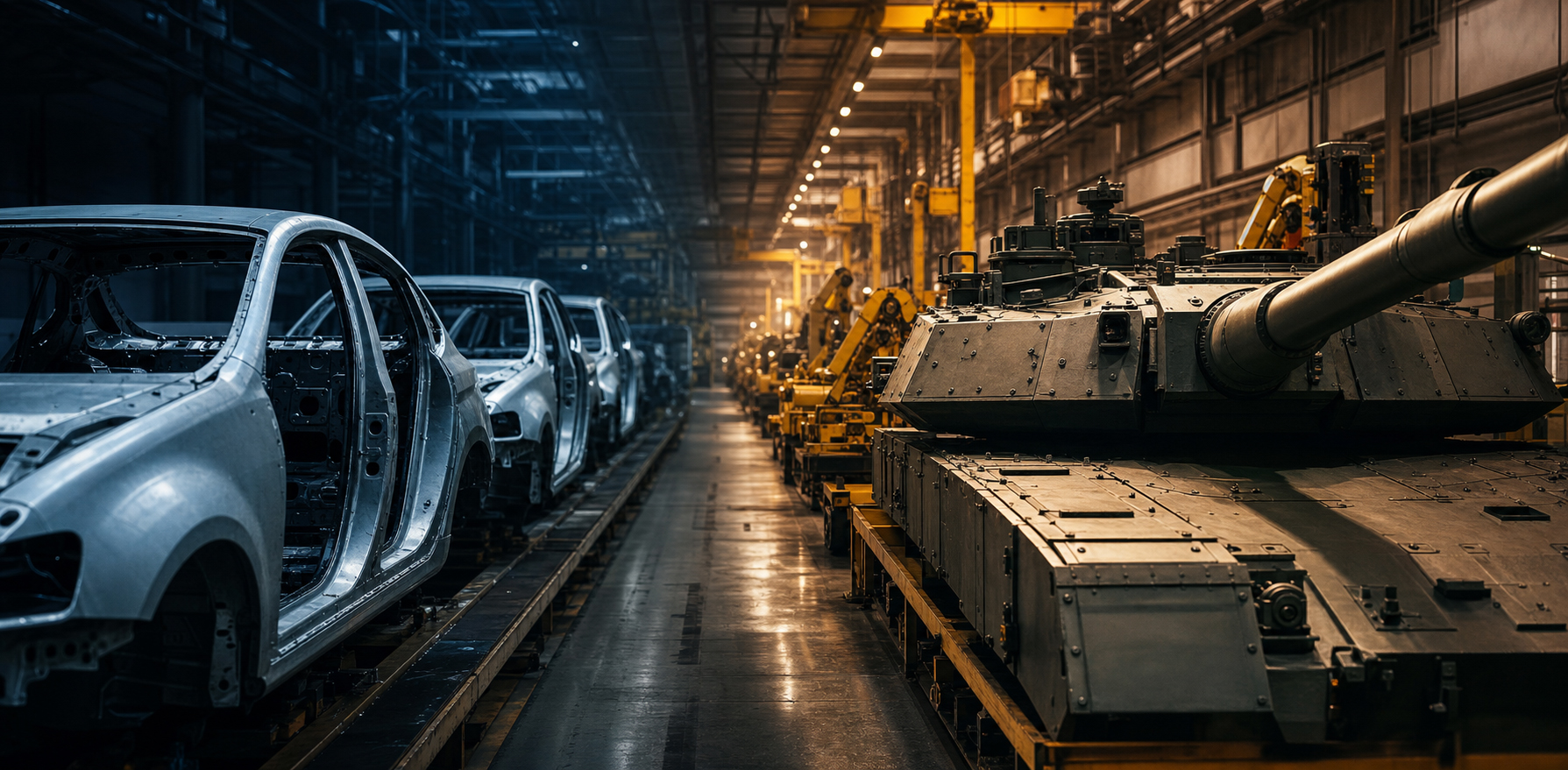
Industrial transformation: VW in crisis, Rheinmetall booming – Is Germany now becoming an arms-producing nation? – Image: Xpert.Digital
From car-centric country to arms manufacturer: What the historic industrial transformation means for our jobs
When the car factory builds tanks: The hard truth about Germany's new arms boom
Job shock in the automotive industry: Can the defense industry really replace VW, Bosch and Co.?
For decades, the automobile was the undisputed engine of the German economy – a guarantor of prosperity, global dominance, and millions of secure jobs. But this foundation is crumbling at an unprecedented pace. While tens of thousands of jobs are at risk at manufacturers like VW and suppliers like Bosch and Continental, and entire factories are facing closure, another sector is experiencing a historic boom: the arms industry. Corporations like Rheinmetall are recording record sales, acquiring former automotive suppliers, and luring skilled workers from the assembly line to the munitions factory. Is Germany, in the shadow of geopolitical crises, currently undergoing a radical transformation from an automotive nation to an arms-producing country? A data-driven look behind the scenes reveals that while the symbolism of this upheaval is immense, the reality on the labor market is far more complex – and alarming for Germany's economic standing.
Is Germany transitioning from a car-making to an arms-producing nation? When the nation's workshop changes its tools
Few economies in the Western world have linked their identity so closely to a single industry as Germany has to the automobile. For over a century, the assembly line stood for prosperity, technological leadership, and international economic strength. This self-evident image has been noticeably crumbling for some years now, not as a short-term economic downturn, but as a profound structural break. At the same time, another, long-neglected industry is experiencing a historic boom, reflected in order books, share prices, and political priorities. The question of whether Germany is truly transforming from a car-producing nation into an arms-producing nation deserves a sober, data-driven analysis, one that transcends headlines and ideological knee-jerk reactions.
The collapse of a key industry in numbers
The German automotive industry is experiencing the most severe decline in employment in its recent history. By the end of 2025, the sector employed only around 725,000 people, a decrease of 6.2 percent compared to the previous year and the lowest figure in 14 years. Since 2019, the pre-pandemic year, the automotive industry has lost an estimated one in seven jobs, specifically around 125,800 positions, while employment fell by a further 32,000 in the twelve months leading up to the beginning of 2026 alone. The German Association of the Automotive Industry (VDA) now anticipates an even more dramatic picture: By 2035, a total of 225,000 jobs could disappear, around 35,000 more than previously projected, with approximately 100,000 jobs already lost between 2019 and 2025.
Suppliers, the industrial backbone of the sector, are being hit particularly hard. Their revenue fell by four percent in 2025, four times as sharply as that of the manufacturers themselves, while employment at suppliers plummeted by eleven percent, compared to 3.6 percent at original equipment manufacturers (OEMs). Since 2019, almost one in four jobs at suppliers in Germany has disappeared, as noted by EY industry expert Constantin Gall, with the downward trend having accelerated recently. The number of insolvency filings in the supplier industry reached a 14-year high of 39 cases between January and November 2025, compared to 29 in the previous year and only 21 in 2023.
The big names in the automotive industry are driving the headlines surrounding these abstract figures. According to media reports, Volkswagen is considering cutting up to 100,000 jobs and closing four German plants. Bosch, ZF Friedrichshafen, Continental, and Mahle have launched comprehensive cost-cutting programs; ZF alone plans to eliminate up to 14,000 jobs in Germany by the end of 2028. Automotive expert Ferdinand Dudenhöffer from the Center Automotive Research in Bochum predicts that total employment in German car factories could fall from the current figure of around 720,000 to well below 700,000 and to approximately 650,000 by 2027.
Why the once flagship industry is faltering
The causes of this crisis are multifaceted and mutually reinforcing. First and foremost is the sluggish and expensive transition to electromobility, which is costing a particularly large number of jobs in the supplier industry because electric drives simply require fewer components and fewer manufacturing steps than the classic combustion engine. Added to this is a serious and persistent location crisis, as VDA President Hildegard Müller puts it: high taxes and levies, expensive energy, high labor costs, and excessive bureaucracy are noticeably impacting competitiveness.
The situation is exacerbated by growing competitive pressure from China, where manufacturers like BYD are increasingly putting German premium brands under pressure, while at the same time the Chinese market as a whole is weakening. US tariffs under the Trump administration are further intensifying the situation for export-oriented German manufacturers. German automakers recorded their lowest profits since the 2009 financial crisis at the end of 2025, and EY automotive expert Constantin Gall speaks of a veritable perfect storm, hitting German manufacturers particularly hard. The international credit insurer Atradius expects a further production decline of 2.7 percent for 2026, following a drop of 1.8 million vehicles to 4.1 million in 2024.
The other side of the coin: The arms boom
While the automotive industry is shrinking, the German defense sector is growing at a pace that would have been unthinkable just a few years ago. Rheinmetall, Germany's largest arms manufacturer, reported a 29 percent jump in revenue to around €9.9 billion for 2025 and is planning growth of 40 to 45 percent for 2026. Operating profit already climbed by 33 percent to €1.8 billion in 2025. Group-wide, Rheinmetall employed more than 32,000 full-time staff at 179 locations worldwide in 2025, compared to around 23,000 employees at 129 locations just five years prior.
The political support for this development is enormous. For 2026, the Federal Ministry of Defense has more than €108 billion at its disposal, comprised of €82.7 billion from the regular budget and €25.5 billion from the special Bundeswehr fund. This sum is projected to rise to around €152 billion by 2029, tripling the amount allocated in 2023. At the NATO summit in The Hague in the summer of 2025, the alliance partners committed to increasing their total defense spending to five percent of their gross domestic product by 2035, with 3.5 percent earmarked for nuclear defense and 1.5 percent for security-related infrastructure. Germany aims to reach the 3.5 percent target as early as 2029, six years ahead of NATO's requirement.
When car factories become weapons manufacturers
The symbolism of this transformation is nowhere more tangible than at Rheinmetall itself, a corporation that originally operated as both an automotive supplier and arms manufacturer and is now definitively focusing on the latter role. The company has signed a contract to sell the majority of its automotive supply division to the Munich-based industrial holding company Aequita for a purchase price of €350 million, with approximately 6,200 employees transferring to the sold business unit and 34,000 remaining with Rheinmetall. The civilian automotive division generated only €2 billion in revenue in 2025, while the arms business had already reached around €10 billion.
Specifically, former automotive parts plants are being physically converted. The Rheinmetall plant in Neuss, formerly solely an automotive supplier, now manufactures protective components and mechanical parts for military use and could in the future also produce Lynx infantry fighting vehicles and self-propelled howitzers. The Berlin site is increasingly focusing on mechanical defense components in addition to fuel cell technology. The Franco-German defense company KNDS has also acquired a plant from the train manufacturer Alstom in Görlitz, eastern Germany, where components for the Leopard 2 main battle tank and the Puma infantry fighting vehicle will be produced, with approximately half of the roughly 700 employees there being retained.
The transfer of personnel is already underway. At the Continental plant in Gifhorn, Lower Saxony, which is being closed due to unprofitability, around 100 employees are being offered the opportunity to transfer to a Rheinmetall munitions factory in Unterlüß, about 55 kilometers away. This transfer is supported by a project called "From Job to Job," overseen by the IG Metall union. Rheinmetall CEO Armin Papperger has also publicly signaled interest in a potential takeover of the VW plant in Osnabrück, which is considered redundant, provided that long-term framework agreements with the government are reached for approximately ten years. VW CEO Oliver Blume has also expressed general openness to such a repurposing.
The limits of compensation
Despite these striking individual cases, numerous economists and labor market researchers warn against a distorted perception of the true scale of the situation. The defense industry is simply too small compared to the overall manufacturing sector to offset the losses in the automotive industry on a one-to-one basis. According to the German Association of Security and Defense Industries, actual arms manufacturers in Germany employ around 100,000 people in approximately 320 member companies, while the automotive industry alone employed around 773,000 people recently. Sophia von Rundstedt of the career consultancy von Rundstedt & Partner puts it succinctly: Based on these sheer size differences, the defense industry will not be able to compensate for the projected job losses in the radically transformed automotive industry.
Labor market researcher Enzo Weber from the Institute for Employment Research also expresses skepticism about the idea of a smooth-running job engine: While the defense industry does indeed create many jobs, it cannot fully compensate for job losses in the manufacturing sector because the automotive industry is simply too large. Concrete forecasts confirm this imbalance: Experts expect losses of 130,000 to 170,000 jobs in the automotive industry alone, losses that the growth of the defense sector can only partially offset. A study by EY-Pantheon and Dekabank arrives at a more nuanced, but similarly cautious, conclusion: Should NATO countries' defense spending reach 3.5 percent of their economic output as planned, around 144,000 new jobs could be created in Germany by 2029; together with jobs already secured, this would result in a total effect of around 360,000 jobs. However, even Ferdinand Dudenhöffer, who comments on this study, makes it clear that this growth spurt will by no means be sufficient to compensate for the losses in the automotive and steel industries, and instead calls for a fundamental improvement in the competitiveness of the industrial location through lower non-wage labor costs, less regulation and cheaper electricity costs.
Hub for Security and Defense - Advice and Information

Hub for Security and Defense - Image: Xpert.Digital
The Security and Defence Hub offers expert advice and up-to-date information to effectively support companies and organizations in strengthening their role in European security and defence policy. Working closely with the SME Connect Defence Working Group, it particularly promotes small and medium-sized enterprises (SMEs) that wish to further develop their innovative capacity and competitiveness in the defence sector. As a central point of contact, the Hub thus creates a crucial bridge between SMEs and European defence strategy.
Related to this:
Industrial transformation in Germany: Why the switch from automotive to defense is not a simple job promise
Professionals caught between two worlds
The seemingly obvious idea of simply transferring unemployed automotive specialists to the defense industry is proving more complicated in practice than anticipated. While it is, in principle, a good match because many technical qualifications are transferable, Sophia von Rundstedt points to real hurdles in personnel transfers: Even with an optimal professional match, applicants need to be won over to the new career prospect at the mindset level, where reservations about the defense industry, differing corporate cultures, and longer commutes play a significant role. Added to this is a counter-challenge on the demand side: A study by EY and Dekabank warns that with a moderate increase in defense spending to 2.5 percent of GDP by 2030, around 460,000 vacancies could arise in the defense sector; with a more significant increase to three percent, this number could rise to as many as 760,000, with a particular shortage of specialists in artificial intelligence and big data.
This seemingly paradoxical simultaneity of job cuts in one sector and a shortage of skilled workers in another illustrates that this is not a simple case of shifting the burden, but rather two labor markets with differing requirement profiles, security clearances, location-based logics, and cultural frameworks. Furthermore, the defense industry is growing significantly in absolute numbers, but from a comparatively small base. According to Financial Times analyses, the number of employees in the defense divisions of Germany's largest corporations and fastest-growing startups has risen from around 63,000 in 2021 to approximately 83,000, an increase of 30 percent. Airbus, with 38,000 employees in the defense sector, and Rheinmetall, with around 23,500 employees, are the largest employers in the industry.
A look at the industry as a whole
The crisis is by no means limited to the automotive industry alone, even though it is the hardest hit. German industry as a whole lost more than 120,000 jobs in 2025, almost twice as many as the previous year, reducing the number of employed people to around 5.38 million. Since the pre-pandemic year of 2019, according to the more recent EY Industry Barometer, 341,500 industrial jobs have disappeared – statistically speaking, one in seventeen industrial jobs in Germany. EY Managing Partner Jan Brorhilker describes the situation unequivocally as a deep crisis in German industry, exacerbated by weak order books, intense competitive pressure, and a rising number of insolvencies, particularly among automotive suppliers. It is noteworthy that the chemical and pharmaceutical industries fared comparatively well, with a job loss of only around 2,000 positions, while the automotive sector alone lost approximately 50,000 jobs. This inconsistent picture shows that it is not a general economic downturn, but rather a selective, structural shift between individual sectors.
Regional disruptions and unequal impact
The industrial transformation is by no means affecting the German federal states uniformly. In the automotive industry, the decline in employment in 2025 was particularly drastic in the smaller locations of Saarland and Schleswig-Holstein, with losses of 11 and 20 percent respectively. Among the major automotive locations, North Rhine-Westphalia fared worst with an 8 percent drop in employment, while Bavaria and Baden-Württemberg, with losses of 2.6 and 3.9 percent respectively, performed considerably better. This is likely attributable to the greater diversification and higher value-added depth of premium manufacturers in these regions. Brandenburg recorded the smallest decline at 1.3 percent, which could be partly due to the establishment of new, future-oriented industries there. This regional disparity means that structurally weaker regions are experiencing the transformation particularly painfully, while economically stronger locations have more buffers and adaptability.
Orders of magnitude in direct comparison
To realistically assess the true economic weight of both sectors, a direct look at the key figures is worthwhile. The following overview illustrates the glaring imbalance between the two sectors at present.
| Key figure | automotive industry | Defense and security industry |
|---|---|---|
| Directly employed in Germany | approximately 721,400 to 725,000 | Approximately 100,000 to 135,000 (pure arms manufacturers), including suppliers approximately 150,000 |
| Employment trends since 2019 | minus approximately 15 percent, or 125,800 jobs | Increase of around 30 percent for large corporations since 2021 |
| Revenue development 2025 | minus 1.6 percent | Rheinmetall alone up 29 percent |
| Projected development | Further decline to around 650,000 employees by 2027 | Rheinmetall plans further growth, with sales increasing by 40 to 45 percent in 2026 |
This table clearly shows that the automotive industry, with its approximately 725,000 employees, remains Germany's second-largest industrial sector, behind mechanical engineering with around 934,200 employees, while the defense industry, even at its fastest-growing, only reaches a fraction of this size. Although the dynamics have clearly shifted towards the defense sector, the absolute economic substance of the automotive industry remains unmatched for the time being.
Political decisions and their limits
By exempting security-related expenditures exceeding one percent of gross domestic product from the debt brake, the German government has created a crucial fiscal lever that makes the massive increase in defense spending possible in the first place. At the same time, a comparably decisive industrial policy response to the crisis in the automotive industry is still lacking. While multi-billion-euro arms contracts with long-term planning security are being awarded, the German Association of the Automotive Industry (VDA) is issuing urgent warnings about political failures regarding energy prices, regulation, and competitiveness, and sees another year of stagnation looming without fundamental reforms. This asymmetric political prioritization, driven by the changed geopolitical security situation since the Russian attack on Ukraine, is further intensifying the observed structural change, regardless of whether this is to be seen as a deliberate industrial policy strategy or a side effect of security policy necessities.
A nuanced assessment of the situation
The assertion that Germany is completely transforming from an automotive to an arms-producing nation does not withstand close scrutiny of the figures in its exaggerated form, but it does contain a kernel of truth that should not be downplayed. It is less a complete substitution than a partial, symbolically highly charged shift in industrial capacity, factories, and individual workers, while the absolute employment volumes of the two sectors remain vastly different. Despite its historic crisis, the automotive industry remains the country's second-largest industrial sector, while the arms industry, despite impressive growth rates, remains a comparatively small sector in absolute terms. The real economic conclusion, therefore, is not that one sector is replacing the other, but rather that Germany is undergoing two fundamental industrial transformation processes in parallel, the outcome of which will depend significantly on whether policymakers address the structural location problems of traditional industries with the same determination with which they are currently driving the expansion of the defense sector.
Consulting - Planning - Implementation

Markus Becker
I would be happy to serve as your personal advisor.
Head of Business Development
Chairman SME Connect Defense Working Group
Consulting - Planning - Implementation
Konrad Wolfenstein
I would be happy to serve as your personal advisor.
You can contact me at wolfenstein∂xpert.digital or
Just call me on +49 7348 4088 965 .





