
Doubly hypocritical: Opportunistic hypocrisy of all parties regarding the firewall
Xpert Pre-Release

Available in 27 languages 📢
Prefer Xpert.Digital on GoogleⓘPublished on: March 16, 2026 / Updated on: March 16, 2026 – Author: Konrad Wolfenstein
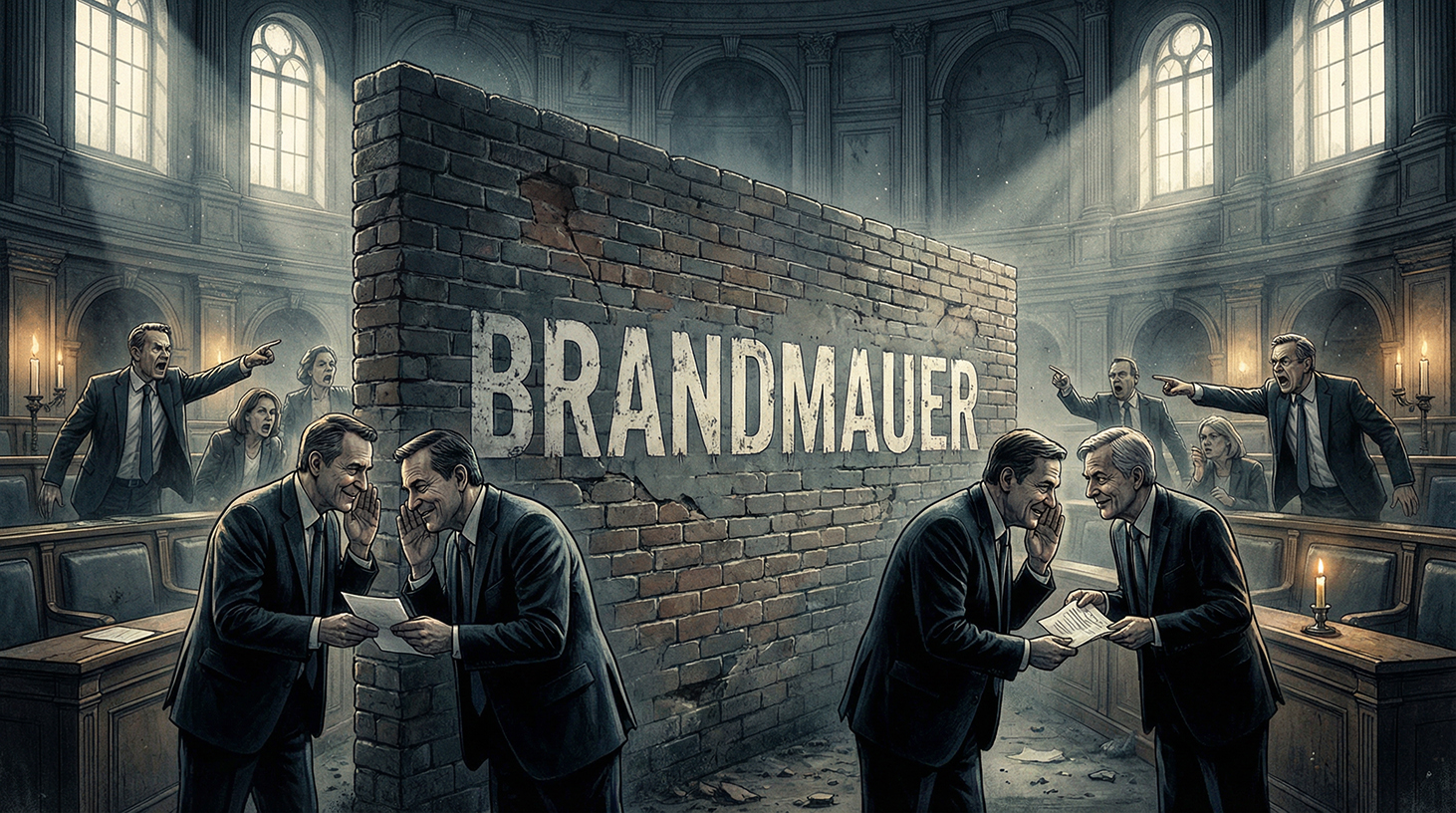
Double hypocrisy: Opportunistic hypocrisy of all parties regarding the firewall – Image: Xpert.Digital
Analysis of 11,000 sessions shows: The myth of the fire wall
The biggest political sham: Why all parties benefit from the firewall fairy tale
A moral sham that has long been undermined from all sides
The firewall against the AfD is considered the highest moral imperative of German politics – yet behind closed doors, it has long since degenerated into a political Potemkin village. Secret WhatsApp chats from Brussels, surprising voting majorities secured by the Greens, and cold-blooded calculations at the local level reveal that when it benefits their own power or agenda, the supposed red line is quietly and opportunistically crossed by all established parties. From the CDU/CSU to the SPD, and on to the Greens and the Left Party, an unprecedented double standard is exposed. This is a ruthless analysis of how clinging to a crumbling moral facade is massively damaging the credibility of democracy.
The foundation is crumbling – What Brussels reveals, what Berlin conceals
In mid-March 2026, the German Press Agency (dpa) reported on an event that was immediately treated as a political watershed in Berlin: The European People's Party (EPP) group in the European Parliament – the political home of the CDU and CSU – had apparently not only voted with the AfD and other right-wing groups on a stricter migration policy, but had also actively prepared for this cooperation. According to dpa's investigation, there was a WhatsApp group in which representatives of the EPP, the right-wing conservative ECR group, the right-wing populist alliance Patriots for Europe, and the European Sovereign Nations (ESN) group, to which the AfD belongs, communicated in a coordinated manner. Shortly after the group's creation, a face-to-face meeting took place, attended by four members of the aforementioned groups, and they drafted a joint bill. The draft bill subsequently received the necessary majority in the relevant committee of the European Parliament. Among other things, the planned law is intended to allow the deportation of asylum seekers to so-called return hubs outside the EU.
This revelation comes against a backdrop of political discourse where the firewall narrative has been carefully cultivated for years. Manfred Weber, the CSU politician and most powerful conservative in Brussels, head of the EPP, declared unequivocally as recently as the end of 2025: “The firewall stands. We know who our enemies are.” He described the AfD as an “anti-European party.” And now, internal chats suggest that staff members in his ministry responded to proposals from the office of AfD MEP Mary Khan with a simple “We can support that.” What Weber officially ruled out was apparently practiced behind the scenes.
Between symbolic politics and realpolitik – The EU's peculiarity
To properly assess the scale of this process, one must understand the structural differences between the European Parliament in Brussels and the German Bundestag in Berlin. In the German Bundestag, the firewall encounters clear national structures: few parties, transparent faction boundaries, and direct public scrutiny. In Brussels, however, representatives of more than 170 national parties meet, painstakingly organized into eight factions. The informal agreement, officially known as the "cordon sanitaire," applies in the European Parliament to the Patriots for Europe (PfE) and Europe of Sovereign Nations (ESN) groups, with the AfD belonging to the latter. Whether this firewall should also apply to the ECR group, which includes Italy's Prime Minister Giorgia Meloni, remains a point of contention among the parties.
Since the 2024 European elections, voting majorities in the European Parliament have shifted considerably in favor of right-wing groups. Weber has long since reacted to this new reality – rhetorically by declaring strict demarcation, and in practice by demonstrating an increasingly pragmatic willingness to cooperate. As early as March 2024, he stated that selective cooperation with "pro-European conservatives" like Meloni was "just as conceivable for him as cooperation with the Greens." The difference being that Meloni's party belongs to the ECR group, which is not formally subject to the cordon sanitaire. The boundaries of the firewall have thus always been handled flexibly – depending on political expediency.
A story of silent transgression – The EPP and the right wing
The current incident is not the first time the EPP has crossed the firewall – it is simply the most remarkable to date because the coordination is documented this time. In September 2024, a few months after the new European Parliament was constituted, the EPP, together with far-right groups, including AfD members, introduced a resolution on Venezuela. According to Green MEP Daniel Freund, this was a historic first: for the first time ever, conservatives and the far right had not only voted together but had jointly submitted a text. The EPP's reaction at the time was that they had expressed a position on Venezuela that they considered correct. With whom they voted was a secondary matter.
In October 2024, the EPP group voted in favor of an amendment drafted by an AfD politician, calling for “adequate funding for physical barriers at the EU’s external borders”—in plain terms: fences. At the time, Weber spoke of objectively necessary external border controls, not of cooperation with the AfD. In November 2025, Weber used the majority held by right-wing and far-right parties to drastically weaken the EU supply chain law. The law, which was intended to obligate companies to comply with human rights and environmental standards in their supply chains, now only applies to companies with more than 5,000 employees and a turnover of at least €1.5 billion—instead of the originally planned threshold of 1,000 employees. Weber argued at the time that the AfD's votes had not been decisive for this majority. He claimed that no dependence on right-wing extremist forces had arisen.
The difference to the current case now lies not only in the frequency of such voting constellations, but also in their qualitative dimension. Until now, Weber could always claim that the EPP and the AfD voted the same way by chance, because the result was factually correct. However, the WhatsApp group and the personal meeting on March 4, 2026, show that these are not coincidental overlaps, but rather active coordination. It makes a difference whether conservatives and the far right raise their hands simultaneously – or whether they jointly draft the proposal they intend to put forward beforehand.
The Green counter-claim and its limits – The Mercosur paradox
No sooner had the dpa news report been published than Erik Marquardt, head of the German Green delegation in the European Parliament, launched a scathing attack. He accused the Christian Democrats of bearing a “grave historical burden.” The outrage was swift and loud. It would have been more convincing had Marquardt himself not caused a stir a few weeks earlier. On January 21, 2026, a majority of the German Green MEPs, eight out of ten, voted to refer the EU-Mercosur free trade agreement to the European Court of Justice. This majority was achieved because, in addition to Left Party MEPs, representatives of the far-right groups—including 13 AfD MEPs—also voted in favor. In other words, Marquardt and his colleagues not only failed to maintain the firewall but also produced a majority that would not have been possible without the far-right. The result was incredibly close, with 334 votes to 324.
What followed was characteristic of political knee-jerk reactions: first the defensive claim, then the half-hearted retreat. Marquardt initially declared that they had only wanted to create legal certainty and hadn't actually voted against the agreement. Then, however, he publicly admitted: “We have to be self-critical and say that the wrong signal was sent by the European Parliament regarding geopolitics. And that this ultimately led to a majority being achieved solely with far-right parties – that, too, is a mistake.” It wasn't until the German Bundestag, where the CDU/CSU and SPD requested a topical debate on the matter at the end of January 2026, that Bundestag member Andreas Audretsch (Greens) also conceded that his own parliamentary group's voting behavior had been an error. That Marquardt, of all people, became the most vocal critic of the EPP-AfD cooperation shortly thereafter is a level of chutzpah that is hard to surpass.
What is remarkable here is the substantive context: Mercosur, after decades of negotiations, is a strategically important free trade agreement between the EU and four South American states. The geopolitical situation – trade war with the US, growing dependence on China – makes such agreements urgently necessary. Providing the far right with a majority for entirely different reasons, a majority that at least temporarily jeopardizes this agreement, is not an oversight that can be explained away by invoking considerations of legal certainty. The voting pattern was predictable.
The left-wing calculation – Who really benefits from the firewall?
The firewall is not only an instrument of exclusion, it is also a political business model – primarily benefiting those parties that most loudly insist on its observance. The left-wing spectrum, i.e., the SPD, the Greens, the Left Party, and the BSW, profits from the firewall on at least two levels: ideologically and in terms of parliamentary strategy.
Ideologically, the firewall places the left in the comfortable role of moral guardian. Those who insist on adherence to the firewall can portray themselves as defenders of democracy while simultaneously placing their political opponents – especially the CDU/CSU – under constant pressure to justify themselves. Every CDU motion that receives AfD support is reflexively interpreted as a declaration of cooperation, regardless of whether any actual agreement has taken place. This created a dynamic during the 2025 federal election campaign in which Friedrich Merz and the CDU/CSU constantly had to explain why certain initiatives should not be considered cooperation with the AfD. The power to define the term "firewall" thus effectively lies with the parties on the left of center.
From a parliamentary-strategic perspective, an even more tangible advantage emerges: the firewall forces the CDU/CSU to rely on parties for majorities that it wouldn't otherwise need. If the CDU/CSU is not allowed to form a majority with the AfD—regardless of the substance of a proposal—it must instead win over the SPD, the Greens, or other left-wing partners. These partners, in turn, can demand far higher prices in coalition negotiations than their election results would justify. The firewall is thus structurally a leverage mechanism that allows parties with significantly fewer votes to gain far more influence on government policy than is democratically intended. Political scientist Philip Manow succinctly summarized this connection: In the shadow of the firewall, the AfD's extremist tendencies can flourish undisturbed. But the more extreme the AfD's rhetoric becomes, the more tightly the ranks of the self-proclaimed "democratic centrist parties" close—at the expense of their own political profiles.
Our EU and German expertise in business development, sales and marketing

Our EU and German expertise in business development, sales and marketing - Image: Xpert.Digital
Industry focus areas: B2B, digitalization (from AI to XR), mechanical engineering, logistics, renewable energies and industry
More information here:
A thematic hub offering insights and expertise:
- Knowledge platform covering global and regional economies, innovation and industry-specific trends
- A collection of analyses, insights, and background information from our key areas of focus
- A place for expertise and information on current developments in business and technology
- A hub for companies seeking information on markets, digitalization, and industry innovations
The firewall lie: A study reveals the true extent of the collaboration
Local politics as a revealing mirror – The silent practice of everyday life
Looking away from the European Parliament and towards the reality at the local level in Germany reveals that the AfD's (Alternative for Germany) firewall has never been a consistent principle across all parties – it has always been selective and situation-dependent. Researchers at the Berlin Social Science Center (WZB) systematically examined 11,053 meetings of district councils and independent cities between mid-2019 and mid-2024. The result: In almost 19 percent of cases nationwide, there was direct cooperation between other parties and the AfD. Of a total of 4,968 AfD motions during the study period, 934 received support from other parties. The researchers explicitly noted that none of the established parties maintains the firewall "without ifs, ands, or buts." The rate of cooperation varies by state and region – it is highest in rural districts in eastern Germany, reaching up to 26.9 percent, and highest among the states in Saxony-Anhalt, at 27 percent.
Particularly revealing are the specific historical cases in which left-wing parties cooperated with the AfD while simultaneously being the loudest in proclaiming a firewall. In April 2024, a parliamentary inquiry committee in the Thuringian state parliament was only initiated thanks to AfD votes – by a red-red-green coalition. In December 2022, the SPD in Hildburghausen (Thuringia) voted together with the AfD for a recall procedure against a Left Party mayor. In January 2024, a Green Party deputy mayor in Blieskastel (Saarland) remained in office only because she received an AfD vote. All of these events were hardly discussed at the time. They didn't fit the narrative.
The most dramatic and recent local example occurred in the Thuringian state parliament in February 2026: The Left Party parliamentary group passed a motion to promote and renovate sports facilities – with the votes of the AfD. The vote ended 32 to 30, although the governing coalition of the CDU, SPD, and BSW was not fully represented. Remarkably, AfD representative Uwe Thrum had openly announced in the debate before the vote that the AfD would vote in favor. When asked, the Left Party's parliamentary manager essentially stated that it was a motion from her own group – she didn't care who voted for it. Bundestag Vice President Bodo Ramelow (Left Party) defended the vote, claiming that the AfD had "perfidiously" altered its voting behavior. Heidi Reichinnek, parliamentary leader of the Left Party in the Bundestag, spoke of a "chance majority" without prior agreement. While this may be formally true, the Left Party representatives present knew how the vote would turn out, at the latest, after Thrum's speech. And yet they agreed.
CDU/CSU under pressure – When opportunism and principle collide
The CDU/CSU finds itself in a particularly exposed and contradictory position in this debate. On the one hand, it has sold the firewall as a constitutional requirement – no coalition agreement with the AfD, no dependence on their votes, no structural cooperation. On the other hand, crossing this firewall promises political results that would otherwise be unattainable: majorities for stricter migration policies, for weakening the supply chain law, for symbolic resolutions on authoritarian regimes. Every time the Union crosses this firewall, it does so with the same semantic contortions: it is not cooperation, but a coincidence. The AfD just happens to vote the same way. Their own position would have garnered a majority anyway.
In the German Bundestag, this construct collapsed in February 2025. When a CDU/CSU motion to tighten migration policy gained a majority in the Bundestag because the AfD voted in favor, an unprecedented political storm erupted. The concept of the firewall dominated the federal election campaign. Friedrich Merz had to explain himself – and did so by arguing that he had not campaigned for AfD votes, but had voted for his convictions. Those who agreed, he claimed, were not his responsibility. The logic sounds plausible if one applies the same standard that would also apply to the Greens and the Left Party – but it doesn't in the public perception because the CDU/CSU is the party in Germany that most loudly promoted the firewall.
Weber's defense strategy after the dpa revelations was meager. He stated that he knew nothing about the WhatsApp group. That may be true. Nevertheless, it remains a deeply unsatisfactory answer to the question of how such cooperation could have arisen within a parliamentary group under his leadership. The EPP has repeatedly produced joint votes with the far right in the recent past, and Weber has commented on each one with the same minimal insights: there is no dependency, no cooperation, no coalition. Anyone who finds this credible must explain why staff members in his ministry react with approval to AfD proposals and distribute applause emojis in the group when an agreement is reached.
The question of honesty – what voters deserve
Behind the controversy surrounding the firewall lies a deeper democratic problem. A party like the AfD, which received around 20.6 percent of the second votes in the 2025 federal election and is polling between 25 and 27 percent in current surveys, represents a significant portion of the German electorate. In a January 2026 survey, one in two respondents in Baden-Württemberg openly supported various forms of cooperation between other parties and the AfD – 24 percent favored ad hoc cooperation, and 26 percent even supported coalitions. Only 42 percent rejected any form of cooperation altogether. The firewall as an absolute principle, therefore, lacks a democratic majority.
This raises the question of whether the firewall serves the parties' self-positioning more than the protection of fundamental democratic values. Certainly, the AfD is classified as a confirmed right-wing extremist organization by the Federal Office for the Protection of the Constitution in large parts of the country, some state branches explicitly so. Uncritical political normalization would be unwise. But there is a difference between normative demarcation – no coalitions, no joint personnel decisions, no substantive compromises – and a sacrosanct hypocrisy in which every accidental overlap of votes is interpreted as a betrayal of democracy, while one's own violations of the same principle are tacitly explained away as exceptions or coincidences.
Political scientist Philip Manow has described the dilemma structurally: the firewall has not weakened the AfD in the long run, but rather strengthened it. The party has more than quadrupled its share of the vote since 2013. In a democracy, anyone who, through an informal blockade of cooperation, deprives a party with 20 to 27 percent of the vote of its parliamentary effectiveness, generates precisely the frustration among its voters that the AfD uses for further growth. This is not a plea for AfD participation in government. It is an argument for more honest communication and a more nuanced approach.
Structural hypocrisy – when everyone violates everyone else
What the analysis so far reveals is a structural hypocrisy that affects all parties involved – albeit to varying degrees and with different motives. The CDU/CSU blatantly violates its own firewall when it sees political benefit in doing so. The Greens do the same when it serves their policy positions, then declare it "normal procedure" or a regrettable mistake. The Left Party effectively cooperates with the AfD when the balance of power in the state parliament allows it, referring to these as "chance majorities." Even at the local level, this is evident: In East German districts where the AfD is the strongest party, other parties voted in favor of AfD motions in almost 27 percent of cases. CDU parliamentary groups in Saxony and Thuringia have already formed majorities with the AfD shortly after the start of a legislative period.
The pattern is clear: All parties maintain the firewall when it is politically advantageous, i.e., when their own majorities are not at stake. As soon as their own proposals can only be implemented with AfD votes, ways are found to downplay the cooperation, place it in a different context, or describe it as a coincidence. Those who appear most morally upright often do so precisely when they themselves cannot afford to violate the firewall—or have already committed a violation that has not yet come to public attention.
The term "firewall" has a peculiar history: it wasn't invented by the AfD's political opponents, but by the AfD itself. A 2014 profile of Hans-Olaf Henkel in the magazine "Stern" described it as a "firewall against right-wing ideology"—referring to its function as a barrier against extremism within the still-young party. Later, Lucke adopted the metaphor to distance himself from radical factions within the AfD. Only in the wake of the refugee crisis and the rise of Pegida did the term enter the lexicon of established political parties. The firewall was thus originally an AfD construct—one that its political opponents adopted and transformed into a weapon against the Christian Democrats (CDU/CSU).
Quo vadis, firewall? – Between honesty and realpolitik
What remains at the end of this analysis? The firewall, in its absolutist form, is a political phenomenon that reveals more about the state of the German party system than about the AfD itself. It is an expression of a political culture in which gaining distinction has become more important than consistent action. Where everyone else fails, one's own principle prevails. Where one fails, one must justify an exception.
Weber must answer for his actions: If the EPP, under his leadership, is actively drafting legislation with AfD representatives, then the statement "The firewall is in place" is not a simplified representation of reality, but rather misinformation. The voters of the Union – including those who believe the firewall is the right thing to do – deserve an honest answer to the question of how far cooperation in Brussels extends and where it is intended to lead.
Marquardt, for his part, admitted that the Mercosur vote was a mistake. But anyone who immediately uses a mistake to attack others who do exactly the same thing has failed to learn from their own error. A credible firewall requires consistent action – not moral outrage the moment the political winds shift.
Finally, the Left Party cannot use the formula of a "chance majority" as a long-term solution. If the AfD announces its support before the vote, it is no longer a matter of chance, but a decision – either for or against the motion, with the knowledge of whose votes will support it.
The firewall has proven itself to be what it has long been in political practice: a rhetorical construct without any consistent substance, primarily serving those who invoke it most loudly. Anyone who permanently excludes a fifth of the electorate from parliamentary effectiveness while secretly practicing the very cooperation they publicly condemn is not practicing a resilient democracy – but political hypocrisy. What Germany needs is not the maintenance of a sham wall that everyone solemnly invokes while everyone silently undermines it. What it needs is open, honest parliamentary competition in which majorities are sought objectively and communicated transparently. Voters of all parties deserve this honesty. Anything else will only fuel political disillusionment.










