
Mother of all deals: The EU's free trade agreement with India is in place, but ratification, as with Mercosur, is not certain
Xpert Pre-Release

Available in 27 languages 📢
Prefer Xpert.Digital on GoogleⓘPublished on: January 27, 2026 / Updated on: January 27, 2026 – Author: Konrad Wolfenstein
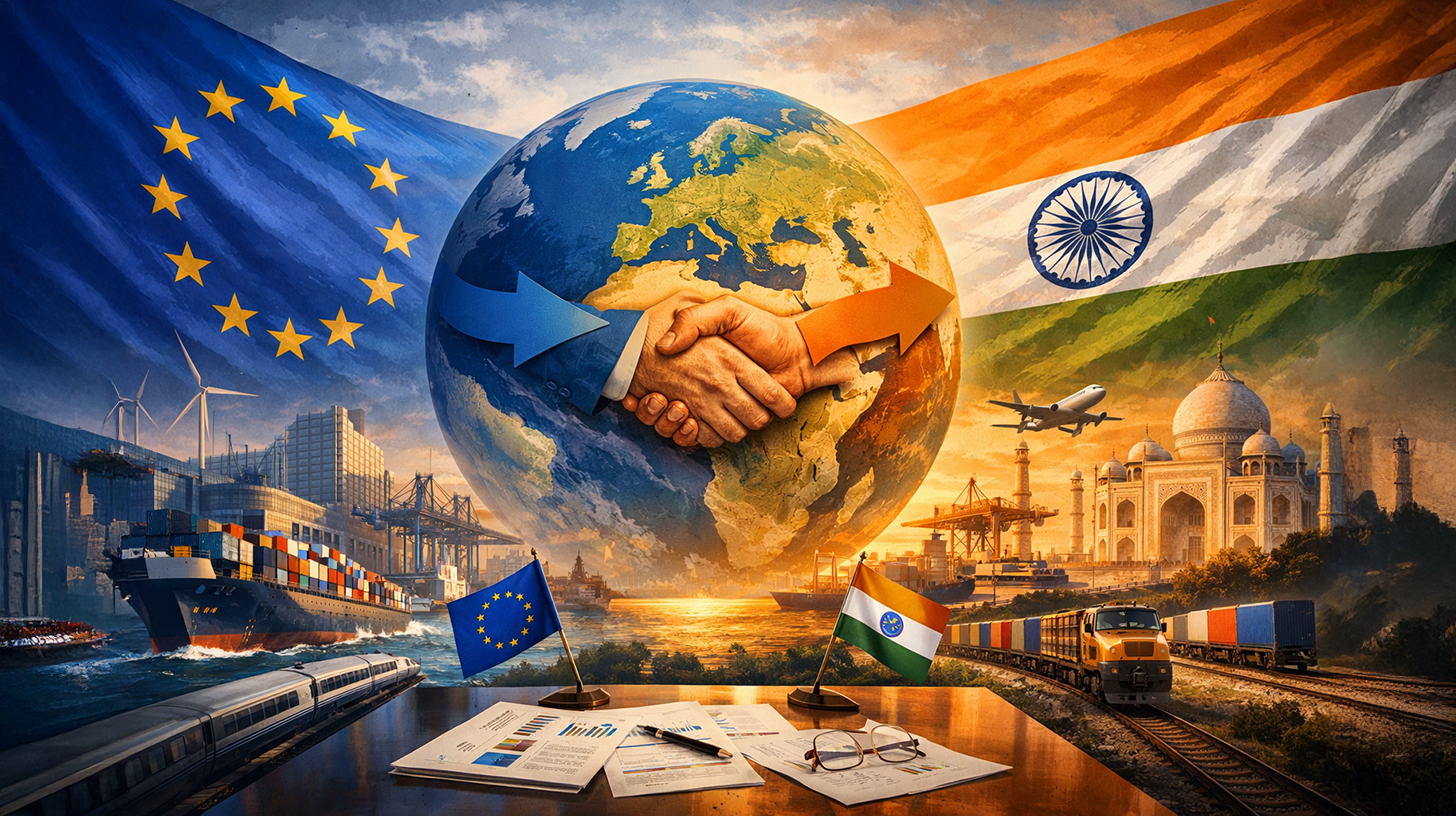
Mother of all deals: The EU's trade agreement with India is in place, but ratification, as with Mercosur, is not certain – Image: Xpert.Digital
Brussels' billion-dollar bet on Delhi: The EU-India free trade agreement as a geopolitical realignment in the era of protectionist trade conflicts
When two economic blocs come to their senses after two decades of marathon negotiations, usually more than just tariffs are at stake
The free trade agreement between the European Union and India, after almost twenty years of arduous negotiations, marks a fundamental strategic shift for both economies. Prime Minister Narendra Modi, with a flair for the dramatic, dubbed the agreement the "mother of all deals" on January 27, 2026. This phrase underscores both the pact's enormous scope and its geopolitical significance. The agreement encompasses a market of two billion people, represents roughly 25 percent of global economic output, and covers a third of worldwide trade. However, the true essence of this agreement lies less in the technical details of the tariff reductions and more in the strategic safeguard it provides against an increasingly unpredictable world order heavily influenced by American dominance.
The announcement came after intensive final negotiations on the sidelines of the 16th India-EU Summit in New Delhi. There, European Commission President Ursula von der Leyen and European Council President António Costa, together with Modi, confirmed the conclusion of the talks. However, practical implementation will still take time. According to an Indian government official, a five- to six-month legal review is now required, followed by translation into all 24 official EU languages and ratification by the European Parliament and the governments of the member states. The agreement is expected to enter into force at the beginning of 2027. This delay is typical of the complexity of modern trade agreements, which go far beyond simple tariff reductions and delve deeply into legal harmonization, investment protection, and the balancing of geopolitical interests.
Suitable for:

Sectoral winners in a fragmented trading world
The agreement aims to eliminate or at least significantly reduce tariffs on over 90 percent of goods traded between India and the EU. The direct beneficiaries of this opening are clearly identifiable on the Indian side. Modi specifically highlighted the textile, gemstone, and jewelry sectors, as well as the leather and footwear industries. These labor-intensive sectors have previously suffered from high EU import tariffs of 10 to 16 percent, which weakened their competitiveness compared to countries like Bangladesh and Vietnam. Textiles and apparel, which generated $7.6 billion in exports to the EU in 2024/25, are at the heart of India's hopes. Industry representatives anticipate that exports to the EU could double within three years once the tariffs are gradually phased out.
The pharmaceutical industry, India's second most important export sector to the EU with $3 billion in 2024/25, benefits less from tariff reductions than from the simplification of regulatory processes. The EU is the second-largest market for Indian medicines after the US, but bureaucratic hurdles such as lengthy approval processes outweigh the already low tariffs. The agreement envisions closer cooperation between authorities, which should accelerate the approval process for generic drugs. This could help Indian pharmaceutical companies significantly expand their market share in Europe, where the share of generic drugs, at 70 percent, is still far below the 90 percent in the US.
The chemical sector, which exported $5.1 billion worth of organic chemicals to the EU, faces a mixed situation. On the one hand, tariff reductions offer new sales opportunities; on the other, cheaper imports from the EU could put pressure on the Indian market. Average Indian import tariffs of 9.3 percent on EU goods are being gradually reduced, making European chemicals, machinery, and plastics more attractive to Indian buyers. Exporters still expect a net gain, as EU demand for specialty chemicals and basic materials should offset increased competition at home.
The automotive industry is one of the most politically sensitive areas of the deal. India has agreed to initially reduce import tariffs on European vehicles valued over €15,000 from the current level of up to 110 percent to 40 percent. These tariffs are then to be further reduced to 10 percent over an unspecified period. The annual quota has been capped at approximately 200,000 combustion engine vehicles. Electric cars are exempt from tariff reductions for the first five years to protect investments by domestic manufacturers such as Mahindra & Mahindra and Tata Motors. These safeguards demonstrate India's desire to avoid overburdening its own industry while gradually granting manufacturers like Volkswagen, Mercedes-Benz, and BMW access to one of the world's largest growth markets.
For European exporters, the main benefit lies in access to a rapidly growing consumer market of 1.4 billion people with an expanding middle class. Von der Leyen emphasized that the EU is gaining unprecedented market access to a traditionally highly protected partner. European machinery, transport equipment, chemicals, and high-value consumer goods will benefit from the lower tariffs. The wine industry, in particular, which currently struggles with extremely high tariffs of up to 150 percent, expects significant improvements. Although the exact figures are not yet public, previous Indian agreements with New Zealand and Australia suggest that a reduction to 25 to 50 percent over ten years is realistic.
Suitable for:

The raw materials issue as the strategic foundation of a long-term partnership
The issue of critical raw materials, particularly rare earths, forms a central, albeit often overlooked, pillar of the EU-India partnership. While there are no explicit raw materials chapters in the free trade agreement, the parallel agreements on technology and critical minerals demonstrate a commitment to deep cooperation. Both sides are part of the Minerals Security Partnership, an initiative aimed at securing the supply of key raw materials beyond Chinese dominance. Approximately 60 percent of the 34 minerals classified as critical by the EU overlap with India's list of 30 key raw materials, suggesting a shared strategic direction.
The working group on green energy technologies, established within the framework of the Trade and Technology Council founded in 2022, has already defined areas such as batteries for electric vehicles, hydrogen technology, and standards. Securing critical minerals is essential in this context. The EU, with its 2023 Critical Raw Materials Act, has created a framework to reduce dependence on China, while India is pursuing similar goals with its National Critical Mineral Mission. Both sides are seeking trilateral partnerships with resource-rich countries such as Australia or African nations to jointly invest in mining and processing.
The strategic importance of this cooperation is enormous. More than 80 percent of large European companies are dependent on individual Chinese producers through just a few supply chain steps, while India imports almost all of its lithium, cobalt, and nickel. By anchoring supply chains in mutual markets and through initiatives like the India-Middle East-Europe Corridor, both regions can reduce their vulnerability. The EU could also leverage its experience with public-private partnerships to strengthen India's mining sector, while India can act as a bridge to the Global South and promote equitable access to resources.
Why New Delhi won't experience a second Brussels-bashing
The stark difference in public perception of the India deal compared to the controversial Mercosur deal with Latin America is remarkable. While farmers in France, Poland, and Ireland protested the Mercosur agreement with tractor blockades, the announcement of the India deal went largely unnoticed. This is no coincidence, but rather the result of strategic risk avoidance through exemptions for certain sectors and a differentiated market opening.
The Mercosur agreement with Argentina, Brazil, Paraguay, and Uruguay aimed to eliminate tariffs on approximately 91 percent of goods, including sensitive agricultural products such as beef, poultry, and milk. European farmers feared a flood of cheap imports produced under lower standards. Countries like France, Poland, and Austria voted against the agreement but failed to secure the necessary majority to block it. The protests focused primarily on unfair competition and concerns that EU farmers would face stricter regulations than their South American counterparts.
In contrast, India and the EU deliberately excluded agriculture and dairy products from the core agreement. These sectors are politically sensitive because they employ millions of smallholder farmers in India. The Indian dairy sector is considered a red line, as it is essential for rural employment and food security. This deliberate exclusion prevents large EU milk imports, which would threaten India's cooperatives. Similarly, the EU protects its markets for sugar, rice, and beef, while India maintains high tariffs on agricultural products to safeguard the livelihoods of many smallholder farmers.
This strategy of targeted exceptions explains why organized protests failed to materialize. While the Mercosur deal was ridiculed as a "cars-for-cows" trade, the India deal lacks this symbolism. India's exports focus on manufactured goods, textiles, pharmaceuticals, and services, which do not directly compete with European farmers. Furthermore, the EU has included safeguard clauses that allow for emergency measures in the event of a price collapse for sensitive products. Such mechanisms were initially absent from the Mercosur proposal, which fueled farmers' skepticism.
Another factor is geopolitics. The Mercosur agreement was often linked to environmental concerns, such as fears of increased deforestation in the Amazon. India, on the other hand, is seen as a strategic partner and counterweight to China in the Indo-Pacific, which gives the agreement a security-related justification. The time factor also plays a role: Negotiations with India were only revived in 2022 and proceeded more discreetly than the lengthy Mercosur talks. The swift agreement left less room for opposition, especially since the deal was announced during a period of geopolitical uncertainty under the Trump administration, which forced Europe to seek new partners.
Geopolitical realignment in the Trump era as an accelerator
The pace of EU-India negotiations in recent months has been closely linked to the unpredictability of US trade policy under Donald Trump. In August 2025, the Trump administration imposed a 25 percent tariff on Indian imports because India was buying Russian oil. This drove total tariffs up to 50 percent and severely impacted key Indian industries such as apparel, jewelry, chemicals, and pharmaceuticals. Although Indian generic drugs were largely spared, this signaled a break in relations. Trump demanded a halt to oil purchases as a condition for tariff reductions—a demand New Delhi rejected as unfair, given that China faced only 30 percent tariffs for the same behavior.
At the same time, Trump's demands regarding Greenland and threats of tariffs against Europe strained the transatlantic relationship. This dual challenge motivated Brussels and New Delhi to deepen their ties and hedge against US protectionism. Von der Leyen emphasized in Davos that the EU is committed to fair trade instead of tariffs and partnership instead of isolation – a clear distinction from Trump's unilateral actions.
The significance of the agreement extends beyond mere trade figures. India recently concluded free trade agreements with the UK, New Zealand, and Oman, and is negotiating with other blocs. This strategy aims to diversify India's trade relationships and reduce dependencies. For the EU, the India deal is part of an attempt to forge new alliances, similar to those recently established with Canada, Mexico, and Japan.
Analysts see the agreement as an important geopolitical signal. At a time when global trade rules are faltering and the US is pushing for its own system, the pact between the EU and India shows that there are still countries that rely on regulated trade. It also proves that alternatives to the US exist. Singaporean expert Alex Capri argues that the deal could accelerate the process of breaking away from unreliable partners. It reduces dependence on Trump's America or China and mitigates the risks posed by fluctuating tariffs, export controls, and the use of supply chains as political leverage.
Our global industry and economic expertise in business development, sales and marketing

Our global industry and business expertise in business development, sales and marketing - Image: Xpert.Digital
Industry focus: B2B, digitalization (from AI to XR), mechanical engineering, logistics, renewable energies and industry
More about it here:
A topic hub with insights and expertise:
- Knowledge platform on the global and regional economy, innovation and industry-specific trends
- Collection of analyses, impulses and background information from our focus areas
- A place for expertise and information on current developments in business and technology
- Topic hub for companies that want to learn about markets, digitalization and industry innovations
More than just trade: The strategic alliance emerging in the shadow of the India deal
Investment protection, intellectual property and mobility as underestimated pillars
While the public focuses on tariffs, the agreement, in over 20 chapters, also covers government cooperation, investment protection, intellectual property, and skilled labor mobility. These areas could prove more important in the long run than mere tariff reductions. Investment protection and designations of origin are even governed by parallel agreements, underscoring their significance. The EU insisted on stronger investment protection, including clear dispute resolution and more reliable procedures. This is intended to provide a more stable business environment for European and Indian companies.
Geographical designations of origin are a sensitive issue. The EU demanded comprehensive protection for its specialties such as wine and cheese. India reacted cautiously, but at the same time wanted protection for its own products such as Darjeeling tea or Basmati rice. The fact that a separate agreement was negotiated in parallel for the first time is historically unprecedented and demonstrates the urgency of the matter.
The mobility of skilled workers is another key issue. India has been pushing for simpler entry rules for IT specialists, engineers, and consultants. This is important for India's strong service sector. Brussels is reportedly offering faster, multi-year business visas for Indian professionals in exchange for better market access for European agricultural and environmental technology companies. Mutual recognition of professional qualifications in nursing or architecture is also being discussed, which could facilitate thousands of job placements in Europe.
Drafts indicate visa-free stays of 90 days for IT managers and accelerated procedures for Indian engineers. The agreement also establishes a dialogue on the recognition of qualifications for accountants, architects, and medical personnel—areas where previous agreements often offered little flexibility. If successfully implemented, this could save weeks of visa waiting time. Industry associations welcome this: optimized regulations could reduce project lead times by 40 percent, and Indian construction companies see the recognition of qualifications as a crucial advantage for securing contracts in the EU.
Suitable for:

Challenges and risks in implementation
Despite the positive rhetoric, hurdles remain. A major problem is the EU's Carbon Border Adjustment Mechanism (CBAM), which will be fully implemented from 2026. This levy acts like a new tariff on exports and could increase the price of Indian products, even if regular tariffs are eliminated. India is particularly concerned about steel, aluminum, and chemicals, where costs could rise by up to 35 percent. Exporters see this as a hidden trade barrier, especially since the EU is also restricting the export of steel scrap.
Another problem is the timing. During negotiations, the EU eliminated the benefits of the Generalised Scheme of Preferences for 87 percent of Indian exports, effective January 1, 2026. This means that preferential access for almost all Indian goods is lost; only a few products retain lower tariffs. Exporters now have to pay the full standard tariff. A garment that previously incurred a 9.6 percent tariff now costs 12 percent. Since the free trade agreement is not expected to take effect until 2027, companies must prepare for a period of higher costs and reduced competitiveness. Price-sensitive sectors like clothing are at risk of losing customers to cheaper countries like Bangladesh.
Ratification by the European Parliament is also not certain. Although most member states approve, MEPs from countries like France, Poland, and Austria could vote against it due to concerns about agriculture. Both right-wing and left-wing factions have expressed reservations. The vote in spring 2026 is expected to be close. Furthermore, some countries could challenge the agreement before the European Court of Justice. These obstacles could delay its implementation or force changes.
Finally, substantive differences remain. Sustainability is a point of contention, particularly India's criticism of the carbon border adjustment mechanism. The agreement could be announced without this issue being definitively resolved. There were also disagreements regarding the wording on the war in Ukraine; ultimately, the topic was removed from the text to avoid jeopardizing the agreement. Whether the agreement will generate genuine growth or remain merely a political symbol depends on how these open questions are resolved.
Strategic defense cooperation as a complement to the economy
Alongside the trade deal, the EU and India also signed a security and defense partnership on January 27, 2026 – the third of its kind with an Asian country. The aim is deeper cooperation on maritime security, cyber defense, and counter-terrorism. Regular talks on defense initiatives and the exchange of arms industries are planned. Where interests align, the partners will explore how India can participate in EU defense projects.
The partnership envisions an annual security dialogue. The document states that closer coordination is necessary in light of global tensions and technological change. India's Defense Minister Rajnath Singh emphasized that shared values such as democracy and the rule of law form the basis for promoting global security and prosperity.
In the long term, New Delhi could gain access to EU defense funding. Although India remains heavily dependent on Russia militarily, it is seeking alternatives. France is already an important partner, and talks are underway with Germany regarding submarines and transport aircraft. India also intends to supply ammunition to the EU to compensate for shortages caused by its aid to Ukraine. The security partnership has gained significant momentum since 2025, underscored by high-level meetings and joint declarations.
Realistic assessment of the economic consequences
Economic forecasts for the agreement vary. Analysts at Emkay Bank estimate that Indian exports to the EU could increase by $3 billion to $5 billion over three years. This is based on the assumption that affected exports will grow by 5 to 8 percent – a common rule of thumb for short-term effects. A more comprehensive study from 2024 predicts that trade in goods could double by 2032, to over €112 billion. EU GDP could rise slightly, while India's could increase by up to 1.0 percent.
However, such figures should be treated with caution. They assume a smooth implementation, which is not guaranteed given political hurdles. Furthermore, factors such as carbon border adjustments or geopolitical shocks are often omitted from the calculations. Real gains from tariff reductions will only materialize after the agreement comes into effect, meaning no earlier than 2027. Until then, exporters will have to contend with higher costs.
Trade relations are already strong. In the 2024/25 financial year, trade in goods amounted to approximately $136.5 billion, making the EU India's largest trading partner. Trade in services is also growing rapidly. Over the past ten years, EU goods imports from India have more than doubled.
The EU is also the largest foreign investor in India, with investments exceeding €132 billion in 2024. Around 6,000 European companies operate there. This close integration provides a solid foundation. However, experience shows that actual profits often fall short of forecasts when bureaucracy and politics create obstacles. The true test of the agreement lies not in the ceremonial signing, but in the arduous work of its implementation in the coming years.
Strategic importance in a world of fragmented alliances
The agreement between the EU and India marks a turning point and demonstrates how the global economy is dividing into regional blocs – in response to US protectionism and China's dominance. It makes clear that middle powers are pursuing their own strategies and are no longer solely oriented towards the US. India's rapid conclusion of several trade agreements and the EU's efforts to reduce dependencies reflect a reorientation: bilateral agreements are gaining in importance, while global institutions like the WTO are losing influence.
The approach of targeted market opening with exceptions for sensitive sectors – such as agriculture – could become the standard for future agreements. This makes agreements politically feasible without creating domestic political dynamite. However, there is a risk that the major economic promises will be diluted as a result.
The linking of trade, security, and technology demonstrates the multidimensionality of modern partnerships. This makes them more resilient to political crises, but also increases complexity and creates new dependencies. Whether the EU-India agreement will generate genuine long-term growth or remain primarily a geopolitical symbol remains to be seen. Crucially, both sides will need to be prepared to resolve contentious issues such as carbon levies and bureaucracy pragmatically and maintain political support even in the face of opposition.
Your global marketing and business development partner
☑️ Our business language is English or German
☑️ NEW: Correspondence in your national language!

Konrad Wolfenstein
I would be happy to serve you and my team as a personal advisor.
You can contact me by filling out the contact form or simply call me on +49 7348 4088 965 (Munich) . My email address is: wolfenstein ∂ xpert.digital
I'm looking forward to our joint project.
☑️ SME support in strategy, consulting, planning and implementation
☑️ Creation or realignment of the digital strategy and digitalization
☑️ Expansion and optimization of international sales processes
☑️ Global & Digital B2B trading platforms
☑️ Pioneer Business Development / Marketing / PR / Trade Fairs
🎯🎯🎯 Benefit from Xpert.Digital's extensive, five-fold expertise in a comprehensive service package | BD, R&D, XR, PR & Digital Visibility Optimization

Benefit from Xpert.Digital's extensive, fivefold expertise in a comprehensive service package | R&D, XR, PR & Digital Visibility Optimization - Image: Xpert.Digital
Xpert.Digital has in-depth knowledge of various industries. This allows us to develop tailor-made strategies that are tailored precisely to the requirements and challenges of your specific market segment. By continually analyzing market trends and following industry developments, we can act with foresight and offer innovative solutions. Through the combination of experience and knowledge, we generate added value and give our customers a decisive competitive advantage.
More about it here:










