
Systemic crisis vs. constant frustration: The frightening parallels between the USA and Germany
Xpert Pre-Release

Available in 27 languages 📢
Prefer Xpert.Digital on GoogleⓘPublished on: February 24, 2026 / Updated on: February 24, 2026 – Author: Konrad Wolfenstein
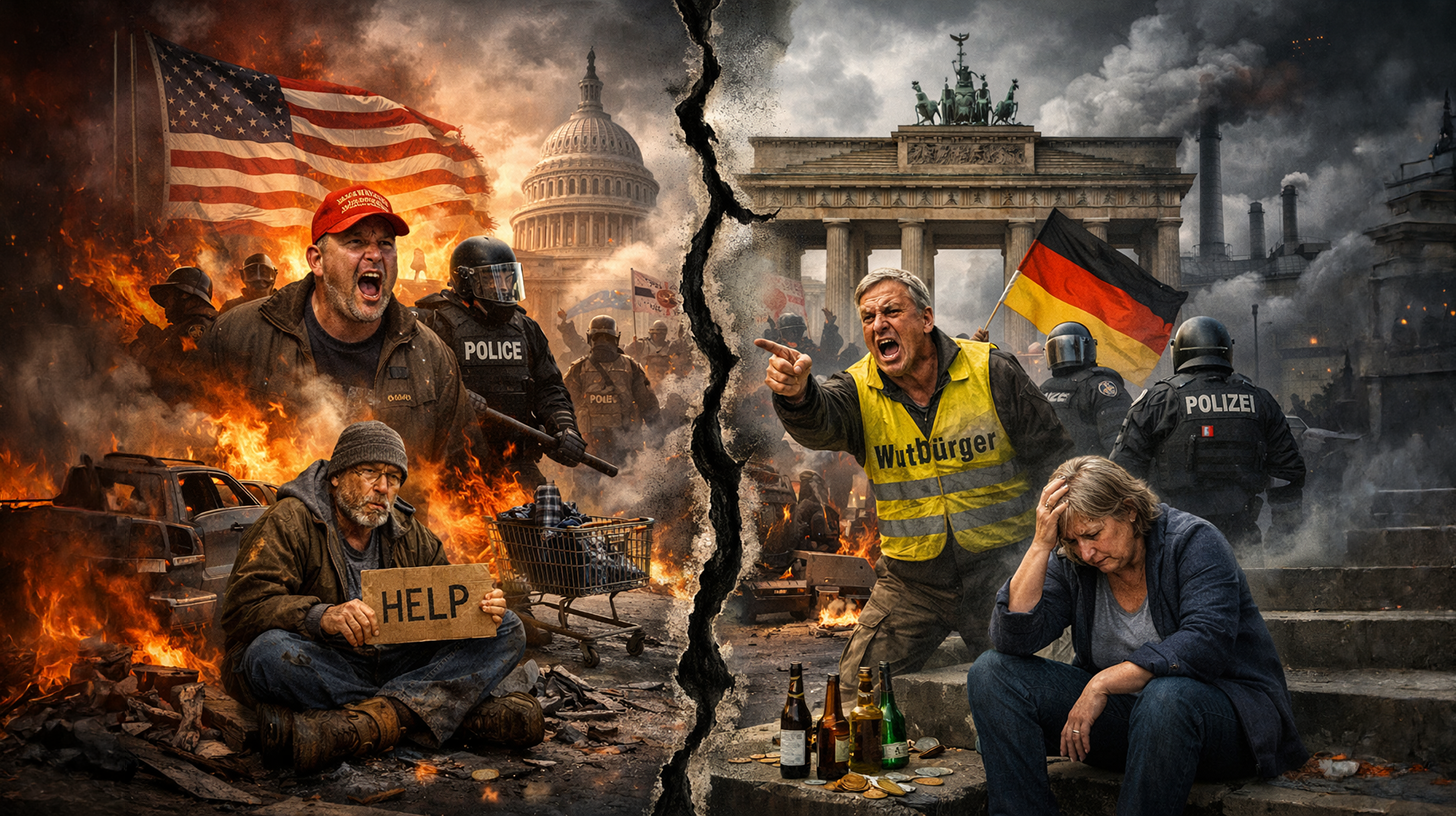
Systemic crisis vs. constant frustration: The frightening parallels between the USA and Germany – Image: Xpert.Digital
America in a slump: 57 percent see the nation in decline
Trump shock and Merz slump: Why the US and Germany are faltering at the same time
It's February 2026, and the political climate on both sides of the Atlantic is characterized by profound disillusionment. Shortly before US President Donald Trump's prestigious State of the Union address, a revealing poll uncovers an alarming finding: 57 percent of Americans consider their nation to be in a weak state. Despite solid macroeconomic growth, noticeable inflationary surges due to aggressive tariffs, the drastic restructuring of government under Elon Musk's "DOGE" initiative, and growing concerns about the foundations of democracy are pushing the country into an unprecedented crisis. Trust in traditional institutions and the separation of powers is eroding rapidly – even within the Republican Party.
But this massive loss of trust is not a purely American phenomenon. A look at Germany reveals striking and alarming parallels: Here, too, the approval ratings of the center-right/center-left coalition government under Chancellor Friedrich Merz are plummeting to historic lows. While the US is grappling with a full-blown systemic and institutional crisis, in which the executive branch itself is attacking the foundation of the separation of powers, Germany is suffering from a paralyzing performance crisis and persistent stagnation. This article examines the anatomy of a dual national frustration and shows why two of the world's most important democracies are currently battling the creeping erosion of public trust – before this frustration finally erupts in the next elections.
When the population loses trust, more than just a poll is at risk
In February 2026, the United States of America experienced a remarkable moment of political self-reflection. Just hours before President Donald Trump's highly anticipated State of the Union address on February 24, 2026, a large-scale poll by NPR, PBS News, and the Marist Institute painted a sobering picture: 57 percent of US citizens surveyed described the state of the nation as not strong or even not strong at all. This was not mere statistical noise, but a finding with substance, fueled by concrete economic, political, and social upheavals. Simultaneously, a poll by the Washington Post, ABC News, and Ipsos revealed a 60 percent disapproval rating for Trump's overall performance in office, with 47 percent expressing strong disapproval. The judgment was even more dramatic when it came to specific policy areas: only 32 percent of respondents approved of Trump's handling of inflation, and a mere 34 percent of his tariff policy.
These figures are more than just a snapshot. They coalesce into a narrative of institutional erosion that extends far beyond party politics and, in its depth, shows clear parallels to the mood in Germany, even though the causes and contexts diverge considerably.
Anatomy of a national disillusionment: What specifically motivates the 57 percent
The 57 percent who rate the state of the Union as weak are composed of several mutually reinforcing layers of dissatisfaction. The economic dimension is the most obvious. Although the US economy grew at an annualized rate of 4.3 percent in the third quarter of 2025, and Goldman Sachs forecasts GDP growth of 2.5 percent for 2026, this growth is not reaching many citizens. Consumer prices rose by 2.7 percent in 2025 compared to the previous year, with the tariffs imposed by Trump contributing around 0.7 percentage points to inflation, according to economists' calculations. Without the effects of the tariffs, the inflation rate would have been around 2.2 percent, significantly closer to the Federal Reserve's target.
Tariff policy, a core element of Trump's economic agenda, generated a total of $287 billion in tariff revenue in 2025. While businesses initially absorbed around 80 percent of tariff costs, JPMorgan forecasts that this share could fall to just 20 percent by 2026, likely triggering a noticeable price increase for consumer goods, particularly food and low-margin products. Prices for imported goods already rose by around 5.4 percent between March and September 2025, while domestic goods were 3 percent above the previous trend. Low-income households are particularly affected, as they disproportionately purchase cheaper products, where the tariff burden is passed on more heavily.
Adding to the drama was a historic turning point: On February 20, 2026, just four days before the State of the Union address, the Supreme Court, by a vote of six to three, declared Trump's sweeping emergency tariffs under the International Emergency Economic Powers Act unconstitutional. Chief Justice John Roberts stated that the Founding Fathers had not granted any taxing authority to the executive branch and that the president had to demonstrate clear authorization from Congress to impose such extensive tariffs. Trump responded immediately with a new 10 percent global tariff under a different legal basis, the Trade Act of 1974, intended to be in effect for 150 days. But the political damage had already been done.
The erosion of institutional trust: Checks and balances under pressure
Economic dissatisfaction alone, however, does not explain the depth of the malaise. What makes the Marist poll particularly alarming is the rapid decline in trust in the functioning of democratic institutions. Sixty-eight percent of respondents believe that the system of checks and balances between the president, Congress, and the judiciary is not working well, an increase of twelve percentage points from the previous year. Since December 2024, shortly before Trump's return to the White House, the proportion of skeptics has even doubled.
It is noteworthy that this loss of trust affects all political camps. Democrats, of course, lead with a decline of 45 points, followed by independents with 34 points, but even Republicans have seen a 19-percentage-point drop in confidence in checks and balances. This trend is reflected in broader perceptions: 78 percent of all respondents see a serious threat to democracy, a figure shared by at least six out of ten respondents across party lines, including 61 percent of Republicans.
Political scientists from Harvard and the University of Toronto argued as early as late 2025 in the journal Foreign Affairs that under Trump the US had slipped into a state of competitive authoritarianism, in which elections do take place, but the ruling party uses its power to silence the opposition and distort the political landscape in its favor. Whether one agrees with this thesis or not, it demonstrates the depth of academic concern.
The DOGE factor: State dismantling as a government program
A concrete catalyst for the loss of trust is the systematic downsizing of the federal bureaucracy under the label of the Department of Government Efficiency, or DOGE, which is de facto headed by Elon Musk. Since Trump took office in January 2025, over 352,000 federal employees have left the civil service. After accounting for new hires, the net reduction in the federal workforce was approximately 242,000 people, representing a decrease of about ten percent. The U.S. Agency for International Development (USAID), the Bureau of Consumer Protection and Human Services, the Department of Education, and the Department of Health and Human Services were particularly affected.
Further cuts are planned for 2026. The Department of Veterans Affairs intends to eliminate up to 35,000 health care positions, following the loss of nearly 30,000 employees in 2025. The human cost of this policy is substantial. Former federal employees report chaotic, difficult, and devastating circumstances, including job searches and financial hardship. Approximately one-third of federal employees placed through a relocation program had to move to another state, and ten percent of those moved across the country.
The waves of protest sweeping the country document the extent of societal polarization. In 2025, over 10,700 protests were registered, an increase of 133 percent compared to the 4,588 protests during the same period of Trump's first term in 2017. These demonstrations took place not only in liberal metropolitan areas, but for the first time also across the country in conservative and rural regions.
Our US expertise in business development, sales and marketing

Our US expertise in business development, sales and marketing - Image: Xpert.Digital
Industry focus areas: B2B, digitalization (from AI to XR), mechanical engineering, logistics, renewable energies and industry
More information here:
A thematic hub offering insights and expertise:
- Knowledge platform covering global and regional economies, innovation and industry-specific trends
- A collection of analyses, insights, and background information from our key areas of focus
- A place for expertise and information on current developments in business and technology
- A hub for companies seeking information on markets, digitalization, and industry innovations
A crisis of confidence on two continents: Why Americans and Germans distrust their politicians
The political fault line: One nation, two realities
The deepest divide in the polling data runs along party lines. While 79 percent of Democrats and 68 percent of independents rate the nation's state as weak, only 23 percent of Republicans share this view. Conversely, 77 percent of Republicans believe the United States is on solid footing. The polarization is also evident in the question of whether the country is worse off than a year ago: 90 percent of Democrats and 68 percent of independents agree, while 82 percent of Republicans disagree.
Beyond party affiliation, further dividing lines emerge. Educational attainment plays a central role: 69 percent of respondents with a university degree describe the state of the nation as weak, while those without an academic degree are split exactly 50/50. Women assess the situation twelve percentage points more negatively than men, with 63 percent compared to 51 percent. Among the groups most pessimistic about the situation are people over 60 and women in small towns and suburbs.
Even within Trump's own camp, cracks are appearing. According to a CNN poll, his approval rating among Republicans fell to 82 percent, a drop of eight points from the previous year. The percentage of those who strongly approve of his performance even fell from 63 percent to 48 percent in the Washington Post poll. Among independents, Trump's approval rating reached a new low in the CNN survey.
Germany in comparison: Different causes, similar malaise
The question of whether Germans assess their own situation similarly negatively can be answered with a nuanced yes. The level of dissatisfaction is comparably high, but it stems from different sources.
In the ARD-DeutschlandTrend survey from February 2026, only 21 percent of respondents were satisfied with the work of the CDU/CSU-SPD coalition government under Chancellor Friedrich Merz, while dissatisfaction stood at around 78 percent. A YouGov survey, also from February 2026, found only 22 percent satisfaction and 75 percent dissatisfaction, marking the lowest level since Merz took office. According to the RTL/ntv Trendbarometer, Merz himself reached an all-time low with a 23 percent satisfaction rating. An INSA poll commissioned by the Bild newspaper found that around two-thirds of Germans were dissatisfied with the Chancellor's and the government's performance. Thirty-five percent even rated Merz's performance as worse than that of his predecessor, Olaf Scholz.
The causes, however, lie less in a crisis of democracy than in a prolonged period of economic weakness. The German economy grew by only 0.2 percent in 2025, after contracting for two consecutive years. The Bundesbank forecasts growth of just 0.6 percent for 2026, while the ifo Institute predicts 0.8 percent. A survey by the Foundation for Future Studies revealed that 78 percent of Germans are pessimistic about economic developments. The EY consumer study shows that 49 percent of respondents expect the economic situation to worsen, while only 16 percent are optimistic.
According to the Körber Foundation, three-quarters of Germans (76 percent) rate the economic situation as less than good or bad. Sixty-two percent doubt that Germany can manage the upcoming transformation challenges, twelve percentage points more than in 2023. The consumer climate index (GfK/NIM) stands at minus 24.1 points in February 2026, a slight improvement but still at a historically low level. NIM expert Rolf Bürkl warned that geopolitical tensions and an escalation of trade conflicts could quickly reverse the mood.
Understanding of democracy in comparison: Fundamentally different
A revealing difference emerges when it comes to the topic of democracy. In the US, 78 percent see a serious threat to democracy, and 68 percent consider the separation of powers dysfunctional. In Germany, fundamental support for the idea of democracy stands at 98 percent, and 60 percent are satisfied with how democracy functions. At the same time, however, 71 percent rate the development of democracy over the past ten years as negative, and the Körber Foundation determined that by 2025, 53 percent of Germans will have little or no trust in democracy.
The crucial difference lies in the focus of the criticism. In the US, concerns center on the erosion of democratic institutions by the executive branch itself, the dismissal of independent checks and balances, the restructuring of the state apparatus, and confrontations with the judiciary. In Germany, frustration is primarily directed at the effectiveness of politics and its inability to act in the face of economic and social challenges. According to a Forsa survey, 54 percent of Germans do not trust any single political party to be politically competent. It is therefore more of a performance crisis than a systemic crisis.
The concerns of Germans revolve primarily around tangible aspects of their lives. 88 percent fear international conflicts and wars, 82 percent are worried about rising living costs, and the fear of declining prosperity significantly shapes the perceptions of many citizens. Satisfaction with the government's crisis management skills has plummeted from 65 percent in 2020 to just 23 percent.
Two democracies, one structural problem
A comparison of political and economic sentiment in the US and Germany in February 2026 reveals a similar structural problem in both democracies. Satisfaction with the government is low in both countries: In the US, approval of President Trump stands at 39%, while in Germany only 21-22% are satisfied with the government. The general state of the nation is also viewed negatively by a majority. In Germany, 76% perceive the economic situation as poor, and in the US, 57% rate the country as "not strong.".
Concern for democracy itself is deeply rooted. A large majority of 78% of Americans see democracy as threatened, and in Germany, 53% have little confidence in it. However, opinions diverge on the separation of powers: While 68% of US citizens view the system of checks and balances as dysfunctional, 60% of Germans believe that democracy generally works.
Economically, people are pessimistic about the future. In the US, 48% say their situation has worsened since Trump took office, and in Germany, 49% expect further economic decline. This is reflected in the differing GDP growth forecasts for 2026, which range from 2.1% to 2.5% for the US, but only from 0.6% to 1.0% for Germany. Trust in political competence has also been shaken: 64% of Americans consider Trump out of touch with reality, and in Germany, 54% of citizens no longer trust any political party to be competent.
| category | USA (Feb. 2026) | Germany (Feb. 2026) |
|---|---|---|
| Satisfaction with government | 39% approval rating (Trump) | 21-22% satisfaction |
| State of the nation: negative | 57% (not strong) | 76% (economic situation poor) |
| Democracy in danger | 78% see a threat | 53% low trust |
| Checks and balances / separation of powers | 68% dysfunctional | 60% works (democracy in general) |
| Economic deterioration | 48% (since taking office) | 49% expect a deterioration |
| GDP growth (forecast 2026) | 2,1-2,5% | 0,6-1,0% |
| Trust in political competence | 64% see Trump as out of touch with reality | 54% do not trust any party to be competent |
The comparison reveals a paradoxical symmetry. In the US, the economy is growing substantially, yet political instability and a loss of institutional trust are generating a sense of national weakness. In Germany, the economy has stagnated for years, but democratic institutions are fundamentally functioning, although trust in the ability of politicians to solve problems is eroding massively. Both countries share the phenomenon that the population perceives politicians as increasingly out of touch with reality, incapable of taking action, and unable to meet the challenges of our time.
But while the discussion in the US revolves around a structural crisis of democracy, with concrete reference points such as the disempowerment of federal agencies, confrontations with the Supreme Court, and the persecution of political opponents, the German debate remains primarily about economic performance and stalled reforms. The fact that 71 percent of Germans nevertheless view the democratic developments of the last decade negatively, and that populist attitudes demonstrably reinforce this skepticism, should not, however, be dismissed as a minor problem. In both cases, the erosion does not begin with a dramatic crash, but with a gradual loss of trust, reflected in opinion polls long before it materializes in election results.
Consulting - Planning - Implementation

Konrad Wolfenstein
I would be happy to serve as your personal advisor.
contact me at wolfenstein ∂ xpert.digital
Just call me on +49 7348 4088 965 (Munich) .
Our EU and German expertise in business development, sales and marketing

Our EU and German expertise in business development, sales and marketing - Image: Xpert.Digital
Industry focus areas: B2B, digitalization (from AI to XR), mechanical engineering, logistics, renewable energies and industry
More information here:
A thematic hub offering insights and expertise:
- Knowledge platform covering global and regional economies, innovation and industry-specific trends
- A collection of analyses, insights, and background information from our key areas of focus
- A place for expertise and information on current developments in business and technology
- A hub for companies seeking information on markets, digitalization, and industry innovations










