
Lack of integrity and the green price of victory: Özdemir's triumph and the economic burden for Baden-Württemberg
Xpert Pre-Release

Available in 27 languages 📢
Prefer Xpert.Digital on GoogleⓘPublished on: March 9, 2026 / Updated on: March 9, 2026 – Author: Konrad Wolfenstein
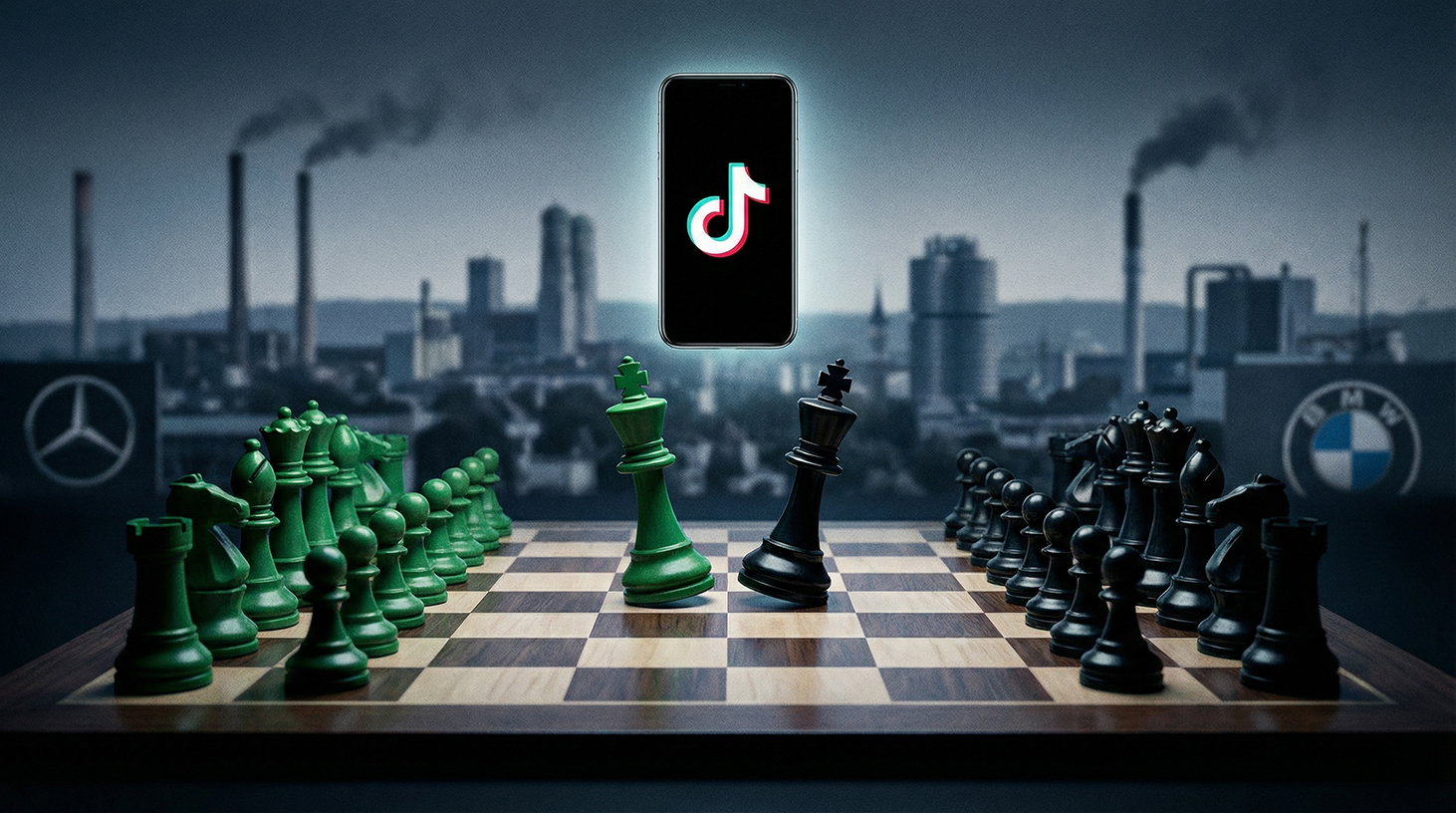
Lack of integrity and the green price of victory: Özdemir's triumph and the economic burden for Baden-Württemberg – Image: Xpert.Digital
Deindustrialization in Baden-Württemberg: The high price for Özdemir's Green Party victory?
The 8-year video: How, among other things, a social media campaign brought down the CDU in Baden-Württemberg
TikTok scandal and industry upheaval: How Özdemir really won the election
The state election in Baden-Württemberg on March 8, 2026, marks a historic turning point: Cem Özdemir leads the Greens to a narrow but momentous victory over the CDU. But behind this political triumph, fueled in large part by an unprecedented social media campaign and the new voting age of 16, lies a dramatic economic reality. Germany's strongest industrial state is on the brink of a profound structural crisis. Giants like Mercedes-Benz and Porsche are massively cutting jobs, suppliers are capitulating to the failed transformation, and once-prosperous municipalities like Sindelfingen are imposing budget freezes. The following article examines the anatomy of this controversial election victory and poses the crucial question: Can a government that owes its power to aggressive campaign tactics and viral algorithms save the economic foundations of Europe before deindustrialization becomes irreversible?
When political strategy overrides economic reason
The state election in Baden-Württemberg on March 8, 2026, with the narrow victory of the Greens under Cem Özdemir, produced a result that sends a signal far beyond the southwest. With 30.2 percent for the Greens compared to 29.7 percent for the CDU, it is clear that the Green-Black coalition will continue under new Green leadership. What at first glance appears to be democratic normality reveals, upon closer inspection, a deeper problem: The path to victory was paved with methods that erode trust in political integrity, while at the same time the economic foundation of Germany's strongest industrial state is eroding at an alarming rate.
This analysis examines the five decisive factors of the election victory, the economic realities of Baden-Württemberg, and the question of whether such a victory can provide the necessary political authority to overcome the most serious industrial structural crisis since the state's inception.
The anatomy of a calculated comeback
The starting position could hardly have been worse for the Greens. In the fall of 2025, they trailed the CDU by a full 14 percentage points in the polls. What transpired in the following months was aptly described by Focus journalist Florian Festl as a Machiavellian masterpiece, the adjective here certainly intended to be understood in its double-edged sense. Cem Özdemir, 60 years old and a veteran of decades in politics, systematically exploited his extensive experience and his opponent's weaknesses. His rival, Manuel Hagel, only 37 years old and comparatively inexperienced as the CDU state chairman, could offer little resistance to this strategic superiority.
The central question that needs to be answered from an economic policy perspective, however, is not whether Özdemir's election campaign was brilliant. The question is whether methods aimed at maximum destabilization of the opponent can create a viable basis for overcoming a once-in-a-century industrial crisis.
Digital annihilation: The TikTok factor as an election decision-maker
The first and arguably most influential factor in the Greens' success was the spread of an eight-year-old video in which Manuel Hagel, then 29, spoke in a local television interview about a school visit and described the appearance of a 16-year-old student named Eva, saying he would never forget her doe-like brown eyes. Zoe Mayer, a Green Party member of the Bundestag from Karlsruhe, posted the clip on TikTok and Instagram a few days before the election, where it quickly garnered 15 million views. Thirteen Green Party elected officials, including party leader Felix Banaszak, shared the video within the first few hours.
The effect was devastating. Hagel was linked to pedophilia on social media and even compared to Jeffrey Epstein. He received numerous death threats. CDU General Secretary Tobias Vogt spoke of a targeted smear campaign that was destroying people and personally accused Özdemir of lacking civic decency. Minister-President Kretschmann emphasized that it was not a coordinated action and that the leadership of the Baden-Württemberg Green Party had initially been unaware of the video. Özdemir himself even defended Hagel, saying that he certainly wouldn't phrase things that way today.
However, this demonstrative distancing cannot disguise the fact that a systematic multiplier effect occurred through party structures. The interplay between a single member of parliament's post and its immediate dissemination by 13 other elected officials within the first few hours can hardly be interpreted as coincidence. This process is relevant to the economic credibility of a future prime minister insofar as it raises the question of the future government's relationship to truth and proportionality. Business leaders and investors closely observe political practices, and a government that owes its rise to power to a viral smear campaign must be prepared to answer the question of whether it would sacrifice economic interests with the same ruthlessness if it served its political agenda.
The blurred dividing line between black and green
The second success factor lies in the specific political constellation of Baden-Württemberg. After 15 years under Minister-President Winfried Kretschmann in a Green-Black coalition, the ideological boundaries between the two camps have largely eroded. The SPD, with 5.5 percent of the vote, has sunk into insignificance, while the FDP, with 4.4 percent, failed to enter the state parliament. For the moderate middle class, the election thus effectively boiled down to a personnel decision: the experienced, nationally known Özdemir versus the young, still relatively unknown Hagel.
From an economic perspective, this situation presents a dangerous paradox. While the blurring of ideological boundaries may suggest short-term stability, it also eliminates the necessary competition of ideas in economic policy. If voters no longer distinguish between the Greens and the CDU governing, then the decision regarding the direction of economic policy also loses its significance. This indifference is precisely where the problem lies: given its industrial crisis, Baden-Württemberg needs a sharply defined economic policy debate. Instead, it is getting a personality-driven election that pushes structural issues into the background.
Özdemir's migration policy squaring of the circle
The third factor concerns Özdemir's skillful navigation of the migration debate. He positioned himself as a security-minded thinker with Turkish roots who showed little tolerance for immigrant criminals, without making the issue the central focus, which would have driven additional voters to the AfD. His personal contribution to the Frankfurter Allgemeine Zeitung in September 2024, in which he described how his daughter had also been subjected to sexual harassment in Berlin by young men with a migration background, set a high public tone. His marriage, performed shortly before the election by the independent mayor of Tübingen, Boris Palmer, considered a maverick and realist within the Green Party, was interpreted as a deliberate signal to the center-right.
From an economic policy perspective, this stance is ambivalent. On the one hand, it demonstrates political flexibility and the ability to build bridges across ideological divides. On the other hand, it reveals an opportunistic attitude that can be cause for concern: Anyone who bases their position primarily on electoral strategy in such a sensitive issue as migration might also be more inclined to follow public sentiment than economic reason in industrial policy matters.
The Merz penalty and Berlin's shadow over the southwest
The fourth factor was largely beyond the control of both candidates. In Baden-Württemberg, around 500,000 jobs depend on the automotive industry. CDU candidate Hagel desperately needed support from federal politics, a strengthening economy, and signs of an economic turnaround. Instead, representatives of small and medium-sized businesses loudly voiced their discontent with what they perceived as the overly social-democratic policies of Chancellor Friedrich Merz. At the same time, Hagel failed to convincingly communicate his plans for a transformed, high-tech Baden-Württemberg.
The Baden-Württemberg branch of the Mittelstands- und Wirtschaftsunion (MIT), the SME and business association, had already issued a stark warning in January 2026: the promised autumn of reforms had turned into a bitterly cold winter of deindustrialization. As a concrete example, they cited the relocation of Mercedes-Benz's A-Class production from Rastatt, Baden-Württemberg, to Hungary. The MIT demanded an immediate U-turn in energy and climate policy, including a shift towards nuclear power and significant tax cuts.
This factor reveals the deepest economic policy irony of the election outcome: Frustration over the lack of reforms at the federal level under a CDU chancellor contributed to the fact that, at the state level, it was precisely the Greens who benefited, whose economic policy record in the state itself is anything but convincing.
Our EU and German expertise in business development, sales and marketing

Our EU and German expertise in business development, sales and marketing - Image: Xpert.Digital
Industry focus areas: B2B, digitalization (from AI to XR), mechanical engineering, logistics, renewable energies and industry
More information here:
A thematic hub offering insights and expertise:
- Knowledge platform covering global and regional economies, innovation and industry-specific trends
- A collection of analyses, insights, and background information from our key areas of focus
- A place for expertise and information on current developments in business and technology
- A hub for companies seeking information on markets, digitalization, and industry innovations
A victory with an expiration date: Why political triumph becomes an economic trap.
The momentum of the winners and the psychology of the last few days
The fifth factor was psychological. Election research shows that undecided voters tend to side with the expected winner in close races. Hagel's campaign in recent weeks was dominated almost exclusively by negative news, from a viral video to a disastrous appearance at a comprehensive school where he allowed himself to be provoked by a teacher in front of a live ARD camera. This downward spiral permeated public perception, while Özdemir increasingly gained momentum.
In addition, a significant structural change occurred: For the first time, 16- and 17-year-olds were allowed to vote in a state election in Baden-Württemberg. This reform was jointly passed by the CDU, the Greens, and the SPD in 2022. Lowering the voting age to 16 expanded the electorate to include an age group that is disproportionately receptive to social media-based campaigning and tends to lean more towards Green positions. The irony that the CDU had agreed to an electoral reform that now worked to its own disadvantage did not go unnoticed in the debate.
The economic reality: An industrialized country in free fall
Beyond all election campaign tactics, the crucial question is what Özdemir's election victory means for the state's economic future. The data paints an alarming picture. With an industrial gross value added of €128 billion and an industrial share of 32.5 percent of total value added, Baden-Württemberg is by far the strongest industrial state in Germany. The national average is only 19.7 percent. The state's gross domestic product amounted to approximately €650 billion in 2024. With annual payments of around €5 billion into the state fiscal equalization system, Baden-Württemberg was the second-largest net contributor after Bavaria in 2024, accounting for 27 percent of the total equalization volume.
These impressive figures, however, mask the dramatic erosion already underway. The number of job vacancies in the country has plummeted by 30 percent compared to 2022. By 2030, 14,000 jobs are expected to disappear in the automotive industry alone. IG Metall state chairwoman Barbara Resch describes the situation as extremely tense and warns that suppliers who have invested heavily in electromobility are running out of money because demand isn't materializing.
Sindelfingen as a warning sign of deindustrialization
The plight of the city of Sindelfingen brings the crisis into sharp focus. Once the wealthiest city in Germany, home to the central Mercedes-Benz plant, it was forced to impose a budget freeze in December 2025. The overall budget deficit exploded from a planned €20.8 million to €68.5 million. A shortfall of €73.2 million is projected for 2026. The main reason: Business tax revenues, originally budgeted at €128 million, plummeted to a mere €30 million, a decline of almost 80 percent.
Mayor Markus Kleemann speaks openly of a structural crisis. Sindelfingen is not an isolated case, but rather a symptom of a widespread trend. Stuttgart itself, along with eleven other state capitals, has written an urgent letter to Chancellor Merz, in which the cities state that they are at their financial limit.
Mercedes, Porsche, Bosch: The industrial icons are faltering
Following a massive drop in profits, the Stuttgart-based automotive group Mercedes-Benz has launched a five-billion-euro cost-cutting program. Around 40,000 administrative employees have been offered severance packages. A 55-year-old team leader with 30 years of service can expect a severance payment of over 500,000 euros. The relocation of A-Class production from Rastatt to Hungary exemplifies the trend of shifting production abroad.
According to Ibrahim Aslan, head of the works council at Porsche, up to 5,500 jobs are at risk, representing a quarter of the workforce at the company's main plants in Stuttgart-Zuffenhausen and Weissach. Bosch, ZF, Trumpf, Voith, and Mahle are also undergoing massive job cuts and restructuring. The automotive supplier Dostech in Mössingen, which focused on electromobility in 2018, has already had to reduce staff due to a lack of anticipated demand.
The dangerous illusion of Kretschmann continuity
Özdemir's election campaign was largely based on the promise of continuing Kretschmann's policies. He presented himself as a pragmatic bridge-builder who wanted to govern across party lines and evaluate good ideas regardless of their origin. On election night, he hinted at a partnership of equals with the CDU and emphasized that it wasn't about a purely Green or purely Black coalition, but about Baden-Württemberg.
This rhetorical moderateness, however, stands in sharp contrast to the campaign methods and the economic record of the Green Party's years in government. During Kretschmann's tenure, Baden-Württemberg's industrial base did not strengthen, but rather gradually eroded. Energy costs rose, bureaucratic burdens increased, and the transformation of the automotive industry was merely accompanied rather than actively shaped. Özdemir's statements to date offer little insight into whether he will correct course. During his campaign, he preferred to speak of livable communities rather than industrial centers, and the fact that his campaign posters lacked a Green Party logo suggests that he is quite aware of the negative connotations associated with his own brand in economic policy matters.
The democratic dilemma of young voters
One particularly controversial aspect is the role of the newly lowered voting age. The 16- and 17-year-olds who were allowed to participate in a state election for the first time represent a voter group whose lives are hardly affected by the consequences of industrial policy decisions. The criticism that students ideologically indoctrinated by green teachers have, through the change in the voting law, helped decide the election and will soon be out of work, may be polemically exaggerated. However, it contains a rational core: Lowering the voting age shifts the electoral balance in favor of an age group that is naturally more receptive to identity politics and environmental issues than to questions of industrial competitiveness.
The juxtaposition with the observation that those over 70 represent the largest electorate and are financially secure highlights the generational dilemma: Neither the youngest nor the oldest bear the direct economic burden of a failed industrial policy. It is the middle generation, those aged 30 to 60, that keeps the country's manufacturing sector running, and whose voice was clearly not loud enough in the TikTok election campaign.
Coalition building under poisoned skies
The question of forming a government arises under extremely unfavorable circumstances. Mathematically, the election results indicate that a continuation of the Green-Black coalition is the only realistic option, but this time with the roles reversed, with the Greens leading. While the CDU achieved a significantly higher percentage of first-preference votes (34.3 percent) than the Greens (25.5 percent), it trailed the Greens slightly in the second-preference votes, which determine the allocation of seats.
The cooperation between the CDU, whose general secretary accuses its coalition partner of smear campaigns, and the Greens, who have deliberately undermined the integrity of the CDU's lead candidate, is likely characterized by considerable mutual distrust. This is extremely bad news for the country's economy: A coalition marked by mutual distrust and knowledge of each other's methods will hardly be able to muster the cohesion and determination necessary for a decisive course correction in industrial policy.
Looking ahead: What the economy needs and what it will get
Baden-Württemberg's economy is facing a transformation of historic proportions. The manufacturing sector, which accounts for 30.6 percent of gross value added, is undergoing a period of upheaval driven by Chinese competition, the bumpy road to electrification, and rising energy costs. Suppliers who have invested heavily in electromobility are facing the dilemma of dwindling demand and dwindling financial resources.
What the country needs are bold structural reforms: competitive energy prices, deregulation, accelerated permitting processes, targeted investment incentives, and an industrial policy guided not by ideological premises but by economic rationality. What it risks getting instead is a Green-led coalition that owes its victory to a social media campaign and whose programmatic priorities lie in climate protection and societal transformation, not in preserving industrial value chains.
A victory with an expiration date
Cem Özdemir's election victory is a textbook example of modern political communication. It demonstrates how an experienced politician, with precise timing, digital clout, and the skillful exploitation of his opponent's weaknesses, can transform a seemingly hopeless situation into a triumph. However, a political masterpiece is not a qualification for governing. Baden-Württemberg is not a campaign arena, but a world-class industrial region whose foundations are eroding in a way that demands swift and decisive action.
The meticulously crafted campaign has produced a state premier who now faces the toughest challenge: saving an economic model that once guaranteed prosperity for all of Germany and is now being crushed between deindustrialization, global competition, and self-inflicted structural deficiencies. Whether the very man who owes his victory to the TikTok algorithm and an eight-year-old video is the right person to lead the nation's manufacturing sector into the future will become clear sooner than he would like. The collapse of trade tax revenue in Sindelfingen, the mass severance packages at Mercedes, and the closure of supplier companies aren't waiting for the next legislative period. They are happening now, and they demand a response that cannot be provided by viral videos and campaign brilliance alone.
The 30.2 percent might be enough for an election night. But it's not enough to save Europe's largest industrial region. For that, substance, trust, and economic policy competence are needed. Whether Özdemir's calculated victory can provide these foundations remains the open and anxious question that affects not only Baden-Württemberg, but the entire German economy.
Consulting - Planning - Implementation

Konrad Wolfenstein
I would be happy to serve as your personal advisor.
contact me at wolfenstein ∂ xpert.digital
Just call me on +49 7348 4088 965 (Munich) .










