
France's true energy dilemma: Nuclear future – risk or opportunity?
Xpert Pre-Release

Available in 27 languages 📢
Prefer Xpert.Digital on GoogleⓘPublished on: October 12, 2026 / Updated on: October 12, 2026 – Author: Konrad Wolfenstein
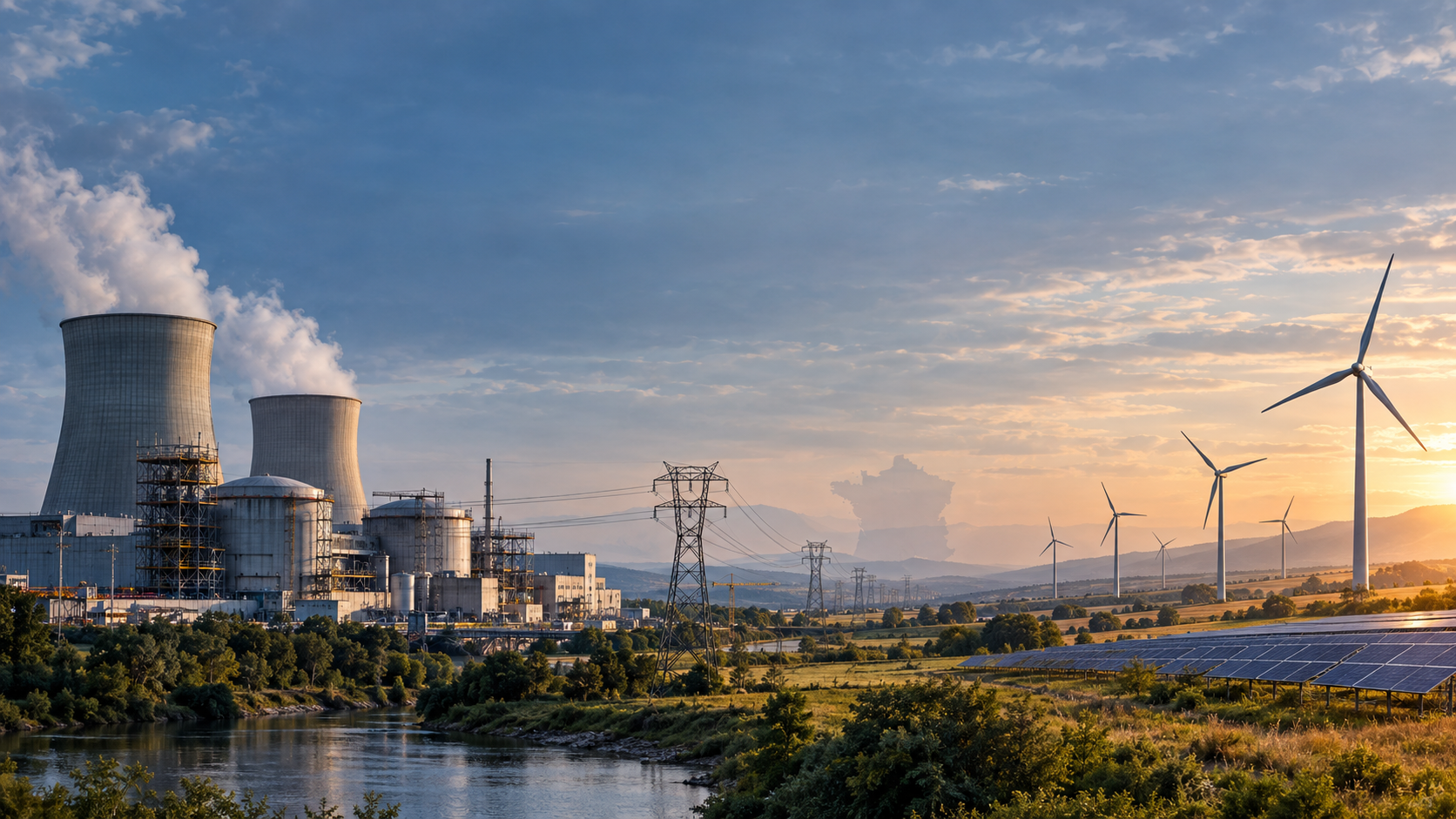
France's true energy dilemma: Nuclear future – risk or opportunity? – Creative image on the topic, created with AI: Xpert.Digital
The challenges facing France's nuclear power plant fleet: A balancing act between safety and cost
Energy policy in France: The tightrope walk between nuclear power and renewable energies
Flamanville and the illusion of cheap nuclear power: Lessons for the future
For decades, France's nuclear power plants have played a central role in national energy policy, making the country one of the largest net exporters of low-carbon electricity. However, while the existing reactor fleet represents both a valuable industrial asset and a growing financial risk, those in charge face the challenge of transitioning nuclear energy to a new market and technological landscape. Discussions surrounding the aging reactor fleet often give the impression that France is on the brink of a supply crisis, but current figures paint a different picture: electricity production remains stable and surplus. Nevertheless, the challenges are significant: maintenance and modernization measures, the construction of new reactors, and the parallel development of renewable energies must be carefully coordinated. The recent failure of the Flamanville EPR reactor has definitively shattered the illusion of cheap nuclear power and underscored that France's energy future cannot depend solely on nuclear energy. Developing a viable strategy for 2040 requires making the right investments while simultaneously keeping a close eye on public finances. The path to the future is therefore anything but easy and requires smart management of available resources and technologies.
France's nuclear gamble: Between industrial wealth and fiscal risk
The reactor fleet is not France's millstone – but the belief in cheap nuclear power could become one
France's nuclear power plant fleet is both an exceptionally valuable industrial asset and a growing financial risk. Those who describe it merely as a millstone underestimate its current economic benefits. Conversely, those who continue to view it as a virtually inexhaustible source of cheap electricity ignore aging, maintenance requirements, construction costs, financing risks, and the long time it takes to commission new reactors. The economic truth, therefore, lies not in a simple judgment for or against nuclear energy, but in the question of how France transitions a historically developed system into a new market and technological landscape.
France's power plant fleet comprises 57 reactors at 18 sites with an installed capacity of approximately 63 gigawatts. A large proportion of these plants were built in the 1970s and 1980s. This standardized expansion program was remarkably successful from an industrial policy perspective: for decades, France was able to generate large quantities of domestically produced, comparatively low-CO₂ electricity, limit its dependence on fossil fuel imports, and establish a complete value chain from research and development through plant construction and operation to fuel management.
The plants are now largely fully depreciated on their balance sheets. This reduces their ongoing capital costs and explains why existing reactors can generate electricity at significantly lower costs than newly built plants. However, this does not mean that the electricity is free or that the entire historical expansion would have been possible without government support. From the outset, France's nuclear industry was part of a centrally controlled industrial and infrastructure policy. The state bore technological, regulatory, and financial risks, and it continues to bear them today through the fully nationalized energy company EDF.
The crucial challenge now lies in financing three waves of investment simultaneously: the extension and modernization of existing reactors, the construction of new nuclear power plants, and the expansion of renewable energies, grids, storage facilities, and controllable flexibility. France cannot completely avoid any of these tasks. It can only decide to what extent, in what order, and with what distribution of risk they are implemented.
An old park with high residual value
The age of reactors is often treated as if there were a technically defined limit after 40 years. In reality, France does not have an American licensing model where an operating license, once granted, automatically applies for a specific total duration. The reactors are assessed in regular safety reviews. Therefore, continued operation beyond 40, 50, or 60 years is neither automatically permitted nor categorically ruled out. The decisive factor is whether each individual plant meets the current safety requirements and what upgrades are necessary to achieve this.
Economically, the situation is only partially similar to that of an old car. With increasing age, maintenance and repair costs rise, while unexpected breakdowns become more likely. However, in the case of a power plant, these costs are offset by a very large remaining production value. A fully depreciated reactor can generate billions of kilowatt-hours over another year of operation without requiring the financing of a completely new replacement power plant. As long as the safety upgrades remain manageable and availability is sufficiently high, extending the operating life of an existing plant can therefore be significantly cheaper than building a new one.
The modernization of the existing wind farm fleet under the Grand Carénage program is now expected to cost at least €100.8 billion between 2014 and 2035. Including additional operating expenses, the total economic burden is even higher. This sum is enormous, but it needs to be put into perspective. It is spread over more than two decades and applies to a fleet that generates several hundred terawatt-hours of electricity in a typical production year. This translates to a cost of approximately €51 per megawatt-hour for extending the operating life from 40 to 60 years, assuming the projected production levels are actually achieved.
This means that continuing to operate existing reactors is likely to be not the most expensive, but rather the most economically attractive pillar of France's electricity supply. However, this is only true under certain conditions. Major serial technical failures, prolonged shutdowns, additional regulatory requirements, or significantly lower electricity revenues could worsen the equation. The corrosion problem on safety-critical pipelines in 2022 demonstrated how severely a common technical issue in a standardized fleet can impact many plants simultaneously. Standardization reduces costs during normal operation, but increases the risk of cluster failures in the event of systematic deficiencies.
Extending the operating lives of existing reactors is therefore more than just a stopgap measure. It is an economic bridge that gives France time to build new capacity. Without this bridge, nuclear power production would decline sharply within two decades, before a sufficient number of new reactors were available. The price of this strategy is a growing dependence on the technical reliability of older plants and on EDF's ability to implement complex retrofit programs on schedule.
Flamanville shatters the old cost illusion
The Flamanville EPR is the strongest argument against uncritically believing in cheap new nuclear power. The reactor was originally planned with construction costs of approximately €3.3 billion. After years of technical problems, rework, and delays, the total costs, including financing, amount to around €23.7 billion at 2023 prices. The plant was connected to the grid at the end of 2024, reached full power output for the first time at the end of 2025, and was shut down again for an extended period in 2026 for a comprehensive inspection and the replacement of the reactor pressure vessel lid. Compared to the original plan, the delay was approximately twelve years.
Flamanville is therefore not a typical infrastructure project with a moderate cost overrun, but rather an example of the loss of industrial routine. France had built very few new reactors for a long time. Supply chains, skilled workers, quality control, project management, and cooperation between clients, manufacturers, and regulators had to be partially rebuilt. At the same time, the EPR, a complex reactor type, was being constructed, the design of which was not yet sufficiently mature during the project. The combination of this initial project, new safety requirements, weak construction organization, and interrupted serial production led to a spiral of delays and financing costs.
Flamanville's profitability is correspondingly weak. At 85 percent capacity, electricity revenue of more than €122 per megawatt-hour would be required to achieve a real return of approximately four percent. Below €90 per megawatt-hour, even a real return of two percent seems difficult to attain. For a private operator without government backing, such a project would hardly have been viable. EDF was only able to complete it because the company holds a special strategic position and is ultimately supported by the French state.
Nevertheless, it would be analytically flawed to simply multiply the costs of Flamanville by 57 and conclude that replacing the entire fleet is unaffordable. Firstly, the existing reactors are not to be replaced simultaneously. Secondly, a series production program is economically different from a single problematic prototype. Thirdly, the simplified EPR2 is intended to learn from the mistakes of previous projects, be more standardized, and be built in pairs at existing sites. The crucial question is not whether every new reactor will necessarily be as expensive as Flamanville, but whether France can credibly demonstrate that the next series can be built significantly cheaper, faster, and more reproducibly.
The EPR2 program remains a gamble
France initially plans to build six EPR2 reactors at the Penly, Gravelines, and Bugey sites. Current cost estimates are €72.8 billion at 2020 prices. Financing costs are not fully included in this figure; with long construction times, they could significantly increase the overall burden. The first reactor is targeted for commissioning in 2038, with subsequent reactors to follow at intervals of 12 to 18 months. Even if this schedule is adhered to, the program will therefore not reach its full potential until the 2040s.
The government support demonstrates that new nuclear power plants in France cannot be built solely on market risks. The plan includes a subsidized loan covering approximately 60 percent of the project costs, a long-term contract for difference to stabilize electricity revenues, and a sharing of exceptional risks between EDF and the government. This model can significantly reduce financing costs. However, it shifts some of the risk from EDF to taxpayers and electricity consumers.
The economic advantage of such a model lies in predictable capital costs. Nuclear power plants are extremely capital-intensive, while fuel costs are low relative to total production. Even a few percentage points difference in the interest rate significantly alters the cost per megawatt-hour. Government-subsidized capital can therefore transform a borderline project into a financially viable one. The disadvantage is that cost overruns become less visible politically, and perverse incentives can arise if the operator does not retain sufficient risk exposure.
The program should therefore not be seen as a mere repetition of the historical French nuclear program. The starting point is fundamentally different today. In the 1970s, electricity demand was growing, permitting processes were simpler, mass production was rapidly established, and the state-owned utility operated in a protected national market. Today, new construction must compete in a European electricity market with sometimes very low or even negative prices. At the same time, safety requirements, construction costs, financing, and public oversight are more demanding.
The EPR2 can be economically viable if France achieves a genuine learning curve. This requires stable design and supply chains before construction begins, the long-term retention of qualified personnel, and minimal project-specific changes. Without this discipline, the strategic insurance against supply gaps risks becoming a permanent, major fiscal risk.
France is not currently suffering from a power shortage
The debate surrounding France's aging nuclear power plant fleet often gives the impression that the country is on the verge of a supply crisis. Current electricity data paints a different picture. In 2025, France produced approximately 547.5 terawatt-hours of electricity. More than 95 percent of this was low-carbon. Nuclear power plants contributed 373 terawatt-hours, the highest output in several years. At the same time, France achieved a new export record with net exports of 92.3 terawatt-hours, remaining Europe's largest net exporter of electricity.
This surplus is economically significant. Exports were valued at approximately €5.4 billion in 2025, based on French market prices. France was therefore not giving away its electricity, but rather benefiting from a competitive, largely low-carbon generation portfolio. The average French spot price was around €61 per megawatt-hour, well below the levels required for a reasonable return on investment for Flamanville.
The record exports also contain a warning signal. Domestic electricity demand remained significantly below pre-crisis levels and stagnated despite political goals for the electrification of transport, building heating, and industry. In the short term, France has more low-carbon generation than its domestic market can absorb. If nuclear power, photovoltaics, and wind power are expanded simultaneously without a corresponding increase in consumption, storage, flexible electrolysis, district heating networks, and cross-border transmission lines, hours of surplus and negative prices will become more frequent.
The central problem is therefore not just production, but the synchronization of the entire system. France must increase electricity consumption where it replaces fossil fuels: in heat pumps, electric vehicles, industrial processes, hydrogen for applications that are difficult to electrify, and potentially data centers. If this demand growth fails, the economic viability of both new nuclear power plants and renewable energy facilities will decline.
Our EU and German expertise in business development, sales and marketing

Our EU and German expertise in business development, sales and marketing - Image: Xpert.Digital
Industry focus areas: B2B, digitalization (from AI to XR), mechanical engineering, logistics, renewable energies and industry
More information here:
A thematic hub offering insights and expertise:
- Knowledge platform covering global and regional economies, innovation and industry-specific trends
- A collection of analyses, insights, and background information from our key areas of focus
- A place for expertise and information on current developments in business and technology
- A hub for companies seeking information on markets, digitalization, and industry innovations
Public debt and energy investments: risks and solutions for France
Renewable energies are both competition and complementary
France possesses excellent natural conditions for wind and solar energy. Its Atlantic, English Channel, and Mediterranean coasts offer significant potential for offshore wind power. The south boasts high levels of solar irradiance and large areas suitable for photovoltaics. Compared to Germany, France has a lower population density, and its geographically large territory allows for a broader spatial distribution of energy generation.
However, this does not mean that renewable energies can simply replace the existing nuclear power plant fleet in the short term. Wind and solar power have low variable costs, but their production is weather-dependent. Therefore, a macroeconomic assessment must not only compare the generation costs of individual plants. Grids, storage facilities, reserve capacities, load management, system services, and the handling of extended periods of low wind and solar production must also be considered.
Conversely, it is equally wrong to view renewable energies as a mere additional burden on a nuclear-dominated system. France needs a massive expansion of renewable energy capacity because new reactors will not be able to supply electricity until the late 2030s at the earliest, and because some of the existing reactors will be phased out gradually despite extensions. No realistic nuclear energy strategy can bridge this gap on its own.
The economically robust approach is therefore a mixed system. Existing nuclear power plants supply large quantities of reliable, low-CO₂ energy. Wind and solar farms supplement this with now cost-effective generation. Hydropower, pumped storage, batteries, flexible demand, and cross-border trade balance out fluctuations. New nuclear power plants can replace some of the reliable capacity in the long term, provided their costs are kept under control.
Competition arises primarily in the electricity market. When solar and wind power are producing a lot simultaneously, prices fall. Nuclear power plants have low fuel costs but high fixed costs and therefore benefit economically from high utilization. Every curtailment reduces their revenue without significantly reducing their fixed costs. However, this problem also affects renewable energy plants when they cannot find a buyer during surplus hours. The conflict, therefore, is less about technologies than about uncoordinated capacity expansion and a lack of flexibility.
Flexible nuclear power is possible, but not free
The claim that French nuclear power plants are fundamentally not designed for flexible operation is too sweeping. France has operated its pressurized water reactors in load-following mode for decades. Many plants can significantly reduce their output within about 30 minutes and then increase it again later. This capability was developed precisely because the high proportion of nuclear energy has long necessitated adaptation to daily and seasonal fluctuations in demand.
What's new is the frequency and economic justification for these interventions. Between 2019 and 2024, the amount of nuclear energy not produced due to power modulation doubled from approximately 15 to more than 30 terawatt-hours. By 2025, it had reached 33 terawatt-hours. Today, reactors are reducing their output not only at night or on weekends, but increasingly at midday, when photovoltaic systems are generating a lot of electricity. If a power reduction is insufficient, temporary complete shutdowns may become necessary.
Technically, load sequential operation does not automatically lead to a dramatically accelerated aging of the entire plant. French experience shows that the reactors can be operated flexibly within defined operating limits. However, certain components such as valves, piping, welded joints, and heat exchangers are subjected to greater stress due to more frequent thermal and mechanical changes. EDF now anticipates additional maintenance costs. Furthermore, fuel utilization, overhaul planning, and operational optimization may become more challenging.
Economically, the greater disadvantage is often not physical wear and tear, but the lost production. A capital-intensive power plant earns its money by selling as many megawatt-hours as possible. If it has to throttle back due to low market prices, capital productivity decreases. This is more manageable for reactors that have already been fully depreciated than for new plants whose construction costs still need to be refinanced. Therefore, the more the future system is characterized by surplus hours, the more challenging the economic viability of new EPR2 reactors will be.
France needs market rules that adequately compensate not only energy, but also guaranteed capacity, grid stability, and flexibility. Otherwise, technologies will compete for ever more hours at low prices, while the capacities necessary for security of supply earn too little. Contracts for difference can safeguard investments, but they must be designed in such a way that facilities can still respond to shortages and surpluses.
The network restructuring is unavoidable
Historically, France's electricity supply was built around large, centralized power plants and a high-performance extra-high-voltage grid. The expansion of wind and solar energy is shifting generation to new regions and lower grid levels. Therefore, substantial investments in lines, substations, digitalization, and grid control are necessary. RTE plans to invest approximately €100 billion in the transmission grid by 2040. This includes the modernization of aging infrastructure, the connection of offshore wind farms, new connections for industry and producers, and adaptation to climate risks.
However, it would be wrong to attribute these 100 billion euros solely to the cost of a decentralized energy transition. A significant portion is attributable to necessary upgrades and resilience against heat waves, storms, and other climate impacts. New nuclear power plants, growing industrial clusters, data centers, electrolyzers, and increasing electricity consumption also necessitate grid connections and reinforcements. Grids are not an alternative to nuclear energy, but rather the shared infrastructure of virtually every future energy system.
Likewise, France does not need to completely transform its grid from centralized to decentralized. The future system will incorporate both. Large reactors, offshore wind farms, and hydroelectric power plants will feed significant power into the central grid. At the same time, rooftop photovoltaics, local storage, heat pumps, and controllable loads will increase the decentralized component. The economic challenge lies in intelligently integrating these two levels.
Grid expansion is expensive, but not unaffordable. Spread over 15 years, 100 billion euros equates to an average of less than seven billion euros per year. However, annual investments will increase significantly and will be partially passed on to consumers through grid fees. For households, grid fees are expected to rise by approximately one percentage point per year above inflation until 2040. This will become politically sensitive when electricity generation, building renovations, electromobility, and public budgets simultaneously demand substantial investments.
National debt exacerbates every mistake
France's public debt reached approximately €3.6 trillion, or 119 percent of its gross domestic product, by mid-2026. This significantly reduces its fiscal leeway compared to previous decades. High primary deficits and rising interest payments make it difficult for the government to guarantee new large-scale projects without clear priorities. This does not mean that France can no longer afford any energy investments at all. However, it does mean that miscalculations, delays, and cost overruns have become considerably more dangerous.
Infrastructure investments should not be equated with ordinary consumer spending. A functioning electricity system creates productivity, security of supply, and industrial advantages for decades. If France uses this to replace fossil fuel imports, a portion of the investment can be very profitable for the economy as a whole. The quality of the projects is crucial, not just their size.
The accumulation of risks on the national balance sheet is problematic. France owns EDF, guarantees or subsidizes a large portion of the EPR2 financing, bears political responsibility for electricity prices, and must simultaneously finance grids, renewable energies, industrial policy, and social compensation measures. Even if individual obligations are formally outside the core budget, they can end up with the state in a crisis.
At the end of 2025, EDF itself had net financial debt of around €51.5 billion and invested approximately €24 billion within a single year. The company is simultaneously financing its existing portfolio, the new British Hinkley Point C project, the French EPR2 program, renewable energy, and grid infrastructure. This concurrent activity does not necessarily overwhelm the balance sheet, but it does increase the importance of clear project boundaries, transparent risk allocation, and realistic timelines.
France cannot simply modernize its power plant fleet with unlimited state subsidies. However, it can strategically deploy long-term public capital where market financing would be structurally expensive due to very long construction and operating periods. This requires that the state does not assume every industrial risk and that independent cost controls are conducted before irreversible decisions are made.
The comparison with Germany falls short
The statement that Germany does not have this problem is only true in a narrow sense. Germany no longer has to extend the operating lives of aging nuclear power plants or finance a new nuclear program. Therefore, it bears neither the technical fleet risk of France nor the direct construction cost risk of an EPR2 program. However, this does not automatically mean that Germany's transformation is cheaper or easier.
Germany must expand its electricity system with a rapidly growing share of weather-dependent generation while simultaneously ensuring reliable power supply during periods of low wind and solar output. This requires substantial investments in transmission and distribution networks, storage facilities, flexible gas-fired power plants with a future conversion to climate-neutral fuels, digitalization, and demand-side flexibility. High electricity prices, grid fees, and slow permitting processes further burden industry. The German approach will also be subject to government regulation, subsidies, and partial guarantees for decades to come.
France, on the other hand, already possesses a large, low-carbon generation base and exports significant amounts of electricity. Its risk lies in the aging and renewal of a centralized capital stock. Germany's risk lies more in the pace of system transformation and the timely provision of flexible capacity. Both countries need to expand their grids, accelerate the development of renewable energies, and electrify their electricity demand. The costs are simply distributed differently.
The assertion that Germany, unlike France, has easy access to the necessary resources is also overly optimistic. Germany has a lower debt-to-GDP ratio and therefore, in principle, more fiscal leeway. At the same time, the debt brake, municipal financial problems, defense spending, demographic burdens, and investment backlogs limit its practical capacity to act. Financial sustainability is not just a question of the debt ratio, but also of institutional implementation capacity.
The Franco-German rivalry is therefore ill-suited for energy policy self-affirmation. France can learn from Germany's rapid expansion of solar energy, storage, and decentralized solutions. Germany can learn from France's low-carbon electricity production, standardization, and long-term industrial policy. Both systems have strengths and significant unresolved issues.
The most dangerous bottlenecks are time and personnel
Capital is not the only scarce resource. France needs tens of thousands of skilled workers for maintenance, safety inspections, new construction, grids, wind farms, and solar plants. Engineers, welders, electricians, project managers, and quality assurance specialists cannot simply be multiplied at will in the short term. If too many large projects are launched simultaneously, wages and construction costs rise, while deadlines become harder to meet.
The nuclear industry, in particular, relies on accumulated experience. Faulty welds, inadequate documentation, or insufficient construction supervision can cause delays lasting for years. A realistic strategy must therefore take available industrial capacity into account. Reactors announced by politicians do not automatically create a reliable supply chain.
The same applies to grid expansion. Transformers, high-voltage cables, and power electronics have long delivery times. Permitting processes, land ownership issues, and local opposition can delay projects. A power plant that is completed on time but lacks a sufficient grid connection offers no economic benefit.
Timing is therefore a more decisive factor in costs than an abstract technological debate. Every additional operating cycle of a safely extended existing reactor can save valuable years. Conversely, every delayed grid connection, every rushed EPR2 decision, and every postponed electrification can result in billions of dollars in unproductive capital tied up.
A viable strategy until 2040
France should extend the operating lives of its existing reactors where the safety authorities permit it after a comprehensive review and where retrofitting remains economically viable. These plants currently represent the most cost-effective form of guaranteed low-carbon electricity generation in the country. Operating lifetimes of 50 and 60 years are therefore not a capitulation, but a sensible use of existing capital. However, a blanket guarantee for all reactors is unacceptable; each plant must be individually assessed from a technical and economic perspective.
In parallel, the expansion of wind and solar energy should be accelerated. However, it should not be measured solely by installed gigawatts. Crucial factors are the simultaneous development of grids, storage facilities, flexible consumers, and guaranteed capacity. Tender and funding mechanisms should give greater consideration to location, grid bottlenecks, and system benefits, so that ever-increasing production is not generated in areas where it frequently has to be curtailed.
The EPR2 program should be implemented in stages with stringent control points. Before a final investment decision is made, design maturity, supply chains, staffing requirements, financing costs, and risk distribution must be robust. The first reactor unit should be treated as an industrial trial run, without negating the benefits of a planned series. Further projects should only be irrevocably committed if costs and construction progress confirm the intended learning curve.
The government should disclose its support transparently. Subsidized loans, guarantees, and contracts for difference have economic value and can burden future budgets. These risks must be included in long-term scenarios for public finances and electricity prices. At the same time, EDF must retain sufficient responsibility so that project management and cost control are not weakened by the government assuming all risk.
The most urgent need is a strategy to increase sensible electricity demand. France currently has a large amount of low-carbon electricity, but still too little additional electrification. Heat pumps, electric vehicles, industrial electric heating, data centers with flexible loads, and selected hydrogen projects can productively utilize surpluses. Not every new demand should be subsidized. Priority should be given to applications that avoid fossil fuel imports, create high domestic value, or provide flexibility to the electricity system.
Not a millstone, but a risky bridge
France's nuclear power plants do not necessarily lead the country to financial ruin. The existing fleet continues to generate large quantities of competitive, low-carbon electricity, strengthens the trade balance, and provides a foundation for electrification and industrial policy. Extending the operating lives of safe plants, despite the high investment costs, is expected to be more economical than replacing them in the short term.
The real millstone would be an energy policy that simply extrapolates from past successes and continues to treat new reactors as an automatically cheap source of electricity. Flamanville has shown how costly lost industrial expertise, immature designs, delays, and funding can be. The EPR2 program can be more successful, but that success is not guaranteed. It must be earned through standardization, mass production, independent oversight, and a credible limitation of government risk.
Equally risky would be the opposite assumption: that wind and solar power could quickly and easily replace the entire wind farm without a fundamental system overhaul. France needs grids, storage, flexibility, and renewable energies regardless of how many new reactors are built. Grid investments are not a sign of failure, but rather a prerequisite for virtually any credible decarbonization strategy.
France is therefore not faced with a simple choice between nuclear power and renewable energies. It faces the more demanding task of safely operating older nuclear power plants, developing new technologies on an industrial scale, consistently unlocking renewable energy potential, and simultaneously protecting public finances. The most viable approach is a phased, mixed path: extending the operating life of existing plants as a bridge, renewable energies as an indispensable pillar of growth, grids and flexibility as the connecting infrastructure, and new nuclear power only under strict cost and risk control.
The French nuclear fleet is therefore neither a free pass nor an unavoidable millstone. It is a valuable, aging capital asset whose benefits may outweigh its costs for many years to come. Whether this will ultimately become a competitive advantage or a fiscal burden is not determined by the technology alone. Crucial factors include implementation, financing, market design, and the state's ability to distinguish in time between strategic patience and costly self-deception.
🎯🎯🎯 Data-driven B2B industry hub as a quasi-in-house solution

The quasi-in-house solution: How Xpert.Digital closes operational gaps in B2B marketing and sales – Smart Content-Driven Business - Image: Xpert.Digital
Xpert.Digital is a data-driven B2B industry hub led by Konrad Wolfenstein . The company acts as an external, quasi-in-house solution for industrial partners, closing operational gaps in marketing, content, and sales – without requiring additional resources on the client side.
More information here:
Your global marketing and business development partner
☑️ Our business language is English or German
☑️ NEW: Correspondence in your native language!

Konrad Wolfenstein
I and my team are happy to be available to you as your personal advisor.
You can contact me by filling out the contact form here [email protected]:or simply call me at +49 7348 4088 965. My email address is
I'm looking forward to our joint project.