
Military logistics: France's € 64 billion upgrading at a record pace and laying speed to the NATO-East flank
Xpert pre-release

Available in 27 languages 📢
Prefer Xpert.Digital on GoogleⓘPublished on: July 14, 2025 / update from: July 14, 2025 - Author: Konrad Wolfenstein
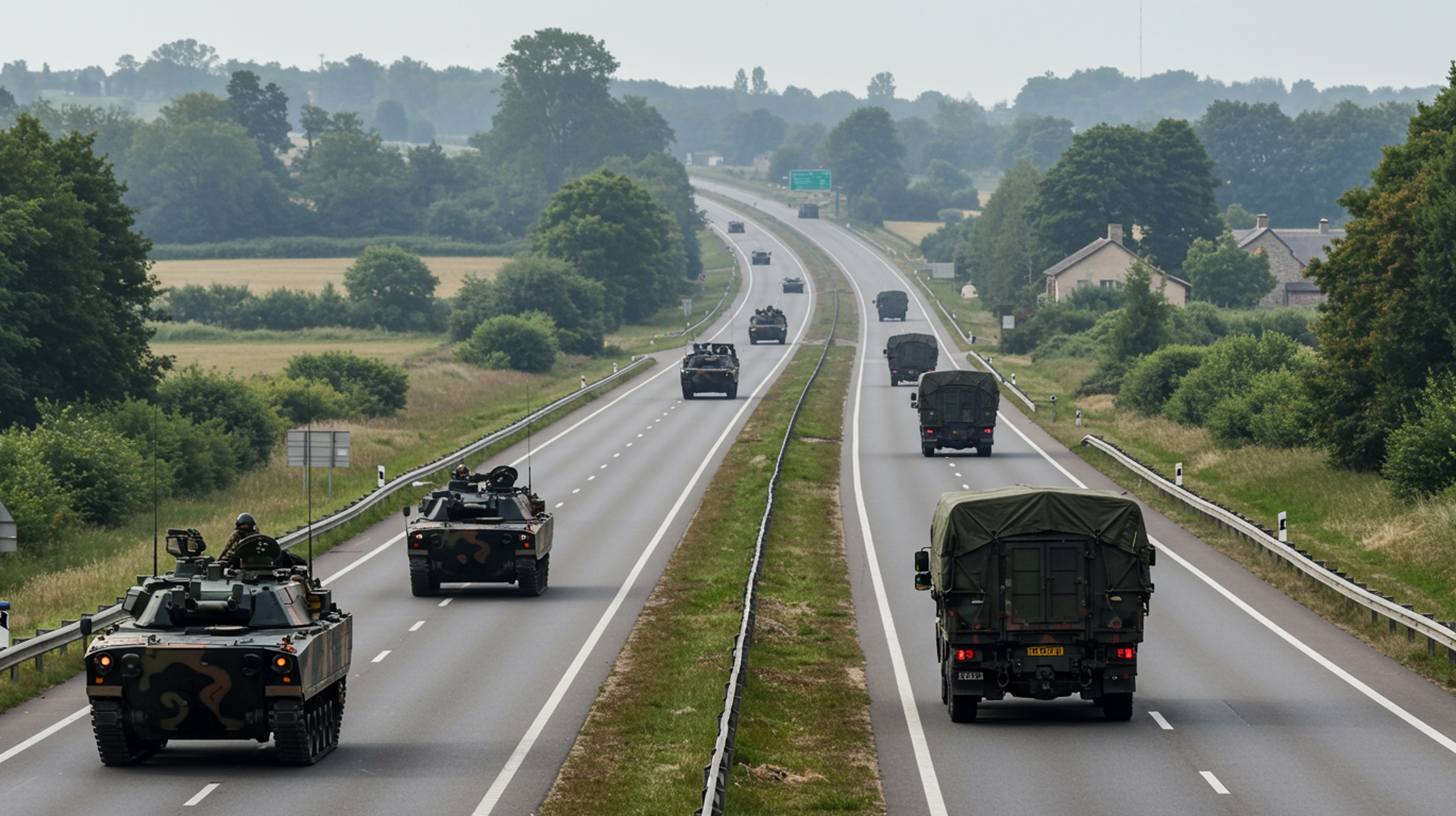
Military logistics: France 64 billion € upgrade at a record pace and speed of laying to the NATO-East flank-creative image: xpert.digital
French defense spending increase from 32 to 64 billion euros in ten years
France adapts military planning prematurely and increases defense budget massively - French defense budget reached in 2027 historical maximum of 64 billion
France accelerates its defense spending drastically: the budget should reach 64 billion euros by 2027-twice as much as 2017. President Emmanuel Macron justifies the step with an "threat situation that has never been existed since 1945" and even fits the applicable military planning (LPM 2024-2030) prematurely.
The development of defense expenditure shows a continuous increase: Based on 32.3 billion euros in 2017, the budget rose to 47.2 billion euros by 2024, which corresponds to an increase of 46 percent compared to 2017. The budget design for 2025 provides for 50.5 billion euros, which means a further increase of 3.3 billion euros compared to 2024. Around 54 billion euros are planned for 2026, i.e. an additional 3.5 billion euros. The goal of 64 billion euros for 2027 would mean another 3 billion euros compared to 2026 and the doubles have been doubled since 2017.
Political motives
- Ducking off against Russia: France's chief of staff Burkhard now calls Paris Moscow's "main opponent" in Europe.
- NATO printing: According to the new 5%goal, 3.5%GD should flow purely militarily, France was a good 2%in 2024.
- Europe's strategic autonomy: Macron sees weapon cooperation-such as FCAS fight jet, MGCS tank-as a key.
Core components of the FCAS
The Future Combat Air System (FCAS) is currently the largest and most ambitious European armaments project and is to form the backbone of the air forces of Germany, France and Spain from around 2040. It is not just a single fighter plane, but a comprehensive, networked "system of systems".
- Next Generation Fighter (NGF): A manned fighter plane of the sixth generation, which is intended as the successor for Eurofighter (Germany/Spain) and Rafale (France). It will be equipped with the latest camouflage technology, new engines, network capability and probably also cyber and energy weapons.
- Remote Carrier (RC): Unmanned accompanying aircraft (drones) that support the NGF - for example by clarifying, electronic fighting or as a "force multiplier".
- Air Combat Cloud (ACC): A high -proof, digital network that combines all manned and unmanned components as well as other military systems (e.g. existing combat aircraft, satellites, ships) in real time and thus enables comprehensive situation assessment and mission planning.
Goals and special features
- Technological sovereignty: The technology is to be mainly developed in Europe to avoid dependencies on the United States.
- Nuclear participation: The new fighter jet is designed in such a way that it can also serve as a carrier for nuclear weapons - a central concern of France.
- Cost and schedule: The project volume is estimated at up to 100 billion euros (some estimates speak of up to 300 billion). A prototype of the NGF is planned for 2028, the use of the overall system for around 2040.
Political dimension
FCAS is considered a litmus test for the ability of Europe to work together in terms of security and industrially. The development is characterized by national interests, industrial rivalries and complex negotiations - most recently by dispute over the work shares between France and Germany.
FCAS is much more than a new combat aircraft - it is a highly networked, modular aircraft system that is intended to secure Europe's military independence and set technological standards.
Content focus of the additional money
- Ammunition & precision weapons: € 16 billion for ammunition supplies, long-distance core steering monkeys.
- Drones & electronic warfare: € 5 billion for € 3,500 small drones + space defense.
- Air defense: € 5 billion to close the "high intensity gap".
- Nuclear deterrence:> 26 billion € for new submarines, M51-3/4 rockets, ASN4G missile.
- Personnel: +6,300 posts by 2030, reserve increased to 60 days.
Financing & fiscal risks
- The LPM 2024-2030 was already ambitious with € 413 billion (nominal +40% for predecessor planning).
- An additional € 6.5 billion by 2027 increase the pressure, while Paris is also aiming for € 40 billion overall savings.
- Debt level> 3.2 bio. €; Zinslast could increase to € 80 billion in 2027 - more than the entire defensive budget today.
- The Court of Auditors complains of the first implementation problems: personnel pieces, high operating costs and "rigid programming" without inflation buffer.
What is the LPM?
The LPM stands for Loi de Programmation Militaire (German: Law for Military Programming). It is a central French law that defines the strategic orientation, goals and, above all, the financial framework of the armed forces for several years. The LPM is regularly renewed and determines how much money France wants to spend on a certain period of time for defense and military modernization.
The LPM 2024-2030 at a glance
- Total volume: 413 billion euros for the years 2024 to 2030
- This corresponds to a nominal increase of around 40 % compared to the previous planning (LPM 2019–2025 with around € 295 billion).
- Objective: The LPM 2024–2030 is an ambitious modernization program that is intended to strengthen and transform the French armed forces in the face of new threats and geopolitical uncertainties.
- Focus:
- Modernization of the nuclear deterrence
- Investments in new technologies such as drones, artificial intelligence and cyber defense
- Expansion of personnel to 275,000 soldiers and 80,000 reservists by 2030
- Strengthening the equipment, including through new aircraft, ships and armored vehicles
- Increasing defense spending to 2 % of GDP between 2025 and 2027
- Distribution of the funds:
- Around 65 % (approx. € 268 billion) are intended for equipment and their maintenance
- 13 % for the nuclear deterrence
- 10 billion € for technological innovations
- 16 billion € for ammunition
Meaning and context
The LPM is a central instrument to ensure the long -term planning and modernization of the French armed forces. It reacts to current security policy challenges, in particular to war in Ukraine, technological upheavals and the need to ensure France's strategic autonomy and sovereignty.
The LPM 2024-2030 is the largest and most ambitious French defense program to date. It marks a paradigm shift towards more investments in defense and innovation and underlines France's claim to continue to play a leading military role in Europe and the world in the future.
Classification in the European context
Germany (2025 ≈ 62 billion €), Great Britain (2025 ≈ 67 billion €) and Poland (massive increase to> 4% GDP) also force their expansion. However, France remains the only EU country with nuclear weapons and global operational presence (Indopacific, Sahel, Mediterranean), which should justify the higher course.
France and the United Kingdom are Europe's only nuclear power, but Germany and Poland are now presenting similarly high dynamics when it comes to growing budgets.
Risks & open construction sites
- Industrial capacity: The high bar demands procurement and production cycles that French works can hardly do so far; Caesar-Haubitzen were recently doubled from 4 to 8 pieces per month.
- Personnel: Despite 6,300 new posts, reports warn of a shortage of skilled workers in maintenance, cyber and space.
- Inflation & exchange rates: The LPM calculates € 30 billion price increase by 2030; Other shocks could reduce the real added value of the expenses.
- Fiskald discipline: Moody's has reduced the view of "negative"; Higher interest rates can eat up the budget scope faster than additional growth effects.
Conclusion
France's upgrading is militarily understandable-Russia, an ambitious NATO goal and the right to European leadership role enforce speed. Whether it remains financially sustainable depends on two variables: macro economy & willingness to reform. If the interest burden increases to € 80 billion as forecast, any further euro for ammunition or drones can become politically a sample. Only when Paris is credible that higher expenses are not loan but growth-financed, will the "réarmement" be more than an ambitious arithmetic.
outlook
- Autumn 2025: Update of the LPM with new upper limits. Opposition parties require shifts in favor of social expenditure.
- NATO summit 2026: Paris wants to present progress in European air defense.
- 2027 year: Success of the upgrade depends on budget discipline and economic growth. If the financing fails, cuts in large programs such as FCAs or new aircraft carriers.
In the face of geopolitical tensions, France relies on a historical upgrade program, the success of which will depend less on military necessity than on fiscal load -bearing capacity.
Hub for security and defense - advice and information

Hub for security and defense - Image: Xpert.digital
The hub for security and defense offers well-founded advice and current information in order to effectively support companies and organizations in strengthening their role in European security and defense policy. In close connection to the SME Connect working group, he promotes small and medium -sized companies (SMEs) in particular that want to further expand their innovative strength and competitiveness in the field of defense. As a central point of contact, the hub creates a decisive bridge between SME and European defense strategy.
Suitable for:
Faster to the front: How Paris wants to press the laying season of 6 weeks to day
From six weeks to ten days: France's challenge for ultra -fast military references
France wants to bring its strength to the NATO-East flank much faster, where today permits, bridge restrictions and lack of rail capacities often delay laying up to six weeks (≈ 45 days). The core of the plan is a step model that will take place in 2025 and should be fully operational in 2027.
Time goals at an overview
The French armed forces have set themselves ambitious time goals for laying their troops, which are significantly below the current EU average. While a brigade with around 7,000 soldiers, 50 Leclerc tanks and 150 Haubitzen or Schützen tanks currently need 42 to 45 days for laying in an EU average, this time in France should be reduced to a maximum of 10 days by 2025. This goal is sought as part of the “Dacian Spring 2025” exercise and is also to be maintained in 2027, whereby the brigade will then be part of a division.
For a division with 20,000 to 27,000 soldiers and 7,000 vehicles, there have been no comparable EU average values so far, but France is planning a maximum installation time of 30 days under the “Division EN 30 Jours” concept by 2027. A corps with around 30,000 soldiers are planned conceptually from 2030 after the division has been relieved.
These numbers are based on army planning, whereby the actual scope can vary depending on the use.
Lever to shorten logistics
1. New management and logistics scaffolding
- CTE (Commandement Terre Europe) in Lille has coordinated all land forces since 2023, leads the emergency associations in Estonia and Romania and is the only NATO/EU contact for road, rail and sea transport.
- B.log - a logistics brigade with 8 regiments (7,000 active, 2,600 reservists) set up in 2024 - should also provide two French and an allied brigade from 2027 and secure the supplement of a division for 30 days.
2. Material and transport planning for "Brigade in 10 days"
- For Dacian Spring 2025, 1,500 containers and 9 km freight access length are planned; Heavy components fly with A400M/KC-1330 or are moved to Constanța in advance on roro ships.
- DB Cargo already reserves 343 flat wagons and daily slots for armored trains towards Poland/Lithuania; France negotiates similar quotas with SNCF and ČD Cargo.
3. Preliminary positioning & depots
- Munition, bridge device and fuel are gradually stored in Romania (Cincu) and Poland (Drawsko Pomorskie) to reduce air/rail transport by up to 60%.
- Multinational depots are created as part of the EU military mobility package 2025-27; Paris is pushing for a first legislative framework.
4. Bureaucracy mining within the EU
- France supports the Dutch Pesco pilot test to handle border formalities in a maximum of three days; Approval is currently often 30-45 days.
- The LPM 2024-2030 obliges defense and transport ministries, bridge and tunnel statics according to NATO load classes so that train and road routes can be checked in advance.
5. Exercises as a load test
- Dacian Spring 2025: First full load testing of a 10-day brigade laying with Belgian reinforcement.
- Orion 2026 / Allied Reaction Force takeover: France represents a strategic reaction corps for twelve months and tests the 30-day division in the Baltic States.
Rest risks and open construction sites
- EU infrastructure-the € 1.7 billion from the CEF participation facility have been exhausted since 2023; Auditors warn of other bottlenecks and demand € 80 billion in investments.
- Bridge load & track width-in Eastern Poland and Lithuania there are sometimes 60-ton bridges; Wide armored trains have to drive detours.
- Household printing-additional railway wagons, heavy-duty low loaders and custodian construction are not yet fully financed; The Court of Auditors warns cost risks for inflation and interest.
- Depending on civilian freight capacities-Antonow availability remain insecure; There are only enough A400M available in 2027.
Classification
France's "Brigade 10 / Division 30" concept sets new standards within the EU: No other continental force is currently planning to bring heavy associations to the front so quickly. However, whether the ambitious goal succeeds depends less on the will in Paris than on:
- the removal of EU-internal bureaucracy (reduction from 45 to 3-day permits),
- massive investments in rail and street corridors,
- and the rapid list of the B.Log structures.
If these bottlenecks remain, the best planned "Brigade EN 10 Jours" will also be back in the event of traffic jams.
Advice - planning - implementation

Markus Becker
I would be happy to serve as your personal advisor.
Head of Business Development
Chairman SME Connect Defense Working Group
Advice - planning - implementation
Konrad Wolfenstein
I would be happy to serve as your personal advisor.
contact me under Wolfenstein ∂ Xpert.digital
call me under +49 89 674 804 (Munich)





