
No more isolated solutions in intralogistics: From individual devices to complete systems – Why the perspective is crucial
Xpert Pre-Release

Available in 27 languages 📢
Prefer Xpert.Digital on GoogleⓘPublished on: July 18, 2026 / Updated on: July 18, 2026 – Author: Konrad Wolfenstein
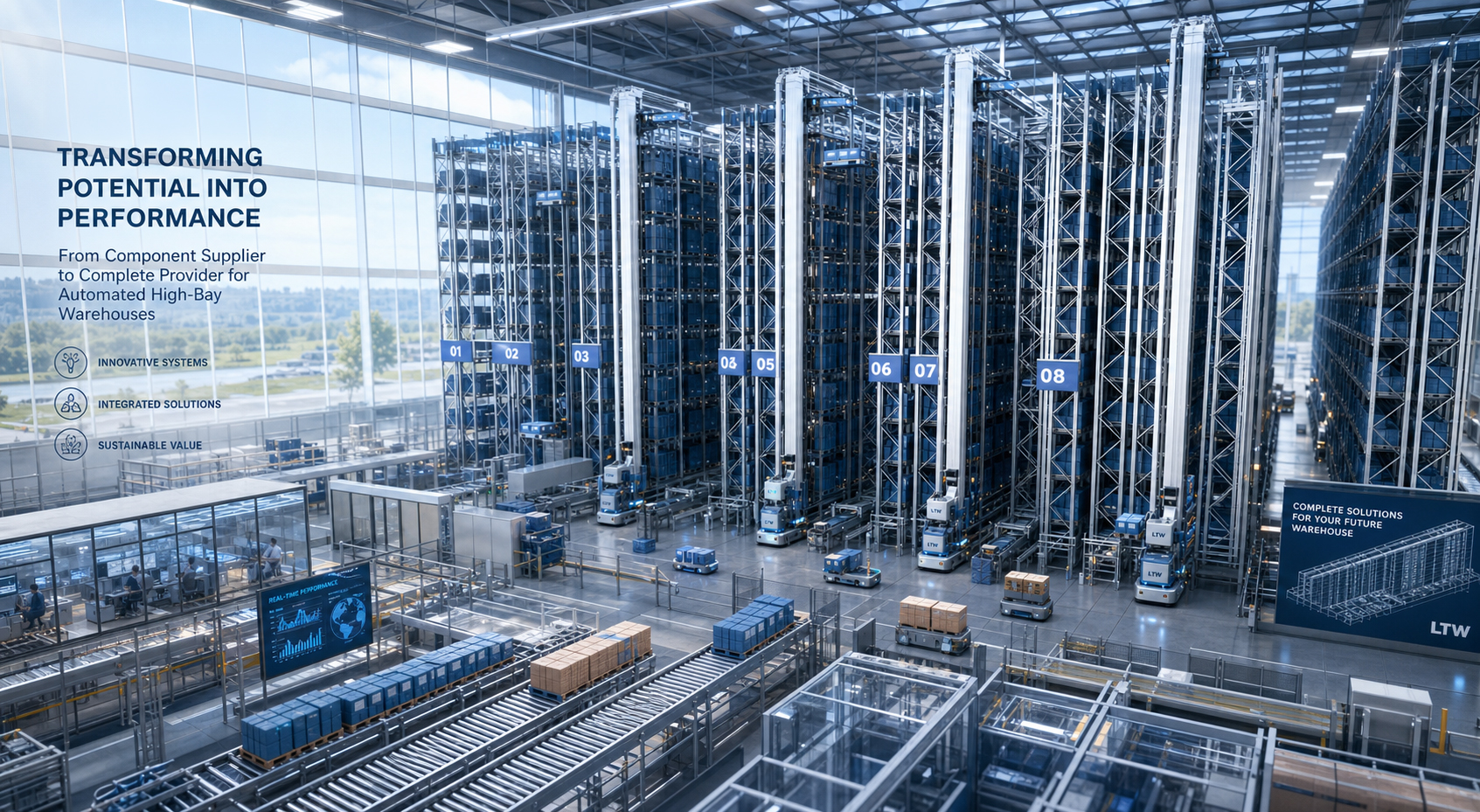
No more isolated solutions in intralogistics: From individual devices to complete systems – Why the perspective is crucial – Image: Xpert.Digital
Trade fair hype vs. harsh reality: What modern warehouse automation really delivers today
Crisis as an opportunity: Why now is the best time for turnkey logistics systems
German intralogistics is at a crucial turning point. While economic fluctuations and geopolitical uncertainties pose major challenges for the industry, a fundamental paradigm shift is simultaneously emerging: simply purchasing storage and retrieval machines or building high-bay warehouses is no longer sufficient to compete globally. Anyone investing in logistics automation today must think in terms of complete systems. It's no longer just about individual mechanical components made of sheet metal and steel, but about intelligent, seamlessly integrated system landscapes. From the overarching software architecture and material flow to AI-supported processes – only those who harmonize interfaces and consistently avoid isolated solutions can fully exploit the potential of modern intralogistics. The following article examines why focusing solely on individual devices is economically misleading, what risks and opportunities the current market situation presents, and what decision-makers must pay attention to now to be prepared for the future.
Those who focus solely on storage and retrieval systems and high-bay warehouses lose sight of the bigger picture
The German intralogistics sector is among the most technologically advanced segments of the mechanical and plant engineering industry, achieving a production volume of approximately €27.7 billion in 2024. However, the relevant VDMA trade association reported a significant decline of 7 percent to €25.8 billion for 2025, due to a weak industrial economy, declining demand from key sectors such as the automotive industry, geopolitical uncertainties, and changing competitive conditions. These figures illustrate that the industry is not solely concerned with the number of storage and retrieval machines sold or the volume of newly constructed high-bay warehouses, but rather with the ability to deliver complete, functional systems that perform reliably under real-world operating conditions. Those who narrow the debate to individual components fail to recognize that the true economic value lies not in the machine itself, but in its intelligent integration into material flow, control software, and personnel organization.
The anatomy of a camp: More than sheet metal and steel
A high-bay warehouse consists of much more than just racks and handling equipment. Analyses of system data from high-bay warehouse commissioning show that stacker cranes are still used significantly more often in practice than shuttle systems, although the selection varies considerably depending on the load carrier type. Shuttles are now used more frequently for large load carriers such as pallets than for small load carriers, while stacker cranes continue to dominate in automated small parts warehouses. The retail sector leads the list of industries commissioning new warehouses by a wide margin, with around two-thirds of all commissioning projects attributable to the five leading sectors. This data already demonstrates that technical selection decisions should never be made in isolation, but must always be considered within the context of load carriers, throughput requirements, and industry-specific logic. Purchasing a stacker crane without understanding its interactions with upstream receiving technology, downstream order picking, and higher-level warehouse management software risks installing a technically sound machine within a structurally unsuitable overall system.
Growth market with risks: Figures that give pause for thought
Various market research institutes provide significantly differing valuations for the German intralogistics market, which in itself indicates the lack of clarity in the market definition. One institute estimated the German intralogistics market at US$4.51 billion in 2024, with an expected annual growth rate of 10.5 percent until 2030, driven primarily by the booming e-commerce sector and the high degree of digitalization in German retail. Other analysts arrive at entirely different absolute figures for the same market, such as US$11.05 billion by 2033 with a CAGR (Compound Annual Growth Rate) of 10.45 percent, or place the German market within a global context, projecting a value of over US$63 billion in 2026 and a growth of US$140.73 billion by 2034. These methodological discrepancies arise because different studies use different value chain stages, component categories, and geographical boundaries. More important than the exact market size is the consistent trend: Demand for automation, artificial intelligence and networked solutions is growing across all industries, regardless of which figures are used as a basis.
Tariffs, economic conditions, and geopolitics as obstacles
The German intralogistics industry is exceptionally export-dependent, making it particularly vulnerable to geopolitical upheavals. In 2025, German manufacturers exported intralogistics technology worth approximately €18.6 billion – a decrease of 7 percent compared to the previous year's figure of €20.1 billion. The United States, Germany's most important single trading partner, received exports worth around €2.3 billion in 2025, also a 7 percent decrease, largely due to the special tariffs on steel and aluminum introduced in the summer of 2025. The decline in business with China was even more drastic: Exports to China fell by 22.8 percent to just €326.8 million, causing China to drop to 14th place among Germany's export destinations. Within Europe, around 60 percent of all German intralogistics exports remain, with France, Italy, and the Netherlands as the most important customers. The association chairman sums up the mood when he states that numerous investments have been postponed, but the structural need for modern intralogistics remains unchanged and a recovery is not expected until 2027 at the earliest.
The fallacy of the single component
It is precisely in this economically challenging phase that it becomes clear why a purely component-centric view of storage and retrieval systems and high-bay warehouses is economically misguided. A company that invests solely in the fastest generation of storage and retrieval systems or the tallest high-bay warehouse, without considering the interfaces to upstream goods receiving processes, order picking, transport logistics, and the higher-level control software, risks creating a high-performance but isolated bottleneck. Turnkey intralogistics systems differ from individual component sales in that a single supplier handles the entire coordination of all processes from planning to commissioning. This creates planning certainty regarding schedules and budgets and significantly reduces coordination risks between different trades. In an industry where construction times, software integration, conveyor technology, robotics, and IT systems must be perfectly aligned, this risk reduction is not a minor detail, but rather the decisive economic lever. Investors and operators who take on the responsibility for integration themselves, instead of transferring it to a general contractor, also bear the full risk of interface conflicts, delays and hidden consequential costs.
The silent market for storage and retrieval machines
Looking at the global market for storage and retrieval machines (SRMs) in isolation, a solid but limited growth segment emerges, approaching a valuation of around US$2 billion. It is driven by a combination of advanced sensors, artificial intelligence, and precise mechanical controls. These machines enable continuous operation without fatigue and can increase warehouse utilization by up to 70 percent, as well as significantly improve picking speed. However, these impressive efficiency gains only materialize if the SRM communicates seamlessly with the higher-level warehouse management software, upstream conveyor systems, and downstream picking processes. A technically brilliant SRM in a poorly integrated overall system is rendered ineffective because bottlenecks arise elsewhere in the material flow, and the theoretical performance of the individual component never translates into actual throughput. This insight is crucial for investment decision-makers because it demonstrates that the technical specifications of individual components reveal little about the true economic viability of an entire system.
LTW Intralogistics Solutions

LTW Intralogistics – Engineers of Flow - Image: LTW Intralogistics GmbH
LTW offers its customers not individual components, but integrated complete solutions. Consulting, planning, mechanical and electrotechnical components, control and automation technology, as well as software and service – everything is networked and precisely coordinated.
In-house production of key components is particularly advantageous. This allows for optimal control of quality, supply chains, and interfaces.
LTW stands for reliability, transparency, and collaborative partnership. Loyalty and honesty are firmly anchored in the company's philosophy – a handshake still means something here.
Related to this:
Consolidation in logistics: Why integrated intralogistics is creating tomorrow's winners now
Consolidation of the supplier landscape as a signal
Recent developments in the supplier landscape impressively confirm the trend toward integrated system solutions. In October 2024, Vanderlande acquired Siemens Logistics, a company specializing in baggage and freight handling systems, to expand its capabilities in automated logistics through advanced technologies and intralogistics expertise. In August 2024, the Kion Group partnered with Eurofork to distribute pallet shuttle systems throughout the EMEA region, thereby expanding its range of automated end-to-end solutions. The Beumer Group acquired the Hendrik Group, a leading manufacturer of air-supported conveyors, back in 2023 to offer more customized product variants and position itself as a market leader in intralogistics. This consolidation is no coincidence, but rather a strategic response to the increasing demand from customers for integrated, coordinated end-to-end solutions from a single source, rather than individual machines. Suppliers who continue to offer only isolated storage and retrieval machines or high-bay warehouses risk being squeezed out of the most lucrative and highest-margin project segments.
The illusion of cost savings with standalone solutions
A common but economically risky misconception is that separately procuring storage and retrieval systems, conveyor technology, software, and robotics from different specialist suppliers is cheaper than a turnkey solution. This assumption systematically underestimates the costs of interface coordination. With separate procurement, the operator bears the responsibility for ensuring that control software, mechanical interfaces, and communication protocols from different manufacturers work together seamlessly. In practice, this often leads to delays, rework, and warranty disputes between the suppliers involved. While high cost pressures in the current economic climate increase the incentive to choose the cheapest supplier for individual components, this very short-term optimization can lead to significantly higher total operating costs in the medium term if the system does not function as planned. Market observers have already identified the high installation costs of advanced automation technologies as a key obstacle to growth, especially for small and medium-sized enterprises (SMEs) that lack the resources for in-house system integration.
Automation pressure despite economic downturn
The apparent contradiction between short-term investment restraint and the continued long-term need for automation is interesting. The VDMA (German Engineering Federation) trade association notes that the structural demand for intralogistics solutions remains high despite the current reluctance to invest, and that technology investments in trade, industry, and logistics continue to be a long-term driving force. At the same time, various global growth regions offer opportunities for risk diversification for German suppliers, who are under pressure due to the weak domestic economy and declining exports to traditional core markets. This simultaneous occurrence of short-term weakness and long-term structural demand suggests that companies should set a strategic course for the future now, instead of simply waiting for an economic recovery. Those who invest today in system integration, software architecture, and process understanding, rather than limiting themselves to simply purchasing equipment, are significantly better positioned for the expected turning point from 2027 onward than competitors who continue to think in silos.
Digital twins, AI and IoT as integration drivers
Technological development itself is driving the need for a holistic systems approach. The integration of artificial intelligence and the Internet of Things (IoT) into intralogistics systems creates significant market opportunities because it enables the optimization of warehouse management, predictive maintenance, and supply chain logistics by providing seamless connectivity and data exchange between devices and systems. However, these technologies only function effectively if they are implemented consistently across the entire facility. An isolated storage and retrieval machine without a connection to a higher-level data ecosystem cannot realize predictive maintenance benefits or AI-supported optimizations. A company that makes investment decisions based on individual components systematically misses out on the value creation potential that only arises from the data-driven networking of the entire system. This is precisely where the real leap in innovation lies in the coming years: not in individual mechanical improvements, but in the intelligent orchestration of the entire system.
Trade fair hype versus actual system maturity
A critical look at current industry events confirms the discrepancy between technological self-promotion and practical feasibility. Observations at LogiMAT 2026 show that while humanoid robots create impressive show effects, they often fail to deliver scalable solutions, and much self-promotion is met with a lack of substance in the actual core technologies. Intralogistics demands robust, integrable solutions rather than individual spectacular highlights, and visitors to such trade fairs are increasingly seeking concrete, deployable innovations rather than mere demonstrations. This observation reinforces the central thesis that the real competitive advantage lies not in spectacular individual technologies, but in the ability to deliver robust, practical, and integrated systems that function reliably even under real-world production and logistics conditions. Suppliers who measure their innovative strength by the integrability rather than the showmanship of individual robots or devices are likely to demonstrate more convincing business models in the medium term.
Strategic advice for decision-makers
For companies facing investment decisions in warehousing and material handling technology, a clear recommendation emerges from the overall analysis: The selection of a storage and retrieval machine or the planning of a high-bay warehouse should never be considered an isolated technical purchase decision, but always as part of a holistic system architecture that equally considers goods receipt, storage, order picking, transport, and software. Given the current market weakness with declining production volumes and falling exports, buyers also have a rare negotiating position, as suppliers are likely to be more flexible and offer more competitive terms due to weak demand. At the same time, the consolidation of the supplier landscape through acquisitions and partnerships shows that the future of the industry clearly lies in integrated, software-supported end-to-end solutions and not in isolated mechanical components. Companies that ignore this structural shift and continue to invest in individual components without a system integration strategy risk being technologically and organizationally unprepared for the economic recovery expected from 2027 onwards – while competitors with turnkey systems will have already built up a decisive efficiency and time advantage.
Consulting - Planning - Implementation

Konrad Wolfenstein
I would be happy to serve as your personal advisor.
You can contact me at wolfenstein∂xpert.digital or
Just call me on +49 7348 4088 965 .
Your intralogistics experts
Consulting, planning and implementation of complete solutions for high-bay warehouses and automated storage systems - Image: Xpert.Digital
More information here:










