
Driverless transport systems and autonomous transport robots: Which robot will determine the future of your company?
Xpert Pre-Release

Available in 27 languages 📢
Prefer Xpert.Digital on GoogleⓘPublished on: May 26, 2026 / Updated on: May 27, 2026 – Author: Konrad Wolfenstein
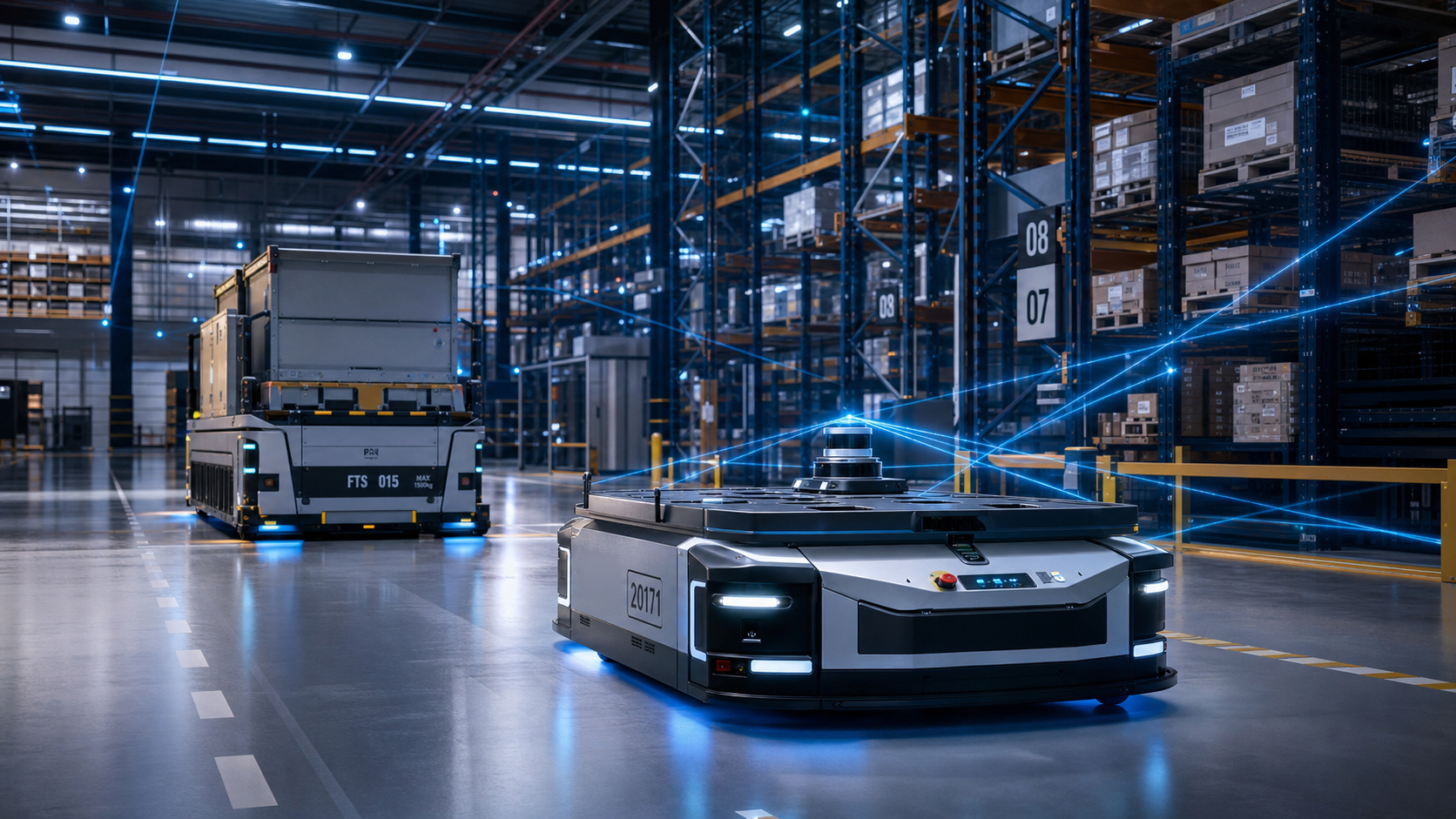
Driverless transport systems and autonomous transport robots: Which transport robot will determine the future of your company? – Image: Xpert.Digital
AGVs vs. AMRs | Up to 75% less electricity and extreme ROI: Are logistics robots really worth it?
AI, 5G and swarm robotics: This is what the sports hall floor of the future will look like
While automated guided vehicles (AGVs) and autonomous mobile robots (AMRs) have long been securing billions in revenue every second for global mega-corporations, a large portion of Germany's medium-sized businesses are still hesitant. But the pressure is mounting: Exploding e-commerce demands, ambitious sustainability goals, and a dramatic shortage of skilled workers have transformed the automation of warehouse floors from a mere luxury into a matter of survival. But when will the multi-million-euro investment in the smart warehouse of tomorrow pay off? And what actually distinguishes the established, precision-engineered AGVs from the highly flexible, AI-controlled AMRs? This comprehensive analysis not only reveals the fundamental technological differences and tangible economic advantages, but also provides a clear strategic roadmap for companies that don't want to fall behind in global competition.
Those who don't automate, lose – The silent transformation of the sports hall floor
Intralogistics is undergoing a fundamental transformation. Automated guided vehicles (AGVs) and autonomous mobile robots (AMRs) are no longer future technologies, but tangible competitive factors that determine whether a company can still meet tomorrow's efficiency standards. This analysis sheds light on why the choice between these two technologies is strategically far more than a mere investment decision – and why Germany's industrial sector is awakening to this challenge, but still has considerable catching up to do.
Market dynamics: Billion-dollar markets on the rise
The global market for autonomous mobile robots is growing at a rate that consistently exceeds even the most optimistic forecasts. The market size of the AMR segment was estimated at around US$3.2 billion for 2024 and is projected to reach nearly US$4 billion by 2025. Medium- to long-term market research paints an even clearer picture of the future: various forecasting institutes anticipate a market volume of up to US$39.8 billion by 2035, representing a compound annual growth rate (CAGR) of approximately 25.9 percent. Other, somewhat more conservative estimates project the market to reach around US$10.6 billion by 2031, corresponding to a CAGR of 15.3 percent – still an exceptionally dynamic growth profile.
The European submarket for automated guided vehicles (AGVs) is also experiencing robust growth. It was estimated at around US$1.87 billion for 2026 and is projected to reach US$3.12 billion by 2031 – with a CAGR of 10.78 percent. Germany plays a special role in this context: As a leading exporter of conveyor technology and intralogistics solutions, the German sector achieved a production volume of around €27 billion in 2023 alone, representing an increase of 9 percent compared to the previous year. Export volume in the same year amounted to €20.4 billion, with the USA remaining the most important trading partner, accounting for €2.7 billion.
This growth is fueled by several structural forces. E-commerce fulfillment centers that have established same-day delivery as the standard are key drivers, as are the demographic-driven shortage of skilled workers in the logistics sector and declining component costs, particularly for lithium-ion batteries. In July 2025, Amazon surpassed the milestone of one million robots deployed in its logistics centers, impressively demonstrating how mobile automation can multiply throughput with the same number of employees. According to the International Federation of Robotics, more than 4.6 million industrial robots are now in operation worldwide – twice as many as ten years ago.
Two concepts, one mission: How FTS and AMR really differ
AGVs and AMRs share the same fundamental mission: to automate and optimize the transport of materials and goods within production and storage facilities. However, behind this common objective lie fundamentally different technological approaches, each with its own specific strengths and weaknesses depending on the application context.
| feature | Automated guided vehicles (AGVs) | Autonomous Mobile Robots (AMR) |
|---|---|---|
| navigation | Fixed routes marked by floor markings, magnetic strips or lasers | Free navigation via AI, LiDAR and SLAM |
| flexibility | Small, difficult to change or scale | High, dynamic route adjustment in real time |
| Infrastructure | Structural measures required | Quick integration without modification |
| load capacity | Up to several tons | Typically up to 1,500 kg |
| Response to obstacles | Stops and signals | Autonomously avoids obstacles |
| Acquisition costs | Higher (including infrastructure) | Tend to be lower |
| scope | Stable, repetitive transport processes | Dynamic, complex environments |
Driverless transport systems – also known as Automated Guided Vehicles (AGVs) – are floor-bound vehicles that move along predefined routes. These routes are defined by various physical guidance systems such as floor markings, magnetic strips, or laser reflectors. The consequence of this close integration with infrastructure is that AGVs operate with exceptional precision and predictability – making them the most reliable option in stable, high-volume transport scenarios. Their strength lies in their consistency: they deliver predictable transport performance with high availability, without having to react to volatile environmental conditions. This makes them the first choice for heavy-load transport, such as for pallets, wire mesh containers, shipping containers, or special production carriers, where the payload can reach several tons.
Autonomous mobile robots (AMRs), on the other hand, represent a more recent evolutionary stage in intralogistics automation. Their key differentiating feature is their navigation intelligence: They use advanced SLAM (Simultaneous Localization and Mapping) technologies in combination with AI-supported route planning, LiDAR sensors, time-of-flight cameras, and sensor fusion to orient themselves in real time, create maps of their surroundings, and dynamically avoid obstacles. A fixed guidance system is not required. This characteristic makes AMRs the ideal solution for brownfield environments—that is, existing factory and warehouse buildings that are to be automated gradually without extensive structural modifications.
Thanks to integrated sensor fusion, the positioning accuracy of modern AMRs averages plus or minus one centimeter. Depending on the model, battery life reaches up to 12 hours per charge cycle, enabling largely uninterrupted shift operation. Individual warehouses are already using an average of 25 to 85 AMR units per location, particularly in Germany and the USA.
The technological difference as a strategic turning point
The decision between AGVs and AMRs is not purely operational, but strategic. It answers the question of how the company wants to orient its logistics architecture for the next ten to fifteen years.
Decisions regarding AGVs (Automated Guided Vehicles) are essentially commitments to stability and predictability. Those who opt for a traditional AGV system are investing in a system that delivers peak performance over extended periods for defined, highly repetitive transport tasks – especially when heavy loads need to be moved reliably. Automotive and heavy industry production facilities, which maintain largely unchanged manufacturing structures for years, are typical AGV users. In German automotive plants, flexible production lines enabled by Industry 4.0 initiatives are a particularly significant driver for AGV investments.
AMR decisions, on the other hand, represent a commitment to adaptability. For companies in volatile markets—such as e-commerce, where seasonal peaks, short-term product range changes, and shifting warehouse layouts are the norm—AMRs offer a decisive advantage in flexibility. They can be scaled modularly, reprogrammed quickly, and integrated into new operational processes without any structural modifications. Markus Külken, Vice President of the Material Flow Product Line at SSI Schäfer, sums up the key message: AMRs are now central building blocks for automation in e-commerce and an enabler for same-day fulfillment, as they offer significantly more flexibility and uninterrupted 24/7 operation compared to rigid conveyor technology. Their use becomes economically viable with an order volume of approximately 2,000 to 3,000 picks per day.
In practice, the trend towards hybrid systems is growing. Many companies are already relying on combinations of AGVs and AMRs, with the former handling the heavy, deterministic transport routes, while the latter cover flexible feeder tasks and area logistics. SSI Schäfer itself recommends this complementary approach: AMRs for flexible transport, AGVs and conveyor technology for special transport such as deep-freeze areas or particularly heavy loads.
Areas of application: Far beyond the classic warehouse
The application range of AGVs and AMRs extends across an impressive range of industries and types of businesses, going far beyond the classic logistics warehouse.
In production and manufacturing, both systems form the nerve pathways of material supply. They handle the automated supply and disposal of materials to production lines, reduce downtime through precise just-in-time deliveries, and connect warehouses and production in a seamless material flow. Over 62 percent of smart factories worldwide already use AMRs for intralogistics tasks. In the automotive and mechanical engineering industries, where Germany has traditionally been strong, flexible production lines in the context of Industry 4.0 are a key application area for AGVs.
Autonomous transport robots have experienced a remarkable rise in healthcare in recent years. Hospitals use them to transport laundry, medications, lab samples, food, and sterile supplies between wards and central service areas. As part of the 5G-RemRob project, Fraunhofer IML, together with industry partners and St. Franziskus Hospital in Münster, developed transport robots that use AI and 5G connectivity to navigate autonomously even in dynamic hospital corridors. The University Hospital of Cologne already operates 94 mobile robots that complete 3,300 trips daily, thus taking over the work of approximately 100 transport staff. According to studies, hospitals with automated transport systems save 15 to 30 percent of nursing time, which corresponds to 1.8 to 3.6 hours per shift – valuable time that can directly benefit patient care.
In e-commerce fulfillment, AMR technology has become the dominant solution. Amazon operates nearly 800,000 robots in its logistics centers worldwide, including thousands of Hercules robots at its Erfurt facility, which opened in 2024 and autonomously transports shelving units to picking stations. DHL and Walmart have also extensively integrated AMRs to accelerate sorting and picking processes. By 2024, over 32 percent of e-commerce fulfillment centers in Europe already had integrated AMRs.
While their use is still limited at airports and in the public sector, it is growing. Typical applications include baggage handling, restocking vending machines, and cleaning large traffic areas. In the hospitality industry – for example, in hotels and restaurants – smaller service robots are increasingly taking over tasks such as guest services, food service, and deliveries.
Economic arithmetic: costs, amortization, and profitability
The investment decision for FTS or AMR is one of the most complex capital allocation issues in business practice, because the actual purchase represents only one part of the overall calculation.
Acquisition costs typically start in the five-figure range. According to the supplier, the price for a single Open Shuttle – an AGV from KNAPP – starts at €45,000. In reality, many individual systems, due to customized requirements, cost in the six-figure range. AGVs are structurally more expensive than AMRs because, in addition to the vehicles themselves, they also require the development of a specific physical infrastructure. Further costs include fleet management software, integration into existing ERP or warehouse management systems, installation, commissioning, and employee training.
Ongoing costs include maintenance, repairs, software updates, energy consumption, and supplier support. According to industry sources, around 80 percent of the costs for conventional logistics vehicles are attributable to personnel alone – a figure that illustrates the transformative cost structure of automation.
The profitability calculation relies on several factors. First, there are the direct savings in personnel costs: AMRs and AGVs can operate 24/7, 365 days a year, without incurring shift premiums, sick pay, or vacation costs. Second, there is the space efficiency: Autonomous robots, especially those with omnidirectional drive, require significantly narrower aisles than human-operated forklifts – unused warehouse space and wide connecting routes are thus a thing of the past. Third, there is the quality improvement: SSI Schäfer reports a picking error rate of less than 0.1 percent for its AMR systems – a level that is significantly superior to manual processes and considerably reduces costs associated with incorrect picking, returns, and quality control.
The payback period varies considerably depending on the system type, usage intensity, and the company's cost structure. In the hospital sector, a typical payback period is 2 to 4 years. In e-commerce fulfillment, where AMRs operate at high capacity, payback can be less than 12 months, according to SSI Schäfer. A Fraunhofer cost analysis of 15 statistically representative AGV systems provided empirical evidence for the economic viability of these systems and demonstrated how investment decisions, payback periods, and cost structures play out in practice. Industry surveys also show that 88 percent of manufacturers cite ROI concerns as the main obstacle to their automation efforts – underscoring the importance of a sound cost-benefit analysis for investment decisions.
Besides purchasing and leasing, the Robotics-as-a-Service (RaaS) model is gaining importance. It enables usage-based billing and lowers the barrier to entry, but is less suitable for scenarios with very short response time requirements. Purchasing remains the most cost-effective option in the long run, while leasing is recommended for companies that want to conserve investment budgets and minimize risks.

Expert partner in warehouse planning and construction
AI, 5G and swarm robotics: The next stage of intralogistics development
The shortage of skilled workers as a structural driver of automation
No factor is accelerating the spread of AGVs and AMRs in Germany as much as the systematic shortage of skilled workers in intralogistics. Industry observers predict that the situation will become particularly critical between 2025 and 2035, as entire cohorts of baby boomers retire and the pool of replacement workers shrinks due to demographic reasons. This demographic shift is not a future risk – it is already an operational reality in German logistics companies.
A TMG study, which surveyed over 2,500 manufacturing companies between March and July 2024, paints a sobering picture: 63 percent of the surveyed companies have not yet automated their intralogistics or have only partially automated it. A further 22 percent have semi-automated processes, while highly automated workflows are found in only 11 percent of the companies. Benjamin Hölzle, Director of Supply Chain Management & Logistics at TMG Consultants, bluntly summarizes the study's conclusion: German industry is squandering its competitive edge due to outdated intralogistics structures. He cites a lack of strategic vision, sufficient project resources, and a sound market overview.
At the same time, there is no reason for pessimism regarding the consequences of automation for employment. The OECD does not expect a significant increase in unemployment due to automation – rather, it anticipates a demand for more skilled jobs. AMRs take over repetitive, physically demanding tasks, while employees become supervisors, maintenance technicians, and process optimizers – a transformation that SSI Schäfer already describes as the norm in its customer facilities. Intralogistics automation is therefore not a job killer, but a catalyst for skills upgrades.
Sustainability: The underestimated advantage of automation
In addition to the immediate cost and efficiency advantages, intralogistics automation offers significant sustainability benefits that are gaining strategic importance in the wake of the EU Green Deal and growing ESG requirements.
The logistics sector – including transport, warehousing, and ports – generates a total of 7 to 11 percent of global greenhouse gas emissions, according to the World Resources Institute, with warehousing contributing around 11 percent of that. AMR-based warehouse concepts can make a substantial contribution to emissions reduction: Geek+, a leading AMR manufacturer, quantified, based on its tracking data for 30,000 deployed robots, that these robots collectively saved 140,000 tons of CO₂ emissions and 16 million kilowatt-hours of energy in 2022. The company also states that AMR solutions enable up to 75 percent lower energy consumption compared to manually operated warehouses – thanks to space-saving, energy-efficient storage areas where no lighting or air conditioning is required for human workers.
KUKA, one of the German market leaders in industrial robotics, emphasizes lean product design as a key to reducing the energy consumption of its AMR systems and is continuously working to lower its CO₂ footprint across the entire product lifecycle. The EU Green Deal incentives for low-emission intralogistics equipment provide further structural support for AMR demand in Germany and the EU.
The sustainability of AMRs is also evident in their resource efficiency: significantly reduced error rates in order picking decrease packaging waste, and paperless warehouse documentation reduces resource consumption across the entire supply chain. At a time when companies are under increasing pressure to measure and reduce their environmental footprint, these effects are being increasingly evaluated as measurable indicators by sustainability reporters and investors.
Technological perspectives: AI, 5G and swarm robotics as the next stage of growth
The technological development of AGVs and AMRs is far from complete. The next stage of evolution will be largely defined by three converging technology trends: artificial intelligence, private 5G networks, and swarm robotics.
AI-powered navigation modules already account for more than 70 percent of new AMR system installations, while cloud-based fleet management systems have achieved an adoption rate of over 64 percent among logistics providers. The next level of sophistication is represented by AI-supported swarm orchestration platforms that coordinate hundreds to thousands of robots in real time and continuously optimize them based on machine learning algorithms. Amazon surpassed the one million mark for deployed robots in July 2025, with DeepFleet fleet intelligence reducing travel time per picking operation by 10 percent. Locus Robotics, after integrating its LocusOne software, exceeded the three billion picking mark and reported a doubling or tripling of productivity.
Private 5G Advanced networks will take real-time data communication between robots and control systems to a new level. Fraunhofer IML, in its 5G-RemRob project, has demonstrated how 5G connectivity enables autonomous transport robots to navigate reliably even in complex, busy environments such as hospital corridors. With a projected impact on the CAGR of around 1.8 percent, private 5G networks are considered a significant medium-term growth driver for the AMR market.
The software side of intralogistics automation is growing particularly dynamically. The global market for AMR software was estimated at US$4.66 billion for 2026 and is projected to grow to US$16.97 billion by 2035 – an expansion of more than 320 percent in a decade. This is no coincidence: software and AI are the true core of value creation in modern intralogistics. Whoever masters fleet intelligence, masters the warehouse.
The Horizon Europe funding program supports research consortia in developing next-generation swarm intelligence navigation algorithms – with Germany, the Netherlands, and France as leading commercialization locations. Fraunhofer IPA hosts regular technology forums on AGVs and AMR, where AI applications, safety standards in the context of the EU AI Act, and the new Machinery Directive are key discussion topics.
Neura Robotics from Metzingen exemplifies the next generation of cognitive robot systems that not only navigate but also perceive, interpret, and learn. Founder David Reger describes their ambition with the statement: "Our systems see, hear, feel, and understand the world in real time." While Asia, particularly China, is leading the way in scaling robot fleets, Europe's strength lies in combining engineering expertise, data sovereignty, and AI-driven system intelligence – a combination that creates a distinct competitive advantage.
German manufacturers in global competition
Germany is not only a user but also a leading global manufacturer of AGV and AMR technologies. KUKA, Jungheinrich, SSI Schäfer, EK Robotics (formerly MLR System), Swisslog (part of the KUKA Group), and Dematic are the best-known German and European players. At LogiMAT 2026, KUKA presented its updated AMR portfolio and participated in cross-industry interoperability demonstrations as part of the "Interoperability Arena"—a clear indication that standardization is becoming increasingly important for the next growth spurt.
MiR (Mobile Industrial Robots) from Denmark, now part of Teradyne, offers one of the broadest portfolios in the AMR segment: from the compact M100 to the MiR1000 for pallet and heavy-duty transport, available through 167 distributors in 48 countries. Odense Hospital in Denmark documented 8,000 kilometers of accident-free operation with MiR robots – a testament to quality that carries particular weight in the safety-sensitive healthcare sector.
Globally, the market leader among AMR operators is clearly Amazon Robotics, which alone surpassed the one million robot mark in 2025. Alongside this, Asian competitors like Geek+, Hai Robotics, and other Chinese providers are increasingly establishing themselves, primarily through aggressive pricing and rapid scaling. For German and European industry, this means that competitive pressure is increasing, and technological leadership alone is no longer sufficient – it must be combined with system integration expertise, open interfaces, and sustainable service offerings.
Decision framework: When is which solution appropriate?
For companies that need to make an automation decision, a clear decision framework can be derived from the available data.
AGVs are suitable when transport routes remain stable in the long term, the loads to be moved exceed the carrying capacity of AMRs, operation takes place in a controlled, newly planned environment (greenfield), and high availability of predictable transport processes is prioritized over flexibility. Typical industries include automotive manufacturing, mechanical engineering, chemicals, and traditional heavy-lift logistics.
AMRs are the superior choice when warehouse structures are frequently adapted, the environment is dynamic and frequented by people (mixed traffic), rapid commissioning without structural modifications is required, and the company wants to enter automation in a modular and capital-efficient manner. Typical industries include e-commerce, healthcare, consumer goods logistics, and wholesale and retail.
Minimum utilization also plays a crucial role. SSI Schäfer states that the use of AMRs becomes economically viable with as few as 2,000 to 3,000 picks per day. Below this threshold, a manual or semi-automated solution may be superior. Above this threshold, particularly with continuous three-shift operation, the full profitability potential of automation becomes apparent.
In many modern intralogistics architectures, the answer to the question of AGVs or AMRs is ultimately: both – in a carefully planned, complementary system in which each technology can play to its core strengths.
Germany lagging behind: A strategic wake-up call
The sobering conclusion of the TMG study – production is good, intralogistics is inadequate – must be understood as a serious strategic wake-up call. While German companies have optimized their manufacturing processes for decades, their internal logistics are structurally lagging behind. Only 4 percent of the surveyed industrial companies have reached the highest level of autonomous intralogistics – and this in a country that sees itself as a stronghold of automation technology.
The consequence: German companies are losing out to their Asian and American competitors not only in the technological race, but above all in the speed of practical implementation. Amazon made a new warehouse with thousands of robots operational in Erfurt within months. Many German medium-sized companies, on the other hand, are still discussing the basic feasibility study.
The solution lies not in blind, knee-jerk investments, but in a sound, data-driven strategy. This begins with an honest assessment of the actual level of automation – which, according to a TMG study, is overestimated by many companies. Next comes the development of a comprehensive architecture that integrates AGVs, AMRs, stationary conveyor technology, and software platforms into a coherent system. Finally, it requires a willingness to invest in the further training of employees and to actively shape the cultural transformation towards a data-driven logistics operation.
Market dynamics leave no time for hesitation: The global AMR market is growing by over 25 percent annually, the technology is maturing rapidly, and costs are falling. Companies investing in AGVs and AMRs today are not only securing operational efficiency – they are defining the logistics architecture that will keep them competitive in ten years' time. Those who wait will later pay not only higher procurement prices, but above all, the price of a lost competitive edge.
Your intralogistics experts

Consulting, planning and implementation of complete solutions for high-bay warehouses and automated storage systems - Image: Xpert.Digital
More information here:
Your global marketing and business development partner
☑️ Our business language is English or German
☑️ NEW: Correspondence in your native language!

Konrad Wolfenstein
I and my team are happy to be available to you as your personal advisor.
You can contact me by filling out the contact form here simply call me at +49 7348 4088 965. My email address is [email protected]:or
I'm looking forward to our joint project.
☑️ SME support in strategy, consulting, planning and implementation
☑️ Creation or realignment of the digital strategy and digitization
☑️ Expansion and optimization of international sales processes
☑️ Global & Digital B2B trading platforms
☑️ Pioneer Business Development / Marketing / PR / Trade Fairs
Our global industry and economic expertise in business development, sales and marketing

Our global industry and economic expertise in business development, sales and marketing - Image: Xpert.Digital
Industry focus areas: B2B, digitalization (from AI to XR), mechanical engineering, logistics, renewable energies and industry
More information here:
A thematic hub offering insights and expertise:
- Knowledge platform covering global and regional economies, innovation and industry-specific trends
- A collection of analyses, insights, and background information from our key areas of focus
- A place for expertise and information on current developments in business and technology
- A hub for companies seeking information on markets, digitalization, and industry innovations










