
Between euphoria and evidence: Why humanoid robots in intralogistics still lag far behind the shuttle storage system
Xpert Pre-Release

Available in 27 languages 📢
Prefer Xpert.Digital on GoogleⓘPublished on: May 5, 2026 / Updated on: May 5, 2026 – Author: Konrad Wolfenstein
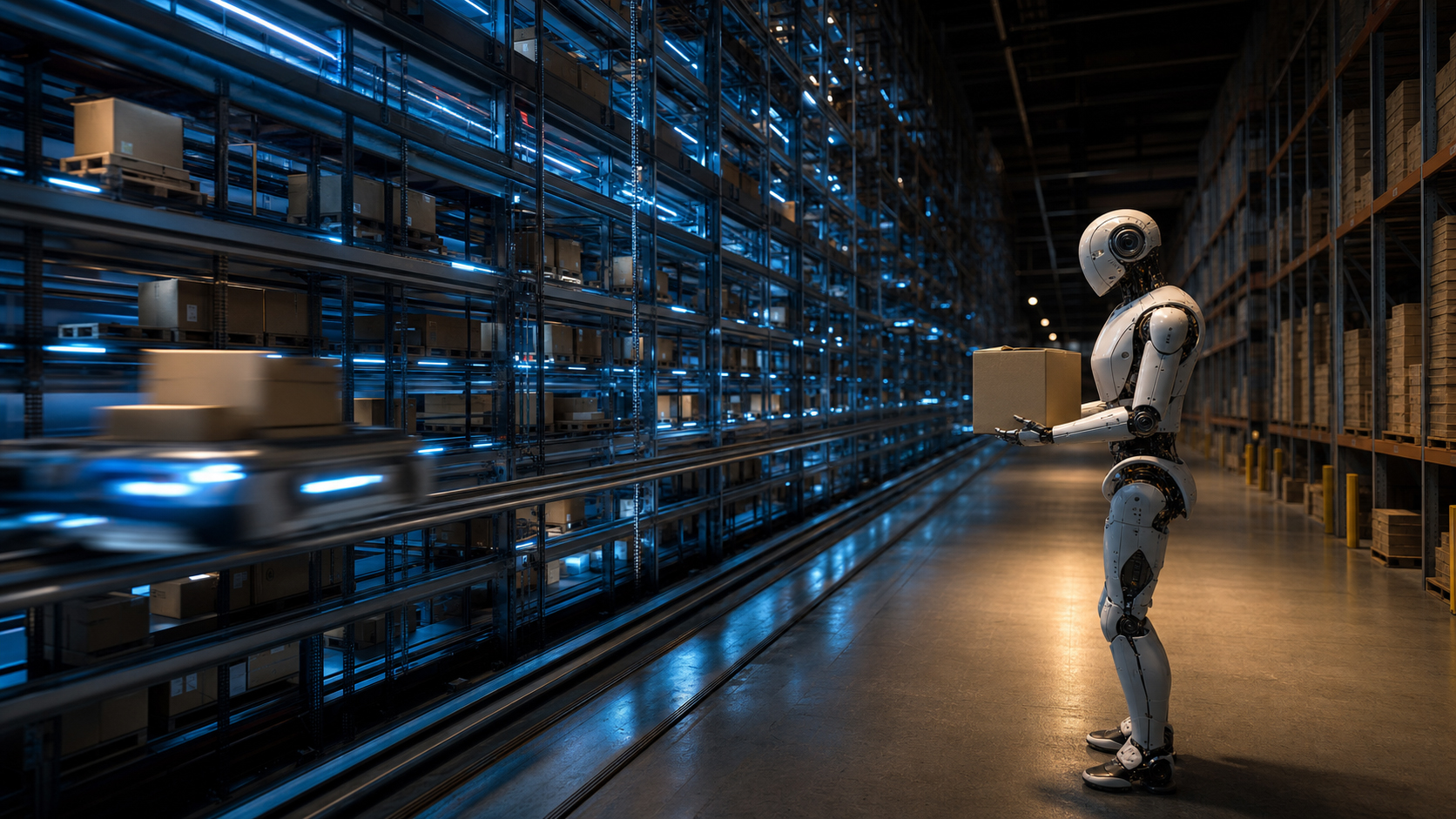
Between euphoria and evidence: Why humanoid robots in intralogistics still lag far behind the shuttle storage system – Creative image: Xpert.Digital
Practical test of intralogistics: Where the hype surrounding humanoid robots painfully reaches its limits
Two-legged versus wheelbarrow: Which system does your warehouse really need right now?
The hype surrounding humanoid robots in logistics is immense: Tech giants, visionary startups, and top-tier analysts promise nothing less than a revolution in the working world on two legs. Fueled by multi-billion-dollar investments and viral, glossy videos on social media, the deployment of robots like the Tesla Optimus or the Digit from Agility Robotics in warehouses seems only a matter of time. But does reality, in the relentless pace of a high-performance warehouse, live up to the promises of the demonstrations?
A sober look at the facts reveals a different picture. When it comes to throughput, millimeter precision, reliability, and, not least, cost-effectiveness (total cost of ownership), these error-prone two-legged robots quickly reach their physical and technological limits. Anyone who lets themselves be blinded by market forecasts today risks costly misinvestments. This in-depth analysis reveals why the established multi-level shuttle system with its push-cart principle will remain far superior to humanoid robots in 24/7 operation for the foreseeable future – and how decision-makers in intralogistics can now successfully navigate the fine line between future-proof innovation and economic prudence.
When market forecasts overtake reality: The hype and its foundations
The global market for humanoid robots is currently developing with a dynamic that is captivating investors, technology analysts, and business consultants alike. According to Fortune Business Insights, the worldwide market value is expected to grow from $3.28 billion in 2024 to approximately $66 billion by 2032. Goldman Sachs estimates this market at $38 billion by 2035, while Morgan Stanley even forecasts $152 billion by 2040. Roland Berger, in its study, identifies 2026 as a potential turning point and outlines a long-term market potential of up to $4 trillion worldwide – a volume comparable to that of the entire automotive industry.
Such figures exert a peculiar fascination. They sound like the next major technological leap, a revolution in the world of work, the solution to all skilled labor problems at once. Tesla CEO Elon Musk has announced the Optimus robot as a future pillar of factory production. Figure AI, Agility Robotics, and Boston Dynamics are implementing initial pilot projects in logistics centers. BMW and Mercedes-Benz are testing humanoid systems for inserting sheet metal and performing assembly support tasks. The logistics giant GXO Logistics had Agility Robotics' bipedal Digit robot transport boxes in a warehouse near Atlanta.
These images spread virally on social media. And this is precisely where the problem begins: a gap exists between media-optimized demonstration videos and the productive, everyday operations of a real, high-performance warehouse, a gap that decision-makers in the logistics industry must bridge with a clear head. Anyone who jumps on the humanoid hype bandwagon now, without a thorough understanding of the technological maturity, operating costs, and specific requirements of professional intralogistics, risks a costly misinvestment.
What the new two-legged creatures can actually achieve in practice: Potential with significant limitations
To put the current capabilities of humanoid robots into perspective, it's helpful to look at what the Fraunhofer IML formulated as a sobering finding in a study published in 2026: Around three-quarters of the companies surveyed expect to see humanoid robots in productive use within the next ten years. But the crucial point is: Today, in 2026, the prerequisites for stable operation under real industrial conditions are often still lacking.
Fraunhofer IML does not classify humanoid robots as replacements for human labor, but rather as flexible, generalist automation units intended for use where traditional automation reaches its limits. This is an important distinction: not heavy-duty operations in high-performance warehouses, not 24/7 order picking systems, but the unstructured gray areas of logistics that are difficult for conventional automation technology to access.
The technical limitations are concrete. Fraunhofer IPA estimates that humanoid robots currently achieve roughly half the performance of a human. This figure should not be confused with the performance metrics of a shuttle system, which executes several thousand movements per hour. Analysts from Fruitcore Robotics point out that, in direct comparison with 6-axis industrial robots, humanoid robots will not yet be competitive in terms of cost-effectiveness, precision, and speed by 2025. And the differences become even more pronounced when compared directly with rail-guided storage systems, which have been optimized for precise process repetition for decades.
Amazon's Blue Jay project provided a vivid example of the pitfalls of hype. At the end of 2024, the company unveiled its new multi-armed robot with a major PR campaign as the warehouse solution of the future. Just a few months later, the project was quietly discontinued. The technology didn't work as promised. Sources within the company aptly describe the core problem: Real-world warehouse environments are significantly more chaotic and unpredictable than digital test environments. A similar situation exists with the Tesla Optimus: Despite billions of dollars in investment and production figures exceeding 50,000 units, the current version, according to numerous reports, still cannot reliably perform even the simplest gripping tasks. One version had to be repeatedly shut down due to overheating problems, and the grippers could barely handle lightweight objects safely.
The multi-level shuttle system with pushcart principle: Technological precision as a competitive advantage
Anyone who engages in the discussion about humanoid robots in logistics without fully understanding the multi-level shuttle system with its combined pushcart principle is making an incomplete comparison. This technology does not represent a future alternative – it has been a field-tested, mature, high-performance system for modern intralogistics for years and sets a benchmark that humanoid robots will not be able to reach in structured warehouse environments for the foreseeable future.
The basic principle of the multi-level shuttle system with a trolley principle is to position several compact storage and retrieval machines on separate rails at different levels, one above the other. Each individual unit can move independently, while a higher-level control system handles the coordination. The combined trolley principle – also known as a carrier-shuttle combination – allows a single carrier vehicle to transport multiple shuttle units or to selectively move load units across multiple levels within the system.
The technical specifications impressively illustrate the performance class. SSI Schäfer specifies a shuttle vehicle speed of 2.5 meters per second and an acceleration of 1.8 m/s² for its Navette system. The Schäfer Lift & Run system achieves vertical conveying speeds of up to 0.6 m/s and serves total heights of up to 45 meters. A single vehicle, operating in a double-cycle configuration, can simultaneously move up to four transport units and serve storage locations on two levels in a single pass – thus doubling the effective process efficiency compared to conventional single-level shuttles.
Depending on the system design, individual shuttle systems achieve up to 1,500 storage movements per hour. In large-scale facilities, many of these vehicles operate in parallel on different levels and aisles, resulting in overall throughput that is unattainable for humanoid robots in any realistic timeframe. Leading systems achieve a positioning accuracy of ±2 millimeters. This precision is not the result of artificial intelligence interpreting and adapting to situations – it is the result of decades of mechanical and control engineering optimization in clearly defined, structured environments.
Crucial to their practical superiority is the 24/7 concept: Shuttle systems operate around the clock without fatigue, without safety distance requirements, without breaks, and without the uncertainties that arise in humanoid systems due to AI-based decision-making in real-world environments. Autonomous charging cycles or optional battery swapping systems prevent downtime, even during peak periods. Space efficiency is another key element: Through multi-deep and multi-level storage, shuttle systems can double or even quadruple storage capacity compared to traditional systems, as fewer aisles are required and more goods can be stored in the same area.
Integration with higher-level warehouse management systems (WMS) and warehouse control systems (WCS) is fully mature. Leading automated guided vehicles (AGVs) systems utilize genetic algorithms and queuing theory to optimize task planning, minimize idle time and congestion, and communicate in real time with the entire logistics network. This industrial-scale system integration is a crucial advantage that humanoid robots cannot yet even come close to replicating.
When numbers don't lie: Throughput, costs and TCO in a direct system comparison
An economic analysis should not be limited to technical specifications – it must also consider the financial dimension across the entire life cycle. The Total Cost of Ownership (TCO) is the crucial framework that reveals the true economic value of an automation system.
A multi-level shuttle system based on a trolley principle is not an inexpensive investment. The initial costs for a large-scale system are substantial and include not only the vehicles themselves but also the racking structure, conveyor technology, lift systems, control software, and integration into existing IT infrastructure. Acquisition costs for automated storage systems vary widely depending on size and complexity. Regarding ongoing operating costs, annual maintenance costs for stationary conveyor technology and shuttle systems can be less than 5 percent of the original investment. The mechanical simplicity of the shuttle movement—linear travel on defined rails with precisely calibrated load-handling devices—significantly limits the complexity of maintenance. Regular lubrication, occasional motor replacement, and software updates keep the system operational.
Humanoid robots exhibit a fundamentally different cost profile. McKinsey estimates the current acquisition costs per humanoid robot at between $30,000 and $150,000. According to McKinsey's analysis, a cost reduction of over 50 percent would be necessary for economically viable mass-market deployment. Adding to the complexity is the fact that approximately 60 percent of the total cost of a humanoid robot is attributable to actuators – the most mechanically demanding and expensive component, which is also the most susceptible to wear and tear. The combination of high acquisition costs, complex, maintenance-intensive mechanisms, and a performance level that, according to current findings from the Fraunhofer IPA, only reaches about 50 percent of human productivity, results in a mathematically unsatisfactory total cost of ownership (TCO) for use in high-throughput logistics centers.
Roland Berger envisions operating costs for humanoid robots of two dollars per hour as a medium-term target once hardware and software improvements take effect. This figure sounds convincing – but it is a projection, not a measured reality. The Horváth study "Redefining Operations with Humanoid Robots" expects that humanoid robots will perform their tasks in logistics and production 3.5 times more efficiently than humans in the long term. This, too, is a prediction – and one that is irrelevant for structured, high-performance warehouse environments with automated shuttle systems anyway, because human labor is already almost completely replaced there.
Equally noteworthy is the amortization calculation: For a well-dimensioned shuttle system, practical examples from the industry show amortization periods of one and a half to five years, with simultaneous personnel cost savings on the order of several hundred thousand euros per year. These figures are based on proven systems with stable operating parameters. For humanoid robots, comparable values are simply not reliably calculable today because the systems have not yet reached the maturity level for continuous productive operation data. A single incident, such as the one in which a Figure 02 robot blocked a warehouse aisle for three hours because it stopped mid-task and did not restart on its own, illustrates the operational risk – such an event is economically unacceptable in a tightly scheduled logistics center with just-in-time requirements.
LTW Intralogistics Solutions – Shuttle System

LTW Intralogistics Solutions – Shuttle System - Image: LTW Intralogistics GmbH
LTW offers its customers not individual components, but integrated complete solutions. Consulting, planning, mechanical and electrotechnical components, control and automation technology, as well as software and service – everything is networked and precisely coordinated.
In-house production of key components is particularly advantageous. This allows for optimal control of quality, supply chains, and interfaces.
LTW stands for reliability, transparency, and collaborative partnership. Loyalty and honesty are firmly anchored in the company's philosophy – a handshake still means something here.
Related to this:
When humanoids make sense — and when classic shuttles are unbeatable
Where the glossy presentation ends: Technical limitations in real-world operation
Beyond cost calculations, humanoid robots reveal a number of limitations in practical logistics operations that often remain under-examined in public discourse. Energy, speed, and software are the three key barriers identified by SCMR in a comprehensive analysis in 2025.
Energy efficiency is one of these weaknesses. A system that balances on two legs, rights itself, and simultaneously carries loads consumes significantly more energy per unit of work than a rail-guided vehicle whose entire kinetic energy is directed in a single direction. The balancing problem is not trivial: it ties up computing power, actuator resources, and energy that a specialized logistics robot would otherwise need for the actual work. Tesla reported overheating problems with the Optimus prototype, which had to be shut down during sustained operation.
Speed is the second obstacle. The current state of humanoid robots allows walking and manipulation speeds that are far below industrial cycle times. Where a shuttle can perform up to 1,500 storage movements per hour, a humanoid robot operates at a significantly slower pace – with the added disadvantage that it hesitates, recalibrates, or aborts when faced with uncertainty. In warehouse operations with high-frequency order fulfillment pressure, this gap is practically a deal-breaker.
Software and AI integration constitute the third problem area. For safe autonomous operation in real-world environments, humanoid robots require AI systems capable of making situational decisions in real time. This requirement currently exceeds the state of the art in industrial applications outside of tightly controlled test scenarios. Amazon's Blue Jay debacle and similar setbacks demonstrate that algorithms can fail in production environments because physical reality is far more complex than digital training data. For a shuttle system, however, this issue is irrelevant: The control software follows defined paths, reacts to sensor data, and makes decisions within a fully modeled parameter space.
The issue of safety also deserves attention. Humanoid robots working in the same space as humans require complex safety architectures and certification procedures that are not yet fully established. The IFR (International Federation of Robotics) explicitly points out in its Top 5 Trends for 2026 that industry standards for safety levels, durability criteria, and consistent performance criteria for humanoids on the factory floor are still under development. A shuttle system within its enclosed racking system does not face this problem: humans simply have no business being in its operating zone, which radically simplifies safety management.
Where humanoid robots actually make sense: The right niche instead of a false claim to universality
It would be a hasty conclusion to deduce a general decline in the importance of humanoid robots from the limitations described. Their potential is real – but it lies in fields of application other than high-performance warehousing.
Fraunhofer IML precisely describes the actual area of application: humanoid robots as a complement to existing systems in areas where flexibility and adaptability are required and classic automation reaches its limits. This applies particularly to dealing with unstructured environments, heterogeneous products, and changing tasks for which no specialized machines exist. In small-batch production, in the processing of returned goods, in setting up production lines with a high degree of product variety, or in the internal supply of workshops – the flexibility of the humanoid system can demonstrate its advantages in these areas.
The aspect of infrastructure compatibility should not be underestimated. A humanoid robot can, in principle, operate in an environment designed for humans without requiring fundamental infrastructure modifications. This represents a real cost advantage for companies that cannot or do not want to invest in a comprehensive warehouse renovation. Humanoid robots offer a viable option for pilot projects, for testing in gray areas, or for developing processes that have previously remained manual and therefore costly.
The long-term technological trajectory is equally important to consider. Global venture capital investments in humanoid robotics more than tripled between 2023 and 2025, exceeding US$40 billion. This capital investment will drive progress. According to the management consultancy Horváth, from around 2028 onward, tasks with high variability and more complex motor requirements will increasingly be handled by humanoid robots. From 2035, according to this assessment, the transition to general-purpose robots is conceivable. This is a timeframe that should not dominate today's investment decisions.
Between regulation, infrastructure and market maturity: What's slowing down the ramp-up
The path of humanoid robots to mass production is hampered not only by technical limitations but also by structural and regulatory factors. Industry standards for safety levels do not yet exist with the necessary depth. Certification processes for humanoid systems operating in close proximity to humans are complex and time-consuming. In Europe, the stringent requirements of the AI Act and the Machinery Directive add further obstacles, imposing specific documentation obligations for autonomously acting, physically interacting systems.
The classic scaling dilemma exacerbates the situation: Low production volumes make upfront investments in production lines difficult – but without cost reductions, demand remains limited. McKinsey describes this contradiction as a key obstacle to growth. For the component supply chain, this chicken-and-egg problem is particularly noticeable with actuators, which account for 60 percent of total costs: Scaling requires volume, which can only be achieved through lower prices.
China is already demonstrating structural advantages. The proximity of the Chinese robotics supply chain to electromobility and industrial manufacturing creates cost advantages for motors, power electronics, and batteries. Germany and Europe, on the other hand, are strong in precision components, safety electronics, and system integration—precisely where the real bottlenecks in humanoid robotics lie. This presents a strategic opportunity for European industry if the market actually reaches the predicted maturity in a few years.
The strategic decision matrix for logistics companies
For decision-makers in logistics, the overall picture provides a clear, albeit nuanced, guideline for action. The question is not: shuttle system or humanoid robot? It is: What are my requirements – and which system is the right fit?
For anyone planning or modernizing a high-performance warehouse today, anyone needing to meet same-day delivery requirements, anyone wanting to combine high SKU diversity with maximum throughput while operating reliably 24/7, the multi-level shuttle system with a sliding carriage principle is the economically and technically superior choice. Payback periods are predictable, availability is proven, integration with WMS and WCS is standardized, and the technology runs stably in hundreds of installations worldwide.
However, those who operate small, flexibly configurable storage areas, who are confronted with a heterogeneous product mix and changing requirements, who do not have the capacity for a large conversion project and who want to benefit from technological developments in the long term, can consider humanoid robots as a sensible piloting option – with realistic expectations regarding today's performance limits.
The most important warning applies to small and medium-sized enterprises (SMEs): Investment decisions in the logistics sector tie up significant capital for extended periods. Those who rely on market forecasts and technology demonstrations instead of trustworthy operational data and proven system architectures risk misallocations that will become painfully apparent in the competitive landscape. The hype cycle surrounding humanoid robots is real – but it is still far from reaching the peak of productivity as defined by the Gartner hype cycle. Shuttle systems, on the other hand, have long since reached the plateau of productivity.
Investment security versus openness to innovation: A sober perspective on the automation market
Intralogistics is facing a decade of profound change. The shortage of skilled workers is worsening, e-commerce is growing unabated, and the pressure on throughput times and error rates is increasing every quarter. This reality makes automation not only desirable, but for many companies a matter of economic survival.
In this context, it is legitimate and necessary to observe new technologies such as humanoid robots with curiosity and strategic interest. What is not legitimate is the uncritical equation of market forecasts with operational reality. The history of technological innovation is rich with examples of inflated expectations that were corrected by the harsh realities of productive use. The logistics industry can only afford such corrections to a limited extent during ongoing operations.
The multi-level shuttle system with its combined push-cart principle represents not an exciting vision, but a reliable reality. It is faster, more precise, requires less maintenance, and offers better economic predictability than any current-generation humanoid system. It provides 24/7 operation without interruption, without error tolerance issues in simple grasping tasks, without overheating risks, and without the uncertainty of AI having to make real-world decisions in an unstructured environment.
At the same time, it would be short-sighted to ignore the long-term development of humanoid systems. Anyone who knows nothing about this technology today will be under pressure in five to ten years. The recommendation is therefore: secure core automation with proven shuttle systems, test humanoid robots in controlled pilot projects, and underpin your own innovation strategy with realistic time horizons. It's not the loudest hype that earns the capital – but the technology that actually works reliably in the warehouse. And in 2026, despite all the fascinating promises, that will still clearly be the shuttle system on its rails.
Consulting - Planning - Implementation

Konrad Wolfenstein
I would be happy to serve as your personal advisor.
me at wolfenstein∂xpert.digital contact
Just call me on +49 7348 4088 965 .
Your intralogistics experts

Consulting, planning and implementation of complete solutions for high-bay warehouses and automated storage systems - Image: Xpert.Digital
More information here:










