

Just-in-case instead of just-in-time: Why the world suddenly needs gigantic warehouses
Xpert Pre-Release

Available in 27 languages 📢
Prefer Xpert.Digital on GoogleⓘPublished on: September 16, 2026 / Updated on: September 16, 2026 – Author: Konrad Wolfenstein
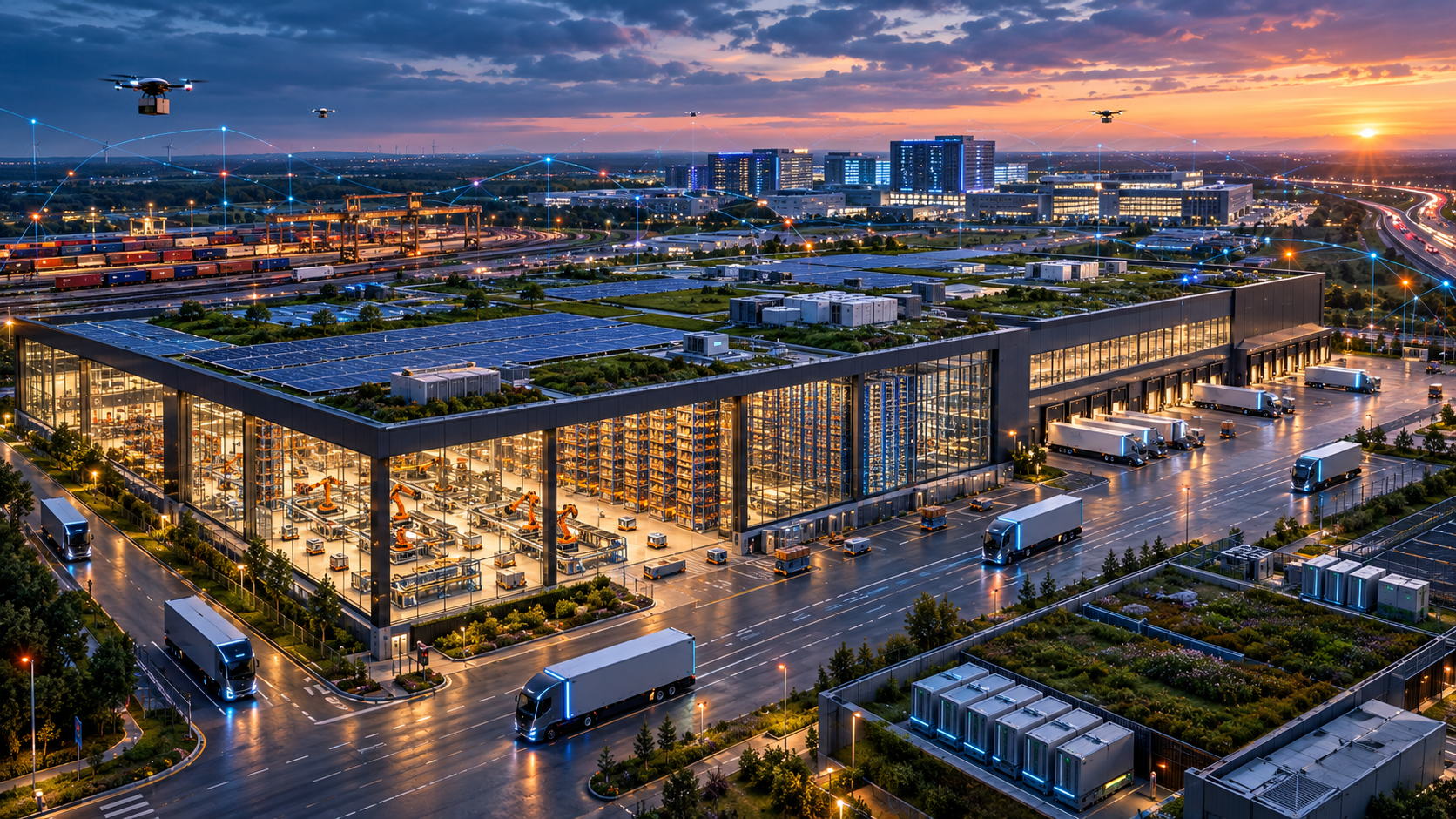
Just-in-case instead of just-in-time: Why the world suddenly needs gigantic warehouses – Creative image on the topic, with AI: Xpert.Digital
The operating system of the global economy: How mega-warehouses in the background ensure our supplies
Energy beats location: Forget about location – Why the electricity connection now determines the future of real estate
The global expansion of logistics centers is undergoing a radical transformation. For a long time, warehouses were considered simple, largely unnoticed concrete structures for storing goods. But driven by the unstoppable rise of e-commerce, geopolitical uncertainties, and the shift away from the pure "just-in-time" principle, they are increasingly evolving into highly complex, cyber-physical hubs. They have become the physical operating system of the global economy.
Anyone who sees the current market simply as a continuation of the pandemic-driven construction boom is sorely mistaken. The market is splitting: While millions of square meters of unsuitable space may be lying vacant worldwide, there is an acute shortage of future-proof, premium properties. The new bottleneck is no longer concrete, but the availability of electricity, automation technology, digital networking, and skilled labor. The following analysis demonstrates how this new geography of supply is completely reshaping power, growth, and dependencies – and why, when investing in modern logistics infrastructure, adaptability will determine success or billions in losses in the future.
The new geography of supply: How logistics centers are reorganizing power, growth, and dependency
The global expansion of logistics centers is more than just a real estate boom. It is the spatial consequence of a global economy that is simultaneously becoming faster, more digital, more prone to disruption, and more security-conscious. Warehouses, fulfillment centers, cold storage facilities, and regional distribution hubs are taking on functions that were previously considered separately: They buffer supply disruptions, enable short delivery times, keep production lines running, integrate returns, and increasingly serve as physical interfaces for data-driven business models. This shifts their economic role. Logistics real estate is no longer merely the shell surrounding inventory, but a productive asset whose location, energy supply, technical equipment, and expandability determine the efficiency of entire supply chains.
The provocative claim that the world will never have enough warehouse space is only true if "enough" is not understood as the abstract sum of all square meters. Globally, there can certainly be too much unsuitable space while simultaneously experiencing an acute shortage of modern, well-connected, and adequately powered facilities. The crucial bottleneck is not concrete per se, but functional space in the right location. A low-ceilinged warehouse without a load-bearing floor, a high-performance power connection, sufficient maneuvering space, and permits for intensive operation is of limited use for an automated fulfillment network. Conversely, a technically excellent building can fail economically in a region lacking a workforce, transport connections, or reliable demand.
The widely varying figures for the global market size already demonstrate how cautiously generalized numbers should be interpreted. Depending on whether studies consider the value of the real estate portfolio, annual transactions, rental income, project developments, or logistics-related services, estimates for the mid-2020s range from just over 100 billion to well over one trillion US dollars. Some market studies cite around 114 billion US dollars for 2026, while others project figures as high as 1.8 trillion US dollars for 2025. These figures are not directly comparable due to differing definitions. Therefore, indicators such as take-up, vacancy rates, new construction volume, rent trends, pre-leasing rates, electricity availability, and the quality of the existing portfolio are more reliable than a spectacular global total.
The clear outlook is therefore this: The structural need for high-performance logistics infrastructure remains high, but the boom is becoming more selective. The next growth phase will not reward every developer, location, or investor. It will favor facilities that solve several bottlenecks simultaneously: proximity to sales and production markets, flexibility in the face of fluctuating goods flows, automation capability, secure energy supply, climate compatibility, and social acceptance. This is precisely the difference between a sustainable infrastructure trend and a speculative construction boom.
After the euphoria, the selection process begins
The years 2020 to 2022 were characterized by exceptional demand for industrial and logistics space. Retailers, manufacturers, and logistics providers attempted to manage explosive growth in online retail, supply bottlenecks, and unusually high inventory levels simultaneously. Developers responded with a significant expansion of speculative projects. As consumption, interest rates, and supply chains normalized, numerous new construction projects encountered a more cautious tenant demand, albeit with a time lag. The result was an increase in vacancy rates and a slowdown in rental growth in many markets. This development did not contradict the long-term logistics trend, but rather represented a cyclical correction following a historically unprecedented period of overheating.
In 2026, a new phase is emerging in key submarkets. In the United States, the industrial vacancy rate fell in the second quarter for the first time since the second quarter of 2022, while leasing activity increased and demand broadened beyond traditional third-party logistics providers. At the same time, approximately 252 million square feet were under construction; the new construction pipeline was thus significantly below the levels seen during the boom period, although construction starts have recently picked up somewhat. Other market observers, using different definitions, arrived at figures between 6.9 and 7.3 percent for the exact national vacancy rate, but confirmed the same turning point: For the first time since 2022, demand exceeded newly completed supply in the second quarter.
A similar mechanism is evident globally. Logistics rents in 2026 were still, on average, around 36 percent higher than in 2020, even though rent growth had slowed considerably in 2025. Cushman & Wakefield expects the share of the surveyed markets with tenant-friendly conditions to fall from 52 percent in 2026 to 33 percent in 2029 if construction activity remains limited and vacancy rates decline again. This is no guarantee of widespread increases in rents. Rather, it suggests that bargaining power in many markets could gradually return to the owners of well-positioned properties.
Europe's recovery is more subdued. CBRE forecasts growth of only 1.8 percent for prime European logistics rents in 2026 and sees above-average opportunities primarily on the Iberian Peninsula, in Dublin, and in selected Central and Eastern European markets. Germany illustrates the simultaneous occurrence of stabilization and restraint. In the first quarter of 2026, approximately 1.3 million square meters were transacted, two percent less than in the same period of the previous year, while the transaction volume for industrial and logistics properties rose by 16 percent to €1.4 billion. Investors are thus returning faster than user demand is growing. This could be a useful lead-up to the economic recovery, but it also carries the risk that capital prices will outpace operational fundamentals.
The real market divide isn't just between countries, but between building classes. Users are increasingly demanding greater ceiling heights, leveler floors, higher load-bearing capacities, more energy, charging infrastructure, and sustainable building technology. The current technical benchmark in many European projects is around 12.2 meters of ceiling height, approximately 5,000 kilograms of floor bearing capacity per square meter, and one loading dock per 1,000 square meters; at the same time, electrical capacity, daylight, solar roofs, and charging points are becoming increasingly important quality features. The market is therefore not simply producing more space, but rather evaluating suitable spaces and weeding out unsuitable ones. The key economic consequence is a widening valuation gap between future-proof premium properties and existing buildings whose modernization is either technically difficult or no longer economically viable.
More proximity, more inventory, more space
E-commerce remains a fundamental driver of space requirements, even though its growth rates no longer reach the exceptional levels seen during the pandemic. Online retail demands more logistics space than traditional brick-and-mortar stores because a broader product range must be available from decentralized locations, individual orders need to be picked, packaging and shipping require additional processing zones, and returns constitute a separate flow of goods. CBRE estimates that an additional $1 billion in online sales requires approximately 1.25 million square feet of additional distribution space and assumes that an e-commerce supply chain, on average, needs about three times as much logistics space as a classic brick-and-mortar supply chain. This rule of thumb is not a hard and fast rule, as product range structure, automation, inventory turnover, and delivery speed all affect space requirements. However, it illustrates why even moderate digital growth can have significant consequences for building infrastructure.
Even more important than the online share is the expectation of immediate availability. Same-day and next-day delivery models shorten the geographical distance between inventory and customer. Companies can achieve this speed either through more regional hubs, better forecasting, or more expensive transportation. In practice, a combination of these approaches usually emerges. A centralized warehouse remains sensible for slow-moving items, while frequently requested products are positioned closer to metropolitan areas. This leads to multi-tiered networks of import centers, national distribution centers, regional fulfillment hubs, and urban delivery bases. Space requirements arise not only from increasing volumes but also from the duplication of selected inventory across multiple locations.
Added to this is the strategic shift away from maximum leanness. Companies have learned that a supply chain optimized solely for minimal inventory and single sources of supply can lead to high consequential costs in the event of geopolitical conflicts, port closures, extreme weather, or shortages of critical components. The new standard is therefore not a complete switch from just-in-time to indiscriminate just-in-case. Rather, hybrid models are emerging: predictable standard goods continue to be managed leanly, while critical components are secured through safety stocks, alternative suppliers, or regional reserves. A British evidence review reports that 77 percent of the surveyed companies use safety stocks in parallel with just-in-time structures. Resilience thus increases tied-up working capital, but also the need for physical buffers.
Nearshoring and reshoring reinforce this trend, albeit in a more nuanced way than political buzzwords suggest. Production is rarely brought back entirely to expensive domestic markets. More often, regional production networks emerge: Mexico supplies North America, Central and Eastern Europe complements Western European locations, and Southeast Asian countries take over parts of supply chains that were previously heavily concentrated in China. Such relocations create new corridors, border warehouses, supplier parks, and consolidation centers. At the same time, existing long-distance transport routes don't disappear immediately. During the transition phase, companies have to operate old and new networks in parallel, which temporarily increases the demand for space.
This resilience comes at a price. Increased inventory ties up capital, incurs insurance, energy, and obsolescence costs, and can be written off if forecasts are inaccurate. Decentralization reduces last-mile transport distances but increases complexity and makes inventory optimization more difficult. Therefore, not every additional square meter is productive. The crucial factor is whether the space reduces the expected losses from delivery disruptions more effectively than it generates in operating costs. The modern logistics boom thus also represents a re-evaluation of redundancy: what appeared inefficient in stable times can be a profitable form of insurance in a volatile world.
The warehouse is being transformed into a cyber-physical factory
The most significant qualitative change is taking place within the buildings themselves. A modern distribution center is a cyber-physical production facility where software, conveyor technology, sensors, robotics, and people generate a continuous flow of materials. Economic output is no longer primarily measured in occupied square meters, but in order items per hour, inventory accuracy, on-time delivery, energy consumption per unit, and the ability to handle peak loads without compromising quality. This perspective is transforming real estate decisions. A more expensive building can prove more cost-effective over its life cycle if it allows for higher throughput, shortens personnel routes, and simplifies automation.
Robots primarily handle transport, sorting, and retrieval tasks. Autonomous mobile robots can reduce walking distances, move containers or shelves to stationary picking stations, and be gradually supplemented during seasonal peaks. This addresses a significant loss of productivity, as employees in many conventional warehouses spend an estimated 50 to 60 percent of their picking time walking. Highly dynamic shuttle systems and automated small parts warehouses vertically consolidate inventory, while automated pallet warehouses move large volumes in a small footprint. A total of 542,000 industrial robots were installed worldwide in 2024, more than double the number from ten years prior; while this figure encompasses far more than logistics applications, it demonstrates the industrial maturity and scalability of the underlying robotics technology.
Artificial intelligence complements mechanical systems with forecasting and orchestration capabilities. Systems can recognize order patterns, plan personnel and robot capacities, dynamically allocate storage locations, optimize routes, and provide early warnings of impending disruptions. Digital twins simulate layout changes or peak loads before operators undertake costly modifications. Sensors monitor goods movements, temperature, humidity, vibrations, and the condition of technical equipment. However, the benefits only materialize if master data, interfaces, and processes are consistent. A poorly managed warehouse won't automatically become intelligent simply by adding AI; it can only exacerbate its errors.
The cost barrier remains significant. Extensive automation projects in North American warehouses often require investments of five to twenty million US dollars per location, depending on the scope. This is in addition to planning, software integration, network technology, training, maintenance, and building modifications. Third-party logistics providers, in particular, face a dilemma: the technical system is expected to pay for itself over many years, while customer contracts often have considerably shorter terms. Furthermore, rigid systems can lose value if product ranges, packaging sizes, or order profiles change. Therefore, modular solutions, standardized interfaces, and phased automation, addressing the most stable and labor-intensive processes first, are economically compelling.
With increasing connectivity comes increased operational risk. If a manual subsystem fails, it can often be bridged with improvisation. However, the failure of a central warehouse management system, a wireless network, or an automated conveyor system can paralyze the entire site. Cyberattacks on warehouse control systems, IoT devices, or access control systems become a real supply chain risk. Operators must segment networks, encrypt communications, restrict access, and test recovery plans. The productivity gains of automation, therefore, come only with higher demands on maintenance, data quality, cybersecurity, and technical expertise.
LTW Intralogistics Solutions

LTW Intralogistics – Engineers of Flow - Image: LTW Intralogistics GmbH
LTW offers its customers not individual components, but integrated complete solutions. Consulting, planning, mechanical and electrotechnical components, control and automation technology, as well as software and service – everything is networked and precisely coordinated.
In-house production of key components is particularly advantageous. This allows for optimal control of quality, supply chains, and interfaces.
LTW stands for reliability, transparency, and collaborative partnership. Loyalty and honesty are firmly anchored in the company's philosophy – a handshake still means something here.
Related to this:
Why the electricity connection is suddenly more important than the location of the property
Electricity becomes more important than location
In traditional real estate theory, location is the deciding factor. While this remains fundamentally true for the next generation of logistics properties, the definition of location is expanding. Highway access, proximity to customers, and a workforce are no longer sufficient. A location increasingly requires reliable electricity capacity, short grid connection times, digital connectivity, and, where applicable, options for on-site generation and storage. JLL describes reliable and affordable energy not as a future issue by 2026, but as an immediate priority for owners and users. Grid connection thus becomes a component of the economic value of a property.
Automation, cooling, charging infrastructure, and data processing increase the base electrical load. At the same time, delivery fleets are to be electrified and fossil fuel heating systems replaced. A building can be structurally complete but still not fully usable if the required connection capacity is only available years later. This risk shifts project development: grid operators must be involved earlier, capacity reserves contractually secured, and expansion pathways examined as early as the land purchase stage. Locations with existing high-capacity supply gain a structural advantage, while seemingly inexpensive building land without a realistic energy solution can become a cost trap.
This is particularly evident in cold storage facilities. Temperature-controlled systems require an uninterrupted supply, specialized insulation, high-performance refrigeration technology, and complex safety concepts. Cooling can account for up to 70 percent of such a building's energy consumption. According to industry figures, modern automated cold storage facilities cost approximately US$250 to US$400 per square foot, significantly more than conventional dry storage facilities, but often command higher rents. The segment's attractiveness stems from the growing demands of the food retail sector, the pharmaceutical industry, and temperature-sensitive supply chains. Nevertheless, the business model remains vulnerable to electricity prices, refrigerant regulations, and technical failures.
Conversely, large roof areas offer the opportunity to cover a portion of energy needs independently. Photovoltaics, battery storage, heat pumps, heat recovery, and intelligent load management can stabilize operating costs and relieve pressure on the grid. A rough industry calculation assumes approximately 500 kilowatts peak photovoltaic capacity and around 475,000 kilowatt-hours of annual yield for a 5,000-square-meter warehouse roof; however, actual economic viability depends heavily on load-bearing capacity, shading, electricity prices, self-consumption, financing, and grid connection. Solar roofs are therefore not merely a decorative feature of energy performance, but can become part of an integrated energy business.
Competition for electricity is intensifying due to data centers, semiconductor factories, and electrified industries. Paradoxically, the expansion of artificial intelligence is simultaneously generating new logistical demand. Servers, transformers, switchgear, cooling systems, fiber optic components, and heavy racks must be received, tested, temporarily stored, pre-configured, and delivered precisely on the installation date. Specialized staging areas are being created near large data center campuses to accommodate this demand. While attractive, this demand is sometimes project-specific and may decline after construction is complete. Therefore, investors should not assume that every temporary occupancy around an AI site represents a permanent structural need.
Three continents, three growth patterns
Asia-Pacific remains the most diverse growth region. China boasts enormous manufacturing and e-commerce networks, India is professionalizing its fragmented inventory, Southeast Asia is benefiting from the diversification of international supply chains, and Japan is modernizing its logistics infrastructure despite slow population growth. India is projected to have an inventory of around 850 million square feet by 2030; particularly modern Grade A facilities and second-tier cities are gaining importance. This expansion is driven not only by consumer growth but also by the adoption of professional leasing models, nationwide trade flows, and higher quality requirements from international users.
However, the region is not developing uniformly. In Australia, third-party logistics providers are consolidating their operations from older buildings into new super-prime facilities, while higher fuel and operating costs may weigh on demand. In Japan, the greater Tokyo area is recovering from previous supply peaks, and vacancy rates are trending downward again. Australia reported an average industrial vacancy rate of around 3.2 percent in the first half of 2026; vacant space was increasingly concentrated in older prime and secondary properties, while modern, top-tier products performed better. This confirms the global quality premium but also shows that national averages can mask local bottlenecks.
North America is driven by three forces: e-commerce, industrial integration with Mexico, and the expansion of data centers. Large domestic markets and long transport distances favor regional networks. At the same time, new construction activity has declined so sharply after the boom phase that large, modern facilities can quickly become scarce when demand picks up. The robot-assisted Amazon center in Loveland, Colorado, which opened in 2026, illustrates the scale and capital intensity: Approximately 3.5 million square feet of space, more than $400 million in investment, and over 1,100 employees work alongside several thousand robots. The site also demonstrates how long the time between planning, completion, and full operation can be.
Europe is growing more slowly, but its planning is more complex. Dense population, scarce land, ambitious climate targets, and lengthy permitting processes limit large-scale developments. As a result, brownfield sites, multi-story concepts, inner-city transshipment hubs, and the modernization of existing warehouses are gaining in importance. Investors increasingly prefer multi-tenant properties because multiple users can reduce the risk of re-leasing and concentration of tenants. At the same time, customized build-to-suit projects for creditworthy tenants can be particularly stable if the technology and lease terms are well-aligned.
Central and Eastern Europe occupies a strategic intermediate position. The region combines comparatively competitive costs with access to the EU single market and industrial clusters. Poland, the Czech Republic, Slovakia, Hungary, Romania, and Bulgaria can benefit from nearshoring, provided their transport and energy infrastructure, permitting processes, and labor supply are competitive. Bulgaria's location between the EU, Turkey, and the Black Sea region offers logistical advantages, but border control, rail quality, regional labor shortages, and the availability of large, developed areas will determine whether this geographical potential translates into real investment. For Southeast European markets, the opportunity does not lie in simply undercutting Western Europe with cheap land. A more successful approach is to combine logistics with production, repair, packaging, customs clearance, digital services, and regional distribution.
Capital seeks platforms, not halls
The professionalization of the sector is evident in the business models of the major players. In 2025, Prologis held stakes in real estate and development projects totaling approximately 1.3 billion square feet across 20 countries. Such a platform's advantage doesn't stem solely from its size. It consolidates access to land, customer data, financing, project development, energy offerings, and institutional capital. Large users can manage multiple locations in different countries with a single partner, while the owner can mitigate shifts in demand across a broad portfolio.
Amazon acts as a user, developer, and technological pacesetter. Its network decisions influence local real estate markets, labor markets, and technical standards. For Prologis, Amazon was recently the largest single customer, accounting for 6.3 percent of consolidated net effective rent and approximately 35 million square feet of occupied space. This relationship also highlights the concentration risk. A large platform customer can generate enormous demand, but strategic network streamlining, automation, or changes in consumer behavior can just as quickly devalue locations. Owners must therefore distinguish between creditworthiness and dependence.
Institutional investors now treat logistics properties as long-term infrastructure with inflation-adjusted returns. This was particularly attractive during the low-interest-rate period. However, higher interest rates change the equation. If the required yield increases, the capital value decreases, assuming rents remain unchanged. Development projects must therefore have a larger buffer between total costs and the stabilized market value. At the same time, construction costs, energy connections, and technical equipment increase the initial investment. This explains the shift from speculative large-scale projects to pre-leasing, build-to-suit, phased construction, and the modernization of existing properties.
The term "core" takes on a new meaning in this context. A long-term lease alone doesn't make a property low-risk if the building's technology quickly becomes obsolete, the tenant is too dominant, or the utility connection doesn't allow for expansion. Conversely, a value-add property can be attractive if a realistic modernization improves ceiling height, access doors, energy efficiency, or automation capabilities. The crucial factor is the difference between the upgrade costs and the future rental or liquidity benefits. The best investments are made where capital eliminates a solvable bottleneck, not where it merely follows a passing trend.
Management is also changing. Owners need a deeper understanding of how users in their buildings generate revenue. Relevant key performance indicators (KPIs) include throughput, peak load, energy intensity, technical downtime, expandability, and transportation costs, not just rent per square meter. Lease agreements are becoming more complex because investments in automation, photovoltaics, storage, or charging infrastructure must be shared between owners and users. Who bears the initial costs, who benefits from energy savings, and what happens to permanently installed technology when a tenant changes? Logistics properties are thus becoming more operational, capital-intensive, and knowledge-dependent. This favors specialized platforms but also opens up niches for regional developers with a deep understanding of the location and its users.
Productivity with side effects
A large logistics center can provide a significant economic boost to a region. During the construction phase, contracts are generated for planning, civil engineering, building technology, and skilled trades. Once operational, the center requires warehouse staff, shift supervisors, maintenance personnel, IT specialists, security personnel, drivers, and external service providers. The Amazon center in Loveland exemplifies the more than 1,100 direct jobs created at a single location. In addition, it generates municipal revenue, increases demand from local businesses, and potentially improves the supply chain for regional companies.
The quality of these effects, however, depends on the type of operation. A highly automated warehouse may create fewer simple jobs per square meter, but more technical and better-paid roles. At the same time, physically demanding, cycle-driven tasks remain. Automation doesn't eliminate jobs across the board, but rather shifts tasks: from long walking distances and heavy lifting to monitoring, troubleshooting, maintenance, and data management. Without further training, this shift can exclude local workers and exacerbate skills shortages despite declining overall employment.
At a macroeconomic level, good logistics increases productivity because goods are available faster and more reliably. Production downtimes become less frequent, inventory levels more transparent, returns more easily reused, and transport networks more predictable. Small and medium-sized enterprises (SMEs) in particular benefit from professional third-party logistics providers because they can utilize modern infrastructure without having to finance a highly automated center themselves. The logistics platform thus becomes a shared production resource, similar to cloud infrastructure in the digital economy.
The external costs are nonetheless real. Large warehouses generate truck and delivery traffic, noise, light pollution, and soil sealing. At the regional level, the development of new logistics sites can significantly increase traffic; in addition, parked trucks and intensive operating hours exacerbate conflicts with adjacent residential areas. Municipalities face an asymmetrical cost-benefit analysis: tax revenues and jobs are visible, while road wear and tear, intersection expansion, fire department capacity, and environmental impacts are partially borne by the general public. A sound business development policy must therefore balance infrastructure costs and benefits across the entire life cycle.
The picture is also mixed from a climate policy perspective. An energy-efficient warehouse with a solar roof can consume less energy per shipment than several outdated locations. A well-planned intermodal hub can shift transport to rail. Conversely, additional space can lead to longer routes, increased consumption, and new traffic volumes. Sustainability should therefore not be measured solely by building certification. Crucial factors include absolute emissions from construction, operation, and transport, the use of already sealed surfaces, accessibility for employees, and whether the logistics network as a whole becomes more efficient. Since 2026, regulations, user requirements, and the capital market have further tightened the sustainability assessment of European logistics properties.
The boom is hitting hard limits
The greatest financial risk remains a mismatch between capital and demand. Logistics properties have long development cycles. Several years can pass between land purchase, permitting, construction, and leasing. If a project is started at the peak of a cycle, it may be completed in a weaker market. The high vacancy rates after the pandemic were partly a direct result of this delay. As modern buildings become increasingly technical, the absolute capital outlay increases, and consequently, so does the potential loss if assumptions regarding rent, occupancy, or financing do not materialize.
Interest rates have a twofold effect. They increase financing costs and, through higher return requirements, reduce the value of future rental income. Developers need more equity, banks demand pre-leasing, and investors scrutinize tenants' creditworthiness more rigorously. At the same time, high interest rates can limit supply and thus support rents for existing, high-quality properties in the medium term. For owners with solid balance sheets, the difficult financing phase can therefore present opportunities, while highly indebted projects come under pressure. The market outcome is not simply a crisis, but a redistribution of wealth in favor of financially strong and operationally competent players.
A second risk is technological obsolescence. Automation only increases a building's value if the technology is suited to the product profile and can be adapted to changing processes. Proprietary systems, a lack of spare parts, or poor software integration can tie a location to the company long-term. Added to this is the stranded asset risk of older warehouses. Insufficient height, weak floors, a lack of sprinkler systems, low electrical capacity, or poor energy efficiency are not always economically feasible to rectify. Such properties can remain permanently vacant despite a theoretically limited total floor space.
The third risk is infrastructure competition. Logistics, data centers, industry, and electromobility all compete for the same scarce grid capacity, land, and skilled workforce. Electricity is therefore not only a resource but also a permitting and development risk. A promised grid connection can be delayed; local expansion costs can alter calculations. Similarly, new environmental regulations, stricter refrigerant rules, or municipal traffic restrictions can necessitate additional investments. From an investor's perspective, sustainability is therefore less a matter of image than a form of technical and regulatory risk mitigation.
Finally, demand is also politically vulnerable. Trade conflicts can accelerate nearshoring but simultaneously reduce the volume of goods and investments. Subsidies can build production clusters whose profitability is called into question after a change of government. The AI boom is creating specialized staging demand, but a decline in data center investment would hit particularly dependent submarkets hard. The right answer is not to forgo growth, but to make reversible decisions: divisible halls, multiple potential user groups, modular technology, sufficient energy pathways, and locations with more than one demand driver.
The most adaptable will win
For operators, the central task is to make joint decisions regarding real estate, processes, and technology. First, the order profile, product structure, peak load, service commitments, and staff availability must be understood. Only then can it be assessed whether more space, higher density, robotics, or a network modification will offer the greatest benefit. Automation should not be a prestige project. It must resolve a clear bottleneck, generate measurable productivity gains, and remain adaptable to changes in demand.
For investors, technical due diligence is now just as important as location and lease agreement. Factors to be examined include network capacity, expansion options, soil quality, roof load-bearing capacity, fire protection, maneuvering depth, divisibility, permitting status, flood and heat protection, and the actual suitability of installed systems for alternative uses. A building with high current rent can be riskier than a less expensive property if the tenant completely removes their specialized equipment upon vacating the premises. Conversely, an unremarkable existing property can possess considerable potential if it can be modernized in terms of energy efficiency and functionality with manageable capital.
The challenge for public authorities is to avoid treating logistics as a leftover use on the city's outskirts. Supply security, industrial policy, transportation, energy, and land-use planning must be integrated. Suitable locations should be developed along robust transport corridors, ideally with rail options. Permitting processes can be accelerated without disregarding environmental and neighborhood interests if requirements are transparent from the outset. Municipalities should address traffic impacts, energy needs, and training measures contractually, rather than reacting to conflicts only after a logistics center has been established.
The long-term outlook is therefore neither boundlessly euphoric nor fundamentally skeptical. Digitization, regionalized production, higher safety stocks, aging labor markets, and more demanding cold chains are creating structural demand. At the same time, interest rates, land scarcity, power shortages, regulations, and local acceptance are acting as brakes. This does not result in a linear supercycle, but rather in a constant competition for the most productive locations and concepts. Globally, there can be too many warehouses and yet too little truly suitable logistics infrastructure.
Logistics real estate of the next decade will therefore not be judged solely by its size. Its value lies in its ability to accelerate the flow of goods, mitigate risks, use energy intelligently, accommodate technological advancements, and integrate seamlessly into its surroundings. While physical structures remain necessary, they are no longer the core of the business model. The true asset is the capacity to reliably manage physical and digital flows under uncertain conditions. Those who master this capability possess more than just warehouse space; they control a part of the global economy's operating system.
Consulting - Planning - Implementation

Konrad Wolfenstein
I would be happy to serve as your personal advisor.
You can contact me at wolfenstein∂xpert.digital or
Just call me on +49 7348 4088 965 .
Your intralogistics experts

Consulting, planning and implementation of complete solutions for high-bay warehouses and automated storage systems - Image: Xpert.Digital
More information here:










