
"From Just in Time" to "Just in Space" – The vertical storage solution for containers in high-bay warehouses
Xpert Pre-Release

Available in 27 languages 📢
Prefer Xpert.Digital on GoogleⓘPublished on: March 11, 2026 / Updated on: March 11, 2026 – Author: Konrad Wolfenstein
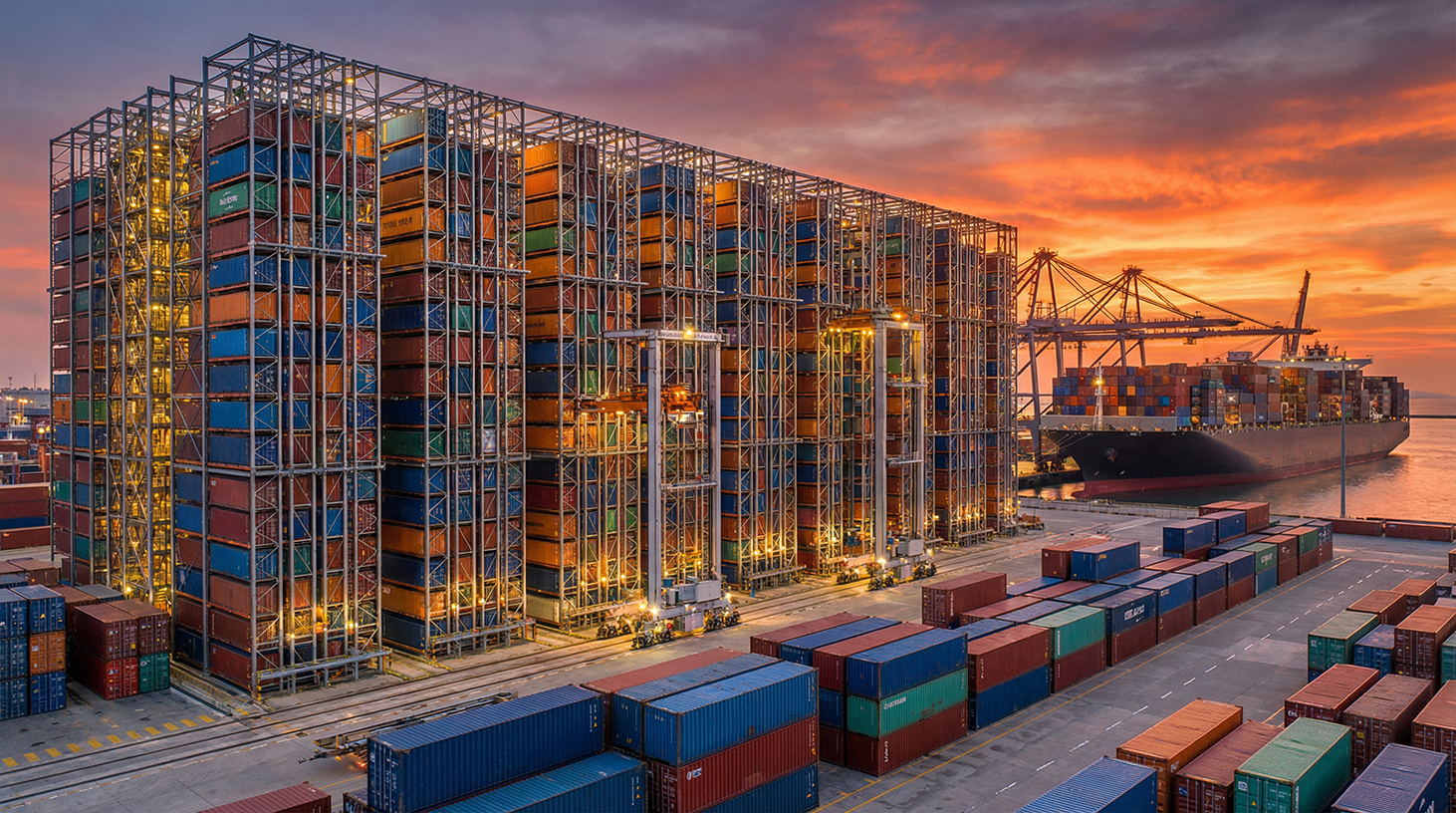
"From Just in Time" to "Just in Space" – The vertical storage solution for containers in high-bay warehouses – Image: Xpert.Digital
“Just in Space”: The ingenious high-tech trick of heavy-lift logistics against the global container congestion
When the ground is no longer sufficient, logistics goes vertical – and thus changes the rules of the game in global trade
Global sea freight is reaching its physical limits. While ships and transport volumes break new records year after year – over 931 million TEU were handled worldwide in 2024 alone – ports are simply lacking space. Conventional terminals, where colorful steel boxes have to be laboriously stacked on top of each other on the floor and constantly rearranged as needed, are proving to be inefficient and expensive bottlenecks in global trade. But a technology originally from the steel industry now promises a revolution: the fully automated high-bay container warehouse. By expanding logistics vertically rather than horizontally, storage capacities can be tripled, unproductive crane movements reduced to zero, and millions saved on land costs. From the successful pilot project in Dubai to the mega-contract at London Gateway, it's clear: the leap from the horizontal to the vertical dimension is no longer a technological experiment, but the urgently needed answer to the global container congestion.
Global congestion and its causes
Global container logistics faces a fundamental dilemma. More than 90 percent of global trade is handled by sea, and volumes are increasing unabated. In 2024, global container throughput reached a new record of approximately 931.8 million TEU, an increase of 7.8 percent compared to the previous year. In May 2024 alone, a record-breaking 15.94 million TEU were transported, driven by pent-up demand following the pandemic and the booming online retail sector. At the same time, container ships are becoming ever larger; the fleet grew to a total capacity of 30.8 million TEU in 2025, representing an increase of 10.8 percent. Land-based infrastructure simply cannot keep pace with this growth.
The problem is physical. Ports aren't factories that can simply be built on a greenfield site. They require deep-water access, hinterland connections, multimodal transport hubs, and are inevitably located on urban or peri-urban coastlines, where land is a scarce and expensive commodity. The Port of Rotterdam stretches over 10,500 hectares along a 40-kilometer length, and even this vast area is barely sufficient to meet the increasing demands. Shanghai, the world's busiest container port with 51.5 million TEU in 2024, has already broken new ground with the fully automated Yangshan Terminal Phase IV, but it too is reaching its spatial limits. The cost of reclaimed port land ranges from €2,000 to €3,000 per square meter worldwide, and even higher in some locations. Every square meter counts, and every square meter that is used inefficiently is a waste of money.
The stacking paradox of conventional terminals
Anyone looking at a typical container terminal today will see colorful steel boxes stacked in towers of four to six layers on the ground. What appears efficient at first glance is, in reality, a constant logistical problem. To reach a specific container at the bottom of a stack, up to six other containers often have to be moved first. This process, known in technical terms as reshuffling or restacking, can account for up to 60 percent of all crane movements in a terminal. In the Port of Busan, for example, before modernization, there were approximately 350,000 such unproductive container movements annually. Each one consumes energy, ties up personnel and equipment, generates emissions, and wastes time without adding a single cent of value.
This paradox of conventional container storage can be traced back to a single root cause: containers are stacked directly on top of each other, without any individual assignment to a fixed storage location. What's at the bottom is trapped. During peak periods, when terminal capacity is high and ships need to be processed quickly, reshuffling becomes an operational nightmare. Ship turnaround times increase, truck turnaround times rise, and the entire supply chain grinds to a halt. Container throughput at the 470 ports listed in the ISL port database grew by 3.4 percent in 2024, but productivity in ports worldwide is threatened with decline because infrastructure cannot keep pace with the growth in volume. The attacks in the Red Sea, which reduced Suez Canal traffic by 56 percent in 2024, further exacerbated the situation with unpredictable arrival patterns.
The paradigm shift: From two-dimensional to three-dimensional space
The solution to this dilemma lies in an idea long established in industrial intralogistics, but representing a radical paradigm shift for container logistics: the container high-bay warehouse. The principle is based on the idea of no longer stacking containers horizontally on the floor, but storing them vertically in multi-tiered steel racking structures – similar to a modern automated small parts warehouse, but designed for shipping containers weighing several tons. Each container is assigned an individual storage space in a massive steel rack that can reach up to eleven or even sixteen levels high. Fully automated storage and retrieval machines, known as stacker cranes or storage and retrieval machines, move along rails in the narrow aisles between the racks and can access each individual container directly without having to move any others.
This direct access is the decisive economic lever. Completely eliminating reshuffling not only means massive time savings but also transforms the entire cost structure of a terminal. Fewer crane movements mean less energy consumption, less equipment wear and tear, fewer personnel, and a reduced risk of accidents. According to the manufacturer, storage capacity on the same footprint can more than triple. A high-bay warehouse system requires only one hectare of terminal space for 3,000 TEU storage capacity, while a conventional system with rubber-tired gantry cranes requires approximately four hectares for the same capacity. With land costs of €2,000 to €3,000 per square meter, the three-hectare land saving translates to savings of €60 to €90 million in land costs alone – a significant portion of the total investment.
The technology behind the tower
The technological basis of container high-bay warehouses comes from a sector not typically associated with port logistics: the steel industry. Amova, a subsidiary of the German SMS group, has been automating the storage of steel coils weighing up to 50 tons in high-bay warehouses for decades. Transferring this principle to shipping containers is a logical step, but requires significant adjustments in structural engineering, control technology, and material flow logic. The SMS group contributed this expertise to the joint venture BoxBay, which it founded together with the global port operator DP World.
The core of a BoxBay system consists of the stacker cranes, which move vertically and horizontally within the aisles. They dock from above at the standardized corner fittings of the containers and transport them precisely to their assigned storage location. An automated conveyor system in the basement handles the transfer to trucks or shuttle carriers via defined interface positions. The entire system is fully electric, and the optional integration of photovoltaic modules on the roof enables partial or complete self-sufficiency with renewable energy. Energy recovery systems, similar to the regenerative braking technology used in electric vehicles, utilize the braking energy of the stacker cranes and feed it back into the system.
The Austrian intralogistics specialist LTW Intralogistics pursues a similar approach. The company has developed high-bay warehouse solutions for combined terminals that can store loaded and unloaded semi-trailers, containers, and swap bodies up to ten levels high. On a footprint of approximately 9,000 square meters, this creates a warehouse for up to 500 loaded semi-trailers, which corresponds to about six times the capacity of a conventional storage area. LTW has implemented over 2,500 rail-guided storage and retrieval machines in more than 40 years and has specific experience with heavy-duty applications up to 18,000 kilograms. The storage and retrieval machines can be equipped with supercapacitor-based energy storage systems that save up to a third of the energy and even maintain operation during short power outages.
LTW Intralogistics Solutions

LTW Intralogistics – Engineers of Flow - Image: LTW Intralogistics GmbH
LTW offers its customers not individual components, but integrated complete solutions. Consulting, planning, mechanical and electrotechnical components, control and automation technology, as well as software and service – everything is networked and precisely coordinated.
In-house production of key components is particularly advantageous. This allows for optimal control of quality, supply chains, and interfaces.
LTW stands for reliability, transparency, and collaborative partnership. Loyalty and honesty are firmly anchored in the company's philosophy – a handshake still means something here.
Related to this:
Less space, more profit: The secret behind the new container towers
Reference projects: From pilot project to major contract
The first fully operational pilot plant of a container high-bay warehouse went into operation at Jebel Ali Port in Dubai at the end of 2020. The 11-level BoxBay test facility, with a capacity of 792 containers, has completed more than 63,000 container movements, exceeding expectations. The system proved to be faster and more energy-efficient than initially calculated, achieving a throughput of 19.3 movements per hour at each waterside transfer point. Modifications made during the test phase further improved performance while significantly reducing the investment required for future installations.
The next milestone came with the contract at the Port of Busan in South Korea. Busan Newport Corporation, a DP World subsidiary, is integrating BoxBay technology into its existing terminal operations as the first commercial project to do so. The retrofit approach is particularly noteworthy: the system is being installed in an existing, previously unused area of the terminal without interrupting ongoing operations with automated gantry cranes and truck handling. The elimination of 350,000 unproductive container movements per year is expected to improve truck handling times by 20 percent.
The largest order to date came in October 2025: BoxBay secured a €91.7 million contract for a high-bay container warehouse at London Gateway, the UK's third-largest container port. With 16 levels, the facility will be the tallest of its kind and offer a capacity of 27,000 TEU. It is specifically designed for empty containers – a segment that BoxBay CEO Christoph Roth sees as having enormous potential, as virtually every port worldwide struggles with empty containers, yet few have efficient solutions. The facility will feature ten storage aisles, 15 stacker cranes, and 40 interface positions for trucks and shuttle carriers, with a waterside capacity of over 200 container movements per hour. DP World is investing a total of around €1.15 billion in the expansion of London Gateway into the UK's largest container port, and the BoxBay facility is a key component of this strategy.
The economic equation: Why upward mobility pays off
The economic viability of a container high-bay warehouse results from the interplay of several mutually reinforcing factors. On the investment side, there are initially high upfront costs for the steel structure, the storage and retrieval systems, the automation technology, and the integration into existing terminal operations. However, these are offset by massive savings in land costs. With a typical space saving of 70 percent compared to conventional systems and land prices in the four-figure euro range per square meter, the land savings quickly add up to tens of millions of euros.
Operating costs decrease for several reasons. Less reshuffling means less equipment in use, lower energy consumption, and reduced maintenance. Full automation reduces staffing needs while simultaneously increasing workplace safety, as people no longer have to work in high-risk areas among stacks of containers weighing tons. Crane productivity increases by up to 20 percent because quayside cranes no longer have to wait for yard reorganization. Increased throughput in the same area boosts annual revenue and thus the terminal's profitability. Shipping companies benefit from shorter waiting times and more flexible time slots, while trucking companies benefit from reduced turnaround times. The freed-up space can be used for higher-value logistics services, such as consolidation, order picking, or value-added services, which generate additional revenue streams.
The market context: Automation as a megatrend
Container high-bay warehouses are part of a broader transformation process sweeping through global port logistics. The market for automated container terminals was estimated at around US$11.9 billion in 2025 and is projected to reach US$18.1 billion by 2032, with a compound annual growth rate (CAGR) of 6.1 percent. Other market analyses predict even more dynamic growth, with a CAGR of 11.2 percent and a target volume of US$22.3 billion by 2033. The drivers are the same across the board: increasing trade volumes, labor shortages, safety requirements, sustainability goals, and the technological maturity of artificial intelligence, IoT, and robotics, which is enabling the widespread and cost-effective deployment of fully automated systems for the first time.
Singapore's Tuas megaport is arguably the most ambitious project. By the 2040s, a fully automated port with an annual capacity of 65 million TEU – almost double the current throughput – is planned for 1,337 hectares of reclaimed land. The second phase alone will cost US$1.1 billion and includes the reclamation of 387 hectares of new land. This project demonstrates the scale of investment required for horizontal expansion and underscores the economic appeal of vertical alternatives that do not require any additional land.
Europe's ports under pressure
The issue of available space is particularly pressing for European ports. Forecasts for the European shipping area indicate a 3.8 percent growth in container throughput in 2025, with northwestern European ports expected to underperform at only 2.9 percent. At the same time, increasing peak cargo volumes are putting more pressure on terminals and hinterland transport systems. Hamburg, Rotterdam, and Antwerp-Bruges, the three major ports of the European Northern Range, have recorded moderate growth, but operate in an environment where expansion is becoming increasingly difficult to implement from a political, environmental, and urban planning perspective.
The problem of limited space is particularly evident at the Port of Duisburg, the world's largest inland port and a central hub for combined transport. Empty containers are stacked high, open spaces for flexible use are a rare exception, and handling capacity is declining. The Stack-X stacking system, developed by duisport, TX Logistik, SGKV, and the engineering firm Wecon, addresses this problem with a drive-over rectangular metal frame that enables the stacking of trailers and containers using reach stackers or gantry cranes. The solution is tailored to the specific requirements of combined transport, where semi-trailers require a particularly large amount of space and their share at the Port of Duisburg has steadily increased.
Security, sustainability and digital transparency
The advantages of vertical storage extend far beyond mere space efficiency. In a conventional container terminal, accidents involving heavy equipment, falling containers, and collisions between vehicles and pedestrians are constant risks. Automated high-bay racking systems eliminate a large portion of these hazards because human workers no longer operate in the immediate danger zone. Containers are no longer precariously stacked on top of each other and moved by manual cranes, but rather stored individually in fixed compartments and transported by machine.
The environmental impact assessment is also positive. Fully electric drives replace diesel-powered straddle carriers and reach stackers. The option of using the roof and wall surfaces of the enclosed warehouses for photovoltaic systems enables a semi-autonomous energy supply. The building cladding also provides noise protection and eliminates light emissions, which is a significant advantage, especially in residential areas near the port. Energy recovery systems in the storage and retrieval machines save up to a third of energy consumption.
At the digital level, complete automation enables seamless, real-time monitoring of every single container. Warehouse management systems control the optimal allocation of shelf space, predict pickup times, and synchronize material flows between the water and land sides. The integration of artificial intelligence and machine learning elevates operational control to a level simply unattainable with manual systems.
Challenges and critical perspectives
For all the enthusiasm surrounding vertical container logistics, it would be naive to ignore the challenges. The initial investments are substantial. The BoxBay contract for London Gateway amounts to €91.7 million, and this covers only the warehouse facility itself, excluding excavation and peripheral infrastructure. For many medium-sized and smaller ports in developing and emerging countries, such sums are virtually impossible to raise, even if operating costs decrease in the long term.
Integration into existing terminal structures presents a further challenge. In Busan, the retrofit approach succeeded on an existing vacant site, but not every port has suitable space within its existing layout. The seismic load-bearing capacity of 16-story steel structures loaded with tons of containers must be demonstrated with particular care in earthquake-prone regions. Furthermore, the reliance on fully automated systems raises questions of cybersecurity and reliability, which have a particular significance for critical infrastructure such as container ports.
Last but not least, the social component must be considered. The automation of container terminals has led to labor disputes worldwide in the past. The transition from labor-intensive, manual operations to fully automated high-bay warehouses will change job profiles, require skilled IT and maintenance specialists, and displace traditional dockworker jobs. This transformation must be managed in a socially responsible manner if the technology is to gain widespread acceptance.
A structural transformation, not a technological experiment
Vertical container storage is no longer a vision of the future, but a commercially proven technology moving from the pilot stage to industrial scaling. The fundamental problem of global container logistics—increasing volumes with limited port space—will intensify, not lessen, in the coming decades. The global container fleet grew by more than ten percent in 2024, and ship sizes continue to increase, while port space is physically finite. In this context, the shift from two-dimensional, horizontal logistics to the third dimension of space offers an economically and ecologically compelling solution.
The question is no longer whether high-bay container warehouses will prevail, but how quickly and in which market segments. The niche of empty container storage, which BoxBay is addressing with its London project, could be the key to unlocking this potential. Virtually every port in the world has an empty container problem, and the willingness to invest in a proven solution is likely to be high if London Gateway actually delivers the promised 65 percent efficiency gain. The transition from the flat container desert to the vertical container tower is no longer a technological experiment. It is a structural transformation that will redefine port architecture, supply chain economics, and the geography of global trade in the coming decades.
Consulting - Planning - Implementation

Konrad Wolfenstein
I would be happy to serve as your personal advisor.
contact me at wolfenstein ∂ xpert.digital
Just call me on +49 7348 4088 965 (Munich) .
Your container high-bay warehouse and container terminal experts

Container high-bay warehouses and container terminals: The logistical interplay – expert advice and solutions - Creative image: Xpert.Digital
This innovative technology promises to fundamentally change container logistics. Instead of stacking containers horizontally as before, they will be stored vertically in multi-story steel racking structures. This not only allows for a drastic increase in storage capacity within the same area, but also revolutionizes all processes at the container terminal.
More information here:










