
The “Power-ready Warehouse”: Why conventional warehouses will soon be obsolete
Xpert Pre-Release

Available in 27 languages 📢
Prefer Xpert.Digital on GoogleⓘPublished on: August 1, 2026 / Updated on: August 1, 2026 – Author: Konrad Wolfenstein
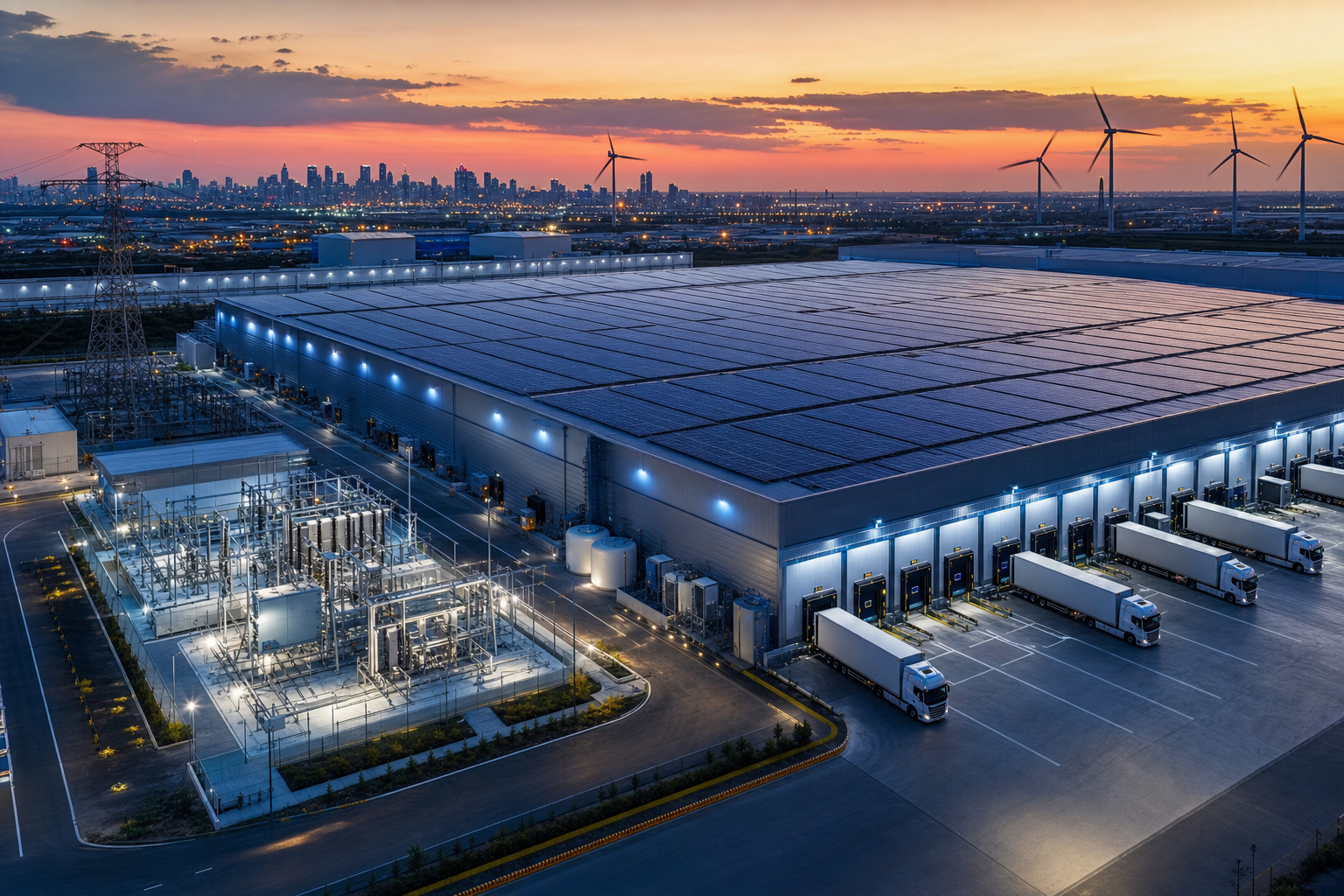
The “Power-ready Warehouse”: Why conventional warehouses will soon be obsolete – Image: Xpert.Digital
Highways are a thing of the past: Why electricity is becoming the most important location factor for logistics properties
Logistics real estate cost trap: Why focusing solely on construction costs is misleading
Hidden risk: How a lack of network capacity is slowing down new logistics projects
The logistics industry is currently undergoing a profound paradigm shift that is literally turning previous certainties regarding site selection and property valuation on their head. For decades, factors such as direct proximity to the highway, favorable land prices, and the regional availability of labor dominated the decisions of project developers and investors. However, the rapid electrification and automation of all core logistics processes—from order picking robots and charging infrastructure for electric trucks to highly complex cold chains—is now bringing a completely new criterion into focus: a secure, adequately sized, and affordable power supply.
Where the power grid is increasingly becoming a bottleneck, a purely construction-related perspective is no longer sufficient. Instead, the "power-ready warehouse" is evolving into the new industry standard. The following article analyzes in detail why the kilowatt-hour is becoming the new benchmark for logistics real estate, how a forward-looking total cost of ownership analysis minimizes investment risks, and why photovoltaic systems and intelligent load management systems are no longer optional extras, but rather the indispensable backbone of future-proof and competitive supply chains.
When the plug becomes a location factor: Why the kilowatt-hour determines the future of logistics real estate
The German logistics industry is facing a quiet but profound shift in its location logic. For decades, highway access, land prices, labor availability, and permitting speed determined where a new distribution center, fulfillment hub, or cold storage facility was built. Now, another factor is increasingly coming to the fore: a secure, adequately sized, and affordable electricity supply. What was once a minor technical detail in building applications is now a strategic bottleneck that influences investment decisions, site selection, and ultimately, the competitiveness of entire supply chains.
The reason lies in the electrification of virtually all processes within logistics facilities. Conveyor technology, sorting systems, order picking robots, charging infrastructure for industrial trucks and increasingly for electric trucks, refrigeration systems, building management systems, and IT systems combine to create load profiles that previous generations of warehouses never experienced. The German Freight Forwarding and Logistics Association (DSLV) anticipates that the logistics sector's electricity demand will increase eightfold by 2045 compared to today's levels, with the operation of logistics facilities such as distribution centers, fulfillment centers, cross-docks, cold storage facilities, and high-bay warehouses alone accounting for a double-digit percentage of this future demand. This forecast fundamentally alters the calculations of project developers, institutional investors, and operators, because a property planned today with insufficient grid connection capacity could become an operational bottleneck in just a few years.
The new seal of approval for future-proof warehouses
The term "power-ready warehouse" describes a warehouse designed from the outset for high, flexible, and redundant energy availability. This encompasses not only the connection capacity to the local grid operator but also an entire ecosystem of transformer stations, medium-voltage systems, low-voltage distribution panels, emergency power concepts, battery storage, and on-site photovoltaic generation. Crucially, all these components must be integrated into the architectural and structural design early on, as subsequent modifications to logistics facilities are technically complex and costly. Later relocation of cable trays, retrofitting a photovoltaic system on a roof not structurally designed to support it, or adapting a transformer location during operation regularly incurs costs many times greater than those of proactive initial planning.
Practical examples from the German Logistics Association's "Power of Logistics" initiative demonstrate how concrete these requirements have become. In a new, predominantly refrigerated building of approximately 31,000 square meters, constructed for the food delivery service HelloFresh, a 6.2-megawatt peak photovoltaic system was integrated into the planning process from the outset, supplemented by a 5-megawatt transformer station. Those responsible emphasized that clarifying grid connection, feed-in options, cable routing, and fire safety requirements early on was the decisive factor for success, as these decisions are virtually impossible to reverse. The system is expected to generate around six gigawatt-hours of solar power annually for two users on the same site – a volume that significantly covers self-consumption and reduces dependence on the volatile electricity market.
Despite these showcase projects, the broader market average paints a decidedly sobering picture. Current surveys on the operating cost structure of logistics properties show that 83 percent of investors do not have a photovoltaic system, a figure that is hardly better even for new buildings. Only one-fifth of investors even use green electricity, and more than half still cover their heating needs with fossil natural gas. This discrepancy between technological aspirations and actual market reality reveals considerable potential for improvement, but also a significant economic risk for all existing properties that are not prepared for this transformation.
The bottleneck of grid connection as an underestimated investment risk
The biggest challenge now lies less in the technology itself than in the availability of sufficient grid capacity at the desired location. Germany's transmission and distribution networks were designed for decades for a significantly less electrified economic system. With the simultaneous boom in data centers, electric vehicles, heat pumps, and energy-intensive logistics properties, entirely different user groups are now competing for the same limited grid capacity in industrial parks. The German Association of Energy and Water Industries (BDEW) has been urging faster grid connection for years, because long waiting times for new or expanded connections are now themselves becoming a limiting factor in location decisions.
For project developers, this means a completely new order for site evaluation. While previously the question of transport connections was paramount, today the grid connection request to the local distribution network operator should ideally be made in parallel with, or even before, the land reservation. Scientific studies on the site selection of energy-intensive buildings, originally developed for data centers, can be directly applied to logistics properties in terms of their methodology, as both types of use share the fundamental problem of high, continuous, and redundant electricity demand. In such evaluation models, the total cost of ownership (TCO) regularly receives the highest weighting among all site criteria, significantly ahead of personnel availability and transport connections.
Paradoxically, logistics properties offer structural advantages that make them particularly well-suited for the energy transition. Large, mostly unused roof areas, often expansive plots with space for ground-mounted solar installations and storage technology, and a generally daytime consumption profile that aligns well with the generation characteristics of photovoltaics create a synergy potential that is lacking in many other asset classes. Real estate consultants and market analysts are now using the slogan "Power is the new Location" to describe how guaranteed energy availability is increasingly influencing property valuation itself, as tenants and investors are placing greater emphasis on this criterion during due diligence and in lease renewals.
The cold chain as an extreme energy case
Nowhere is the urgent need for energy efficiency more evident than in the temperature-controlled storage sector. According to consistent studies, cold storage and deep-freeze warehouses consume three to five times more energy than a conventional warehouse of the same size because refrigeration must run around the clock, seven days a week, regardless of outside temperature or occupancy. The German Association of Cold Storage and Refrigerated Logistics Companies estimates that the refrigeration system itself accounts for 70 to 85 percent of a cold storage facility's total energy consumption, while additional energy consumers such as lighting, conveyor technology, and mobile racking systems make up the remainder. Consequently, energy costs can account for up to 30 percent of a cold storage facility's total operating costs, making it the second largest cost factor after personnel costs.
These figures explain why the total cost of ownership (TCO) analysis is of far greater strategic importance in the refrigerated goods sector than in dry goods storage. Anyone planning a cold storage facility solely based on the lowest construction costs per square meter systematically ignores the cost component that truly determines the overall cost over the entire lifespan of the property. Expert analyses of cold storage operations show that heating, ventilation, and air conditioning (HVAC) alone can account for up to 70 percent of such a facility's energy budget, while switching to refrigeration systems with variable-speed compressors can achieve savings of between 15 and 30 percent. Frequency converters on compressors, which automatically reduce energy consumption during periods of lower cooling load, can further reduce annual electricity costs by 15 to 25 percent. These efficiency gains far exceed anything even considered in dry goods storage and thus fundamentally alter the investment logic for this entire asset class.
The situation is exacerbated by the regulatory dynamics surrounding the European F-Gas Regulation, which is gradually restricting the use of climate-damaging refrigerants and forcing operators of existing systems to retrofit or completely replace their equipment. This transition coincides with already rising energy prices and creates a double investment dilemma for many cold storage operators: significant capital commitment is required in the short term, while in the long term, the efficiency gains that are essential for maintaining competitiveness are on the horizon. Those who link this conversion early on with a comprehensive energy strategy, rather than replacing individual components in isolation, can minimize downtime and spread investment risks over a longer period.

Expert partner in warehouse planning and construction
Logistics properties of the future: Why energy efficiency will become the most important investment criterion
Why focusing solely on construction costs is misleading
A classic mistake in evaluating logistics and, in particular, cold storage facilities lies in focusing solely on construction costs. Internationally, the construction costs for a cold storage warehouse are significantly higher than those of conventional warehouses, which at first glance suggests a purely capital-cost-based decision. However, any reputable life cycle assessment shows that the ongoing energy costs over a typical service life of twenty to thirty years can far exceed the initial additional costs for high-quality insulation, efficient refrigeration technology, or an integrated photovoltaic system. This is precisely the methodological core of the Total Cost of Ownership (TCO) perspective: it shifts the decision-making focus from the initial investment to the cumulative costs over the entire operating period.
For conventional, non-temperature-controlled logistics properties, current market research provides further evidence for this trend. The latest operating cost report for German logistics properties documents a significant shift in cost responsibility from investors to tenants, triggered by the increasing prevalence of so-called double-net leases, in which tenants bear operating costs such as electricity, security, and cleaning themselves. In practice, this shift in contract terms means that tenants are increasingly and directly financially responsible for the energy efficiency or inefficiency of the warehouse they occupy, structurally strengthening the incentive for energy-optimized new construction and renovations. At the same time, historical comparative studies show that the total costs of owner-occupied properties develop significantly more favorably than those of rented properties when owners invest in more efficient electricity and heating systems, with cost savings being particularly pronounced in transshipment warehouses due to their higher door density and the associated heat losses.
Photovoltaics as a calculable component of operating cost accounting
Given the large, often unused roof areas of logistics properties, photovoltaic systems are now considered the most obvious and best-proven solution to rising energy costs. Current economic analyses of photovoltaic systems on warehouses show that such investments, if correctly sized, pay for themselves within a manageable timeframe. However, the actual profitability depends heavily on the roof's structural suitability, the level of self-consumption, and the feed-in tariff or electricity price at the specific location. Crucially for logistics properties, the self-consumption rate can be particularly high when operating hours coincide with hours of sunshine, such as in multi-shift operations with a strong emphasis on daytime use or in cold storage facilities whose refrigeration systems require a continuous power supply anyway.
The structural design of the roof often determines the feasibility of solar installations years in advance, which is why proactive "PV-ready" planning for new buildings is now considered a sound business practice. If a building is constructed from the outset with sufficient roof load-bearing capacity, pre-installed cable routes, and a transformer station dimensioned for future expansion, the additional costs of a subsequent solar installation are significantly reduced, while simultaneously increasing flexibility for future capacity expansions. In combination with stationary battery storage, the so-called simultaneity of peak loads can also be mitigated, which, especially at locations with limited grid connection capacity, can make the difference between a feasible expansion and one that fails due to grid bottlenecks. Storage systems thus function not only as a pure energy source but also as a tool for grid congestion management and operational resilience during short-term power outages.
Automation, load management and the new role of digitalization
Another, often underestimated, lever lies in the intelligent control of existing energy consumers. Modern energy management systems collect consumption data in real time, identify inefficient operating conditions, and enable targeted load management that shifts or reduces peak loads. Especially in cold storage facilities, where refrigeration systems represent the largest single energy consumer, predictive, weather- and capacity-dependent control can unlock significant savings potential without compromising the integrity of the cold chain. Initiatives such as the Energy Consumption Working Group of the German Logistics Association (BVL) are now developing industry-wide standards for consumption data measurement to provide operators with reliable benchmarks for different usage profiles and to make the ongoing electrification process truly data-driven and controllable.
Priorities are also shifting on the automation side. Automated storage and retrieval systems, particularly in refrigerated and deep-freeze environments, require specialized, cold-resistant designs with correspondingly higher acquisition costs. However, they reduce both energy consumption and operational risks through shorter door opening times, more precise temperature control, and fewer personnel in refrigerated areas. LED lighting with motion and daylight control can reduce lighting energy consumption by 60 to 70 percent compared to conventional technology – a seemingly small amount, but by no means negligible when considering thousands of square meters of warehouse space.
Consequences for investors, project developers and tenants
For institutional investors, this development means a fundamental reassessment of their acquisition criteria. A logistics property without a robust energy concept, without a roof structure suitable for photovoltaics, and without documented grid connection capacity carries a latent depreciation risk that is likely to worsen in the coming years with rising energy prices and stricter regulations. Conversely, properties with proven energy self-sufficiency, a secured grid connection reserve, and modern refrigeration technology can achieve a valuation advantage because they offer tenants lower operating cost risks and greater operational reliability. This logic is already beginning to be reflected in acquisition reviews, so-called due diligence processes, where energy issues are increasingly forming an independent review category instead of being treated merely as a peripheral aspect of the building's technical equipment.
For project developers, the critical path of a construction project is thus shifting noticeably towards the energy infrastructure. Where building permits and access roads were previously the time-critical factors, today it is often the grid connection request to the distribution network operator whose processing time determines the entire project schedule. Those who submit this request too late or underestimate the required connection capacity risk delays that can drag on for months or even years, thereby jeopardizing the entire project budget. A robust energy strategy must therefore be an integral part of the early feasibility study and not a subsequent detailed planning step.
For tenants and operators, the increasing prevalence of double-net contracts, where energy costs are passed on directly, means that the energy efficiency of a rented building has a direct impact on their own cost structure and thus on their competitiveness compared to competitors in more efficient facilities. A lease agreement without an assessment of the building's energy performance therefore becomes a business risk in itself, one that can have an impact for years and can only be rectified after the lease expires.
A long-term structural transformation
The shift from energy as a technical detail to energy as a central location and valuation factor is not a short-term trend, but rather an expression of a deeper structural transformation of the entire economy. The electrification of transport, heating, and industrial refrigeration is encountering an electricity grid whose expansion is structurally lagging behind demand, while at the same time regulatory requirements regarding climate neutrality and refrigerants are increasing the pressure to act. Logistics properties occupy a particularly exposed intersection in this context because, on the one hand, they themselves are among the growing consumers of energy, and on the other hand, their large roof areas and land reserves make them one of the most obvious drivers of the energy transition.
Anyone investing in, developing, or operating logistics properties today can no longer ignore this reality. The question is no longer whether energy will become the decisive location factor, but rather how quickly individual market participants adapt their planning, investment, and operational processes to this new reality. Given that a large portion of the current stock lacks photovoltaics, modern refrigeration technology, and a reliable grid connection buffer, the need for retrofitting and modernization in the coming years is likely to be substantial and will fundamentally transform the entire industry, both economically and technically.
Your intralogistics experts

Consulting, planning and implementation of complete solutions for high-bay warehouses and automated storage systems - Image: Xpert.Digital
More information here:
Your global marketing and business development partner
☑️ Our business language is English or German
☑️ NEW: Correspondence in your native language!

Konrad Wolfenstein
I and my team are happy to be available to you as your personal advisor.
You can contact me by filling out the contact form here [email protected]:or simply call me at +49 7348 4088 965. My email address is
I'm looking forward to our joint project.
☑️ SME support in strategy, consulting, planning and implementation
☑️ Creation or realignment of the digital strategy and digitization
☑️ Expansion and optimization of international sales processes
☑️ Global & Digital B2B trading platforms
☑️ Pioneer Business Development / Marketing / PR / Trade Fairs
Our global industry and economic expertise in business development, sales and marketing

Our global industry and economic expertise in business development, sales and marketing - Image: Xpert.Digital
Industry focus areas: B2B, digitalization (from AI to XR), mechanical engineering, logistics, renewable energies and industry
More information here:
A thematic hub offering insights and expertise:
- Knowledge platform covering global and regional economies, innovation and industry-specific trends
- A collection of analyses, insights, and background information from our key areas of focus
- A place for expertise and information on current developments in business and technology
- A hub for companies seeking information on markets, digitalization, and industry innovations










