
Toyota | “We will not survive”: Why the world’s largest automaker is suddenly trembling despite record figures
Xpert Pre-Release

Available in 27 languages 📢
Prefer Xpert.Digital on GoogleⓘPublished on: June 1, 2026 / Updated on: June 1, 2026 – Author: Konrad Wolfenstein
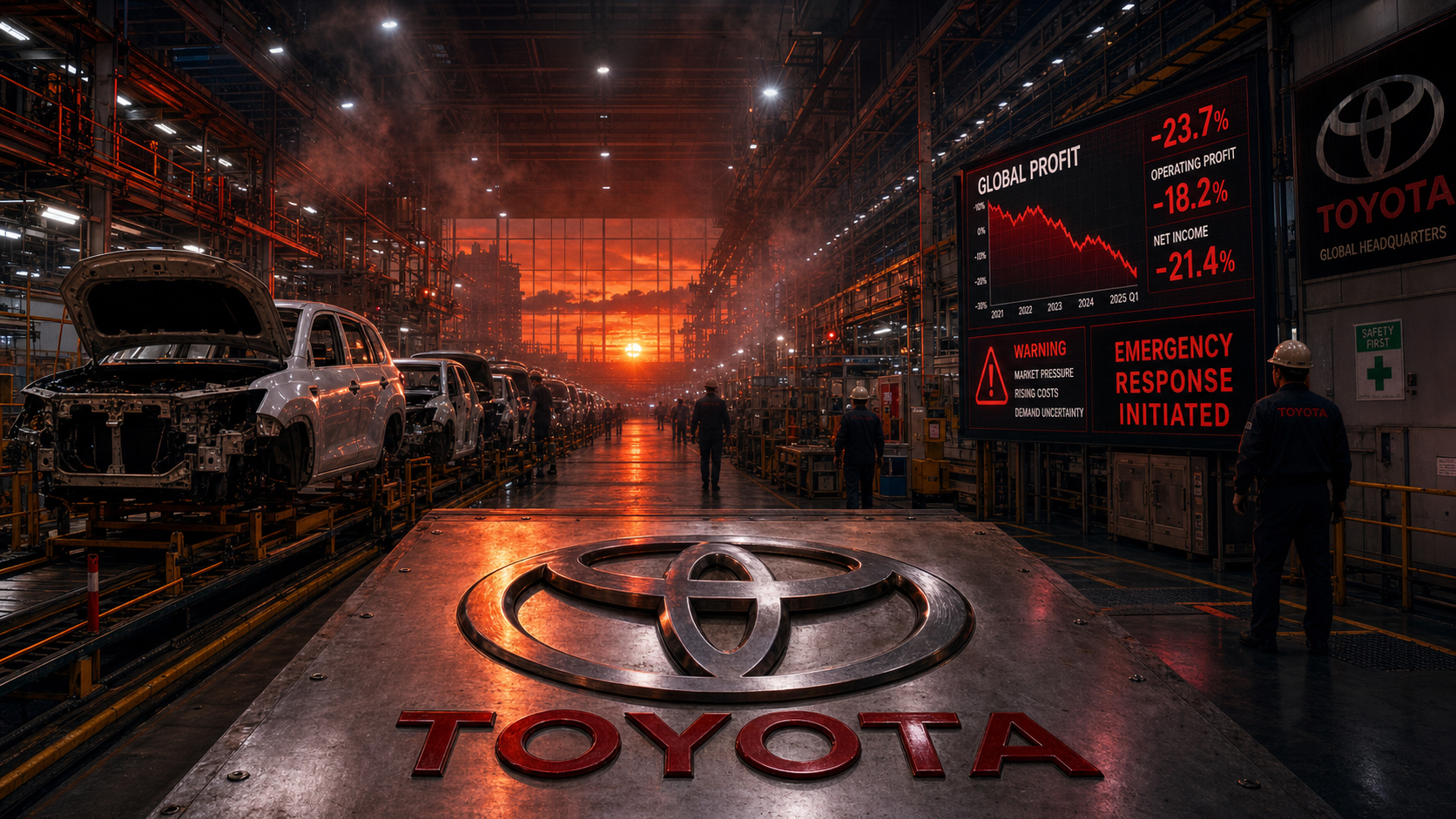
Toyota | “We won’t survive”: Why the world’s largest automaker is suddenly trembling despite record figures – Image: Xpert.Digital
The insidious hybrid trap: Why Toyota's record sales are massively misleading
Profit slump and software disaster: The unvarnished truth about Toyota's future
Left behind in the electric car market? Why Toyota's greatest strength is now becoming a deadly threat
Toyota is experiencing a historic paradox: On the one hand, the world's largest automaker has become the first Japanese corporation ever to break the magical 50 trillion yen revenue barrier and is significantly outperforming competitors like Volkswagen in pure vehicle sales. But the gleam of these record figures is massively deceptive: Operating profits are dwindling rapidly, the company is drastically lagging behind its own targets for electric vehicles, and Toyota risks losing its global competitive edge in the crucial area of software development. When the CEO warns hundreds of suppliers, "We will not survive if we do not change," it's not an empty PR platitude, but an unprecedented wake-up call. It's a deep dive into the inner workings of a giant whose greatest strength – the famous "Toyota Way" – could now become its most dangerous trap in this transformation.
Record sales, profit slump, technological lag – Why strength can become the most dangerous trap
Toyota is selling more cars than ever before and still earns more than most of its competitors. And yet, the outgoing CEO tells 700 suppliers: "Unless things change, we will not survive." Anyone who wants to understand why this statement isn't mere coquetry but a sober assessment of the situation needs to look deeper – beyond the record figures, beyond the Toyota Way, beyond the myth of the perfect automotive company.
Figures that are both a record and a warning signal
Toyota concluded fiscal year 2026 (April 2025 to March 2026) with a historic revenue milestone: Toyota became the first Japanese corporation ever to surpass the 50 trillion yen mark in revenue. This equates to approximately 307 billion euros. Vehicle sales rose to 11.3 million units – marking the sixth consecutive year that Toyota was the global number one, significantly ahead of Volkswagen with 8.98 million vehicles sold.
But behind these record figures lies a structural profit crisis. Operating profit for FY2026 was 3.8 trillion yen – a decrease of 1.0 trillion yen compared to the previous year. Toyota is already significantly below its profit peak of around 4.9 trillion yen in FY2024. Even more worrying: For fiscal year 2027, Toyota itself forecasts operating profit of only 3.0 trillion yen – a decline of almost 40 percent compared to the peak. In the last quarter of the past fiscal year alone, operating profit plummeted by 49 percent. The pattern is clear: Revenue is growing, profit is shrinking.
The fact that Toyota posted an operating loss in North America – its first in years – completes the picture. US tariffs alone burdened the overall result with 1.45 trillion yen. At the same time, geopolitical tensions in the Middle East are massively increasing the cost of aluminum and raw material procurement, as Japan's automotive industry sources around 70 percent of its aluminum from this region. This results in several billion euros in additional costs every year, without Toyota being able to counteract them operationally.
The Trump tariff problem and its systemic dimension
US tariffs on Japanese car imports are hitting Toyota structurally harder than many of its European competitors. While Toyota produces significant numbers of vehicles in the US, its North American supply chain, component sourcing, and profit repatriation are heavily dependent on exchange rate risk and tariff policy fluctuations. A strong yen further impairs the conversion of foreign profits.
Despite this massive headwind, Toyota is still in a better operational position than most German manufacturers. Volkswagen is projecting an operating margin of around 2.8 percent for 2025, Mercedes approximately 5.0 percent. Toyota's margin for FY2026 is around 7.4 percent – a figure that Volkswagen can only dream of at this stage. But that's precisely the problem: those who are still making good profits have little incentive for radical restructuring. And time is running out.
The new CEO, Kenta Kon – who took over from CFO to Group CEO on April 1, 2026 – made it unequivocally clear during the earnings call that the quarterly figures were no cause for complacency. His introductory statement didn't sound like a fresh start, but rather like crisis management: Toyota was not in a "safe and comfortable position," and he intended to systematically lower the company's break-even point. His predecessor, Koji Sato, had already struck the same tone in March 2026 before 700 representatives from 484 supplier companies.
The electric car gap: Not a smart retreat, but missed targets
In Germany, the persistent narrative claims that Toyota deliberately waited on electromobility and is now reaping the rewards of its hybrid-focused patience. This is false. It obscures a politically explosive reality: Toyota has dramatically missed its own electric vehicle targets.
In 2021, then-CEO Akio Toyoda announced a target of 3.5 million all-electric vehicles by 2030. His successor, Koji Sato, followed up in 2023 with a target of 1.5 million BEVs per year by 2026. In the past fiscal year, the company produced approximately 243,000 units – 84 percent below its own target. The target was subsequently lowered to one million units for 2026, but even this revised figure is unlikely to be achieved. For comparison, the Volkswagen Group sold nearly one million all-electric vehicles in 2025 – four times as many as Toyota. BYD even surpassed the 2.25 million mark for all-electric BEVs worldwide in 2025.
The good news: There are initial signs of acceleration. In March 2026, Toyota's global BEV sales surged 139 percent year-over-year to 35,525 units – the strongest EV month in the company's history. In Europe, Toyota's BEV sales increased by 85 percent in the first quarter of 2026. These growth rates sound impressive, but are immediately put into perspective when viewed in the context of absolute figures. The updated bZ4X – now marketed as the "bZ" – has at least climbed to third place among the best-selling electric cars in the US, behind Tesla models. The base is simply too small to catch up quickly.
The hybrid model as both a bridge and a trap
What is currently saving and stabilizing Toyota is its hybrid portfolio. For the current fiscal year, Toyota expects to sell over 5 million hybrid vehicles – almost every second Toyota sold is now a hybrid. In Europe, Toyota achieved an all-time record of 1.229 million sales in 2025, with 77 percent of its vehicles being electrified (hybrid plus PHEV plus BEV). The RAV4, the Corolla Hybrid, and the Yaris Hybrid dominate their segments in many European markets.
This strength comes at a price. Hybrids are not a model for the future, but rather a transitional phase. European regulations are pushing for the end of the combustion engine by 2035, and requirements are also becoming stricter in China. Even more critical is the economic dimension: While hybrids maintain the existing ecosystem of maintenance and workshop visits, their maintenance costs are already significantly lower than those of purely combustion-engine vehicles. Pure electric vehicles require 30 to 40 percent less maintenance than combustion-engine vehicles. Toyota's primary profit today is not from new car sales – the value chain of service, spare parts, and customer loyalty for the approximately 150 million Toyota vehicles worldwide is a key pillar of its profitability. If this fleet is electrified, the model will erode.
In China, Toyota has already had to admit strategic defeat: The entry-level electric model bZ3X is not based on a Toyota-developed platform, but on the architecture of GAC, its Chinese joint venture partner. This is more than just a technical detail. It marks the moment when a company that has prided itself for decades on its control over its core competencies relinquishes control of its powertrain architecture to a partner.
Software: The deepest structural deficit
If Toyota had to be pinned down to a single dimension by which its future viability could be measured, it would be its software expertise. This is where its deepest deficit lies – and the greatest distance from what once defined the company.
Toyota has established a dedicated unit for this transformation: Woven by Toyota, often simply called "Woven." At its core is the Arene software platform, a vehicle-wide operating system designed to enable over-the-air updates and completely decouple hardware and software. In May 2025, Arene was used for the first time in a production model, the newly developed RAV4 – a significant step. At the same time, its limitations are undeniable: Arene currently controls infotainment and driver assistance systems. Safety-critical systems – brakes, steering, and powertrain – continue to rely on traditional control units from suppliers. When will the complete software stack arrive? Toyota refers to it as "the next generation of electric vehicles" – without specifying a date.
The Gartner Digital Automaker Index 2025 assesses 24 automakers based on their ability to leverage software for competitive advantage. Toyota ranks 21st, behind all German manufacturers and behind American and Chinese competitors. Only three companies fare worse. Tesla tops the list, followed by Chinese brands like NIO, Xiaomi, and Xpeng. The gap between first and 21st place isn't a tactical advantage for the leader—it reflects a systemic technological disparity.
An internal Woven engineer described the development state of the Arena system as "horrendous, full of bugs." This quote illustrates the dilemma all traditional automakers face when building software: The industry's hardware engineering culture is optimized for zero-defect tolerance. A bug in the brake software means a recall. Software development, on the other hand, thrives on rapid iteration, on "ship and fix," on the beta stage as the norm. These cultures are incompatible—and Toyota has internalized the hardware logic more deeply than any other company.
Volkswagen experienced this internal contradiction with CARIAD and ultimately decided to outsource its software expertise – to Rivian and other partners. Toyota continues to pursue an internal approach. Whether this will succeed is one of the crucial industrial questions of the coming years.
Our Japan expertise in business development, sales and marketing

Our Japan expertise in business development, sales and marketing - Image: Xpert.Digital
Industry focus areas: B2B, digitalization (from AI to XR), mechanical engineering, logistics, renewable energies and industry
More information here:
A thematic hub offering insights and expertise:
- Knowledge platform covering global and regional economies, innovation and industry-specific trends
- A collection of analyses, insights, and background information from our key areas of focus
- A place for expertise and information on current developments in business and technology
- A hub for companies seeking information on markets, digitalization, and industry innovations
The Toyota Way Dilemma: How Lean Culture Hinders Change
Autonomous driving: Technology from the outside, body by Toyota
The same pattern emerges with autonomous driving as with electric drive systems and software: Toyota supplies the vehicle, while the core technology comes from Chinese partners. Since February 2026, series production of robotaxis based on the bZ4X has been underway in Guangzhou – the Level 4 autonomous driving technology comes from Pony.ai. The vehicle is jointly manufactured by Pony.ai and GAC Toyota at a plant in Guangzhou. Plans call for over 1,000 units in 2026, with the goal of a total fleet of more than 3,000 robotaxis by the end of the year.
The technological achievement is impressive. Pony.ai's seventh generation of autonomous driving system costs 70 percent less to manufacture than its predecessor. But for Toyota, this collaboration represents a strategic dependency: what defines the vehicles of the future—the "brain"—does not belong to Toyota. In the long run, the race for autonomous driving will be decided between those who master the thinking, not those who bend the sheet metal.
Internally, Toyota is working on its own AI models – not for the vehicle itself, but for production and life in the test city of Woven City. In April 2026, Toyota and Woven by Toyota presented the "Woven City AI Vision Engine," a large vision language model designed to detect traffic and behavioral risks in real time within the test city. Woven City itself – a 175-hectare experimental site at the foot of Mount Fuji with an estimated investment of $10 billion – welcomed its first approximately 100 residents in the fall of 2025. The concept is visionary. Whether it can be translated into competitive advantages for the core automotive business remains an open question.
The Toyota Way paradox: What makes you strong also makes you vulnerable
No management system has shaped the automotive industry more profoundly than the Toyota Way. Kaizen, Lean Production, the Toyota Production System – these concepts are now global standards, implemented in factories from Wolfsburg to Shanghai. The system is based on the principle of continuous, incremental improvement: not on revolutionary changes, but on perfecting existing processes over decades.
This approach is the reason why Toyota, with an operating margin of 7.4 percent, is still significantly better positioned than VW (2.8 percent) or most of the industry. It is the reason why Toyota operates its supply chains so efficiently that even the pressure from US tariffs and rising commodity prices has not yet triggered an existential crisis. And it is precisely the reason why the company is making such slow progress in technological reinvention.
Lean production is optimized for established processes. Software development, as practiced by Tesla or BYD, operates according to different principles: iterative development, agile teams, rapid failure and learning, and over-the-air updates as a core competency. Toyota has spent decades ingraining zero-defect tolerance into the company's DNA. This culture is structurally incompatible with the "move fast and break things" approach of the tech industry.
In addition, there is a cultural element that extends beyond Toyota: Japanese corporate culture is geared towards stability, loyalty, and hierarchical consensus. Career changes are the exception, not the rule. Lifelong learning within the same system is the ideal. This creates deep institutional knowledge and extraordinary reliability—but it stifles the radical self-criticism and disruptive restart that the industry urgently needs. Ironically, the very culture that made Toyota great could become a brake on this transformation.
The after-sales business model under scrutiny
Toyota's profitability depends more heavily on its after-sales business than most observers realize. The value chain of the approximately 150 million Toyota vehicles worldwide – maintenance, spare parts, diagnostics, and service visits – generates stable, high-margin revenues. According to forecasts, the value chain's output should exceed the profitability of the new vehicle business for the first time in FY2026.
This very model is at stake. Electric vehicles inherently require less maintenance: no oil changes, less brake wear due to regenerative braking, and fewer mechanical wear parts in general. Software-defined vehicles update themselves over-the-air, eliminating the need to visit a workshop. As Toyota's current fleet of 150 million vehicles gradually transitions from combustion engines and hybrids to battery electric vehicles (BEVs), the service volume per vehicle will decrease significantly. A business model that has provided Toyota with reliable revenue for decades is losing its lifeblood.
Toyota is aware of this erosion. Its strategy of creating more "touchpoints" with the customer after the purchase – through connectivity, data, and new financing models – demonstrates that it is working on a replacement for the traditional service business. However, this transformation requires precisely what Toyota lacks most: rapid software development and a deep understanding of digital business models.
The seven-point plan: Ambitious, but without guarantees
At the Supplier Summit in January 2026, Koji Sato presented a seven-point plan to secure competitiveness. The points address securing raw materials (rare earths, lithium), the multi-pathway propulsion strategy, the circular economy, international technology partnerships, catching up in autonomous driving, tax reforms in Japan, and efficiency improvements in the supply chain. The plan is broad – perhaps too broad to be truly focused.
The accompanying "Smart Standard Activity" is more concrete: Toyota is relaxing overly stringent quality standards for non-safety-relevant parts. The example of the 10,000 wiring harness components scrapped monthly due to discolored plastic illustrates how deeply ingrained the zero-defect culture is, even in areas where it's not needed. Similarly, standardization of identical parts is being pursued more rigorously – door handles, sun visors, and other unseen components. This saves costs without altering vehicle characteristics.
These measures are necessary and sensible. But they represent operational fine-tuning of a company under cost pressure, not a strategic realignment. The structural questions – how Toyota will overcome its software deficit, how it will become globally competitive in the BEV segment, how it will reinvent its after-sales model – remain unanswered.
What Germany can learn from Toyota – and what it cannot
The parallels between Toyota's situation and the German automotive industry are not coincidental. Volkswagen, Mercedes, and BMW face structurally comparable challenges: a core business that is still profitable but losing earning power; software expertise that lags behind Tesla and Chinese competitors; an after-sales model that is eroding with increasing electrification; and a corporate culture trained in optimizing existing systems, not in innovating.
The crucial difference: Toyota communicated this diagnosis earlier, more bluntly, and more publicly than most of its German competitors. The "We will not survive" statement to 700 suppliers is not a PR blunder. It is a strategic communication decision—a public commitment demanding change and one that is virtually impossible to reverse internally. In organizations focused on consensus and saving face—as is the case with both large Japanese and German corporations—this step is remarkable and consequential.
What Toyota is doing right: using its hybrid strategy as a cash flow bridge, entering into external technology partnerships where in-house development is too slow, and communicating the company's transformation honestly to the entire ecosystem. What remains questionable: whether the internally focused AI initiative in the Woven City can be translated into vehicle benefits quickly enough; whether Arene, as a proprietary operating system, will be able to compete against the platform expertise of Chinese and American tech companies; and whether a corporate culture built on centuries of Japanese tradition and principles of loyalty can keep pace with the speed of transformation demanded by the industry.
The crucial question of the next decade
Toyota's situation is a cautionary tale about the most perilous moment in corporate history: the moment when current business is still so successful that the need for change is rationally apparent but not emotionally felt. It's not a Kodak moment, not a Nokia moment – Toyota isn't asleep. But it is the moment that will determine whether a global leader in the old industry will also become a serious player in the new one.
The figures for FY2027 will show whether Toyota's cost savings support its profit forecast of 3.0 trillion yen, or whether external factors – tariffs, commodity prices, exchange rates, a weakening Chinese market – will have a further, more severe impact. The BEV sales curve in March 2026, showing a 139 percent increase, gives cause for cautious optimism – but it would be premature to conclude that a trend reversal is underway based on a single quarter of strong percentage growth from a small base.
New CEO Kenta Kon said the right thing: hiding behind the still-solid quarterly figures would be dangerous. Toyota is a company with exceptional operational strength, deep brand loyalty, one of the best manufacturing systems in the world, and a global network of 150 million vehicles driven daily. This is an outstanding starting point for the transformation – better than that of many competitors.
But the starting point is not a predetermined fate. The question is not whether Toyota has the resources for change. The question is whether Toyota can develop the cultural and organizational capacity to radically question its own model of success. This is precisely what Koji Sato means when he says, "Unless things change, we will not survive." The statement sounds like a warning. In reality, it is an invitation.
🎯🎯🎯 Data-driven B2B industry hub as a quasi-in-house solution

The quasi-in-house solution: How Xpert.Digital closes operational gaps in B2B marketing and sales – Smart Content-Driven Business - Image: Xpert.Digital
Xpert.Digital is a data-driven B2B industry hub led by Konrad Wolfenstein . The company acts as an external, quasi-in-house solution for industrial partners, closing operational gaps in marketing, content, and sales – without requiring additional resources on the client side.
More information here:
Your global marketing and business development partner
☑️ Our business language is English or German
☑️ NEW: Correspondence in your native language!

Konrad Wolfenstein
I and my team are happy to be available to you as your personal advisor.
You can contact me by filling out the contact form here simply call me at +49 7348 4088 965. My email address is [email protected]:or
I'm looking forward to our joint project.










