
It's only a matter of time before Industry 4.0 and the metaverse fully unfold – a German concept is conquering the world

Available in 27 languages 📢
Prefer Xpert.Digital on GoogleⓘPublished on: October 16, 2023 / Updated on: October 16, 2023 – Author: Konrad Wolfenstein

It's only a matter of time before Industry 4.0 and the metaverse fully unfold – Image: Xpert.Digital
🏭 Industry 4.0: A German concept with global significance
Industry 4.0 is undoubtedly a term that has gained global importance in recent years. But is it actually a concept that originated in Germany? The answer to this question is clear: Yes, Industry 4.0 is a concept that originated in Germany and has conquered the world from there.
🏭 The origins of Industry 4.0
Industry 4.0 refers to the intelligent networking of machines and processes in industry using information and communication technology. This concept was first presented at the Hannover Messe trade fair in 2011 and has since revolutionized the way companies produce and work in industry. But how did Germany become the birthplace of Industry 4.0?
The roots of Industry 4.0 can be traced back to German industrial culture, which is characterized by a strong tradition in mechanical engineering and automation technology. Germany is known worldwide for its highly developed industry and its innovative strength in this field. This tradition of engineering and industrial production has provided fertile ground for the emergence of Industry 4.0.
🏭 The basic principles of Industry 4.0
Industry 4.0 is based on several fundamental principles that drive the digital transformation of industrial production. These principles are:
1. Networking
In Industry 4.0, machines and systems are networked. This enables real-time communication and data transfer between the various components of production. This allows processes to be optimized and controlled.
2. Transparency
Networking creates a high degree of transparency regarding the condition and performance of production facilities. This transparency makes it possible to react to problems early and increase efficiency.
3. Decentralization
Industry 4.0 enables decentralized decision-making. This means that machines and systems are able to make autonomous decisions, for example to adapt production processes or plan maintenance work.
4. Real-time capability
In Industry 4.0, data is processed in real time. This allows companies to react quickly to changes and adapt their production flexibly.
🏭 The impact of Industry 4.0
The introduction of Industry 4.0 has far-reaching implications for industrial production and the economy in general. Here are some of the most important effects:
1. Increased efficiency
Industry 4.0 enables a significant increase in production efficiency. By optimizing processes and reducing downtime, companies can lower their production costs.
2. Innovation
The networking of machines and the availability of real-time data open up new opportunities for innovation. Companies can develop new products and services based on the data and insights gained from networked production.
3. Flexibility
Industry 4.0 makes production processes more flexible. Companies can react quickly to changes in demand and adjust their production accordingly.
4. Competitiveness
Companies that successfully implement Industry 4.0 generally become more competitive. They can bring products to market faster and offer customers customized solutions.
🏭 The international spread of Industry 4.0
Although Industry 4.0 originated in Germany, the concept has quickly spread beyond national borders. Companies and governments worldwide have recognized the advantages of Industry 4.0 and are investing in the digital transformation of their industries.
In China, for example, the concept of “Made in China 2025” was developed, which is strongly inspired by the principles of Industry 4.0. There are also initiatives in the USA to promote Industry 4.0, particularly in the field of industrial automation.
The international spread of Industry 4.0 shows that this concept is relevant not only in Germany but worldwide and has a profound influence on the way companies produce and do business.
🏭 Challenges and opportunities for Germany
While Germany, as the birthplace of Industry 4.0, plays a pioneering role in the digital transformation of industry, it also faces challenges. One of these challenges is addressing the data protection and security aspects of networked production. With the increasing networking of machines and systems, the risk of cyberattacks also rises.
Another aspect is the need to prepare the workforce for the demands of Industry 4.0. New skills and competencies are required to fully exploit the opportunities of Industry 4.0. This necessitates investment in the training and further education of skilled workers.
On the positive side, Industry 4.0 offers Germany the opportunity to consolidate its position as a leading industrial nation and to continue offering innovative products and solutions. Through close cooperation between companies, government, and educational institutions, Germany can maintain and expand its competitiveness.
🏭 Pioneering role in development
Industry 4.0 is undoubtedly a German concept that has revolutionized the way companies produce and work. With its core principles of networking, transparency, decentralization, and real-time capability, it has attracted worldwide attention and driven the digital transformation of industry.
Germany has taken a pioneering role in the development and implementation of Industry 4.0, but at the same time, challenges lie ahead that need to be addressed. However, the international spread of the concept shows that Industry 4.0 is not just a German concept, but is relevant and significant worldwide.
The future of industrial production will undoubtedly be shaped by Industry 4.0, and Germany will continue to play a key role in this development. It will be exciting to see how this concept evolves in the coming years and what innovations it will generate.
📣 Similar topics
- 🏭 The roots of Industry 4.0: German industrial culture
- 🌐 The basic principles of Industry 4.0
- 📈 The impact of Industry 4.0 on efficiency
- 🚀 Industry 4.0 and Innovation: New Opportunities
- 🔄 Flexibility through Industry 4.0 in production
- 💼 Competitiveness through Industry 4.0
- 🌍 International spread of Industry 4.0
- 🔐 Challenges: Data protection and security
- 📚 Education for Industry 4.0: Skills and Competencies
- 🇩🇪 Germany as a pioneer in Industry 4.0
#️⃣ Hashtags: #Industry40 #GermanInnovation #Digitalization #Competitiveness #InternationalExpansion
🌐 Industry 4.0: A look at the German concept and its development in other countries
The fourth industrial revolution, also known as Industry 4.0, has significantly changed the way we produce. Originally from Germany, this concept has gained global traction in recent years. In this article, we take a closer look at the "German" Industry 4.0 concept and the progress made in other countries such as the USA, China, Japan, and Europe.
🇩🇪 1. The German Industry 4.0 Concept
Industry 4.0 is a term that was first introduced at the Hannover Messe trade fair in 2011. It refers to the vision of intelligent and networked production, in which machines, systems, and people communicate with each other via the Internet of Things (IoT). This enables more efficient production, faster adaptability, and better use of data for decision-making.
Germany is considered the birthplace of Industry 4.0, and the country has made considerable efforts in recent years to implement this concept. German companies, particularly in the automotive and manufacturing industries, have driven the integration of IoT technologies. This has led to improved productivity and competitiveness.
🇺🇸 2. Developments in the USA
The United States has also embraced Industry 4.0, albeit with a somewhat different approach. The US is increasingly focusing on the digitalization and automation of production processes. Technology companies like Google, Amazon, and Tesla are leading the way in developing solutions for smart manufacturing.
A key difference is that the US is not only focused on the manufacturing industry, but also on integrating Industry 4.0 into sectors such as healthcare, logistics, and agriculture. This broader application of Industry 4.0 principles promises to increase US competitiveness across various sectors.
🇨🇳 3. China and its ambitions
China has made massive efforts in recent years to adopt Industry 4.0. The “Made in China 2025” program is a central element of these efforts. It aims to make China a global leader in high-tech industries by focusing on advanced manufacturing practices.
Chinese companies like Huawei and Alibaba are investing heavily in research and development in the fields of IoT and artificial intelligence (AI). The Chinese government actively supports these efforts and provides incentives for companies to invest in smart manufacturing technologies.
🇯🇵 4. Japan and its tradition of innovation
Japan, known for its tradition of innovation, has also embraced Industry 4.0. Companies like Toyota are pioneers in implementing IoT and robotics in their production processes. The principles of Industry 4.0 are helping Japan solidify its position as a leading industrial nation.
However, Japan also has its own approaches to digitalization, based on the so-called “Society 5.0”. This involves not only networking production but also improving the quality of life for citizens through technology.
🇪🇺 5. Europe and its diversity
Europe as a whole has different approaches to Industry 4.0. Countries like Germany and France are leading the way in implementation, while other nations are still catching up. The European Union has launched initiatives to promote the development of Industry 4.0 in all member states.
The diversity in Europe is also reflected in the various sectors that benefit from Industry 4.0. While Germany is a leader in mechanical engineering and the automotive industry, Sweden is focusing on developing IoT solutions for forestry.
🌍 6. Shared Challenges and Opportunities
Despite the different approaches and progress in different countries, they all face similar challenges and opportunities:
Security
With the increasing interconnectedness of production systems, the threat of cyberattacks is growing. All countries must therefore invest in cybersecurity and develop robust protection mechanisms.
qualification
The implementation of Industry 4.0 requires highly skilled workers who are familiar with the new technologies. Education systems must be adapted to impart the necessary skills.
standardization
A globally uniform standardization of IoT protocols and technologies is crucial to ensure interoperability and facilitate global trade.
Data protection
With the abundance of data generated in networked production processes, data protection issues are of paramount importance. Data protection laws and guidelines must be further developed to guarantee the protection of privacy.
Competition and cooperation
Competition between countries and companies in the implementation of Industry 4.0 is intense. At the same time, opportunities arise for international cooperation to develop common standards and to benefit from the strengths of different regions.
🔍 7. Progress
Industry 4.0 has revolutionized the world of production and manufacturing, and Germany can be proud of having paved the way. Progress in the USA, China, Japan, and Europe demonstrates the global impact of this concept. Each country is pursuing its own strategy to leverage the benefits of Industry 4.0, while simultaneously facing common challenges.
The future will show which approach is most successful and how cooperation between nations will further advance the development of Industry 4.0.
📣 Similar topics
- 🏭 Industry 4.0: Global Developments and Trends
- 🇩🇪 Germany: The origin of Industry 4.0
- 🇺🇸 USA: The digital transformation of production
- 🇨🇳 China: On the path to technological leadership
- 🇯🇵 Japan: Tradition meets innovation
- 🌍 Europe: Diverse approaches to Industry 4.0
- 🌐 IoT and Security: Challenges and Solutions
- 🎓 Education for Industry 4.0: Qualifications in Transition
- 📊 Standardization in the IoT world 🔒 Data protection in networked production processes
#️⃣ Hashtags: #Industry40 #IoT #Technology #Innovation #Globalization
🗒️ If you don't understand something or need advice, we also offer training courses and workshops

Metaverse & Extended Reality training, lecture or workshop for Augmented, Mixed and Virtual Reality – Xpert.Digital
In today's digital age, technology is evolving at a rapid pace. New terms and technologies are constantly emerging, requiring understanding and mastery. If you're struggling to keep up with topics like the metaverse, XR technologies, or immersive 3D, you're not alone.
More information here:
📶🚀 🌐 Advances, significance and impact of wireless connectivity for Industry 4.0 and the metaverse
Advances in wireless connectivity play a crucial role in promoting and expanding Industry 4.0. This technological upswing also has a direct impact on the Industrial Metaverse and is expected to bring about significant changes in other metaverse business models such as the Consumer Metaverse (V-Commerce/Virtual Shopping), the Customer Metaverse, and the Business Metaverse.
📡 The importance of wireless connectivity in Industry 4.0
The importance of wireless connectivity in Industry 4.0 cannot be overstated. It enables seamless communication between various devices, machines, and systems in production environments. This leads to a significant increase in efficiency, productivity, and flexibility in manufacturing. Industry 4.0 represents the fourth industrial revolution, which focuses on the digitalization and networking of production processes. This transformation toward smart, networked factories is driven primarily by improvements in wireless connectivity.
🌐 The Industrial Metaverse and its effects
The Industrial Metaverse is an emerging concept that merges the digital and physical worlds. It enables the creation of virtual representations of physical production facilities and processes. These virtual representations, also known as digital twins, can be used to monitor, control, and optimize real-world facilities. The Industrial Metaverse also offers the possibility of conducting training and education in virtual environments, significantly improving employee training and development.
💼 Impact on various metaverse business models
The impact of the Industrial Metaverse extends beyond manufacturing alone. It has the potential to revolutionize other Metaverse business models. Here are some areas where the Industrial Metaverse could have an impact:
1. Consumer Metaverse
The Industrial Metaverse could transform the way consumers buy products online. By integrating virtual product presentations and interactive shopping experiences, customers could explore products in a virtual environment before purchasing them. This would elevate online shopping (V-commerce/virtual shopping) to a new level and influence consumer purchasing decisions.
2. Customer Metaverse
Companies could leverage the Industrial Metaverse to provide their customers with a deeper understanding of their products and services. By creating virtual training courses and presentations, customers could be better informed and develop a stronger connection to the products and brands offered.
3. Business Metaverse
In the business world, the Industrial Metaverse could improve collaboration and communication between companies and their partners. Virtual meetings and conferences in a realistic virtual environment could increase the efficiency of business processes and reduce travel.
Related to this:
🌐 Technologies in the context of the Industrial Metaverse
It is important to emphasize that the Industrial Metaverse does not exist in isolation, but rather within a larger context. The integration of 5G networks, advanced matrix codes, and other technologies plays a key role in realizing this concept. These technologies enable the rapid, real-time transmission of large amounts of data, which is crucial for the smooth operation of the Industrial Metaverse.
🇩🇪 Development of the Industrial Metaverse in Germany
The development of the Industrial Metaverse has already begun in Germany and other industrialized nations. It is part of efforts to strengthen the competitiveness of German industry within the framework of Industry 4.0. German companies are increasingly relying on innovative technologies to optimize their production processes and remain competitive in the global economy.
🛠️ Applications and Benefits
Insights into the Industrial Metaverse reveal that this is more than just a technological gimmick. It's a strategic move to increase efficiency, product quality, and innovation in the manufacturing industry. By creating digital twins, companies can better understand and optimize complex production processes. This leads to a reduction in scrap and errors, which in turn lowers production costs.
The Industrial Metaverse will also be crucial for employee training and development. Training in virtual environments allows employees to gain practical experience without having to enter physical facilities. This is particularly beneficial in safety-critical industries where realistic simulations of work processes are essential.
Another important aspect of the Industrial Metaverse is the possibility of remote maintenance and repair of equipment. Technicians can operate in virtual environments and monitor and maintain equipment remotely. This saves companies time and money and minimizes downtime.
🤝 Impact on the Business Metaverse
The influence of the industrial metaverse on the business metaverse, the business environment within companies, should also not be underestimated. Virtual meetings and conferences in realistic virtual spaces could fundamentally change the way business is conducted. The physical distance between business partners would become increasingly irrelevant, as virtual gatherings allow for the same level of interaction as physical meetings.
🌍 Potential
The Industrial Metaverse is an exciting development within the framework of Industry 4.0 and has the potential to transform not only the manufacturing industry but also other metaverse business models. Improved wireless connectivity is a driving force behind this development, as it forms the basis for the smooth operation of the Industrial Metaverse. It remains to be seen how quickly this technology will be adopted across various industries, but one thing is certain: the world of metaverses is on the rise, and the Industrial Metaverse plays a significant role in this development.
📣 Similar topics
- The future of Industry 4.0: The Industrial Metaverse 🌐
- Wireless connectivity and Industry 4.0: A revolution in manufacturing 🔗
- Virtual realities in industry: The Industrial Metaverse in focus 👓
- From Wireless to Digital Revolution: The Industrial Metaverse in Action 📡
- Customer loyalty in the digital age: The Customer Metaverse 💼
- The future of virtual shopping: The Consumer Metaverse 🛍️
- Virtual training and further education: The potential of the Industrial Metaverse 🎓
- Business transformation through the Business Metaverse 💹
- The role of 5G technology in the Industrial Metaverse 📶
- German innovations: Leading the way in the Industrial Metaverse 🇩🇪
#️⃣ Hashtags: #Industry40 #IndustrialMetaverse #WirelessConnectivity #VirtualReality #5GTechnology
Our Industrial Metaverse Configurator
Simply try out our universally applicable (B2B/Business/Industrial) Metaverse Configurator for all CAD / 3D demo options:

Xpert (B2B/Business/Industrial) Metaverse Configurator for all CAD / 3D data, usable on all end devices, one platform!
Related to this:
🗒️ Xpert.Digital: A pioneer in the field of Extended and Augmented Reality

Finding the right Metaverse agency, planning office, or consulting firm - Image: Xpert.Digital
🗒️ Finding the right Metaverse agency, planning office, or consulting firm – Search and search: Top Ten Tips for Consulting & Planning
In the age of digitalization, where technologies such as Extended Reality (XR) and the metaverse are constantly gaining in relevance, Xpert.Digital is positioning itself as a thought leader and pioneer. With over 1,500 specialist articles, Xpert.Digital is establishing itself as a central point of contact for the industry.
🌌 Extended Reality (XR): The best of both worlds
Extended Reality is an umbrella term encompassing Virtual Reality (VR), Mixed Reality (MR), and Augmented Reality (AR). Xpert.Digital is dedicated to creating impressive XR experiences that are both informative and entertaining.
- Interactive experiences: XR allows users to immerse themselves in virtual worlds and interact with their environment in ways that were previously unimaginable.
- Education and training: XR can be used for educational purposes to convey complex topics and concepts in an understandable and tangible way.
- Entertainment: Whether games, films or art – XR opens up new horizons in digital entertainment.
🔮 Augmented Reality (AR): Seeing the world with digital eyes
Augmented Reality, a particular focus of Xpert.Digital, makes it possible to integrate digital information or graphics into the real world. The possibilities are virtually limitless.
- Marketing and advertising: AR can be used to create interactive advertising campaigns that engage customers in a completely new way.
- Everyday assistance: From navigation apps that project the route directly onto the street, to furniture apps that show what a new sofa would look like in the living room – AR makes it possible.
🌐 The Metaverse: The Next Big Thing
The metaverse is a virtual world where people can interact through avatars and create shared experiences. Xpert.Digital recognizes the enormous potential of the metaverse and is working to translate this potential into usable products and services.
- Social interaction: The Metaverse offers the opportunity to connect with people from all over the world and share common experiences.
- Economy and trade: In the Metaverse, virtual goods and services can be traded, opening up completely new business models and sources of income.
- Creative freedom: From building your own worlds to designing individual avatars – the metaverse is a place of endless creative possibilities.
🚀 Xpert.Digital at the forefront of innovation
Xpert.Digital demonstrates how a company can be at the forefront of the technological revolution. With their focus on XR, AR, and the metaverse, they are well-positioned to shape and define the future of digital interaction.
More information here:

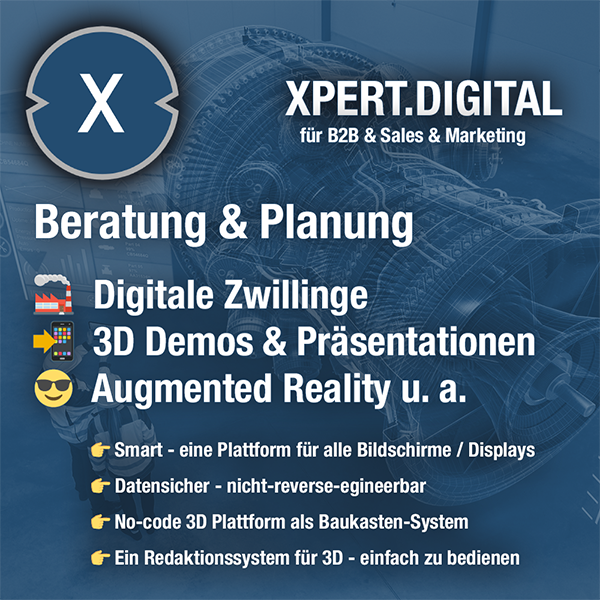
We are here for you - Consulting - Planning - Implementation - Project Management
Xpert.Digital - Pioneer Business Development
Smart Glasses & AI - XR/AR/VR/MR industry expert
Consumer Metaverse or Metaverse in general
If you have any questions, require further information or advice, please feel free to contact me at any time.

Konrad Wolfenstein
I would be happy to serve as your personal advisor.
You can contact me by filling out the contact form below or simply call me on +49 7348 4088 965 (Munich) .
I'm looking forward to our joint project.
Write to me

Xpert.Digital - Konrad Wolfenstein
Xpert.Digital is a hub for industry focusing on digitalization, mechanical engineering, logistics/intralogistics and photovoltaics.
With our 360° Business Development solution, we support renowned companies from new business to after-sales.
Market intelligence, smarketing, marketing automation, content development, PR, mail campaigns, personalized social media and lead nurturing are part of our digital tools.
You can find more information at: www.xpert.digital - www.xpert.solar - www.xpert.plus
Keep in touch










