Cross-docking: When the warehouse becomes a high-speed node
Xpert Pre-Release

Available in 27 languages 📢
Prefer Xpert.Digital on GoogleⓘPublished on: October 12, 2026 / Updated on: October 12, 2026 – Author: Konrad Wolfenstein
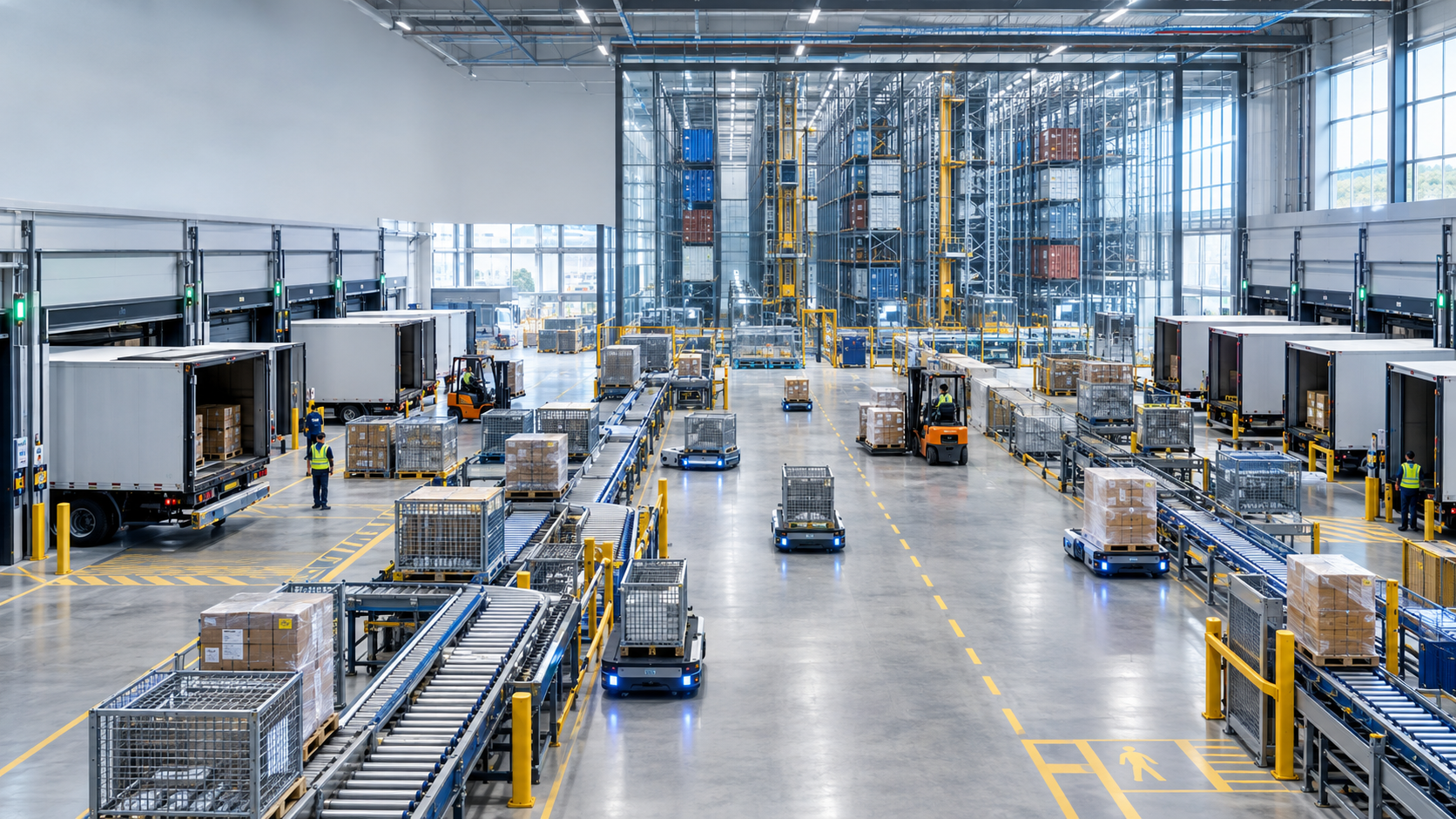
Cross-docking: When the warehouse becomes a high-speed hub – a creative image on the topic, using AI: Xpert.Digital
From warehousing to flow optimization: Cross-docking explained
Cross-docking and its importance for modern supply chains
In today's fast-paced economy, efficient warehouse management is crucial for business success. Cross-docking has established itself as an innovative solution for revolutionizing traditional warehousing processes. Instead of simply storing goods, cross-docking treats the warehouse as a strategic transshipment point where incoming goods are immediately prepared for shipment. This approach not only minimizes storage times but also optimizes capital tied up in inventory and increases throughput. At its core, cross-docking enables close coordination of timing and data between suppliers, logistics centers, and recipients. The focus is on minimizing inventory and maximizing efficiency. Companies that rely on cross-docking benefit from a leaner supply chain that adapts to the dynamic demands of the market. But how exactly does this system work, and what challenges and advantages does it present? In this article, we will examine the fundamentals, advantages, and challenges of cross-docking and demonstrate how companies can successfully implement this approach.
Those who continue to store goods even though they could have moved on long ago are paying for downtime
Cross-docking fundamentally alters the economic logic of a warehouse. While a traditional distribution center is designed to receive, store, pick, and later ship goods, cross-docking primarily treats the facility as a transshipment and synchronization point. Incoming shipments are unloaded, identified, inspected, sorted, consolidated into new transport units, and loaded onto outgoing vehicles as quickly as possible. Ideally, the goods remain in the building for only a few hours. This reduces inventory, space requirements, and tied-up capital, while increasing throughput and delivery speed.
The common misconception that cross-docking simply means quickly transferring a pallet from one truck to another is too simplistic. The process is not a single step, but rather an operational model for the entire supply chain. It only works if suppliers, carriers, logistics centers, information systems, and recipients collaborate closely in terms of timing and data. The less physical inventory is available as a buffer, the more critical reliable arrival times, accurate shipping notifications, clear labeling, appropriate packaging units, and robust outbound planning become.
Economically, cross-docking is therefore neither a universal cost-saving program nor automatically the more modern form of warehousing. It is particularly efficient when high and relatively predictable flows of goods need to be distributed across numerous sources or destinations. However, in cases of highly fluctuating demand, unreliable suppliers, complex quality checks, or intricate processing, a traditional warehouse or a hybrid model may be more economical and robust. The crucial question is not whether as much goods as possible can be processed, but rather which items, relationships, and orders will actually generate lower costs and better delivery performance in the overall supply chain.
From storage location to flow node
Cross-docking is a logistics process in which goods move from receiving to shipping with little or no intermediate storage. The term thus describes a deliberate departure from the traditional warehouse function. A classic warehouse decouples procurement and sales through inventory: it receives goods regardless of the specific outgoing order and keeps them available until demand arises. In contrast, a cross-docking facility closely links inbound and outbound processes. Ideally, incoming goods are already assigned to a destination, a delivery route, a branch, a production order, or a customer order.
In practice, "without storage" does not necessarily mean that each transport unit moves directly from vehicle to vehicle without any intermediate stops. There are almost always short-term staging, sorting, or buffer zones. Quality controls, labeling, consolidation, and waiting for outbound traffic to be fully established may also be necessary. A dwell time of less than 24 hours is considered a typical guideline; efficient processes often operate within a few hours. The crucial factor is not a rigid time limit, but rather the avoidance of regular storage within a long-term managed inventory.
This shifts the focus of value creation. In traditional warehousing, it lies in the availability of inventory and flexible order picking. With cross-docking, it arises from temporal coordination, consolidation, and accelerated throughput. Smaller incoming shipments can be combined with more efficiently utilized outgoing loads based on destination regions. Conversely, large, single-product deliveries can be broken down and distributed as needed to branches, production areas, or delivery routes. The hub thus replaces storage time with high-quality information and operational precision.
This leads to a frequently overlooked point: Cross-docking doesn't eliminate all inventory, but rather shifts and reduces it. Safety stock may still be held by the supplier, in an upstream plant, in regional buffers, or at the point of sale. Similarly, goods remain economically tied up during transport. A sound assessment must therefore consider the entire supply chain and not just measure the visibly decreasing inventory at the cross-docking location. If inventory is merely transferred to suppliers or if more frequent transport results in higher costs, the supposed advantage diminishes.
Three operating models with different logic
In single-stage or pre-commissioned cross-docking, the destination is determined before delivery. For example, the supplier assembles a separate pallet for each branch, marks it with a unique identifier, and delivers it to the transshipment point. There, the unit is inspected and, without any changes to its contents, is directed to the correct output gate. This model minimizes internal processing effort and enables very short lead times. However, it requires a high degree of discipline from the supplier and relatively stable demand information, as errors or short-term changes in demand are difficult to correct.
In two-stage cross-docking, larger incoming units are broken down and reassembled at the hub. For example, a supplier might deliver a single pallet of goods, the cartons of which are then distributed to several branches. Simultaneously, each branch receives a consolidated shipment consisting of goods from multiple suppliers. This method increases the bundling effect and allows for later, more market-oriented allocation. However, it also increases space requirements, personnel costs, sorting complexity, and the potential for errors at the distribution center.
Extended or hybrid cross-docking combines high-speed throughput with selected warehousing, order picking, and value-added services. Some goods pass through the facility directly, while others are stored for short or long periods. Additionally, labels can be applied, displays assembled, packaging customized, kits created, or quality checks performed. In practice, this model is often more economical than a strictly "no-inventory" approach because it accommodates exceptions and consolidates different product profiles at a single location.
Choosing between these systems is a matter of economic considerations. Pre-picked processes are particularly efficient with stable demand, short lead times, and high data quality. Assigning goods only at the transshipment center offers greater flexibility and can partially compensate for demand uncertainty, but incurs higher operating costs. Hybrid systems create a buffer against disruptions, but require additional space and capital. Therefore, the optimal solution often lies not in a single model for the entire product range, but in segmentation based on turnover rate, demand profile, delivery reliability, value density, and service requirements.
The process determines the performance
The cross-docking process begins long before a vehicle arrives. The supplier or carrier transmits an electronic delivery notification with details of the order, item, quantity, loading unit, markings, arrival time, and destination. Based on this information, the warehouse management system can compare the expected goods with outstanding requirements, assign a loading dock, plan personnel and material handling, and prepare outbound routes. Without this advance information, handling becomes reactive: only after the vehicle is opened does it become clear what has arrived. This wastes time and makes predictable, high-performance operations virtually impossible.
At goods receiving, loading units are identified and checked against the announced data. Barcodes are the most economical solution for many applications; RFID can offer advantages with very high volumes, concealed markings, or automatic gate readings. The inspection must be fast enough to avoid interrupting the flow, yet reliable enough to detect quantity discrepancies, damage, or incorrect destinations. An undetected error is particularly costly in cross-docking because there is hardly any time for correction, and the incorrect unit may immediately enter the outbound process.
The system then assigns each unit a direct transport route, a staging area, a sorting line, or an exclusion zone. Pallets can be moved by forklift, tugger train, automated guided vehicle (AGV), or autonomous mobile robot. Cartons and packages are suitable for conveyor belts and automated sorting technology. The shorter the internal routes and the fewer intersections between material flows, the higher the throughput and workplace safety. Therefore, the allocation of inbound and outbound gates is not a minor detail, but a key optimization task.
In the outbound area, units are consolidated according to route, recipient, or departure window. A final identity and completeness check is performed before loading. The system must prevent pallets from ending up at the wrong gate or vehicles from departing incomplete. At the same time, waiting outbound vehicles must not unnecessarily block loading docks. Economic success therefore depends on finely tuned scheduling: Early arrivals create buffer requirements, late arrivals jeopardize departures, excessively short time windows increase stress and errors, and overly generous time windows reduce throughput.
Where cross-docking has its greatest leverage
In the grocery retail sector, cross-docking is one of the most obvious applications. Many branches regularly require small quantities from a broad supplier network, while fresh produce has a limited shelf life. A regional distribution center can consolidate deliveries, sort them by branch, and forward them on the same day. Cold chains are shortened, write-offs can be reduced, and branch deliveries can be organized into more efficiently utilized routes. However, temperature control, hygiene, traceability, and tight delivery windows must be strictly managed.
In traditional retail, cross-docking is often used to supply stores with fast-moving items, promotional merchandise, or seasonal assortments. Large quantities from suppliers are distributed to sales outlets without the distribution center holding them in reserve stock. This is particularly attractive when the start of a promotion, an advertising campaign, and product availability must be closely aligned. However, a miscalculation reveals the downside: excess quantities cannot be automatically absorbed by inventory buffers, while under-deliveries directly jeopardize shelf availability.
In the automotive industry and other clocked production systems, cross-docking supports just-in-time and, in some cases, just-in-sequence concepts. Components from various suppliers are consolidated and delivered to plants or assembly lines on schedule. The benefit lies not only in reduced inventory levels but also in an organized, production-ready supply chain. At the same time, the dependence on uninterrupted transport increases. Traffic problems, quality defects, or incorrect sequences can quickly trigger production interruptions, the costs of which far exceed the savings in storage costs.
Parcel services and general cargo networks also operate on core cross-docking principles. Shipments arrive from regional consolidated transport, are automatically sorted according to their destination, and leave the hub on new scheduled routes. The building here is not a storage facility, but a sorting machine with gates. Efficiency arises from network effects: the better volumes are consolidated and vehicles are utilized, the lower the transport costs per shipment can be.
In e-commerce, cross-docking is particularly suitable for pre-sold goods, fast-moving items, marketplace orders, and supplier models where products are simply consolidated on their way to the customer. However, it cannot completely replace traditional fulfillment. Individual orders with many items, returns, customer-specific packaging, and highly fluctuating demand often still require warehousing and picking capabilities. A hybrid architecture is therefore particularly promising, in which suitable items bypass inventory while others are fulfilled regularly from a warehouse.
Cross-docking offers advantages for spare parts and time-critical industrial goods when incoming units are already assigned to specific service cases or production needs. In contract logistics, multiple customers and carriers can be consolidated via a common hub. Similar models are conceivable in hospital supply, fashion collections, or for imported goods with fixed orders. The common denominator is always a soon-to-be-known outbound demand that already "pulls" the goods upon arrival.
Economics beyond saved shelf space
The most obvious advantage lies in the elimination of multiple warehouse movements. Goods that are not stored don't require regular storage space, subsequent retrieval, and often even time-consuming picking from inventory. Fewer points of contact can reduce personnel costs, handling hours, energy consumption, and the risk of damage. At the same time, the time between receipt and dispatch is shortened, improving the responsiveness of the supply chain.
Equally important is the amount of capital tied up in inventory. Inventory finances the time between purchase and sale. If the average inventory holding period decreases, less working capital is tied up; in addition, inventory risks such as spoilage, obsolescence, shrinkage, or write-offs are reduced. This effect is particularly relevant for high-value, rapidly obsolete, or capital-intensive products. However, the calculation should not only consider local inventory. If suppliers have to hold larger inventories or additional safety stocks are built up in branches, the capital tied up in inventory simply shifts.
Cross-docking can also reduce transport costs, even though it creates an additional transshipment point. The key is consolidation. Several small inbound shipments destined for the same region can be combined into fuller outbound vehicles. Conversely, large deliveries can be efficiently distributed to numerous recipients. This increases capacity utilization and can reduce the number of underutilized direct routes. However, studies of multi-stage distribution networks do not show automatic superiority: depending on distances, volumes, vehicle costs, and network structure, the additional node can either reduce or increase transport costs.
On the cost side, investments include buildings, gates, staging areas, conveyor technology, identification systems, software integration, and, if applicable, automated sorting. Additional costs include data maintenance, supplier integration, training, process control, and exception handling. A cross-docking facility with insufficient utilization is problematic because many costs are fixed. Conversely, an overloaded facility can become expensive due to congestion, waiting times, incorrect loading, and special transports. Therefore, profitability depends heavily on volume and synchronization logic.
Real-world savings figures vary considerably and are only reliable within their specific context. Individual applications report double-digit improvements in transport or handling costs, significantly shorter lead times, and noticeably lower inventory levels. However, such figures cannot be generalized to other networks. Product structure, labor costs, degree of automation, distance patterns, initial conditions, and measurement limits all significantly influence the outcome. Therefore, a sound investment analysis should consider at least the total cost per unit, the change in tied-up capital, delivery quality, expected disruption costs, and the required reserve capacity.
The price of speed
Cross-docking makes a supply chain leaner, but not automatically more resilient. Traditional inventory buffers time variations. Without this buffer, delays and quantity discrepancies have a more immediate impact on downstream processes. A late arrival can block an outbound vehicle; its delayed departure, in turn, jeopardizes delivery windows, store supplies, or production schedules. The financial damage from a disruption can therefore increase disproportionately.
Concentrated arrival waves are particularly critical. When many vehicles arrive in close succession, queues form at the gates, leading to peak staffing needs and bottlenecks on internal transport routes. High nominal plant capacity is insufficient if the timing is unfavorable. Therefore, planning must consider not only daily volumes but also specific time windows, unloading durations, routes, resources, and priorities. Simulation and mathematical optimization can help improve gate occupancy and vehicle sequencing.
The consequences of errors also change. In a warehouse, a misplaced pallet can often be located and corrected later. In cross-docking, however, it can quickly end up in the wrong line of transport. This leads to return shipments, special deliveries, delivery failures, and potentially production disruptions. Real-time validation during scanning, unique loading units, standardized labels, and system-based locking mechanisms are therefore not merely convenience features, but essential, cost-effective safety mechanisms.
Another risk is over-standardization based on stable conditions. Supply chains are subject to fluctuations caused by weather, traffic, strikes, geopolitical events, surges in demand, and IT failures. An efficient system therefore requires defined exception areas, alternative gateways, backup processes, and clear escalation procedures. Resilience requires capacity but can reduce the overall expected damage. Consequently, the most economically viable solution does not utilize every available space to its maximum capacity during normal operations but deliberately maintains a limited operational margin.
LTW Intralogistics Solutions

LTW Intralogistics – Engineers of Flow - Image: LTW Intralogistics GmbH
LTW offers its customers not individual components, but integrated complete solutions. Consulting, planning, mechanical and electrotechnical components, control and automation technology, as well as software and service – everything is networked and precisely coordinated.
In-house production of key components is particularly advantageous. This allows for optimal control of quality, supply chains, and interfaces.
LTW stands for reliability, transparency, and collaborative partnership. Loyalty and honesty are firmly anchored in the company's philosophy – a handshake still means something here.
Related to this:
Container high-bay warehouse as support for cross-docking
The digital infrastructure as the actual warehouse
When physical inventory decreases as a buffer, information becomes the central control medium. The warehouse management system must consolidate expected inbound shipments, open orders, available loading bays, staging areas, and outbound routes in near real-time. The transportation management system complements this with arrival forecasts, vehicle capacities, routes, and time slots. Both systems must use consistent master data and exchange information seamlessly.
The electronic delivery notification is of fundamental importance. It describes, before arrival, which items and quantities are coming on which loading units and where they are to be forwarded. Only then can personnel, gates, and outbound capacity be planned proactively. If data is missing or if item numbers, units of measure, and packaging hierarchies do not match, operations revert to manual verification. The time advantage of cross-docking then quickly disappears.
Barcodes, RFID, camera systems, and automatic identification create transparency regarding physical movements. Crucially, it's not just about capturing a scan, but about immediately verifying its compliance with the planned process. The system must indicate or prevent a unit from being at the wrong gate, not belonging to the outbound order, or not yet released. Robust barcode processes are often sufficient for pallets and containers. RFID or image-based recognition become relevant when dealing with very high throughput, poor visibility, or contactless mass data capture.
Artificial intelligence can improve forecasts, arrival times, gate allocation, and resource utilization, but it cannot replace clean data and stable underlying processes. A learning system can recognize delay probabilities or dynamically suggest alternative allocations. However, it cannot optimize away missing labels, unclear responsibilities, or non-compliance with delivery standards. The greatest digital leverage often lies initially in standardized master data, reliable interfaces, and consistent event management.
The correct layout prevents costly oncoming traffic
Cross-docking buildings are often elongated and have numerous loading docks on opposite sides. Incoming goods enter the building on one side and exit on the other. This I-shape is easy to understand and facilitates a directed flow of materials. Depending on the site, shipment structure, and number of relationships, L-, T-, or X-shaped layouts are also possible. While an increasing number of loading docks can shorten routes, it also increases the demands on traffic management and control.
The largest area component is not the shelving, but the handling and staging area. It must be large enough to quickly separate shipments according to destination and to assemble outbound loads. Too little buffer space leads to blocked aisles; too much buffer space encourages sluggish storage and increases construction costs. Clearly marked aisles, flexible storage locations, and separate exception areas for damaged, unclear, or delayed goods are advisable.
Gate allocation directly impacts internal transport costs. Frequently linked inbound and outbound connections should be located close to each other. At the same time, vehicle sizes, temperature zones, hazardous materials requirements, conveyor technology, and occupancy patterns must be considered. Since the optimal allocation can change with each arrival wave, purely static planning is often insufficient. Dynamic systems can assign gates based on current quantities, distances, and departure priorities.
Automation is particularly worthwhile for high, recurring volumes and standardized loading units. Conveyor technology and sorters achieve high throughputs but are capital-intensive and less flexible when dealing with widely varying dimensions. Driverless transport systems and autonomous mobile robots offer more modular scalability but require reliable traffic control and effective fleet management. Conventional forklifts remain economically attractive for heterogeneous pallets and changing tasks. In many facilities, the best solution results from a combination of these technologies.
Which products are truly suitable?
Cross-docking is particularly suitable for goods with high and regular throughput, a known destination, and minimal need for warehouse handling. Fast-moving items, pre-sold goods, store replenishment, promotional items with a fixed expiration date, fresh produce, and standardized production components often meet these criteria. Robust, clearly marked loading units that can be moved without repacking are also advantageous.
Less suitable are slow-moving items with sporadic demand, products with lengthy or complex testing processes, goods with unclear target assignment, and items requiring extensive picking or customer-specific processing. In cases of highly unreliable deliveries or volatile demand, a physical warehouse can also offer better service. High stockout costs also argue in favor of cautious hybrid models, as a missing part can block an entire order or production run.
An ABC analysis alone is insufficient for selection. A high-volume item might be unsuitable due to extreme demand fluctuations, while a medium-volume item with stable orders performs well. A multidimensional classification based on volume, forecast accuracy, delivery reliability, value, shelf life, handling effort, target clarity, and stockout costs is advisable. This leads to rules determining which goods should be processed directly, buffered in the short term, or stored regularly.
The decision should also be based on relationships rather than just items. The same item might be cross-docking-ready for a large branch with daily demand, but not for a small recipient with irregular orders. Similarly, one reliable supplier might be suitable for direct delivery, while another might require a control and buffering process first. Cross-docking is therefore most effective when rules are granular enough but remain operationally understandable.
Container high-bay warehouse: Counter-model or perfect partner?
A container high-bay warehouse initially appears to be the antithesis of cross-docking. Cross-docking aims to avoid storage, while a high-bay warehouse for ISO containers is specifically designed for dense, automated storage. However, this contrast is only partially accurate. In a seaport, inland port, or large multimodal terminal, a container high-bay warehouse can serve as a high-performance buffer within a larger cross-docking and transshipment system.
Conventional container storage systems stack boxes on top of each other. If a container at the bottom needs to be removed, the units above it must be moved. Such unproductive restacking movements consume time, energy, and equipment. Modern high-bay container storage systems store each container in its own compartment and allow direct access. Depending on the design, loaded containers are stored up to eleven levels high, and empty containers even higher. Automated storage and retrieval systems handle storage and retrieval, while transfer stations connect to trucks, terminal vehicles, rail, or waterborne transshipment.
The impact on available space is significant. High-bay racking systems can achieve roughly three times the capacity of a conventional container yard on the same footprint, or require only about a third of the space for the same capacity. Pilot and project data also show that direct access can largely eliminate unproductive restacking and significantly increase throughput per hectare. However, such figures depend on layout, number of cranes, interfaces, operating profile, and utilization, and should not be considered a guarantee for every terminal.
Cross-docking of containers takes place on two levels. On the first level, the closed container itself is transferred between modes of transport, such as from ship to rail or truck. If it only stays briefly at the terminal and its onward journey is already planned, this process is similar to cross-docking for entire loading units. On the second level, the container is opened; its contents are unloaded, sorted, consolidated, and loaded into other containers or vehicles. This area, called the Container Freight Station, corresponds to classic cross-docking at the pallet, carton, or general cargo level.
The high-bay warehouse can support both levels. It buffers containers between transport modes that are not perfectly synchronized and provides them in the required sequence. Direct access is particularly valuable because a delayed train, a changed shipping window, or a truck dispatched at short notice does not necessarily trigger numerous restacking operations. The warehouse decouples the schedules of ship, rail, road, and cargo handling without fully inheriting the disadvantages of a difficult-to-access block storage system.
Nevertheless, a container high-bay warehouse is not a cross-docking facility in the strictest sense. As soon as containers are stored for extended periods, the facility fulfills a storage and buffer function. The term "cross-docking" should therefore describe the process, not the structure. A facility can simultaneously handle direct throughput, short-term buffering, and regular storage. The economically decisive factor is whether the system accelerates the entire handling chain, saves space, and avoids a sufficient number of unproductive movements to justify its high investment and maintenance costs.
The unique economics of large steel boxes
The cost structure of ISO containers differs significantly from that of pallet storage. These units are large, heavy, and valuable to handle. Every additional movement requires crane, vehicle, or forklift capacity. At the same time, waiting times, demurrage charges, delayed collection, and terminal congestion can cause substantial additional costs. Therefore, reliable container delivery is of high economic value.
A high-bay racking system can partially decouple performance from floor space utilization. In a block storage system, accessibility tends to decrease when stacks are denser and picking sequences become uncertain. With direct access to individual storage locations, every container remains reachable. This allows the system to operate closer to its capacity limit without necessarily requiring more restacking. Furthermore, performance becomes more predictable, which can stabilize delivery windows for trucks and the supply of goods to ships or trains.
This is offset by high fixed costs. Steel construction, foundations, automated cranes, power supply, control systems, fire protection, safety concept, and system integration require significant investments. The business case is therefore most compelling at locations with limited and expensive land, high container throughput, frequent restacking, and long-term guaranteed capacity utilization. On a spacious site with low land costs and fluctuating throughput, a conventional yard system may remain more economical.
Technical availability and redundancy are also critical. If a central aisle or transfer station fails, terminal operations must not come to a standstill. Modularity, alternative routes, backup equipment, maintenance windows, and emergency plans must be considered during the design phase. A high-bay container warehouse can increase robustness if it offers direct access and multiple transfer points. However, it can also decrease it if automation is too centralized and failures cannot be avoided.
Properly combining cross-docking and high-bay warehouses
The most efficient combination is achieved when not every unit necessarily passes through the high-bay warehouse. Containers or pallets whose outbound transport is already prepared should be given a direct route. Units with delays, unclear status, or later departure dates are automatically buffered. The warehouse or terminal operating system dynamically decides between direct transfer and storage route. This ensures that cross-docking remains the preferred fast route, while the high-bay warehouse provides the necessary time decoupling.
Such an architecture prevents two extremes. Without buffers, any delay can trigger a domino effect. With mandatory storage, on the other hand, even synchronized units would cause unnecessary movements. The hybrid approach treats storage as a selectively deployed option rather than as the default. This, however, increases the demands on the software, because it must simultaneously evaluate the destination, departure time, priority, available transfer points, and system status.
For a distribution center near a port, the integration can go even further. Import containers are taken from the terminal, stored in an automated container warehouse, and, if needed, transported directly to unloading gates. There, the goods either enter regional outbound traffic as a cross-docking stream or are stored as regular inventory in a high-bay pallet warehouse. Customs status, clearances, and order volume determine the route. Especially with limited port space and large, predictable import volumes, this integrated solution can combine advantages in terms of transport, space, and time.
The key difference between a container high-bay warehouse and a conventional pallet high-bay warehouse lies in the logistical unit. In the first case, the ISO container remains closed and is moved as a whole; in the second, its contents are stored. Both can be relevant for cross-docking. The choice depends on whether the next transport stage takes over entire containers or whether a redistribution of goods is required.
Key performance indicators for a robust business case
The most important operational KPI is the dwell time from goods receipt to loading. This should not be considered solely as an average, as individual very long dwell times can go unnoticed in an otherwise fast process. The median, upper percentiles, and the distribution by product group, supplier, and route are also useful. Additionally, the percentage of units processed within a defined time window shows how stable the process actually is.
Other key performance indicators (KPIs) include throughput per hour, gate, and square meter; number of touches per unit; internal route per pallet or container; misrouting rate; damage rate; on-time departures; and vehicle waiting times. For the consolidation effect, the utilization rate of outbound vehicles, avoided trips, and cost per transported unit are relevant. For high-bay racking systems, technical availability, crane movements per hour, energy consumption per movement, and avoided restacking are also important.
Financially, the investment calculation shouldn't end with storage costs. A complete model includes buildings and technology, software and interfaces, personnel, energy, maintenance, capital commitment, transport costs, space costs, and the expected costs of errors and malfunctions. These costs are offset by savings from fewer warehouse movements, lower inventory, higher vehicle utilization, shorter delivery times, avoided special trips, and potentially additional capacity on the same footprint.
Scenario analysis is particularly important. A baseline scenario is insufficient because cross-docking is highly sensitive to volume, on-time delivery, and demand uncertainty. At a minimum, low, expected, and high utilization rates, varying delivery reliability, labor and energy prices, and equipment downtime should be considered. For high-bay container warehouses, key sensitivities include construction costs, land value, throughput development, and the costs of conventional restacking operations.
Implementation without costly system disruption
A sensible implementation doesn't begin with a new building, but with data analysis. Historical goods movements reveal which items and relationships could regularly be arriving and departing on the same day. Subsequently, current throughput times, interactions, routes, inventory levels, vehicle utilization, and deviations are determined. Only then does it become clear whether the main problem is actually warehousing or rather lies in poor transport planning, unreliable suppliers, or unclear data.
A limited pilot project with a few stable items, suppliers, and outbound relationships is recommended. Goods should be clearly labeled, processes manageable, and all involved parties willing to cooperate. During the pilot, actual dwell times, errors, staffing requirements, and impacts on transport are measured. A successful test is characterized not only by speed but also by repeatable performance under normal fluctuations.
The next step involves establishing binding regulations for supplier standards, electronic notification, time windows, and exception procedures. Only once data quality and operational discipline are stable should further automation be implemented. This sequence prevents expensive technology from simply speeding up an immature process. Automation enhances good processes but cannot remedy poor master data or conflicting responsibilities.
Scaling should be based on economic benefit. Suitable goods flows are expanded gradually, while unsuitable items are deliberately kept in the warehouse. Buildings, software, and technology should support both approaches. A hybrid system is not a sign of inconsistency, but often the most economically sound response to heterogeneous demand and supply profiles.
The strategic limit of the principle
Cross-docking doesn't primarily optimize warehousing, but rather the flow through the supply chain. Its strength lies in reducing avoidable waiting times, unnecessary inventory, and repetitive handling. The price for this is increased reliance on data, on-time delivery, and coordination. Companies are trading physical buffers for organizational and digital precision.
Cross-docking is therefore particularly compelling where volumes are large enough, demand is sufficiently predictable, and destination allocations are known well in advance. In these cases, a single location can move more goods in less space, reduce tied-up capital, and better consolidate shipments. Where uncertainty prevails, however, inventory can be an economically sound safeguard. The best solution is therefore rarely "all cross-docking," but rather a clear segmentation of goods flows.
Container high-bay warehouses do not contradict this principle. They can act as automated buffers, providing the necessary temporal decoupling required by complex port or multimodal operations. Direct access to each container, high storage density, and predictable deployment improve the conditions for rapid transshipment. However, the connection only becomes economically viable if the high-bay warehouse actually replaces unnecessary movements and expensive space on a significant scale.
The strategic perspective is therefore: it's not the warehouse as a building that needs to disappear, but rather the unnecessary storage process itself. Cross-docking is successful when each unit is given the fastest and most economical route. Sometimes this route leads directly from entry to exit. Sometimes it involves a buffer for a few hours. And sometimes a regular warehouse remains the more robust solution. Progress doesn't come from dogmatically avoiding inventory, but from precisely deciding where inventory creates value and where it merely finances stagnation.
Consulting - Planning - Implementation

Konrad Wolfenstein
I would be happy to serve as your personal advisor.
You can contact me at wolfenstein∂xpert.digital or
Just call me on +49 7348 4088 965 .
Your intralogistics experts

Consulting, planning and implementation of complete solutions for high-bay warehouses and automated storage systems - Image: Xpert.Digital
More information here: