
Burning freighter and fake chancellor: How much war can everyday German life tolerate without anyone noticing?
Xpert Pre-Release

Available in 27 languages 📢
Prefer Xpert.Digital on GoogleⓘPublished on: August 8, 2026 / Updated on: August 8, 2026 – Author: Konrad Wolfenstein

Burning freighter and fake chancellor: How much war can everyday German life tolerate without anyone noticing? – Creative image on the topic, created with AI: Xpert.Digital
Invisible danger: How hybrid warfare is shaking up our logistics and politics
Fake video about Merz and ship attack: What's behind the new threat to Germany
A burning merchant ship under German management in the Black Sea and a highly professionally faked video announcing the resignation of Chancellor Friedrich Merz – at first glance, these dramatic incidents seem to have little in common. However, on closer inspection, they reveal a shared, disturbing dynamic: In 2026, Germany is increasingly confronted with hybrid warfare, which is no longer fought on distant military fronts. The targeted combination of physical attacks on global logistics bottlenecks and insidious digital disinformation at the heart of democracy is creating entirely new, elusive threat scenarios. These recent events mark a turning point in security policy and ruthlessly demonstrate that traditional crisis management strategies employed by the economy, government, and society urgently need to be rethought in order to continue effectively protecting economic stability and political trust.
A burning wreck off Odessa as a warning sign of the new reality
On August 5, a civilian merchant ship was targeted in a military attack off the Ukrainian port city of Odessa, the economic and political repercussions of which extend far beyond the incident itself. The bulk carrier "Emil," a Capesize bulker built in 2012, measuring approximately 292 meters in length and with a deadweight tonnage of about 175,000 tons, was repeatedly struck by drones about 21 nautical miles off the coast. The ship sailed under the Liberian flag but was commercially managed by the Hamburg-based shipping company Johann MK Blumenthal GmbH & Co. KG from the Altona district, while technical and ISM management was handled by its subsidiary Blumenthal Asia, and the registered owner was the single-ship company Charm Marine. This complex ownership and management structure is typical of international merchant shipping and illustrates how difficult it is to assign clear political and legal responsibility in a crisis.
The attack came in several waves. The ship was initially hit, caught fire, and lost maneuverability due to the failure of its technical systems. While the eleven-member crew was subsequently evacuated, another drone struck in the immediate vicinity, suggesting a deliberate continuation of the attack during the rescue operation and further increasing the danger to the sailors. Initial reports indicated the crew was unharmed, but independently verifiable information on the ship's condition was unavailable for several days. According to industry sources, the disabled freighter was still adrift and unmanned in the waters off Odessa days later.
Two ships, one pattern: The systematic threat to the merchant fleet
In addition to the "Emil," the grain ship "Mera Queen," sailing under the flag of Guinea-Bissau and loaded with Ukrainian wheat, was also hit almost simultaneously. According to the governor of the Odessa region, Oleh Kiper, at least one crew member was killed and several others were injured in the attack. The Russian Ministry of Defense immediately confirmed the attacks on both cargo ships south and east of Odessa via its Telegram channel, justifying them by claiming that the ships were transporting military equipment for the Ukrainian armed forces. However, Russia has never presented any credible, publicly available evidence for this claim, meaning the accusation cannot currently be independently verified.
The very next day, the Russian military reported further attacks on three additional ships en route to Ukraine, underscoring the continuity and systematic nature of the campaign and suggesting that this was not an isolated incident. It is also noteworthy that ship tracking services registered the last location signals of the "Emil" on the day of the attack, off the Romanian coast near Sulina, in close proximity to the Ukrainian border, indicating a deliberately chosen target area of high military concern. The accumulation of such incidents within just a few days demonstrates that the conflict in the Black Sea has evolved into a systematic economic war against civilian shipping, no longer driven solely by military logic but deliberately accepting economic collateral damage.
Related to this:

Why the Black Sea is becoming Europe's economic bottleneck
The economic dimension of these attacks can hardly be overstated, as the Black Sea is one of the world's key grain and commodity shipping routes. Both warring parties, Russia and Ukraine, are among the world's leading grain exporters, and repeated drone and sea-based drone attacks have already severely restricted their exports via the inland sea. According to industry sources, both countries have so far lost approximately 38 percent of their grain exports, while Russia has also suffered significant losses in its Black Sea oil exports. These losses are not limited to the region but are already having a measurable impact on global commodity markets, where wheat prices have subsequently reached a two-year high.
The escalation is also directly impacting German logistics infrastructure. The Hamburg port operator HHLA, which maintains its own terminal in Odessa, has not handled a single ship there for approximately two weeks, highlighting the de facto paralysis of civilian freight traffic in the region. Since July 22, merchant ships have neither entered nor left the Ukrainian ports of Odessa, Chornomorsk, Yuzhny, Mykolaiv, and Izmail, meaning that the presence of the "Emil" in the immediate vicinity of Odessa already posed a significant logistical risk even before the actual attack. For German shipping companies and freight forwarders, this represents a fundamentally altered risk profile, calling into question traditional insurance models, route planning, and freight calculations in the Black Sea region.
Hamburg shipping company caught between silence and systemic risk
The shipping company Johann MK Blumenthal responded to press inquiries from both the North German Broadcasting Corporation (NDR) and the trade journal Hansa with complete reticence and declined to comment publicly on the incident. While this silence is understandable from a corporate strategy perspective, as ongoing investigations, insurance matters, and potential liability issues typically warrant cautious communication, it simultaneously leaves a public debate about the risk assessment of German shipping companies in war zones unanswered. The fact that a German-managed vessel operating under the Liberian flag was so close to an active theater of war raises fundamental questions about due diligence, crisis management, and the balancing of economic interests against physical security risks.
At the same time, this case exemplifies how strongly the globalized shipping industry is characterized by complex international ownership and flag structures. A "German" ship, as used in media parlance, is often, from a legal perspective, a vessel operating under a foreign flag, whose economic ownership, technical management, and insurance arrangements are distributed across multiple jurisdictions. This structure not only complicates the legal prosecution of attacks but also relativizes hasty political attributions that claim Germany as a state has been directly attacked, when in reality, primarily German capital and German management expertise are affected.
Hub for Security and Defense - Advice and Information

Hub for Security and Defense - Image: Xpert.Digital
The Security and Defence Hub offers expert advice and up-to-date information to effectively support companies and organizations in strengthening their role in European security and defence policy. Working closely with the SME Connect Defence Working Group, it particularly promotes small and medium-sized enterprises (SMEs) that wish to further develop their innovative capacity and competitiveness in the defence sector. As a central point of contact, the Hub thus creates a crucial bridge between SMEs and European defence strategy.
Related to this:
The second front: manipulation without a single shot
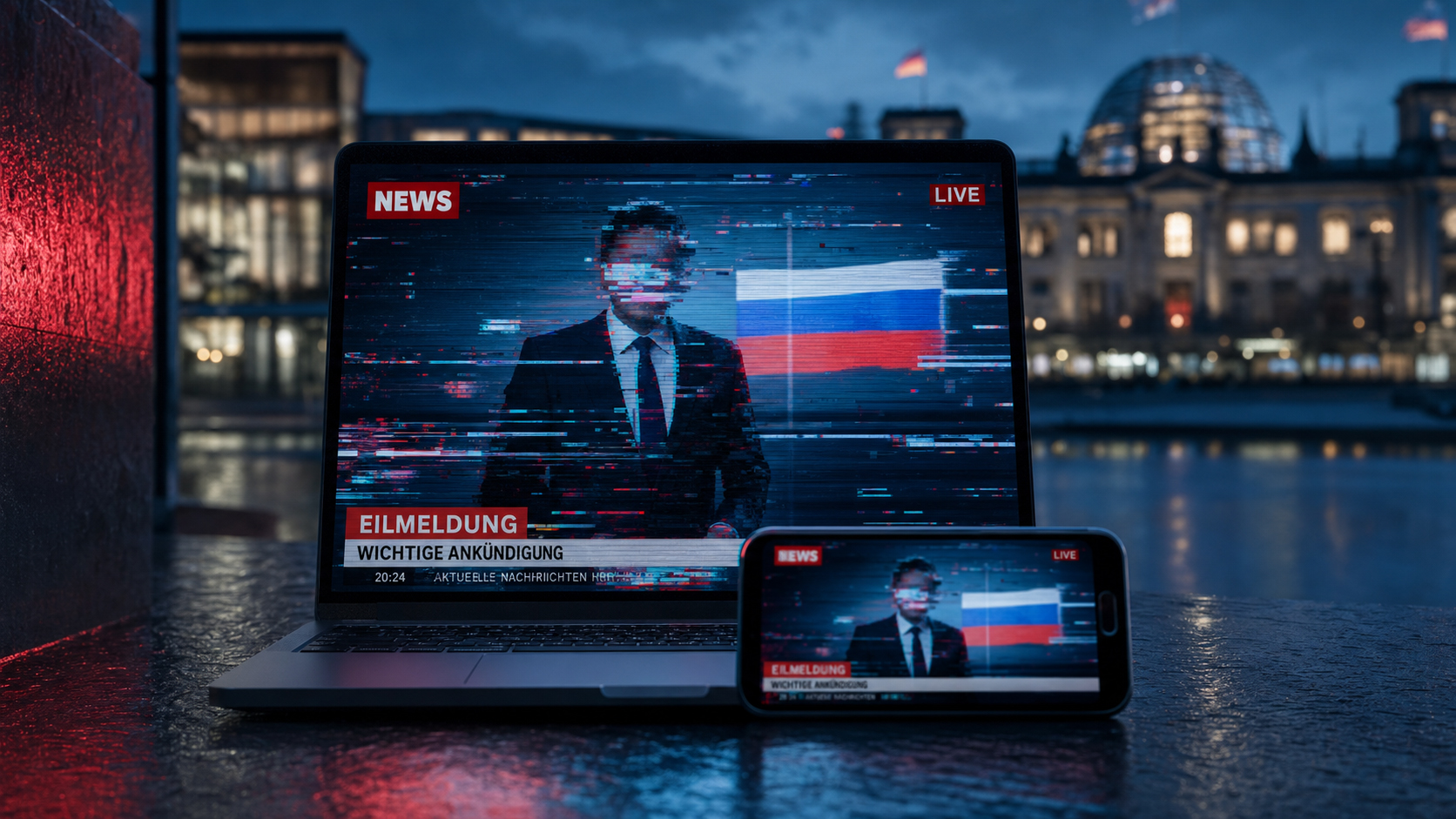
The second front: Manipulation without a single shot – A fake resignation as a test run for digital destabilization – Creative image on the topic, with AI: Xpert.Digital
A fake resignation as a test run for digital destabilization
Almost simultaneously with the physical attack in the Black Sea, a professionally produced video, bearing the logo of the public international broadcaster Deutsche Welle, circulated on social media. Citing an alleged Handelsblatt document, the video announced the imminent resignation of Chancellor Friedrich Merz. According to the video, Merz was to announce his resignation on August 10 due to persistently weak poll numbers. Internal correspondence from the CDU federal executive committee served as the alleged source, and North Rhine-Westphalia's Minister-President Hendrik Wüst was named as the most likely successor. The video garnered views in the six figures, and in some cases over a million, via verified accounts on the X platform, highlighting its considerable potential reach.
Both Deutsche Welle and Handelsblatt immediately and unequivocally denied ever having published such a report or received any corresponding internal correspondence. Handelsblatt explicitly called the video a fake and clarified that the supposed Handelsblatt website shown in the clip was not genuine. The CDU press office also confirmed upon request that the alleged internal party correspondence simply did not exist. Chancellor Merz's office told the AFP news agency that the claims made in the video were completely fabricated and intended to unsettle and confuse the public, while the CDU simply dismissed the matter as nonsense.
Storm-1516: A familiar pattern with a new target
German security authorities have attributed the video with a high degree of probability to the Storm-1516 network, which is linked to the Russian military intelligence service GRU. This network had already been officially held responsible by the German government in December of the previous year for disinformation campaigns during the federal elections in February 2025, from which Merz emerged as Chancellor in a coalition with the SPD. According to the French agency Viginum, which specifically monitors foreign disinformation campaigns, Storm-1516 is responsible for at least 77 documented disinformation operations against Western states between the end of 2023 and March 2025. This number underscores that this is by no means an isolated, improvised incident, but rather an established, organizationally structured campaign with considerable operational experience.
The technique used is known by experts as media spoofing, in which the visual identity of trusted media brands is deliberately imitated to lend fabricated narratives an air of journalistic credibility. Disinformation expert Julia Smirnova pointed out to Deutsche Welle several characteristic indicators of Storm-1516's authorship, including the German language version, the use of an actual human voice, and the targeted distribution via high-reach, verified accounts on the X platform. A technical error in the video, which incorrectly referred to a "general federal election in September" when no such election was scheduled, provided further evidence of the true authorship and the producers' lack of factual accuracy.
When warfare becomes an information economy
The close temporal proximity between the physical drone attack in the Black Sea and the digital disinformation campaign against the German government is no coincidence from an economic and security policy perspective, but rather an expression of a deliberately hybrid warfare strategy. While the attack on the "Emil" causes immediate, real economic costs in the form of material damage, insurance claims, disrupted supply chains, and rising commodity prices, the disinformation campaign targets a more subtle, but potentially equally effective resource: trust in political stability and media credibility. Both instruments can be understood as complementary building blocks of a strategy that aims to simultaneously weaken Western societies materially and undermine their psychological well-being.
From an economic perspective, it is remarkable that disinformation campaigns, such as the one surrounding the alleged resignation of Merz, incur comparatively low production costs, but if successful, can trigger significant macroeconomic consequences, for example through short-term market reactions, political uncertainty, or an erosion of trust in institutions and the media. The fact that professionally produced fake videos are now capable of deceptively imitating reputable brands like Deutsche Welle and Handelsblatt significantly shifts the cost-benefit analysis of such operations in favor of the perpetrators and poses considerable challenges to established mechanisms of media regulation and platform moderation.
Consequences for the German economy and security architecture
For the German economy, both incidents present several immediate areas for action. First, shipping companies and logistics firms must fundamentally revise their risk assessment models for war zones, as traditional insurance policies and route planning are clearly no longer adequate for the new realities of hybrid threats in the Black Sea. Second, the massive decline in grain exports by both warring parties, by approximately 38 percent each, demonstrates that the conflict's impact has long since evolved from a regional military problem to a global issue of food security and commodity price stability. German companies with supply chains dependent on grain or agricultural commodities must prepare for persistently volatile and potentially rising prices.
Thirdly, the case of the fake video illustrates that German information security is systematically attacked in the run-up to politically sensitive times, such as before important decisions or elections, and that while existing early warning and fact-checking mechanisms function, they remain reactive. The swift and coordinated response by Handelsblatt, Deutsche Welle, the CDU press office, and the federal government demonstrates a functioning crisis response system, but it does not change the fact that the original false report had already reached millions of people before the correction. For both companies and government institutions, this necessitates that communication strategies no longer focus solely on traditional crisis communication, but explicitly on countering coordinated disinformation campaigns.
A sober assessment instead of alarmism
Despite the dramatic nature of the events, a nuanced assessment is necessary. The attack on the "Emil" cannot be definitively interpreted as a targeted attack on Germany, as it was legally a ship sailing under the Liberian flag, with its connection to Germany limited to the commercial management by a Hamburg shipping company. Furthermore, the Russian claim that it was transporting military equipment cannot be confirmed or refuted due to a lack of publicly available evidence. Likewise, the uncertainty caused by the fake video should not be overestimated, as both the affected media outlets and political institutions reacted relatively quickly and unanimously, publicly exposing the forgery.
Nevertheless, the sobering conclusion remains that the threat situation for Germany as a trading and logistics nation, as well as a democratic information society, has structurally intensified in recent months. The combination of physical violence against civilian economic infrastructure and digital manipulation of the political public sphere no longer represents a hypothetical future threat, but is already a lived reality in 2026. Anyone who dismisses this development as merely a distant geopolitical fringe event negligently underestimates how closely economic stability, media credibility, and national security are actually intertwined in a networked world.
Consulting - Planning - Implementation

Markus Becker
I would be happy to serve as your personal advisor.
Head of Business Development
Chairman SME Connect Defense Working Group
Consulting - Planning - Implementation
Konrad Wolfenstein
I would be happy to serve as your personal advisor.
You can contact me at wolfenstein∂xpert.digital or
Just call me on +49 7348 4088 965 .





