
Europe's diplomatic self-disenfranchisement: Biggest payer, zero say – Why the EU is relegated to the kids' table in the Ukraine war
Xpert Pre-Release

Available in 27 languages 📢
Prefer Xpert.Digital on GoogleⓘPublished on: May 15, 2026 / Updated on: May 15, 2026 – Author: Konrad Wolfenstein
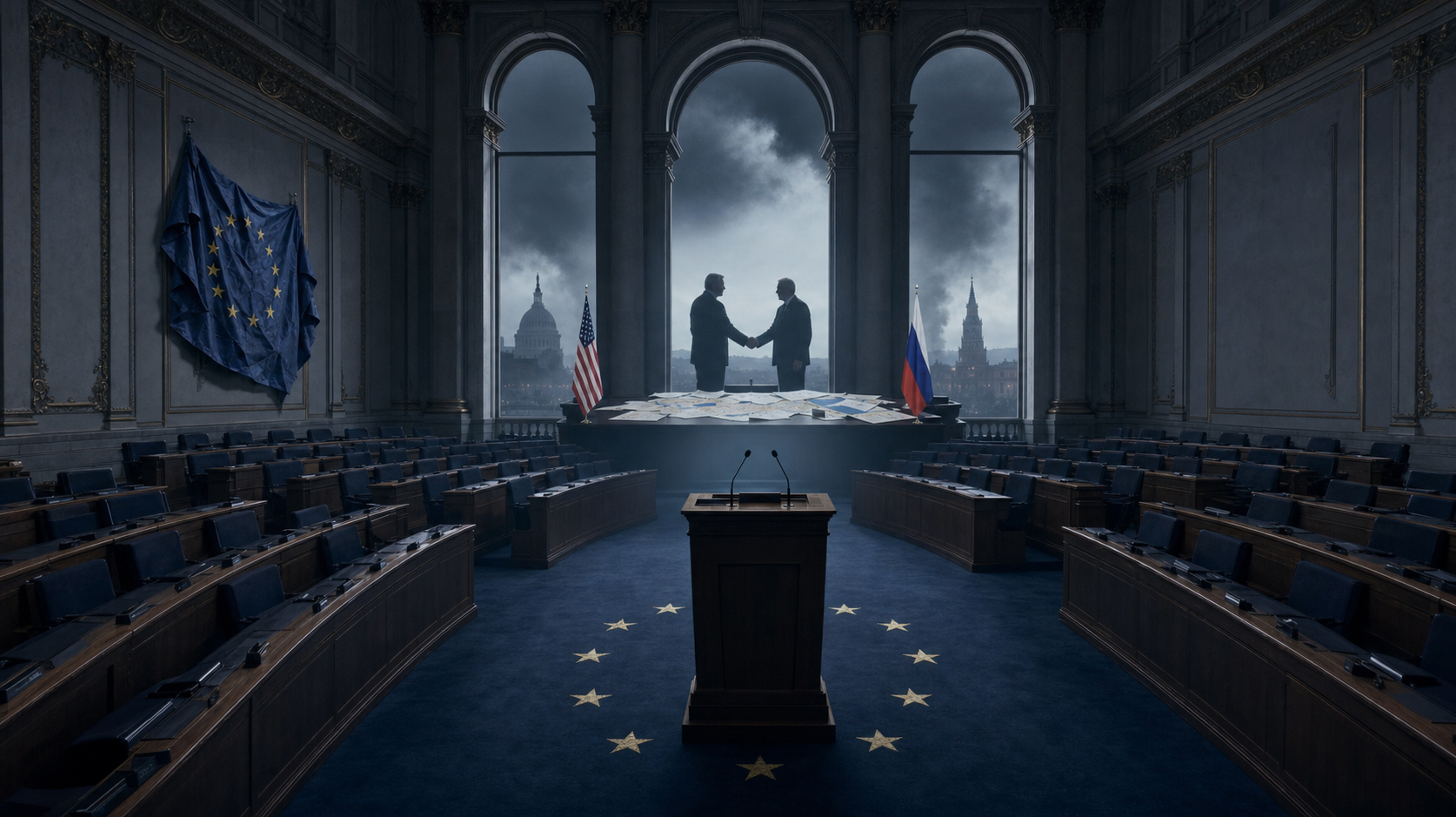
Europe's diplomatic self-disenfranchisement: Biggest payer, zero say – Why the EU is relegated to the kids' table in the Ukraine war – Image: Xpert.Digital
Laschet's harsh reckoning: How Europe has disenfranchised itself in the face of Putin
The US and Russia are negotiating alone: The fatal flaw in European foreign policy
The bitter truth about the Ukraine war: How Europe's self-imposed blockade is hindering peace
The European Union is paying the highest price in the Ukraine conflict – yet when it comes to concrete peace negotiations, Washington and Moscow dictate the rules of the game. Armin Laschet succinctly captures this paradox with a stark assessment: He speaks of Europe's "diplomatic self-disenfranchisement." Instead of representing its own interests with strategic resolve and pragmatic realpolitik, the EU is losing itself in moral appeals and institutional self-imposed gridlock. The fatal consequence: While American business representatives negotiate directly with the Kremlin about the continent's future, Europe has been relegated to the role of mere spectators. But how could it have come to this?
This comprehensive analysis sheds light on the historical errors, the paralyzing unanimity principle in Brussels, and shows why the wake-up call from figures like Mario Draghi and Friedrich Merz now demands radical reforms. From a "two-speed Europe" to massive economic rearmament – nothing less than the question of whether Europe will act as a sovereign world power in the future or become a pawn in the game of foreign interests is at stake.
Europe's diplomatic self-disenfranchisement – Laschet's analysis and the structural causes of European impotence
When the biggest payer sits at the smallest table: How Europe took itself out of the game at the decisive moment
On May 14, 2026 – the day the International Charlemagne Prize was awarded in Aachen to former ECB President and Italian Prime Minister Mario Draghi – Armin Laschet, Chairman of the Foreign Affairs Committee of the German Bundestag and head of the Charlemagne Prize Directorate, addressed sharp words to the European Union. Europe is so weak internationally because it tends to moralize rather than actively pursue diplomacy, Laschet explained to the German Press Agency. The symptom that most worried him, he said, was that only American businesspeople were negotiating between Russia and Ukraine because the EU refused to represent its own positions diplomatically and forcefully vis-à-vis Russia – a situation he described as absurd and summed up with the term "Europe's self-disenfranchisement.".
This statement may sound like political rhetoric at first glance, but on closer inspection it is a precise diagnosis of a structural problem that has built up over years and is now becoming starkly apparent in the Ukraine conflict. This analysis examines what lies behind Laschet's criticism, what institutional, historical, and geopolitical causes underlie the phenomenon, and what reform approaches are currently being discussed.
From financier to spectator: Europe's paradoxical role in the Ukraine war
A look at the raw figures might lead one to believe that Europe is the decisive player in the Ukraine conflict. Since the start of Russia's war of aggression in February 2022, the European Union and its member states have provided a total of more than €193 billion to Ukraine – more than all other supporters combined. In January 2026, the European Commission approved a further €90 billion package for 2026 and 2027, of which €60 billion was for military aid and €30 billion for budgetary support. The European Parliament approved this loan by a large majority. Four million Ukrainian refugees were taken in, close ties were established with the Ukrainian arms industry, and 20 sanctions packages against Russia were adopted.
And yet: Europe is not at the crucial negotiating table. When the US and Russia drafted a 28-point peace plan in the fall of 2025 without European participation – a plan that included, among other things, a Russian veto against Ukraine's NATO membership, a limitation of the Ukrainian army, far-reaching territorial concessions, and the return of frozen Russian central bank assets – the EU reacted with outrage and incomprehension. European leaders, together with Ukrainian President Zelenskyy, developed positions that were subsequently conveyed to Moscow by American negotiators, as Laschet had already criticized in January 2026. He described it as a game of "telephone" in an n-tv broadcast – everything was being handled through US intermediaries instead of Europe using its own diplomatic channels to Russia.
The Peace Research Institute Frankfurt (PRIF) aptly described the situation in a March 2026 analysis with a metaphor: Europe was "on the menu" in the Ukraine war negotiations – European interests were being negotiated, but not with Europe. The Europeans had failed, at the crucial turning point when the US under Trump assumed the role of power mediator, to develop a coherent diplomatic approach and to generate economic and strategic bargaining chips. Therefore, they were relegated to the sidelines and forced to watch as their interests were negotiated.
Moralizing as a strategy and its foreign policy costs
Laschet's diagnosis that Europe moralizes instead of diplomatizes strikes at a critical juncture in EU foreign policy. The European Union was conceived as a peace project and has, over decades, developed a normative foreign policy based on promoting democracy, the rule of law, human rights, and multilateral institutions. These values are not wrong—they are the core of the European project. The problem arises, however, when this normative stance becomes the sole language in which Europe communicates with the world.
Major powers like Russia, China, or the US under the Trump administration speak a different language: interests, power, trade volume, threats, and bilateral deals. In this world, European moralizing often appears helpless or condescending. The EU itself has recognized this weakness – as early as 2003, the European Security Strategy described the Union as an "inevitably global actor" that must pursue its strategic goals more actively. However, a significant gap has existed between aspiration and reality ever since. While the EU has developed strategic documents, it does not pursue them in a coherent and consistent manner.
The problem is structurally embedded: The so-called "Brussels method"—the logic of always resolving conflicts through negotiation, patience, and compromise—has proven successful within the EU. However, this inclination toward engagement and dialogue becomes a liability when faced with determined revisionist powers that seek to undermine Western unity. Russia has recognized this and has been strategically exploiting Europe's tendency toward de-escalation and dialogue for years. The consequence is a structural asymmetry: While Russia and the US articulate and pursue concrete interests, the EU formulates lists of demands and principles without backing them up with genuine negotiating power.
The unanimity principle as an institutional paralysis
A key reason for Europe's diplomatic weakness lies in its own decision-making architecture. The Common Foreign and Security Policy (CFSP) operates on the principle of unanimity: all 27 member states must agree to a decision – each country effectively possesses a veto. In practice, this means that a single small state or a state-controlled dissenter like Hungary can paralyze the entire EU foreign policy. German Foreign Minister Johann Wadephul (CDU) cited a concrete example in his keynote address at the Konrad Adenauer Foundation on May 5, 2026: Hungary's months-long resistance to the €90 billion loan for Ukraine. Wadephul warned that the unanimity principle could become an existential threat in matters of security, where life and death are at stake.
The principle has its historical justification. It was introduced to involve all member states – including the smaller ones – in security policy issues and to protect their interests. However, in a rapidly changing world, this principle is increasingly becoming a constraint. While the EU introduced so-called passerelle clauses with the Lisbon Treaty, which would allow for a shift from unanimity to qualified majority voting in certain areas, these clauses have never been used – another symptom of institutional self-imposed gridlock. To make matters worse, even abolishing the unanimity principle itself requires unanimity – a classic dilemma.
Wadephul's proposal to replace the unanimity principle in foreign and security policy with qualified majority voting is therefore not new, but it is now being presented with renewed urgency. For a qualified majority in the EU, at least 55 percent of the member states (i.e., 15 out of 27) must agree, representing at least 65 percent of the EU population. This system would allow for faster decisions without completely bypassing the smaller member states. Besides Wadephul, EU High Representative Kaja Kallas also supports this reform approach. Several German governments – from Annalena Baerbock to Heiko Maas – have made similar demands, so far without success.
A two-speed Europe: solution or new division?
As a way out of the institutional deadlock, Laschet, Wadephul, and now also Chancellor Merz are advocating the concept of a "two-speed Europe." The basic principle: A smaller group of states willing to act takes the lead if no agreement can be reached among all 27 members. Those who do not want to—or cannot—participate should not be allowed to obstruct those who want to move forward. Laschet stated that he considers it long overdue to extend this mechanism to the common foreign and security policy. In doing so, he explicitly supported Wadephul's initiative.
The concept is by no means revolutionary. It already exists in EU practice: not all countries use the euro, not all are in the Schengen Area, and the defense framework PESCO (Permanent Structured Cooperation) already allows for differentiated military integration. German Finance Minister Lars Klingbeil took up the idea in February 2026 and proposed the formation of a core group of six economically strong states – Germany, France, Spain, Italy, Poland, and the Netherlands – which should make faster progress in key areas. Wadephul stated that, at Germany's initiative, twelve EU member states had already come forward that were striving for such changes.
Even Charlemagne Prize laureate Draghi himself stated at the prize announcement in Rome that it was unrealistic to assume that all 27 member states could always move in lockstep on all issues – particularly in foreign and security policy. However, this by no means signifies a delay for the European project; if a smaller group convincingly takes the lead, it creates an attraction, and others follow suit – the euro being one such example. Critics, on the other hand, warn of increasing fragmentation of the EU and a deepening of the differences between East and West, as well as between wealthier and less developed countries. The danger of a two-tier EU is real and should not be underestimated.
Hub for Security and Defense - Advice and Information

Hub for Security and Defense - Image: Xpert.Digital
The Security and Defence Hub offers expert advice and up-to-date information to effectively support companies and organizations in strengthening their role in European security and defence policy. Working closely with the SME Connect Defence Working Group, it particularly promotes small and medium-sized enterprises (SMEs) that wish to further develop their innovative capacity and competitiveness in the defence sector. As a central point of contact, the Hub thus creates a crucial bridge between SMEs and European defence strategy.
Related to this:
Draghi, Merz and the vacancy in EU foreign policy: Three ways out of impotence
Why the EU broke off its contacts with Russia – and what it cost
To fully understand Laschet's criticism, one must consider the historical context. Following the Russian attack on Ukraine in February 2022, the EU largely froze its diplomatic contacts with Russia. This decision was morally justifiable and politically consistent: the EU did not want to legitimize an aggressor through normal diplomatic relations. However, it came at a high strategic price: Europe effectively removed itself from the equation.
While Europe severed ties with Moscow, the US under Trump developed a new, direct negotiating architecture. Special envoys like Steve Witkoff—in fact, a real estate developer from Trump's inner circle—became key players in Ukraine diplomacy. European leaders drafted positions together with Zelenskyy, which were then conveyed to Moscow by these American negotiators. The system functioned like a game of telephone: what began in Kyiv as a European position may arrive in Moscow distorted or weakened. Europe's influence on the content and direction of the negotiations was structurally limited.
The EU itself attempted to regain its influence. EU High Representative for Foreign Affairs Kaja Kallas declared in February 2026 that if the US did not demand concessions from the Russians, it was up to the Europeans to do so; Moscow and Washington had to understand that Europeans were essential for lasting peace. Commission President von der Leyen repeatedly emphasized that nothing about Europe would be decided without Europe. However, these assurances contradicted reality: Europeans were initially absent from the crucial direct talks between American and Russian representatives – for example, in Geneva in November 2025. They attempted to subsequently influence the US framework and modify the most problematic points – but this is reactive diplomacy, not proactive diplomacy.
The survey results: What citizens want and what they experience
The shortcomings described are now having a dramatic impact on public perception. A representative survey conducted by infratest dimap on behalf of the Charlemagne Prize Foundation and presented at the Charlemagne Prize Forum in Aachen on May 13, 2026, reveals a shocking discrepancy. While in 2024 a remarkable 72 percent of Germans were convinced that the EU offers protection and stability in uncertain times, by 2026 this figure had dropped to just 48 percent. The decline was particularly drastic in eastern Germany: only 38 percent of eastern Germans see the EU as a protective factor, compared to 50 percent in western Germany.
At the same time, the desire for a strong Europe remains unabated: 82 percent of Germans believe that Germany needs a strong EU to stand up to major powers like Russia, China, and the USA. Laschet commented on this discrepancy, saying that people want a strong European Union, but apparently don't experience this strength being felt enough in everyday life and in times of crisis. This tension between desire and reality is politically explosive: it fuels populists and nationalists who argue that Europe is the problem, not the solution.
This data is economically significant. Trust in European institutions is not merely a barometer of public opinion – it influences citizens' willingness to support European projects, accept transfers, and relinquish national powers. If this trust declines, the political foundation for further integration narrows. An EU perceived as powerless finds it more difficult to secure the necessary room for maneuver to avoid being powerless – a classic vicious cycle.
Draghi's wake-up call: Economic strength as the basis of all other power
Against this backdrop, the selection of Mario Draghi as the recipient of the Charlemagne Prize in 2026 is anything but accidental. The Charlemagne Prize Directorate deliberately sent a signal, as Laschet himself explained: the award to Draghi was a signal to the Commission that the pace of the European Union is not the pace of the world in which Europe must compete. In 2024, Draghi published a monumental report on European competitiveness, which is considered a wake-up call and a concrete roadmap for reforms. The diagnosis was unflinching: Europe is falling behind in many areas, especially compared to the USA and China; its weaknesses are increasing.
The Charlemagne Prize Directorate concurred with this assessment: the situation was dramatic, and Europe was in danger of becoming a pawn in the hands of other powers. Draghi's message in Aachen was that Europe was currently too dependent on others; one reason for this was that the European single market was not yet truly complete, as a level playing field was being undermined by national subsidies. The answer, he argued, lay in reforms to create a truly integrated economic area: the more Europe reformed itself, the less it would have to plunge into debt.
This economic dimension is crucial. Diplomatic and military power are rooted in economic strength in the long term. A Europe that falls behind the US and China in the technological race, that has not overcome its energy dependencies, and whose capital market remains fragmented, will also lose clout in foreign policy. The Draghi Report, with its calls for deeper capital market integration, a common industrial policy, and investments in strategic key technologies, is therefore not only an economic policy document but also a geopolitical one. Economic capacity for action is the prerequisite for foreign policy credibility—without it, Europe's foreign policy remains a moral appeal without any real power.
Merz and the call for a Europe as a power
At the Charlemagne Prize ceremony, Chancellor Friedrich Merz combined economic and security policy demands into a coherent vision. Europe has set out to become a power – a power that can withstand the storms of this new era, Merz said in Aachen. Specifically, he called for a fundamental modernization of the EU budget, focusing on military and economic strength, a streamlined structure, and investments in competitiveness and defense. At the same time, he clearly rejected new joint debt: Germany could not follow this path, if only for constitutional reasons.
Merz thus articulated a paradigm shift in German European policy: away from the expectation that Germany would act as reservedly as possible and hold Europe together through financial redistribution, towards a stance in which Germany confidently defines European interests and mobilizes resources to pursue them. Europe's sovereignty, he argued, could only be secured through economic and security policy strength, and for this, the EU budget had to be realigned. In this, Merz was in complete agreement with Laschet's call for greater diplomatic strength and Wadephul's reform agenda to abolish the unanimity principle: all three represent an attempt to overcome Europe's self-imposed disempowerment.
What Europe's foreign policy structurally lacks
An honest diagnosis must name the institutional shortcomings. Foreign policy responsibilities in the EU are distributed across various institutions: the European External Action Service (EEAS), the High Representative for Foreign Affairs and Security Policy, the European Council, the European Commission, and the Council of the European Union. This fragmentation leads to unclear responsibilities, interinstitutional rivalries, and incoherent messaging externally. Wadephul has therefore called for consolidating foreign policy responsibilities in Brussels. Furthermore, there is a lack of a European Security Council structure that could make strategic decisions quickly and confidentially.
Another structural problem is the EU's tendency to act reactively rather than proactively in times of crisis. The EU broke off contact with Russia after the 2022 invasion without developing an alternative diplomatic strategy. It reacted to the 28-point plan of the US and Russia instead of setting its own framework. It formulates positions vis-à-vis Zelenskyy, but allows American negotiators to represent them. In all these cases, Europe acts as a follower, not as an initiator. This is not due to a lack of talent or resources, but rather to a lack of institutional mechanisms for strategic and diplomatic action under time pressure.
Europe's strategic autonomy – a concept that Commission President von der Leyen declared a core objective of her term – remains an aspiration as long as the structural prerequisites are lacking. These include: its own military capabilities capable of operating independently of US infrastructure; rapid decision-making mechanisms in foreign policy; a unified external representation; and the political will to take even uncomfortable positions vis-à-vis rivals.
The crucial question: Is Laschet's criticism justified?
Laschet's diagnosis is accurate in its core, but requires nuance. It would be unfair to deny the EU any diplomatic initiative. The Commission has implemented 20 sanctions packages against Russia, which, given the unanimity principle and the pro-Russian stance of some member states, represents a considerable political achievement. Von der Leyen and Kallas have taken a clear public stance and formulated red lines for an acceptable peace. The EU has mobilized more than €193 billion – a sum that would not have been raised without considerable institutional will.
Where Laschet's criticism is valid, however, is in the question of direct diplomacy with Russia. The decision to sever all channels of communication with Moscow may have been morally consistent, but it was strategically short-sighted. Without its own channels of communication, the EU cannot directly present its own positions, send signals, or explore room for maneuver. It is permanently dependent on intermediaries—be it the US or other third parties. This is not a sovereign foreign policy, but rather dependence born of adherence to principles. Kaja Kallas herself seemed to have acknowledged this gap when she declared that if the US did not demand concessions from Russia, it was up to the Europeans to do so—but without a direct channel of communication, this demand remains abstract.
Political scientist Johannes Varwick also introduced an uncomfortable counter-argument: European interference in Ukraine diplomacy could actually prolong the war rather than shorten it. This view is unpopular, but not without significance. It highlights that Europe's problem is not only a lack of assertiveness, but also a lack of clarity about what the EU actually wants and what compromises it is prepared to make. A diplomatically strong Europe must not only make clear demands, but also be able to negotiate intelligent compromises – and this requires a willingness to negotiate that has so far been overshadowed by the demand for the full implementation of European principles.
Three ways out of self-disenfranchisement
The analysis reveals three complementary reform paths that must be pursued cumulatively, not alternatively.
The first path is institutional reform: moving away from the unanimity principle in foreign and security policy in favor of qualified majorities, consolidating foreign policy responsibilities, and strengthening the European External Action Service as an effective unit. This reform path is urgent but politically the most difficult to implement because it requires unanimity to abolish unanimity.
The second path is the concept of differentiated integration: A core group of states willing to act moves forward on foreign and security policy issues without being held up by obstructive members. This approach is more pragmatic and utilizes existing treaty frameworks. However, it carries the risk of a permanent division of the EU into an inner and outer ring.
The third path is economic strengthening: completion of the single market, deepening of the Capital Markets Union, reduction of national subsidies, joint arms procurement, and securing strategic raw material supply chains. This path is the longest-term, but in a sense also the most fundamental: without economic strength, Europe's foreign policy remains an appeal without substance. Draghi's report provides the most detailed and convincing blueprint for this.
Laschet's term "self-disenfranchisement" is perhaps the most apt phrase in the current European debate. It makes clear that Europe's foreign policy weakness is not fate, not a result of hostile external powers, but rather the consequence of its own decisions, structures, and omissions. Europe has disenfranchised itself—through institutional self-blockade, the severing of diplomatic channels, and the prioritization of moralizing over negotiation. The good news is: what is self-inflicted can also be self-repaired. The bad news: time is running out.
Consulting - Planning - Implementation

Markus Becker
I would be happy to serve as your personal advisor.
Head of Business Development
Chairman SME Connect Defense Working Group
Consulting - Planning - Implementation
Konrad Wolfenstein
I would be happy to serve as your personal advisor.
me at wolfenstein∂xpert.digital contact
Just call me on +49 7348 4088 965 .





