

Historic humiliation: Why oil giant Russia is buying back its own gasoline from India
Xpert Pre-Release

Available in 27 languages 📢
Prefer Xpert.Digital on GoogleⓘPublished on: June 27, 2026 / Updated on: June 27, 2026 – Author: Konrad Wolfenstein
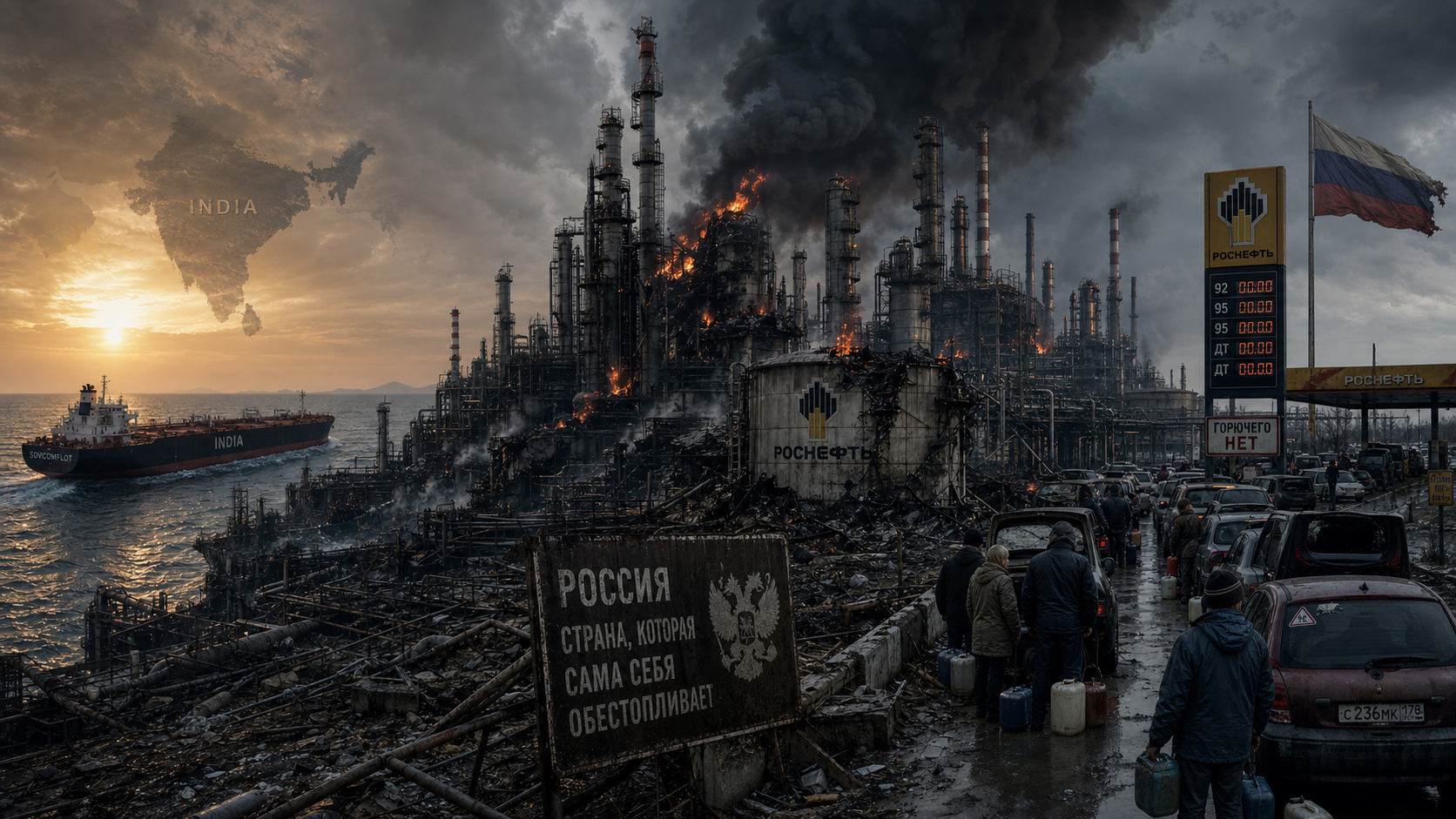
Historic humiliation: Why oil giant Russia is buying back its own gasoline from India – Image: Xpert.Digital
Putin's strategic own goal: The Kremlin suddenly has to import Russian oil at world market prices
Gasoline rationing in the oil-rich state: Ukrainian drones plunge Russia into a deep supply crisis
Devastating drone attacks: Putin's most important weapon of war is now devouring itself
For decades, Russia has been considered the undisputed global energy superpower, ruthlessly exploiting its massive oil and gas reserves as a geopolitical weapon. But now the country faces an economic paradox unprecedented in modern history: the world's third-largest oil producer is simply running out of fuel. A precise and strategically devastating drone campaign by Ukraine has so severely damaged Russia's refining infrastructure that the Kremlin is forced to take an extremely costly and humiliating measure. Moscow plans to buy back refined fuels like gasoline and diesel from India—precisely the end products India has been extracting from cheaply sold Russian crude oil. This historic supply crisis is not only leading to gasoline rationing in the heart of Siberia's most resource-rich regions, but is also fueling inflation and pushing the war economy to its limits. A detailed analysis shows how a strategic own goal is shaking Russia's social stability and why Ukraine's economic warfare is far more painful than Vladimir Putin is willing to admit publicly.
Related to this:

Russia is buying back its own oil from India
When the world's largest oil exporter becomes a fuel beggar: The strategic own goal of the war economy
Russia, the world's third-largest oil producer, faces an economic humiliation of historic proportions: The country, which has used energy exports as a geopolitical weapon for decades, is now buying back refined fuel products from India—the very crude oil that Moscow had previously shipped there at substantial discounts. This situation is the result of a consistent Ukrainian drone campaign against Russian refineries, which reached a new and devastating intensity in 2026, and simultaneously exposes the deep structural weaknesses of a war economy under pressure on multiple fronts at once.
The drone war is hitting the heart of Russia's energy supply
Since the start of Ukraine's drone campaign against Russian energy infrastructure, the frequency of attacks has increased at a remarkable pace. Between January and May 2026, Ukraine doubled the number of oil refineries attacked compared to the same period the previous year. Reuters calculated that Ukrainian drone attacks alone disabled approximately 700,000 barrels of refining capacity per day between January and May 2026 – spread across 16 refineries, some of which were hit multiple times. The IEA reported that Russia's crude oil production fell by 460,000 barrels per day year-on-year to about 8.8 million barrels per day in April 2026.
The geographical reach of this campaign is remarkable. Attacks targeted facilities in the Samara region (Sysran and Novokuibyshevsk), the Saratov refinery on the Volga River, the Tuapse refinery on the Black Sea, facilities in the Leningrad region, and—particularly symbolically—the Moscow refinery in the Kapotnya district, just 15 kilometers from the Kremlin. This latter facility supplied more than a third of the Russian capital's total fuel needs. When Ukrainian drones once again set fire to the Moscow refinery on June 17, 2026, and President Putin simultaneously hosted guests in Kazan without uttering a single public word about the attacks, it illustrated the profound discrepancy between the official narrative and the material reality.
Beyond the individual attacks, the attacks also massively damaged Russia's export infrastructure. In March 2026, the important Baltic Sea export ports of Ust-Luga and Primorsk were hit, followed in April by the Shezhariz oil export terminal in Novorossiysk, Russia's most important Black Sea port. The Kremlin-affiliated Center for Macroeconomic Analysis and Short-Term Forecasting (CMAKP) estimated the resulting decline in export capacity at around one million barrels per day, which corresponds to almost 20 percent of Russia's total export capacity.
From accumulated damage to a supply crisis
The extent of the accumulated damage is difficult to overstate. According to Ukrainian data, almost 40 percent of Russia's primary oil processing was at a standstill in May 2026. Refinery output fell to 4.58 million barrels per day in May 2026 – a 13 percent decrease compared to the same month of the previous year and the lowest level since autumn 2009. The Carnegie Russia Eurasia Center estimated the loss of refinery capacity at around 1.3 million barrels per day and emphasized that the resulting disruptions to transportation are impacting the entire Russian economy.
The crisis becomes particularly clear when looking at concrete gasoline production figures. At the beginning of June 2026, the remaining Russian refineries produced approximately 85,000 tons of gasoline per day, while the Russian economy requires around 110,000 tons per day during the summer months. This results in a daily deficit of at least 25,000 tons of fuel – a gap that cannot be filled by current imports from Belarus. Belarus supplies only 3,000 to 5,000 tons daily.
The Kremlin's response to this structural shortage was a rapid series of crisis measures. First, the Russian government imposed a comprehensive export ban on gasoline and diesel fuel to prioritize domestic supply. In May 2026, this was followed by an export ban on kerosene until November 30, 2026. Rosneft CEO Igor Sechin proposed requiring all oil companies to refining at least 30 percent of their crude oil domestically. The government is also considering actively subsidizing fuel imports—a measure unthinkable for an oil exporter in peacetime.
The paradox: Russia is buying back its own oil
The core of this analysis lies in an economic policy paradox unparalleled in modern economic history. Following the start of Russia's war of aggression against Ukraine in February 2022, India became the largest buyer of Russian sea oil. With discounts of up to $20 to $30 per barrel compared to the world market price, Indian state-owned companies such as IOC, BPCL, and Nayara Energy, as well as Reliance Industries – operator of the world's largest refinery complex – purchased Russian crude oil on a massive scale. In June 2026, India's crude oil imports from Russia reached a new record high of 2.66 million barrels per day.
These crude oil shipments were processed by Indian refineries into finished fuels – diesel, gas oil, jet fuel, and gasoline. India's gasoline exports soared to a record 400,000 barrels per day, with Asian countries as the main customers. Now, Russia plans to buy back precisely these refined products – that is, the gasoline produced in India from its own crude oil – to bridge its domestic fuel shortage.
According to reports, the Russian tax code is to be amended to introduce subsidies for oil companies that source gasoline abroad. These subsidies are to be calculated within the framework of the existing dampening mechanism for stabilizing fuel prices – and explicitly based on the "indicative gasoline price on the Indian market and delivery costs from Indian ports." The Kremlin is, of course, aware of the irony of this arrangement: Russia exports its crude oil at massive discounts and now buys back the resulting finished product at world market prices plus transportation costs.
From an economic perspective, this represents a significant loss of value. Russia loses the refining margin generated during the transformation process from crude oil to finished product – this typically ranges between $10 and $25 per barrel, depending on the process and product mix. Added to this are substantial transportation costs for returning the oil from Indian ports to Russian domestic markets. The repurchase therefore occurs at considerably higher costs than would have been incurred with intact domestic refining capacity.
The strategic failure of Russia's energy resilience
This situation exposes deep structural weaknesses in the Russian energy system. Russia possesses vast crude oil reserves, but a geographically concentrated and technologically outdated refining infrastructure. The Soviet-era mega-refineries were built for maximum throughput, not resilient distribution – a few very large plants each supply huge regions. This degree of centralization has now proven to be a strategic disadvantage: if individual large plants fail, entire regions face supply shortages.
Repair capacity is significantly hampered by sanctions pressure. Until 2022, key refinery equipment and control technology were primarily imported from Western Europe and the US. Russia's exclusion from Western supply chains after 2022 has drastically reduced the availability of spare parts, meaning that repairs to damaged equipment take considerably longer than in peacetime. Carnegie researcher Sergei Vakulenko warned as early as summer 2025 that some of the damaged facilities could remain permanently out of service. According to energy experts in Kyiv, the Rosneft plant in Tuapse has suffered such severe damage that a complete reconstruction of the facility may be necessary – at a cost of up to $5 billion.
Perhaps the most remarkable aspect of the unfolding crisis is its geographical spread to Siberia, the region that holds Russia's largest oil reserves. Gasoline rationing has been introduced in the Khanty-Mansiysk Autonomous Okrug, which contributes roughly 40 percent of Russia's total production. The Omsk and Novosibirsk regions, as well as Irkutsk, have also reported restrictions. The fact that a resource-producing region has to ration its own fuel demonstrates the extent to which the logistics and refining chain has been disrupted by the drone attacks.
The overall economic escalation spiral
The fuel crisis is not an isolated supply problem, but rather has broad macroeconomic repercussions. In its interest rate decision in June 2026, the Russian central bank explicitly cited rising gasoline prices as a pro-inflationary factor. Central bank governor Elvira Nabiullina explained that the increased cost of gasoline could also influence inflation expectations, as it is a particularly "sensitive commodity" for both consumers and businesses. The key interest rate remained at the high level of 14.25 percent – an immense burden for an economy already burdened with substantial war expenditures.
In the first quarter of 2026, the Russian economy contracted for the first time in three years, as the civilian sector suffered from high interest rates and a chronic labor shortage. The budget deficit for the first five months of 2026 already stood at six trillion rubles (around 61 to 62 billion euros), or 2.6 percent of GDP – 60 percent higher than projected for the entire year. Despite this, the Russian government plans to increase military spending by another four to five trillion rubles.
Oil and gas revenues, traditionally the backbone of Russian state financing, are in sharp decline. In 2025, they fell by 24 percent to 8.48 trillion rubles – the lowest level since the beginning of the decade. Their share of total federal revenue dropped from around 50 percent to about 23 percent in 2025. The Kremlin-affiliated analysis center CMAKP halved its GDP growth forecast for 2026 to just 0.5 to 0.7 percent.
To make matters worse, the ruble exchange rate is problematic for the budget. The budget calculation is based on an exchange rate of 92.2 rubles per US dollar, while the actual rate is below 80 rubles – which reduces real revenue in rubles. The total consolidated deficit for 2025 was reported as a historic record of 8.3 trillion rubles (around 90 billion euros).
Our global industry and economic expertise in business development, sales and marketing

Our global industry and economic expertise in business development, sales and marketing - Image: Xpert.Digital
Industry focus areas: B2B, digitalization (from AI to XR), mechanical engineering, logistics, renewable energies and industry
More information here:
A thematic hub offering insights and expertise:
- Knowledge platform covering global and regional economies, innovation and industry-specific trends
- A collection of analyses, insights, and background information from our key areas of focus
- A place for expertise and information on current developments in business and technology
- A hub for companies seeking information on markets, digitalization, and industry innovations
Ukraine relies on infrastructure attacks: The strategy behind the refinery attacks
India as the new linchpin of the Russian energy industry
India's role in this crisis is multifaceted and touches upon fundamental questions of geopolitical economics. Since 2022, India has become Russia's largest single customer in the oil trade. In May 2026, India imported fossil fuels from Russia worth a total of €5.8 billion. Major refineries such as Reliance, IOC, BPCL, and Nayara continue to purchase Russian crude oil, despite the US sanctions imposed on key Russian oil companies like Rosneft and Lukoil.
For India, the business was highly profitable: Cheap Russian crude oil was exported as a finished product at world market prices – a classic arbitrage between commodity and processing markets. At the beginning of 2026, the EU introduced new rules stipulating that it would no longer accept fuels from refineries that had processed Russian oil within the previous 60 days. Reliance Industries responded by splitting its production between its export-oriented and domestically oriented refinery complexes.
India's strategic autonomy in energy policy is of central importance in this context. Despite considerable US pressure, New Delhi has refused to fully adopt the sanctions rules and simultaneously benefits from low purchase prices. The Indian refining industry is now involuntarily becoming an intermediary in a geo-economic circular trade: Russia sells cheaply, India refines and sells back at a higher price. The political sensitivity of this situation is well understood in both Moscow and New Delhi, but is tacitly tolerated in light of the mutual economic advantages.
Related to this:

Social erosion: Rationing and growing dissatisfaction
The economic crisis is unfolding in a social dimension that is becoming increasingly dangerous for the Russian regime. In at least 55 of Russia's 83 regions, restrictions on fuel sales were in place until June 24, 2026. In some areas, gas stations are no longer allowed to sell gasoline in jerrycans. In other regions, strict quantity limits apply per vehicle or person—for example, Tatneft limits it to 30 liters of gasoline and 60 liters of diesel. In the Omsk region, gasoline sales have been limited to 40 liters per vehicle, and jerrycan sales are completely prohibited.
Russian agriculture is already sounding the alarm. Farmers warn that if fuel shortages persist during the crucial summer harvest season, the agricultural industry could face serious difficulties. For a war-torn economy that must simultaneously feed its population and supply its armed forces, this is a dangerous situation.
In Moscow, social media has proven to be an outlet for growing discontent. Videos show long lines at gas stations, and an app called "Where can I find gasoline?" maps open and stocked stations in real time. Bitter jokes about the gasoline shortage circulate on Russian-language social networks, including in the occupied Ukrainian territories. In a speech to military academy graduates on June 23, 2026, President Putin implicitly acknowledged that the Ukrainian drone strikes were achieving their goal when he described them as an attempt "to destabilize society.".
The logic of Ukrainian economic warfare
This context underscores the strategic consistency with which Ukraine is pursuing its drone campaign against Russian energy infrastructure. Since 2022, Ukrainian drones and missiles have carried out over 120 attacks on Russian energy infrastructure, 81 of them targeting refineries alone. Russian insurance experts have estimated the total losses suffered by the Russian oil industry due to drone attacks in 2025 at over $13 billion – approximately $1.1 billion in direct damage to facilities and further losses from lost revenue amounting to around $11.5 billion.
In 2026, Ukraine further intensified its campaign. From January to May 2026 alone, attacks on refineries, export terminals, and pipelines cost Russia over $7 billion, according to Ukrainian calculations. The shutdown of the Baltic Sea ports and the Novorossiysk terminal resulted in approximately $2.2 billion in lost export revenue within just a few weeks. Harvard researcher Craig Kennedy calculated that the average oil price would have to reach at least $115 per barrel by the end of the year for Russia to meet its 2026 budget targets without cuts.
The strategy is militarily precise: Ukraine's aim is not to immediately ruin Russia, but to increase risk premiums, deplete its repair resources, and—through the resulting discontent in Russia's hinterland—increase domestic political pressure on Vladimir Putin to maintain his legitimacy. The Kremlin has so far responded with a mixture of downplaying the situation, rationing decrees, and procuring replacements abroad, without being able to offer a sustainable solution.
Sanctions, the Shadow Fleet, and the limits of systemic resistance
Russia's adaptability to Western sanctions was remarkable between 2022 and 2024. A shadow fleet of an estimated 1,000 tankers circumvented Western insurance and transport restrictions, and new trade routes via Turkey, the United Arab Emirates, and India were established. The G7 price cap on Russian crude oil was undermined through creative workarounds.
But by 2026, it becomes clear that this resilience has its limits. First, a damaged refinery cannot be circumvented as easily as a financial market mechanism. Processing capacity is physical and location-bound; it cannot be relocated or replaced by shadow fleets. Second, at the beginning of 2026, the US tightened new sanctions against Russian oil tankers and companies, prompting large Indian refineries like Reliance to temporarily suspend Russian imports. Third, Russia's buffer storage facilities for surplus crude oil that can no longer be exported are nearing capacity, forcing producers to cut output.
The medium and long-term perspective
In the long term, Russia's energy sector faces structural challenges that extend beyond the current state of war. Even independent of drone attacks, energy expert Sergei Vakulenko of the Carnegie Russia Eurasia Center predicts a "gradual but steady" decline in Russian oil production as the most likely scenario for the coming decade. Western sanctions have cut off access to crucial exploration and production technology, particularly for Arctic deepwater projects and shale oil fields.
While Russia's crude oil reserves are immense, their economic exploitation without Western technology is becoming increasingly difficult and expensive. The temporary repurchase of fuel from India serves as a striking symbol of a deeper trend: the disconnect between raw material wealth and industrial processing capacity. A resource economy that is no longer able to fully process its own resources and instead relies on external service providers has taken a decisive step toward economic dependency.
Whether and at what pace Russia can close these deficits depends on the further course of the war, the efficiency of repairs under the pressure of sanctions, Ukraine's ability to sustain the offensive campaign, and the development of global oil prices. The Kremlin-affiliated CMAKP forecasts GDP growth of only 0.5 to 0.7 percent for 2026. Independent economists like Vakulenko expect even less, at just 0.3 percent growth.
A question of system stability
The question that arises at the end of this analysis is not purely economic: it is political. In Russia, oil is not just an export commodity, but the very means of social stabilization – affordable energy prices for the population have been part of the implicit social contract between the Kremlin and the people for decades. Put simply, the contract is: you get cheap gasoline, housing, and stability; we get political obedience.
Rationing in Crimea, Siberia, the Moscow region, and 55 of Russia's 83 regions is not just a logistical problem—it represents a crack in the agreement. The Russian central bank is explicitly warning of the inflationary consequences of rising gasoline prices on the population's inflation expectations. And the Kremlin is apparently considering postponing the parliamentary elections scheduled for September 2026 to avoid holding them under the shadow of a worsening supply crisis.
That Russia, as one of the world's largest oil producers, now has to import gasoline from abroad because its own refineries are in ruins is more than just an economic weakness. It's a geopolitical signal: The strategy of using energy as a tool of power no longer works in one direction when the adversary consistently targets processing infrastructure. Ukraine has found an asymmetric response to Russia's energy weapon – and this response is literally burning.
Consulting - Planning - Implementation

Markus Becker
I would be happy to serve as your personal advisor.
Head of Business Development
Chairman SME Connect Defense Working Group
Consulting - Planning - Implementation
Konrad Wolfenstein
I would be happy to serve as your personal advisor.
You can contact me at wolfenstein∂xpert.digital or
Just call me on +49 7348 4088 965 .










