
Automated high-bay warehouses as the key to a circular economy: Why classic logistics systems fail at modern recycling
Xpert Pre-Release

Available in 27 languages 📢
Prefer Xpert.Digital on GoogleⓘPublished on: August 13, 2026 / Updated on: August 13, 2026 – Author: Konrad Wolfenstein
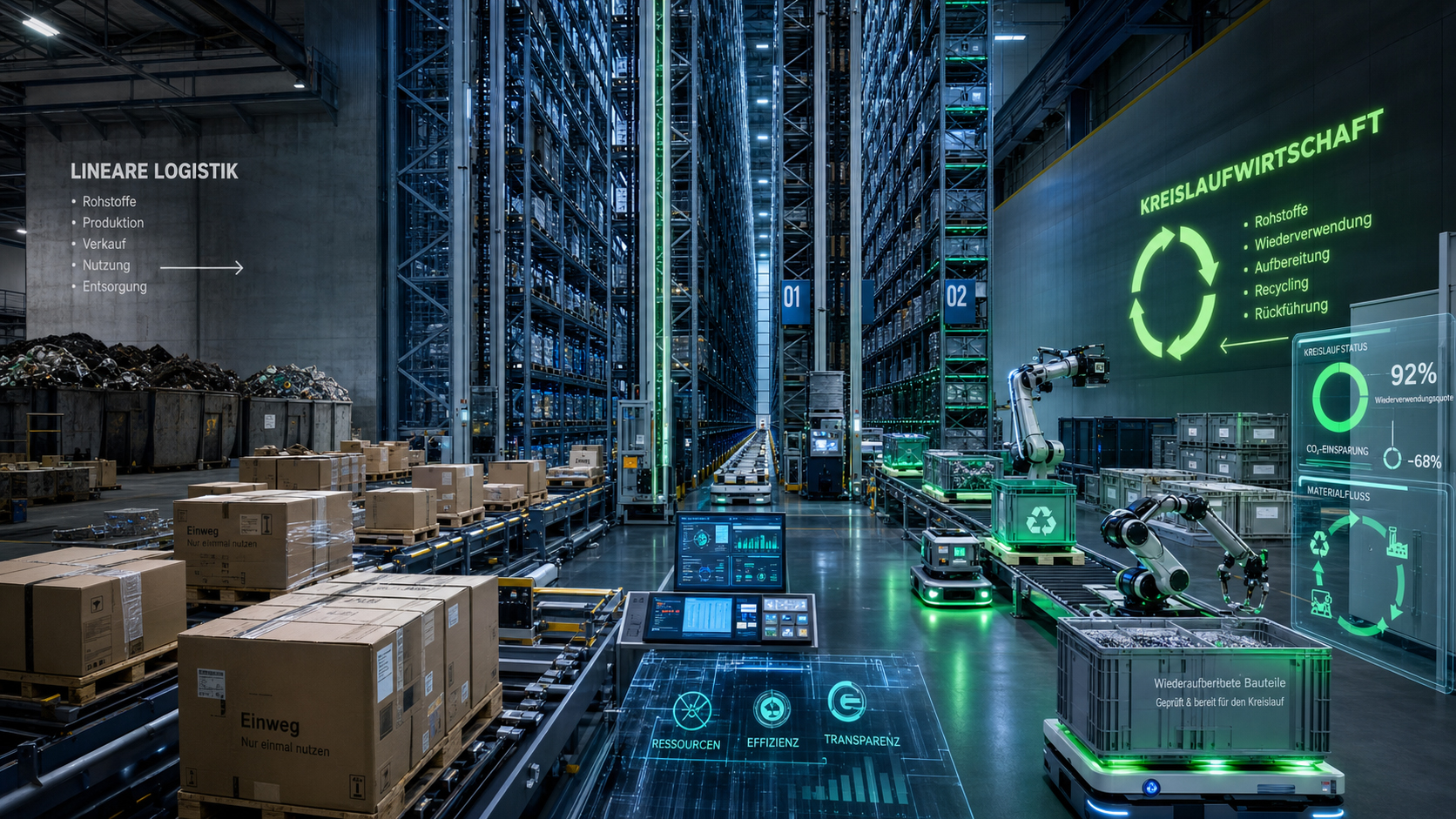
Automated high-bay warehouses as the key to a circular economy: Why classic logistics systems fail at modern recycling – Image: Xpert.Digital
Too rigid for the future? That's why 20-year-old high-bay warehouses now need an update
Retrofit instead of new construction: How companies are making their logistics fit for the circular age
Resource trap and billion-dollar opportunity: How smart logistics saves the circular economy
German industry is facing a historic turning point: The circular economy promises not only a way out of dangerous geopolitical dependence on raw materials, but also enormous value creation potential of up to €880 billion. However, on the path to this sustainable economic model, an unexpected and often overlooked bottleneck is revealed – our physical logistics infrastructure. For decades, high-bay warehouses were designed as pure "one-way streets" for standardized new goods and for maximum efficiency. Today, however, these rigid systems are encountering unpredictable returns, variable recycling fractions, and entirely new regulatory documentation requirements. Anyone who wants to implement circular business models profitably must recognize that the best sustainability strategy will fail if the warehouse cannot technically support it. This article examines why the transformation of industry must necessarily begin in the warehouse. Learn why the software level is becoming the real challenge, how clever retrofit concepts can future-proof old systems, and why intelligent reverse logistics is determining tomorrow's industrial competitiveness.
When concrete and steel are still trapped in the throwaway logic
German industry faces a paradoxical situation. While the circular economy is celebrated as the economic model of the future in politics, the media, and countless sustainability reports, much of the physical infrastructure that would technically enable these cycles still operates according to the principles of the old linear economy. High-bay warehouses, the backbone of industrial warehouse logistics, were designed for decades for a simple, directional flow of materials: raw material in, product out, end of story. Returns, remanufactured components, secondary raw materials, or heterogeneous recycling fractions were simply not considered in this way of thinking. This is precisely where a structural gap arises, which is increasingly becoming the limiting factor for circular business models because even the most sophisticated return strategy fails due to a warehouse that was simply not built for diversity, variable batch sizes, and reverse flows.
This structural backwardness is not a fringe issue for those interested in technology, but a very real economic problem. A recent study by the Federation of German Industries (BDI) and the Boston Consulting Group estimates the cumulative value creation potential of the circular economy for German industry at up to €880 billion by 2045, with annual circular gross value added more than doubling from the current €60 billion to up to €125 billion. At the same time, the 2026 status report on the German circular economy shows that volatile secondary raw material markets, rising energy and operating costs, and increasing regulatory requirements are putting key segments of the sector under pressure. Between this enormous economic potential and the sobering operational reality lies the storage infrastructure, a silent but crucial bottleneck.
Why raw material dependency is becoming a wake-up call for industry
The geopolitical dimension significantly increases the urgency. For critical raw materials such as lithium, nickel, and rare earth elements, Germany's import quota is almost 100 percent, making the industry directly vulnerable to geopolitical tensions, export restrictions, and sudden price fluctuations. According to the BDI-BCG analysis, recycling and reuse could replace between 20 and 40 percent of strategic raw material imports by 2045, with import dependency potentially decreasing by up to 20 percent for rare earth elements and up to 10 percent for battery materials. These figures illustrate that a circular economy is no longer merely an ecological extravaganza, but has become a matter of industrial sovereignty and security of supply.
To fully realize this potential, up to 83 million tons of recyclates must be made available annually, and the corresponding material flows must be kept within the country. Such a volume of heterogeneous secondary materials, often varying significantly in quality and composition, cannot possibly be managed with the rigid storage systems of the linear economy, designed for standard pallets and single-use goods. What's needed are storage architectures that can flexibly adapt to changing batch sizes, inconsistent container formats, and recurring return cycles, instead of treating them as disruptive factors in established processes.
The legacy of linear logistics architecture
To understand why existing high-bay warehouses are reaching their limits, it helps to look at their original design logic. In a traditional linear economy, natural resources are extracted from the earth, processed into products, and disposed of after use, without any significant reintegration of the materials into the economic cycle. This is because they are either not assigned economic value or because the necessary technological systems are lacking. These missing technological systems are precisely what modern, circularly conceived warehouse logistics must now provide.
Automated high-bay warehouses, known in industry jargon as unit-load AS/RS, have historically been optimized for maximum storage density for standardized large load carriers such as Euro pallets, industrial pallets, or wire mesh containers, reaching heights of over 40 meters. This specialization in homogeneity was economically logical in the post-war industrial era because it enabled enormous efficiency gains with standardized goods flows. However, this very strength becomes a weakness as soon as a company starts processing refurbished components, differently shaped returned goods, or variable recycling fractions through the same system for which it was never designed.
Reverse logistics as an underestimated value creation engine
A key component of any functioning circular economy is reverse logistics, the systematic return of products, components, and materials from their use cycle back into production or reprocessing. Expert analyses emphasize that a well-designed, integrated IT system landscape is essential for connecting the various stakeholders in this return process and increasing efficiency. In addition to a warehouse management system with real-time tracking, a dedicated inventory management system is also recommended, ensuring a constant overview of returned products or used parts. This recommendation exemplifies that the software layer of warehouse control is at least as crucial as the physical racking architecture itself.
The practical relevance of this is particularly evident in e-commerce, where returns have long since become one of the biggest logistical challenges, especially in the fashion segment with its high volumes, short processing times, and complex quality requirements. A real-world example shows how a logistics provider, together with a workwear brand, established a highly automated returns management system in which returned packages are automatically routed to the responsible employees, inspected, and then restocked in the automated shuttle system on the same day. Such solutions demonstrate that reverse flows are technically manageable if the automation architecture is designed for two-way logistics from the outset, rather than forcing it into a purely one-way system after the fact.
When 20-year-old systems meet new material flows
A key structural problem lies simply in the age of the existing infrastructure. Automated high-bay warehouses with lifespans exceeding 20 years generally require modernization because the demands placed on intralogistics systems are constantly evolving. A prominent example is a logistics service provider whose automated high-bay warehouse at its Herne site had been in operation for 35 years before a comprehensive modernization of the storage and retrieval machines, conveyor technology, and control systems was commissioned, with the entire conversion carried out while the facility remained operational. Such timeframes illustrate that many of today's active systems originate from an era in which the circular economy, as we understand it today, was not yet an established industrial principle.
As a general guideline in the industry, automated storage systems typically operate for ten to fifteen years before a major overhaul is strongly recommended, with a timely retrofit often being a significantly more cost-effective alternative to a complete new purchase. This economic logic opens up a considerable window of opportunity for companies to strategically combine their already necessary modernization with a realignment towards circular material flows, instead of simply preserving the old linear logic in new hardware.
Retrofit instead of new construction as a pragmatic transformation path
For many companies, constructing a completely new high-bay warehouse is hardly economically feasible, which is why retrofitting existing systems plays a central role in practice. A typical retrofit concept includes replacing storage and retrieval machines, renewing the conveyor technology, modernizing the control and sensor systems, and switching to current software architectures, with particular emphasis placed on ensuring that implementation can be carried out gradually and while operations continue. In one documented case, an existing long goods storage system was fundamentally modernized within just four weeks, with only the steel structure and cassettes of the original system remaining, while the storage and retrieval machine, undercarriage, carousel stations, and all safety and control technology were completely replaced.
Modular retrofit solutions now exist for existing buildings without prior automation. These solutions largely preserve existing infrastructure and allow for installation during ongoing operations, even in buildings up to 14 meters high. Another example from the metal industry demonstrates how a retrofit project involved the installation of more energy-efficient, frequency-controlled drives, resulting in significantly higher energy efficiency and optimized processes. These examples illustrate that retrofit projects are no longer simply about repairing wear and tear, but can become a strategic lever for transforming entire material flow concepts.
LTW Intralogistics Solutions

LTW Intralogistics – Engineers of Flow - Image: LTW Intralogistics GmbH
LTW offers its customers not individual components, but integrated complete solutions. Consulting, planning, mechanical and electrotechnical components, control and automation technology, as well as software and service – everything is networked and precisely coordinated.
In-house production of key components is particularly advantageous. This allows for optimal control of quality, supply chains, and interfaces.
LTW stands for reliability, transparency, and collaborative partnership. Loyalty and honesty are firmly anchored in the company's philosophy – a handshake still means something here.
Related to this:
From linear to circular: Strategies for modernizing automated warehouse systems
The technical architecture of circular storage systems
For a high-bay warehouse to truly become circular, simply replacing individual components is not enough. Crucially, it must be able to efficiently handle homogeneous new goods as well as heterogeneous returns, remanufactured components, and variable recycled fractions within the same system. Modern automated small parts warehouses designed for standardized plastic containers offer significantly greater adaptability than traditional pallet warehouses with rigid load units, thanks to highly dynamic storage and retrieval systems and flexible conveyor technology. The targeted use of recyclable materials in the logistics process itself, such as robust plastic containers instead of single-use cardboard boxes, further supports the circular economy at the packaging level.
Robot-assisted handling systems are playing an increasingly important role, particularly when it comes to processing non-uniform material shapes, as are typical for recycling or remanufacturing processes. In an example from the cable industry, a pioneering combination of automated high-bay warehouse and robot-assisted coil handling was implemented over a decade ago. This system is now being adapted to current requirements as part of a comprehensive retrofit, including the replacement of the storage and retrieval machines and a complete redesign of the warehouse management software. Such projects exemplify how highly specialized handling technology and flexible software control can be combined to form a robust foundation for circular material flows.
The IT level as the actual bottleneck of the transformation
While the mechanical modernization of storage and retrieval machines and conveyor technology is well-documented in the technical literature, the real strategic bottleneck often lies at the software level. Warehouse management systems must be able to manage returns, remanufactured batches, and secondary raw materials with completely different attributes than standard goods, such as quality levels, origin marking, or further processing paths. The development of integrated IT systems is recommended, systems that can fully map a process chain from return and sorting to connection with recycling or reprocessing facilities, supplemented by automated, rule-based checks of return orders, for example, using Robotic Process Automation.
In practice, this software complexity is regularly underestimated in retrofit projects. For example, the modernization of a cable warehouse involved not only replacing physical components but also completely redesigning the warehouse management software and migrating and redeveloping the higher-level plant control system. Similarly, an example from the chemical industry shows that modern retrofit concepts increasingly rely on programmable logic controllers (PLCs) that are directly connected to higher-level enterprise systems such as SAP to ensure seamless integration into the overall IT landscape. These examples illustrate that the true circularity of a warehouse is less a question of its steel structure than a question of its data architecture.
Economic incentive structures for restructuring
From a business perspective, many companies face the crucial question of whether a targeted circular orientation of their warehouse infrastructure is even worthwhile. The BDI-BCG study provides a remarkably concrete answer by demonstrating that one-off investments of around €20 billion by 2045 could strategically expand the circular economy in Germany and retain additional value creation domestically. Compared to the projected cumulative value creation potential of up to €880 billion, this investment requirement appears relatively moderate, suggesting a favorable ratio between capital outlay and long-term economic benefits.
In addition, there is a clearly quantifiable climate effect, as the circular economy could enable around 11 million tons of additional greenhouse gas savings by 2045 and reduce the cumulative costs of the energy transition by almost 40 billion euros. The reuse and reprocessing of components for wind turbines, transformers, and batteries is particularly interesting in this context, as it allows for a more cost-efficient development of the energy transition infrastructure while simultaneously reducing dependence on critical raw materials. It is precisely for these types of components, which are neither standardized mass-produced goods nor classic scrap, that storage systems are needed that can flexibly mediate between reprocessing, intermediate storage, and reuse.
Regulatory pressure as an additional accelerator
In addition to purely economic incentives, the regulatory framework is increasingly acting as a driver of transformation. The 2026 status report on the German circular economy emphasizes that the sector plays a central role in ensuring waste disposal security, raw material supply, value creation, and environmental infrastructure in Germany, while growing regulatory requirements simultaneously burden key segments of the industry. This dual role—being both a strategic growth driver and a heavily regulated segment—forces companies to align their warehouse logistics not only with pure efficiency criteria but also with verification and documentation obligations regarding material origin and recycled content.
This development further intensifies the pressure on the IT level of warehouse systems, because seamless track-and-trace functionality will no longer be merely a business-related nice-to-have, but a regulatory requirement. Therefore, the use of transport management systems with track-and-trace functionality for seamless product tracking, as well as time slot management for delivery planning to return locations, is already recommended. Those who integrate these requirements into their warehouse architecture early on gain a structural advantage over competitors who have to retrofit regulatory documentation requirements into existing systems.
Industry-specific use cases between chemicals, packaging and consumer goods
The need for circular storage solutions is evident in a wide variety of industries, albeit with specific characteristics in each. In the chemical industry, for example, the modernization of existing pallet conveyor technology and storage and retrieval systems focuses primarily on ensuring a reliable long-term supply of spare parts and optimizing the transport of various chemical raw materials. This modernization is carried out gradually to avoid disrupting ongoing operations. Meanwhile, a packaging manufacturer built a completely new automated distribution center to accommodate further company growth and establish an intelligent system solution for a customized material flow.
In the perishable goods sector, automated storage and retrieval systems demonstrate how they support manufacturers in terms of speed, inventory accuracy, and process reliability. Automated high-bay warehouses, stacker cranes, and conveyor technology take over the complete control of storage and retrieval processes as well as the internal transport of loading units. These examples from diverse industries such as chemicals, packaging, and food production prove that the demand for flexible, circular economy-oriented warehouse logistics has long since become relevant across all sectors and is no longer limited to traditional recycling companies.
What a truly circular high-bay warehouse must be able to do
By combining the various case studies and research findings, a clear set of requirements for a high-bay warehouse strategically aligned with the circular economy can be derived. First, the conveyor technology must be capable of processing both standardized new goods and heterogeneous returns and secondary raw materials without requiring structural modifications during ongoing operations. Second, warehouse management software is needed that comprehensively documents material origin, quality levels, and processing paths, while seamlessly integrating with higher-level enterprise systems. Third, a modular, retrofittable architecture is crucial so that future adaptations to new material flows do not necessitate a complete rebuild, but can be implemented gradually during ongoing operations, as has already been successfully demonstrated in numerous modernization projects.
Fourth, robot-assisted handling systems should be integrated, specifically designed for processing non-uniform material shapes, such as those typically encountered in remanufacturing and recycling processes. Fifth, the energy efficiency of the drive technology gains additional strategic importance, as frequency-controlled, energy-efficient drives not only reduce operating costs but also contribute directly to the overall climate footprint of the circular economy strategy. Companies that consistently consider these five dimensions together transform their high-bay warehouse from a passive cost factor into an active strategic lever for circular value creation.
A long overdue structural realignment
The analysis makes it clear that the discussion about the circular economy cannot end at the abstract level of sustainability strategies and political targets, but must be consistently considered down to the concrete physical infrastructure of warehouse logistics. As long as automated high-bay warehouses are still technically and software-wise designed for the old linear, one-way logic, a significant portion of the value creation potential of up to €880 billion identified by the BDI and BCG remains theoretical because the necessary operational basis is lacking. The good news is that the technical solutions for this transformation already exist, be it through modular retrofit concepts for existing systems, robot-assisted handling systems for heterogeneous material flows, or integrated IT architectures for the seamless tracking of secondary raw materials.
Given that many existing facilities are due for a major overhaul anyway due to their age, German industry has a historically favorable window of opportunity to strategically combine the necessary modernization with a realignment towards circular material flows. Those who miss this opportunity and merely preserve the old linear logic in new hardware risk not only missed value creation but also increasing dependence on volatile commodity markets and geopolitically fragile supply chains, while competitors with consistently circular storage infrastructures are unlocking structural cost advantages and new business models.
Consulting - Planning - Implementation

Konrad Wolfenstein
I would be happy to serve as your personal advisor.
You can contact me at wolfenstein∂xpert.digital or
Just call me on +49 7348 4088 965 .
Your intralogistics experts

Consulting, planning and implementation of complete solutions for high-bay warehouses and automated storage systems - Image: Xpert.Digital
More information here:










