
Why autonomous high-bay warehouses will ensure the survival of industrial sites
Xpert pre-release

Available in 27 languages 📢
Prefer Xpert.Digital on GoogleⓘPublished on: January 7, 2026 / Updated on: January 7, 2026 – Author: Konrad Wolfenstein
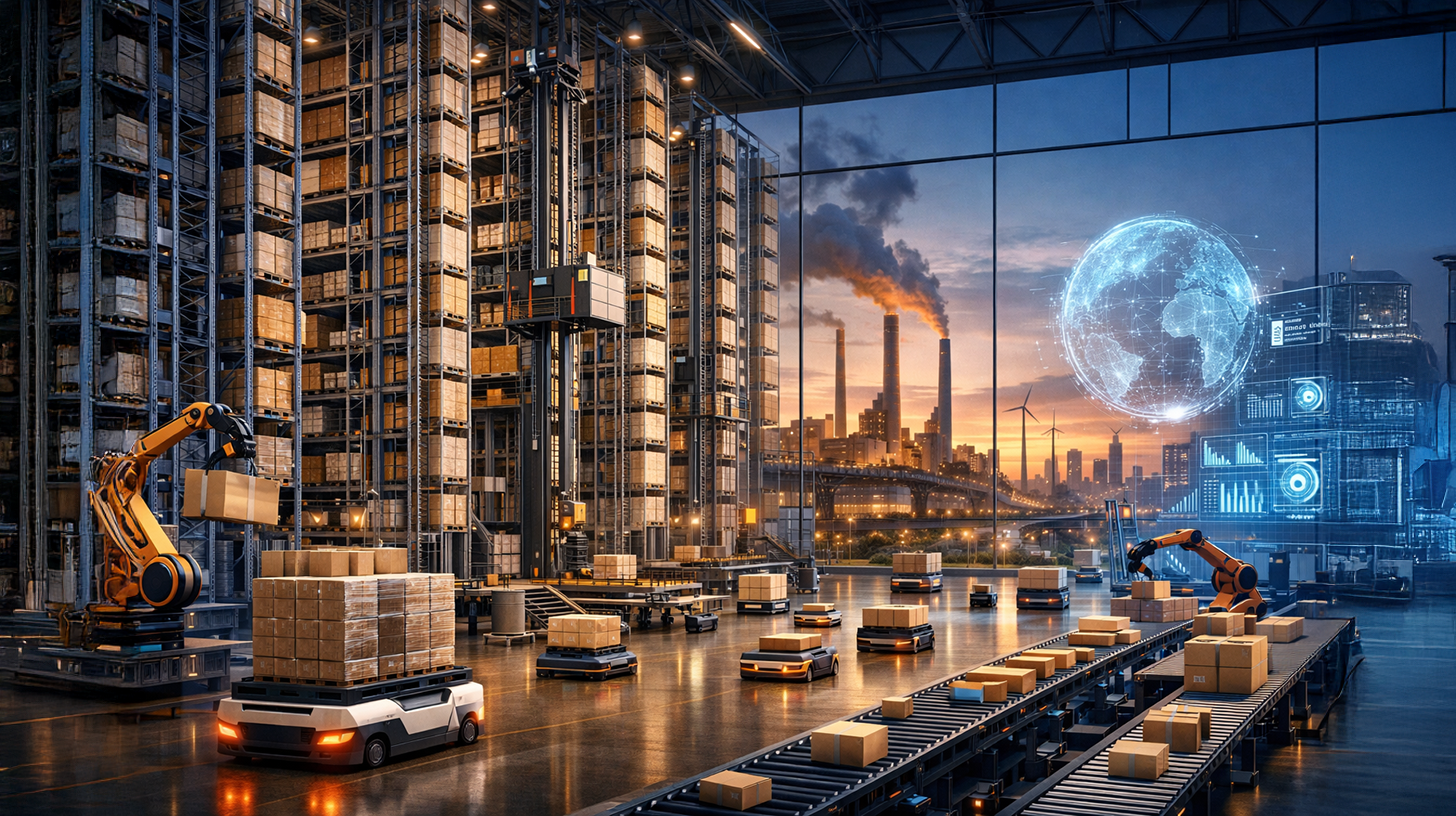
Why autonomous high-bay warehouses ensure the survival of industrial sites – Image: Xpert.Digital
From static concrete block to intelligent organism: The inevitable evolution of the high-bay warehouse
Is your supply chain at risk? This technology secures your company's future
The image of the traditional warehouse as a dusty hall where forklifts are manually maneuvered through endless rows of shelves is fading rapidly. We stand on the threshold of a new industrial era in which the high-bay warehouse is no longer mere infrastructure, but has transformed into the autonomous heart of global value creation. The drivers of this transformation are no longer just the desire for moderate efficiency gains, but stark economic and demographic necessities.
By 2035, the market for logistics automation will grow to almost 400 billion US dollars. But behind these enormous investment sums lies a dramatic reality: The massive shortage of skilled workers, which in regions like Baden-Württemberg is already causing surplus employment rates of almost 40 percent, is making human labor a resource that is simply no longer scalable. Companies are faced with a choice: complete automation or the loss of their ability to deliver.
The following article analyzes in depth why the use of artificial intelligence, robotics, and autonomous systems (AMR) is the only logical answer to this crisis. We examine the financial mathematics beyond the classic ROI, explain why the energy-efficient dark warehouse is becoming an ecological imperative, and how new business models like Robotics as a Service (RaaS) enable even medium-sized businesses to enter the market. We also take a critical look at the regulatory pitfalls of the EU AI Regulation and the growing threats to cybersecurity. Learn why the autonomous high-bay warehouse ensures the survival of industrial sites and how you can strategically position your company for the year 2035.
Billion-dollar market by 2035: Those who don't automate now will lose their place among the world's leading companies
The structural transformation of global trade flows and the accompanying technological evolution of intralogistics mark the beginning of a new era in which the high-bay warehouse no longer functions as a static structure, but as a highly dynamic, autonomous ecosystem. In a world characterized by increasing volatility, extreme demands for delivery speed, and an unprecedented shortage of skilled labor, the integration of artificial intelligence, robotics, and autonomous systems is becoming a decisive competitive advantage. The economic logic is shifting away from optimizing human labor toward complete technological autonomy, with Germany, as a leading technology hub, facing the challenge of spearheading this transformation both regulatory and operational.
The market-economic dimension of automation until 2035
Global investments in logistics automation are following a steep growth trajectory, driven by the need for increased efficiency and the digitalization of Industry 4.0. The market for automation components, which reached a volume of approximately US$161.04 billion in 2025, is projected to grow to US$399.09 billion by 2035. This represents an average annual growth rate of approximately 9.5 percent. More broadly, the entire industrial automation market is estimated to reach a volume of between US$533.31 billion and US$608.59 billion by 2035. A significant portion of this market is attributable to industrial robots, which are expected to account for 56 percent by 2035, driven by their ability to perform tasks with a precision and speed that far surpasses human capabilities.
The geographical distribution of these investments shows that highly developed industrialized nations, in particular, are modernizing their production and logistics facilities to strengthen local industry against global competition. Policy initiatives such as Germany's Industry 4.0, Made in China 2025, and Make in India are massively promoting the adoption of smart manufacturing technologies and autonomous systems. In the US, the government is investing billions in infrastructure, which indirectly increases the need for highly efficient logistics solutions for distributing technological components.
| Market indicator | Value in 2025 (billion USD) | Forecast 2035 (billion USD) | CAGR (%) |
|---|---|---|---|
| Automation components | 161,04 | 399,09 | 9,5 |
| Industrial Automation Overall | 215,20 | 533,31 | 9,5 |
| Optimistic scenario | 226,07 | 608,59 | 10,6 |
| Share of industrial robots | 120,51 | 298,65 | 9,5 |
| Control and DCS systems | 139,88 | 346,65 | ~9,5 |
These figures illustrate that automation is no longer considered a marginal phenomenon, but rather a central foundation of the modern economy. The decentralized control systems (DCS) segment is expected to account for over 65 percent of revenue, underscoring the increasing networking and intelligence of industrial plants. Particularly in emerging markets, rapid industrialization is driving the demand for automated solutions, with a growing focus on economic development and efficiency.
The demographic abyss and the new logic of unemployment
Perhaps the strongest driver for autonomy in high-bay warehouses is the structural deficit in the labor market. In Germany, and specifically in technologically leading regions like Baden-Württemberg, the shortage of skilled workers has escalated into widespread unemployment. In the 2024/2025 fiscal year, Baden-Württemberg alone was short approximately 53,560 qualified workers, with a surplus of job vacancies of around 38 percent. This means that for almost four out of ten open positions, there are no suitable applicants. In logistics hubs like Offenburg or Ulm, this figure is even higher, exceeding 50 percent.
The shortage affects all qualification levels, but is most critical for experts with master's or diploma degrees, while the absolute gap is greatest for skilled workers with traditional vocational training. For the logistics sector, this represents an existential threat. The shortage of drivers and warehouse staff already cost the German economy around €10 billion in 2022. Nine out of ten medium-sized companies consider the staff shortage a real threat to their operational capacity.
| Region/Industry | Force shortage (BW) | Staff surplus (%) | Focus professions |
|---|---|---|---|
| Baden-Württemberg Total | 53.560 | 38,0 | Sales, maintenance, electrical work |
| Offenburg region | – | 56,7 | Logistics and Industry |
| Ulm region | – | 53,9 | Production and craftsmanship |
| Healthcare (Germany) | 46.000 | – | Physiotherapy, nursing |
| Construction industry (Germany) | 41.300 | – | Electrical engineering, HVAC |
The consequence of this demographic shift is a change in corporate strategies towards a fully automated infrastructure. When human labor is no longer available or affordable, the autonomous high-bay warehouse becomes the only option for maintaining supply chains and increasing resilience to global shocks. Digitalization is thus transforming from an optimization tool into a survival strategy for Germany's industrial base.
Financial mathematics of autonomy: Return on capital and total operating costs
The economic evaluation of automation projects is traditionally based on return on investment (ROI), but modern experts call for a more in-depth analysis of total cost of ownership (TCO). While manual warehouses require lower initial investments, they incur high operating costs due to personnel costs, susceptibility to errors, and inefficiency. In manual warehouses, order picking alone often accounts for 50 to 60 percent of operational warehousing costs.
An automated system, such as a vertical lift module or an AutoStore system, reduces space requirements by up to 80 percent and significantly increases storage density on the same footprint. This space saving allows companies to operate in smaller buildings or expand in existing warehouses without expensive extensions. The payback period for such investments is typically between 18 and 36 months, and even shorter in ideal scenarios (multi-shift operation, high labor costs).
A crucial factor is the cost of errors. In manual, paper-based processes, accuracy is often only around 97 percent, meaning that approximately 30 errors occur for every 1,000 picks. Each of these errors incurs average follow-up costs of around €19.50 through returns, customer service, and reshipments. Automated systems achieve an accuracy of over 99.9 percent, which, with high order volumes, enables annual savings in the high six-figure range.
The calculation of the economic benefit can be represented by the following formula for the annual error costs:
E_Errors = N_Picks × R_Errors × K_Errors
Here, N_Picks represents the number of annual picking operations, R_Errors the error rate, and K_Errors the average cost per incorrect pick. With one million picks per year and an error rate of three percent in a manual warehouse, the annual error costs amount to approximately €585,000; this represents the avoidable potential for error costs. Since automated systems typically reduce the error rate by orders of magnitude and, in practice, achieve near 99.9 percent accuracy, a large portion of this amount can flow directly back into the operating result.
| Key figure | Manual warehouse | Automation (VLM/AutoStore) | effect |
|---|---|---|---|
| Throughput (picks/h) | ~60 – 80 | 300+ | +400% |
| Error rate | 3,0% | < 0,1% | -97% |
| Land use | 100% basis | 20% of the base | -80% area |
| Training time | Days to weeks | 10-20 minutes | Immediate productivity |
| Employee travel time | Up to 15 km/day | Almost 0 | Ergonomics and time savings |
Furthermore, soft factors such as employee retention and ergonomics must be considered. In a manual warehouse, employees cover considerable distances daily (often up to 10–15 kilometers), which can lead to physical strain and increased rates of illness. Automated goods-to-person systems deliver items at an optimal ergonomic height, increasing job satisfaction and significantly reducing downtime.
Robots as a service: Drivers of democratized automation
An innovative trend that lowers the economic barrier to entry for small and medium-sized enterprises (SMEs) is the "Robots as a Service" (RaaS) model. Here, the company no longer invests in owning the hardware, but pays for actual performance, for example, per pick or per bin presentation. This transforms capital expenditures (CapEx) into variable operating expenses (OpEx), thereby improving balance sheet ratios and credit lines for the company.
RaaS providers bundle hardware, software, maintenance, and updates into a single package. This is particularly attractive in an environment of high interest rates (often 6 to 8 percent per year) and rapid technological innovation cycles. The break-even point between purchasing a system and using a RaaS model is often around one million picks per year. For companies with seasonal fluctuations, RaaS offers the necessary flexibility to scale capacity up or down without long-term commitments.
The advantages of this model are obvious:
First, there is an immediate positive cash flow, as the savings in personnel costs are often directly greater than the monthly RaaS fee. Second, the risk of technological obsolescence is eliminated, as the provider is responsible for keeping the fleet up to date. Third, companies without in-depth internal automation expertise can operate complex systems, since support is an integral part of the contract.
However, challenges remain. Vendor lock-in, i.e., dependence on a provider's proprietary software, must be avoided through appropriate contractual clauses regarding data portability. Furthermore, data protection and cybersecurity are critical issues, as operational data is often processed in the service provider's cloud.
LTW Solutions

LTW Intralogistics – Engineers of Flow - Image: LTW Intralogistics GmbH
LTW offers its customers not individual components, but integrated complete solutions. Consulting, planning, mechanical and electrotechnical components, control and automation technology, as well as software and service – everything is networked and precisely coordinated.
In-house production of key components is particularly advantageous. This allows for optimal control of quality, supply chains, and interfaces.
LTW stands for reliability, transparency, and collaborative partnership. Loyalty and honesty are firmly anchored in the company's philosophy – a handshake still means something here.
Suitable for:
Logistics 2035: Why autonomous warehouses will soon be more important than factories
Technological shifts through machine vision and generative intelligence
The performance of autonomous systems in high-bay warehouses is being massively enhanced by advances in artificial intelligence and sensor technology. Modern autonomous mobile robots (AMRs) use computer vision and simultaneous localization and mapping (SLAM) to orient themselves in space without physical infrastructure such as magnetic strips or QR codes. Market leaders like Amazon Robotics already deploy over 750,000 such units, with newer models like Proteus capable of completely free navigation and dynamically avoiding obstacles.
Artificial intelligence acts as the brain of the warehouse. It optimizes storage strategies (slotting) by automatically moving frequently used items closer to the dispensing stations and predicts when a component is at risk of failure through predictive maintenance. Generative AI, in particular, offers new potential by learning complex picking processes through reinforcement learning. A robot can thus learn in a very short time how to safely grasp unstructured objects with varying surfaces and weights – a task that previously required human intuition.
The combination of vertical storage and mobile robotics creates synergies that can increase throughput to over 300 picks per hour. Robots perform continuous inventory counting (cycle counting), which minimizes stock discrepancies and eliminates the need for costly annual stocktaking. This results in real-time transparency, which is essential for modern just-in-time supply chains.
| technology | Function in the warehouse | Economic benefits |
|---|---|---|
| SLAM navigation | Free movement of AMRs | No costs for floor markings |
| Predictive maintenance | Predicting wear | Avoiding costly downtime |
| Machine vision | Object detection and grasping | Automation of unstructured tasks |
| AI slotting | Optimization of goods distribution | Reduction of robot travel paths |
| Cloud connectivity | Fleet management | Scalability across multiple locations |
The integration of these technologies enables systems not only to perform tasks but also to learn and adapt to changing environments. This represents the transition from mechanized automation to true autonomy, where the system independently makes decisions to optimize processes.
The dark storage facility as an ecological and energetic imperative
The concept of a dark warehouse describes a fully autonomous logistics unit that operates without human presence. Since robots do not require light and are insensitive to extreme temperatures, these facilities can operate under conditions unsuitable for humans. Eliminating the need for lighting, heating, and air conditioning for personnel drastically reduces the energy consumption of such a warehouse.
A dark storage system offers significant environmental benefits through a reduced carbon footprint. Shuttle systems and modern storage and retrieval machines consume considerably less energy compared to conventional forklifts and can further increase their efficiency through regenerative braking. Studies show that automated shuttle systems can reduce energy consumption and CO2 emissions by more than 50 percent compared to conventional rack storage systems.
Ecological sustainability is further enhanced by compact construction methods. Since no wide aisles for forklifts or escape routes for personnel are required, warehouses can be built up to 36 meters high, drastically reducing land use. This protects natural habitats and reduces the sealing of soil surfaces in urban fringe areas.
| Sustainability factor | Effect of automation | Economic/ecological consequences |
|---|---|---|
| lighting | Virtually 0% in dark storage | Reducing electricity costs |
| air conditioning | Only needed for product characteristics | Massive savings on heating/cooling |
| Land use | Reduction of up to 80% | Lower construction costs and less land sealing |
| Waste management | AI-supported reduction of packaging | Savings in corrugated cardboard and plastics |
| CO2 emissions | Reduction of > 50% | Achieving ESG targets and tax bonuses |
Furthermore, automation enables a circular economy through AI-supported returns management. Artificial intelligence can assess returned goods more quickly and reintegrate them into the warehouse cycle, reducing product waste and increasing added value. Sustainability is therefore no longer merely a compliance factor, but a direct source of cost efficiency and brand reputation.
Standardization and overcoming proprietary lock-in effects
A historical obstacle to the adoption of autonomous systems was market fragmentation. Each company used its own communication protocols, which meant that robots from different manufacturers could not cooperate with each other. This technological lock-in effect increased switching costs and deterred many companies from investing.
The introduction of the VDA 5050 interface marks a turning point. This standard enables cross-manufacturer communication between autonomous vehicles and a central control system. Companies can now operate a fleet consisting of specialized robots from different suppliers – for example, a heavy pallet robot from one manufacturer and a small container robot from another. This fosters competition and allows for gradual, modular automation.
Organizations like the Open Logistics Foundation support this trend by providing a neutral platform for open-source software in logistics. The goal is to avoid redundant development work through the collaborative development of core components and to establish interoperability as an industry standard. This strengthens the digital sovereignty of users and reduces dependence on individual large vendors like Daifuku, Dematic, or SSI Schäfer, who nevertheless dominate the market as technological pioneers.
From an economic perspective, standardization means:
First, integration costs are drastically reduced, as expensive individual programming efforts are eliminated. Second, agility increases, since fleets can be flexibly expanded or replaced as needed. Third, investment security is enhanced, as companies no longer have to gamble on a single proprietary vendor remaining in the market for ten years or keeping their software up to date.
The high-risk regulatory space between AI regulation and liability law
With increasing autonomy, the legal framework is becoming a focus of economic analysis. The European Union has established strict rules with the AI Act and the revised Machinery Regulation (EU) 2023/1230 to ensure the safety of autonomous systems. Systems used in logistics for safety-critical functions can be classified as high-risk systems, which entails comprehensive conformity assessments and human oversight.
A particularly critical aspect of the new machinery regulation is the definition of substantial modifications. If an operator alters a robot's software through AI updates in such a way that its behavior evolves significantly, they can legally become the manufacturer and thus assume full liability for the system's safety. This necessitates precise documentation of data governance and the algorithm logic to clarify the chain of liability in the event of accidents.
Product liability law has also been extended to digital products and software. If an AI error leads to property damage or personal injury, strict liability applies. This forces companies to adapt their insurance models and ensure technical reliability throughout the entire lifecycle of the system.
Requirements for high-risk AI systems under EU law:
- Systems must have robust risk management systems that continuously identify and minimize potential hazards.
- Data sets for training the AI must be representative and free from bias.
- Complete technical documentation and logging of all system decisions is absolutely essential.
- Effective human intervention (kill switch function) must be possible at all times to put the system into a safe state.
Compliance with these rules is not only a legal obligation but also an economic factor. Violations can lead to massive fines and the loss of operating licenses. At the same time, a clear regulatory framework fosters confidence among investors and customers in the reliability of autonomous systems.
Cybersecurity as a prerequisite for the existence of the autonomous supply chain
The complete networking of autonomous high-bay warehouses makes the logistics industry a prime target for cybercriminals. Since every link in the supply chain is digitally interconnected, a single vulnerability at one supplier can be enough to cripple the entire network. Ransomware attacks, in particular, which encrypt critical operational data, pose an existential threat.
Outdated IT systems (legacy systems) in existing warehouses are often the biggest entry points for cyberattacks. Many ERP or WMS systems are based on technologies that are not designed for the threat scenarios of 2025. An industrial PC connected unprotected to the warehouse Wi-Fi network can serve as an entry point for malware that can penetrate all the way to the central control systems.
The economic consequences of a cyberattack are devastating:
production downtime results from blocked material flow systems. High costs are incurred for data and system recovery. Reputational damage with customers and partners jeopardizes long-term contracts. Furthermore, requirements are increasing due to laws such as the Cyber Resilience Act (CRA) and the NIS2 Directive, which mandate a minimum level of security for networked products.
Prevention strategies for autonomous storage environments:
- Companies must conduct regular penetration tests to proactively find vulnerabilities.
- Implementing a zero-trust architecture ensures that every connection in the network must be verified.
- Continuous employee training in the detection of phishing and social engineering is essential, as humans often remain the weakest link in the security chain despite automation.
- Finally, emergency plans and backups must be tested regularly to enable a quick resumption of operations in case of emergency.
Cybersecurity is therefore no longer purely an IT task, but a strategic management task that directly affects the delivery capability and financial stability of the company.
2035: How autonomous camps will change our economy forever
Economic analysis shows that autonomous high-bay warehouses will form the backbone of the global economy by 2035. The transition to full autonomy is not a linear process, but a disruptive leap driven by technological maturity and demographic necessity. Germany must leverage its position as a technology leader not only to export hardware, but also to set the standards for the autonomous ecosystem.
The following strategic recommendations for action are recommended for decision-makers:
- First, automation should be viewed as a modular project. Open interfaces like VDA 5050 allow companies to start small and scale their systems with business success.
- Secondly, the shift from CapEx to OpEx through models such as RaaS must be examined in order to maintain financial flexibility.
- Thirdly, early engagement with the EU AI Regulation and the Machinery Regulation is essential in order to transform legal risks into competitive advantages through certified safety.
- Fourthly, sustainability should not only be used as a reporting obligation, but also as a source of energy efficiency and cost reduction through dark warehousing.
The autonomous high-bay warehouse of the future is more than just a storage facility; it's an intelligent machine that learns, optimizes itself, and contributes to global value creation around the clock. Companies that actively shape this transformation now will be the winners in a market that no longer tolerates inefficiency. The path to complete autonomy is clear, and the economic data impressively demonstrates that hesitation is more costly than investment. Tomorrow's logistics is digital, autonomous, and sustainable—and it begins today in the high-bay warehouses of the world's leading companies.
Your global marketing and business development partner
☑️ Our business language is English or German
☑️ NEW: Correspondence in your national language!

Konrad Wolfenstein
I would be happy to serve you and my team as a personal advisor.
You can contact me by filling out the contact form or simply call me on +49 7348 4088 965 (Munich) . My email address is: wolfenstein ∂ xpert.digital
I'm looking forward to our joint project.
☑️ SME support in strategy, consulting, planning and implementation
☑️ Creation or realignment of the digital strategy and digitalization
☑️ Expansion and optimization of international sales processes
☑️ Global & Digital B2B trading platforms
☑️ Pioneer Business Development / Marketing / PR / Trade Fairs
🎯🎯🎯 Benefit from Xpert.Digital's extensive, five-fold expertise in a comprehensive service package | BD, R&D, XR, PR & Digital Visibility Optimization

Benefit from Xpert.Digital's extensive, fivefold expertise in a comprehensive service package | R&D, XR, PR & Digital Visibility Optimization - Image: Xpert.Digital
Xpert.Digital has in-depth knowledge of various industries. This allows us to develop tailor-made strategies that are tailored precisely to the requirements and challenges of your specific market segment. By continually analyzing market trends and following industry developments, we can act with foresight and offer innovative solutions. Through the combination of experience and knowledge, we generate added value and give our customers a decisive competitive advantage.
More about it here:
Our global industry and economic expertise in business development, sales and marketing

Our global industry and business expertise in business development, sales and marketing - Image: Xpert.Digital
Industry focus: B2B, digitalization (from AI to XR), mechanical engineering, logistics, renewable energies and industry
More about it here:
A topic hub with insights and expertise:
- Knowledge platform on the global and regional economy, innovation and industry-specific trends
- Collection of analyses, impulses and background information from our focus areas
- A place for expertise and information on current developments in business and technology
- Topic hub for companies that want to learn about markets, digitalization and industry innovations










