

Heavy loads, fast-moving goods, safety: High-bay warehouse in the railway maintenance depot
Xpert Pre-Release

Available in 27 languages 📢
Prefer Xpert.Digital on GoogleⓘPublished on: September 24, 2026 / Updated on: September 24, 2026 – Author: Konrad Wolfenstein
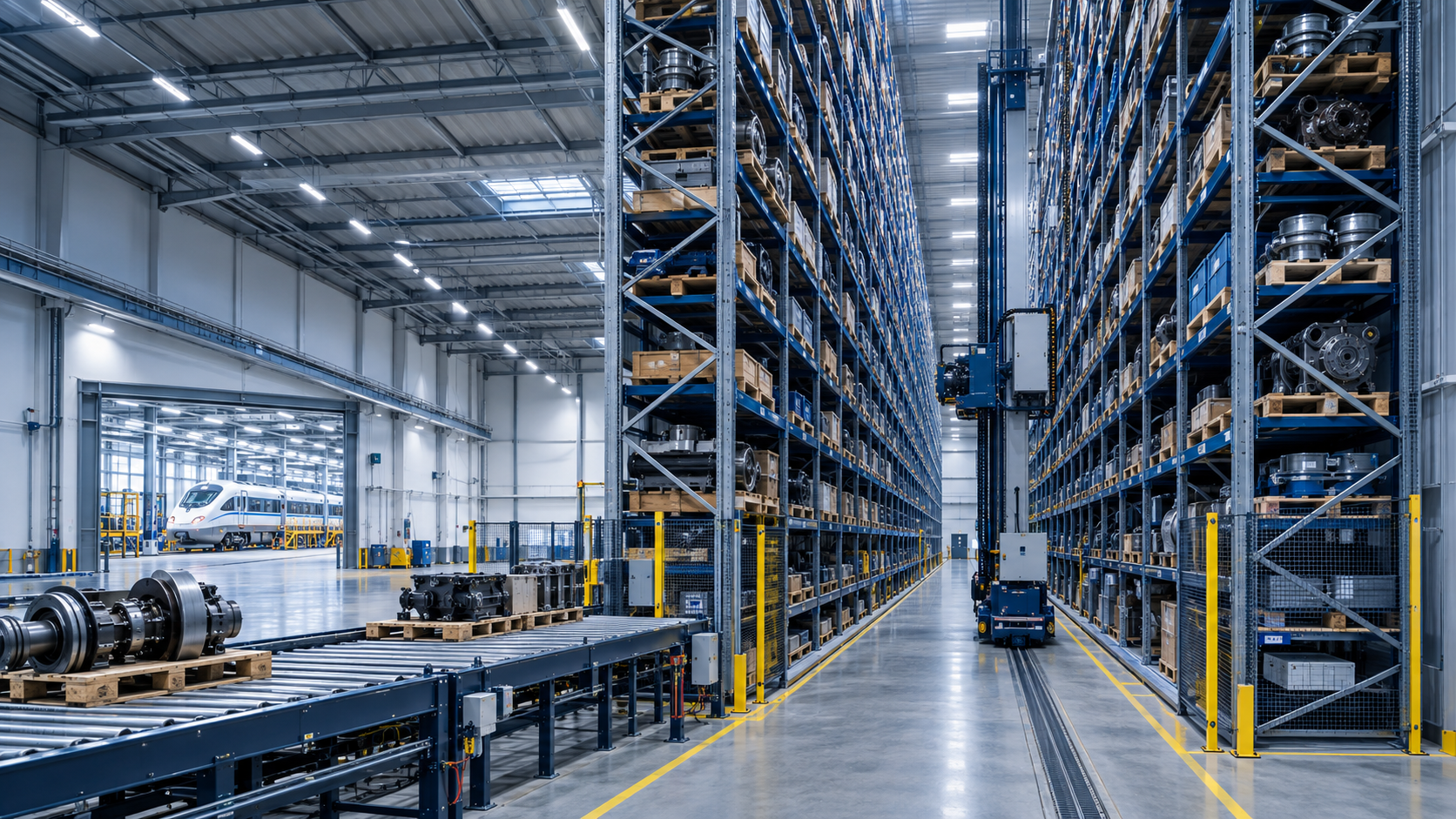
Heavy loads, fast-moving goods, safety: High-bay warehouse in the railway maintenance depot – creative image on the topic, with AI: Xpert.Digital
The automation fallacy: What really matters in high-bay warehouses at railway plants
Expensive waiting times at the maintenance depot: Why the spare parts warehouse determines punctuality
Hidden costs in the workshop: This is why material availability is the biggest lever for railway operators
A train waiting for a spare part in the workshop costs money, time, and ties up valuable resources. In modern railway maintenance, intralogistics is no longer a mere background issue, but a crucial competitive factor. If a heavy unit, a specific bogie component, or even just a small but safety-critical electronic module is missing, the entire maintenance plan is thrown into disarray. Often, however, the planning of high-bay warehouses focuses solely on storage density, degree of automation, and maximum building height – a costly mistake. The true currency in a maintenance depot is availability. An intelligent warehouse concept must integrate seamlessly into the highly complex processes of the workshop and respond flexibly to both predictable deadlines and spontaneous breakdowns. This article explores why spare parts supply must be consistently considered from the perspective of the workshop process, where the limits of pure automation lie, and how a simple building with numerous pallet spaces can be transformed into a high-performance availability infrastructure.
The perfect warehouse architecture for railway maintenance depots: Availability is the deciding factor, not storage height
Those who merely store spare parts lose maintenance time
A modern railway maintenance depot is often perceived through its halls, lifting equipment, underfloor wheel lathes, test benches, or track capacity. These facilities shape the visible image of value creation. However, the economic performance of a depot is frequently determined in a less spectacular area: the availability of spare parts, components, consumables, and specialized tools at the right time and in the right place.
A train, locomotive, or carriage can be in a workshop as scheduled. However, if a safety-relevant spare part, a suitable bogie component, a seal, an electronic module, or a heavy unit is missing, the downtime is extended. A planned work step becomes a waiting time. A maintenance measure can disrupt operational planning. The costs then arise not only in the workshop but also in dispatching, vehicle circulation, replacement provision, and customer service.
Therefore, a high-bay warehouse in a railway maintenance depot is more than just a building with many pallet spaces. It is an availability infrastructure. Its quality is not measured by the maximum storage height, the number of stacker cranes, or the visual impact of an automated system. What matters is whether the overall system integrates materials reliably, traceably, economically, and with priority into the maintenance processes.
This perspective changes the planning process. A warehouse project should not be developed in isolation from the perspective of space efficiency, construction costs, and storage density. It must be conceived from the perspective of the workshop process. Which parts are needed when? How does demand fluctuate? Which items are critical? Which goods are heavy, bulky, valuable, safety-relevant, or sensitive to temperature and humidity? What material flows result from returns, repair parts, used parts, warranty claims, and components requiring reconditioning? Only when these questions are answered can a decision be made regarding which storage and automation technology is economically viable.
The workshop is not a distribution center
Logistics in a railway maintenance depot differs fundamentally from that of a traditional retail or consumer goods warehouse. Distribution centers are often dominated by standardized order structures, high repetition rates, and large quantities of identical items. The goal is a stable, rapidly scalable throughput. In the railway sector, however, the reality is more heterogeneous. Material requirements are strongly linked to maintenance programs, damage patterns, vehicle series, mileage, deadlines, conversion projects, and unplanned events.
Some demand is predictable. Regular scheduled maintenance and standardized maintenance packages enable proactive provisioning. Other needs arise at short notice. Inspection findings, unplanned damage, component failures, or technical changes can trigger material requirements that were not previously planned in this specific form. Therefore, the ability to handle exceptions in a controlled manner is just as important as speed in the standard process.
Added to this is the sheer variety of items. In a single factory, small screws, cables, connectors, filters, seals, and electronic assemblies can be stored alongside heavy couplings, air conditioning components, brake equipment, wheelsets, or large housings. These items differ not only in size and weight, but also in value, turnover rate, safety relevance, and handling effort. A uniform storage system for all goods therefore often leads to compromises that later prove costly in operation.
The central task is therefore not: How can as many pallets as possible be accommodated in a building? It is: How can the material supply be organized in such a way that maintenance windows are reliably adhered to, search times are reduced, missing parts are detected early, and disruptions do not unnecessarily impact operations?
A high-bay warehouse can be very helpful in this regard. It creates concentrated storage capacity, improves inventory transparency, and enables structured retrieval. However, it doesn't automatically solve the challenges of workshop logistics. Without a clear process architecture, even the most modern system becomes a technically impressive buffer that fails to eliminate crucial pathways, priorities, and information gaps.
Spare parts availability is an economic indicator
Maintenance is not just a cost center. It is a key factor for plant availability, vehicle quality, and competitiveness. Reliable and prompt maintenance reduces downtime, increases fleet utilization, and lowers the likelihood of costly ad-hoc repairs. Material availability is a crucial economic lever because it directly impacts the duration of work processes and the predictability of workshop capacity.
The economic evaluation of a high-bay warehouse should therefore not be limited to construction costs, racking prices, and personnel expenses. The avoided costs of poor availability are also relevant. These include extended vehicle downtime, overtime, rescheduling, express deliveries, multiple handling operations, unproductive search times, and high safety stock levels. In many organizations, these consequences are allocated to different cost centers. As a result, the true cost of a non-integrated material flow remains hidden.
A sound business case must therefore connect several levels. At the direct level are area productivity, personnel deployment, throughput, energy consumption, maintenance costs, and investments. At the indirect level are process stability, service level, error risk, inventory quality, and the ability to fulfill priority orders without improvised special processes. At the strategic level, the focus is on scalability, resilience, data quality, and adaptability to changing vehicle fleets and new maintenance concepts.
The distinction between inventory quantity and availability is particularly important. A high inventory level does not automatically mean that the required part will be available at the right time. A warehouse can be capital-intensively overstocked and still create bottlenecks if master data is incorrect, inventory is booked incorrectly, spare parts are not located, or the supply chain between the central warehouse and the workshop breaks down. Conversely, a well-managed system with differentiated inventory strategies can achieve high service quality with less tied-up capital.
The key performance indicator (KPI) that should be the focus is therefore not just inventory turnover. Crucially, it is the percentage of material requests that are provided completely and without errors within the required timeframe. In addition, the missing parts rate, throughput time, search time, replenishment reliability, inventory discrepancies, the percentage of express deliveries, and the number of workshop-related waiting times must be analyzed. Only this combination reveals whether a high-bay warehouse actually improves maintenance.
The right warehouse architecture begins with product classes
The question of whether a high-bay warehouse should be automated, semi-automated, or operated conventionally cannot be answered in general terms. It depends on the product structure, demand, service requirements, and spatial constraints. Therefore, an economically viable concept begins with consistent segmentation.
Fast-moving items with stable demand require short access times and often proximity to order picking or the point of use. They can be effectively stored in automated small parts warehouses, dynamic staging areas, or easily accessible shelving units. Medium- and slow-moving items benefit more from high density and systematic storage. Heavy and bulky components require specific load-bearing and safety concepts. Valuable parts demand protected access rights, complete traceability, and reliable inventory management.
A high-bay warehouse is particularly efficient when standardized loading equipment, sufficient inventory density, and recurring storage and retrieval processes are combined. For palletizable spare parts and components, the combination of high storage height, stacker crane, and integrated conveyor technology can be economical. For extremely diverse, irregular, or infrequently needed goods, a separate heavy-duty or special parts warehouse is often more suitable.
The most important decision, therefore, is often not the choice between a storage and retrieval machine and a shuttle. It's the question of which items actually belong in which subsystem. Incorrect allocation creates ongoing friction in operations. If fast-moving items are stored too far away, travel distances and waiting times increase. If heavy, specialized parts are stored in a system optimized for standard pallets, handling risks arise. If returned and repairable components are not clearly separated, inventory quality suffers.
A robust architecture therefore combines different zones. These can include a high-bay warehouse for palletized stock, an automated small parts warehouse for quickly needed items, a heavy-duty area for large components, secure zones for valuable or safety-critical parts, receiving and quality control areas, and a staging area for workshop orders. It is not maximum uniformity, but rather the intelligently managed diversity that makes the system economical.
Material flow between warehouse, track and workbench
A warehouse only becomes truly effective when the movement of materials to their point of use functions reliably. In a railway maintenance depot, it's not enough to simply place parts on a ramp or in a picking zone. They must reach the correct hall, the correct track, the correct work group, and ideally, at the right time.
Several logics converge here. The warehouse logic optimizes routes, bundling, and capacity utilization. The workshop logic is geared towards work progress, findings, personnel availability, and vehicle appointments. The dispatching logic considers vehicle circulation, priorities, and operational bottlenecks. When these systems operate separately, typical problems arise: material is provided too early and ties up space, provided too late and creates waiting time, or delivered to the wrong location and requires time-consuming handling.
An effective material flow architecture therefore requires a prioritization logic. Not every order is equally urgent. A component for a planned, time-sensitive job can be handled differently than a part that gets a vehicle back on the road with a tight deadline. The system must digitally map these priorities and simultaneously make them practically executable. A high-priority order must not only be prioritized in the software; it must be visibly given priority in the warehouse, on the conveyor system, in order picking, and during transport.
Various solutions are available for physical supply. Permanently installed conveyor technology can be advantageous for stable routes and high volumes. Tugger trains are suitable for bundled transport along recurring supply routes. Driverless transport systems or autonomous mobile robots can offer advantages in dynamic environments, provided that floor conditions, safety zones, routing, and IT integration are reliably managed. Manual transport remains practical in many areas, particularly for special parts, irregular loads, and exceptional situations.
The combination becomes economically viable when technology isn't an end in itself. An automated system that only functions under ideal conditions and requires manual workarounds for every special case quickly loses its value. A good material flow is robust, transparent, and fault-tolerant. It can change priorities, process returns, identify bottlenecks, and switch to alternative processes in a controlled manner when disruptions occur.
LTW Intralogistics Solutions

LTW Intralogistics – Engineers of Flow - Image: LTW Intralogistics GmbH
LTW offers its customers not individual components, but integrated complete solutions. Consulting, planning, mechanical and electrotechnical components, control and automation technology, as well as software and service – everything is networked and precisely coordinated.
In-house production of key components is particularly advantageous. This allows for optimal control of quality, supply chains, and interfaces.
LTW stands for reliability, transparency, and collaborative partnership. Loyalty and honesty are firmly anchored in the company's philosophy – a handshake still means something here.
Related to this:
Innovative approaches to automation in railway maintenance
Automation requires a clear division of tasks
Automation is often equated with saving on personnel. This is an oversimplification. In complex maintenance environments, the most significant benefits often lie in process stability, inventory accuracy, ergonomic relief, and reproducible performance. Automation does not automatically reduce complexity; it shifts it to planning, control, interface management, and service organization.
Storage and retrieval systems (SRMs) excel when high storage density, standardized load units, and predictable storage and retrieval processes converge. They offer high precision and can economically unlock access to vertical space. Shuttle systems can provide advantages with great depth, numerous identical storage locations, and specific performance profiles. Automated small parts warehouses are suitable for small, high-value items that are needed quickly. Conveyor technology connects these systems with goods receiving, order picking, and staging areas.
However, not every area needs to be automated. Especially with heavy components, varying geometries, rare special parts, or highly project-specific materials, a well-organized manual area can be more economical and flexible. A maintenance facility therefore often requires a hybrid concept. Standardized mass production is automated, while complex, exceptional cases are handled in specialized areas.
The key question is not: How much automation is technically possible? It is: Which recurring tasks are so stable, safety-relevant, ergonomically demanding, or time-critical that technical automation is superior in the long run? This approach protects against overinvestment and simultaneously prevents overlooked profitable potential.
Another key question is the availability of the automation itself. In a high-bay warehouse for a production-critical site, a failure must not immediately lead to a standstill in the material supply. Redundancies, maintenance concepts, spare parts inventory, remote access, fault diagnosis, and manual fallback processes are therefore integral to the system design from the outset. The highest theoretical performance is of little use if the system is completely blocked by a single malfunction.
Software determines the practical benefit
The visible warehouse is only the physical aspect of intralogistics. The real advantage in terms of control lies in the data and software architecture. Warehouse management systems, material flow computers, plant control systems, maintenance systems, ERP systems, and, if applicable, vehicle or asset management systems must work together in such a way that a demand is transformed into a reliable supply of materials.
A warehouse management system controls inventory, storage locations, putaways, picking, inventories, and order picking. A warehouse control system, or material flow computer, coordinates the technical equipment, such as conveyor technology, stacker cranes, shuttles, or sorting systems. The workshop, in turn, requires information from maintenance planning, work orders, and inspection processes. The system only becomes economically effective when these levels are seamlessly integrated.
Effective integration prevents media breaks. Requirements are not recorded manually multiple times, withdrawals are not booked only later, and returns don't disappear into some unclear intermediate zone. Instead, a digital chain is created: maintenance order, material reservation, picking, transport, consumption recording, return delivery, and, if necessary, reprocessing. This chain must also handle exceptions, such as partial deliveries, alternative parts, damaged loading equipment, quality checks, or unexpected findings.
Traceability is of particular importance. In railway maintenance, serial numbers, batches, installation histories, test status, and condition information can be relevant. Warehouse logistics must not only store this data but also make it available throughout the process. From an economic perspective, a high-quality component with an unclear origin, missing test status, or incorrect assignment is not available inventory.
Master data is also an underestimated success factor. Dimensions, weights, packaging types, storage conditions, minimum shelf life, hazardous material characteristics, criticality, and permissible loading aids must be correctly maintained. Errors in this data later lead to incorrect storage, malfunctions in the automation system, safety risks, and manual rework. Many projects invest heavily in mechanics and control systems but underestimate the effort required for data cleansing. This is risky, because a high-bay warehouse only operates as reliably as the information on which its decisions are based.
Heavy haulage logistics needs its own rules
Railway maintenance often combines small parts logistics with component logistics. This combination is challenging. While small items can be efficiently processed via containers, picking stations, and automated systems, heavy or irregularly shaped parts require a different approach.
Heavy-duty components place special demands on load-bearing capacity, load distribution, storage layout, crane and forklift access, securing, and ergonomic handling. For heavy components, it is not enough to consider only the theoretical payload of a shelf compartment. Dynamic loads, vibrations, access routes, lifting equipment, transfer points, and the ability to safely transport parts from the warehouse to the workshop are also crucial.
The question of returned parts is also economically critical. Many components are not consumed but are inspected, repaired, refurbished, or scrapped after removal. This creates closed-loop systems. A defective unit must not be confused with a usable replacement unit. A refurbished part requires clear approvals. A returned part can be valuable spare parts or simply material destined for disposal.
A modern warehouse concept must therefore combine status logic and physical separation. Quarantine areas, inspection zones, return zones, and released stock must not only have different identifiers within the system. They must also be organized spatially and procedurally in such a way that errors are eliminated or at least made highly unlikely. Especially with safety-relevant components, this discipline is not only a matter of quality but also an economic necessity.
Construction during ongoing operations is a separate project
The construction or expansion of a high-bay warehouse in an active factory presents unique challenges. Operations cannot simply be paused until the new infrastructure is complete. The workshop, rail logistics, deliveries, waste disposal, and material supply must continue uninterrupted. This makes the construction phase itself a logistical project.
One of the greatest risks is the interface between construction and operational processes. Construction traffic, restricted areas, noise, dust, detours, and safety zones can disrupt established material routes. If track areas, hall entrances, or traffic areas are affected, construction planning must be closely coordinated with plant scheduling. A missing transfer route or a short-term closure can cause more damage than a delay in the structural work.
Migration is particularly challenging. A new high-bay warehouse doesn't become operational simply through technical acceptance. Inventories must be cleaned up, items classified, storage locations defined, master data verified, employees trained, and interfaces tested. Therefore, commissioning should be carried out in stages. Pilot items, test orders, parallel inventory management, and clearly defined fallback processes reduce the risk.
The temptation to switch over completely as quickly as possible at the end of a construction project is strong. However, a controlled ramp-up phase can be significantly more cost-effective. It reveals errors before they affect workshop operations. It allows for the optimization of software parameters, the refinement of operational rules, and the safe introduction of employees to new processes.
Energy, fire protection and resilience belong together
An automated high-bay warehouse is also an energy and safety project. Conveyor technology, storage and retrieval machines, lighting, charging infrastructure, IT, sensors, air conditioning, and, if necessary, refrigeration or ventilation technology create a complex load profile. Therefore, the planning must be linked to building services engineering, energy supply, and fire protection at an early stage.
The focus is not solely on the kilowatt-hours consumed. Peak loads, grid connection, reserve capacities, load management, emergency power and safety concepts, as well as the maintainability of the technical infrastructure are also relevant. When multiple systems start up simultaneously, load peaks can occur. Intelligent control can help smooth energy consumption and peak loads without jeopardizing the availability of material supplies.
Fire protection is particularly challenging in high-bay warehouses because storage height, type of goods, packaging, plastic content, sprinkler system, smoke extraction, and accessibility all interact. The fire protection concept should not be developed only after the storage technology has been selected. It influences building height, rack layout, aisle width, technical rooms, and operational concepts. Changes in later project phases can cause significant costs and delays.
Resilience also means considering disruptions from more than just a technical perspective. A resilient warehouse requires clear emergency procedures: What happens if a storage and retrieval machine fails? How are critical parts provided if the warehouse management system is unavailable? Which inventory items are accessible for manual replenishment? How are cyber risks addressed at the intersection of IT and operational technology? Which spare parts for the warehouse equipment itself must be kept on-site?
These questions may seem defensive at first glance. In reality, they are economically sound. A system that continues to operate in a controlled manner even during disruptions protects plant availability and reduces the costs of unplanned downtime.
The business case begins before the technology decision
A high-bay warehouse is a long-term investment. Its economic viability therefore depends less on a single key performance indicator than on the quality of the underlying assumptions. Common mistakes occur when the expected performance is overestimated, the integration is overly simplistic, or the operational changes are underestimated.
A robust business case should address at least five perspectives. First, capacity: What inventory trends, safety stock levels, and space constraints are anticipated? Second, performance: How many inbound and outbound movements, picking positions, and workshop supplies must be handled within what timeframe? Third, costs: What investments, operating costs, maintenance costs, and reinvestments will be required? Fourth, risks: What are the consequences of disruptions, delays, data issues, or fluctuations in volume? Fifth, strategic impact: How does the system improve availability, scalability, and future viability?
It is important to calculate different scenarios. A baseline scenario can assume stable vehicle fleets and predictable maintenance volumes. A growth scenario considers increasing parts diversity, new model series, or additional maintenance orders. A stress scenario examines higher failure rates, supply bottlenecks, additional safety stock, and temporarily fluctuating workshop workloads. A concept that only works in the baseline scenario is too fragile for a critical maintenance environment.
The correct economic perspective, therefore, is not to amortize the investment in the shortest possible time. The goal is to ensure a reliable supply throughout the system's lifecycle. A slightly higher initial investment can be worthwhile if it reduces system failures, improves data quality, enables future expansions, and avoids costly custom processes. Conversely, a highly automated system is not economical if it is too rigid for the actual diversity of products and processes.
Availability takes precedence over maximum automation
The high-bay warehouse of the future in a railway maintenance depot is not an end in itself, nor is it a symbol of technological modernity. It is a tool for improving the availability of vehicles and workshop capacity. Its economic performance arises from the interplay of the building, storage technology, material flow, software, data, people, and operational organization.
A good concept consolidates inventory without compromising access. It automates standardized, repetitive, and ergonomically demanding processes without ignoring exceptions. It digitally links workshop orders and warehouse movements without burdening employees with inflexible system settings. It creates transparency regarding inventory and material status without getting bogged down in data complexity. And it plans redundancy, maintenance, and fallback processes not as an afterthought, but as an integral part of the economic solution.
This perspective is particularly important for railway maintenance depots. Logistics doesn't supply abstract orders, but rather concrete maintenance and repair processes with direct consequences for availability, safety, and punctuality. Every reliably delivered item can prevent waiting times. Every accurate inventory record can avoid urgent transport. Every robust interface between warehouse and workshop can improve the planning capabilities of the entire site.
The crucial question for a new high-bay warehouse is therefore not: How tall, how automated, and how impressive will the system be? The real question is: How reliably will it ensure that the workshop gets exactly what it needs before a missing part turns a planned maintenance task into a costly operational problem?
Anyone who makes this question the guiding principle of their planning isn't building a warehouse. They're building an infrastructure for availability.
Consulting - Planning - Implementation

Konrad Wolfenstein
I would be happy to serve as your personal advisor.
You can contact me at wolfenstein∂xpert.digital or
Just call me on +49 7348 4088 965 .
Your intralogistics experts

Consulting, planning and implementation of complete solutions for high-bay warehouses and automated storage systems - Image: Xpert.Digital
More information here:










