
From foundation to software: The ultimate guide to container and heavy-duty high-bay warehouses in general
Xpert Pre-Release

Available in 27 languages 📢
Prefer Xpert.Digital on GoogleⓘPublished on: February 9, 2026 / Updated on: February 9, 2026 – Author: Konrad Wolfenstein
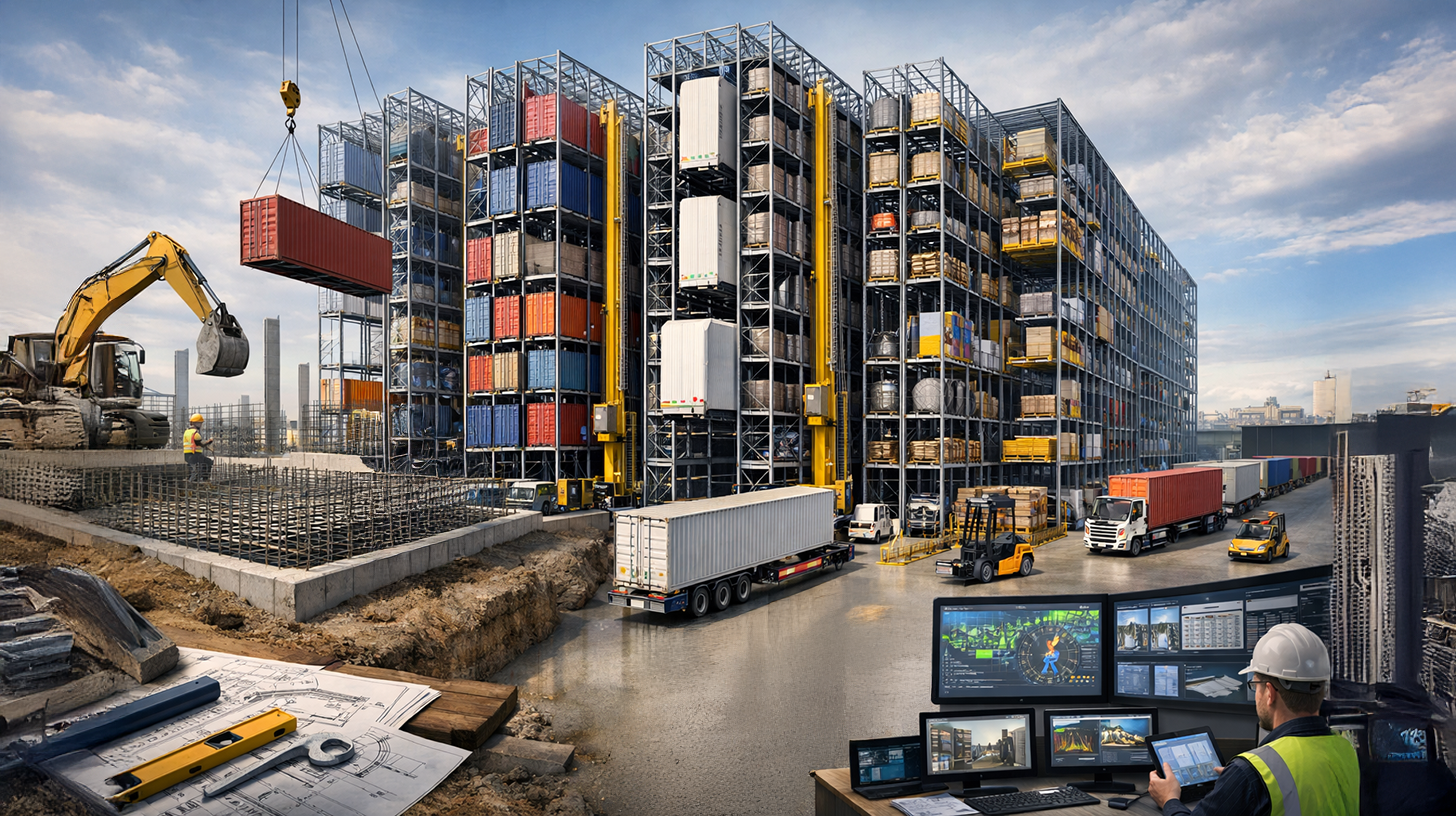
From foundation to software: The ultimate guide to heavy-duty high-bay warehouses – Creative image: Xpert.Digital
Heavy-load logistics in high-bay warehouses: When know-how exceeds the load limit
Why automated tonnage systems become a suicide mission when you don't know the ground beneath your feet
The realization of an automated high-bay warehouse for heavy goods is considered the ultimate challenge in modern intralogistics – and simultaneously one of the riskiest economic ventures for companies without in-depth expertise. When tons of steel coils, bulky car bodies, or massive concrete elements are moved fully automatically at dizzying heights, standard solutions quickly reach their physical and technological limits. This involves not only impressive investment sums of between ten and fifty million euros, but also a complex interplay of structural engineering, IT intelligence, and precision mechanical engineering.
But why do ambitious projects promising enormous efficiency gains so often turn into suicide missions? The answer rarely lies in the availability of the technology – modern storage and retrieval machines can easily handle twelve tons or more. Failure begins much earlier: in the literal foundation, which doesn't tolerate even millimeters of settling, in underestimating fire safety regulations, or in a software architecture that collapses under the complexity of heterogeneous stored goods.
This article highlights the critical success factors for the construction and operation of heavy-duty high-bay warehouses. From the vital soil conditions and the specific requirements of different load carriers to energy management and the often-neglected aspect of change management: Learn how to avoid dangerous pitfalls in planning and future-proof your logistics without letting your expertise collapse under the strain.
Planning and implementing an automated high-bay warehouse for extremely heavy goods, such as multi-ton car bodies, steel coils, or concrete elements, is among the most demanding projects in modern intralogistics. While the technology has developed rapidly in recent decades, and storage and retrieval machines with a load capacity of up to twelve tons are now available, many projects fail not because of the technology itself, but due to a lack of expertise in the design and strategic planning. Such an infrastructure project can cost several million euros and take two to three years to build. Anyone embarking on this project without sound knowledge is treading on dangerous ground.
The economic dimensions are considerable. A fully automated high-bay warehouse for heavy goods can cost between ten and fifty million euros, depending on capacity, height, and level of automation. Studies show that such systems can pay for themselves within five to seven years if planned and executed correctly. However, this calculation only works if the right decisions are made from the outset. Faulty design not only risks construction delays and cost overruns, but also permanently inefficient operation, negating the intended productivity gains.
Related to this:

Soil quality as an underestimated fundamental issue
The load-bearing capacity of the subsoil forms the physical foundation of every high-bay warehouse, yet it is surprisingly often underestimated or considered too late in the planning process. An automated heavy-duty high-bay warehouse for steel coils or concrete elements, including its stored goods, can easily weigh several thousand tons, concentrated at specific points on the racking columns. The base slab must therefore have a minimum concrete grade of C20/25 with appropriate reinforcement and a minimum thickness of twenty centimeters. However, these are only minimum values for conventional systems.
For heavy-duty applications, the requirements increase exponentially. While a standard pallet racking system is designed for bay loads of up to 24.5 tons, heavy-duty storage and retrieval machines of the MAGNO series can move up to twelve tons per load unit, and specialized systems can even handle individual loads of up to eighteen tons. The resulting point loads on the warehouse floor necessitate detailed structural calculations by qualified engineers. Asphalt or interlocking paving stone floors are unsuitable, and even rolled concrete floors must undergo prior structural analysis. Furthermore, automated storage systems are subject to stricter tolerance requirements according to FEM 9.831 and FEM 9.832, which far exceed the standard DIN 18202.
Differential settlement of the base slab is particularly critical. While manually operated racking systems can accommodate shimming of up to ten millimeters, automated storage and retrieval systems (AS/RS) tolerate only minimal deviations. Uneven ground settlement can cause the AS/RS's load-handling devices to no longer grip precisely or for load carriers to become jammed in the storage channels. Such problems lead to costly downtime and, in extreme cases, can necessitate a complete realignment of the racking system. Those who consider these geotechnical aspects from the outset and obtain appropriate soil surveys and structural analyses avoid subsequent additional costs that can quickly reach six figures.
Specific requirements of different heavy loads
Heavy goods weighing several tons are not a homogeneous category, but rather, depending on their type and geometry, place entirely different demands on storage and handling systems. Steel coils, for example, are cylindrical objects weighing between five and thirty-five tons and with outer diameters between one and 2.5 meters. They cannot be stacked arbitrarily, as heavy coils placed on top of lighter ones can deform them or cause them to roll off. Modern warehouse management systems for automated crane storage systems therefore use highly specialized algorithms that calculate an optimal storage location for each coil to be stored, taking both weight and dimensions into account. The coils are typically transported on heavy-duty stacker cranes using cantilever arms and can be stored up to three layers high.
Heavy car bodies from the automotive industry, weighing several tons, have entirely different characteristics. They are comparatively bulky but less dense than steel coils and require special lifting equipment that won't damage their delicate surfaces. Precast concrete elements, on the other hand, are not only extremely heavy but also rigid and brittle. They require particularly stable support points and must not be subjected to impacts during storage and retrieval. Choosing the right lifting equipment is crucial here. Telescopic forks, cantilever arms, heavy-duty rollers for multi-deep roller racks, or rotary push forks with adjustable tines – each solution is tailored to specific load carriers and types of goods.
Another critical factor is storage density. While chaotic storage with maximum space utilization is the goal for small parts warehouses, heavy-load logistics often requires safety distances between storage units. This is particularly important for fire safety reasons, but also to prevent mechanical stress. VDI guideline 3564 provides clear recommendations for high-bay racking systems handling heavy goods. Companies planning without relevant experience tend to overestimate storage density and later find that the achievable capacity falls significantly short of their initial expectations.
The technological complexity of heavy-duty storage and retrieval machines
Storage and retrieval machines for heavy-duty applications differ fundamentally from their counterparts in standard pallet high-bay warehouses. The mechanical loads necessitate a torsionally rigid, two-mast design for maximum stability. The chassis features special wheels and reinforced S54 guide rails that withstand the enormous dynamic forces. The overall height can reach up to twenty-five meters, and in special applications even up to forty or forty-four meters. Vertical lifting is achieved via two or more suspension cables, which improves ease of maintenance and increases reliability.
Energy management presents a particular challenge for heavy-duty systems. The potential energy released when lowering loads weighing several tons is recovered via modern drive inverters and DC link coupling and fed into energy storage systems. This not only reduces energy consumption but also the required transformer power and the size of the conductor rails. Without these intelligent energy management systems, the operating costs of a heavy-duty high-bay warehouse would be prohibitively high. Studies show that modern systems with energy recuperation consume up to forty percent less energy than older generations without this technology.
Control technology must make real-time decisions regarding travel strategies, especially in multi-unit systems that navigate curves, where several stacker cranes can switch between different aisles via diverters. These systems offer the advantage that if one unit fails, the others can take over its tasks, significantly increasing the overall availability of the system. However, this also increases the complexity of sequence control and collision avoidance. With sufficiently high throughput, the investment in a curve-navigating system can pay for itself within three to four years, but this requires that the material flow planning is designed for this flexibility from the outset.
Warehouse management systems as the nerve center of heavy-load logistics
A warehouse management system for heavy-duty applications is far more than inventory management software. It is the central intelligence that orchestrates all physical and logical processes. The system must know the specific characteristics of each individual load unit – weight, dimensions, center of gravity, stackability, and expiration date for perishable goods – and use this information to calculate optimal storage and retrieval strategies. For steel coils, this means implementing algorithms that prevent heavy coils from being stored on top of lighter ones. For precast concrete elements, constraints and bearing surfaces must be taken into account to prevent damage.
Integrating the warehouse management system into the existing IT landscape is another hurdle that is often underestimated. The system must communicate seamlessly with the higher-level ERP system to receive orders and report inventory information. Simultaneously, it controls subordinate material flow computers and the controllers for the stacker cranes, conveyor technology, and transfer stations. Standard interfaces such as OPC UA or proprietary protocols must be implemented and tested. Practical experience shows that interface integration can consume up to thirty percent of the total project time during the software development phase.
Modern systems also offer features such as continuous inventory management, batch tracking, pick-by-light or pick-by-voice for manual picking zones, as well as detailed analyses and reports for continuous process optimization. The selection of the right warehouse management system should not be based solely on its range of functions, but also on the provider's experience with heavy-duty applications. Many standard systems are primarily designed for pallet storage or small parts and require extensive customization. Specialized providers, on the other hand, already have proven modules for coil storage, long goods, or other special cases.
Fire protection as an existential dimension
High-bay warehouses with a height of 7.5 meters or more are subject to special fire protection requirements, which are detailed in the Model Industrial Building Guideline and VDI 3564. The challenge lies in the combination of great height, high storage density, and often flammable packaging materials. The so-called chimney effect can cause a fire to spread to the ceiling within minutes and then be extremely difficult to extinguish. In the case of heavy-duty warehouses containing steel coils or precast concrete elements, the goods themselves are often not flammable, but the heat generated can lead to structural damage to the racking system.
Automatic fire extinguishing systems are mandatory for storage heights exceeding 7.5 meters; even stricter requirements apply above 9 meters. Sprinkler systems are standard, but must be sized to generate sufficient pressure even in the upper racking levels. In-rack sprinkler systems, integrated directly into the racking structure, offer additional safety. An alternative is oxygen reduction through inerting in airtight building envelopes, which is particularly attractive for unmanned high-bay warehouses because it is preventative and does not cause water damage.
Aspirating smoke detectors are the preferred solution for high-bay warehouses, as they continuously draw in air samples and detect smoke particles at an early stage. Ideally, the sampling lines are integrated directly into the racking system to prevent damage during goods handling. The cost of a comprehensive fire protection concept can amount to five to ten percent of the total investment, but it is essential. Insurance companies often offer significantly lower premiums for high-bay warehouses with a high-quality fire protection system, allowing the investment to pay for itself over time.
Regulatory hurdles and approval procedures
The legal requirements for high-bay warehouses vary considerably between the German federal states, as the state building codes contain different regulations. Generally, high-bay warehouses above a certain height or floor area require a permit. The thresholds are typically a building height of more than ten meters or a floor area of more than one thousand square meters. Automated systems with stacker cranes are also subject to the Machinery Directive and CE marking requirements.
The permitting process includes a building application, structural calculations, a fire protection concept, a noise impact assessment (especially if the site is near residential areas), an environmental impact assessment (if applicable), and, in the case of silo construction, additional requirements for the load-bearing racking structure. Processing time can range from three to six months, and even longer for complex projects. Experienced planning offices can provide valuable support here, as they are familiar with the specific requirements of the building authorities and can prepare the documents accordingly. Delays in the permitting process are one of the most frequent causes of project delays and can lead to significant additional costs, as components that have already been ordered must be stored temporarily and personnel remain tied up.
In addition, there are standards such as DIN EN 15512 for pallet racking, DIN EN 15095 for power-operated movable racking, and FEM guidelines for automated storage systems. While these standards are not always legally binding, they are considered state-of-the-art by experts and trade associations. A high-bay warehouse that does not comply with these standards can lead to liability issues and jeopardize insurance coverage in the event of damage. Therefore, compliance with these standards should be an integral part of the planning process from the outset.
LTW Solutions

LTW Intralogistics – Engineers of Flow - Image: LTW Intralogistics GmbH
LTW offers its customers not individual components, but integrated complete solutions. Consulting, planning, mechanical and electrotechnical components, control and automation technology, as well as software and service – everything is networked and precisely coordinated.
In-house production of key components is particularly advantageous. This allows for optimal control of quality, supply chains, and interfaces.
LTW stands for reliability, transparency, and collaborative partnership. Loyalty and honesty are firmly anchored in the company's philosophy – a handshake still means something here.
Related to this:
General contractor or system integrator? This decision will shape your warehouse for decades
Partner selection as a strategic decision
Given the enormous complexity, choosing the right partner or general contractor is perhaps the single most important decision in the entire project. The market offers various models. General contractors provide complete, turnkey solutions, from planning and racking systems to conveyor technology and control software. This has the advantage of clear responsibilities and perfectly coordinated components. However, as the client, you are heavily dependent on this single partner, and pricing is often opaque.
The alternative is system integrators, who combine components from different manufacturers into a complete solution. This makes it possible to select the best specialist for each sub-area and can lead to more cost-optimized solutions. The disadvantage lies in the increased coordination complexity and potentially unclear responsibilities in the event of interface problems. However, experienced system integrators have established partnerships and can submit proposals within three days of technical clarification. Delivery times for components are typically twelve weeks, which allows for tight project planning.
The following criteria should be considered when making a selection: reference projects in comparable industries and sizes, specific experience with heavy-duty applications, service capability and spare parts supply throughout the entire lifespan of the system, the supplier's financial stability to secure long-term warranty claims, future-proof technology and upgrade options, as well as training and support concepts. It is advisable to visit at least one reference system and speak with the operator about their experiences. This often reveals strengths and weaknesses that are not apparent in glossy presentations.
The tender should be based on a detailed specification document that precisely describes all functional and technical requirements. A good specification document includes capacity requirements, throughput requirements, specifications of the goods to be stored, interfaces with existing systems, availability and maintenance requirements, as well as budget and timeframes. The more precise the specification document, the more comparable the incoming bids will be. A preliminary cost estimate, which determines the expected costs based on market prices and experience, helps to identify unrealistic bids.
Related to this:

Project management and milestones as risk management
A high-bay warehouse project typically goes through the phases of concept development, detailed planning, tendering and awarding of contracts, implementation including construction and assembly, commissioning with testing and acceptance, and a ramp-up phase until full-load operation is reached. Each phase carries specific risks and requires defined milestones for monitoring success. In the concept development phase, these include needs analysis, feasibility studies, soil surveys, and the basic layout planning. Capacity reserves for future growth should be planned for at this stage, as subsequent expansions are often significantly more expensive than a more generous initial design.
Detailed planning encompasses the precise design of the racking systems, the selection and specification of the storage and retrieval machines and load handling devices, the planning of the conveyor technology and transfer points, the material flow concept, and the software architecture. External specialists should be involved if the necessary expertise is lacking in-house. The costs for external consultants at this stage are typically in the low six-figure range, but can prevent misinvestments amounting to millions. A common mistake is rushing the detailed planning process in order to quickly move to implementation. Experience shows that every week invested in thorough planning can prevent several weeks of delay in the implementation phase.
The implementation phase is characterized by the coordination of various trades. Structural work, racking installation, assembly of the storage and retrieval machines, installation of the conveyor technology, relocation of the control technology and cabling, as well as software implementation and interface integration, must be coordinated both temporally and spatially. A tight schedule with buffer times for critical paths is essential. Weekly meetings with all project stakeholders and professional claims management for documenting changes and additional services help maintain control. The construction time for a medium to large high-bay warehouse is eighteen to thirty-six months.
Change management as an underestimated success factor
The technical implementation of an automated high-bay warehouse is only half the battle. Change management—guiding the organization and its employees through the transformation—is at least as critical. A high-bay warehouse fundamentally alters how warehouse processes are carried out. Forklift drivers and order pickers become system monitors and troubleshooters. New qualifications are required, ranging from operating complex warehouse management systems to diagnosing faults in automated systems.
Employees who have worked with manual processes for decades often see automation as a threat to their jobs. These fears must be taken seriously. Successful companies involve their workforce from the outset, communicate transparently about the changes, and offer comprehensive training programs. Studies show that productivity can initially decline during the ramp-up phase if employees are not yet familiar with the new systems. A well-planned training initiative can shorten this phase to just a few weeks, while inadequate preparation leads to months of lost efficiency.
Modern change management approaches rely on continuous communication through employee apps, visualizations of project progress on large screens in the reception area, involvement of key users from the workforce as early as the planning phase, and targeted incentive systems for successful adoption. Some companies organize visits to reference facilities so that employees can see for themselves. The investment in change management typically amounts to two to five percent of the total project costs, but pays off many times over through faster implementation and greater acceptance.
Operational phase and continuous optimization
After successful commissioning, the real test begins. The availability of the system is the decisive factor for success. Modern high-bay warehouses achieve availability rates of over 99 percent, meaning that planned and unplanned downtime combined amounts to less than 90 hours per year. This requires a sophisticated maintenance concept with preventive maintenance according to manufacturer specifications, remote monitoring with automatic alarm notifications in case of anomalies, spare parts inventory for critical components, and trained maintenance personnel or a service contract with the supplier.
The operating costs of an automated high-bay warehouse comprise energy costs, maintenance and repair costs, personnel costs for monitoring and troubleshooting, and insurance premiums. Automation can reduce personnel costs by up to 40 percent compared to manual warehouses. However, energy consumption for storage and retrieval machines, conveyor technology, and IT systems increases. Energy-efficient components with energy recovery and intelligent control can significantly contribute to cost reduction. The total operating costs over the system's lifespan should be considered in the investment decision, not just the initial purchase price.
Continuous optimization is essential to adapt the system to changing requirements. The warehouse management system provides detailed analyses of throughput, utilization, access times, and error rates. This data should be analyzed regularly to identify optimization potential. Often, it turns out that storage strategies need to be adjusted, that certain items should be reclassified, or that processes in goods receiving or shipping can be improved. Companies that view their high-bay warehouses as static infrastructure are missing out on potential. Leading operators establish continuous improvement processes and thus achieve further productivity increases year after year.
Identify and minimize risks
Despite careful planning, risks remain that cannot be completely eliminated. Technical problems such as software errors, hardware defects, or power outages pose a significant risk. A failure of the high-bay warehouse can lead to delivery delays within hours and to serious economic damage within days. Redundant systems for critical components, emergency power generators, and manual backup systems for emergency operation are therefore essential. The cost of these redundancies typically ranges from five to ten percent of the system costs, but offers significant risk reduction.
Market changes can render originally planned capacities inadequate. Oversizing leads to unnecessarily high capital commitment costs, while undersizing results in bottlenecks. A modular design with clearly defined expansion options offers flexibility in this regard. Some high-bay warehouses are designed from the outset to allow for the addition of further aisles or additional storage and retrieval machines in a second construction phase. The additional costs for this flexibility are moderate, while the benefits in the event of actual growth are enormous.
Organizational risks often arise from a lack of process discipline. For example, if items are recorded without correct master data during goods receipt, the warehouse management system cannot assign optimal storage locations. If employees disregard safety regulations and enter the high-bay warehouse area without authorization, accidents are likely. Clear process definitions, regular audits, and a culture of continuous improvement help to manage these risks. The error rate in manual processes is often around three percent, while automated systems achieve accuracies of over ninety-nine percent. However, this only works if the input data is correct – the principle of "garbage in, garbage out" still applies even in the most advanced automation.
The path to decision-making maturity without in-house expertise
For companies planning to implement an automated heavy-duty high-bay warehouse for the first time and lacking in-house expertise, a structured, multi-step approach is recommended. First, a comprehensive needs analysis should be conducted, capturing current and future requirements for capacity, throughput, and product range. External logistics consultants can provide valuable support here, as they can contribute experience from comparable projects and develop realistic scenarios. The cost of a professional needs analysis typically ranges from fifty thousand to two hundred thousand euros, depending on the project's complexity.
Based on the needs analysis, a feasibility study should be conducted to evaluate and roughly dimension various technical solutions. This study should also include an initial cost-benefit analysis, outlining investment costs, operating costs, and the expected payback period. Only after fundamental feasibility and economic viability have been demonstrated should investment in detailed planning begin. Many companies make the mistake of planning in too much detail too early, thus wasting resources when the feasibility study reveals that the project is not viable in its current form.
Selecting an experienced general planner or system integrator is the next critical step. A structured tender process with a clear specification, evaluation based on technical and commercial criteria, and site visits to reference plants will help in finding the right partner. When drafting the contract, attention should be paid to clear descriptions of services, defined acceptance criteria, warranty and maintenance provisions, and escalation mechanisms for problems. Legal advice from law firms specializing in plant engineering contracts is recommended to avoid future disputes. The entire preliminary phase, from the initial concept to the signing of the contract, can easily take twelve to eighteen months, but should by no means be shortened.
Close project monitoring by internal and external specialists is essential during the implementation phase. Regular construction and project meetings, milestone monitoring, early identification of risks and delays, and continuous communication with all stakeholders ensure project success. Many companies underestimate the internal resources required for such a project. A dedicated project team of at least three to five full-time employees is necessary for medium to large-scale projects. These employees should be appointed early on and released from other duties to fully concentrate on the high-bay warehouse project.
Strategic perspective
Developing a concept and strategy for automated high-bay warehouses handling multi-ton loads such as car bodies, steel coils, or precast concrete elements is undoubtedly one of the most demanding challenges in modern intralogistics. The technical complexity, regulatory requirements, necessary investments, and organizational changes make this a high-risk project if the required expertise is lacking. At the same time, well-planned and implemented systems offer significant competitive advantages through increased efficiency, higher storage capacity, improved delivery quality, and reduced operating costs.
The key to success lies in the combination of external expertise, a structured approach, and long-term thinking. Companies that are willing to invest in sound planning, carefully select experienced partners, and actively guide their organization through the change process have excellent prospects for success. Conversely, those who try to save costs by taking shortcuts in planning or who view the project as a purely technical challenge and neglect the human and organizational dimensions risk costly failures.
Investing in an automated, heavy-duty, high-bay warehouse is a strategic decision with implications for decades. The lifespan of such systems is typically twenty to thirty years, during which time markets, technologies, and organizations will change significantly. Flexibility and adaptability should therefore be incorporated into the design from the outset. Modular systems, open interfaces, scalable software, and physical expansion options form the basis for long-term success. Those who heed these principles and address the critical success factors described can realize a high-bay warehouse that meets ambitious expectations and becomes the backbone of efficient logistics processes, even without in-depth in-house expertise.
Consulting - Planning - Implementation

Konrad Wolfenstein
I would be happy to serve as your personal advisor.
contact me at wolfenstein ∂ xpert.digital
Just call me on +49 7348 4088 965 (Munich) .
Your intralogistics experts

Consulting, planning and implementation of complete solutions for high-bay warehouses and automated storage systems - Image: Xpert.Digital
More information here:










