

Published on: July 14, 2025 / update from: July 14, 2025 - Author: Konrad Wolfenstein
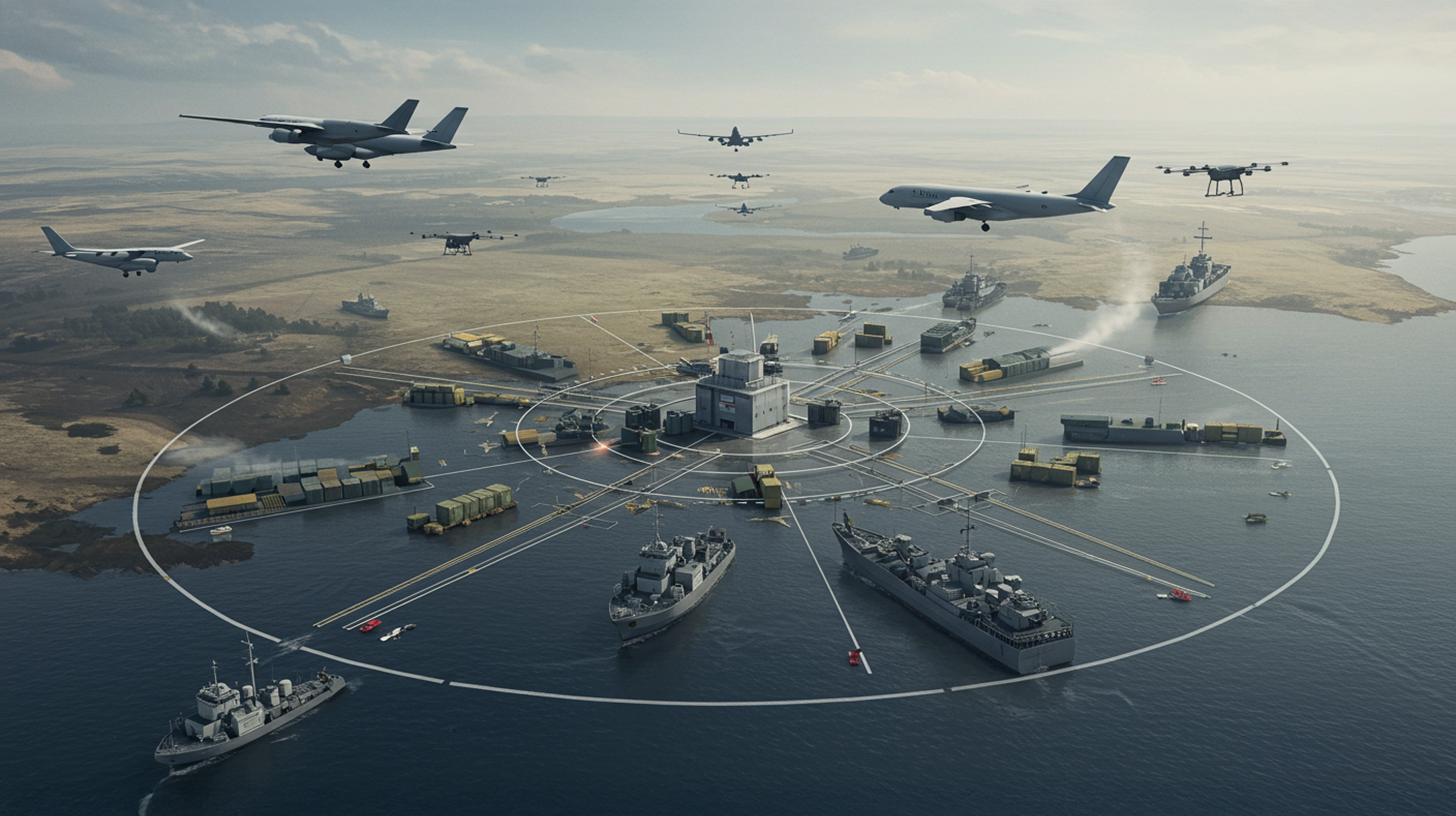
OPLAN AU: Germany's new defense reality - from the front state to the logistical hub - Image: Xpert.digital
Alliance defense newly thought: Operation Plan Germany defines strategic turntable function for Eastern Europe
Operation Plan Germany: Like the Federal Republic of the Logistical Heart of NATO defense
Germany is at a turning point in terms of security in 2025. The territory, which formed the foremost line of defense in NATO during the Cold War, is now in the geostrategic center of the alliance. A completely new mandate grows from this situation: Germany is the logistical heart of the alliance and national defense, the indispensable "turntable" for every large-scale marching of Allied forces in the direction of Eastern and Northeastern Europe. The "Operation Plan Germany" (OPLAN AU) for the first time bindingly anchor this order in a cross-departmentally executable framework and uses experiences from pandemic, flood and official aids as well as the teachings from Russia's war of aggression against Ukraine.
Suitable for:

From the edge to the middle: Germany's strategic role change
The potential front line ran across Germany until 1990; Personnel, material and ammunition were pre -positioned along this line. With the eastern expansion, the NATO demarcation line moved to Poland, the Baltic States and the Black Sea coast. Germany was from the endangered initial defense to the inevitable transit, supply and collection room- comparable to a huge logistical node, in which supply streams from the USA and from South and Western Europe interlink.
This change has four core tasks:
- Host-nation support: reception, accommodation and forwarding of Allied troops,
- Military mobility: rapid border and customs processes, resilient traffic routes, priority for military transports,
- Protection of critical infrastructure: railway nodes, ports, pipeline and power grids must be secured against hybrid attacks,
- Total resilience: municipalities, countries, business and the population are integrated into defense planning.
The Operation Plan Germany (OPLAN AU)
Objective and structure
OPLAN AU is not a pure military document, but a total state planning that interpens civil support services with military requirements. It defines procedures, responsibilities and processes from normal operation to warfare and includes seven thematic working groups - from transport infrastructure to health to strategic communication.
Milestones by 2026
- First iteration (March 2024): Basic concept approved, partial infringement
- Reality check with the countries (Q1 2025): Stress samples of the logistics chains and management organization
- Second iteration (March 2025): Specification of the protection and forces of strength, tactical detailed plans
- Third iteration (March 2026): Final vote, integration into NATO regional plans
Operative priorities
1. Traffic management and corridor logic
A “model corridor” of port systems on the North and Baltic Sea across the Netherlands to Poland bundles heavy transports. Priority, digital customs-pre-clearance and military pilot services receive transitions.
2. Log hubs network
As part of the Pesco project "Network of Logistic Hubs", multinational warehouse and transshipment points are created, including in Wilhelmshaven and Rostock.
3. Protection of critical infrastructure
Together with municipalities, state commands are planning to guard bridges, tunnels, depots and energy systems. The police, THW, fire brigades and reservists form modular security forces.
4. Health and medical supply
Regional "Role-2-enhanced" units and central blood and medication management ensure wounded supply even with mass inflows.
5. Communication and position images
A common civilian situation center brings information from state and federal institutions. Robust "red networks" and satellite -based command paths are prioritized.
Suitable for:

Military Mobility: The European “Military Sching”
In order for OPLIU to work, European Military Mobility has to become a reality. The EU Defense Minister is therefore looking for the end of the shoulder with NATO in order to replace lengthy approval and customs processes. The model is a "logistical Schengen":
- Standardized transit documents,
- Eidas-based digital signatures for border handling,
- Standardized bridge and tunnel classes for military loads,
- Joint investments in railway magistrals, such as Rail Baltica and the "Atlantic-Karlsruhe-Korridor".
The EU flank this project financially through the Connecting Europe Facility Fund and politically with the Safe Ordinance (Security Action for Europe), which is intended to make the armaments sector more resilient and reactionable.
Overview of defense initiatives in 2025
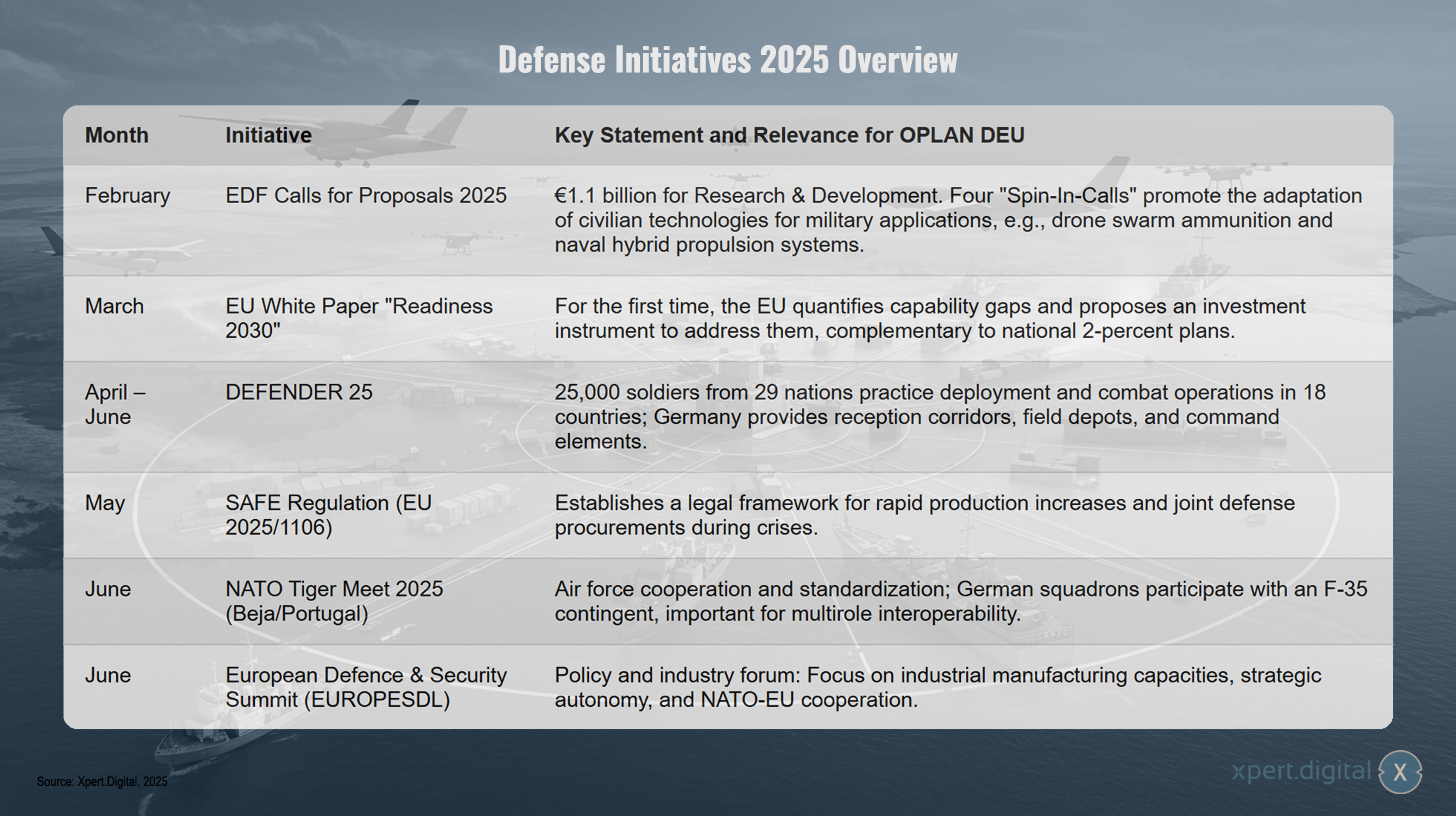
Overview of defense initiatives 2025 - Image: Xpert.digital
In 2025, various significant defense initiatives are implemented, which are of great relevance for the OPLU. In February, EDF advertisements start with a budget of 1.1 billion euros for research and development. Particularly noteworthy are the four “spin-in calls” that aim to adapt civilian technologies for military applications, including drone mass ammunition and naval hybrid drives.
March produces the EU-Weißbuch "Readiness 2030", which for the first time quantified gaps in ability and proposes an investment tool that is intended to supplement the national 2 percent plans. From April to June, the major exercise will take place, in which 25,000 soldiers from 29 nations train in 18 countries. Recording corridors, field depots and management shares.
In May the Safe Ordinance (EU 2025/1106) comes into force, which creates a legal framework for quick production increases and joint armaments in crisis times. June is characterized by two important events: the NATO Tiger Meet 2025 in Beja, Portugal, focuses on air force cooperation and standardization, with German squadrons participating with F-35 quotas, which is of great importance for multirole interior operability. At the same time, the European Defense & Security Summit (Europesdl) takes place, a political and industrial goal with a focus on industrial manufacturing capacities, strategic autonomy and NATO-EU cooperation.
These initiatives work synergetically: EDF projects provide technology, Safe provides industrial series production, the white book defines capacity goals, defender 25 tries to implement the implementation, while conferences such as Europesdl or the EDA DEFENCE ENDROUDRY CONFERENCE secure civil-military dialogue.
Challenges on the way to logistical excellence
Funding requirement
After the Bundeswehr Special Fund expires, a cover gap of around € 30 billion is being built annually in the regular defense budget from 2028. Without long-term financing, infrastructure and ability projects threaten to steal.
Infrastructure bottlenecks
Many German bridges and locks are not designed for 70-ton tank transports. Railway track arches, tunnel profiles, bridge triapics and heavy-duty parking spaces must be upgraded or rebuilt.
Legal and bureaucratic hurdles
During the pandemic, legal ordinances ("Health Protection", "Disaster Protection") offered blueprints for quick decision -making channels. In the event of a voltage, however, other constitutional bases (Art. 115a GG, military constitution). The interface between national and federal competence requires precise application rules ("Rules of Allocation") and alarm periods.
Hybrid threats
Cyber attacks on the Deutsche Bahn networks or targeted disinformation against transshipment stations can massively impair the marching speed. The opplan therefore links cyber resilience measures (NIS2 guideline) with physical property protection.
Acceptance in the population and economy
Troop marches create noise, stress on streets and rails as well as space for depots. Strategic communication is therefore part of the OPLAN: District councilors, mayors and business chambers are included in exercises at an early stage so that planning does not have to be explained in the event of a crisis.
Suitable for:

Practical example: South German logistics corridor
The Corridor Augsburg-Ingolstadt-Regensburg will be classified as a railway heavy lazil in the category C by 2030. Planned measures:
- Lowering six track arches for armored transport trains,
- New construction of heavy -duty handling ramps on the Danube,
- Expansion of federal road 16 as an alternative route,
- Integration of a Medical-Role-3 center in the Ulm Wehrmed Clinic for wounded air bridge,
- Use of unused industrial areas as temporary log hubs in the course of a PPP model.
This example illustrates how the federal government, countries, the Bundeswehr and private sector together with the infrastructure and at the same time generate civilian benefits (freight transport, jobs).
View forward - Readiness 2030 and beyond
The EU white book goals set a binding stock of Schützen armor chains, 35-clear ships for See-Line-Security and a joint ammunition pool of at least 1.4 million artillery grants. So Germany must:
- Moderate the production base - e.g. B. automate powder and explosive works,
- Serving reserves - Multi -year contracts for 200,000 grenades/year were signed,
- Practice management structures-Defender and Tiger-Meet cycles remain test stone for C2 systems,
- Accelerate digitization-Satcom, 5G RA and Cloud Edge nodes are essential for multi-domain operations.
Strategic autonomy does not mean departure from the United States, but resilience in the worst case of a transatlantic engagement in the Indo-Pacific. Europe must be able to close bottlenecks independently.
Suitable for:

The Oplan Deu fundamentally transforms Germany's defense architecture. Logistics becomes a national key ability, comparable to the importance of tanks in the Cold War. Infrastructure, industry and society are transferred to defense mode without paralyzing without economy and everyday life.
The defense initiatives of 2025 form like gears: EDF provides technology, Safe creates manufacturing capacity, the EU white book shows the strategic path, and exercises such as Defender 25 or the NATO Tiger Meet test the practical implementation.
Whether Germany can permanently fill the role of the logistical “turntable” is decided by three factors: sustainable financing, resilient infrastructure and social support.
If this triad succeeds, the Federal Republic becomes an indispensable center of European deterrence and defense ability- and the stability anchor of an increasingly insecure world.
Hub for security and defense - advice and information

Hub for security and defense - Image: Xpert.digital
The hub for security and defense offers well-founded advice and current information in order to effectively support companies and organizations in strengthening their role in European security and defense policy. In close connection to the SME Connect working group, he promotes small and medium -sized companies (SMEs) in particular that want to further expand their innovative strength and competitiveness in the field of defense. As a central point of contact, the hub creates a decisive bridge between SME and European defense strategy.
Suitable for:
Advice - planning - implementation

Markus Becker
I would be happy to serve as your personal advisor.
Head of Business Development
Chairman SME Connect Defense Working Group
Advice - planning - implementation
Konrad Wolfenstein
I would be happy to serve as your personal advisor.
contact me under Wolfenstein ∂ Xpert.digital
call me under +49 89 674 804 (Munich)
Your dual -use logistics expert
Dual -use logistics expert - Image: Xpert.digital


