
Du logistics² | Double dual-use logistics: integration of rail and street for civil and military purposes
Xpert pre-release

Available in 27 languages 📢
Prefer Xpert.Digital on GoogleⓘPublished on: April 30, 2025 / update from: April 30, 2025 - Author: Konrad Wolfenstein

Du logistics² | Double dual-use logistics: Integration of rail and street for civil and military purposes-Image: Xpert.digital
Dual-use logistics: The key to resilient supply chains (reading time: 29 min / no advertising / no paywall)
The strategic need for dual-use logistics in combined traffic
The modern logistics landscape of Europe faces a double challenge: it must increase the efficiency and sustainability of civilian supply chains and at the same time meet the increased demands on military mobility in a changing geopolitical environment. In this context, the concept of the “dual -use” logistics, especially in combined traffic (KV) Schiene-Straße, is gaining in importance. It promises to raise synergies between civilian economic interests and military defense requirements and to create a more resilient, more powerful transport infrastructure for both areas.
Definition of “dual -use” in logistics: Civil needs meet military requirements
The term “dual -use” (double intended use) traditionally refers to goods, software and technologies that can be used for both civilian and military applications. The regulation focuses strongly on the control of the export of such goods to prevent the spread of sensitive technologies, especially in connection with weapons of mass destruction or conventional armor. The EU dual-us regulation (EU) 2021/821 forms the central legal framework, which specifies goods lists, approval obligations and control procedures.
In the context of the logistics infrastructure, however, the term experiences a strategic expansion. Dual-us transport infrastructure refers to systems such as railway lines, bridges, tunnels and in particular terminals of combined traffic, which are designed, built or upgraded that they meet both the requirements of civil freight transport and the specific needs of military transport. This implies joint use and potentially also a joint financing or at least a double justification for investments.
The emphasis on “double” dual-use logistics in the original concern underlines two dimensions of integration:
- Integration of the modes of transport: The use of combined traffic Schiene-Straße as the backbone of the system.
- Integration of users: the interpretation of the infrastructure and processes for efficient processing of both civil and military logistics flows.
Although the physical infrastructure itself (e.g. a bridge or a KV terminal) is usually not on the export control lists for dual-use goods, it still falls into the strategic dual-use area. Her ability to transport military forces and potentially controlled arms or dual-use goods, as well as their general importance for national and alliance defense give it this character. The EU itself describes infrastructure projects that serve both civil and military mobility requirements as a “dual-use” project as part of its support programs such as Connecting Europe Facility (CEF). The core idea of double the intended use - the usability for civil and military purposes - also applies to strategically relevant transport infrastructure.
Suitable for:

The role of combined traffic (rail/road) in modern logistics
The combined traffic (KV) is a form of goods transport, in which standardized loading units (such as containers, alternating containers or semi-trailers) are transported over the largest part of the route by rail or waterway, while the truck is only used for the short initial and from the terminal. The essential feature is that the loading unit is not opened even during transport between the transport companies.
The advantages of the KV are varied:
- Environmental friendliness: significant reduction in CO2 emissions (up to 80% savings compared to pure truck transport on long routes are mentioned) and higher energy efficiency (rail approx. 5x more efficient than road).
- Relief of the streets: reduction in traffic jams and noise pollution.
- Higher transport weights: In Germany and the EU, trucks used in the KV may have a higher overall weight (up to 44 tons) than in pure road transport (40 tons), which increases efficiency.
- Security: Standardized, closed loading units offer high protection for the transported goods.
A distinction is made mainly the unaccompanied KV, in which only the loading units are handled (dominant shape), and the accompanied KV (“rolling country road”), in which entire trucks are transported on special trains and the drivers travel. Special alternating structures with support legs can partially be handled without crane.
The KV is based on a network of envelope terminals on which the change between rail and street (or ship and street/rail) takes place. Germany has around 150 such terminals, which are often located near ports or large industrial areas.
Despite its advantages, the competitiveness of the KV is heavily dependent on the pure road transport. Road transport often remains flexible and faster on short and medium -sized routes. The cost-effectiveness of the KV is only reached from a certain distance (a sample calculation puts a break even at approx. 600 km close). The efficiency of the envelope terminals (avoidance of long waiting times) and the availability and quality of the rail network (sufficient capacity, punctuality, avoidance of disorders) are also crucial. These dependencies are to be assessed critically if the KV is also to be used for time -critical and highly permissible military transports, since military logistics often place high demands on speed and predictability, which can collide with operational characteristics of the KV (e.g. waiting for full trains), provided that the infrastructure is not optimized accordingly.
The convergence: Why Dual-Fair in combined traffic is now relevant
Several factors mean that the integration of civilian and military requirements in KV logistics has a high level of strategic urgency right now:
- Changed security situation: The geopolitical “turnaround in time”, triggered by the Russian attack war against Ukraine, has steered the focus in Europe massively on military deterrence, willingness to defend and the ability to quickly relocate armed forces.
- NATO and HOST Nation Support (HNS): Germany as a central logistical hub (“Turntable Germany”) plays a key role for the laying of NATO troops, especially to the eastern flank of Allianz. This requires a robust transport infrastructure that can manage large troops (potentially up to 800,000 soldiers in 180 days in the event of a crisis) and heavy device (tank, artillery). The rail is the preferred means of transport over long distances.
- EU initiatives on military mobility: The European Union has recognized the strategic importance of military mobility and has published action plans as well as financing instruments (in particular the Connecting Europe Facility-CEF Military Mobility) in order to promote dual-use infrastructure projects in line with the Trans-European Transport Network (TEN-V).
- Economic and ecological drivers: At the same time, there is still pressure to increase freight traffic more efficiently, cheaper and sustainable (climate goals) and the resilience of economic supply chains.
This convergence creates a unique time window. The current geopolitical urgency provides a strong political justification and potentially the financial means to promote long-neglected investments in the transport infrastructure, especially in the rail network and the KV terminals. By positioning investments in the context of the dual-use concept as essential for national and alliance defense (“securing defense ability”), defense households may be opened up for projects, which at the same time bring significant civilian advantages in terms of effects, capacity and sustainability. This could help to overcome earlier financing hurdles for purely civilian infrastructure projects.
Conceptual framework: Principles and synergies
The successful implementation of dual-use logistics in combined traffic requires a clear understanding of the underlying principles and the potential synergies between the civil and military sector.
Core principles of planning and operating dual-use infrastructure
An effective dual-use system is based on several basic principles:
- Common use (shared use): infrastructures such as terminals, sections of the route and bridges are planned, built or upgraded from the outset that they live up to the requirements of commercial freight transport and the specific needs of military transport.
- Prioritization mechanism: Clear rules and procedures must be established that determine how military transports can be prioritized in crisis, tension or defense cases without dismissing civilian users in normal times. This requires transparent criteria and possibly contractual regulations.
- Standardization: Wherever possible, technical standards should be sought that meet both civil requirements and military specifications. This applies, for example, to light space profiles of tunnels, load capacities of bridges and tracks (keyword military load classification - MLC), loading units and communication systems (e.g. ETCS).
- Resilience through design (Resilience by Design): The infrastructure should be interpreted from the start in such a way that it is resistant to disorders (technical, nature -related) and attack (physical or cyber). This includes aspects of physical security, redundancy of systems and cyber security.
- Integrated governance: the planning, financing, the construction and operation of dual-use infrastructure require close and institutionalized cooperation between various actors: military bodies (e.g. Bundeswehr, NATO), civilian authorities (transport ministries, infrastructure agencies), infrastructure operators (e.g. DB infrago) and private transport companies.
Suitable for:

Synergies between business logistics and military logistics in combined traffic
The combination of civil and military use in the KV offers significant synergy potential:
- Infrastructure overlap: Analyzes of the EU Commission and the European Foreign Service have shown that there is a very high agreement (approx. 94% on average of all modes of transport) between the military mobility requirements and the civilian TEN-V network. Investments in the TEN-V network therefore often benefit military mobility directly.
- Efficiency gains: The common use of infrastructure avoids the structure and maintenance of parallel, costly and potentially redundant military transport systems. Military funds can accelerate the expansion and modernization of infrastructure, from which civilian users also benefit. Conversely, civilianization in peace can help to cover the operating costs strategically important systems and to maximize their utilization.
- Increase in ability: Infrastructure improvements that are primarily driven by military requirements - such as increasing the load -bearing capacity of bridges and tracks to military load classes (MLC) or the upgrading of routes for longer trains (e.g. 740m) - often also increase capacity and efficiency of civil freight transport.
- Knowledge transfer and innovation: Cooperation can promote innovations. Military planning and resilience concepts can be transferred to civilian supply chains. Conversely, civilian technological developments (e.g. digitization, automation in terminals) can be used for military logistical processes. In addition, the training of soldiers in logistical skills that are also in demand in civilian life can counteract the shortage of skilled workers in both sectors and facilitate the transition to civil life.
Although the synergy potential is considerable, potential conflicts must not be overlooked. The military requirements for short-term, high transport capacities for large inserts or relocations (“Surge Capacity”) can be contradicted to the optimized “just-in-time” logic of modern civilian supply chains, trimmed for efficiency and punctuality. An effective governance structure must proactively address these potential friction points. Without clear rules, transparent communication and possibly mechanisms for compensation for flexibility or accepted disorders, a military prioritization could be sensitive to civil supply chains, which are dependent on the same infrastructure.
Advantages: economy, resilience, strategic ability, sustainability
The implementation of a dual-use strategy in the KV promises a number of advantages:
- Economicity: better utilization of capital investments in expensive infrastructure. Potential reduction of the overall social logistics costs by shifting the more efficient rail. Strengthening the logistics location of Germany and Europe.
- Increased resilience: Creation of a more robust and more flexible transport network that is better able to react to disturbances of various kinds (natural disasters, technical failures, sabotage files, crises). This supports both national security and the continuity of important economic processes. It addresses weaknesses of infrastructures that were designed purely for civilian purposes.
- Strategic ability: direct improvement in military mobility. Enabling a faster laying and supply of armed forces for state and alliance defense (especially in the context of NATO HOST Nation Support) and for coping with crisis. This strengthens the deterrence.
- Sustainability: Contribution to the achievement of climate goals by moving freight traffic from the street to the more energy -efficient and low -emission rail. Reduction of street traffic jams and associated environmental pollution.
The advantage of “increased resilience” goes beyond purely military aspects. It is about resisting the ability of the entire system - civilian economy and military defense - shocks and crises. The investment in robust dual-use infrastructure not only strengthens the military operational readiness, but also the resilience of critical civilian supply chains and society as a whole. This is in accordance with more comprehensive concepts of the overall state resilience and the protection of critical infrastructures, as are also pursued in national strategies and in the context of civil-military cooperation (ZMZ).
🎯🎯🎯 Benefit from Xpert.Digital's extensive, fivefold expertise in a comprehensive service package | R&D, XR, PR & SEM

AI & XR 3D Rendering Machine: Fivefold expertise from Xpert.Digital in a comprehensive service package, R&D XR, PR & SEM - Image: Xpert.Digital
Xpert.Digital has in-depth knowledge of various industries. This allows us to develop tailor-made strategies that are tailored precisely to the requirements and challenges of your specific market segment. By continually analyzing market trends and following industry developments, we can act with foresight and offer innovative solutions. Through the combination of experience and knowledge, we generate added value and give our customers a decisive competitive advantage.
More about it here:
Germany in the center: logistical linchpin of Europe
The European and German landscape: politics, infrastructure and actors
The development and implementation of dual-use logistics in combined traffic takes place in a complex environment of European initiatives, national policies, existing infrastructure and a variety of actors.
EU initiatives: military mobility action plan, TEN-V network orientation, CEF financing
At the European level, significant steps have been taken in recent years to improve military mobility:
- Military Mobility Action Plan: The EU has put on action plans (currently Action Plan 2.0, 2022-2026), which offer a framework for measures to improve the fast and seamless movement of military personnel and material. The focus is on the adaptation of the infrastructure, the harmonization and simplification of regulations (e.g. border permits, dangerous goods transport), the digitization of processes and the close cooperation with NATO. The “Military Mobility Pledge 2024” of the Member States sets concrete goals, such as granting border permits within a maximum of three working days.
- TEN-V orientation: It was recognized that the civilian trans-European transport network (TEN-V) and military transport needs match a very high degree (approx. 94%). The recently revised TENV regulation therefore explicitly takes into account dual-use aspects to promote military mobility, in particular through prioritization and the expansion of strategic corridors.
- CEF financing: As part of the Connecting Europe Facility (CEF), a specific budget of around 1.7 billion euros for dual-us transport infrastructure projects was first provided for the Finance 2021-2027. With these funds, 95 projects in 21 countries were co -financed. Germany was able to raise significant funding (over 296 million euros for projects with a total volume of around EUR 592 million). Typical funded measures include the upgrading of bridges, the construction of overtaking tracks and the expansion of KV terminals.
Financing gap: However, this dedicated budget for military mobility was completely bound by calls from 2021 to 2023. Until the end of the current multi-year financial framework (MFF) 2027, there are therefore no further specific EU funds available for this purpose. Future dual-use projects have to apply to funds from the general CEF transport budget or fall back on national or other sources of financing.
Regulatory aspects: In addition to the infrastructure, the EU is working on the tightening of cross -border administrative procedures, the harmonization of regulations (e.g. for dangerous goods transport), the simplification of customs formalities and the promotion of digitization. Regardless of this, dual-use goods are subject to strict EU export control regulations (Regulation (EU) 2021/821), which must be observed in transports.
The expires of the dedicated CEF funds for military mobility marks a critical point. While the political framework (action plan, Ten-V orientation) continues, the lack of specific funds could slow down the implementation and increase the dependence on national defense households or less secure general EU funding. This harbors the risk that the progress in improving military mobility will stall or that Member States are disadvantaged with less financial strength, especially for projects whose purely civilian justification is less strong. There is a potential discrepancy between the strategic ambitions at EU level and the available dedicated resources.
Suitable for:

German context: strategic role (Host Nation Support), OPLAN AU, National Politics & Regulations
For Germany there are specific framework conditions and challenges:
- Strategic role: As a “turntable Germany” in the center of Europe, the country is of outstanding importance for the logistical support of NATO partners (Host Nation Support-HNS), especially in the case of troops towards Eastern Europe. This places high demands on the capacity and performance of the national transport infrastructure.
- OPLAN AU: The Operation Plan Germany (OPLEU) is the national defense plan, which presumably also provides for the integration of civil resources and infrastructures into overall defense. This underlines the need for effective civil-military cooperation (ZMZ) and the relevance of dual-use concepts for national security architecture.
- National Politics: The Federal Government has declared a priority to renovate and modernize the rail network. There are national funding programs for the construction and expansion of KV terminals. There are also legal relief for trucks in the KV pre-run and afterrise, such as exceptions from the vehicle tax or from Sundays and holiday driving bans. The implementation requires close coordination between the federal government (especially BMVG and BMDV) and the countries.
- Dual-us control: The national regulations for export control, implemented by the Federal Office for Economics and Export Control (BAFA), complement the EU requirements and are relevant for logistics companies that transport potentially controlled goods. Specific embargos or carry-on restrictions also apply to certain countries, also to dual-use goods.
- Civil-military cooperation (ZMZ): Germany has established structures of the ZMZ, such as the command of territorial tasks of the Bundeswehr, the ZMZ Center in Nienburg and the State and Liaison Commands. These serve to coordinate and mutual support between the Bundeswehr and civilian authorities and organizations, both in disasters and in the context of the state and alliance defense.
However, there is a potential gap between the strategic necessities that are formulated in concepts such as HNS and OPLAN AU, and the practical realities. These include the sometimes inadequate state of transport infrastructure as well as administrative and bureaucratic hurdles that can make military transports difficult. The closure of this gap not only requires significant financial investments, but also an optimization of cross-departmental cooperation (effectiveness of the ZMZ structures in the event of a defense) and possibly adjustments in the legal framework to enable faster and more flexible reactions.
Evaluation of the key infrastructure: condition of the rail network, terminal of combined traffic
The performance of the dual-use system depends largely on the condition of the physical infrastructure:
- Condition of the rail network: The German rail network suffers from a significant investment backlog. Many bridges, signal boxes and sections of the route are outdated and in need of renovation. Extensive modernization and renovation programs have started, but lead to considerable operational restrictions and punctuality problems in the short and medium term, both in passenger and freight transport. The freight traffic on the rail recently recorded declining transport quantities.
- Capacity of the KV terminals: Existing terminals often reach their capacity limits. There is a need for extensions (additional tracks, storage areas) and modernizations (more powerful cranes, longer envelope tracks for 740m trains, digitization of the processes). Examples of ongoing or planned extensions can be found in Kornwestheim or Leipzig-Wahren.
- Specific deficits for military use: Many sections of the route and in particular bridges do not meet the necessary military load classes (MLC) for the transport of heaviest military vehicles such as combat tanks. There is no sufficient number of suitable heavy load wagons (flat wagons). In addition, many KV terminals do not have the necessary loading facilities (e.g. fixed or mobile ramps) for the independent absorption and departure of military vehicles (roro ability). Safe storage and provision areas are also often in short supply.
- Situation at DB Cargo: The economically tense situation of DB Cargo, the main actor in German rail freight transport, and a possible reduction in transport contracts by the Bundeswehr raise questions regarding the future dependence on this one provider of military rail transports.
The partially poor condition of the existing rail infrastructure is probably the greatest practical obstacle to the effective implementation of a powerful dual-use-KV system. The necessary general renovation is essential, but inevitably leads to years of construction and route closures. This creates a difficult conflict of goals between the long-term structure of skills and the short to medium-term ensuring operational availability for civilian and military users alike. The long periods for basic infrastructure renovations are also contrasting to the perceived geopolitical urgency.
Important actors and their roles
A successful dual-use system requires the coordinated interaction of a large number of actors:
- Military: Bundeswehr (logistics command, dispute base, command of territorial tasks), NATO partner (as a user as part of HNS). Define military requirements, use the infrastructure.
- Government: Federal Ministeries (BMDV for Transport/Infrastructure, BMVG for Defense, BMWK/BAFA for export control), state governments (spatial planning, permits), Federal Network Agency (regulation of network access). If political framework conditions determine, funds provide funds, issues.
- Infrastructure operator: Primary DB Infrago AG (as owner and operator of the majority of the German rail network), potentially also private infrastructure operator. Responsible for maintenance, expansion and operation of the infrastructure.
- Transport operator: DB Cargo, private rail traffic company (EVU) in freight transport, freight forwarders and truck companies (for up and forth), terminal operator (e.g. Duss-Deutsche Umschlaggesellschaft Schiene-Straße), logistics service provider (e.g. DB Schenker). Provide the actual transport and envelope.
- Industrial associations: representations of logistics, transport and, if necessary, defense industry (e.g. BDI, DSLV, VDV). Bundle interests, bring in expertise, have a part of standardizations.
- EU institutions: European Commission (especially GD Move, GD Defis), European Foreign Service (EAD), Executive Agency Cinea (funding management), European Parliament, Council of the EU. If the European political framework set, funds provide funds and promote cross -border cooperation.
Suitable for:

Operationalization of the dual-use-combined traffic: challenges and requirements
The implementation of a functioning dual-use-KV system requires overcoming numerous practical challenges and the creation of specific requirements in the areas of infrastructure, regulation, governance, security and financing.
Infrastructural bottlenecks and the need for now
The physical infrastructure must be adapted and expanded in many places in order to meet the double requirements:
- Capacity bottlenecks: There are capacity bottlenecks on important rail corridors and in the KV terminals that hinder the flow of traffic. The expansion of routes (e.g. additional tracks), digitization (ETCS Level 2/3 to increase capacity) and the expansion as well as the increase in efficiency of terminals should be remedied.
- Modernization needs: Outdated signal box technology must be replaced by digital systems (DStW). The electrification of further routes is necessary. Trips must be upgraded for the use of 740 -meter -long freight trains to increase efficiency. The poor condition of many bridges and track systems requires comprehensive renovations.
- Military load classes (MLC): A central challenge is to ensure that strategically important routes and in particular bridge structures can bear the high military load classes (e.g. MLC 100 or 120 for heavy martial shells). This often requires specific and costly reinforcement measures that go beyond normal civil standards.
- Terminal capabilities: KV terminals must be upgraded for military use. This includes the installation of sufficiently dimensioned crane systems for heavy loads, the creation of suitable ramps (fixed head or side ramps, mobile systems) for loading cycling and chain vehicles (roro ability), the provision of secured parking, storing and departure areas as well as potentially increased safety precautions (fences, surveillance).
The extensive upgrading of the network to high MLC standard is a significant technical and financial challenge. Prioritization is inevitable. It will probably have to concentrate on predefined strategic corridors that are defined in coordination with NATO and EU planning and, for example, connect important ports, military locations and routes to the east. Conversely, this means that the entire KV infrastructure cannot or must be completely “militarized”, but a graded skill profile will arise across the network.
The following table illustrates the comparison between typical civilian and specific military demands on the KV infrastructure:
Comparison of civil and military requirements for KV infrastructure
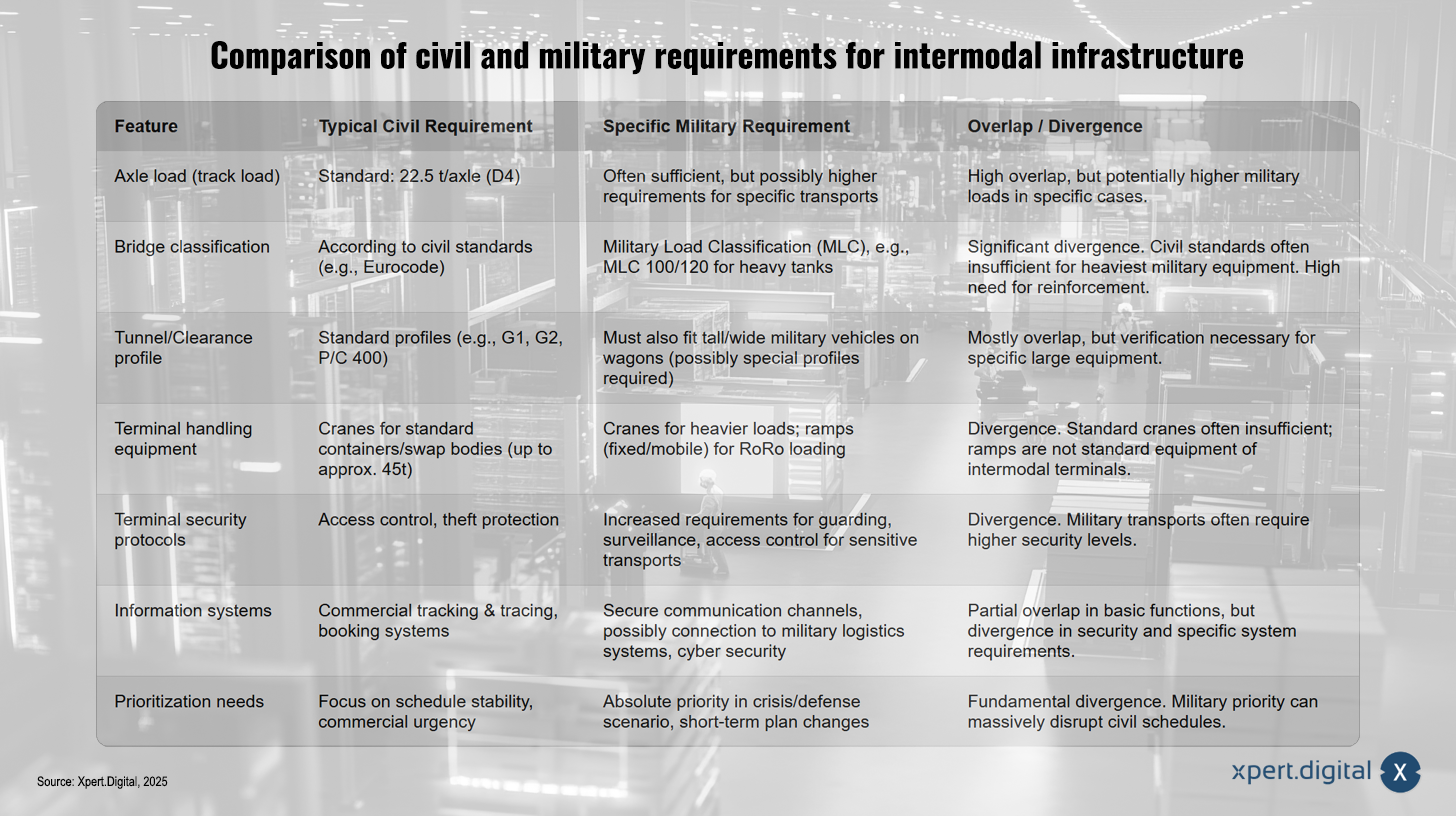
Comparison of civil and military requirements for KV infrastructure-Image: Xpert.digital
The comparison between civil and military requirements for the KV infrastructure shows both overlaps and significant deviations. While civil requirements are often based on standards such as a route load of 22.5 t/axis (D4), military infrastructures must withstand higher loads, for example in heavy transports. The situation is similar in bridges that adhere to civil standards such as the Eurocode, but often not sufficient for the heaviest military equipment, which requires adjustment or reinforcement. There are also overlaps for tunnel and light space profiles, but these must be checked for particularly high or wide military vehicles and, if necessary, adjusted. There are greater differences in terminal handling devices: While civil terminals use cranes for standard containers, military applications often require more special systems, such as cranes for heavier loads or ramps for roro loading that are not standard in civilian terminals. Security protocols also play an important role, with military transports having stricter requirements for monitoring and access control. With regard to information systems, there are common ground in the basic functions, but the military requires safe communication channels, integration into military logistics systems and high cyber security standards. The need for prioritization shows fundamental differences, since military transports in crisis situations have absolute right of way, which can significantly influence civil timetables. Overall, careful consideration of the different requirements and a corresponding adaptation of the infrastructure is necessary in order to meet both civil and military needs.
Regulatory and bureaucratic hurdles
In addition to the physical bottlenecks, regulatory and administrative hurdles represent considerable obstacles:
- Cross-border permits: The acceleration and simplification of approval procedures for military transports across EU internal borders is a core target of the EU military mobility initiative (goal: max. 3 working days). However, this remains a major challenge, especially for oversized transports (heavy transport) and the transport of dangerous goods. It requires considerable efforts at the national level to adapt regulations and processes as well as better international coordination.
- Dangerous goods transport: The harmonization of the different national regulations for the transport of military dangerous goods is complex, but essential for a smooth border crossing.
- Standardization deficits: Missing uniform technical or operational standards for various terminal operators or between national rail systems can hinder the seamless interoperability of military transports.
- Customs formalities: The digitization and simplification of customs registrations and procedures for military goods that are moved into the, from or through the customs area of the Union is necessary to reduce administrative delays.
The overcoming of these regulatory hurdles requires considerable political will and sustainable efforts both at EU and at the national level. There is a risk that progress in the individual Member States will be unevenly, which could lead to bottlenecks only shifted to limits, where the procedures have not yet been sufficiently tightened. Digitization is a key element, but requires investments, interoperable systems and agreements on data exchange, which in turn can encounter concerns about sovereignty or security.
Governance and operational models
Controlling a dual-use system requires new forms of cooperation and clear regulations:
- Balance of priorities: A robust governance framework requires clear access rules, timetable procedures and prioritization protocols for normal times versus crisis situations. This requires a clear legal basis and detailed contractual agreements between the actors involved.
- Coordination mechanisms: The establishment of permanent coordination bodies with the participation of the military, government agencies, infrastructure operators and transport operators is necessary for strategic planning, operational management and conflict resolution. At the national level, cross -departmental coordination groups are recommended.
- Distribution of costs and financing: It must be clarified how investment and operating costs are divided between defense households, civilian traffic and possibly the users. The development of models for mixing financing (national, EU, private) must be checked.
- Operator models: Alternatives or additions to the sole dependency on a main actor such as DB Cargo should be checked. This could include the integration of private surgeons via specific performance agreements (Service Level Agreements) for military transports.
The creation of a functioning governance model that satisfies both military urgency and civilian commercial needs is a complex task. It requires the structure of trust and transparency between sectors, which traditionally act rather separately (defense and commercial logistics). Mechanisms may need to be developed to compensate for civil surgeons for the willingness of surge capacity or the acceptance of disorders during military prioritization, which in turn presupposes negotiations and a secure financing.
Security aspects
The common use of critical infrastructure increases the security requirements:
- Physical security: Critical infrastructure elements (terminals, bridges, signal boxes) and the military transports themselves must be protected against sabotage, theft, espionage or attacks.
- Cyber security: The protection of control systems (e.g. ETCS, signal boxes), communication networks and logistics management software against cyber attacks is of outstanding importance, since a failure or manipulation could have catastrophic consequences.
- Information security: Sensitive data about military movements, transport routes and loads must be protected against unauthorized access.
The integration of civil and military logistics on a common infrastructure increases the potential area of attack for physical and cyber threats. Civil systems could become gates for attacks on military logistics and vice versa. The increasing digitization increases efficiency, but also increases cyber risks. Comprehensive security concepts must therefore be developed and implemented between military and civilian authorities (police, intelligence services, infrastructure operators, surgeons). This can cause additional costs and operational complexity and requires constant consideration between security and operational efficiency.
Financing and investment strategies
The financing of the necessary retraining measures is a key question:
- Primary source of financing: Defense budgets are proposed as an essential source, with investments in dual-use infrastructure with the need to "secure defense" and the fulfillment of national and alliance obligations.
- EU funding: Even if the dedicated CEF funds are exhausted for military mobility, future projects can try to acquire funds from the general CEF traffic budget, potentially from future MFF periods or other EU programs (e.g. regional funding). The proof of the clear dual-use character and synergies is crucial for this.
- National traffic households: Co -financing from regular infrastructure budgets is useful where significant civilian advantages (increase in capacity, efficiency gains) are realized.
- Private investments: The possibilities of co-financing by the private sector, for example in the context of public-private partnerships (PPP) for terminal expansion or technology designs, should be explicit (although not explicitly detailed in the available sources).
After the specific CEF funding line for military mobility has expired, the increased dependence on national defense households could lead to financing decisions being directed more by purely military priorities. There is a risk that the optimization of civilian co-use will take a back seat when conflicts of goals occur, unless this is explicitly controlled and requested by strong governance structures. This could undermine the full synergy potential of the dual-use approach.

Xpert.Plus warehouse optimization - high-bay warehouses such as pallet warehouses consulting and planning
Strategic recommendations for an integrated dual-use transport network
Case studies and proven practices (illustrative)
In order to make the abstract concepts more tangible, a consideration of concrete infrastructures and experiences is helpful.
Analysis of selected terminals/corridors on dual-use approval
The suitability of a KV terminal or a rail corridor for effective dual-use use depends on various factors. This includes the existing cover capacity, the quality of the rail connection, the current and potentially accessible load capacity (MLC), the strategic location (closeness to ports, military bases, main traffic axes), expansion options and safety aspects.
The following table gives an illustrative assessment of dual-use approval for some German KV terminals mentioned in the sources. It should be emphasized that this is based on limited information and a detailed technical test on site is essential for a definitive assessment.
Illustrative evaluation of dual-use approval of selected German KV terminals
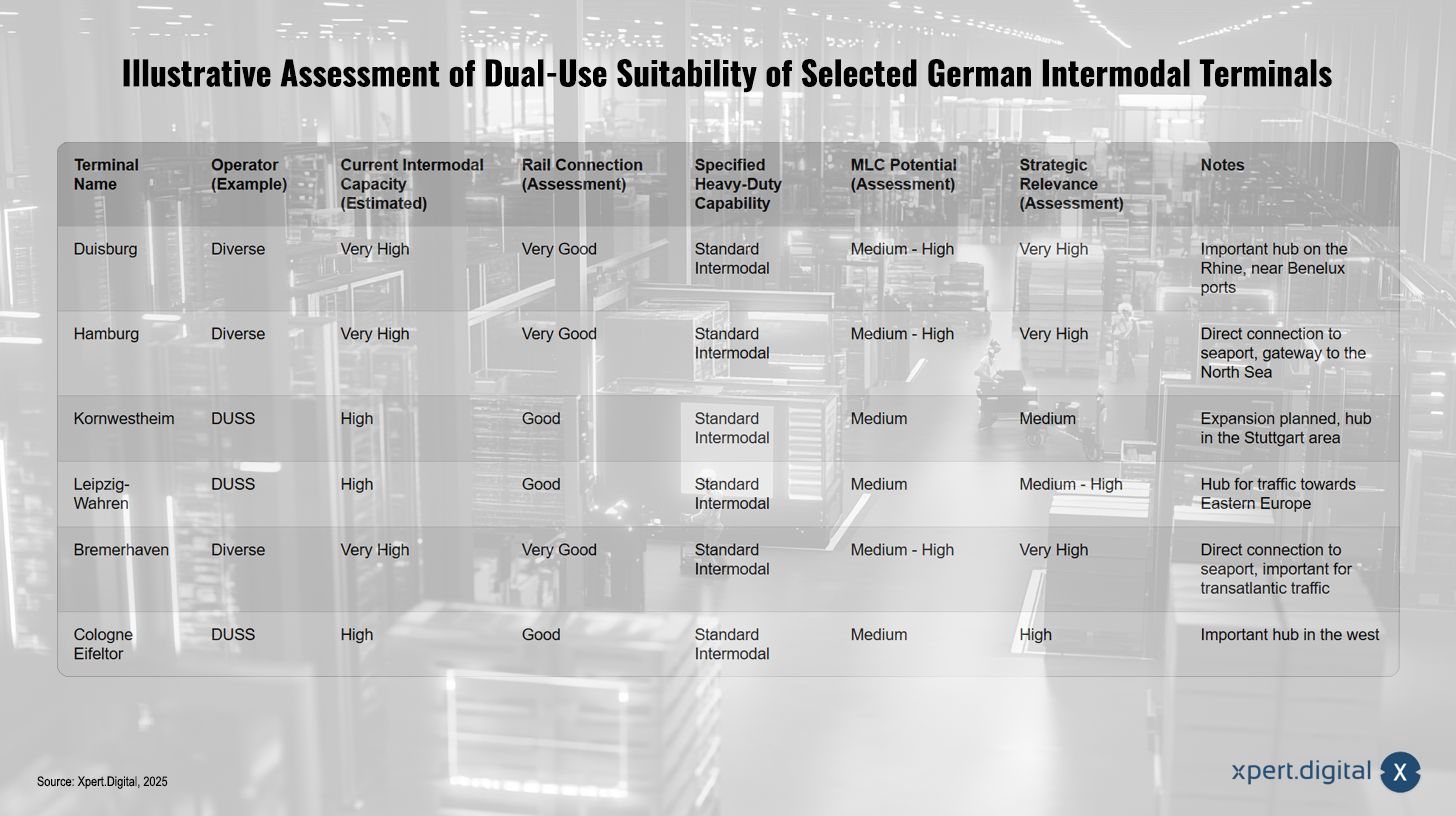
Illustrative evaluation of the dual-use approval of selected German KV terminals-Image: Xpert.digital
The evaluation of the dual-use approval of selected German KV terminals shows a clear hierarchy with regard to capacity, rail connection, heavy load capacity, MLC potential and strategic relevance. Duisburg presents itself as an important hub on the Rhine near the Benelux ports and scores with a very high capacity, excellent rail connection and strategic importance. Hamburg is similarly evaluated, which stands out as a gateway to the North Sea due to its direct connection to the seaport and the function. In Bremerhaven, the strategic function is underlined by connecting to transatlantic traffic. Kornwestheim and Leipzig-Wahren have a slightly lower strategic importance, but act as important nodes for regional traffic and east-west connections. Cologne Eifeltor proves to be a central knot in the west with good rail connection and medium to high MLC potential. Overall, the analysis illustrates the different strengths of the terminals and their respective function in the German network of combined traffic.
Note: The reviews for MLC potential and strategic relevance are qualitative assessments based on the sources and general geographical-strategic considerations.
This table illustrates that not all terminals are equally suitable for military upgrading or strategically relevant. Investments should focus on nodes that, due to their location, capacity and their expansion potential, promise the greatest strategic added value for dual use use.
Teaching from implemented dual-use projects or cross-border initiatives
Experience from projects and exercises that have already been carried out can provide valuable information for future design:
- CEF-funded projects: The analysis of the 95 projects co-financed by CEF Military Mobility can provide information about which types of measures were particularly successful and where challenges occurred (e.g. in complying with schedules, coordination between civil and military actors or at cross-border voting).
- Cross-border cooperation: Projects such as Rail Baltica, which explicitly also takes into account dual-use aspects, or specific bilateral agreements to facilitate military transportation can serve as models for governance structures and cooperation mechanisms.
- Exercises: Military exercises that test cross -border relocations are crucial to identify practical bottlenecks in the infrastructure or in the administrative processes and uncover potential for improvement.
- Proven practices (best practice): Successful examples of the cooperation between different stakeholders, for the mobilization of funds or for simplification of regulations should be identified and distributed. It is interesting, for example, why some shippers successfully put on the rails despite the challenges, while competitors do not do this.
A remarkable observation from the previous CEF funding is the small number of projects with explicitly cross-border character (only 2 out of 95 funded projects). This could indicate that either national priorities in the project selection dominated or that the complexity of the coordination and planning of cross -border projects is a significant hurdle. This potentially contradicts the strategic goal of creating seamless transnational transport corridors for military mobility, and underlines the need to promote and facilitate the cross -border dimension more in the future.
Suitable for:

Strategic recommendations and future outlook
The creation of an integrated, resilient and efficient dual-use transport network in combined transport is a strategic necessity for Germany and Europe. In order to achieve this goal, concerted efforts by all actors involved and a clear future perspective are required.
Recommendations for action
Based on the analysis, the following recommendations result:
For political decision -makers (EU & National):
- Ensure sustainable financing: develop long-term and reliable financing mechanisms for dual-use infrastructure beyond the current MFF.
- Accelerate regulatory harmonization: Process for cross -border permits (especially for dangerous goods and large -scale transports) and continue to standardize and digitize customs formalities.
- Strengthen ZMZ/CIMIC frames: to further develop the structures and processes of civil-military cooperation and to adapt to the requirements of overall defense.
- Specify robust governance models: create clear legal and contractual framework for the joint use and prioritization of dual-use infrastructure.
- Prioritize strategic corridors: Investments on upgrading the most important transnational corridors for military mobility concentrate.
For infrastructure operators (e.g. DB Infrago):
- Integrate dual-use requirements: Systematically include military requirements (MLC, loading profiles, security) in the long-term network development and renovation plans.
- Implementing prioritized upgrading: drive expansion and modernization measures on the strategically relevant corridors.
- Optimize construction site management: improve the coordination of construction work in order to minimize the effects on civil and military traffic.
- Increase cyber security: make investments in the protection of digital leading and security technology.
For military planners:
- Clearly define requirements: formulate changing military transport needs precisely and communicate at civilian planning points at an early stage.
- Actively participate in governance: participate in common planning and control bodies.
- Practice regularly: test and validate infrastructure and procedures through realistic exercises.
- Maintain relationships: build and maintain partnerships with civilian logistics providers.
For logistics operators:
- Check participation: evaluate opportunities and risks of participation in dual-use models.
- Develop flexible models: create operational flexibility to react to potential military prioritization.
- Search for dialogue: maintain active exchange with military and government agencies.
- Ensure compliance: ensure compliance with all transport regulations, especially for sensitive or controlled goods.
Comprehensive:
- Establish permanent dialogue platforms: create multi-stakeholder bodies for continuous exchange, joint planning and problem solving.
- Initiate pilot projects: Start pilot projects on strategically important corridors to test operative models in practice and to optimize gradually.
Future trends: effects of digitization, automation and ecologization
The future development of dual-use logistics is significantly influenced by technological trends:
- Digitization: Technologies such as the digital automatic coupling (DAK), the European train security system ETCs and digital platforms for capacity management and cross -border data exchange offer considerable potential for increasing efficiency and interoperability - both for civilian and military traffic. At the same time, however, they increase the attack area for cyber threats.
- Automation: Automated envelope processes in terminals and potentially autonomously driving trucks or trains could shorten the envelope times and change the personnel requirements, which also had an impact on the organization and flexibility of dual-use operations.
- Ecologization (Greening): The political pressure to decarbonize traffic increases the trend towards relocating on the rail and the KV. However, the development of alternative drives (hydrogen, battery electrical) for locomotives and trucks in the forefront/follow-up must also take into account the military requirements for range, refueling/charging infrastructure (also in the area of application) and robustness.
This technological advances offer the opportunity to significantly increase the efficiency and performance of dual-use logistics. However, they also bring new complexities and potential weaknesses with them (cyber security, requires specialized infrastructure, interoperability of new systems). A proactive examination of these trends and taking into account their specific military implications in strategic planning are therefore essential to take advantage of the opportunities and manage the risks.
On the way to an integrated, resilient and efficient dual-use transport network for Europe
The strategic need to integrate civil and military demands on transport logistics is obvious. As a dual-use system, the combined traffic Schiene-Straße offers significant potential to increase efficiency, to strengthen resilience and to improve the strategic ability of Germany and Europe. The advantages range from economic and ecological profits to direct support for national and alliance defense.
However, the implementation of this potential requires the overcoming of significant challenges: the reduction of the investment in the infrastructure, the harmonization of regulations, the establishment of effective governance structures and the guarantee of security in an increasingly complex threat landscape.
The path to a really integrated, resilient and efficient dual-use transport network requires sustainable political will, close and trusting cooperation between all involved from the military, politics, administration and business, targeted investments in strategically important infrastructures and continuous adaptation to technological developments and changing framework conditions. A powerful dual-use logistics is not an end in itself, but a crucial building block for economic prosperity, social resistance and strategic autonomy in Europe in an insecure world.
🎯📊 Integration of an independent and cross-data source-wide AI platform 🤖🌐 for all company matters

Integration of an independent and cross-data source-wide AI platform for all company matters-Image: Xpert.digital
Ki-Gamechanger: The most flexible AI platform-tailor-made solutions that reduce costs, improve their decisions and increase efficiency
Independent AI platform: Integrates all relevant company data sources
- This AI platform interacts with all specific data sources
- From SAP, Microsoft, Jira, Confluence, Salesforce, Zoom, Dropbox and many other data management systems
- Fast AI integration: tailor-made AI solutions for companies in hours or days instead of months
- Flexible infrastructure: cloud-based or hosting in your own data center (Germany, Europe, free choice of location)
- Highest data security: Use in law firms is the safe evidence
- Use across a wide variety of company data sources
- Choice of your own or various AI models (DE, EU, USA, CN)
Challenges that our AI platform solves
- A lack of accuracy of conventional AI solutions
- Data protection and secure management of sensitive data
- High costs and complexity of individual AI development
- Lack of qualified AI
- Integration of AI into existing IT systems
More about it here:
We are there for you - advice - planning - implementation - project management
☑️ SME support in strategy, consulting, planning and implementation
☑️ Creation or realignment of the AI strategy
☑️ Pioneer Business Development

Konrad Wolfenstein
I would be happy to serve as your personal advisor.
You can contact me by filling out the contact form below or simply call me on +49 7348 4088 965 (Munich) .
I'm looking forward to our joint project.
Write to me

Xpert.Digital - Konrad Wolfenstein
Xpert.Digital is a hub for industry with a focus on digitalization, mechanical engineering, logistics/intralogistics and photovoltaics.
With our 360° business development solution, we support well-known companies from new business to after sales.
Market intelligence, smarketing, marketing automation, content development, PR, mail campaigns, personalized social media and lead nurturing are part of our digital tools.
You can find out more at: www.xpert.digital - www.xpert.solar - www.xpert.plus
Keep in touch











