
Germany faces a shortage of space in logistics – Lack of space jeopardises Germany’s competitive position
Xpert pre-release

Available in 27 languages 📢
Prefer Xpert.Digital on GoogleⓘPublished on: August 11, 2025 / Updated on: August 11, 2025 – Author: Konrad Wolfenstein
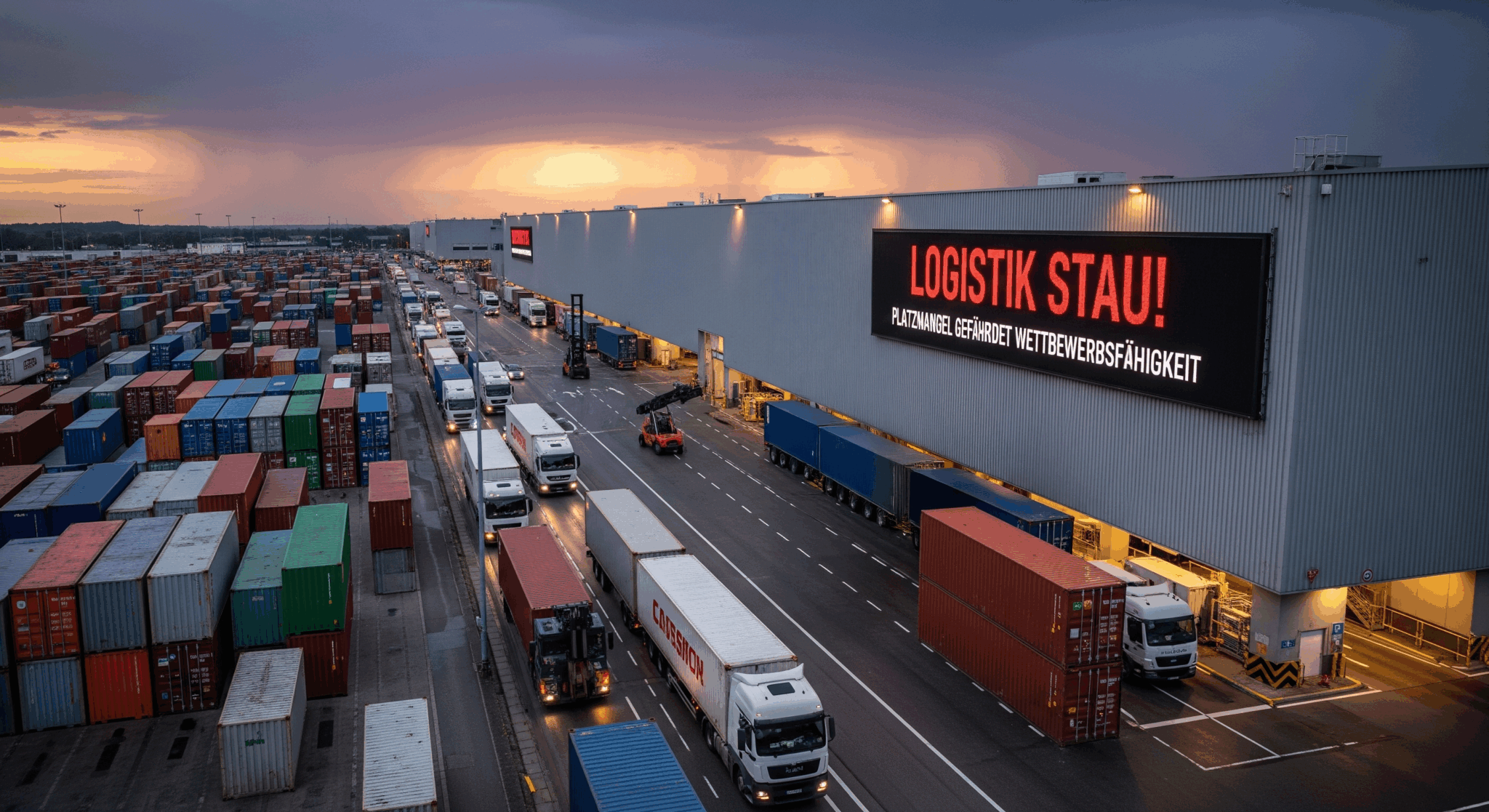
Germany faces a shortage of space in logistics – Lack of space jeopardizes Germany's competitive position – Creative image: Xpert.Digital
Lack of logistics space threatens Germany's business location
What does the paradoxical situation of the German economy mean for the logistics industry?
The German economy finds itself in a seemingly contradictory situation: While gross domestic product is stagnating or even shrinking, a massive shortage of logistics space is emerging. This paradox raises fundamental questions about the structural problems of the German economy and their impact on competitiveness.
The German economy shrank for the second consecutive year in 2024, by 0.2 percent, following a 0.3 percent decline in 2023. At the same time, data show continued demand for logistics space, reflected in a shortage of supply and rising rents. This development suggests that the stagnation of the overall economy does not necessarily equate to a decline in logistics requirements.
The causes of this stagnation are diverse and primarily structural. High energy costs, elevated interest rates, increasing international competition, and political uncertainty are weighing on the German export economy. Germany's production potential is more than five percent below the figure expected in 2019 for 2024. These structural challenges create an environment in which companies must hold back their investments and expansion plans while simultaneously optimizing and modernizing their existing supply chains.
The need for space in logistics is driven by several factors that operate independently of the general economic situation. The e-commerce boom, even though it has cooled somewhat, continues to require decentralized logistics structures. At the same time, restructuring processes in industry, particularly in the automotive sector due to electromobility, are leading to additional space requirements.
How has the German logistics real estate market developed in recent years?
The German logistics real estate market has undergone remarkable development in recent years, characterized by sustained demand and a simultaneously tight supply. This development is reflected in both turnover figures and price trends, as well as in the structural changes within the market.
Take-up in the German logistics real estate market has fluctuated between 5.7 and 6.9 million square meters annually in recent years. For the first half of 2025, 2.7 million square meters were already taken up, representing an increase of almost eleven percent compared to the previous year. These figures demonstrate that, despite the economic challenges, there is stable demand for logistics space.
The development in the major logistics hubs is particularly noteworthy. While these traditional markets dominated the market for a long time, they have suffered significant declines in recent years. This is primarily due to the scarcity of space and rising land prices in these regions. As a result, demand is increasingly shifting to peripheral locations where more space is available at more favorable conditions.
Rent trends reflect the shortage of supply. In the top regions, rents are rising continuously by up to 3.5 percent annually. Prime rents in the A-cities have already reached €9.20 per square meter. These price increases are driven not only by the shortage of space, but also by rising construction costs and increased requirements for sustainability and energy efficiency.
Another important trend is the high proportion of new construction in the logistics real estate market. Approximately two-thirds of total take-up is accounted for by new buildings. This demonstrates that existing space often no longer meets modern requirements and that companies are willing to invest in new, technologically advanced logistics properties.
The demand structure has also changed. While logistics service providers once dominated the market, industrial companies are now the most important user group, accounting for over 40 percent. This reflects the trend toward internalizing logistics functions and the importance of logistics for industrial restructuring processes.
What are the structural causes of the space shortage?
The shortage of logistics space in Germany is not only the result of rising demand, but also of structural problems on the supply side. These causes are deeply rooted in the political, legal, and planning framework and require long-term solutions.
A key problem is the restrictive zoning policies of municipalities. Logistics space plays a secondary role in inner-city development concepts, despite being crucial for small and medium-sized enterprises. Urban planners and municipalities often prefer other uses such as residential or office space, as these are perceived as more attractive and less disruptive.
The German government is pursuing the goal of reducing land consumption to less than 30 hectares per day by 2030, and the EU is even aiming for net-zero land consumption by 2050. These environmental policy goals increase the pressure on available commercial land and significantly complicate the designation of new commercial and industrial areas.
Lengthy approval procedures further exacerbate the problem. The development of new logistics space involves complex planning and approval processes that can drag on for several years. These delays mean that supply cannot keep pace with growing demand quickly enough.
The scarcity of urban land further limits supply, especially in prime logistics centers. In metropolitan areas, logistics space competes with other uses for limited land, often losing out. This leads to the displacement of logistics to peripheral locations, which in turn results in longer transport routes and higher costs.
Another structural factor is banks' increased risk aversion when financing speculative logistics projects. The share of speculatively constructed logistics properties has fallen to just 13 percent of total development volume, compared to an average of 32 percent between 2019 and 2023. This means that new space is mainly being developed only with secured pre-leasing, which limits market flexibility.
The fragmentation of responsibilities between different administrative levels complicates coordinated spatial planning. While the federal government sets the overarching goals, the actual implementation lies with the states and municipalities, which often have different priorities. This lack of coordination leads to suboptimal results and delays necessary developments.
Why does the logistics industry continue to experience strong growth despite economic stagnation?
The continued dynamism of the logistics industry despite overall economic stagnation can be explained by several structural trends and changes that operate independently of the general economic situation. These developments underscore the central role of logistics for the modern economy and its function as an enabler for other industries.
E-commerce remains a key growth driver, even if the pace has slowed somewhat. Consumer expectations for fast delivery times and flexible delivery options require decentralized logistics structures and modern distribution centers. One forecast predicts an expansion of e-commerce-related logistics space by up to 500,000 square meters in Germany alone by 2028.
Restructuring processes in industry are also driving demand for logistics space. The automotive industry, in particular, requires new storage and distribution structures for batteries, spare parts, and changing supply chains in the wake of electromobility. These industrial transformation processes are largely independent of short-term economic fluctuations and continue even in economically difficult times.
The increasing complexity of global supply chains and the need for risk diversification are leading to additional warehousing requirements. Companies are building buffer stocks to protect themselves against supply disruptions and implementing nearshoring strategies that require local warehousing. These defensive strategies are increasing demand for logistics space, even when the overall economy is stagnating.
Sustainability requirements are driving the modernization of existing logistics structures. Over 65 percent of institutional investors prefer ESG-compliant real estate projects. This is leading to demand for energy-efficient, certified logistics buildings and the replacement of outdated structures with modern, sustainable alternatives.
The digitalization of logistics processes requires new infrastructures and building concepts. Automated warehouse systems, robotics, and artificial intelligence require specially designed spaces with appropriate technical equipment. These technological requirements are rendering many existing logistics properties obsolete and creating a need for modern, technology-compatible space.
Demographic change and the shortage of skilled workers are accelerating the trend toward automation in logistics. Companies are investing in technology-intensive solutions to reduce their dependence on human labor. These automation investments are being made even when the overall economy is weakening, as they create long-term competitive advantages.
Your container high-bay warehouse and container terminal experts

Container high-bay warehouses and container terminals: The logistical interplay – Expert advice and solutions – Creative image: Xpert.Digital
This innovative technology promises to fundamentally change container logistics. Instead of stacking containers horizontally as before, they are stored vertically in multi-tiered steel rack structures. This not only enables a drastic increase in storage capacity within the same space but also revolutionizes the entire processes in the container terminal.
More about it here:
How Germany can overcome the logistics space shortage – strategies and forecasts
What impact does the shortage of land have on German competitiveness?
The lack of suitable logistics space threatens Germany's competitiveness on several levels and could weaken the country's position as a business location in the long term. The effects range from direct cost increases to strategic disadvantages in international competition.
Germany has already lost its position as the world leader in logistics, falling from first to third place in the World Bank's Logistics Performance Index. This deterioration is partly due to infrastructure deficits and capacity bottlenecks, including the lack of
Logistics space belongs to this category. German logistics is no longer competitive in many areas, which is symptomatically reflected in the former locational advantages.
The shortage of space is leading to significant cost increases, which are straining the competitiveness of German companies. Rising rents and land costs in logistics centers are passed on to customers and ultimately make German products more expensive on international markets. Companies must either accept higher costs or resort to suboptimal locations, resulting in longer transport routes and less efficient processes.
The lack of suitable land is hindering investment and the establishment of international companies. Foreign investors seeking to use Germany as a logistics hub for Europe are unable to find the necessary land or are forced to pay prohibitively high prices. This weakens Germany's position as a gateway to Europe and favors other locations in the region.
The space shortage is forcing companies to make suboptimal location decisions. Instead of choosing the most logistically optimal location, they are forced to opt for the available one, which impairs the efficiency of the entire supply chain. This leads to longer delivery times, higher transport costs, and poorer customer service, weakening the competitive position of German companies.
Limited flexibility in location selection hampers the German economy's ability to adapt to changing market conditions. In a dynamic global environment, the ability to quickly adapt logistics structures is a crucial competitive factor. If companies cannot operate flexibly due to a lack of space, they lose responsiveness and market adaptability.
The lack of modern, technology-compatible logistics space is slowing down the digitalization and automation of German logistics. While other countries are investing in state-of-the-art, automated logistics centers, German companies often rely on outdated structures. This leads to productivity disadvantages and higher operating costs, which impair international competitiveness.
How will demand for logistics space develop by 2028?
Forecasts for the development of logistics space demand through 2028 paint a differentiated picture, characterized by short-term slowdowns and long-term growth. This development reflects the complex interplay between economic factors and structural trends.
A temporary dip in demand is initially expected for 2024, reflecting current economic uncertainties and growing cost pressures on tenants. However, this decline is primarily cyclical and should not obscure longer-term growth trends.
Forecasts for the development up to 2028 paint a significantly more positive picture. Studies predict an increase in space take-up to around 7.1 million square meters in 2028, corresponding to growth of 27 percent compared to 2023. This growth will be driven by various megatrends, including digitalization, flexibilization, and demographic change.
The volume of new construction could increase to over 4.5 million square meters per year by 2028, provided the necessary land is provided by municipalities. This forecast shows that the growth potential depends heavily on the availability of suitable land and is influenced by political decisions at the municipal level.
Different sectors will contribute differently to demand growth. Despite current slowdowns, e-commerce will continue to be a key growth driver, particularly due to the realignment of established players and initial restructuring toward decentralized logistics. Retail and wholesale are also showing continued momentum in the restructuring of their logistics networks.
Wholesale is of particular importance, and according to expert surveys, it should increasingly attract the attention of developers and landlords. This sector has received less attention to date, but shows considerable growth potential in demand for modern logistics space.
The automotive industry will develop additional space requirements due to the transformation to electromobility. New supply chains for batteries, altered spare parts logistics, and restructured production processes require adapted logistics structures. This industrial transformation is largely independent of economic fluctuations and will structurally support demand.
Demand for sustainable logistics space will grow disproportionately. By 2030, the supply gap for sustainable logistics space in Germany is expected to reach 42 percent. Across Europe, demand will exceed supply by 21.2 million square meters, creating significant investment opportunities for developers and investors.
What solutions are there to address the space shortage?
Addressing the space shortage in the German logistics industry requires a multifaceted approach that includes both short-term efficiency-enhancing measures and long-term structural reforms. Various players are already working on innovative solutions that have the potential to ease the situation.
Multi-story logistics properties offer a promising solution to the shortage of space, especially in urban areas. In Asian metropolises, logistics properties with four to six floors are already standard, with external ramps allowing trucks to easily reach the upper levels. In Germany, however, the legal requirements for this type of logistics property must first be established.
The development of brownfield sites is becoming increasingly important. In many regions severely affected by structural change, unused inner-city areas are available. These areas can be developed for modern logistics applications through redevelopment and conversion, enabling the efficient use of already sealed areas and reducing pressure on green spaces.
The revitalization of older buildings represents another key pillar in solving the space problem. With vacancy rates below two percent in many metropolitan regions, demand forecasts are necessary at the federal, state, and municipal levels, which must be closely coordinated with regional spatial planning programs. Existing buildings can be adapted to today's requirements through modernization and technical upgrades.
Innovative mixed-use concepts could help increase the acceptance of logistics space in urban areas. Projects that combine living, working, retail, and logistics demonstrate ways in which logistics functions can be better integrated into urban development. However, these approaches require a rethink among urban planners and project developers.
Digitalization and automation can help increase the efficiency of existing logistics space. The use of artificial intelligence, robotics, and optimized warehouse management systems can increase space productivity. This reduces the absolute space requirement and enables more intensive use of existing capacity.
Cooperation between companies can contribute to more efficient use of logistics space. Shared logistics concepts, in which several companies use joint warehouse and distribution centers, reduce overall space requirements and improve capacity utilization. However, these approaches require new forms of cooperation and trust between competitors.
Policymakers must adapt the legal framework to enable innovative solutions. This includes changes to building regulations to allow for multi-story logistics properties, simplified permitting procedures for brownfield developments, and more flexible zoning regulations for mixed-use projects. Without these regulatory adjustments, many promising solutions will remain unused.
Your container high-bay warehouse and container terminal experts

Container terminal systems for road, rail, and sea in the dual-use logistics concept of heavy-duty logistics – Creative image: Xpert.Digital
In a world characterized by geopolitical upheavals, fragile supply chains, and a new awareness of the vulnerability of critical infrastructure, the concept of national security is undergoing a fundamental reassessment. A state's ability to ensure its economic prosperity, the supply of its population, and its military capability increasingly depends on the resilience of its logistics networks. In this context, the term "dual-use" is evolving from a niche category of export control to a overarching strategic doctrine. This shift is not merely a technical adaptation, but a necessary response to the "turning point" that requires the profound integration of civilian and military capabilities.
Suitable for:
How international role models are solving Germany's logistics space problem
What international examples show successful coping strategies?
Other countries have already developed innovative approaches to addressing the shortage of space in logistics, which could serve as models for Germany. These international examples demonstrate how, through creative solutions and political will, efficient logistics structures can be created even with limited space resources.
Singapore, which has surpassed Germany as the world's logistics champion, impressively demonstrates how a highly efficient logistics infrastructure can be built even in a situation of extreme space constraints. The city-state model relies on vertical logistics solutions, highly automated systems, and the optimal use of every available square meter. Particularly noteworthy is the integration of various modes of transport and the seamless interconnection of sea, air, and land transport.
The world's tallest logistics building, with 200,000 square meters of space spread across 24 floors, is located in Hong Kong. All floors are individually accessible via a spiral ramp, enabling efficient distribution of goods without complex elevator systems. This example demonstrates how innovative architecture and engineering solutions can create large storage capacities even with minimal floor space.
Japanese cities like Tokyo have developed multi-story logistics centers with integrated ramps that allow trucks to drive directly onto different levels. This solution combines the advantages of vertical space utilization with the practical handling of cargo. Particularly impressive is the integration of these logistics centers into the urban fabric without disrupting the neighborhood.
The Netherlands has successfully developed logistics parks near ports that function as multimodal hubs. The Port of Rotterdam serves as a model for the efficient linking of different modes of transport and the creation of synergies between different logistics functions. This concentration enables optimal utilization of infrastructure and reduces the space required per ton handled.
Sweden has developed innovative concepts for integrating logistics into residential areas. Underground logistics centers in Stockholm demonstrate how space can be created for logistics functions even in densely populated areas without compromising the quality of life of residents. While these solutions are more expensive to build, they offer significant long-term advantages in terms of land use.
France has successfully implemented mixed-use concepts that combine logistics, offices, and even residential areas within a single building complex. These projects in Paris demonstrate how innovative architecture and thoughtful planning can harmoniously integrate different functions. Careful separation of different traffic flows and usage times is particularly important.
What are the long-term consequences without strategic countermeasures?
Without a strategic shift in land-use policy and appropriate countermeasures, the German economy faces significant long-term damage that could permanently weaken the region's competitiveness. The consequences would affect various sectors of the economy and have cumulative effects.
Germany's ongoing deindustrialization would be accelerated by the shortage of logistics space. Industrial companies that cannot find suitable logistics space or are forced to pay prohibitively high costs will increasingly relocate their production abroad. A survey by the Federation of German Industries already shows that 16 percent of the companies surveyed are actively relocating at least part of their production abroad, while 30 percent are considering this step in the near future.
The loss of its role as a European logistics hub would cost Germany considerable added value. International companies that previously supplied Europe from Germany will relocate their distribution centers to other countries where sufficient space is available at reasonable prices. This would not only directly cost jobs in logistics, but also affect related services and industrial suppliers.
Rising logistics costs would increase the prices of German products on international markets and impair their competitiveness. German companies would either have to accept suboptimal locations, leading to inefficient supply chains, or pay high premiums for the few available prime locations. Both alternatives would worsen the cost structure and impair export capabilities.
The innovative strength of the German logistics industry would suffer, as new technologies and business models require appropriate testing environments and scaling options. Without sufficient space for pilot projects and the testing of automated systems, Germany would fall behind international developments. This would also jeopardize its technological leadership in related areas such as Industry 4.0 and autonomous systems in the long term.
Regional disparities would intensify as logistics functions are increasingly pushed to peripheral areas, while economic centers lose their logistical base. This would weaken metropolitan areas as business locations and simultaneously increase traffic congestion due to longer transport routes. The associated environmental impacts would run counter to the German government's climate goals.
The labor market would be significantly affected, as the logistics sector is one of the most important employers in Germany. The loss of logistics jobs would not only have direct employment effects, but also indirect repercussions for related industries such as transport, warehousing technology, and IT services. Lower-skilled workers, for whom logistics often represents an important employment option, would be particularly affected.
Germany's attractiveness for foreign investment would diminish, as logistics connectivity is a crucial location factor for many industrial companies. Investors would increasingly prefer other European locations that offer better logistics conditions. This would trigger a vicious cycle, as fewer investments would also mean less innovation and modernization of existing infrastructure.
What strategic shift is needed?
An analysis of the current situation makes it clear that Germany is facing a critical juncture. The paradoxical situation of a stagnating economy combined with a shortage of logistics space requires a fundamental reassessment of previous policies and a strategic shift that goes beyond short-term measures.
The structural problems of the German economy are deep-rooted and include high energy costs, demographic change, increasing international competition, and outdated infrastructure. In this context, a functioning logistics system is not only an important building block, but a crucial success factor for the competitiveness of the entire business location.
Expert findings show that the space shortage is not just a temporary problem, but a long-term threat to Germany's competitiveness. The warning of a massive shortage of logistics space is based on sound analyses and should be seen as a wake-up call for politicians and businesses.
Successfully addressing these challenges requires a coordinated approach that involves various levels and stakeholders. The federal government must create the overarching framework, the states must adapt spatial planning accordingly, and municipalities must rethink their specific land designation practices. Without this coordinated approach, isolated measures will not suffice.
International examples demonstrate that innovative solutions are possible even with limited land resources. Germany can learn from the experiences of other countries and simultaneously develop its own solutions tailored to German conditions. In particular, the development of multi-story logistics properties and the better integration of logistics into urban areas offer considerable potential.
Digitalization and automation in logistics offer additional opportunities for increasing efficiency and should be encouraged. Investments in modern technologies can help increase the productivity of existing space and reduce absolute space requirements. At the same time, such investments would strengthen the competitiveness of the German logistics industry.
Sustainability must be seen as an opportunity, not an obstacle. The high demand for sustainable logistics space demonstrates that environmentally friendly solutions can also be economically successful. The development of energy-efficient, CO2-neutral logistics properties can give Germany a competitive advantage while simultaneously contributing to achieving its climate goals.
The time for a strategic shift has come. The German economy cannot afford to wait any longer while other countries modernize and expand their logistics infrastructure. Only through decisive action at all levels can Germany maintain and expand its position as a major business location and logistics hub in Europe. The logistics industry is ready for this challenge, but it needs the appropriate political and social framework to realize its full potential.
Advice – planning – implementation

Markus Becker
I would be happy to serve as your personal advisor.
Head of Business Development
Advice – planning – implementation
Konrad Wolfenstein
I would be happy to serve as your personal advisor.
contact me under Wolfenstein ∂ Xpert.digital
call me under +49 89 674 804 (Munich)










