
Hybrider, multimodal logistics traffic (road rail) in Germany with civil-military double use
Xpert pre-release

Available in 27 languages 📢
Prefer Xpert.Digital on GoogleⓘPublished on: April 23, 2025 / Updated on: May 1, 2025 – Author: Konrad Wolfenstein

Hybrid, multimodal logistics transport (road-rail) in Germany with dual civilian-military use – Image: Xpert.Digital
Dual-use infrastructure for business and defense - Strategies for a hybrid transport system - Security meets efficiency, meets military resilience (Reading time: 46 min / No advertising / No paywall)
Strategic logistics proposals for a hybrid, multimodal combined road-rail transport system in Germany, taking into account civil-military dual use
Germany faces a dual strategic challenge: As Europe's central logistics hub and a crucial hub for NATO, particularly within the framework of Host Nation Support (HNS) and the defense of its eastern flank, the country must possess a high-performance and resilient transport infrastructure. At the same time, current analyses reveal significant deficiencies and bottlenecks in the existing network, which impair both civilian economic activity and military readiness and responsiveness. The renewed focus on national and collective defense (LV/BV) in the context of this "turning point" underscores the urgency of addressing these weaknesses.
This article presents strategic proposals for the development of a hybrid, multimodal logistics system focused on combined road-rail transport. The core concept is based on a dual-use infrastructure: Critical combined transport facilities (terminals, track sections, loading facilities) are primarily financed through defense funds allocated under the heading of "ensuring military preparedness and defense logistics." However, this infrastructure is designed from the outset to be efficiently shared by civilian logistics actors during non-emergency periods.
The analysis reveals significant deficiencies in the condition of the German rail network, particularly regarding bridges, signal boxes, and heavily used sections of track, despite initial signs of improvement and ongoing modernization programs such as the "general refurbishment." While the combined transport market possesses considerable growth potential and is essential for modal shift, it suffers from these infrastructure deficiencies and capacity bottlenecks. Military transport faces specific challenges: bureaucratic hurdles, limited capacity for heavy-load transport (lack of flatcars, limited contracts with DB Cargo), and an infrastructure that often fails to meet military requirements (e.g., Military Load Class – MLC). Funding options exist through national defense budgets, potentially supplemented by EU funds (e.g., CEF Military Mobility), with the aim of achieving civilian cost sharing through usage fees. Furthermore, the strained situation of DB Cargo necessitates the examination of alternative operating models involving private railway companies.
The key recommendations include the prioritized upgrading of selected intermodal terminals and rail corridors for dual-use operation, taking into account military standards (MLC, security, loading capacities for military vehicles). The creation of a clear legal and operational framework for hybrid operation is proposed, ensuring military prioritization when needed while simultaneously enabling reliable civilian use. Funding should be strategically secured through a combination of national defense resources and EU programs. The development of pilot projects on strategically relevant corridors (e.g., towards Eastern Europe), involving all relevant stakeholders (Federal Ministry of Defense, Federal Ministry of Transport and Digital Infrastructure, German Armed Forces, DB InfraGO, private operators), is recommended to demonstrate feasibility and implement the model gradually.
Suitable for:

Strategic imperatives: The need for hybrid road-rail logistics
The dual need: strengthening defense logistics and civilian supply chain efficiency
The need for a robust and efficient logistics infrastructure in Germany arises from two complementary strategic requirements: the increased military needs within the framework of national and alliance defense, and the ongoing civil-economic requirements for efficient and sustainable transport routes.
From a military perspective, the changed security situation in Europe, particularly since the Russian aggression against Ukraine, necessitates a significant increase in the responsiveness and deployment capabilities of the German Armed Forces and allied NATO forces. Commitments under the NATO New Force Model (NFM), such as Germany's ability to mobilize 30,000 soldiers, 85 ships, and aircraft within 30 days by 2025, or the permanent stationing of a brigade in Lithuania, place enormous logistical demands on the country. Germany serves as a central hub for troop and equipment movements, especially to NATO's eastern flank. In the event of an alliance conflict, potentially up to 800,000 NATO soldiers would need to be transported through Germany within 180 days. Rail transport is the preferred mode of transport for heavy equipment such as tanks and artillery due to its capacity and efficiency over long distances. However, current infrastructure and logistical capacities are only partially able to meet these demands, which can lead to significant delays and bottlenecks.
At the same time, the German economy, as one of the largest exporting nations and heavily dependent on imports, faces the challenge of making its supply chains more efficient, cost-effective, and increasingly sustainable. While road freight transport dominates in terms of volume, it is reaching its capacity limits and causing significant environmental pollution. Shifting freight from road to rail is a declared transport policy objective, both for ecological reasons (reducing CO2 emissions) and to relieve the burden on road infrastructure. Combined road-rail transport plays a key role in this and, despite economic fluctuations, exhibits high long-term growth potential. A high-performance combined transport infrastructure is therefore of great importance not only for environmental goals but also for the competitiveness of Germany as a business location.
The synergy between these two areas of need is obvious: Investments in upgrading rail infrastructure and intermodal terminals, necessary for improving military mobility, can simultaneously increase the capacity and efficiency of civilian freight transport, provided they are designed from the outset as dual-use systems. Such hybrid use makes it possible to utilize the considerable investment costs incurred for military upgrades more broadly for the national economy and to increase the resilience of the entire transport system.
Leveraging synergies: The advantages of dual-use infrastructure
The concept of dual-use infrastructure, meaning facilities and systems that serve both civilian and military purposes, offers a strategic lever for addressing the outlined challenges. It is based on the understanding that many requirements for transport infrastructure—be it bridge load-bearing capacity, tunnel clearance, transshipment facility capacity, or the performance of communication and control systems—are relevant for both modern civilian logistics and military deployments. A study by the European Commission revealed a 94% overlap between military requirements and the civilian TEN-T network.
The economic rationale for a dual-use approach is compelling. Instead of building and maintaining separate, potentially redundant, and costly infrastructures for military purposes alongside civilian systems, dual-use allows for the pooling of investments. Defense budgets, which are often less subject to direct profitability constraints and are geared toward long-term strategic security, can thus be used to create or modernize infrastructures that generate broad macroeconomic benefits. Civilian co-use during peacetime can help cover operating costs and maximize the utilization of these expensive facilities, which in turn improves overall economic efficiency. Studies indicate the general cost-efficiency of combined transport compared to road transport alone, an advantage that would be further enhanced by improved infrastructure.
Beyond purely economic aspects, a robust, shared infrastructure strengthens national resilience. A high-performance, redundant, and well-maintained transport network is less susceptible to disruptions, whether technical in nature, caused by natural disasters, acts of sabotage, or cyberattacks. The ability to quickly switch between civilian and military transport priorities in a crisis, relying on a functioning infrastructure, is an essential component of modern defense and security concepts, as required by NATO. The EU explicitly promotes this approach through programs such as the Connecting Europe Facility (CEF) Military Mobility, which specifically supports dual-use projects.
The German context: Geostrategic role and current logistics landscape
Germany's central geographical location in Europe gives it outstanding geostrategic importance. As a transit country for goods flows and as a logistical hub for NATO partners, especially for deployments to the eastern flank, a functioning transport infrastructure is of vital importance. At the same time, as a leading industrial nation with a strong export orientation, Germany depends on efficient and reliable logistics chains.
The current reality of the German logistics landscape, however, stands in stark contrast to these strategic requirements. Transport infrastructure suffers from a significant backlog of investment and is, in some areas, in a worrying state. This is particularly true of the rail network, where, despite recent minor improvements, a considerable proportion of the infrastructure is rated as mediocre or worse, and chronic underfunding has led to a state of "permanent repair." Bridges and signal boxes are in particularly dire need of modernization. Important waterways are also hampered by outdated locks and weirs, and thousands of road bridges are unsuitable for heavy loads. These deficiencies result in capacity bottlenecks, unpunctuality, and increased susceptibility to disruptions, burdening both the civilian economy and severely hindering military mobility. Added to this are bureaucratic hurdles, such as lengthy approval processes for military transports—even between federal states—and restrictive regulations (e.g., night-time driving requirements), which further impede rapid deployments. The operational and financial difficulties of DB Cargo, the traditional partner of the German Armed Forces for rail transport, further exacerbate the situation.
This situation represents a strategic vulnerability. The documented fragility of Germany's transport infrastructure and the administrative inefficiencies directly contradict Germany's critical role as a NATO hub. The inability to deploy troops and equipment quickly and reliably undermines not only national defense capabilities but also the credibility of NATO's collective defense, particularly on its eastern flank.
At the same time, the security policy "turning point" and the development of the German Operations Plan (OPLAN DEU) present a historic opportunity. The political recognition of the increased threat level and the explicit integration of civilian actors and infrastructure into national defense planning create the strategic justification and potentially the political will to prioritize large-scale investments in upgrading critical infrastructure. Financing such dual-use projects under the aspect of "ensuring defensibility" is facilitated by this, as they directly contribute to strengthening national and alliance resilience and defense capabilities. This window of opportunity offers the chance to address long-neglected infrastructure problems while simultaneously creating a modern, hybrid logistics system that meets both military and civilian requirements.
Assessment of the fundamentals: Germany's rail network and intermodal capacities
Current state of German rail infrastructure: capacity, bottlenecks and modernization efforts
The efficiency of the German rail network is a fundamental prerequisite for a successful hybrid intermodal transport system. However, the current assessment of this foundation paints a mixed picture with significant challenges. While the years-long trend of deteriorating network condition was halted for the first time, according to the 2024 InfraGO condition report, with a slight improvement in the overall condition rating from 3.03 to 3.00, this is attributable to extensive renewal measures (over 2,000 km of track and 1,800 switches in 2023). However, this stabilization occurred at only a mediocre level, following a previous decline from 2.93 in 2021 to 3.01 in 2022.
A significant portion of the network continues to exhibit serious deficiencies. In 2022, assets worth 51.5% of the assessed portfolio were classified as "fair or worse" (condition rating ≥ 3). The condition-based backlog of replacement investments was estimated at a massive €90.3 billion in 2022, a substantial increase compared to €54.3 billion in the previous year, largely due to price effects. The condition of bridges (€27.6 billion backlog) and signal boxes (€26.2 billion backlog, affecting almost half of the portfolio) is particularly critical. Tracks (average rating 3.13, €11.3 billion backlog) and switches (€4.3 billion backlog) also show considerable deficiencies, often due to aging. Heavily used sections of track, comprising approximately a quarter of the network, are even rated at only 3.05. These structural deficits are the result of years of underfunding compared to other European countries such as Austria or Switzerland.
These shortcomings have a direct impact on capacity and operational quality. The German rail network has shrunk by approximately 21% since 1994, while freight transport performance (in tonne-kilometers, tkm) increased by 91% during the same period . A significantly smaller network must therefore handle considerably more traffic. This inevitably leads to high utilization and bottlenecks, particularly on main corridors and at major hubs such as Cologne, Duisburg, Düsseldorf, and Dortmund. Increasing transport demand and extensive construction activity further exacerbate these capacity constraints. The result is declining punctuality and reduced operational quality, which is also reflected in the lower freight volumes in 2023 (-6.1% in tonnes, -6.5% in tkm).
To meet these challenges, Deutsche Bahn has initiated a paradigm shift with its "Strong Rail" strategy and the establishment of the public-benefit infrastructure company DB InfraGO AG. At its core is the program for the comprehensive modernization of approximately 4,200 kilometers of track in the heavily used network by 2030, with the goal of creating a 9,400-kilometer high-performance network. Instead of piecemeal modernization, corridors will be modernized comprehensively and in a coordinated manner. Examples include the already completed modernization of the Riedbahn line between Frankfurt and Mannheim and the planned, extensive modernizations of important connections such as Hamburg-Berlin, Emmerich-Oberhausen, and Hamburg-Hanover. In parallel, the expansion of the European Train Control System (ETCS) is being accelerated (target: 40% of the network by 2030), which is a prerequisite for increasing capacity.
These necessary major renovations, however, represent a significant burden in the medium term. The required complete closures of critical corridors, often lasting for months, lead to massive disruptions in passenger and freight traffic. Trains have to be diverted over long distances, resulting in longer travel times and reduced capacity. Experience, such as during the renovation in the Rhine Valley, shows that diversionary routes are often themselves overloaded or lack sufficient capacity. This can lead to traffic having to be temporarily shifted back to the roads, which counteracts the goals of modal shift and exacerbates the economic disadvantages of the construction work. The coordination of these large-scale projects and the provision of adequate diversionary capacity are therefore crucial to minimizing the negative impacts on combined transport and potential military transports during the renovation phase. Transparent planning and potentially temporary solutions are needed to maintain the functionality of the overall system.
Suitable for:

Landscape of Combined Transport (CT): Terminals, Operators and Market Dynamics
Combined transport (CT) is a key component in shifting freight traffic from road to rail and thus an important factor in achieving transport and environmental policy goals in Germany and Europe. It encompasses the transport of loading units (containers, swap bodies, semi-trailers) over longer distances by rail or inland waterway, with pre- and post-carriage carried out by truck over short distances.
Combined transport (CT) has experienced strong growth in recent decades and now accounts for a significant share of rail freight. In 2021, CT accounted for approximately 26.6% of the transport volume (tons) and 40.5% of the transport performance (tkm) in rail freight. Compared to other modes of transport, CT has often shown above-average growth rates. Long-term forecasts continue to predict significant growth; for the period 2025-2027, annual increases of 2.3% (volume) and 2.8% (tkm) are expected, significantly exceeding the projected growth of overall rail freight. The market is heavily dominated by seaport hinterland traffic, which accounted for approximately 55.5% of rail-based CT in 2017. However, the market is also subject to economic fluctuations and infrastructural influences, as shown by the significant decline in shipments at operators such as Kombiverkehr in 2023 (-15.9%).
Intermodal terminals, the interfaces between road and rail, play a key role in combined transport. In Germany, there is a network of approximately 219 terminals (as of 2018), operated by various stakeholders. Deutsche Umschlaggesellschaft Schiene-Straße (DUSS), a subsidiary of DB Netz AG and Kombiverkehr, operates around 25 large terminals. In addition, there are numerous terminals in seaports and inland ports, as well as facilities operated by private companies, municipalities, or large shippers. However, the capacity of these terminals is a critical factor. Studies indicate that existing capacities will not be sufficient in the medium to long term to handle the projected growth of combined transport. Bottlenecks at terminals can negatively impact the quality and availability of combined transport services. A terminal's proximity to the shipper or consignee is crucial for the economic viability of combined transport; 82% of the volume is generated within a 50 km radius of a terminal, and 65% even within a 30 km radius. To promote expansion, the federal government's KV funding guidelines exist, which grant subsidies of up to 80% to non-federal companies for new construction and expansion, as well as (since 2022) for replacement investments, provided that conditions such as economic viability, need for funding and non-discriminatory access are met.
The operator market in German rail freight is highly competitive. While DB Cargo remains a significant player, the company is struggling with considerable financial difficulties and operational challenges. The EU Commission is demanding profitability by the end of 2026. At the same time, numerous private railway undertakings (RUs), often referred to as "competitive railways," have gained significant market share. As early as 2022, 59% of tonne-kilometers in rail freight were attributable to non-federal RUs. Companies such as Captrain, TX Logistik, SBB Cargo Deutschland, HSL Logistik, RheinCargo, Lineas, LTE, hvle, and CFL Cargo Deutschland are key players in the market. In addition, there are specialized intermodal operators such as Kombiverkehr, Hupac, and Helrom, as well as innovative providers like CargoBeamer, which develops new transshipment technologies. This diversity of operators offers alternatives and promotes competition.
This fragmented structure of the terminal and operator market, however, presents specific challenges for the implementation of a standardized dual-use system. While the multitude of actors and privately financed terminals offers flexibility and alternatives to the dual-use system, it complicates the assurance of uniform standards. Military transport requires specific technical prerequisites (e.g., MLC capability, ramps for tracked vehicles), high security standards, and, above all, guaranteed prioritization in crisis situations. These requirements must be ensured across all potentially used terminals and by all participating operators, regardless of ownership or funding sources (e.g., intermodal transport funding guidelines with their own conditions). This necessitates a robust governance framework for the dual-use system that goes beyond existing civilian regulations and includes clear contractual agreements and potentially certifications for participating terminals and operators to guarantee the necessary uniformity and reliability for military purposes.
Key corridors for east-west and north-south traffic
The efficiency and capacity of the main transport corridors are crucial for the functioning of German and European freight transport, as well as for military mobility. Germany lies at the center of several trans-European transport networks (TEN-T), which serve as the backbone for international freight and passenger transport. Five of the nine TEN-T core network corridors cross Germany: Rhine-Alps, Scandinavia-Mediterranean, North Sea-Baltic Sea, Orient/Eastern Mediterranean, and Rhine-Danube. These corridors are designed for multimodal transport and are of paramount importance for cross-border traffic and thus also for combined transport.
At the same time, these main axes are often the most heavily congested sections of the rail network and exhibit significant bottlenecks. Analyses repeatedly identify critical bottlenecks on the Rhine lines (both left and right banks), the approach lines to the North Sea ports (especially Hamburg/Bremen – Hanover), the east-west connections through North Rhine-Westphalia (Ruhr area) and further via Hamm and Hanover towards Poland and the Czech Republic, as well as on the southern axes towards Austria and Italy (especially the Brenner approach). Major railway hubs such as Hamburg, Hanover, the Ruhr area (Cologne, Duisburg, Dortmund), Frankfurt/Rhine-Main, Mannheim/Karlsruhe, and Munich are also known as systemic bottleneck areas. These bottlenecks lead to delays, reduced reliability, and limit the potential for further rail traffic growth.
From a military perspective, corridors that enable the rapid deployment of forces and equipment toward NATO's eastern flank are of particular strategic importance. The connections from the North Sea ports (as landing points for transatlantic reinforcements) through Germany to Poland and the Baltic states are of central importance here. The establishment of a planned military mobility corridor between the Netherlands, Germany, and Poland underscores this priority. This corridor is intended to reduce bureaucratic hurdles and optimize the physical infrastructure for rapid troop movements. The modernization and expansion of these east-west axes are therefore essential not only for civilian trade but also for collective defense.
The close link between civilian TEN-T expansion goals and military mobility requirements presents a significant opportunity for financing dual-use infrastructure projects. Within the framework of the Connecting Europe Facility (CEF), the EU promotes both the expansion of TEN-T corridors and specific measures to improve military mobility. Projects that demonstrably serve both objectives—that is, increasing the capacity of a TEN-T corridor while simultaneously meeting military requirements—have a high probability of co-financing from the (currently exhausted) CEF Military Mobility fund or potentially from general CEF funds. This creates a clear mechanism for the targeted use of defense-related EU funds for upgrading strategically important rail lines and terminals in Germany that serve both civilian intermodal transport and military deployment, particularly eastward. Prioritizing investments on these corridors within the proposed hybrid model can thus draw on a dual strategic justification (economic and military) and potentially on additional sources of funding.
🎯🎯🎯 Benefit from Xpert.Digital's extensive, five-fold expertise in a comprehensive service package | BD, R&D, XR, PR & Digital Visibility Optimization

Benefit from Xpert.Digital's extensive, fivefold expertise in a comprehensive service package | R&D, XR, PR & Digital Visibility Optimization - Image: Xpert.Digital
Xpert.Digital has in-depth knowledge of various industries. This allows us to develop tailor-made strategies that are tailored precisely to the requirements and challenges of your specific market segment. By continually analyzing market trends and following industry developments, we can act with foresight and offer innovative solutions. Through the combination of experience and knowledge, we generate added value and give our customers a decisive competitive advantage.
More about it here:
Rail network under test: Key role for NATO transport capacities
Defense in focus: Militarization of transport infrastructure in times of crisis
Transport requirements of NATO/German Armed Forces: volume, frequency, heavy load, security
The demands placed on military transport, particularly in the context of national and collective defense, are characterized by high volumes, the need for rapid deployment, and specific requirements for transporting heavy and sensitive equipment. The capability for "military mobility"—the rapid and seamless movement of personnel and materiel across borders—is a crucial factor for NATO's deterrence and defense capabilities.
The required transport volumes are considerable. Under the NATO New Force Model, for example, Germany must maintain the capability to rapidly deploy large contingents. In the event of an alliance conflict, hundreds of thousands of allied soldiers and their equipment could need to be transported through Germany. Such large-scale deployments often need to be carried out at short notice. For transporting heavy military equipment such as main battle tanks (e.g., Leopard 2), infantry fighting vehicles, or self-propelled howitzers, rail is the preferred mode of transport, especially over longer distances, to minimize wear and tear on equipment and personnel. These vehicles place high demands on the load-bearing capacity of the infrastructure (bridges, tracks) and the railcars used. Classification is based on the Military Load Class (MLC), a NATO standard (STANAG 2021) that defines the load-bearing capacity of bridges and roads. Tanks like the Leopard 2 fall into high MLC categories (e.g., MLC 70 or higher), which places corresponding demands on the infrastructure. Special heavy-duty flatcars (e.g., Samms type) are required for rail transport. The German Armed Forces have their own and leased wagons, but their number is limited.
Loading wheeled and tracked vehicles onto railway wagons requires specific facilities and procedures. Loading typically takes place via end or side ramps at terminals or dedicated loading points. The German Armed Forces (e.g., H.Dv. 68/5) have detailed regulations for the proper loading and securing of vehicles using wedges and chains. Adherence to these procedures is crucial for transport safety. For flexible loading, even away from fixed ramps, mobile ramp systems or RoRo-like (roll-on/roll-off) capabilities are desirable, allowing vehicles to drive directly onto special wagons. NATO Standardisation Agreements (STANAGs) play a vital role in ensuring the interoperability of equipment and procedures among alliance partners, which can also encompass aspects of transport and loading.
Security is another critical aspect of military transport. Sensitive equipment must be protected from theft or unauthorized access. Transports, especially of weapons and ammunition, require escorts and secured routes and rest areas. The infrastructure itself must be protected against sabotage (physical or cyber). Furthermore, the transport of dangerous goods is subject to strict national and international regulations, the harmonization of which is essential for smooth cross-border military transport.
Identified bottlenecks for military transport in Germany (infrastructure, bureaucracy, capacity)
Despite Germany's strategic importance as a logistics hub, significant bottlenecks exist that hinder military mobility. These can be divided into three main categories: infrastructure deficits, bureaucratic hurdles, and capacity limitations.
The infrastructure has serious deficiencies, particularly affecting military transport. A significant portion of the rail network and thousands of bridges are in poor condition and often fail to meet the required MLC standards for heavy military vehicles. This forces detours and restricts route options. Key corridors, especially those running east-west, suffer from capacity bottlenecks. Infrastructure for 740-meter trains is not yet universally available, and many terminals are not designed for handling heavy military equipment or specific loading procedures (e.g., ramps for tracked vehicles). The secondary road network, which must be used when highways are closed, is also often inadequate for military transport. Updating and digitizing the Military Road Network (MSGN) is urgently needed.
Bureaucratic hurdles represent another significant obstacle. Lengthy and complex approval processes for military transports, even within Germany between federal states, cause considerable delays. Harmonised and expedited procedures for cross-border transport in Europe are lacking, both with regard to permits and customs formalities, as well as the transport of dangerous goods. While the EU aims for a maximum approval time of three working days, the reality is often considerably longer. Additional restrictions such as night-time driving bans or noise protection zones hinder the flexibility and efficiency of military deployments.
Capacity bottlenecks affect both infrastructure and available transport. The number of specialized heavy-duty flatcars for tank transport has been drastically reduced since the Cold War. The existing framework agreement between the German Armed Forces and DB Cargo reserves only a limited number of these wagons (up to 343) and a few daily time slots for military transport. The majority of capacity is reserved for commercial traffic, making it difficult to quickly provide additional capacity for military needs. There is no formal agreement ensuring that private railway companies will provide sufficient wagons and locomotives in a crisis. The German Armed Forces' planned reduction in the contract volume with DB Cargo for 2024 could further exacerbate the situation. Overall, the system lacks redundancy and readily available surge capacity.
Host Nation Support (HNS) and the role of logistics infrastructure
Host Nation Support (HNS) refers to the civilian and military support that a host country provides to the armed forces of allied or friendly nations that are stationed on or transiting its territory. For Germany, as a central hub of NATO in Europe, providing HNS is a key task within the framework of its alliance obligations.
The range of HNS services is broad and is individually agreed upon at the request of the nation being supported. It includes logistical support such as transport escort, provision of rest areas, refueling, catering, medical care, and technical assistance, but also administrative aspects such assegenpermits and diplomatic clearances, as well as protective measures against sabotage or disruptions. The coordination of these services on German soil is the responsibility of the Territorial Command of the Bundeswehr (TerrFüKdoBw).
Logistics infrastructure plays a crucial role in the effective delivery of High-Nighting Services (HNS). Functioning seaports and airports, an efficient rail and road network, and sufficient storage and transshipment capacities are fundamental prerequisites for receiving, supplying, and moving allied troops and their equipment across the country. The quality and availability of this infrastructure significantly determines the speed and reliability with which HNS can be delivered.
A key feature of the Humanitarian Support (HNS) concept is the integration of civilian resources and actors. HNS is a national responsibility that encompasses not only the German Armed Forces (Bundeswehr) but also civilian authorities, rescue services, and explicitly the private sector. Civilian support services generally take precedence, provided they can be delivered promptly and effectively. In peacetime, this often occurs on the basis of standard market contracts, with the Bundeswehr also acting as an intermediary. Framework agreements and specific arrangements exist with companies for certain HNS tasks, such as Rheinmetall's logistical support of convoys.
The legal basis for human resource management (HNS) in Germany consists of national laws and international agreements such as the NATO Status of Forces Agreement and supplementary bilateral treaties. For crisis and defense situations, there are also specific legal regulations (e.g., the Federal Performance Act, the Transport Security Act) that allow access to civilian resources. NATO and the EU have also developed concepts and standards (e.g., STANAGs, Memoranda of Understanding – MOUs) for HNS to standardize planning and implementation.
Germany's transport system is the focus of defense planning
The German Operations Plan (OPLAN DEU) represents the military contribution to national defense planning and is a direct response to the changing security situation in Europe. It defines how the German Armed Forces would act in the event of a crisis or defense situation to protect Germany and its critical infrastructure, while simultaneously fulfilling its obligations within the framework of NATO collective defense, in particular its role as a hub and the provision of host nation support.
A key innovation and essential implication of the German Defense Plan (OPLAN DEU) is the explicit and profound integration of civilian actors and infrastructures into defense planning. The plan recognizes that Germany's defense capability cannot be guaranteed solely through military means, but depends significantly on the functionality and resilience of civilian systems. This applies particularly to critical infrastructure (KRITIS), which includes the transportation system (rail, road, waterways, ports, airports).
The German Defense Plan (OPLAN DEU) assigns the civilian sector an active role as "demand-suppliers and service providers" in the event of a defense emergency. This goes beyond the previous practice of the German Defense Strategy (HNS) and implies a stronger commitment and involvement. Specifically, this means that civilian logistics companies, infrastructure operators (such as DB InfraGO, port operators), and other relevant companies (e.g., energy suppliers, construction companies) must provide specific services or make resources available in a crisis. Legal frameworks such as the Federal Performance Act (Bundesleistungsgesetz) allow for the requisitioning of civilian goods and capacities (e.g., trucks, cranes, industrial sites) in an emergency. DB Cargo, for example, is already storing replacement bridges for wartime use.
This close integration of military and civilian capabilities within the German National Plan (OPLAN DEU) underscores the need to consider the resilience and performance of civilian transport infrastructure as part of national security. Preparations for this must begin in peacetime. This requires a change in mindset among all stakeholders – both military and civilian. For infrastructure operators and logistics providers, this means that their facilities and processes must potentially meet military requirements and that they must prepare for closer cooperation and coordination with the German Armed Forces. This provides a strong basis for financing infrastructure projects: investments in upgrading and increasing the resilience of transport infrastructure, even if it is primarily used for civilian purposes, directly contribute to the implementation of the German National Plan and thus to national security and defense capabilities. This legitimizes the use of defense resources for such dual-use projects within the framework of the proposed hybrid combined transport model.
Suitable for:

Design of the hybrid road-rail solution
Conceptual model: Integration of military financing and civilian co-use
The proposed hybrid model for combined road-rail transport is based on the principle of dual-use infrastructure, which is strategically financed by defence resources and operationally made available to both military and civilian users.
The core of the model lies in the financing of critical intermodal transport infrastructure – including selected terminals, route sections, and specialized loading facilities – primarily from the defense budget under the heading "Ensuring Defence and Defense Logistics." The selection of infrastructure to be funded is based on military requirements (e.g., strategic corridors, HNS hubs, relevance to the German Operational Plan). This funding source enables investments that go beyond purely civilian profitability considerations and aim for long-term resilience and availability. The funds cover both the initial investment (new construction, expansion, modernization) and the ongoing costs for maintenance and operation, insofar as these are necessary to guarantee military requirements (e.g., higher standards, security measures, guaranteed availability).
Civilian co-use is an integral part of the concept. During periods when the infrastructure is not needed for military purposes (normal operations), it is available to civilian combined transport operators and their customers. This maximizes the utilization of the expensive facilities and generates broad economic benefits by strengthening environmentally friendly rail freight transport. Access for civilian users is governed by clear rules and potentially subject to fees (e.g., track access or terminal usage charges). These revenues can contribute to covering operating costs and reduce the financial burden on the defense budget.
A crucial component is the governance structure. A clear framework is needed to regulate cooperation between military and civilian actors. A conceivable option would be a committee with the participation of the Federal Ministry of Defense (BMVg), the Federal Ministry of Defense (BMDV), the German Armed Forces (TerrFüKdoBw, LogKdoBw, BAAINBw), DB InfraGO, as well as representatives of private intermodal operators and terminal operators. This committee would have to define and monitor access rules, prioritization protocols for crisis situations, cost-sharing mechanisms or fee structures, and quality and safety standards. Existing models such as the intermodal funding guidelines or the organizational structures of the US Defense Logistics Agency (DLA) could offer inspiration, but they must be adapted to the specific German circumstances and military requirements.
The legal framework also needs to be adapted. Clear regulations are required that legitimize financing from defense funds while simultaneously enabling civilian use. This could be achieved through amendments to existing laws (e.g., the Federal Railway Expansion Act, the Passenger Transport Act) or through specific international or contractual agreements. Crucially, a clear military priority must be legally established in the event of an emergency, while ensuring reliable and non-discriminatory access for civilian users during normal operations. Emergency legislation such as the Federal Performance Act forms the basis for access in the event of a defense emergency, but should be supplemented by clear preventive agreements within the framework of the hybrid model.
Infrastructure improvements: Prioritization of dual-use upgrades (terminals, routes, charging facilities including RoRo/ramp)
Implementing the hybrid model requires targeted investments in upgrading the intermodal transport infrastructure to meet both civilian efficiency requirements and specific military needs. Prioritization should focus on strategically important corridors and hubs.
Terminal upgrades: Existing or newly constructed intermodal terminals along the identified strategic corridors (TEN-T, Military Mobility Corridors, routes according to OPLAN DEU) must be upgraded for dual-use operation. This includes:
- Capacity increase: Sufficient handling capacities through high-performance cranes (gantry cranes, reach stackers) and sufficiently long handling tracks (at least 740 m EU standard) are essential.
- Areas: Sufficient storage space for containers/swap bodies and parking areas for trucks, as well as adequate maneuvering areas, are necessary.
- Heavy-duty capability: Terminals must be designed to handle heavy loads. This includes the load-bearing capacity of cranes and storage areas, as well as potentially specialized equipment for heavy goods.
- MLC compliance: Paved surfaces, access roads and, if applicable, bridges in the terminal area must comply with the relevant Military Load Classes (MLC) for heavy wheeled and tracked vehicles.
- Security: Separate, secured areas must be provided for the handling and temporary storage of sensitive military goods.
- Vehicle loading: Crucial for military transport is the ability to load wheeled and, in particular, tracked vehicles. This requires suitable ramps (fixed end or side ramps, mobile ramp systems) or potentially RoRo-capable track sections and wagons. The design must take into account the specific loading procedures of the German Armed Forces.
Route upgrades: In parallel with the terminals, the approach tracks and main corridors must be upgraded. Key areas of focus include:
- Capacity expansion: Elimination of bottlenecks through double-tracking, passing loops, and block densification.
- 740-meter trains: Adaptation of passing tracks and signaling systems to enable the continuous operation of trains with a length of 740 m.
- Signalling: Expansion of the European Train Control System (ETCS) to increase track capacity and interoperability.
- Electrification: Where not yet available, to increase efficiency and environmental friendliness.
- Prioritization: Investments should focus on corridors critical for NATO's eastern flank deployment (e.g., routes from the North Sea ports to Poland/the Baltic states) as well as on important north-south axes (e.g., Rhine-Alps). Connecting strategic seaports such as Wilhelmshaven (deep-water port, good rail connections, expansion potential), Bremerhaven, and Hamburg as entry points for the North-South Transit (HNS) is also a priority. The priorities of the German Operational Plan (OPLAN DEU) must be given significant consideration.
The following table provides a comparative overview of selected German intermodal terminals/ports regarding their potential suitability for dual-use applications:
Comparison of selected intermodal terminals/ports for dual-use suitability
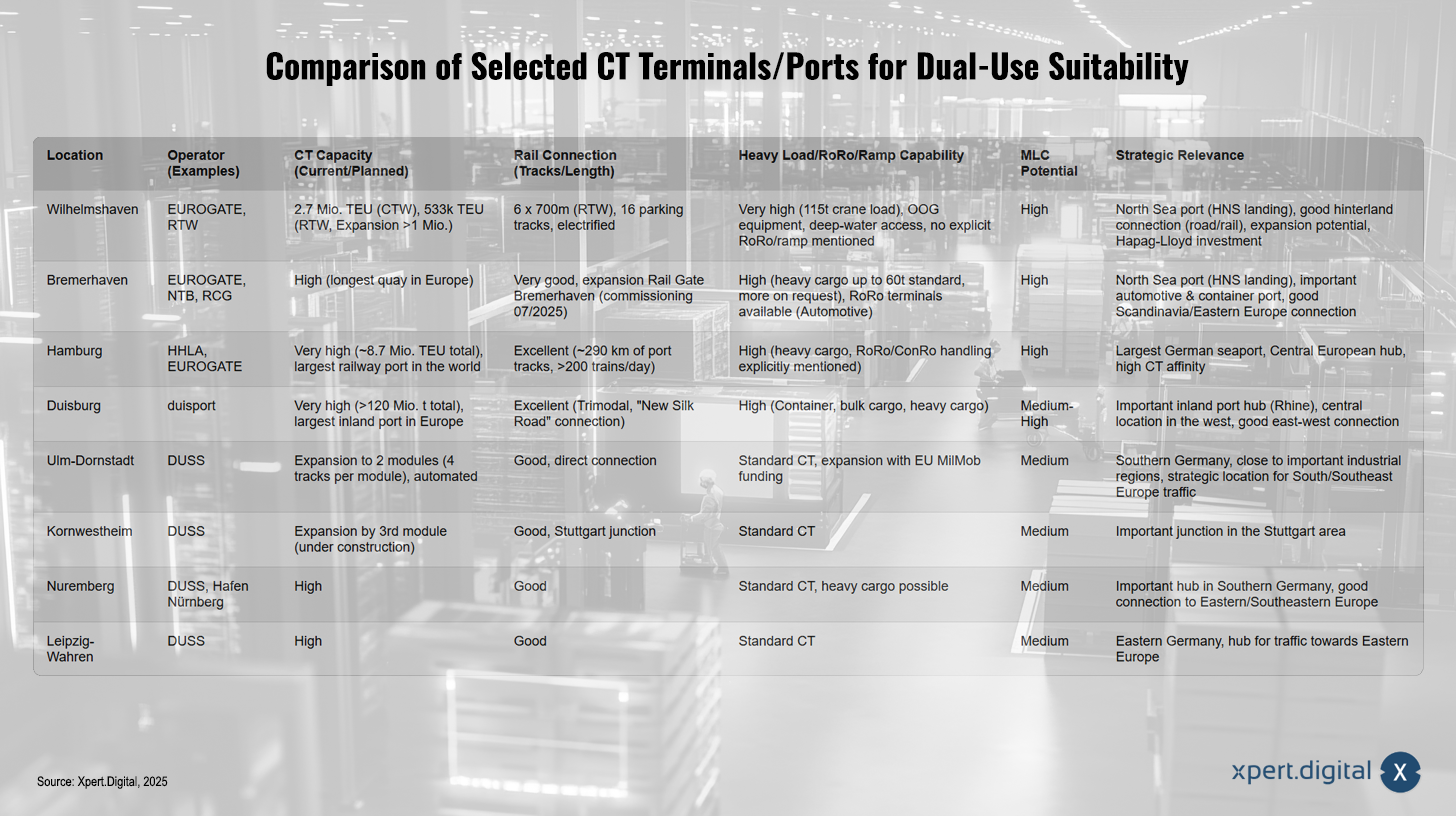
Comparison of selected intermodal terminals/ports for dual-use suitability – Image: Xpert.Digital
Note: This table is for illustrative purposes only and is based on the available snippets. A detailed suitability assessment requires further on-site technical analysis.
A comparison of selected intermodal terminals and ports regarding their dual-use suitability shows that the Wilhelmshaven site, operated by EUROGATE and RTW, has an intermodal capacity of 2.7 million TEU (CTW) and 533,000 TEU (RTW, with planned expansion to over 1 million TEU). Rail connections include six tracks with a length of 700 meters (RTW) and 16 electrified sidings. Heavy lifting capacity is very high (115-ton crane load), with out-of-ground equipment and deep-water access. Explicit RoRo or ramp capability is not mentioned. The MLC potential is high, and its strategic relevance is underscored by its North Sea port location, good hinterland connections, and expansion potential.
In Bremerhaven, operated by EUROGATE, NTB, and RCG, high intermodal capacity is ensured by the longest quay in Europe. Rail connections are excellent, with the Bremerhaven Rail Gate scheduled to begin operation in July 2025. Heavy-lift capacity is high (up to 60 tons standard, above that on request), and there are existing RoRo terminals, particularly for the automotive sector. MLC potential is also high. Bremerhaven is strategically important as a North Sea port with good connections to Scandinavia and Eastern Europe, as well as for its significance in automotive and container logistics.
Hamburg, operated by HHLA and EUROGATE, boasts a very high intermodal capacity of approximately 8.7 million TEU and is considered the world's largest rail port. Rail connections are excellent, with around 290 kilometers of port track and more than 200 trains per day. Heavy cargo capabilities are high, with dedicated RoRo and ConRo handling. MLC potential is significant, and as Germany's largest seaport, Hamburg is a key European hub with a strong affinity for intermodal transport.
The Port of Duisburg (duisport) boasts a very high intermodal capacity of over 120 million tons and is the largest inland port in Europe. Its trimodal rail connections are excellent and include links to the "New Silk Road." Its heavy-lift capability is high, allowing for the handling of containers, bulk goods, and heavy cargo. Its MLC (Medium Cargo Liaison) potential is rated as medium to high. Strategically, Duisburg is a central inland port hub with good east-west connections due to its location on the Rhine in western Germany.
Ulm-Dornstadt, operated by DUSS, is currently being expanded and comprises two modules, each with four tracks. Rail connections are good and include a direct connection. Heavy-load capacity corresponds to standard intermodal transport, with expansion supported by EU MilMob funding. The MLC potential is medium, as is its strategic relevance due to its location in southern Germany near important industrial regions and its strategic connections to southern and southeastern Europe.
Kornwestheim, also operated by DUSS, is being expanded with a third module. Rail connections are good, and the location is an important hub in the Stuttgart area. Its heavy-load capacity corresponds to standard intermodal transport. The MLC potential and strategic relevance are both rated as medium.
Nuremberg, operated by DUSS and the Port of Nuremberg, offers high intermodal capacity and good rail connections. Its heavy-load capability corresponds to standard intermodal transport, and heavy goods are possible. Its MLC potential is medium, as is its strategic importance, particularly as a key hub in southern Germany with good connections to Eastern and Southeastern Europe.
Leipzig-Wahren, operated by DUSS, also has high intermodal capacity and good rail connections. Its heavy-load capability corresponds to standard intermodal transport. The MLC potential and strategic relevance are rated as medium, with the location being an important hub for traffic towards Eastern Europe.
Operational framework: Access rules, scheduling and prioritization (emergency vs. normal operation)
A key aspect of the hybrid KV model is the definition of clear operational rules that ensure both efficient civilian use during normal operation and guaranteed military prioritization when needed.
Normal operation (non-emergency): In this phase, the infrastructure will be utilized to its maximum extent to optimize its economic benefits. Civilian intermodal operators (DB Cargo and private railway undertakings) will gain access to the routes and terminals based on established procedures. This could be done via DB InfraGO's existing systems for track access registration and capacity allocation, with the specific conditions for the dual-use sections (e.g., fee structure, performance standards) being contractually agreed upon. The goal is non-discriminatory access for all eligible users, analogous to the requirements of the intermodal transport funding guidelines. As suggested in the user query, usage fees from civilian actors could contribute to covering operating costs.
Emergency Operations (Military Prioritization): In the event of a crisis, a state of tension or defense, or in case of urgent military need (e.g., large-scale exercises, short-notice deployments according to OPLAN DEU), a mechanism for activating military priority must be implemented. This means that military transports will be given priority over civilian traffic, and allocated civilian time slots can be canceled or rescheduled at short notice. The trigger criteria for this prioritization must be clearly defined and legally enshrined. Implementation requires robust and redundant communication channels as well as clear command and control (C2) structures between military command centers (e.g., the German Armed Forces Territorial Command) and civilian infrastructure operators. Experience gained from the existing contract between the German Armed Forces and DB Cargo, which provides for an "express surcharge" for military priority, can serve as a starting point but must be extended to the entire hybrid system and all participating stakeholders.
Scheduling and capacity management: The system must be able to handle both predictable, regular civilian traffic and potentially short-term, high-volume military requirements. Digital planning tools, such as those developed within the framework of "KaZu Novum" or "click & ride" concepts, could play a crucial role in efficiently allocating capacity and minimizing conflicts. A high degree of transparency regarding available capacity and planned uses (both civilian and military, taking security aspects into account) is essential. Coordination between military planners and civilian infrastructure managers must be institutionalized.
Security protocols: Depending on the type of transport (standard civilian goods vs. military equipment, potentially sensitive or dangerous), different security protocols must be applied. This includes access controls to terminals, monitoring during handling and transport, and measures to defend against physical or cyber threats. Security requirements must not disproportionately impair the efficiency of civilian operations, but must be able to be rapidly escalated to a higher level if necessary.
Role of operators: DB Cargo and capabilities of the private sector
The operational execution of transports in the hybrid combined transport system can be carried out by various actors. The selection and interaction of these operators are crucial for the system's performance and resilience.
DB Cargo: As a traditional partner of the German Armed Forces for rail transport, DB Cargo has a large network, an extensive fleet (including special-purpose wagons), and experience in handling military transport requirements. The company also plays a role in OPLAN DEU, for example, through the storage of replacement bridges for military use. However, DB Cargo has been in a difficult financial situation for years, incurring significant losses, and is currently undergoing a comprehensive transformation process. This raises questions regarding its future reliability, flexibility, and capacity availability, particularly for short-notice, large-volume military requirements. Dependence on a single, potentially struggling supplier poses a risk.
Private operators (competitive railways): The German rail freight market is characterized by a high proportion of private operators, who together provide more than half of the transport services. Companies such as Captrain, TX Logistik, HSL, RheinCargo, hvle, and many others, as well as specialized intermodal operators like Hupac or Kombiverkehr, have modern fleets, established networks, and often high operational efficiency and flexibility. Many of these companies are capable of transporting heavy or hazardous goods and could potentially also handle military transport, provided the corresponding contracts and security certifications are in place. The integration of private operators into the hybrid system is already provided for by the HNS principles, which enable and even prioritize the use of civilian capacities.
The current situation of DB Cargo thus presents not only a risk but also a strategic opportunity. The need to reduce dependence on DB Cargo strengthens the argument for greater integration of private rail transport companies into the dual-use system. This could be achieved through tenders for specific transport services (both civilian and military within the framework of HNS) or through framework agreements. Such a model would promote competition, potentially reduce costs, and increase the resilience of the overall system through a broader supplier base. However, cooperation with multiple operators requires a clear definition of interfaces, responsibilities, and performance standards, as well as robust mechanisms to ensure military prioritization and security across all participating actors. Cooperation between companies, for example, in personnel provision to avoid bottlenecks, could also contribute to system stability.
🎯📊 Integration of an independent and cross-data source-wide AI platform 🤖🌐 for all company matters

Integration of an independent and cross-data source-wide AI platform for all company matters-Image: Xpert.digital
Ki-Gamechanger: The most flexible AI platform-tailor-made solutions that reduce costs, improve their decisions and increase efficiency
Independent AI platform: Integrates all relevant company data sources
- This AI platform interacts with all specific data sources
- From SAP, Microsoft, Jira, Confluence, Salesforce, Zoom, Dropbox and many other data management systems
- Fast AI integration: tailor-made AI solutions for companies in hours or days instead of months
- Flexible infrastructure: cloud-based or hosting in your own data center (Germany, Europe, free choice of location)
- Highest data security: Use in law firms is the safe evidence
- Use across a wide variety of company data sources
- Choice of your own or various AI models (DE, EU, USA, CN)
Challenges that our AI platform solves
- A lack of accuracy of conventional AI solutions
- Data protection and secure management of sensitive data
- High costs and complexity of individual AI development
- Lack of qualified AI
- Integration of AI into existing IT systems
More about it here:
Dual-use transport: a key element for national and European resilience
Financing and profitability
Use of defense budgets: “Ensuring military preparedness” as the primary source of funding
The financing of the necessary infrastructure measures forms the foundation of the proposed hybrid combined transport model. The primary funding stream is to come from the defense budget, earmarked for "ensuring military preparedness and defense logistics.".
The legitimacy for the use of defense resources derives directly from the strategic necessity of ensuring military mobility and logistical support for national and collective defense. A high-performance and resilient transport infrastructure is an indispensable prerequisite for the operational readiness and responsiveness of the German Armed Forces and their allies. Upgrading intermodal terminals and railway lines for military purposes (e.g., higher payloads, secure handling, guaranteed availability) thus directly strengthens defense capabilities. The explicit inclusion of civilian infrastructure in the German Defence Strategy (OPLAN DEU) reinforces this argument, as the functionality of this infrastructure is considered part of the overall national defense effort.
The scope of financing from defence funds should cover the costs of planning, construction or expansion as well as the specific military additional costs for higher standards (e.g. MLC capability, security systems) and the guarantee of military availability (e.g. higher maintenance expenses to ensure reliability).
The budgetary context appears favorable. The “turning point” has led to a significant increase in defense spending, partly through the €100 billion special fund. Furthermore, there are political efforts to adjust the debt brake for defense spending, potentially opening up further financial leeway. The announced massive investments in infrastructure (€500 billion special fund according to the coalition agreement) and defense create an environment in which strategic dual-use projects could enjoy high priority. Defense funds have already been used in the past for militarily relevant components of civilian transportation infrastructure.
EU financing mechanisms: CEF Military Mobility and TEN-T synergies
In addition to national defence resources, programmes of the European Union offer an important complementary source of financing, especially for projects with a cross-border or European dimension.
The Connecting Europe Facility (CEF) Military Mobility was a specific EU funding instrument for the period 2021-2027, explicitly aimed at co-financing dual-use transport infrastructure projects. With a budget of approximately €1.74 billion, 95 projects in 21 member states were funded to improve military mobility on the TEN-T network or the EU military network. Funding rates were up to 50% (in exceptional cases 85%) of the eligible costs. Examples included the expansion of railway lines, road sections, ports, airports, and multimodal terminals. The expansion of the Ulm-Dornstadt intermodal terminal also received funding from this program. However, this budget was brought forward due to the urgency following the Russian attack on Ukraine and is now fully exhausted for the current MFF period until 2027.
Despite the exhaustion of the specific military mobility fund, synergies with general TEN-T funding via the CEF remain. Since there is a high degree of overlap between military transport networks and the civilian TEN-T network, projects primarily aimed at expanding TEN-T corridors can also offer significant benefits for military mobility. Such projects can continue to be funded through the regular CEF transport calls. The revised TEN-T Regulation now explicitly addresses military mobility requirements.
Other EU funding sources are also being discussed, such as a potential reallocation of funds from the Cohesion Fund or InvestEU for dual-use projects, but this faces legal hurdles. The European Investment Bank (EIB) has expanded its support for security and defence projects, including critical infrastructure.
However, limitations exist. Current EU funding for military mobility falls far short of the estimated need. Future funding in the next MFF (after 2027) is uncertain. Furthermore, it has been criticized that the selection criteria for funded projects may not adequately consider geostrategic priorities.
Nevertheless, the EU level represents an important financing and coordination framework that should be used to complement national investments in dual-use infrastructure and to ensure cross-border coherence.
The following table summarizes the potential sources of financing:
Potential sources of funding for hybrid healthcare infrastructure
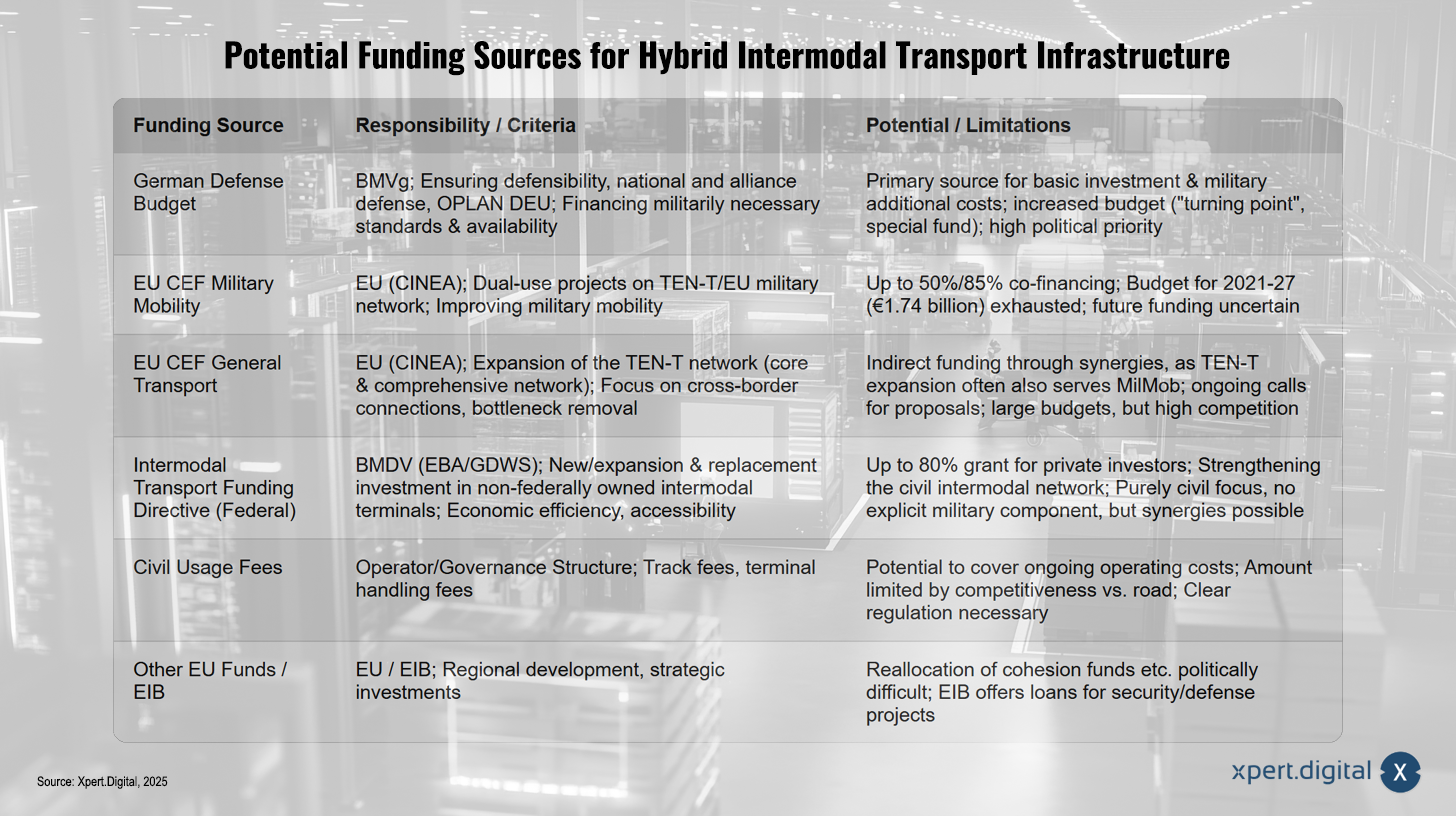
Potential funding sources for hybrid healthcare infrastructure – Image: Xpert.Digital
Potential funding sources for hybrid intermodal transport infrastructure encompass various national and international approaches, each with specific responsibilities, criteria, potential, and limitations. The German defense budget, administered by the Federal Ministry of Defense (BMVg), primarily finances militarily necessary standards and has been strengthened through increased budgets such as the special fund. The EU's Military Mobility initiative, under the Common European Framework for Transport (CEF), offers dual-use project funding on the Trans-European Transport Network (TEN-T) and the European military network, with co-financing of up to 85% possible, although uncertainties exist regarding future budgets. The EU's CEF General Transport indirectly supports military mobility through synergies in TEN-T expansion, focusing on cross-border connections and bottleneck removal. National intermodal funding guidelines concentrate on the civilian sector, particularly non-federal intermodal terminals, with subsidies of up to 80% for private investors. Ongoing operating costs can be financed through civilian usage fees such as track access charges, although there are limitations regarding competitiveness with alternative modes of transport. Furthermore, other EU funds and the EIB offer strategic financing options, although reallocations of cohesion funds are politically challenging, while the EIB provides specific loans for security and defence projects.
Civilian cost absorption: Potential models and economic benefits
A key element of the economic viability of the hybrid model is the possibility that civilian co-use can contribute to covering costs. Several conceptual approaches exist for this:
- Usage charges: The most obvious approach is to levy fees for the use of the infrastructure by civilian operators. These could be track access charges or transshipment fees at the terminals. The level of these charges must be set at a level that ensures combined transport remains competitive with pure road transport. The revenue could be used to cover ongoing operating and maintenance costs.
- Public-Private Partnership (PPP) elements: Although the core funding comes from defense funds, certain operational areas or maintenance tasks could be contracted out to private companies under PPP models. This could yield efficiency gains. The existing practice of contracting private firms for logistics services under HNS provides a starting point for this. However, pure PPP models for critical defense infrastructure are complex and require careful risk assessments.
- Implicit cross-subsidization/economic benefits: The improved infrastructure, financed by defense funds, creates significant benefits for civilian users: increased reliability, greater capacity, potentially shorter transit times, and lower costs compared to road transport. This improved service quality can justify a higher willingness to pay or divert additional traffic to rail, indirectly contributing to the system's economic viability. Furthermore, the reduction in road congestion and CO2 emissions represent significant external economic benefits.
The combination of these approaches – moderate usage fees plus the realization of the qualitative and economic benefits – appears to be the most promising way to achieve partial cost absorption through civilian use without jeopardizing the competitiveness of commercial transport.
Comparative economic efficiency compared to separate systems
The crucial question for justifying the hybrid model is its cost-effectiveness compared to alternative approaches, especially maintaining separate systems for civilian and military logistics.
The main argument for the hybrid model lies in avoiding redundancies and maximizing asset utilization. Building a separate, exclusively military-used combined transport (CVT) infrastructure would be extremely capital-intensive and would remain largely unused during peacetime. At the same time, the civilian network would continue to be underfunded and overloaded. The hybrid model leverages synergies by allowing a single investment to benefit both user groups. This potentially leads to lower overall societal lifecycle costs compared to two separate, suboptimal systems.
The challenges of the hybrid model lie in the higher complexity of governance, the need for clear prioritization rules, and the potential friction between military security requirements and civilian efficiency interests.
A sound economic analysis must go beyond a mere comparison of construction costs. It must quantify the costs of the current situation—that is, the macroeconomic costs of congestion and delays in civilian freight transport due to infrastructure bottlenecks, as well as the potential costs (monetary and strategic) of failed military deployments due to inadequate infrastructure. These "costs of inaction" must be compared to the investment and operating costs of the hybrid model. Furthermore, the difficult-to-quantify but strategically crucial benefits of increased national resilience must be included in the evaluation. Such a comprehensive analysis is expected to show that, despite its complexity, the hybrid model represents the more strategically and economically sound long-term solution, as it reduces the costs of inefficiency and vulnerability while simultaneously maximizing the benefits of the investments made.
Ensuring resilience and security
A hybrid, dual-use KV system must not only be efficient, but also highly resilient and safe in order to meet both the demands of the civilian market and the critical needs of defense.
Addressing infrastructure vulnerabilities (physical and cyber)
The reliance on critical infrastructure carries inherent risks. Physical threats include acts of sabotage, as demonstrated by the targeted attack on Deutsche Bahn cables in 2022, which paralyzed train traffic in northern Germany. Natural disasters and conventional attacks during times of tension or defense also pose risks. These risks must be addressed through physical security measures at critical points (terminals, bridges, signal boxes), redundancy in network planning, and contingency plans.
Cyber threats are a growing danger. Attacks on control systems (such as ETCS), signal boxes, communication networks (GSM-R), or operators' IT systems can severely disrupt railway operations. The use of components from potentially unsafe sources (e.g., Huawei technology in DB networks) poses an additional risk that must be carefully assessed and managed. Robust cybersecurity measures, secure software architectures, regular security audits, and potentially separate, secure networks for sensitive military data transmissions are essential. The requirements of the KRITIS umbrella law must be consistently implemented.
Hybrid threats, which combine physical attacks with cyberattacks and disinformation campaigns to cause maximum disruption and cripple response capabilities, require an integrated approach. Early warning systems, clear responsibilities for threat mitigation, and practiced response mechanisms involving all stakeholders (military, civilian operators, security agencies) are essential.
Building redundancy and flexibility in the hybrid system
Resilience arises not only from hardening, but also from flexibility and redundancy within the system.
- Network design: The intermodal network must be designed to provide alternative routes in case main lines fail. Experiences with insufficient diversion capacity during major renovations must be incorporated into the planning. Strategically placed terminals and passing loops increase flexibility. Single points of failure must be avoided.
- Operational flexibility: The system must allow for rapid train rerouting. Flexible digital planning systems and the ability to adjust timetables at short notice are essential. Cooperation between different operators, for example through mutual support with personnel (train drivers) during bottleneck situations, can increase operational flexibility.
- Interoperability: Technical and operational interoperability is crucial. This includes the compatibility of vehicles and infrastructure (e.g., ETCS, power systems), harmonized operating procedures (especially across borders), and seamless cooperation between different operators (DB and private companies). Technologies such as the digital automatic coupler (DAK) can play a key role here, as they not only increase efficiency but also enable the continuity of data and power lines. Compliance with NATO standards (STANAGs) is essential for the military component.
- Maintenance strategy: Proactive, condition-based maintenance (“predictive maintenance”) can minimize unplanned downtime. Large-scale, planned work such as major overhauls must be carefully coordinated to keep the impact on the overall system as low as possible and to ensure efficient alternative routes.
By combining these measures – hardening against threats and creating flexibility and redundancy – a hybrid KV system can be created that meets the high demands for resilience and security in the dual-use context.
Suitable for:

Recommendations and Implementation Roadmap
To translate the concept of a hybrid, dual-use healthcare system from strategic vision into operational reality, concrete steps and measures are required.
Concrete proposals for pilot projects/corridors
It is recommended that the hybrid model be initially implemented and evaluated in the form of pilot projects on selected corridors. These corridors should be selected based on the following criteria:
- High strategic relevance for military mobility: In particular corridors towards NATO's eastern flank (e.g. connections from North Sea ports or western/southern Germany to Poland) or important north-south axes for HNS.
- High civilian combined transport volume and/or existing bottlenecks: corridors where capacity expansion is urgently needed for civilian traffic as well.
- Existing or planned infrastructure measures: Linking to ongoing or planned general renovation or TEN-T expansion projects to leverage synergies.
Possible pilot corridors:
- North Sea Ports Corridor – Eastern Germany/Poland: For example, upgrading the Wilhelmshaven/Bremerhaven – Hanover – Magdeburg – Berlin – Frankfurt (Oder)/Polish border axis. This would connect HNS landings with the eastern flank relocation and simultaneously strengthen important civilian hinterland traffic.
- Rhine-Ruhr Corridor – Southeast Europe: For example, upgrading sections on the Duisburg/Cologne – Nuremberg – Regensburg – Passau/Austrian/Czech border axis. This addresses bottlenecks in the west and improves connections to southeastern partner countries.
Pilot terminal measures: Within the pilot corridors, 2-3 terminals (e.g., a seaport terminal like Wilhelmshaven, a large inland hub like Duisburg, and a strategically located inland terminal like Nuremberg or Leipzig) should be upgraded for dual-use operation on a pilot basis. This includes:
- Concrete planning and implementation of measures to meet military requirements (MLC upgrade, ramp construction, security areas).
- Implementation of operational rules for prioritization and civilian access.
- Building the necessary governance and communication structures on a small scale.
- Detailed cost accounting and economic evaluation of the pilot operation.
Necessary political and regulatory adjustments
Successful implementation requires adjustments to the political and legal framework:
- Establishing a clear legal framework: Anchoring the dual-use principle for KV infrastructure and defining funding responsibilities (Defense for military necessities, potentially the Federal Ministry of Defense/EU for the civilian component). Establishing military priority in case of need and the rules for civilian access. This could require amending existing laws or enacting a separate regulation.
- Acceleration and harmonization of approval procedures: Reduction of bureaucratic hurdles for military transports, especially for cross-border traffic, in line with EU objectives (target: max. 3 days). Examination of exemptions from civilian restrictions (e.g., night driving bans) for militarily necessary transports.
- Mandatory consideration of military requirements: Inclusion of dual-use criteria (MLC, security, etc.) as a binding planning and funding condition for relevant civilian infrastructure projects within the framework of TEN-T, BVWP and, if applicable, the KV funding guideline.
- Adaptation of Bundeswehr regulations: Revision of internal Bundeswehr regulations on transport, loading and logistics to reflect the use of the hybrid system and cooperation with civilian actors.
Framework for stakeholder cooperation (military, government, industry)
A collaborative approach is crucial for success. The establishment of a permanent coordination platform is recommended, which will perform the following tasks:
- Strategic planning: Joint setting of priorities for expansion, coordination with OPLAN DEU and civil transport planning (Deutschlandtakt).
- Operational coordination: Development and monitoring of operational rules, management of interfaces, crisis management.
- Technical standardization: Ensuring interoperability and defining technical requirements for dual-use systems.
- Communication and training: Regular exchange between all participants, joint exercises to test procedures in normal and crisis situations.
Participating actors:
- Military/Defense: BMVg, TerrFüKdoBw, LogKdoBw, BAAINBw.
- Government/Transport: BMDV, EBA, Federal Network Agency, possibly state transport ministries.
- Infrastructure: DB InfraGO AG, operator of seaports and inland ports, private terminal operators.
- Operators: DB Cargo, private railway undertakings, intermodal operators.
- Industry/Associations: Logistics and forwarding associations (e.g. DSLV), transport associations (e.g. SGKV), railway industry (e.g. VDB).
This platform should be equipped with clear mandates and resources to ensure effective management and implementation of the hybrid healthcare system.
Dual-use transport: Efficient infrastructure for civilian and military purposes
The creation of a hybrid, dual-use combined road-rail transport system represents both a strategic necessity and a significant opportunity for Germany. Given the increased demands on national and collective defense within the framework of NATO, and the simultaneous urgent need to make civilian freight transport more efficient and environmentally friendly, the proposed model offers a synergistic solution. It allows the substantial investments required to strengthen military mobility to also be used to improve civilian logistics infrastructure, thereby increasing overall national resilience.
The analysis has shown that the current infrastructure, particularly the rail network, has significant deficiencies that hinder both military deployments and civilian combined transport. At the same time, the political "turning point," the OPLAN DEU (Operational Plan for Germany), and available national and European financing instruments (despite current limitations on CEF Military Mobility) create favorable conditions for addressing these challenges. Involving private operators and leveraging competition can unlock additional efficiency potential and reduce dependence on individual actors.
The realization of such a hybrid system is undoubtedly complex and requires a coordinated effort from all participating actors in the military, government, and private sector. It necessitates clear legal and operational frameworks, a strategic prioritization of investments on key corridors and terminals, and a robust governance model. The proposed pilot projects can serve to demonstrate feasibility and gather valuable experience for broader implementation.
Investing in a high-performance, resilient, and dual-use combined transport system is not merely an expenditure, but a strategic investment in Germany's security and future viability. It strengthens defense readiness within the alliance, reduces traffic congestion, protects the environment, and improves the competitiveness of the German economy. The time to act is now to lay the foundation for a logistics infrastructure that can meet the challenges of the 21st century.
Advice - planning - implementation

Markus Becker
I would be happy to serve as your personal advisor.
Head of Business Development
Chairman SME Connect Defense Working Group
We are there for you - advice - planning - implementation - project management
☑️ SME support in strategy, consulting, planning and implementation
☑️ Creation or realignment of the digital strategy and digitalization
☑️ Expansion and optimization of international sales processes
☑️ Global & Digital B2B trading platforms
☑️ Pioneer Business Development
Konrad Wolfenstein
I would be happy to serve as your personal advisor.
You can contact me by filling out the contact form below or simply call me on +49 7348 4088 965 (Munich) .
I'm looking forward to our joint project.
Write to me

Xpert.Digital - Konrad Wolfenstein
Xpert.Digital is a hub for industry with a focus on digitalization, mechanical engineering, logistics/intralogistics and photovoltaics.
With our 360° business development solution, we support well-known companies from new business to after sales.
Market intelligence, smarketing, marketing automation, content development, PR, mail campaigns, personalized social media and lead nurturing are part of our digital tools.
You can find out more at: www.xpert.digital - www.xpert.solar - www.xpert.plus
Keep in touch










