
China is becoming a tougher competitor: German industry under pressure – Why technological superiority is no longer enough
Xpert Pre-Release

Available in 27 languages 📢
Prefer Xpert.Digital on GoogleⓘPublished on: October 31, 2026 / Updated on: October 31, 2026 – Author: Konrad Wolfenstein
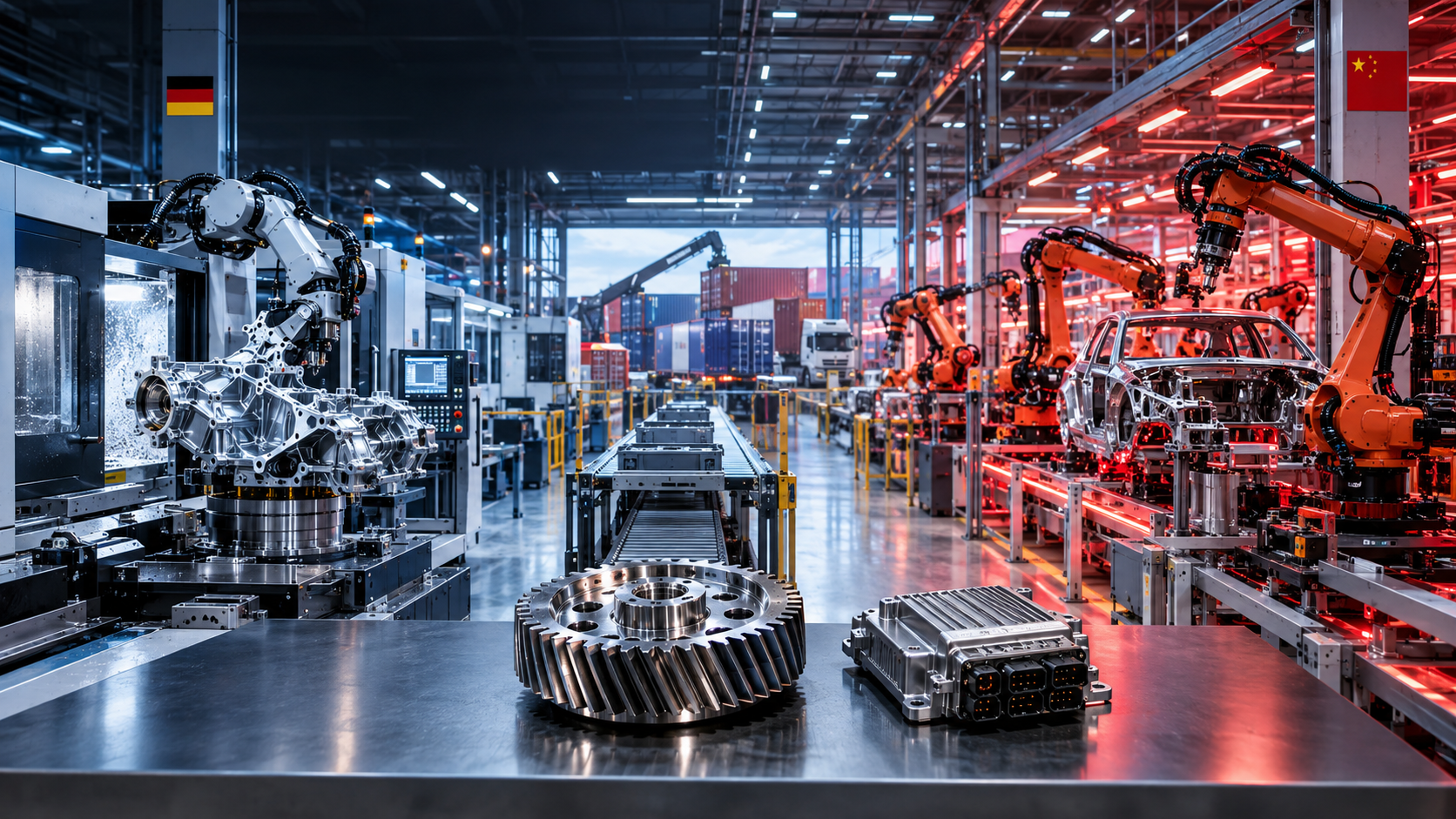
China is becoming a tougher competitor: German industry under pressure – Why technological superiority is no longer enough – Creative image on the topic, with AI: Xpert.Digital
Mechanical engineering, automotive, chemicals: How differently China is affecting German industry
China remains an important market – despite growing competition for German companies
German industry faces a difficult balancing act in its competition with China: While pressure from Chinese suppliers is growing in Europe, China remains an important sales and production location for many companies. A survey of 151 German industrial companies reveals the contradictory nature of this situation: A quarter of them rate their own competitive position in Europe as weaker than that of their Chinese competitors. Since the beginning of 2025, 28 percent have lost business to Chinese suppliers – 13 percent have even lost existing customer relationships. At the same time, the Chinese market has gained importance for more than a third of the companies operating there.
The findings vary depending on the industry. Many companies in mechanical engineering, plant construction, and the automotive industry feel technologically superior to Chinese suppliers. Nevertheless, mechanical engineering companies in particular frequently report lost orders and customers. This makes it clear: technological strength alone guarantees neither market share nor profit. What matters is whether companies convincingly demonstrate their customer benefits, calculate competitively, and align their services with actual customer requirements. The central question, therefore, is not whether German companies are fundamentally better or worse – but whether their offerings are worth the price they charge.
Germany's industry in the China dilemma: Why technological strength alone is no longer enough
German industry is not faced with the simple choice of either isolating itself from China or further developing the Chinese market. It must manage both simultaneously: intensified competition in its European home market and continued significant economic ties with China. A quarter of the industrial companies surveyed consider their competitive position in Europe to be inferior to Chinese suppliers; 28 percent have lost business to Chinese competitors since the beginning of 2025, and 13 percent have lost existing customer relationships. At the same time, China is gaining importance as a sales market for a considerable number of companies operating there.
The crucial economic question, therefore, is not whether German companies are fundamentally better or worse. The decisive factor is whether their respective strengths generate customer value that actually compensates for higher prices, longer development times, or other disadvantages. The following findings support a more nuanced perspective: Germany continues to possess industrial capabilities and competitive companies, but technological confidence alone protects neither market share nor profit margins.
The fault line runs through industries
Overall, 52 percent of the surveyed companies consider themselves superior to their Chinese competitors in the European market, while 25 percent perceive themselves as inferior. However, this overall picture reflects very different industry realities: In mechanical and plant engineering, 77 percent consider themselves superior, and in the automotive industry, 72 percent. In contrast, a pessimistic assessment prevails in energy-intensive industries: 39 percent see themselves as inferior, while only 34 percent consider themselves superior.
These differences are more economically significant than the simplistic notion of a uniform competition between Germany and China. A specialized production plant, a vehicle component, and a standardized chemical raw material are subject to different purchasing decisions. The more a product can be compared based on measurable properties and sourced from various suppliers, the more difficult it can become to consistently enforce a substantial price premium. Conversely, where application-specific knowledge, complex integration, or particularly high failure risks are decisive, additional opportunities for differentiation can arise.
However, this does not imply a rigid separation between protected high-tech industries and vulnerable standard producers. Even sophisticated technologies can come under economic pressure if customers prioritize their needs differently or consider a cheaper offer to be sufficiently efficient. Conversely, companies in energy-intensive industries can succeed through specialized products, process expertise, or a particularly reliable supply. A robust strategy must therefore be broken down into individual products and customer groups, rather than simply settling for a positive or negative industry label.
What the numbers actually measure
The data is based on telephone assessments of 151 executives from German industrial companies in the summer of 2026. These include 37 companies from the automotive industry, 51 from the mechanical and plant engineering sector, and 63 from the energy-intensive chemical, paper, ceramics, and metal industries. The scope described applies to these sectors with annual revenues of ten million euros or more, not to all industrial companies, and in particular not automatically to smaller companies below this threshold.
When interpreting data, it's crucial to distinguish between perception, reported business performance, and objectively measured competitiveness. An executive may, for good reason, consider their company a technological leader without this assessment having been verified by an independent product comparison. Similarly, the statement that business has been lost does not necessarily mean that a specific percentage of revenue has disappeared. The data captures the prevalence of such experiences among companies, not their direct financial magnitude.
Furthermore, the limited number of cases in each sector and the different reference groups are problematic. Data for all companies cannot be directly compared with data exclusively for companies active in China. Additionally, the reported competitive impacts relate to the period since the beginning of 2025, while the development of China activities covers a three-year period. The results therefore provide a serious overview of the current situation, but are neither a complete company balance sheet nor a precise forecast of future market shares.
Self-confidence does not protect against losses
The mechanical and plant engineering sector is particularly revealing. Although 77 percent of companies there feel superior to Chinese suppliers, 38 percent report lost business. This is the highest percentage among the three industry groups studied. The mechanical engineering sector also exceeds the cross-industry average of 13 percent in terms of lost existing customers, at 22 percent.
This is not necessarily a contradiction. Technical superiority and commercial success are different things. A product can be more precise, durable, or feature-rich and still not be the most economically attractive solution for a specific customer. If additional features are hardly used in actual operation, the willingness to pay a higher price for them decreases. In such cases, a less technically complex offering can deliver greater economic value per euro invested.
For machine manufacturers, this should lead to a review of their own performance promise. Which characteristics actually influence productivity, scrap rates, personnel requirements, and plant availability at the customer's site? Which additional functions primarily increase development effort and complexity? The business challenge lies in distinguishing between valuable specialization and costly over-equipment. The data do not prove that over-equipment causes the observed losses. However, they do show why a blanket reliance on technical strength is insufficient as both an explanation and a counter-strategy.
Customer churn is impacting the business model
Across all sectors, 28 percent of companies have lost business to Chinese suppliers since the beginning of 2025. For 13 percent, existing customer relationships have already been affected. Among companies with annual revenues of €100 million or more, the corresponding figures are 34 and 26 percent, respectively. Thus, for larger companies, the percentage reporting customer churn is twice as high as the overall result; however, this does not necessarily indicate the actual revenue loss.
Economically, losing an existing customer can have far-reaching consequences beyond a single missed opportunity. Long-term customer relationships can generate recurring revenue from spare parts, maintenance, upgrades, and technical services. If the relationship ends, not only is current revenue at risk, but also future revenue streams. At the same time, a business relationship can allow competitors to build a reference base and gain a better understanding of the specific needs of potential customers.
A customer switch doesn't necessarily have to be permanent. Delivery quality, customer service, actual operating costs, and everyday performance can all influence future decisions. Therefore, it would be wrong to categorize every reported loss as an irreversible loss of market share. A more sensible approach is a systematic analysis: Why did the customer switch, which part of their needs is affected, and under what conditions would winning them back be economically viable? Without this distinction, there's a risk of either unnecessary price reductions or a dangerous trivialization of the problem.
Energy-intensive businesses are fighting on several fronts
The fact that 39 percent of companies in energy-intensive industries feel at a disadvantage and only 34 percent feel superior indicates a particularly difficult competitive situation. Official production figures further illustrate the existing pressure: In the energy-intensive industries defined therein, calendar-adjusted production in 2025 was 17.8 percent below the 2021 level. Compared to 2024, the decline was 2.6 percent. This official industry classification is not entirely synonymous with the composition of the group of companies under consideration.
A production decline of this magnitude cannot be attributed solely to Chinese competition. Energy prices, demand, location factors, technological changes, and business decisions can all have a simultaneous impact. For business analysis, however, it is important to note that low capacity utilization can increase the cost per unit produced. If large portions of plant and personnel costs remain unchanged, these expenses are spread across fewer products sold. This can exacerbate external price pressure internally.
The strategic response must therefore extend beyond short-term cost savings. The viability of individual product lines, the cost-effectiveness of process heat and power supply, and the actual benefits of production close to the customer must all be examined. Specialization can be a solution, but not every company can simultaneously retreat into profitable niches. If too many suppliers target the same small growth markets, competition can quickly intensify there as well. A convincing realignment therefore requires robust demand assumptions, not just an attractive technology label.
Europe's heritage needs economic added value
In response to Chinese competitors, 60 percent of companies use production in Europe as a seal of quality. A further 47 percent place greater emphasis on their quality or their systems expertise, meaning their ability to combine various technical elements into a functioning overall solution. This positioning is understandable, but remains economically incomplete as long as it is not translated into concrete benefits for the customer.
European production can be relevant, for example, if it allows for shorter transport routes, more readily available service, or closer coordination. However, such advantages are not an automatic characteristic of every European product. They must actually exist and should be verified based on delivery capacity, response times, and operational results. A statement of origin alone reveals neither how many critical components come from other regions of the world, nor whether a supplier can provide faster assistance in the event of a disruption.
The stronger argument therefore focuses on the total cost of ownership over the product's lifespan. This includes not only the purchase price but also energy consumption, maintenance, downtime, training, spare parts, and subsequent modifications. Anyone demanding a higher purchase price should be able to explain how this expense will be recouped. Conversely, a company must accept that the added value for certain applications may not be significant enough. In such cases, a differentiated product range can be more economically viable than attempting to serve every customer segment with the same premium solution.
Cost discipline is not a cheap strategy
Only 21 percent of companies report having reduced their product or process costs in response to Chinese competition. Another 21 percent have established partnerships with Chinese companies. The discrepancy between the frequent emphasis on origin and quality and the less frequently mentioned cost reduction is noteworthy. However, it does not prove that the remaining companies are fundamentally neglecting efficiency or have not yet implemented any improvements.
An effective cost strategy doesn't begin with across-the-board cuts. It examines which variants are actually needed, how much rework is required, which processes waste time unnecessarily, and where interfaces cause errors. Simplifying a product, in particular, can simultaneously relieve the burden on development, purchasing, manufacturing, and service. If the same assembly can be used in multiple applications, not only the purchase price may decrease, but also the costs for warehousing and technical support.
Securing margins should not be confused with short-term profit improvement at any cost. If development, customer service, or quality control are cut too drastically, later costs can increase and differentiating factors can disappear. The crucial question, therefore, is not how to save the most money, but which resources generate the greatest customer value. Competitiveness arises from a sustainable balance between performance and effort, not from technical maximization or cost reduction as an end in itself.
China's strength is not just cheap
The notion that Chinese industrial companies gain success solely through low wages and simple products is an oversimplification. A visible indicator of industrial modernization is automation: In 2025, approximately 354,000 new industrial robots were installed in China. This represented 59 percent of new installations worldwide and a 20 percent increase compared to the previous year.
Germany remained the largest European robot market and ranked fifth worldwide. However, new robot installations in Germany declined by eight percent in 2025 to fewer than 25,000 units. These absolute figures do not allow for a direct comparison of the productivity of individual companies. China has a significantly larger industrial base, and an installed robot is not in itself proof of economically optimal manufacturing. Nevertheless, the figures contradict the image of a competitor that can only succeed through cheap, manual production.
This presents German suppliers with a more demanding task of comparison. They must monitor Chinese companies not only in terms of price, but also in development times, manufacturing organization, software integration, and the implementation of new products. A technological advantage may exist in one area and be absent in another. Therefore, a regular comparison of specific competitor offerings is more helpful than a general national assessment of quality. The question is no longer whether Chinese suppliers can catch up technologically in principle, but rather in which applications they already deliver a compelling overall offering.
🎯🎯🎯 Data-driven B2B industry hub as a quasi-in-house solution

The quasi-in-house solution: How Xpert.Digital closes operational gaps in B2B marketing and sales – Smart Content-Driven Business - Image: Xpert.Digital
Xpert.Digital is a data-driven B2B industry hub led by Konrad Wolfenstein . The company acts as an external, quasi-in-house solution for industrial partners, closing operational gaps in marketing, content, and sales – without requiring additional resources on the client side.
More information here:
Cooperation or competition: Strategies of German companies
Subsidies explain a lot, but not everything
Government support is a significant factor in competitive conditions. An analysis of large industrial companies shows that, for 2024, Chinese companies received support amounting to approximately two percent of their costs. In the US comparison group, this figure was 1.4 percent, and in the Eurozone, 0.6 percent. These figures refer to the specific selection of companies and support instruments examined, not to a complete survey of all government assistance in the respective economies.
The economic impact can extend beyond the immediate subsidy. More favorable financing can facilitate investment, bridge extended periods of losses, and support capacity building. At the same time, government support can also influence economic decisions outside of China. An objective analysis must therefore distinguish between genuine efficiency gains, government-facilitated expansion, and potentially distorting competitive advantages. These factors can coexist.
The existence of subsidies does not imply that every lower Chinese price is unfair or that every successful Chinese product is state-produced. Likewise, it would be wrong to ignore proven distortions by pointing to functioning competition. The viable perspective lies between these extremes: differences in competitive conditions must be examined and, where necessary, addressed; at the same time, European companies must improve their own costs, development processes, and offerings. Trade policy can complement entrepreneurial performance, but it cannot permanently replace it.
Cooperation is becoming a strategic option
Twenty-one percent of companies have established partnerships with Chinese companies, and nine percent have opened their own production capacities to Chinese partners. In the machinery and plant engineering sector, the partnership rate is 30 percent, exceeding the overall result. Cooperation thus plays a particularly significant role in the sector with the most frequently reported business losses.
However, no cause-and-effect relationship can be derived from this. It is not known whether companies experiencing losses and companies with partnerships are identical. Likewise, the aggregated data does not show whether collaborations arose before or after an increase in competition. Several economic explanations are conceivable: A partnership can open up market access, supplement missing components, better utilize capacities, or enable joint technological development.
However, it can also create new dependencies. A collaboration becomes problematic when one partner controls the customer interface, important data, or essential components, and the other loses its negotiating position. Therefore, before entering into a partnership, not only expected revenues but also intellectual property protection, decision-making rights, data access, and exit options should be clarified. Partnerships are neither an admission of defeat nor an automatic sign of strategic strength. Their value depends on whether both sides make clearly defined contributions and whether the relationship remains viable even if interests change.
China remains too economically important
48 percent of the companies have conducted business in or with China in the past three years. Among these companies active in China, the Chinese market has gained importance for 36 percent, while it has declined for 22 percent. Consequently, the majority of the industries studied cannot be described as either entirely focused on China or as comprehensively withdrawing from it. Different business models lead to different decisions.
The reference point is particularly important: the 36 percent figure refers to companies active in China, not all companies surveyed. Similarly, increasing importance does not necessarily imply rising absolute revenue. The market may become relatively more important because other sales regions are performing less well. Conversely, decreased importance may be consistent with deliberate diversification, without the China business shrinking entirely. Additional company data would be required for a definitive statement regarding revenue and profit.
In energy-intensive industries, China has become an important sales market for 43 percent of companies operating there, and for 31 percent in the machinery and plant engineering sector. Companies facing economic pressure in Europe, in particular, may therefore still have reasons to maintain their presence in China. However, market size alone is not the deciding factor. A presence should be evaluated based on whether it delivers a reasonable return after all costs and what strategic dependencies are associated with it.
Localization is changing the industrial division of labor
Twenty percent of all companies surveyed have organized more of their development, purchasing, and production in China. Twelve percent have increased their investments there. This local focus is based on a different logic than the traditional export model: products are to be developed, sourced, and manufactured closer to the sales market. This can reduce transportation costs, facilitate coordination with customers, and make better use of local supply networks.
Economically, this creates an important distinction between the success of a company and the success of its German operations. A German corporation can improve its position in China through additional local production without necessarily generating a corresponding increase in manufacturing in Germany. Conversely, successful international business can support central development, corporate functions, or specialized deliveries at the German site. Which effect predominates depends on the specific division of labor and cannot be determined solely from an investment decision.
Therefore, localization is neither automatically a story of relocation nor an unqualified gain for the home location. It would be necessary to examine which functions are newly created, which are relocated, and how value creation is distributed in the long term. The following development is particularly significant: as products are increasingly designed for local regional markets, application-related knowledge can also become more regionally concentrated. Corporate strategies and location policies should consider this possibility without prematurely treating every expansion abroad as a loss at home.
Risk reduction is not a complete withdrawal
Only four percent of companies have reduced their activities in China; another four percent have deliberately decoupled their business from the global supply chain. These two figures represent different measures and should not be added together or automatically interpreted as referring to the same group of companies. They argue against a widespread, fundamental withdrawal, but do not permit the conclusion that the industry is not implementing any risk mitigation measures at all.
Risk mitigation can involve establishing additional suppliers, sourcing critical components from alternative sources, or better separating regional production chains. A company can expand its business in China while simultaneously preventing a complete shutdown of its European operations in the event of a disruption. The crucial factor is not simply a physical presence in a country, but rather the dependence on functions and intermediate goods that are difficult to replace.
Even a regionally based approach does not automatically eliminate risks. A seemingly European supply chain may indirectly depend on a Chinese raw material, a single processing capacity, or a specific electronic component. Conversely, a Chinese unit may rely on key technology from Germany. A robust risk assessment must therefore extend beyond the direct suppliers. It should determine how long a disruption could be sustained, what alternatives are actually available, and what costs activating them would entail.
Larger companies bear more exposure
Companies with annual revenues of €100 million or more are particularly closely intertwined with China: 58 percent conduct business there. In this size category, 31 percent have established or expanded Chinese partnerships, 28 percent have more locally organized development, purchasing, and production, and 18 percent have increased their investments in China. At the same time, larger companies report more frequently the loss of business and existing customers to Chinese competitors.
This combination is not irrational. Companies active in many markets can tap into more growth opportunities, but they also encounter international competitors more frequently. The sheer number of products, business relationships, and sales situations can increase the likelihood of reporting at least one loss. Therefore, a higher proportion of affected large companies does not automatically mean that they are more severely damaged per euro of revenue or are worse managed.
For larger companies, the question is rather how to allocate their capital effectively. A high-revenue business can be economically unattractive if margins, capital commitment, and risks are unfavorable. Conversely, a limited presence can remain strategically important if it provides access to customers or technological development. What's needed is an evaluation of individual business units, rather than a blanket decision for or against China. Especially in cases of extensive interconnectedness, those responsible should be able to explain which activities are indispensable and which are merely continued out of historical habit.
Foreign trade data show the shift
German foreign trade trends underscore the growing pressure to adapt. In the first half of 2026, goods worth €36.4 billion were exported to China, 12.2 percent less than in the same period of the previous year. Imports from China, on the other hand, rose by 8.8 percent to €89.1 billion. The German trade surplus with China thus increased from €40.5 billion to €52.7 billion.
This development is consistent with a relationship in which China is both an important supplier and a more demanding sales market. However, a bilateral trade deficit, in itself, is not proof of overall economic damage. Imports can relieve the burden on consumers and provide companies with cheaper machinery or intermediate goods. Furthermore, merchandise trade statistics record cross-border trade, not the local production and sales activities of German companies in China. A decline in German exports and an expansion of local activities can therefore occur simultaneously.
The relevant question is what industrial value creation remains domestic and how productive it is. If imported components help German companies produce competitive end products, this can strengthen the country's economic position. Conversely, if entire capabilities are permanently displaced, later adjustments can become more difficult. This distinction cannot be made based solely on trade values. A more detailed look at product groups, supply chains, domestic investments, and the development of the respective competitors is needed.
The danger extends beyond direct losses
In the automotive industry, 72 percent of companies consider themselves superior to their Chinese competitors. At the same time, 16 percent report lost business and five percent lost existing customers; 79 percent report no such impacts regarding the immediate consequences they observed. However, this comparatively favorable direct picture should not be interpreted as a complete all-clear.
A supplier can suffer from Chinese competition without directly losing a customer to a Chinese component manufacturer. If its current vehicle manufacturer sells fewer cars, the demand for its parts can also decline. Furthermore, the development of new models with different technical architectures changes the need for components. The pressure can therefore be passed along the value chain instead of manifesting as a direct change of supplier.
This leads to a broader understanding of competitiveness. For a supplier, it is not enough to be well-positioned within an existing customer relationship. They must also assess how competitive their customer is and which technologies will be in demand in the future. New customers, different applications, or additional industries can reduce dependency. However, such steps require suitable products, approvals, sales expertise, and economically realistic start-up times. Diversification is an investment decision, not an immediately available insurance policy against every structural change.
Innovation must deliver faster returns
The pressure to adapt is not limited to the 151 companies studied. In a further survey of 1,325 companies in the summer of 2026, 83 percent of the participating industrial companies reported increasing Chinese competition. Among the companies experiencing growing competitive pressure, across all sectors, 60 percent focused on product innovation, 50 percent on cost reduction, and 39 percent on finding new sales markets.
These figures are not directly comparable to the previously mentioned 21 percent cost reductions. The selection of companies, reference groups, and questions differ. However, they broaden the picture: The industrial response is not solely about emphasizing its own origins. Innovation, efficiency, and new markets are also being pursued as answers. The crucial question is whether these activities actually generate economic results.
Therefore, when it comes to digitalization and artificial intelligence, the operational bottleneck should be the starting point. Improved error detection can reduce waste, more precise planning can decrease inventory, and faster quote processing can support sales. Whether such applications are profitable depends on data quality, integration, ongoing costs, and actual usage. A company doesn't gain competitiveness by launching as many technology projects as possible. It gains by shortening the time between identifying a problem and a demonstrably effective solution, and then disseminating successful applications throughout the company.
Europe's response needs two levels
The economic policy challenge lies in reconciling open markets with fair competition. A blanket protectionist approach could also affect European companies that rely on Chinese intermediate goods or serve their own customers there. Conversely, failing to react at all could become problematic if proven distortions of competition permanently displace economically viable capacities. Therefore, targeted measures with comprehensible justifications and an assessment of their side effects are crucial.
In parallel, the controllable conditions for businesses in Europe must be improved. Reliable energy supply, efficient infrastructure, available skilled workers, and predictable processes affect many companies simultaneously. However, it would be equally simplistic to attribute all competitive problems to the state. Product complexity, slow decision-making, unclear pricing, or insufficient customer focus remain entrepreneurial challenges. Location policy and operational innovation are complementary, not alternatives.
Public support should also be measured by whether it creates additional capacity or merely preserves existing structures. It can be beneficial where shared infrastructure, research, or difficult-to-finance start-up phases promise clear added value. It becomes problematic, however, when long-term economic viability can only be achieved through ongoing subsidies. Europe should therefore not attempt to replicate every Chinese production sector. Instead, it should secure and develop capabilities where they are economically promising, difficult to replace, or particularly important for other industrial activities.
The benchmark is paid performance capacity
The findings do not point to an inevitable defeat for German industry. A majority of the companies studied still see their own strengths, many remain active in China, and partnerships are as much a part of the response as differentiation and localization. Nor do the data justify the assumption that German quality will be sufficient in the long run. The very combination of a positive self-image and frequently reported business losses necessitates a sober assessment of the actual market position.
The most strategically compelling perspective combines four tasks: sharpening the demonstrable value proposition of one's own offering, delivering the service more economically, strategically leveraging international opportunities, and limiting critical dependencies. These tasks can be mutually exclusive. Increased security can lead to higher costs, greater localization can shift knowledge, and a simpler product architecture can reduce certain differentiating features. Therefore, conscious priorities are needed, rather than conflicting individual measures.
Industrial competition is ultimately not decided by a company's origin or its self-assessment. It is decided by whether customers are willing to pay a price for its services that covers investments, risks, and a reasonable profit. German companies don't have to be the cheapest everywhere. But they must convincingly explain and practically demonstrate why their offering is worth the asking price. It is precisely this combination of technical capability and economic customer benefit that will reveal which companies can maintain their position and which will have to fundamentally change their existing business model.
📈🚀 From visibility to trust 👀🤝 Your scalable path with Xpert.Digital

From visibility to trust: Your scalable path with Xpert.Digital - Image: Xpert.Digital
In industrial B2B, sustainable business relationships rarely emerge overnight. They develop step by step – through visibility, professional relevance, recurring touchpoints, and growing trust. Xpert.Digital's 4-stage model addresses precisely this: It offers a structured path that begins with a manageable entry point and can evolve into deeper collaboration in business development if needed.
Instead of relying on loud marketing promises, this model puts the relationship at the forefront. Companies start with clearly defined, easily calculable measures and then decide, based on their own experience, how far they want to expand the collaboration. A key factor for this undisturbed trust-building process: The platform completely avoids annoying advertising ads, so the editorial focus remains solely on the companies' expertise.
More information here:
Your global marketing and business development partner
☑️ Our business language is English or German
☑️ NEW: Correspondence in your native language!

Konrad Wolfenstein
I and my team are happy to be available to you as your personal advisor.
You can contact me by filling out the contact form here [email protected]:or simply call me at +49 7348 4088 965. My email address is
I'm looking forward to our joint project.