
From container handling to gateway: Vizhinjam wants to become India's economic gateway – but the crucial infrastructure lies on land
Xpert Pre-Release

Available in 27 languages 📢
Prefer Xpert.Digital on GoogleⓘPublished on: November 10, 2026 / Updated on: November 10, 2026 – Author: Konrad Wolfenstein
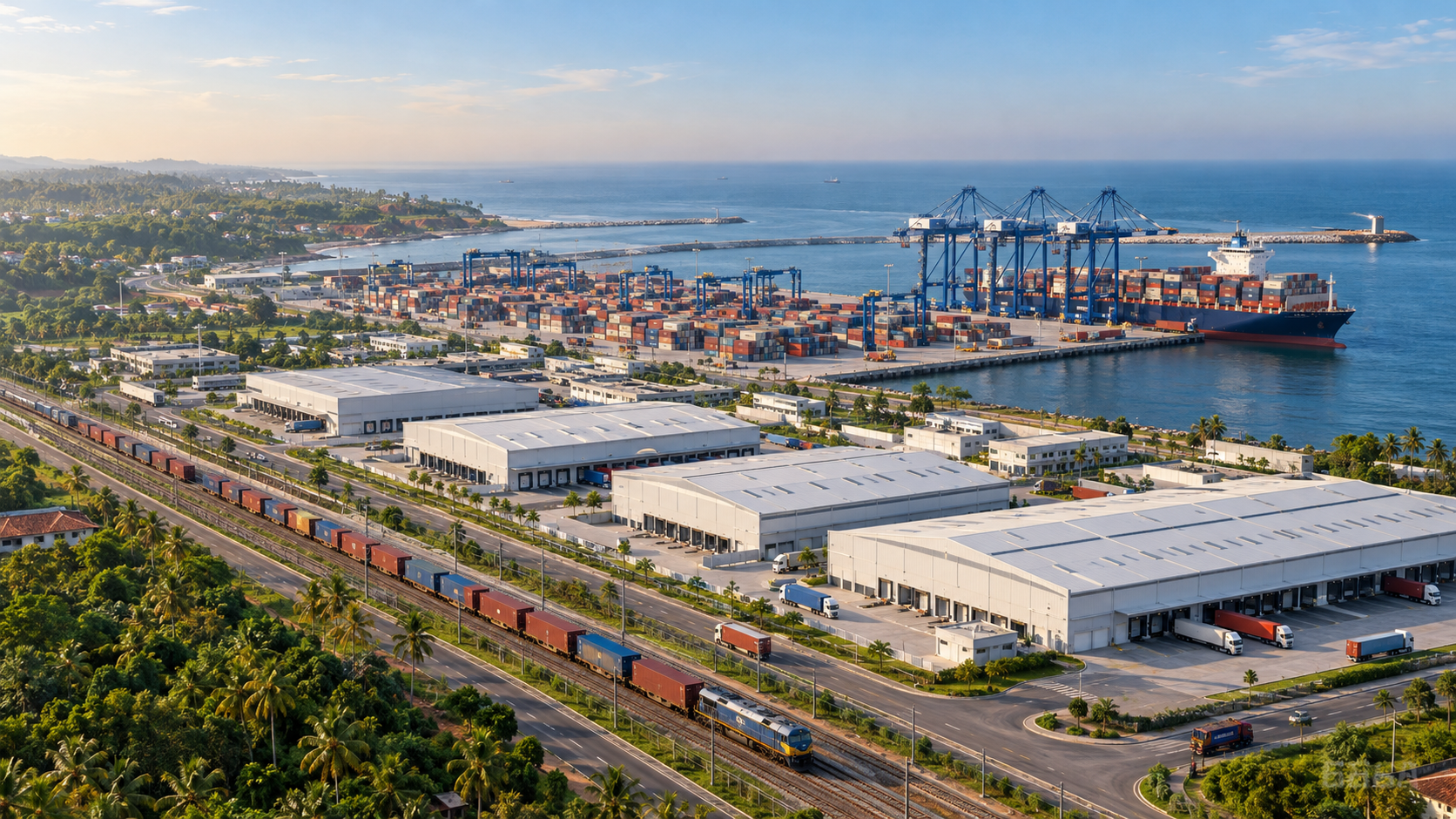
From container handling to gateway: Vizhinjam aims to become India's economic gateway – but the crucial infrastructure lies on land – Creative image on the topic, created with AI: Xpert.Digital
Billion-dollar port in India: Why Vizhinjam's success depends on rail, warehouse space and public acceptance
A port is not yet an economic location: The major challenge behind Vizhinjam
Smaller area, big ambitions: Can Vizhinjam's hinterland keep up with the port expansion?
Vizhinjam in Kerala, southern India, is intended to be far more than just a port where containers are transshipped between ships. With the expansion of its maritime facilities and the goal of significantly increasing gateway traffic within a decade, the need for efficient connections to the hinterland is also growing. However, development there is more complex than simply constructing new quays: land must be secured, roads and railways connected, and storage and transshipment capacities planned effectively. The search for a location for a logistics park in Amaravila illustrates how closely economic expectations and practical implementation are intertwined. At the same time, the protests that arose beforehand raise questions about land requirements, social consequences, and local acceptance. Vizhinjam's multi-billion-dollar ambitions will therefore not be measured solely by the port's capacity. The crucial factor is whether the individual infrastructure projects will create a reliable, economically viable, and socially accepted transport chain.
Large ships alone do not create an economic hub – without land, rail lines and public acceptance, the deep-water port remains an expensive stopover
The economic future of a port is not solely determined at the quayside. It is also shaped by access roads, warehouses, freight yards, and wherever companies produce, process, or consolidate goods for international markets. The expansion of Vizhinjam in the southern Indian state of Kerala illustrates this connection. While the maritime infrastructure is being prepared for additional container traffic, the search for a location for a logistics park demonstrates just how challenging the development of a high-performing hinterland truly is.
The state-owned project company Vizhinjam International Seaport Ltd (VISL) is examining a site near Amaravila, south of Udiyankulangara. The plan is to build a facility for the Central Warehousing Corporation (CWC) there. The project envisions a logistics park and storage capacity for goods flowing to and from the port. The site search was refocused after significant opposition arose against a previously considered location.
For economic context, a correction to the scale is crucial: The newly identified plot of land comprises approximately 20 acres, or about 8.1 hectares, not 20 hectares. CWC's earlier request was for up to 50 acres, or about 20.2 hectares. The parallel plans being pursued by the Container Corporation of India (CONCOR) in Kottukal involve approximately 25 acres, or 10.1 hectares. This distinction is significant because confusing acres and hectares increases the area actually under discussion by a factor of approximately 2.47.
The new area is therefore significantly smaller than the previously stated maximum requirement of CWC. However, this does not yet guarantee a reduction in the overall project size. It remains unclear whether the site is intended to represent a revised overall solution, a first development phase, or merely one component of a more comprehensive site concept.
Equally important is the planning status: Identifying a property is neither equivalent to a completed purchase nor to a building permit. Amaravila is initially a location option. Anyone who infers from this a guaranteed logistics capacity is confusing a development prospect with an available production factor.
From transshipment point to economic gateway: Two business models with different requirements
Vizhinjam is pursuing an ambitious economic development plan: The port is not intended solely to handle container traffic between large and small ships, but rather to serve more as an entry and exit point for Indian foreign trade. Behind this distinction lie two different business models.
Transshipment involves transferring containers from one ship to another. The goods do not necessarily have to leave the port area for this to occur. Crucial factors include maritime accessibility, reliable terminal processes, available berths, and attractive connections within shipping networks. The economic impact is comparatively concentrated on the port and its immediate services.
Gateway traffic, on the other hand, connects the port with production and sales regions in the hinterland. Imported goods are transported to companies, distribution centers, or consumer markets. Export goods arrive at the sea terminal from factories, agricultural regions, or processing plants. This increases the demands on roads, railways, warehousing, customs clearance, and the coordination of different transport segments.
For the regional economy, gateway traffic can open up a broader value creation base. In addition to the actual container handling, services in warehousing, transport organization, goods processing, packaging, quality control, and distribution potentially emerge. However, these activities do not arise automatically simply because a port provides additional maritime capacity.
The central economic question is therefore not how many containers Vizhinjam can technically handle. It is what benefits companies derive from the entire transport chain. A port becomes attractive as a gateway when it connects their goods to international markets reliably, competitively, and with reasonable organizational effort.
A logistics park can contribute to demand. However, it is not an independent generator of demand. Without companies that need and pay for its services, warehouses remain merely tied-up capital.
A tenfold increase in gateway traffic demands more than ambitious target figures
The development plan aims to increase the annual gateway volume from 150,000 to 1.5 million TEU within a decade. TEU stands for Standardized Container Unit, based on a 20-foot container. A 40-foot container is equivalent to two TEU. This metric therefore measures standardized container capacity and is not the same as the number of individual containers or the amount of goods transported in tons.
The targeted increase represents a tenfold rise. To achieve this goal consistently over ten years, average annual growth of approximately 26 percent would be required. This poses a significant commercial challenge. It demands not only additional infrastructure but also the ongoing development of customer relationships, transportation services, and economically viable supply chains.
A distinction must be made between newly emerging traffic patterns and the shifting of existing trade flows. Part of the growth could result from companies using Vizhinjam instead of other ports in the future. Another part could be based on additional production, increased trade, or new distribution structures. Both developments are possible, but they have different regional economic impacts.
Shifting existing traffic patterns improves regional value creation, especially when additional services are established locally or companies reduce their logistics costs. Newly established production facilities can also trigger investment and employment. However, such developments require further prerequisites, including suitable commercial space, energy supply, a workforce, and reliable framework conditions.
The target of 1.5 million TEU should therefore be understood as a strategic guideline, not as guaranteed demand. For investors, what matters is what portion of this volume can be supported by reliable customer commitments, concrete transport connections, and actually available locations.
Billions spent on water increase time pressure on land
The first phase of commercial port operations began on December 3, 2024. The integrated development of phases II, III, and IV officially commenced in January 2026. Completion is scheduled for December 2028. This provides the overall project with a timeframe to which the development of complementary infrastructure must adhere.
Plans include extending the container quay to two kilometers, widening the breakwater to 3.88 kilometers, and creating additional container space through land reclamation. Once the expansion is complete, an annual handling capacity of up to 5.7 million TEU will be available.
The stated investment sum of approximately 7,398 crore Indian rupees is equivalent to about 73.98 billion rupees. One crore represents ten million rupees. This magnitude underscores the scale of the project, but in itself says nothing about its future profitability.
Capacity is a supply-side measure. Throughput is an actual market performance. Revenue is only generated when shipping companies and cargo customers use the facilities and pay economically viable fees. Therefore, it would be misleading to treat the planned 5.7 million TEU as future traffic volume.
The gateway target cannot simply be interpreted as a future capacity utilization rate. Purely mathematically, 1.5 million TEU corresponds to approximately 26 percent of a capacity of 5.7 million TEU. However, these two figures refer to different planning horizons. Furthermore, the actual distribution between gateway and transshipment traffic depends on subsequent business developments.
Economically, however, a clear correlation emerges: the faster maritime capacity grows, the more important coordinated development on land becomes. A high-performing port with an inadequate hinterland can still operate transshipment businesses, but its opportunities to establish additional regional trade and production relationships will remain limited.
Amaravila must function as an operating system, not just as a plot of land
Based on the current assessment, Amaravila's advantages include a lower population density and proximity to a railway line. While both factors are relevant, they are insufficient for a sound site selection decision.
Lower population density can reduce the number of potentially affected households. It can also create more flexibility for traffic management and business development. However, this does not automatically guarantee easy land availability or a lower environmental or social impact. Site layout, ownership, existing uses, and infrastructure development must be examined separately.
The same applies to the railway. Proximity to a railway line is a locational advantage, but it doesn't automatically guarantee a functioning rail freight transport system. For that, a technically suitable connection, usable track capacity, transshipment facilities, and a viable operating concept are needed. The crucial factor is not the distance to the track on a map, but rather whether goods can be transported reliably and economically by rail.
A location can be geographically advantageous yet still incur high operating costs. Bottlenecks on the access road, a lack of maneuvering space, or unfavorable plot shapes can significantly reduce its benefits. Conversely, a slightly greater distance to the port may be justifiable if it allows for better facilities, predictable travel times, and smooth operations.
The site assessment should therefore consider the entire transport chain. This includes travel times, waiting times, handling costs, area productivity, and the availability of complementary services. The lowest land price does not necessarily lead to the most cost-effective logistics.
Amaravila must ultimately function as an operational hub. Its economic viability derives from its connections to the port, rail, road, and customers, not from the land area alone.
Less space can save capital – or become a permanent bottleneck
The difference between CWC's earlier request for up to 50 acres and the now-considered area of approximately 20 acres is significant from a business perspective. If the smaller area were to actually comprise the entire site, the planning would have to manage with considerably less space.
This can have advantages. A more compact development approach could reduce the initial capital requirement and better align the first expansion phase with the actual, proven demand. It could also limit interventions in existing settlement structures. However, these advantages would only be real if the necessary functions can still be arranged in a sensible way.
A logistics park does not consist solely of warehouses. It requires internal traffic routes, maneuvering areas, safety distances, technical infrastructure, and, if necessary, parking spaces for trucks or containers. Areas for drainage and other operational requirements further reduce the proportion that is directly available for storage or handling.
Therefore, it would be irresponsible to derive a specific annual container throughput from 8.1 hectares without further information. This would require knowledge of factors such as the usage mix, stacking concept, dwell time, operating hours, and handling technology. A high-speed transshipment facility requires different space ratios than a warehouse for longer-term supplies.
The smaller footprint could also complicate future expansions. If neighboring plots are unavailable, a solution that initially appears inexpensive could ultimately lead to increased transportation between separate locations. This could potentially negate any initial cost savings through higher ongoing expenses.
The most economically viable area is therefore not necessarily the largest. It is the one that enables a robust initial operation while simultaneously allowing sufficient scope for realistic growth scenarios.
LTW Intralogistics Solutions – Intermodal Transport

LTW Intralogistics Solutions – Intermodal Transport – Image: LTW Intralogistics GmbH
LTW offers its customers not individual components, but integrated complete solutions. Consulting, planning, mechanical and electrotechnical components, control and automation technology, as well as software and service – everything is networked and precisely coordinated.
In-house production of key components is particularly advantageous. This allows for optimal control of quality, supply chains, and interfaces.
LTW stands for reliability, transparency, and collaborative partnership. Loyalty and honesty are firmly anchored in the company's philosophy – a handshake still means something here.
Related to this:
Logistics parks: Key to the economic future
The protests are making previously suppressed costs visible
The earlier site assessment near Udiyankulangara met with resistance from the local population. Residents pointed to approximately 500 houses in and around the area under consideration and feared displacement. An action group organized the protest; the local branch of the Communist Party of India (Marxist) supported it.
The figure of approximately 500 houses must be carefully considered. It reflects the scale of potential impact as indicated by residents. It is not a confirmed number of households that will actually be expropriated or relocated. Without a completed assessment of the land use and social impact, the extent of potential interventions cannot be definitively quantified.
Economically, such conflicts are far more than a communication problem. Housing, social networks, local employment opportunities, and access to everyday infrastructure have real value. If a project impacts these structures, costs arise, even if they are not initially fully reflected in an investment calculation.
A sole focus on land prices and construction costs would underestimate these burdens. Compensation can offset certain financial losses. However, it does not necessarily replace established neighborhoods, local customers, or access to schools and jobs.
The protest thus serves an economic function: it makes visible distributional effects that are easily overlooked in a tight project budget. This does not mean that every local opposition should categorically rule out an infrastructure project. It does mean, however, that societal costs must be assessed early and transparently.
Against this backdrop, relocating the site assessment can be a rational adjustment. A more complex search process initially may prove more economically advantageous than a project plagued by ongoing conflict and uncertain timelines.
Planning certainty arises from acceptance and clear responsibilities
Infrastructure investments require reliable timelines. The more interdependent land acquisition, development, and construction are, the greater the impact of any delays. If a site is considered secured too early, subsequent planning may be based on assumptions that will later need to be revised.
This poses a risk for companies. A warehouse operator cannot base their investment solely on when a property might become available. They also need to know when access roads, utility lines, and, if applicable, rail connections will be operational. Shippers, in turn, require reliable information about when specific services can actually be used.
Societal acceptance is therefore not merely a soft location factor. It influences scheduling risks, financing costs, and the willingness of private stakeholders to get involved early on. However, acceptance is not achieved solely through information campaigns, but through comprehensible alternative assessments, transparent impact analyses, and fair solutions.
A distinction should be made between unavoidable conflicts of interest and avoidable uncertainty. Not every conflict can be completely resolved. However, it is possible to prevent unclear area boundaries or contradictory project information from generating additional concerns.
For Vizhinjam, this results in a practical priority: Before a new location is assessed as economic progress, its actual availability, accessibility, and social impact must be sufficiently clarified.
Several public actors need a common economic logic
VISL is wholly owned by the Government of Kerala. Its responsibilities include land acquisition, external infrastructure, and monitoring obligations under the port concession. It also supports complementary logistics, warehousing, and free trade structures.
Under the current plan, CWC will develop its own facility and obtain the necessary permits. VISL will not automatically assume operation of the logistics park. Responsibilities differ between providing the site and developing the operational facilities.
This division of labor is fundamentally understandable. It can pool specialized knowledge and clearly assign tasks. At the same time, it creates interface risks. If securing land progresses but external development lags behind, the operator's investment can be blocked. Conversely, public funding can go unused if operational development does not follow in time.
The existing fundamental political approval for logistics projects and the possibility of negotiating long-term lease terms are therefore merely prerequisites for further development. Non-binding declarations of intent do not replace final economic and technical implementation.
For a sustainable structure, project durations, investment obligations, development standards, and responsibilities must be aligned. It is particularly important to determine who bears the consequences of delays and which services must actually be in place before operations commence.
The quality of coordination is therefore an independent location factor. A port ecosystem can consist of high-performing individual organizations and still operate inefficiently if their decisions are not coordinated in terms of timing and cost.
Kottukal and Amaravila should complement each other, instead of chasing the same traffic
In addition to CWC, CONCOR is pursuing its own plans for approximately 25 acres in Kottukal, near the port. These parallel projects demonstrate that the hinterland concept is not limited to a single logistics park.
A network of multiple locations can be advantageous. Different facilities can focus on different tasks, such as container handling near the port, rail-based transport, warehousing, or distribution-related services. Such a division of labor could utilize space more effectively and distribute traffic congestion more evenly.
However, it also carries risks. If several locations with similar services rely on the same, still uncertain, customer demand, overcapacity can arise. In that case, the traffic volume is spread across multiple facilities, without any one of them reaching sufficient utilization.
Functional fragmentation would be equally problematic. If containers have to be moved between separate locations for multiple processing steps, this results in additional trips, coordination requirements, and time losses. A network is not efficient simply because it consists of multiple facilities.
Therefore, a joint analysis of goods flows is necessary. What services do shippers actually require? Which functions should be located together for operational reasons? Where does rail offer an advantage? And which activities do not need to be located directly in the port area?
As long as the specific details remain open, the optimal division of tasks cannot be definitively assessed. However, one thing is clear: success should be measured by the overall system's performance, not by the number of announced locations.
A broad range of logistics services is only worthwhile if there is sufficient demand
The planned environment includes multimodal logistics parks, inland container depots, container freight stations, free trade warehouse zones, cold chains, and truck terminals. These facilities fulfill different functions and should not be considered interchangeable infrastructure.
An inland container depot relocates certain container-related handling and transshipment processes inland. A container freight station can, in particular, support the consolidation, unloading, or loading of containerized goods. Storage areas, in turn, serve other goods movements and time-related requirements.
Cold chains also require a reliable energy supply, appropriate temperature control, and coordinated transfers between transport segments. Truck terminals can organize waiting and parking processes, but they do not replace sufficient road capacity or effective scheduling at the port.
Each component therefore requires its own justification for demand. General growth in container traffic does not automatically mean that all specialized facilities are needed in the same proportion.
The announced agreements with Indian Oil Corporation, CONCOR, and CWC demonstrate the intention to develop a broader infrastructure environment. However, they do not, in themselves, prove the existence of completed facilities or binding commitments regarding commodity volumes.
From an economic perspective, development should focus on areas with actual bottlenecks. Where a lack of storage space hinders existing transport, additional capacity can have an immediate impact. Conversely, where transport connections or customer demand are lacking, building more warehouses would not solve the underlying problem.
Total costs and reliability are decisive, not individual port fees
Shippers don't choose their transport routes solely based on the handling fee at the port. The total costs up to the destination are relevant. These include pre- and post-carriage, transshipment, storage, potential waiting times, and the capital tied up during transport.
A cheap port can therefore be expensive overall if the hinterland connection is unreliable. Conversely, a slightly higher individual fee can be economically justifiable if it is accompanied by more predictable processes and lower safety stocks.
The fluctuation in transit times is particularly important. Companies don't just plan with averages; they also need to hedge against delays. If transport times vary significantly, they often require additional inventory or time buffers. This hedging ties up capital and can create storage requirements.
Vizhinjam concludes that the gateway strategy must go beyond price competition. It requires a reliable performance commitment across multiple organizational boundaries. Ports, warehouses, transport providers, and authorities must work together to create a usable transport chain.
This includes transparent status information and coordinated processes. Digital systems can support coordination, but cannot replace a lack of physical capacity or unclear responsibilities.
The decisive economic indicator is therefore not just the speed at the terminal. It is the performance of the entire connection between ship and customer.
Regional value creation must be developed in a targeted manner
A high-performing port can open up new economic opportunities for a region. However, these opportunities should be neither underestimated nor overstated across the board. The mere movement of additional containers is not proof of comprehensive regional development.
Value creation occurs where companies provide services and generate income. In Vizhinjam's case, this can include transport organization, warehousing, maintenance, packaging, or specialized goods handling. Further industrial effects depend on whether companies actually establish new operations due to improved market access or whether existing businesses expand.
The quality of employment is just as important as its quantity. Simple handling tasks, technical maintenance, and complex supply chain management place different demands on qualifications and training. A convincing site concept should take these differences into account.
The spatial distribution of the benefits also deserves attention. Landowners near the port, logistics companies, and affected residents can experience very different consequences. Rising land values do not equate to an evenly distributed increase in prosperity.
A sound regional economic assessment would therefore have to compare additional income, business investment, and public revenue with the costs of development, land use, and potential burdens. Reliable employment or multiplier effects cannot yet be derived from the available planning data.
The reasoned perspective is therefore neither euphoric nor negative: Vizhinjam has development potential whose regional impact must be actively shaped.
A phased implementation protects against wasted capacity and wrong decisions
The greatest economic risk lies in an incorrect sequence of events. If large logistics areas are developed before demand and transport connections are adequately secured, low occupancy rates and tied-up capital are likely. Conversely, if the areas are developed too late, interested customers may opt for other transport solutions.
A phased development approach can mitigate this conflict of objectives. It should begin with a realistically usable initial operating phase and link expansions to demonstrable demand. A prerequisite is that later expansion options are not precluded by the initial choice of site.
Announced investment sums are insufficient for such management. Verifiable milestones are needed: secured land, completed assessments, available infrastructure, operational facilities, and actual customer traffic generated.
Similarly, several development scenarios should be considered. In the case of rapid gateway growth, additional capacity must be available in a timely manner. With slower growth, the project should not be burdened with permanently high fixed costs. And in the event of delayed rail connections, it must be clear whether interim road operation would be economically and traffic-wise viable.
Such scenarios are not forecasts, but rather tools for limiting poor decisions. They reveal which investments remain sensible under different conditions and which depend on particularly optimistic assumptions.
Precisely because the port plans are ambitious, the hinterland doesn't need impressive announcements, but verifiable progress.
Vizhinjam's success depends on the combination of its individual parts
The Amaravila project is more than just a local land issue. It demonstrates the prerequisites for transforming maritime infrastructure into a high-performing economic hub. Harbor basins, container cranes, storage areas, rail connections, and public acceptance are not independent components. Their economic benefit arises from their interplay.
The initial situation presents both opportunities and risks. The planned port expansion creates additional technical possibilities. The gateway objective clearly defines a commercial goal. The parallel logistics projects demonstrate that the need for a broader hinterland network has been recognized.
However, key implementation steps remain open. Neither final land acquisition nor building permit approval has been confirmed for Amaravila. The precise role of the smaller plot within the CWC concept is unclear. Furthermore, the functional coordination with other locations must be demonstrated in a robust operational plan.
The most economically convincing strategy therefore lies in closely integrating maritime expansion and onshore development, without confusing planning objectives with guaranteed demand. Social conflicts should not be treated as an external disruptive factor, but rather as part of a comprehensive cost and risk analysis.
Vizhinjam can become more than just a place where containers are transferred between ships. For this to happen, the port must offer a measurable advantage to businesses in the hinterland. Whether this succeeds will not be solely determined by the size of its ships or its quays, but by whether goods can reliably, economically, and socially sustainably find their way between the coast and the hinterland.
Consulting - Planning - Implementation

Konrad Wolfenstein
I would be happy to serve as your personal advisor.
You can contact me at wolfenstein∂xpert.digital or
Just call me on +49 7348 4088 965 .
Your intralogistics experts

Consulting, planning and implementation of complete solutions for high-bay warehouses and automated storage systems - Image: Xpert.Digital
More information here:










