

From yogurt cups to kerosene: The billion-dollar business with plastic waste – airplanes refuel with plastic
Xpert Pre-Release

Available in 27 languages 📢
Prefer Xpert.Digital on GoogleⓘPublished on: September 8, 2026 / Updated on: September 8, 2026 – Author: Konrad Wolfenstein
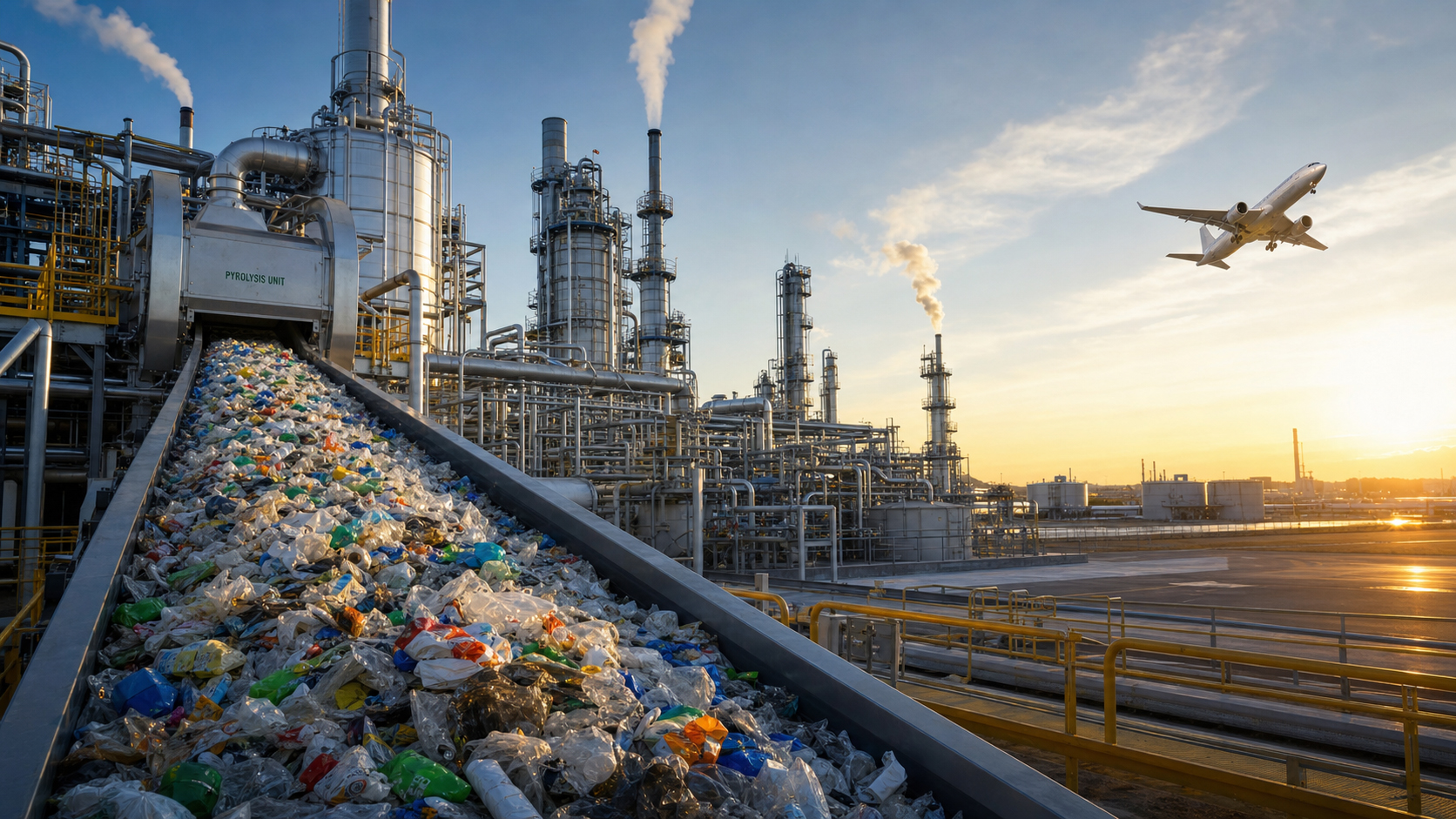
From yogurt cups to kerosene: The billion-dollar business of plastic waste – airplanes refuel with plastic – creative image on the topic, created with AI: Xpert.Digital
Kerosene from plastic waste: Ingenious solution or pure smoke and mirrors?
Revolution in the skies? Why plastic waste is set to replace our kerosene soon
New process makes aviation fuel from plastic: Here's what's really behind it
The aviation industry is desperately searching for ways to decarbonize, while the world is simultaneously drowning in plastic waste. What could be more logical, then, than to combine these two global crises? That's precisely what an ambitious large-scale project by the Chinese plant engineering company Niutech promises: In a converted refinery, tens of thousands of tons of plastic waste are to be processed into sustainable aviation fuel (SAF) through pyrolysis. But as tempting as the vision of yogurt containers in airplane fuel tanks sounds, the reality is far more complex. From unresolved questions about the carbon footprint and the pitfalls of continuous industrial operation to the massive pressure of European quota regulations: An in-depth analysis reveals whether the transformation of plastic waste into kerosene is the hoped-for breakthrough or merely an industrial policy illusion.
From the recycling center to the cockpit: How plastic waste is to become a kerosene substitute
When the garbage mountain becomes a gas station – a bold promise from the chemical industry
The aviation industry is considered one of the world's most difficult industries to decarbonize, while at the same time hundreds of millions of tons of plastic waste are generated globally each year, for which there is no satisfactory solution. The Chinese plant engineering company Niutech has now signed a contract with a previously unnamed international energy company to convert an existing refinery into sustainable aviation fuel (SAF). This brings to an industrial scale a technology that was long ridiculed as a niche solution but now appears increasingly attractive economically, as regulatory requirements in Europe and the US are dramatically increasing the demand for alternative fuels.
The basic idea is strikingly simple: a waste problem meets a raw material problem, and both seemingly solve each other. Whether this equation actually works, however, depends on technical, economic, and environmental details that are often overlooked in public debate. A sober analysis of the process chain, market mechanics, and criticisms reveals that while the technology has real substance, it is by no means the simple blueprint that some advertising copy suggests.
The transformation of plastic waste into aviation fuel – a two-stage process
The journey from used yogurt cups to kerosene involves two technically demanding stages. First, the collected plastic waste is shredded and heated to high temperatures in an oxygen-deprived environment, causing the long polymer chains to break down into shorter hydrocarbon compounds. This process, called pyrolysis, produces not only solid residues and flammable gases, but above all, pyrolysis oil, the key intermediate in the entire chain.
Only in the second step is a fuel usable for aircraft produced. The pyrolysis oil is further processed and hydrogenated in a refinery, where impurities are removed and the molecular structure is adapted to the stringent specifications for aviation fuel. Ideally, the end result of this process chain is SAF, which can partially or completely replace fossil kerosene. Scientific studies on such pyrolysis processes show that, under favorable conditions, an oil output of up to 70 percent of the plastic weight used can be achieved, with the remainder produced as gas and solid residues, some of which can be used to generate energy for heating the process itself. This self-sufficiency in process energy is a crucial factor for economic viability, as pyrolysis plants are energy-intensive and their success depends on a closed energy cycle.
Why mixed waste becomes a location advantage
A key technical argument from Niutech concerns the flexibility of the input materials. The plant is designed to process various types of plastic together, including polyethylene and polypropylene from packaging, as well as polystyrene, ABS, and nylon. Crucially, the complex washing, sorting, and drying of the waste should not be necessary to the extent required by conventional mechanical recycling processes.
This point is economically significant because, in practice, plastic waste almost never consists of a single, pure material. Food scraps, different types of plastic, and other contaminants typically complicate recycling considerably and drive up the costs of pre-treatment facilities. If a pyrolysis plant can indeed operate with less complex pre-sorting, the entry barrier for waste management operators drops significantly because the most expensive and logistically complicated part of the chain is shortened. Depending on its configuration, the planned plant is expected to be able to process between 10,000 and 50,000 tons of plastic waste per year, placing it in the category of large-scale industrial recycling plants and significantly exceeding previous pilot projects, which mostly remained in the range of around 10,000 tons of annual capacity.
Forty years of pyrolysis experience as strategic capital
Niutech is not entering this project as an unknown startup, but as a company with almost forty years of experience in pyrolysis processes. According to the company, its plants are already operating in Great Britain, South Korea, Denmark, Thailand, Vietnam, and China, with several projects achieving a processing capacity of around 10,000 tons per year. This international track record lends the company a certain degree of credibility with a client who needs to convert an existing refinery and commit significant capital in the process.
For the unnamed energy company, this ultimately boils down to a strategic gamble. Converting an existing refinery into a continuous production chain, from plastic waste to finished SAF, entails substantial investment costs and a technical risk that will only truly prove itself over several years of continuous operation. A marketing representative from Niutech emphasized that large-scale pyrolysis projects place high demands on continuous operation and that the company possesses sophisticated systems and extensive experience with larger projects. This statement can be interpreted as an indirect admission that previous generations of pyrolysis plants frequently failed precisely at this point, as downtime and technical malfunctions are significantly more costly in an integrated refinery environment than in isolated pilot plants.
The fuel market is growing faster than its supply
The real economic driver behind this project lies less in waste management than in the explosively growing market for sustainable aviation fuel (SAF). Various market analyses estimate the global SAF market for 2026 at between approximately US$2.3 billion and nearly US$6 billion, with annual growth rates ranging from 27 to over 60 percent, depending on the study, suggesting a market volume in the tens or hundreds of billions by the 2030s. This enormous range of forecasts also demonstrates how young and volatile this market still is and how much the figures depend on regulatory assumptions.
Despite this projected growth, the actual availability of SAF remains negligible. According to data from the International Air Transport Association (IATA), fossil kerosene consumption grew roughly ten times faster than SAF supply in 2025, and an even more rapid increase of sixteen times is expected for the current year. SAF's market share of total aviation fuel consumption is therefore likely to remain below one percent in 2026, even though global production capacity more than doubled from around 2.9 million tons at the end of 2024 to approximately 6.1 million tons at the end of 2025. This discrepancy between capacity growth and actual market share illustrates the extent of the structural deficit and why every additional source of raw materials, including plastic waste, is politically and economically welcome.
🎯🎯🎯 Data-driven B2B industry hub as a quasi-in-house solution

The quasi-in-house solution: How Xpert.Digital closes operational gaps in B2B marketing and sales – Smart Content-Driven Business - Image: Xpert.Digital
Xpert.Digital is a data-driven B2B industry hub led by Konrad Wolfenstein . The company acts as an external, quasi-in-house solution for industrial partners, closing operational gaps in marketing, content, and sales – without requiring additional resources on the client side.
More information here:
Plastic waste as a fuel source: The hidden risks behind the promises of the SAF industry
European regulations as the real price driver
A key reason for the interest of major energy companies in synthetic aviation fuel (SAF) lies in European regulation. The ReFuelEU Aviation Regulation has mandated minimum minimum shares of SAF in all aviation fuel supplied at EU airports since 2025. This share starts at two percent in 2025 and increases to six percent in 2030, twenty percent in 2035, and finally seventy percent in 2050. Within this overall quota, there is also a growing sub-target for synthetic aviation fuels, starting at 1.2 percent in 2030 and rising to 35 percent by 2050.
This regulation creates a reliable, legally secured market, which is what makes investment decisions like the Niutech contract economically viable. Without such a regulatory demand guarantee, the construction of costly conversion plants would be difficult to justify for many corporations, as SAF remains significantly more expensive than conventional kerosene from virtually all known production methods. The European Commission assumes that the production capacities currently under construction should be sufficient to supply the 3.2 million tons mandated for 2030, although a considerably faster expansion rate will be required thereafter. The business model of plant manufacturers like Niutech targets precisely this gap between short-term capacity coverage and the steeply increasing long-term demand.
The hidden competition for raw materials
To date, the majority of existing SAF (Sustainable Aviation Fuel) comes from a process called HEFA, which converts used cooking oils and other waste fats into aviation fuel and, according to market analyses, will still account for more than 87 percent of the SAF market in 2026. However, this process is increasingly reaching its raw material limits because the globally available quantities of used cooking oil are limited and already compete with other uses such as biodiesel for road transport.
From this perspective, plastic waste offers a strategic advantage because it is generated in enormous and ever-increasing quantities and has so far been largely untapped as a raw material for aviation fuel. However, this apparent abundance should not obscure the technical hurdles. Plastic waste must be collected, transported, and pre-treated, and the logistics costs for a diffusely distributed, often municipally managed waste stream differ fundamentally from those for centrally generated edible oil waste from the catering and food industries. Anyone who wants to realistically assess the economic viability of such facilities must include these upstream procurement costs in the overall calculation, even if they are rarely quantified in press releases.
Why the climate balance is more complicated than the promise
The public perception of the project as a dual environmental solution, simultaneously eliminating plastic waste and replacing fossil kerosene, warrants a more nuanced examination. SAF derived from plastic waste is by no means emission-free, as its combustion in an aircraft engine still releases carbon dioxide that originally came from the fossil petroleum used to manufacture the plastic. The climate policy benefit, therefore, does not lie in zero emissions, but at best in the fact that the carbon is used once more before it is ultimately released into the atmosphere, and in avoiding landfilling or incineration of the waste under less than ideal conditions.
Even more critical is the energy efficiency of the entire process. Independent studies on the pyrolysis of plastic waste indicate that more than half of the carbon originally contained in the plastic is lost during pyrolysis, while the resulting pyrolysis oil must undergo additional energy-intensive purification steps before it can even be used as a feedstock for high-value products such as aviation fuel. After examining several chemical recycling plants in the United States, the American environmental organization Natural Resources Defense Council concluded that some of these plants ultimately amount to little more than an energy-intensive form of waste incineration marketed under the misleading label of recycling. While this criticism is primarily directed at plants that aim to convert pyrolysis oil back into new plastics, the underlying technical problems of carbon loss and energy consumption also apply to the SAF (Solid Energy Filtration) process.
Certification tricks and the limits of mass balance
Another aspect often overlooked in public debate concerns the accounting methods used to calculate the proportion of recycled material in end products. The so-called mass balance approach does not allocate each individual ton of pyrolysis oil to a specific end product, but rather distributes the calculated proportion of recycled material across an entire production batch and then assigns it to specific product units. A 2023 study published by the environmental organization Zero Waste Europe estimated that, in practice, often only five to twenty percent pyrolysis oil needs to be mixed with eighty to ninety-five percent virgin, petroleum-derived plastic to even make the plants technically viable.
Applied to the SAF context, this means that statements about aviation fuel made entirely from plastic waste should be viewed with caution if they are based on such accounting methods. Furthermore, a 2024 report commissioned by the Swiss Federal Office for the Environment concluded that the technical feasibility, environmental benefits, and economic viability of chemical recycling were not sufficiently substantiated overall, and warned that excessive promotion or investment in this technology could lead to a misallocation of capital to ecologically questionable infrastructure. This assessment tempers the technological optimism with which projects like Niutech's are often presented in specialist publications, without denying the fundamental merit of the approach.
The real stress test lies in continuous operation
From a purely industrial economic perspective, the decisive test for the Niutech project lies not in laboratory chemistry, which has been known as such for decades, but in continuous, trouble-free operation within a large-scale industrial refinery environment. Pilot plants with a few thousand tons of annual capacity are relatively easy to operate because short downtimes are economically manageable. However, a plant integrated into an existing refinery with an annual capacity of up to 50,000 tons must operate reliably and synchronously with the upstream and downstream process steps for years, as failures at this point can affect the entire refinery value chain.
Historically, numerous chemical recycling and pyrolysis projects worldwide have failed precisely at this hurdle or never reached their originally announced capacities because the irregular composition of the feedstock, wear and tear on reactor components, and complex cleaning requirements are considerably more difficult to manage in continuous operation than at a pilot scale. Niutech's explicit reference to its many years of experience and several international reference projects should therefore be understood less as a marketing ploy and more as a direct response to this well-known weakness in the industry. Whether the unnamed energy company and Niutech will actually overcome this hurdle will only become clear after several years of commercial operation of the converted refinery.
Strategic classification for investors and industrial policy
From a strategic perspective, the project represents an economically sound, but by no means risk-free, response to two parallel market pressures. On the one hand, there is a demand for SAF (Sustainable Aluminized Fiber) driven by European and increasingly also non-European regulations, which is growing far faster than the available supply from established raw material sources such as used cooking oil. On the other hand, there is a global plastic waste problem for which there is currently no scalable, economically viable solution beyond traditional mechanical recycling and incineration.
Combining both problems via pyrolysis and subsequent hydrogenation to produce SAF is technically feasible and is being implemented by an established plant manufacturer with many years of operational experience, which distinguishes the project from many previous, more experimental chemical recycling projects. At the same time, fundamental questions remain unanswered, such as the actual carbon footprint over the entire life cycle, the long-term availability of sufficiently homogeneous waste quantities, and the ability to actually achieve the promised processing volumes in continuous industrial operation. Therefore, companies looking to invest in or partner with this sector are advised to conduct a sober review of the specific reference plants, the actual operating times, and the underlying certification methodology, rather than relying solely on the enticing narrative of a dual-problem solution. The technology has real potential to make a small but growing contribution to the decarbonization of aviation, but it is no substitute for a fundamental reduction in plastic consumption and the growth of air traffic itself.
📈🚀 From visibility to trust 👀🤝 Your scalable path with Xpert.Digital

From visibility to trust: Your scalable path with Xpert.Digital - Image: Xpert.Digital
In industrial B2B, sustainable business relationships rarely emerge overnight. They develop step by step – through visibility, professional relevance, recurring touchpoints, and growing trust. Xpert.Digital's 4-stage model addresses precisely this: It offers a structured path that begins with a manageable entry point and can evolve into deeper collaboration in business development if needed.
Instead of relying on loud marketing promises, this model puts the relationship at the forefront. Companies start with clearly defined, easily calculable measures and then decide, based on their own experience, how far they want to expand the collaboration. A key factor for this undisturbed trust-building process: The platform completely avoids annoying advertising ads, so the editorial focus remains solely on the companies' expertise.
More information here:
Your global marketing and business development partner
☑️ Our business language is English or German
☑️ NEW: Correspondence in your native language!

Konrad Wolfenstein
I and my team are happy to be available to you as your personal advisor.
You can contact me by filling out the contact form here [email protected]:or simply call me at +49 7348 4088 965. My email address is
I'm looking forward to our joint project.










