
The multi-billion dollar monopoly: Why even the toughest sanctions can't stop the ruby business in Myanmar (formerly Burma)
Xpert Pre-Release

Available in 27 languages 📢
Prefer Xpert.Digital on GoogleⓘPublished on: May 18, 2026 / Updated on: May 18, 2026 – Author: Konrad Wolfenstein
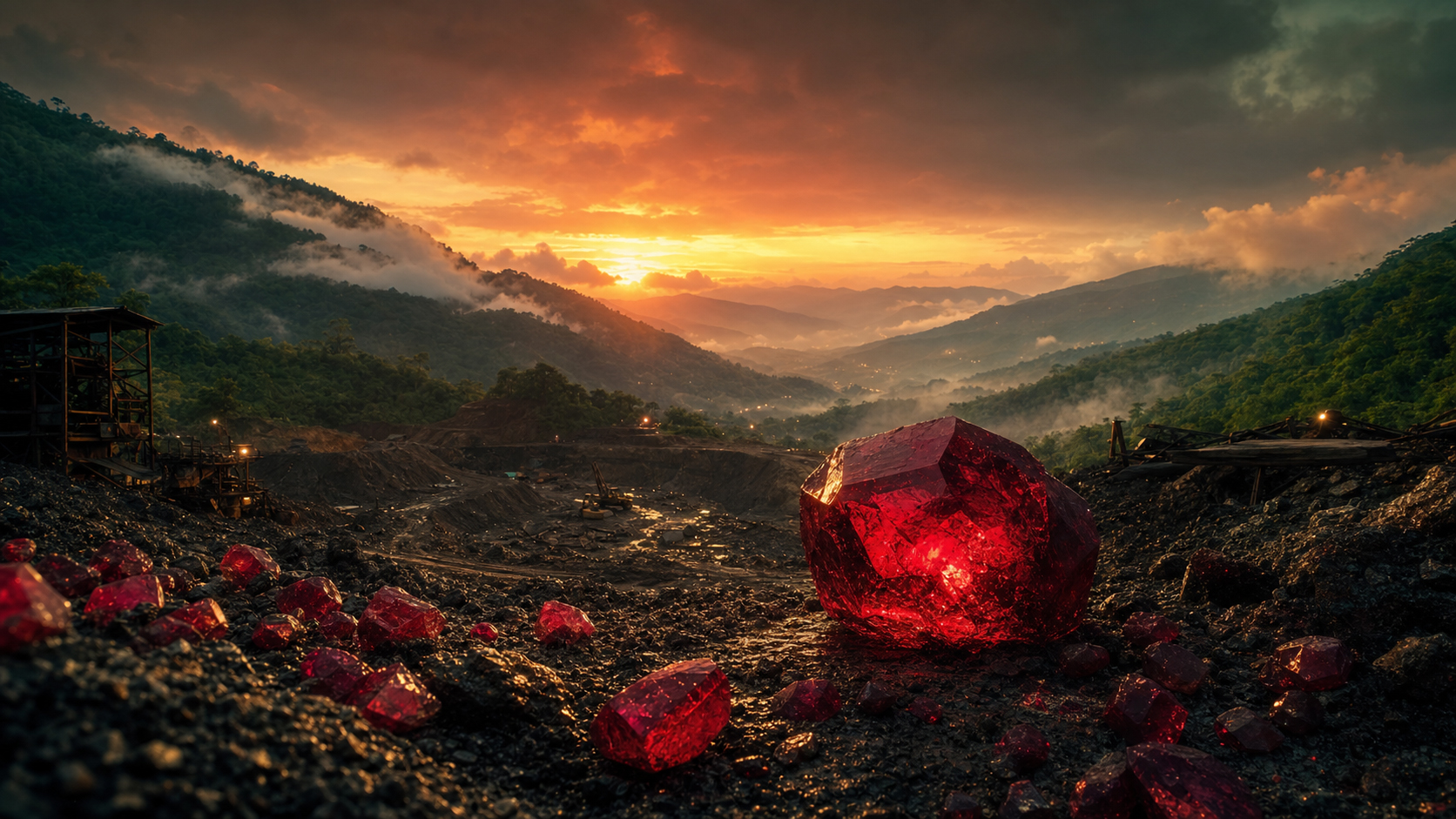
The multi-billion dollar monopoly: Why even the toughest sanctions can't stop the ruby business in Myanmar (formerly Burma) – Creative image: Xpert.Digital
“Pigeon blood” rubies: The dark truth about the luxury gemstones of Cartier, Bulgari & Co.
Red wealth in the shadow of the junta: How Myanmar's mega-rubies finance an entire army
A sensational find is shaking the global gemstone market: In crisis-ridden Myanmar, an 11,000-carat raw ruby has been discovered – a natural wonder of inestimable value. But the breathtaking, crimson stone casts a dark shadow. While top prices are paid in the shop windows of Western metropolises for the legendary "pigeon's blood" rubies from the mythical Mogok Valley, their mining locally finances a brutal military dictatorship. Between systemic smuggling, China's geopolitical interests, and the omnipresent despair of disenfranchised miners, the bitter reality of a country is revealed: Myanmar's red wealth is a Segen for a few rulers – and a curse for its own people. This article sheds light on the abyss of a multi-billion-dollar industry where a stone is often worth more than a human life, and questions the responsibility of the global luxury economy.
When a stone is worth more than a human life: How Myanmar's ruby industry is being torn apart between global market dominance, military control, and international sanctions pressure
In mid-April 2026, shortly after the traditional Burmese New Year, miners near the city of Mogok unearthed a gemstone that astonished even seasoned gemologists: an 11,000-carat raw ruby. This equates to 2.2 kilograms of pure, untreated corundum in a rich purple-red with yellowish undertones and a vitreous luster that is impressive even in its raw state. The state-run newspaper "Global New Light of Myanmar" reported on a stone with a high quality gradient, moderate transparency, and a highly reflective surface, which was extracted from the ground without any treatment or refinement. Military chief Min Aung Hlaing had the colossal stone transported to his palace in Naypyidaw and personally inspected it—a gesture that symbolically encapsulates what is always at stake in Myanmar when gemstones are involved: political power and state control over mineral resources of immense value.
Measured by weight, this find is considered the second largest ruby ever discovered in Myanmar. The previous record holder, a 21,450-carat specimen from 1996, weighs almost twice as much, but is considered significantly less valuable by experts. In the ruby trade, price is determined not only by size or weight, but also by color, clarity, and origin from the mythically charged Mogok Valley. Experts believe the April find could fetch a price in the tens of millions – and in exceptional cases, perhaps even more. A precise estimate is still pending. What is certain is that the stone is yet another impressive piece of evidence that Myanmar is in a league of its own when it comes to rubies.
The Valley of the Red Stones: Mogok as a geological wonder of the world
The rubies produced by Mogok are no ordinary gemstones. Located about 200 kilometers north of Mandalay in a mountainous region of the upper Mandalay District, the valley produces, according to gemologists and market analysts, roughly 90 percent of the world's traded rubies and other colored gemstones, not including jade. The unique geological composition of marble, gneiss, and hydrothermal processes creates a quality of stone that is simply unparalleled elsewhere in the world. In Mogok, the mineral corundum achieves a crystalline purity and depth of color that gave the famous Pigeon Blood ruby its name.
This term is not a romantic metaphor, but a gemological term defined by Gemresearch Swisslab AG (GRS) on an official color scale: A genuine pigeon-blood ruby must achieve level 3 out of 4 on this scale, meaning it exhibits an exceptionally saturated, pure red with a slightly bluish undertone and high transparency. These stones are considered the most expensive colored gemstones in the world. Untreated specimens of the highest quality fetch prices of over $100,000 per carat on the world market. By comparison, similar sums are demanded for an exceptional diamond, but rubies of this quality from Mogok are rarer than diamonds of the corresponding category.
The absolute highlight was the auction of the so-called "Sunrise Ruby" in May 2015 at Sotheby's in Geneva. This 25.59-carat stone from Burma fetched a hammer price of US$30.42 million, equivalent to US$1.19 million per carat – a world record for both the total price and the price per carat of a ruby. The stone thus exceeded the then-current estimate of a maximum of US$18 million by over US$12 million and simultaneously set a new record for a Cartier piece of jewelry and for any non-diamond gemstone ever auctioned. Such figures clearly demonstrate the explosive economic potential of the red stones from Myanmar.
The Economics of the Ruby: Numbers Behind the Glitter
When Myanmar is referred to as the "Ruby Power," it's not an exaggeration, but a stark statistical reality. According to the human rights organization Global Witness, Myanmar's colored gemstone sector generated between US$346 million and US$415 million annually during peak production, based on official figures, though industry sources indicate the true figure could be up to five times higher. Another Global Witness study estimated the total value of the gemstone industry, including jade and smuggled goods, at US$1.73 billion annually.
Even in the years prior to the 2021 military coup, the state-owned Myanmar Gems Enterprise demonstrated impressive growth dynamics: In the 2006/2007 fiscal year, it recorded gemstone revenues of nearly US$300 million, an increase of almost 45 percent compared to the previous year, making it the country's third-largest exporter after the state-owned oil and timber companies. The gemstone sector is therefore not a marginal phenomenon of the economy, but a crucial pillar structurally linked to state power. Myanmar's mining and minerals industry as a whole grew at an average annual rate of 37.6 percent between 2000 and 2010, increasing its contribution to the gross domestic product from 15 billion kyat to 367 billion kyat.
Myanmar's sheer market power in rubies is particularly remarkable because it faces no significant competition. While Mozambique has been developed as an alternative supplier in recent years and certainly produces high-quality stones, the specific color and quality of Mogok rubies remain unique in the opinion of the vast majority of gemologists. Industry estimates suggest that Myanmar produces more than 80 to 90 percent of the world's traded rubies by value. This structural dominance gives the country a market position comparable in the history of the commodities industry to OPEC in the oil business or Botswana's monopoly on certain diamond qualities, although institutionalization in Myanmar is still more rudimentary and the shadow economy proportionally much larger.
Smuggling, tax evasion, and the dark side of the spotlight
Behind the official market power lies a systematically undermined state economy. According to calculations by the Natural Resource Governance Institute (NRGI), up to two-thirds of Myanmar's total jade and gemstone production is not subject to taxation because it is either smuggled or massively undervalued. The taxes actually collected by the government are estimated at only 2 to 5 percent of the production value – a fiscal catastrophe for a country that is among the poorest in Asia. The gemstone trade thus creates enormous value, but this benefits neither the state nor the general population.
The mechanisms of tax evasion are multifaceted and systemic. Myanmar's official tax system taxes gemstones multiple times, effectively forcing every legitimate trader to either operate illegally or systematically conceal the value of their goods. As one NRGI expert succinctly put it: if the effective tax rate truly reflected the official rate, no one in Myanmar would mine gemstones anymore. Instead, a large proportion of the mined stones are diverted to Thailand via informal routes, where they are reintroduced into the legitimate market and re-documented. The supply chain of a Burmese ruby can involve a Mandalay dealer, a Bangkok cutting workshop, a Hong Kong trading company, and a New York wholesaler before it reaches a retail store, with new documents being created or falsified at each stage.
The asymmetry between official trade statistics and actual trade flows is striking. Between 2012 and 2016, Myanmar reported average annual jade sales of $1.2 billion to the state Emporium, while China reported importing more than twice that amount, $2.6 billion, from Myanmar during the same period. For the 2015/2016 fiscal year, the NRGI estimated the actual production value of the jade industry alone to be between $3.7 billion and $43.1 billion, far exceeding all officially recorded figures. These numbers illustrate the scale of an informal economy that not only circumvents state institutions but also structurally corrupts them.
Military control as a business model: From miner to general
The key to understanding the Burmese ruby industry lies not in geological peculiarities, but in the political economy of control. For decades, the Burmese military, the so-called Tatmadaw, has systematically expanded and institutionalized its rule over the country's mineral-rich regions. The method is twofold: On the one hand, lucrative mining licenses are granted to company-owned enterprises, primarily Myanmar Economic Holdings and Myanmar Economic Corporation; on the other hand, informal miners are deprived of a portion of their earnings through targeted extortion, without being given any legal basis for their work.
After the expiration of the last official mining licenses in 2020 and the military coup in February 2021, the junta developed a particularly cynical strategy: it allowed tens of thousands of informal miners to flood into the Mogok region to maintain production, but denied them any legal protection. The military systematically exploited this vacuum as leverage: miners' motorcycles were confiscated and returned only upon payment of exorbitant fees, mine operators had to pay bribes for the release of arrested colleagues, and arbitrary tolls were collected at roads and markets. The gemstone trade thus became institutionalized plunder.
Global Witness documented in a report that the jade industry, structurally similar to the ruby sector, has become a de facto bribery machine for the armed forces, reaching into the highest ranks of the military hierarchy. Even Min Aung Hlaing's son was named as a beneficiary of a dynamite shipment for jade mines. Human Rights Watch established as early as 2007 that the gemstone trade is a central pillar of military power financing: sales provide the junta with hard currency to maintain its grip on power. This fundamental logic remains unchanged to this day – it was merely intensified by the 2021 coup attempt.
Sanctions: Between moral aspiration and economic reality
The international community has responded to the human rights situation in Myanmar with several waves of sanctions, but these have remained limited in their effectiveness and controversial in their targeting. The first major attempt was the US "Tom Lantos Block Burmese Jade Act," which imposed a complete import ban on Burmese gemstones into the United States between 2008 and 2016. Criticism from the industry was unanimous: this measure affected not the generals, but small-scale traders and artisanal miners. The junta remained virtually unaffected because its main market was not the US, but China and Asia.
Following the 2021 coup, the US Treasury Department responded by first placing individual companies—Myanmar Ruby Enterprise, Myanmar Imperial Jade Co., and Cancri Gems & Jewellery—on the Specially Designated Nationals list and ultimately sanctioning the state-owned Myanmar Gems Enterprise, effectively banning the vast majority of Burmese gemstones imported into the US. The European Union had already taken action in 2007, including the mining sector in its sanctions regime. Nevertheless, just a few months after these measures, Global Witness reported that freshly mined rubies from Myanmar continued to appear on international markets—from Bangkok's trading hubs to the jewelry collections of European luxury jewelers.
The fundamental problem with sanctions policy is structural: China is the key player in the Burmese gemstone trade, and Beijing has not supported these measures. Rubies and jade from Myanmar flow via the main route through the border town of Ruili in the Chinese province of Yunnan into the global market, where a well-oiled infrastructure of traders, intermediaries, and processing plants awaits. Western sanctions that do not include China risk merely shifting trade routes instead of actually disrupting the flow of money. Geneva-based luxury companies, including jewelry houses and commodity traders, continued to do business in Myanmar despite international sanctions, as research by the NGO Corporate Responsibility Switzerland demonstrates. The gaps in the international sanctions regime are not accidental but rather reflect a deep conflict of interest between the normative imperative of human rights protection and the commercial interest in rare luxury goods.
🎯🎯🎯 Global Sourcing & Commodity Trading with integrated logistics

Raw materials, global procurement & trade - Image: Xpert.Digital
State-of-the-art cargo planes, optimized transport routes, and multimodal logistics chains are interchangeable—they can be bought, leased, or outsourced. What money can't buy are direct contacts with producers in Peruvian mines, reliable supply relationships in the CIS countries, and years of built-up trust in markets that are unfamiliar to outsiders. The decisive competitive advantage in global commodity trading lies not in transporting the good from A to B, but in knowing where the good comes from, who produces it, and how to gain access before others even know the market exists. Whoever owns the network sets the price. Everyone else pays it.
More information here:
11,000-carat ruby from Mogok: Propaganda, profit and the supply chain gap – How China's interests are stabilizing Myanmar's ruby trade
Civil war as a production disruption: Mogok in the crosshairs
The already fragile structure of Mogok's ruby mining industry before the coup came under massive pressure from October 2023 onwards due to the military offensive "Operation 1027." The Ta'ang National Liberation Army (TNLA), one of the most powerful ethnic resistance groups, launched a major offensive together with allies, which led to the capture of Mogok – the heart of global ruby production – in the summer of 2024. The fighting brought mining to a virtual standstill: most civilians fled, the Mandalay-Muse Highway, the most important trade route, was closed, and the military systematically cut off telecommunications access in the region. Chinese buyers, who had previously traveled to Mogok regularly, stayed away.
This had immediate consequences for the global gemstone industry: the supply of Mogok rubies on the world market collapsed, while at the same time, stones already mined could no longer be freely traded. Uncertainty over ownership rights and smuggling opportunities caused informal trade to dwindle. In October 2024, following negotiations mediated by China in Kunming, the TNLA agreed to withdraw from Mogok and neighboring Momeik – a deal that unequivocally underscores China's enormous strategic interest in the stability of supply routes. The junta, in turn, pledged to cease airstrikes, and both sides agreed to a ceasefire. However, the return to normal production has progressed only slowly since then.
The discovery of the 11,000-carat ruby in April 2026 falls precisely within this phase of fragile stabilization. It is not proof of economic normalization, but rather of the region's geological inexhaustibility, even under the most challenging conditions. Min Aung Hlaing's decision to stage the find for maximum publicity follows a clear propagandistic logic: the gemstone is intended to demonstrate the legitimacy of his rule over Mogok and thus over the country's wealth – regardless of the fact that the legitimate ownership of this stone is highly contested, both legally and politically.
The global luxury industry and its responsibility
Myanmar rubies ultimately don't end up in local markets, but rather in the windows of the world's most prestigious jewelers. A Global Witness investigation identified luxury brands such as Graff, Bulgari, Van Cleef & Arpels, and major auction houses as likely buyers of stones mined in territory controlled by the Myanmar military. Only a handful of companies—including Tiffany & Co., Signet Jewelers, Cartier, and Harry Winston—have stated that they have consistently removed Burmese rubies from their collections. The vast majority of the industry operates in a gray area, facilitated by a lack of supply chain traceability.
The central problem is the lack of traceability across the various processing stages. A rough stone from Mogok is cut and polished in Thailand, certified in Hong Kong, set in a piece of jewelry in Switzerland, and finally sold in Germany or France. At what point in the supply chain should liability begin? Gemological laboratories such as the Gemological Institute of America (GIA) or the GRS can determine the geographic origin of a stone with a high degree of probability based on mineralogical characteristics, but such a certificate alone is insufficient to ensure that no profits have flowed to war criminals. The industry has been working on blockchain-based traceability systems for years, but their implementation in the fragmented and informal gemstone sector encounters structural limitations.
The comparison with the conflict minerals regime for tantalum, tin, tungsten, and gold from the Congo Basin is obvious. There, the US Dodd-Frank Act and later the EU Conflict Minerals Regulation at least introduced a legal due diligence obligation for companies. For colored gemstones from Myanmar, a comparable legally binding framework is largely lacking at the global level – a blatant regulatory failure given the documented links between the gemstone trade, war financing, and human rights violations.
Jade, rare earth elements and the bigger resource picture
The ruby trade is just one, albeit highly visible, part of a much larger resource complex that binds Myanmar to a global network of dependencies. Myanmar produces up to 70 percent of the world's high-quality jadeite, whose trade value is sometimes even more spectacular than that of rubies. Furthermore, the country has become a key player in the global rare earth market: with a 16 percent share of global production in 2024, Myanmar ranked second only to China, and between January and September 2025, China imported more than 52,000 tons of rare earths, 53 percent of which originated in Myanmar. The value of these exports reached US$724 million in the first nine months of 2024 before declining by approximately US$100 million the following year.
This broader resource picture shows that Myanmar is not a single-commodity economy, but rather a resource-politically significant player in several strategic sectors simultaneously. However, the structural weakness remains the same as with the ruby: the state captures only a marginal share of the added value, while the vast majority of the benefits flow to foreign buyers, primarily China, and to domestic power elites. Even before the coup, Myanmar's tax burden, at 6 to 7 percent of GDP, was among the lowest of all ASEAN countries worldwide, a fact directly linked to the structural failure in taxing the extractive sector. A country that theoretically ranks among the most resource-rich in Asia thus remains one of the poorest – a perverse resource logic described in political science as the "resource curse.".
China's strategic calculations: gemstones, infrastructure and geopolitical stability
No actor has a greater interest in the smooth functioning of Burme's gemstone and raw materials sector than China. Beijing not only sources a large portion of its jade and ruby imports from Myanmar, but has also made massive investments in infrastructure that positions Myanmar as a corridor between China's interior and the Indian Ocean – a key element of the Belt and Road Initiative. This geopolitical investment makes China the de facto guarantor of Myanmar's economic stability, but also the junta's most important safeguard against Western sanctions.
China's role as mediator in the Mogok conflict therefore stems not from humanitarian impulses, but from hard-nosed resource policy. The Kunming talks between the TNLA and the junta, which led to the rebels' withdrawal from Mogok, served a clear Chinese self-interest: the disruption of ruby supplies and, above all, rare earth supply chains directly impacted Chinese processing plants. Beijing's willingness to negotiate should therefore not be mistaken for political neutrality. China is pursuing conflict stabilization to ensure the unimpeded flow of resources – a strategy that explains why sanctions remain structurally ineffective without Chinese involvement.
This presents the international community with a deeply rooted dilemma: as long as China acts as a buyer, investor, and diplomatic shield for the Burmese junta, Western measures are largely ineffective. The political economy of the ruby and gemstone trade is embedded in a Sino-Burmese dependency structure that cannot be fundamentally shaken by either sanctions or appeals to the luxury goods industry as long as the world's largest market participates.
Small-scale mining in a stranglehold: Who really benefits?
Behind the spectacular auction prices and billions of dollars lies the harsh everyday reality of tens of thousands of informal miners in and around Mogok. These people mine using the most basic means, often without any safety equipment, at their own risk, and without legal protection. After the last state mining licenses expired in 2020, they found themselves in a legal gray area, which the military deliberately exploited to arbitrarily collect fees and arrest people. Many of the miners come every day hoping for that one find that would change their lives, as the recent 11,000-carat stone seems to have done for a group of miners. But whether the discoverers of this stone will actually share in its value is highly questionable, given the junta's political control over the gemstone industry.
The paradox is evident: Myanmar holds a near-monopoly on one of the world's most valuable raw materials, yet an estimated 32 percent of its population lived in poverty even before the coup. This contradiction is no accident, but rather the product of a deliberately constructed system of exploitation. The state collects hardly any taxes, the junta has distributed the most valuable licenses to its own conglomerates, and smuggling networks siphon off any further added value from the public coffers. A systemically functioning mining sector with transparent taxation, fair licensing regulations, and reinvestment in social infrastructure would provide Myanmar with the means to escape the poverty trap—but that is precisely what the ruling elite has no interest in.
Outlook: A ruby power without the rule of law
The 11,000-carat ruby from April 2026 is more than a gemological spectacle. It is both a symptom and a symbol: of the unbroken geological potential of the Mogok Valley, of Myanmar's unresolved political crisis, and of the fundamental tension between global luxury consumption and the reality of local exploitation. Myanmar remains a world power in the ruby trade – but it is a power that rests on profoundly fragile foundations, riddled with violence and undermined by the rule of law.
The challenge for the international community is not to punish Myanmar, but to create a framework in which the country's wealth can benefit its people. This requires a combination of targeted sanctions that actually affect the military elite, binding due diligence obligations for importing companies in Europe, the US, and, in the future, China, support for alternative governance structures beyond the junta, and a long-term strategy to strengthen transparent supply chains. As long as none of these levers are consistently applied, the red bricks from Mogok will continue to glitter—for those who can buy them, while those who extract them remain in the dark.
Your contact for raw materials ⛏️ Global sourcing 🚢🌐 & trading 📦

Dmitry Kovalenko
I would be happy to serve as your personal advisor.
Dmitry Kovalenko
Tel: +49 7348 4088 961
Your contact for raw materials ⛏️ Global sourcing 🚢🌐 & trading 📦

Konrad Wolfenstein
I would be happy to serve as your personal advisor.
Konrad Wolfenstein
Email: [email protected]
Our Asia expertise in business development, sales and marketing

Our Asia expertise in business development, sales and marketing - Image: Xpert.Digital
Industry focus areas: B2B, digitalization (from AI to XR), mechanical engineering, logistics, renewable energies and industry
More information here:
A thematic hub offering insights and expertise:
- Knowledge platform covering global and regional economies, innovation and industry-specific trends
- A collection of analyses, insights, and background information from our key areas of focus
- A place for expertise and information on current developments in business and technology
- A hub for companies seeking information on markets, digitalization, and industry innovations





