
The dancing robot is the show, the gripper arm is the business – Hannover Messe 2026 and the economics of humanoid robotics
Xpert Pre-Release

Available in 27 languages 📢
Prefer Xpert.Digital on GoogleⓘPublished on: May 7, 2026 / Updated on: May 7, 2026 – Author: Konrad Wolfenstein
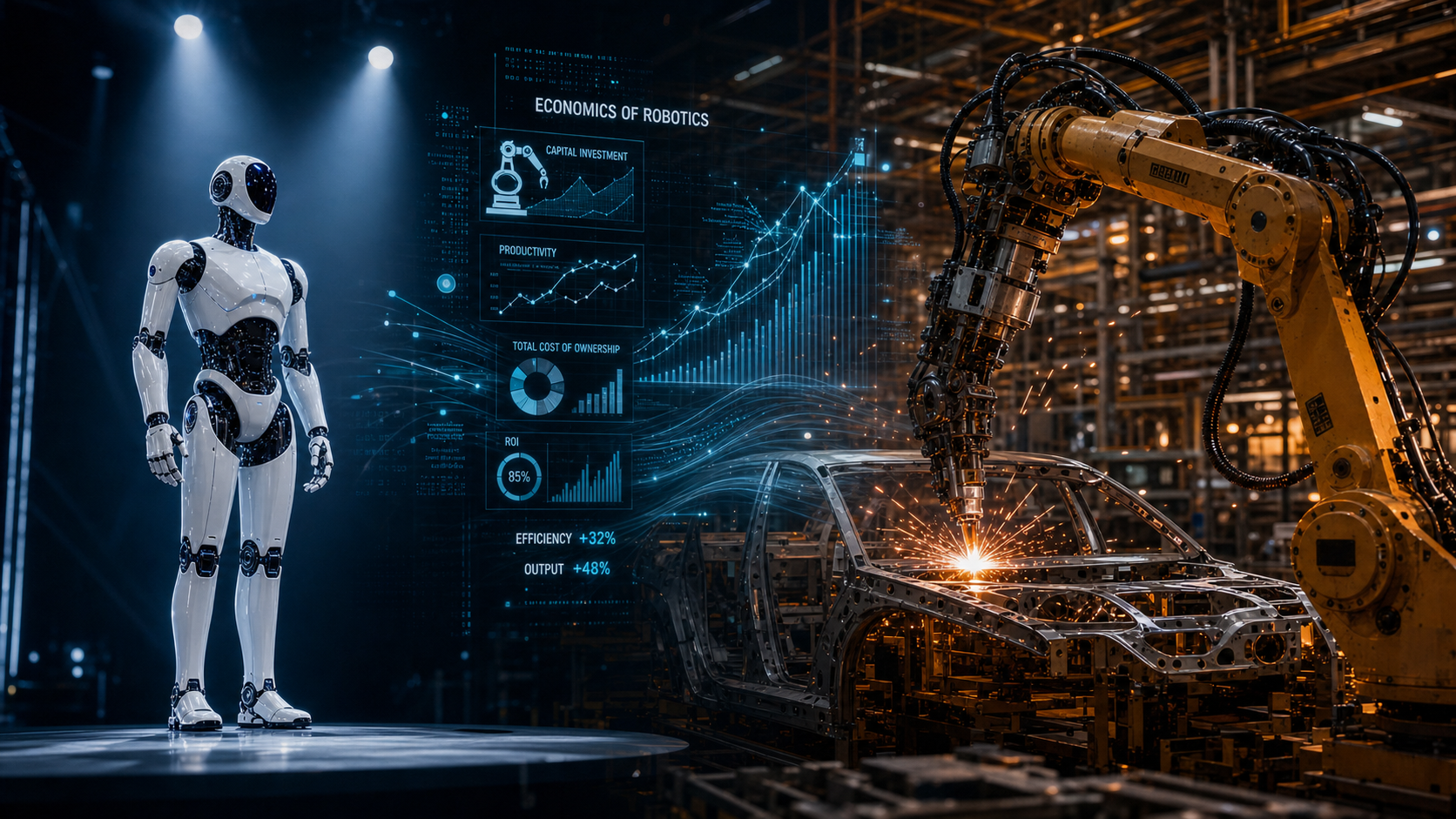
The dancing robot is the show, the robotic arm is the business – Hannover Messe 2026 and the economics of humanoid robotics – Image: Xpert.Digitql
Between trade fair spectacle and factory reality: Who will win the race for the future of industrial automation?
Physical AI in crisis? Why only 4% of companies are truly using robots profitably
AI, data and steel: Are Germany and the rest of the world missing out on the most important industrial trend of the decade?
At the 2026 Hannover Messe, they are undeniably in the spotlight: humanoid robots that dance, grasp components, and fascinate with their human-like motor skills. They dominate social media feeds and attract the attention of top politicians and investors alike. But behind the glittering facade of the world's largest industrial trade fair, a huge gap exists between media hype and business reality. While these two-legged creatures embody the promise of a completely new era of "Physical AI," the real money is still being made elsewhere: It is the classic cobot and the tireless robotic arm that are currently securing locations and recording gigantic growth rates.
A recent analysis shows that only a fraction of companies have fully scaled up AI-powered robotics systems so far. Nevertheless, it would be a fatal mistake to dismiss the development of humanoid robots as mere gimmicks. Given demographic changes and the acute shortage of skilled workers in industrialized nations, they will soon be indispensable. While Europe is still grappling with regulatory frameworks and perfecting the mechanics, a completely different, global race is already underway in the background. Fueled by massive government subsidies and cross-subsidization from the electric vehicle industry, China is currently building an ecosystem that could dominate the market. Because the crucial question of the coming decade is not whether a robot has two legs – but rather who owns the foundation models, who controls the training data, and who ultimately makes the technology truly profitable.
Related to this:

Why humanoid robots dance – but the robotic arm earns the big money
At the Hannover Messe 2026, humanoid robots dance, grasp, and assemble under the spotlight of the world's largest industrial trade fair. Chancellor Friedrich Merz was greeted at the Agile Robots booth by the humanoid robot Agile ONE and witnessed firsthand the strategic economic importance of physical AI for Germany's industrial competitiveness. The scene is symbolically charged. At the same time, it reflects an ambivalence that currently characterizes the entire field of humanoid robotics: rarely is the gap between media attention and business reality as wide as it is here. Humanoid robots fill the news feed. The robotic arm still secures the location.
From hydraulic arm to bipedal colleague: Sixty years of robotics history in three acts
The history of industrial robotics is a history of patience. In 1961, at General Motors, the first industrial robot welded car body panels – hydraulically powered, heavy, and blind to its surroundings, but reliable in its narrowly defined task. It was the beginning of a wave of automation that would transform the manufacturing industry of the Western world for decades to come. The robot, as a tool, as an extended and tireless arm of the engineer, proved its economic value not in trade show demonstrations, but in the millions of welds produced without loss of quality and without interruption.
Twelve years later, in 1973, the Japanese WABOT-1 entered the research arena: the first humanoid robot capable of speaking a few sentences and walking from point A to point B. It wasn't a production tool—it was a promise of research. Between the productive deployment of the industrial robot and this first "walking step" of the humanoid machine lay twelve years of intensive engineering work. Between the WABOT-1 and a commercially viable humanoid robot capable of independently performing assembly tasks in a real factory environment, there are yet more than fifty years—and not all of them have been covered.
This timeline is not a sign of failure, but rather evidence of the sheer complexity of the undertaking. A human being can grasp an unknown object, switch between tasks, and navigate an unstructured environment with an ease rooted in millions of years of biological evolution. Teaching robots this level of adaptability requires not only powerful mechanics, but above all, the ability to learn—and at a speed and with a generality that was simply unavailable until a few years ago. The current generation of foundation models and physical AI systems is now fundamentally changing this equation, albeit gradually.
When numbers slow down the hype: What the Capgemini study reveals about the state of Physical AI
Anyone wanting to understand the extent of the discrepancy between expectations and reality would do well to carefully read the study published in April 2026 by the Capgemini Research Institute entitled "Physical AI: Taking human-robot collaboration to the next level." The institute surveyed 1,678 executives from 16 countries and 15 industries worldwide – one of the most comprehensive surveys of its kind on this topic.
The result is both sobering and promising. While nearly eight out of ten organizations (79 percent) are now actively engaged with physical AI, and 27 percent are already using or scaling such systems, a closer look at full implementation reveals the true extent of the challenge: Only 4 percent of the surveyed companies have fully scaled their physical AI solutions. The vast majority are still in pilot or early testing phases. Almost eight out of ten executives report that scaling remains a key challenge for them.
The biggest obstacle, cited by 72 percent of the surveyed decision-makers, is the technological immaturity of the overall system – not the malfunction of individual components, but the failure of the system as a whole in the unregulated, chaotic daily environment of a factory or warehouse. Added to this, 63 percent point to the still excessively high acquisition and operating costs. Safety concerns, the certification of autonomous systems, and the lack of economic viability for small and medium production runs complete the list of hindering factors. At the same time, 60 percent of executives are convinced that physical AI will enable robot applications that were previously technically impossible or economically unfeasible. Short-term growth in the industry will not be driven by humanoid robots, but by cobots and mobile systems – that is, by forms of robotics that already possess an established safety architecture and proven application scenarios.
Cobots as the real foundation: Where growth is actually taking place today
To understand the economic dynamics of the robotics market, one must shift one's focus from the catwalk of humanoid robots to the shop floor, where cobots have long since proven their worth. The global market for collaborative robots was estimated at around US$2.69 billion in 2024. While various forecasts differ in their growth expectations, they all point in the same direction: uninterrupted, strong growth over the next few years. Depending on the valuation model, the market is expected to reach volumes of between US$11 billion and US$65 billion by 2031 or 2033.
The mobile cobot segment is even more dynamic. The corresponding global market was estimated at over US$2.5 billion for 2025 and is projected to grow to over US$21 billion by 2035 – with an average annual growth rate of approximately 24 percent. Europe is the fastest-growing regional segment, demonstrating that the core industrial market is particularly receptive to cobots. Drivers of this growth include a shortage of skilled workers, rising labor costs, and the ongoing pressure to increase efficiency. Cobots now offer a solution to this problem, at transparent prices, with robust safety certifications, and without the need to redesign entire production lines.
The Hannover Messe 2026 exhibit confirms this picture. Companies like DENSO Robotics are presenting high-performance systems with cycle times of 0.28 seconds in the Application Park. Huayan Robotics, which was listed on the Hong Kong Stock Exchange on March 30, 2026 – the offering was oversubscribed more than 5,000 times – is showcasing automated palletizing and welding solutions with a precision of ±0.15 millimeters. The capital that institutional investors are channeling into such companies is not speculative: it flows to those where operational scalability and established customer relationships are already generating cash flow.
Why the humanoid is nevertheless indispensable: The argument of demographic change
Despite all the hard facts, it would be a serious analytical error to dismiss the development of humanoid robots as a luxury, a spectacle, or a mere research exercise. There is one argument that transcends the entire discourse on costs, technological maturity, and scalability: the demographic reality of industrialized nations.
Germany and large parts of Europe, Japan, South Korea, and, in the foreseeable future, China as well, are facing a shrinking working-age population. In Germany, this situation is exacerbated particularly dramatically by the retirement of the baby boomers. A representative Bitkom survey of 555 German industrial companies with at least 100 employees, published on the occasion of the Hannover Messe 2026, reveals that 58 percent of German industrial companies believe that humanoid robots can counteract the shortage of skilled workers. Nearly seven out of ten industrial companies (68 percent) also see humanoid robots as a tool for reducing workplace accidents.
The real argument for the necessity of humanoid robots, however, lies in the way the world is built. Our factories, warehouses, hospitals, and offices were designed for human workers: doors, stairs, reach heights, sight lines, hand tools. Traditional industrial robots can excel in defined cells, but they fail due to the unstructured flexibility that human environments demand. Mobile robotic systems lack the dexterity for complex assembly tasks. Only a robot that resembles a human in proportion and mobility can utilize this infrastructure without costly retooling. This is precisely why, according to a Capgemini study, 43 percent of the executives surveyed see physical AI as the only way to scale production domestically.
The real race: Whoever owns the foundation models, sensors, and data
The debate about bipedalism distracts from the real competition. The crucial question in the race for commercial dominance in humanoid robotics is not whether a system can stand, dance, or stack boxes. It is: Who owns the foundation models, who controls the sensor architecture, and who collects sufficient quantity and quality of training data?
Robotic Foundation Models (Robotic Foundation Models) – large, multimodal models that combine perception, planning, and tactile control – are changing the fundamental logic of robotics development. The principle is similar to what language models have achieved for text: a pre-trained foundation model, which can be specialized for many different tasks, replaces the complex programming of each individual function. Agile Robots from Munich, a DLR spin-off, trains its Robotic Foundation Model on one of the largest European datasets of industrial tasks – a combination of real-world production data, simulation, and human teleoperation. NVIDIA is advancing an open infrastructure for Robotic Foundation Models with its Isaac GR00T platform and has taken an important step toward standardizing training with the GR00T N1 model.
But the data issue is the crucial bottleneck. While language models have been trained on trillions of tokens from the entire digitized knowledge base of humankind, high-quality training data for humanoids—real grasping movements, force data, failures—is rare, expensive, and difficult to standardize. Whoever can build these data pipelines at a sufficient scale, whoever manages the transition from small laboratory datasets to industrially relevant training corpora, will dominate the next phase of the industry. And therein lies one of China's key structural advantages.
🎯🎯🎯 Sino-Cooperation

Sino-Cooperation is a platform based in China and Germany
Sino-Cooperation is a platform based in China and Germany that promotes exchange and cooperation between German and Chinese companies, especially through events, digital formats and an online cooperation exchange for market entry and partnerships.
More information here:
Hype or breakthrough? How foundation models and manufacturing data will determine the future
China's industrial ecosystem strategy: More than scaling, more than subsidies
China is not simply another player in the global humanoid robotics market. It is the only actor that simultaneously pulls all the critical levers of the ecosystem – in a coordinated manner, with state support, and backed by an unparalleled industrial infrastructure.
According to data from the Chinese Ministry of Industry and Information Technology (MIIT), there were over 140 humanoid robot manufacturers in China alone in 2025. Over 40 billion RMB – equivalent to approximately 4.98 billion euros – flowed into the sector in 2025, and six new unicorns emerged. Global shipments of humanoid robots rose to around 18,000 units in 2025, representing a 508 percent increase over the previous year – with China accounting for the vast majority of these devices. Of the 100 leading global humanoid robotics companies published by Morgan Stanley, 37 were from China.
The Chinese market for humanoid robots is projected to reach 10.47 billion yuan (approximately US$1.45 billion) by 2026 and grow to 119 billion yuan by 2030. China's market for embodied AI – the closer integration of AI and physical interaction – is projected to reach approximately 103.8 billion yuan by 2030, representing nearly 45 percent of the global market share.
Related to this:

The EV dividend: How China's electric car sector is cross-subsidizing robotics
China's perhaps underestimated structural advantage lies not only in government subsidies – it lies in the industrial cross-subsidization through the electric vehicle sector. Companies like BYD, Xpeng, Nio, and the GAC Group have, within the context of the global EV boom, established supply chains, scaled manufacturing capacities, and developed expertise in areas that can be transferred almost directly to humanoid robotics: actuator technology, power electronics, battery management systems, sensor integration, and precision manufacturing.
AgiBot, the Shanghai-based company that claims to have produced more than 1,500 humanoid robots in Shanghai's first mass production factory by 2025, explicitly attributes its rise to the mature supply chain in the Yangtze River Delta and crossover components from the EV sector. Co-founder Peng Zhihui described the pricing potential at scaled production volumes: under 200,000 yuan—less than the price of a mid-range car. For comparison, the Unitree G1, the best-selling humanoid robot system of 2025 with approximately 5,500 units shipped, currently costs around US$16,000.
According to a Morgan Stanley report, China controls 63 percent of the key companies in the global supply chain for humanoid robot components—particularly in drive components and rare earth processing. This dominance is not a coincidence, but the result of decades of industrial policy that is now paying off in the robotics sector. The vertical integration of Chinese manufacturers—similar to BYD's model in the automotive industry, which combines battery production, power electronics, and manufacturing under one roof—allows them to extract margins from the entire value chain and set prices that are structurally unattainable for Western competitors.
State strategy as a competitive advantage: The new five-year plan and cluster policy
The promotion of the humanoid robotics sector in China is not a fragmented industrial policy, but rather part of an integrated national strategy. The new five-year plan (2026–2030), presented in January 2026, explicitly declares humanoid robots and embodied AI as a national priority industry, alongside AI foundational models and 6G mobile communications. The Ministry of Industry and Information Technology announced a national standardization framework and an open-source community intended to create a unified ecosystem for quality and safety.
Hangzhou, for example, published its so-called "1134" plan in early 2026: an action plan to strengthen the supply chain for embodied AI robotics, with a planned total output of over €6.4 billion by 2027. The plan envisions developing at least three mass-producible humanoid robot models and five bionic models, expanding Binjiang County into a national competence cluster for embodied AI, and creating three service platforms: a national pilot base for industrial applications, a test and application center, and a manufacturing innovation center. Shenzhen, Suzhou, and Beijing operate similar programs. Anyone visiting these Chinese industrial clusters firsthand will find not only venture capital-backed startups but also a dense network of suppliers, research institutions, universities, and state-owned enterprises operating in close proximity to one another.
This cluster policy accelerates innovation cycles in a way that decentralized industrial ecosystems cannot replicate. Anyone in China needing a new actuator design can find the supplier in the same industrial park. Anyone requiring test data from real-world production environments can access government-funded pilot plants. Unitree Robots CEO Wang Xingxing succinctly captured the strategic analogy: “Robotics is where electric vehicles were a decade ago—a trillion-yuan battlefield waiting to be conquered.”.
Europe between strength and structural risk: What the Hannover Messe 2026 really reveals
The Hannover Messe 2026, with around 3,000 exhibitors from nearly 60 countries, was significantly smaller than in previous years. Nevertheless, it served as a seismograph for tectonic shifts. Chinese exhibitors no longer simply showcased inexpensive versions of Western technologies – they presented independent concepts that cannot be adequately described as "good enough." Industry representatives, including several members of major associations, publicly called for greater flexibility in Europe's regulatory framework to keep pace with the innovation speed of Asian competitors.
Europe possesses real strengths: sensor technology, drive technology, precision mechanics, and above all, industrial know-how for complex application environments. German companies such as Agile Robotics, KUKA (now owned by the Chinese Midea Group), Schunk, and Festo are global leaders in their respective segments. The German Aerospace Center (DLR) explicitly bridges the gap between cutting-edge research and marketable systems, collaborating with industry partners to commercialize its robotics research. At the Hannover Messe trade fair, the Munich-based company Agile Robotics presented its industrial humanoid, Agile ONE – developed not for trade fair displays, but for the industrial shop floor, trained on real factory data, and equipped with its own foundation models.
But Europe is grappling with a structural time problem. While Chinese manufacturers complete innovation cycles in months, European companies operate within regulatory and cultural frameworks optimized for perfection and safety – which is a long-term quality advantage but a short-term speed problem. The race for foundation model training data, cost parity in components, and securing initial customer positions within the next two years could determine which players will shape the architecture of the global robotics industry in a decade.
The paradox of the attention economy: When hype becomes a trap
The history of technology marketing is replete with instances where confusing spectacle with strategy proved costly. The Gartner Hype Cycle precisely describes the pattern: the peak of inflated expectations is followed by the trough of disillusionment, before the path of enlightenment leads to productive maturity. In 2026, humanoid robots will very likely still be on their way to the peak or already at the beginning of their descent into the trough.
This doesn't mean a pessimistic forecast for the technology itself. It means that companies currently relying exclusively on humanoid robots as a solution to their automation problems, while ignoring other forms of robotics, are making economic decisions based on trade show presentations – not on sound business analysis. Industry expert Georg Stieler succinctly summarized the situation for 2026: We will see a trend away from high-profile spectacles and toward real-world applications with commercial benefits – and investors are pushing for this.
The parallel to the dot-com bubble of the early 2000s is striking: Back then, too, the technology was revolutionary at its core. What failed was not the internet itself, but the companies that forgot to distinguish between technological potential and immediate profitability. The same applies to humanoid robotics: The technology will come; the only questions are when, at what price, and who will control the value chain.
The three strategic timeframes: Now, in five years, in a decade
A sober economic analysis of humanoid robotics must clearly separate three time horizons, because the answer to the question "When does it pay off?" depends crucially on the company's planning horizon.
By 2026, the commercial value for the vast majority of industrial companies lies in cobots, mobile robot systems, and traditional industrial robots. The scaling gap for physical AI—only 4 percent at full operational—reflects the current reality without distortion. Those investing in building automation expertise now should prioritize these tools.
By 2030, the commercialization of humanoid robots for specific, well-defined tasks in structured environments—automotive manufacturing, electronics assembly, logistics centers—will become a reality. Tesla plans to deliver its Optimus robot by the end of 2026 or the beginning of 2027 at a price between $20,000 and $25,000. Chinese manufacturers like AgiBot are aiming for prices below 200,000 yuan when scaling up production. By 2030, the cost threshold should be in a range that allows for economically viable return-on-investment calculations—initially for tasks with a high degree of repetition and clearly defined grasping operations.
In the decade after 2030, embodied AI—the interplay of foundation models, sensors, physical intelligence, and machine learning—will form the basis of a new generation of manufacturing and service systems. For economies experiencing demographic decline while simultaneously maintaining their industrial output, there will be little alternative at that point. Those who fail to invest now in pilot projects, data pipelines, and infrastructure expertise will fall behind not only technologically but also structurally in a decade's time.
The strategic compass: What decision-makers need to do now
Six decades of robotics history teach us that crucial decisions are rarely made at trade fairs. They are made in planning meetings, research budgets, and cooperation agreements, while the public is still marveling at dance performances.
This leads to concrete recommendations for action for European and German industrial companies. First, a clear distinction must be made between immediately deployable automation solutions and long-term platform investments. Cobots ensure productivity today; the data and expertise foundation for humanoid systems must be laid now, even if the benefits will only become apparent in years. Second, data collection in production environments is the real strategic resource of the next phase. Companies that begin collecting structured movement data, gripping patterns, and error sequences now will have a significant advantage when fine-tuning foundation models. Third, collaborative models with research institutions—such as the German Aerospace Center (DLR), the Fraunhofer Society, and European universities—are not merely an academic exercise, but an operational necessity to gain access to the models and data pipelines that will make all the difference.
China has internalized these lessons and translated them into state policy. The US is investing massively in software and AI expertise. Europe possesses the industrial know-how – what's lacking is coordinated speed in implementation. The Hannover Messe 2026 was an impressive demonstration of what is possible. The real question it raises is not whether the humanoid robot will have two legs. It is who, at the end of the next decade, will own the foundation models, the sensors, and the data – and who will truly make the technology profitable.
The humanoid fills the newsfeed. The robotic arm still secures the location. But anyone who doesn't understand today that the two belong together hasn't yet learned the lesson of robotics history.
Your global marketing and business development partner
☑️ Our business language is English or German
☑️ NEW: Correspondence in your native language!

Konrad Wolfenstein
I and my team are happy to be available to you as your personal advisor.
You can contact me by filling out the contact form here simply call me at +49 7348 4088 965. My email address is [email protected]:or
I'm looking forward to our joint project.
☑️ SME support in strategy, consulting, planning and implementation
☑️ Creation or realignment of the digital strategy and digitization
☑️ Expansion and optimization of international sales processes
☑️ Global & Digital B2B trading platforms
☑️ Pioneer Business Development / Marketing / PR / Trade Fairs
Our China expertise in business development, sales and marketing

Our China expertise in business development, sales and marketing - Image: Xpert.Digital
Industry focus areas: B2B, digitalization (from AI to XR), mechanical engineering, logistics, renewable energies and industry
More information here:
A thematic hub offering insights and expertise:
- Knowledge platform covering global and regional economies, innovation and industry-specific trends
- A collection of analyses, insights, and background information from our key areas of focus
- A place for expertise and information on current developments in business and technology
- A hub for companies seeking information on markets, digitalization, and industry innovations









